SEFO
SPANISH AND INTERNATIONAL ECONOMIC & FINANCIAL OUTLOOK
VOLUME 11 | number 5, September 2022
The impact of rate hikes on Spain´s economy and financial sector
Housing markets ahead of the threat of recession
Spain: Reduced vulnerability to gas rationing relative to other European countries
Spanish banks ahead of the return to positive interest rates Translating EURIBOR increases into improved banking margins:
Differential timing on asset and liability repricing
Monetary policy and business lending: Impact on pricing Securing fiscal stability in the context of uncertainty
Income inequality in year one WHAT MATTERS
SEFO
Spanish and International Economic & Financial OutlookVOLUME 11 | number 5, September 2022Orders or claims:
Funcas
Caballero de Gracia, 28 28013 Madrid (España) Teléfono: 91 596 54 81 Fax: 91 596 57 96 [email protected] www.funcas.es
ISSN: 2254 - 3880 9772254388005
9772254389002
SEFO is a bi-monthly Economic Journal published by Funcas and written by its experts, on the most pressing issues facing the Spanish and international economy / financial system today.
Readers can find this and archived issues of SEFO at www.funcas.es. Please contact us to request permission to republish an article at [email protected]
Electronic Edition
An electronic edition of this Journal is available at
http://www.funcas.es/Publicaciones
Board of Editors Carlos Ocaña Santiago Carbó José Félix Sanz Raymond Torres
Managing Editors Alice B. Faibishenko Juan Núñez
Board of Trustees Isidro Fainé Casas (President) José María Méndez Álvarez-Cedrón (Vice president)
Fernando Conlledo Lantero (Secretary) Manuel Azuaga Moreno
Carlos Egea Krauel Miguel Ángel Escotet Álvarez Amado Franco Lahoz Pedro Antonio Merino García Antonio Pulido Gutiérrez Victorio Valle Sánchez Gregorio Villalabeitia Galarraga
Contact [email protected]
Web Site www.funcas.es Orders or Claims:
Funcas, publications
Tel.; +34-91-5965481, Fax: +34-91- 5965796, e-mail: [email protected] Printed in Spain
Editorial and Production Funcas
Caballero de Gracia, 28. 28013 Madrid (Spain)
Ownership and Copyright:
© Funcas 2012
ISSN print edition 2254-3899 ISSN electronic edition 2254-3880 Depósito Legal: M-10678-2012 Prints: Cecabank.
SEFO
SPANISH AND INTERNATIONAL ECONOMIC & FINANCIAL OUTLOOK
This page was left blank intentionally.
Letter from the Editors
he international context has deteriorated sharply since the July issue of Spanish and International Economic & Financial Outlook (SEFO). According to leading indicators, the risk of recession has increased in three of the world´s leading economic growth engines, – the US, China and the eurozone. For the first time since the start of the post-COVID recovery period, the global purchasing managers’ index (global PMI) fell below 50 in August, marking the threshold for a contraction.
This deterioration is largely a reflection of the intensification of the energy crisis, particularly in gas markets. The stagflationary nature of the energy disruption has prompted the ECB to cut its eurozone growth forecasts and sharply raise those for inflation.
Within this uncertain context, the September issue of SEFO starts off by assessing the outlook for the housing market, one of the main unknowns in the current economic environment, with critical potential ramifications for both social and financial stability.
Despite the drop in household income as a result of prevailing inflation, the housing market has remained dynamic: transaction volumes are up 20% so far this year and prices are tracking 8% higher. This atypical trend is attributable to the safe-haven appeal
addition to the savings accumulated during the pandemic and access to abundant financing.
The current bull market may be reaching an inflection point, however, in light of the tighter monetary policy stance. Though we still expect prices to increase by around 6% on average this year, in line with our earlier estimate, a marked slowdown is predicted for next year.
The market will not collapse, however, in light of the strong underlying demand and relatively healthy financial position of households. The main risk to that baseline scenario is not the formation of a bubble (as is the case in other countries), but rather the macroeconomic fallout from the energy crisis and general climate of uncertainty.
We then take a deeper look at how gas market tensions are expected to impact Spain. The “Save Gas for a Safe Winter”
plan approved by the European Commission involves a 15% reduction in gas demand between August 1st, 2022, and March 31st, 2023, although some countries, such as Spain, will only face a reduction of 7%. On the productive side, the economic sector most sensitive to a rationing of gas consumption will be industry and, in particular: (i) chemicals and pharmaceuticals; and, (ii) the transport and storage sector, which have the greatest direct weight in Spain’s GVA (also in the euro area).
From a country perspective, among the large European nations, Germany and Italy are
T
IV
Spain is less sensitive, not only because its industry consumes very little Russian gas, but also because the country´s expected reduction in demand will be lower. In any case, Spain will still be exposed to the risks that this adverse geopolitical environment poses for the coming autumn-winter.
The next three articles in the September SEFO examine how the recent shift in ECB monetary policy, namely, the beginning of the interest rate hike cycle, will impact both the financial sector, as well as firms.
As regards the banks, they now have the opportunity to advance on the challenge of boosting their profitability. With interest rates gradually rising, the banks are looking at business and margin growth prospects not enjoyed in recent years. However, the new rate climate is not all good news for the banks, particularly in the current complex economic environment, characterized by high uncertainty (largely as a result of inflation and deteriorating confidence), which does not bode well for immediate growth in business lending volumes sufficient to translate into significant growth in profitability in the near-term. Indeed, latest available figures show that prior to ECB rate hikes, Spanish banks´
net interest margins remained stuck at 0.8%
of average total assets, with interest income at around 1.1% and interest expense at 0.3%. That said, Spanish banks remain at the forefront of increasing operating efficiency through reducing operating expenses and fee and commission income has been growing, albeit displaying a high degree of volatility. Moreover, a number of risks carried over from the previous financial crisis remain, including those related to: business sector vulnerability; the ability to repay the state- guaranteed loans extended during the pandemic;
and, the looming end of the various credit relief schemes.
As well, the timing of asset and liability repricing will play a key role in the pace of profitability increases. The historical evidence- backed convention indicates that the banks’ net
interest margin gets squeezed far more during times of low rates and, certainly during periods of zero or negative rates, as has been the case in the eurozone for more than five years. By this logic, the Spanish and European banks’ margins should improve within the context of the new, positive interest rate environment. The most important curve for the retail banking business is 12-month EURIBOR, which is currently trading firmly in positive territory, after more than five years in negative terrain. However, rate increases will not translate into higher net interest income (NII) in a linear fashion. In fact, it is highly probable that we will see the banks’ income etch out a sort of J-curve, with margins actually dipping before recovering and heading decisively north.
The reason for this is the different pace and intensity of bank asset and liability repricing in response to the new EURIBOR curve. Indeed, the pace of repricing is slower in the case of floating mortgages (an asset category of significance for the Spanish banking system), giving rise to the initial effect of contracting margins prior to a gradual recovery ahead of moving into clear positive territory.
As regards corporates, the recent reversal of the ECB´s unconventional monetary policy is already driving interest rates higher, raising the risk of triggering an increase in corporate bankruptcies, which would increase the private sector´s marginal cost of borrowing even further.
In this regard, this issue of SEFO analyses the measures implemented since the financial crisis of 2008 and the extent to which they have affected the real economy, with a focus on how they have affected business loan price formation.
Our analysis shows that both the ECB´s corporate bond buyback program and its liquidity scheme have played a particularly important role in reducing the cost of borrowing for SMEs since 2014. The reversal of those unconventional monetary policies will drive interest rates higher, as we are already seeing. That phenomenon could trigger an increase in corporate bankruptcies, which would increase the business community’s marginal cost of borrowing even further. The thorny issue for the central banks is whether the
existence of inflation per se has more adverse consequences for the economy than the path of rate tightening they establish. This will be the crux of the difficult debate for governing councils´ of central banks globally going forward, particularly since monetary policy has already begun shifting direction all around the world, as exemplified by the ECB’s recent moves to hike its key rates by 50 basis points and subsequently by 75 basis points and provide new forward guidance.
We close the September SEFO by analysing the impact of recent fiscal measures taken to mitigate the consequences of the pandemic as part of the broader outlook for future fiscal stability, as well as inequality in Spain.
As regards fiscal consolidation, decisive policy actions in response to the pandemic at the EU and Spanish level have been more effective than those taken to tackle the Great Recession.
However, those same decisions have also clouded the outlook for fiscal stability. Transitory relief is drawing to an end at a time when interest rates are increasing, and the adverse effects of uncertainty will weigh on GDP growth and its trajectory back to pre-pandemic levels. In the first half of the year, the overall deficit has come down sharply to already below the target of 5%
for 2022, compared to 6.8% in 2021, although the forecasts for this year are not entirely aligned.
The positive and unexpected dynamics of tax collection are the reason why the increase in public spending is not having a significantly adverse impact on the deficit. Assuming no change in policy, the government expects the deficit to gradually trend down towards around 3% in 2025, shaped by a structural deficit which, despite a slight improvement, would remain above 3%. Moreover, while the government is forecasting a very slow but steady reduction in the debt ratio, the Bank of Spain sees no prospect for improvement. Within this context, it is not enough to hope for correction via the economic situation, which looks likely to be more complex in 2023 than was anticipated a few months ago. To ensure compliance with the incoming European
Transmission Protection Instrument, limit the country’s debt service burden in the medium-term and win back space for discretionary fiscal policy, now is the time to define reforms and targets to realign public revenue with expenditure.
On the topic of inequality, were it not for the mitigating social protection measures rolled out, the effects of COVID-19 on Spanish households’
primary income would have been felt more keenly in the lower income brackets and would have translated into a sharp increase in inequality.
Public transfers offset a significant portion of the income lost by the households most affected by unemployment or disability. However, they were not capable of fully neutralising the increase in inequality. The adverse effect on disposable income was concentrated in the first decile of the income distribution. Moreover, the persistence of pockets of poverty in Spain cannot be blamed on the crisis induced by the pandemic but rather must be attributed to more structural factors related with low levels of education and job qualifications in some segments of the population, the insufficiency of the minimum income scheme, the scarcity of help for families and the limited size of non-contributory pensions.
VI
This page was left blank intentionally.
What´s Ahead (Next Month)
Month Day Indicator / Event
October 3 Eurogroup meeting
4 Social Security registrants and official unemployment (September)
4 Tourists arrivals (August)
6 Industrial production index (August)
10 Financial Accounts Institutional Sectors (2nd. quarter)
14 CPI (September)
18 Foreign trade report (August) 20-21 European Council meeting
27 ECB monetary policy meeting 27 Labour Force Survey (3rd. quarter) 28 GDP 3rd. quarter, advance estimate 28 Preliminary CPI (October)
31 Retail trade (September)
31 Non-financial accounts: Central Government, Regional Governments and Social Security (August)
31 Non-financial accounts, State (September) 31 Balance of payments monthly (August)
November 3 Social Security registrants and official unemployment (October)
3 Tourists arrivals (September)
4 Industrial production index (September)
7 Eurogroup meeting
15 CPI (October)
17 Foreign trade report (September) 29 Preliminary CPI (November)
30 Non-financial accounts: Central Government, Regional Governments and Social Security (September)
30 Non-financial accounts, State (October) 30 Retail trade (October)
30 Balance of payments monthly (September)
This page was left blank intentionally.
What Matters
Housing markets ahead of the threat of recession
Despite the drop in household income as a result of inflation, the housing market has remained dynamic due to its safe- haven appeal, pent-up savings and abundant financing. This atypical trend may, however, be reaching an inflection point in the face of changing monetary conditions; nonetheless, we are not looking at a market standstill or a major increase in non- performing loans but rather a sharp slowdown of the current expansionary cycle, with the main risk to this baseline scenario stemming from the macroeconomic effects of the energy crisis and a worsening geopolitical context.
Raymond Torres
Spain: Reduced vulnerability to gas rationing relative to other European countries
Spain´s lower expected reduction in demand under the pan European plan, together with a generally lower consumption of Russian gas by the country´s industry, translates into less sensitivity to current geopolitical tensions. Nonetheless, Spain will still be exposed to the risks generated by the adverse geopolitical environment heading into the autumn-winter.
María Romero and Juan Sosa, A.F.I.
5
11
Spanish banks ahead of the return to positive interest rates
Now that interest rates are finally back in positive territory, banks have the opportunity to advance on the challenge of increasing profitability. However, prevailing macroeconomic conditions of uncertainty and pessimism, together with risks, both those carried over from the previous financial crisis and emergent ones, mean that translating rate increases into commensurate growth in banks’ earnings may not be so straight forward a task.
19
Securing fiscal stability in the context of uncertainty
Decisive policy action in response to the pandemic at the EU and Spanish level has been more effective than measures taken to tackle the Great Recession; yet, recent support measures have clouded the outlook for fiscal stability. Ensuring
compliance with the European fiscal rules and securing a path towards debt sustainability in the future will require defining today the reforms and targets needed to realign public revenue with expenditure.
Santiago Lago Peñas
49
Monetary policy and business lending: Impact on pricing
The recent reversal of the ECB´s unconventional monetary policy is already driving interest rates higher, raising the risk of triggering an increase in corporate bankruptcies, which would increase the private sector´s marginal cost of borrowing even further. As interest rate hikes have started around the world, global central banks will have to determine whether or not they choose to live with inflation, or risk adverse consequences for the economy.
Antonio Mota, Diego Aires, Fernando Rojas and Francisco del Olmo
37
Translating EURIBOR increases into improved banking margins: Differential timing on asset and liability repricing
After more than five years of abnormally low, even negative, interest rate levels in the case of the 12-month EURIBOR, the fact that rates have turned positive and look likely to stay there on a structural basis foreshadows a clearcut improvement in the banking sector’s net interest income.
Irrespective of the clearly positive impact of the new rate scenario for the banks, the transition will not be linear and before margins increase, they will likely dip.
Marta Alberni, Ángel Berges and María Rodríguez, A.F.I.
29
Regulation and Economic Outlook
Recent key developments in the area of Spanish financial regulation
65
Prepared by the Regulation and Research Department of the Spanish Confederation of Savings Banks
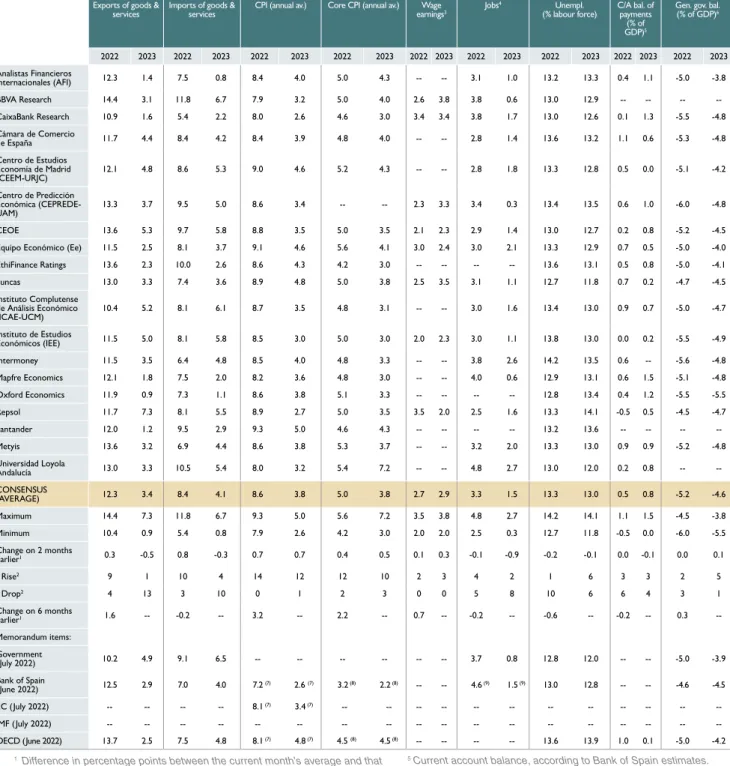
Spanish economic forecasts panel: September 2022
69
Funcas Economic Trends and Statistics Department
Key Facts
Economic Indicators
77
Financial System Indicators
115
Social Indicators
121
Income inequality in year one of the pandemic
Social protection measures rolled out by the government during the COVID-19 crisis strongly mitigated the negative effect of the pandemic on lower income households. However, public transfers were not enough to fully neutralize the increase in inequality in Spain, which must be attributed to more structural factors.
Eduardo Bandrés
57
This page was left blank intentionally.
Housing markets ahead of the threat of recession
Despite the drop in household income as a result of inflation, the housing market has remained dynamic due to its safe-haven appeal, pent-up savings and abundant financing. This atypical trend may, however, be reaching an inflection point in the face of changing monetary conditions; nonetheless, we are not looking at a market standstill or a major increase in non-performing loans but rather a sharp slowdown of the current expansionary cycle, with the main risk to this baseline scenario stemming from the macroeconomic effects of the energy crisis and a worsening geopolitical context.
Abstract: Despite the drop in household income as a result of prevailing inflation, the housing market has remained dynamic:
transaction volumes are up 20% so far this year and prices are tracking 8% higher.
This atypical trend is attributable to the safe-haven appeal of housing at a time of rampant inflation, in addition to the savings accumulated during the pandemic and access to abundant financing. The current bull market may be reaching an inflection point,
policy stance. Though we still expect prices to increase by around 6% on average this year, in line with our earlier estimate, a marked slowdown is predicted for next year. The market will not collapse, however, in light of the strong underlying demand and relatively healthy financial position of households. The main risk to that baseline scenario is not the formation of a bubble (as is the case in other countries), but rather the macroeconomic fallout from the energy crisis and general Raymond Torres
HOUSING MARKET
6 Funcas SEFO Vol. 11, No. 5_September 2022
Introduction
In recent months, particularly since the invasion of Ukraine, the economic outlook has deteriorated sharply. The intensification of the energy crisis, coupled with the effects of the war and its broader geopolitical tensions, have heightened the risk of recession, especially in Europe (ECB, 2022). That turbulence is also continuing to fuel inflationary pressures, forcing the main central banks, including (after much hesitation) the ECB, to change monetary tack.
In an increasingly uncertain environment, one of the main unknowns relates to the housing market. Its predicament is an important question from the social point of view as well as in terms of financial stability. The property market has been surprisingly dynamic throughout the pandemic, fanned by the prospects of recovery and ongoing low interest rates. Now that the risk of recession looms, the sustainability of that dynamism is in question.
The housing market has continued to grow despite the economic slowdown
For now, the downturn in economic prospects has hardly affected the housing market,
at least in Spain. Transaction volumes continue to rise at an annual rate of over 20%, according to the second-quarter figures, albeit slowing slightly compared to the start of the year (Exhibit 1). Prices have also been heading north since the dip taken during the pandemic. The average appraisal value has been increasing at an annual rate of close to 8% up until the summer. In August, a traditionally slow month, the price index fell back slightly (-0.8% compared to July, which is similar to the contraction observed in August 2021).
There are no major differences among the various regions, although the trend is less even than in recent years. Prices continue to rise in places like Madrid, the Balearics and, to a lesser extent, the Canaries. However, prices are stagnating in regions with less dynamic demographics, such as Castile La Mancha, Castile & Leon and Extremadura, and they are stagnating at relatively low levels, moreover.
Nor are we seeing a change of trend in the mortgage market, where transactions are registering year-on-year growth of close to 1% so far this year, compared to 0.7% in 2021. That performance contrasts with the
80.9 73.0 100
15.2 0
15 30 45 60 75 90 105
2000 2001 2002 2003 2004 2005 2006 2007 2008 2009 2010 2011 2012 2013 2014 2015 2016 2017 2018 2019 2020 2021 2022
Price Demand (transaction volumes) New supply (housing starts)
Exhibit 1 The market remains buoyant but cooler than at the height of the bubble
House prices (TINSA), transaction volumes and housing starts during the last 12 months. Rebased 1Q07 = 100
Sources: Author’s own elaboration based on the Bank of Spain, INE and TINSA.
Housing markets ahead of the threat of recession
contraction observed prior to the pandemic when loan repayments were outpacing the arrangement of new loans.
In short, despite the economic slump, the market continues to grow, although the pace of that growth may well be easing. We are therefore talking about dynamics that contrast starkly with those observed when the real estate bubble burst, evidencing the fact that this time the market is not starting from a position of widespread overvaluation.
A comparison with other European countries leads to a similar conclusion (Exhibit 2).
According to the European statistics office, Eurostat, the Spanish market remains below the valuation levels observed at the height of the bubble 15 years ago, while the EU market as a whole has revalued almost 40%
and the German market has doubled in price. The analysis performed by the Bank
for International Settlements, an organism watched closely by the market, coincides with these findings (BIS, 2022).
Housing growth has been nurtured by surplus savings and demand for safe assets in a context of inflation The main market support factor is buyers’
perceptions that housing is a safe investment in the current context of uncertainty and inflation. Housing is a wealth-preserving investment for now, unlike liquid deposits which tend to depreciate with CPI, or financial products, such as bonds and shares, which have proven highly volatile so far this year.
The return on property investments, in addition to being relatively stable, stands at 3.7% (without factoring in valuation upside).
That yield is very attractive relative to other
“ The Spanish market remains below the valuation levels observed at the height of the bubble 15 years ago, while the EU market as a whole has revalued almost 40%. ”
0 50 100 150 200 250
Cyprus Spain Ireland Latvia Bulgaria Croatia France Slovenia Finland Denmark EU Lithuania Belgium Slovakia Netherlands Malta Estonia Portugal Germany Sweden Czech Rep. Hungary Luxembourg
4Q05 4Q07 4Q14 1Q22
Exhibit 2 House prices: A European comparison
House prices: 1Q07 = 100
Source: Author’s own elaboration based on Eurostat.
8 Funcas SEFO Vol. 11, No. 5_September 2022 alternatives for financial savings (take a look at the housing market indicators updated periodically on the Bank of Spain’s statistics portal). For now, that return is also higher than the related borrowing cost, thanks to favourable mortgage terms and conditions, despite monetary policy tightening. The expectation that rates will rise may even have triggered a temporary spike in purchase intent.
Elsewhere, the savings set aside during the pandemic are also driving demand for housing, offsetting the loss of purchasing power induced by current inflation. Spanish households increased their savings by €75 billion between 2020 and 2021, in clear contrast to the excessive leverage observed during the previous real estate bubble. Those surplus savings are fuelling demand for housing while helping finance investments in refurbishment which had stagnated during the lockdown. Although the savings rate fell back during the first half of this year, it remains slightly above the long-run average, evidencing households’ cautious attitude in the current climate of uncertainty.
Another plus is the fact that the job market has performed relatively well. Social Security contributors numbers have continued to increase, albeit seemingly starting to lose momentum, as the economy looks increasingly likely to slump. The jobs being created are, moreover, more stable than before the labour market reform, which may be giving buyers a sense of security.
Lastly, the supply side is reacting slowly to the growth in demand due to the paralysis of the construction sector during the lockdown and, afterwards, the onset of bottlenecks in the supply chain. According to Spain’s official statistics office, investment in housing remained 8.5% below pre-crisis levels as of the fourth quarter of 2021. The run-up in production costs in the construction sector has also eroded supply-side responsiveness to vibrant demand. Average construction material prices are 19% higher than before the pandemic (using INE data as of November, by comparison with November 2019 figures).
The shift in monetary policy:
Prelude to a significant deceleration but not a market collapse
In the very near-term, we are likely to see additional increases in prices as a result of lingering underlying support factors on both the demand and supply sides.
However, the market is expected to slow as financing terms and conditions tighten, as is to be expected in light of rising interest rates.
EURIBOR, the main benchmark index for the mortgage market, which was still in negative territory at the start of the year (at around -0,5%, which is close to the ECB’s deposit facility rate for the first part of the year), is currently trading at over 2%. The Funcas consensus estimate suggests that EURIBOR will rise a further half a point over the coming year (Funcas, 2022).
“ Spanish households increased their savings by € 75 billion between 2020 and 2021, in clear contrast to the excessive leverage observed during the previous real estate bubble. ”
“ It is estimated that each additional point in mortgage rates increases
the ratio of borrowing costs to disposable income by four percentage
points - the housing affordability index. ”
Housing markets ahead of the threat of recession
It is estimated that each additional point in mortgage rates increases the ratio of borrowing costs to disposable income by four percentage points – the housing affordability index. Note, however, that effect takes place gradually, as the stock of mortgages gets turned over. That estimate is based on the following equation:
A=I*(D/GDI)+(R/GDI),
where A is the Affordability index; I is the Interest rate; D is the Debt taken on to purchase a home; R is the annual loan Repayment amount and GDI is the household’s Gross Disposable Income.
The values observed in the market today yield an estimated affordability index of 35.5%.
In other words, the households that borrow money to buy their homes have to earmark over one-third of their income to the payment of interest and repayment of principal.
That estimate is in turn underpinned by the following assumptions:
■The average house purchase price is equivalent to 8.5 times’ gross disposable
income and the mortgage taken on by home-buyers represents 65% of the value of the property purchased. Those assumptions yield a borrowing ratio (D/GDI) of 5.5x.
■We assume the mortgage has an average life of 25 years, which, coupled with the previous estimates, leads to a ratio of R/GDI of 22.1%.
■The effective interest rate (EURIBOR plus the fees borne by the borrower), I, is 2.4%.
An increase in the interest rate of one percentage point, to 3.4%, would increase the affordability index to nearly 39.4%. That is the threshold beyond which households will begin to taper their demand for square metres or forgo mortgages either because they cannot afford to borrow or because the banks decide, under prevailing prudential regulations, not to extend them (this estimate already factors in a slight drop in demand).
The affordability index is already slightly above the long-run average (Exhibit 3), such that demand will inevitably slow as
34.3 35.5 34.3
51.2
0 10 20 30 40 50 60
1Q22 September 2022
(Estimate) Historical average Bubble (2008)
Exhibit 3 Housing affordability index
Interest and principal burden as a % of household income
Source: Author’s own elaboration based on the Bank of Spain’s affordability index (for estimate details, refer to the text above).
10 Funcas SEFO Vol. 11, No. 5_September 2022 the financial burden of purchasing a home increases.
Elsewhere, the volume of bank deposits is not necessarily a good predictor of demand for housing. To sustain new home purchases, the savings accumulated in bank accounts would have to continue to increase, which is unlikely in the context of declining purchasing power.
These mitigating factors will become more tangible from 2023, when mortgage rates will fully reflect the unfolding shift in monetary policy and the supply side will have surmounted the current procurement issues (a prediction in line with others, like Montgoriol, 2022). As a result, in 2022, the current situation of surplus demand should prevail, driving faster growth in average annual prices than in household disposable income, of around 6% (by outpacing the estimated growth in households’ gross disposable income, the affordability index is already worse than before the pandemic, as we have seen).
The tightening of borrowing terms and conditions will become more tangible in 2023, weighing on demand. That, coupled with growth in supply, is likely to trigger a slowdown, with prices potentially trending in line with household disposable income.
That situation would still be compatible with the banks’ prudential ratios in terms of financial burden in relation to income at the aggregate level. As a result, we do not expect non-performance to rise considerably, unless the job market takes a turn for the worse:
indebted households that have borrowed at floating rates will be able to afford the higher cost of their mortgages so long as they hold on to their jobs, an eventuality that could be more likely than in the past, thanks to the Spanish economy’s overall competitive positioning,
the absence of bubbles and the recent labour market reform.
In short, the housing market looks set to weaken as financing conditions tighten.
However, we are not looking at a market standstill or a major increase in non- performing loans but rather a sharp slowdown of the current expansionary cycle. The main risk to this baseline scenario stems from the macroeconomic effects of the energy crisis and a worsening geopolitical context.
References
BIS (2022). BIS residential property price statistics in Q1 2022. https://www.bis.org/statistics/pp_
residential_2208.pdf
ECB (2022). ECB staff macroeconomic projections for the euro area, September.
https://www.ecb.europa.eu/pub/pdf/other/ecb.
projections202209_ecbstaff~3eafaaee1a.en.pdf Funcas (2022). Spanish economic forecasts panel: September 2022. https://www.funcas.es/
textointegro/panel-de-previsiones-de-la- economia-espanola-septiembre-2022/
Montgoriol, J. (2022). How long can the real estate sector’s upward trend last? CaixaBank Research, July. https://www.caixabankresearch.
com/en/sector-analysis/real-estate/how-long-can- real-estate-sectors-upward-trend-last
Torres, R. and M. J. Fernández (2022). The conflict in Ukraine and the Spanish economy. SEFO, Spanish and International Economic & Financial Outlook, 11(2) (March). http://www.sefofuncas.
com/The-war-in-Ukraine-and-implications-for- Spain/The-conflict-in-Ukraine-and-the-Spanish- economy
Raymond Torres. Economic Perspectives and International Economy Division, Funcas.
“ Indebted households that have borrowed at floating rates will be able
to afford the higher cost of their mortgages so long as they hold
on to their jobs, an eventuality that could be more likely than in the
past, thanks to the Spanish economy’s overall competitive positioning,
the absence of bubbles and the recent labour market reform. ”
Spain: Reduced vulnerability to gas rationing relative to other European countries
Spain´s lower expected reduction in demand under the pan European plan, together with a generally lower consumption of Russian gas by the country´s industry, translates into less sensitivity to current geopolitical tensions. Nonetheless, Spain will still be exposed to the risks generated by the adverse geopolitical environment heading into the autumn-winter.
Abstract: The “Save Gas for a Safe Winter”
plan approved by the European Commission involves a 15% reduction in gas demand between August 1st, 2022, and March 31st, 2023, although some countries, such as Spain, will only face a reduction of 7%. On the productive side, the economic sector most sensitive to a rationing of gas consumption will be industry and, in particular: (i) chemicals and pharmaceuticals; and, (ii) the transport and
weight in Spain’s GVA (also in the euro area).
From a country perspective, among the large European nations, Germany and Italy are most exposed to this geopolitical risk, while Spain is less sensitive, not only because its industry consumes very little Russian gas, but also because the country´s expected reduction in demand will be lower. In any case, Spain will still be exposed to the risks that this adverse geopolitical environment poses for María Romero and Juan Sosa
GAS MARKETS
12 Funcas SEFO Vol. 11, No. 5_September 2022
Introduction
The rise in gas prices in recent weeks (Exhibit 1) responds to the risk of a cut in Russian supplies of this raw material, which is so important for Europe, as Russia will continue to use gas as a geopolitical tool against Europe and in efforts to secure a relaxation of economic sanctions imposed as a result of the war in Ukraine. The most likely scenario being discounted by the market is that supply will suffer, leading to different gas rationing scenarios to be considered for the coming autumn-winter.
This article attempts to identify which economic sectors are more intensive in energy consumption and which are more dependent on supplies from Russia, with the
aim of quantifying their direct weight and anticipating the economic impact that could arise if this risk materializes.
The European gas demand rationing plan: “Save gas for a safe winter”
Aware of the risk that gas supply could be cut- off from Russia, the European Commission designed and published at the end of July:
(i) a draft legislation; and, (ii) a plan (“Save Gas for a Safe Winter”) aimed at reducing the use of gas in Europe by 15% between August 1st, 2022, and March 31st, 2023.
The legislation consists of a new Council Regulation that would give the Commission the possibility to declare, after consulting with member states, a ‘Union Alert’ on security of
“ The run-up in gas prices prompted the European Commission to design a consumption rationalisation plan targeting in particular the corporate segment. ”
0 50 100 150 200 250 300
Jul 21 Aug 21 Sep 21 Oct 21 Nov 21 Dec 21 Jan 22 Feb 22 Mar 22 Apr 22 May 22 Jun 22 Jul 22 Aug 22
Exhibit 1 Gas prices in Europe
€/MWh
Source: Afi, Bloomberg.
Spain: Reduced vulnerability to gas rationing relative to other European countries
supply, imposing a mandatory gas demand reduction on all member states. That alert could be triggered when there is a substantial risk of a severe gas shortage or exceptionally high demand for gas. The member states are being asked to update their national emergency plans by the end of September to show how they intend to meet the reduction target and to report to the Commission on progress every two months.
To help member states deliver the necessary demand reductions, the Commission has also adopted a European Gas Demand Reduction Plan which sets out measures, principles and criteria for coordinated demand reduction. As anticipated, the new plan not only urges retail consumers to change their habits so as to
reduce their energy consumption (e.g., limit air conditioning thermostats to 25 degrees in the summer and heating to 19 degrees in the winter), it also urges the business population to use alternative sources of energy (prioritising renewable sources but acknowledging that a switch to coal, oil or nuclear power could be necessary as a temporary measure) in order to increase gas reserves as soon as possible (even though Spain is not as dependent on supplies from Russia and has already set aside over 80% of its total storage capacity by the end of August – Exhibit 2). The plan contemplates rationing measures that could reduce production in certain important sectors, weighing on growth for the rest of this year and, above all, in 2023 by more than we are currently contemplating.
50 55 60 65 70 75 80 85 90 95 100
Jan Feb Mar Apr May Jun Jul Aug Sep Oct Nov Dec
2019 2020 2021 2022
Exhibit 2 Gas stocks in Spain
Percentage of storage capacity
Sources: Afi, GIE AGSI.
“ The extractive industry, the chemical and pharmaceutical industry,
and the transportation and storage sector are the most energy-
dependent on gas, the latter two being the most relevant in the euro
area´s productive structure. ”
14 Funcas SEFO Vol. 11, No. 5_September 2022
Economic sectors dependent on Russian gas: Direct and indirect impact
Following the approval of this Plan by Brussels and all the member states, it is worth asking which economic sectors are more energy dependent and which of them consume more gas from Russia, in order to anticipate which economic activities will be more sensitive to this rationing of demand. Although the following exercise has been carried out for Spain, it has also been replicated for the euro area and its main member states, allowing comparisons to be made and conclusions to be drawn as to which countries are most exposed to this geopolitical risk.
The input-output tables for the main European countries [1] provided by the OECD [2] show that the manufacturing sector is the most intensive user of energy. Tracking the weight of energy consumption over total sector gross value added (GVA) reveals that the metallurgy (basic metals) sector is the most dependent on energy (energy consumption accounts for nearly 80% of its GVA). That sector is followed by the extraction of non-energy products, the chemicals and pharmaceuticals industry, and
other non-metallic minerals, whose energy consumption represents roughly 40% of the GVA they generate. Rounding out the top 10, with energy consumption ratios of over 10% of GVA and above the manufacturing sector average are activities such as: paper and printing; timber and cork; the extractive industry (mining support services); rubber and plastics; transportation and storage; and the agri-food industry (Exhibit 3). These energy-intensive economic activities in Spain are the same as those detected for the euro area as a whole.
However, the activities in Spain most dependent on energy sourced from Russia are, in this order, the extractive industry, the chemicals and pharmaceuticals industry and the transportation and storage sectors (Exhibit 4). In all of these, the energy imported from Russia accounts for over 1.5% of their total consumption (5% in the case of their eurozone equivalents), leaving them more vulnerable to a cut – total or partial – in energy supply during the coming months and rendering them some of the energy-intensive activities that may have to rationalise their activity the most, judging by the plan published by the Commission in July 2022.
0% 20% 40% 60% 80% 100%
Basic metals Mining and quarrying of non-energy producing
products
Chemicals and pharmaceutical products Other non-metallic mineral products Paper products and printing Wood and products of wood and cork Mining support service activities Rubber and plastic products Transportation and storage Food products, beverages and tobacco
Exhibit 3 Energy consumption/GVA by sector (ordered from highest to lowest)
Pecentage
Source: Afi, OECD.
Spain: Reduced vulnerability to gas rationing relative to other European countries
Other than the extractive industry, the other two economic sectors most dependent on Russian gas are those with the highest direct weight in the Spanish economy of the 10 sectors analysed above. Specifically, the transportation and storage sector is the most important of the three, as it generates 5% of total GVA. The chemicals and pharmaceuticals industry, meanwhile, is less significant, as its direct impact is a lower 2% of GVA. On aggregate the 10 sectors that are most dependent on energy account for 12.4% of GVA (Exhibit 5), painting a picture of the magnitude of the potential impact of the suspension of gas supply in the eurozone and of the Commission’s proposed rationing policy.
Moreover, the chemical and pharmaceutical sectors and the different means of transport are activities of significant strategic importance in the Spanish economy. Firstly, all of these sectors have an important carry- over effect over the rest of the economy, so that a negative shock on their turnover would lead, additionally, to a decrease in revenue (and activity) for suppliers and other auxiliar activities, and would also impact their capacity to generate employment; these are the “backward linkages”. Secondly, these two sectors also produce inputs to other value chains in the economy, so that the imposibility to serve orders, or a sharp increase in prices, would rapidly affect other sectors, both in terms of production and margins. These effects are particularly prevalent in the
0% 20% 40% 60% 80% 100%
Basic metals Mining and quarrying of non-energy producing products Chemicals and pharmaceutical products Other non-metallic mineral products Paper products and printing Wood and products of wood and cork Mining support service activities Rubber and plastic products Transportation and storage Food products, beverages and tobacco
Domestic Imports from Russia Imports from the RoW
Exhibit 4 Source of the energy consumed by sector (ordered from highest to lowest energy consumption/GVA)
Percentage
Source: Afi, OECD.
“ Although Spain will be one of the countries least affected by current
geopolitical tensions, it is not immune to the rationing policies imposed
by the Commission; thus, the government will need to implement
measures to support affected sectors. ”
16 Funcas SEFO Vol. 11, No. 5_September 2022 chemical industry, air and road transport, and warehousing, and are measured through the
“forward linkages” (Exhibit 6). [3]
However, a comparison with other European countries indicates that Spain would be one of the countries least affected by this situation.
Sectors less intensive than average in energy consumption, 87.6%
1.8%
4.8%
Sectors more intensive than average in energy consumption; 12.4%
Basic metals
Mining and quarrying of non-energy producing products Chemicals and pharmaceutical products
Other non-metallic mineral products Paper products and printing Wood and products of wood and cork Mining support service activities Rubber and plastic products Transportation and storage Food products, beverages and tobacco
Exhibit 5 Direct weight of the sectors that use energy most intensively in Spain
Percentage of total GVA
Sources: Afi, OECD.
Forestry
Extractive industries
Food products Chemical industry
Pharmaceutical industry
Metallurgy
Vehicles Energy and gas
Retail
Road transport
Sea transport
Air transport Warehousing
IT Financial services
Real Estate
Education Health services 0.0
0.1 0.2 0.3 0.4 0.5 0.6 0.7 0.8 0.9 1.0
0.0 0.1 0.2 0.3 0.4 0.5 0.6 0.7 0.8 0.9 1.0
Forward linkages
Backward linkages
KEY
STRONG CARRY- OVER EFFECT BASE
INDEPENDENT
Exhibit 6 Linkages of the Spanish economy
Percentage of total GVA
Sources: Afi, OECD.
Spain: Reduced vulnerability to gas rationing relative to other European countries
That is not to say, however, that it is immune to the rationing policies imposed by the Commission. Germany and Italy are the major economies most exposed, specifically via their respective chemicals and pharmaceuticals industries.
That sector unquestionably stands to be one of the most affected by the rationing policies imposed over the coming months. Energy rationing will not only be guided by criteria of economic relevance but also the classifications made by each member state of their critical sectors in order to safeguard supply to their citizens. Against that backdrop, the European Gas Demand Reduction Plan published by the European Commission this week also helps the member states to identify and prioritise those critical sectors which, so far, include services related with health, food, safety, security, refining and defence.
At any rate, the authorities will have to implement fiscal policy measures to support the sectors most affected by energy rationing in order to mitigate all the adverse effects that may derive from this situation. In fact, the European Commission’s plan contemplates the member states providing support to their industries by amending the State aid Temporary Crisis Framework. The amendments increase the amount of direct aid that can be provided to companies in need to €500,000, specifying that the aid may cover only up to 70% of the beneficiary’s gas and electricity consumption during the same period of the previous year.
Conclusion
The European “Save Gas for a Safe Winter”
plan approved by Brussels and ratified by all member states involves a 15% reduction in gas
general, although some countries will suffer a lower cut (7%), as is the case of Spain.
The plan includes a series of recommendations for member states to implement measures to reduce gas demand, which will mainly affect the productive sector, although households will also have to make an effort in this respect.
Within the productive fabric, the sector most sensitive to a rationing of gas consumption will be industry and, in particular, the extractive industry, the chemical and pharmaceutical industry, and the transport and storage sector. These last two sectors are the most dependent on Russian supplies and among the most important in the production structure of the euro area.
Their weight varies from country to country, with Germany and Italy being the most exposed and whose economies could suffer more from the direct and indirect effects of gas being potentially cut-off, possibly leading to a greater reduction in their activity than that contemplated in the analysts’ consensus forecasts. Spain, on the other hand, is less sensitive, not only because it hardly consumes any Russian gas, but also because its expected reduction in demand will be lower. In any case, it will also be exposed to the risks that the adverse geopolitical environment poses for this coming autumn-winter.
In this sense, the approval of measures to support these economic sectors as a way of mitigating the negative effects that may derive from this hypothetical risk should not be ruled out.
Notes
[1] The following countries have been considered for the preparation of this article: Germany, France, Italy, Spain and Portugal. Together
“ Energy rationing will not only be guided by criteria of economic
relevance but also the classifications made by each member state of
their critical sectors in order to safeguard supply to their citizens. ”
18 Funcas SEFO Vol. 11, No. 5_September 2022 [2] The latest available data refer to 2015.
[3] “Backward Linkages” are the result of dividing Intermediate Consumption by total Production.
The higher the ratio, the stronger the carry-over effects (or economic spillovers) on the rest of the economy. “Forward Linkages” are the result of dividing total Intermediate Demand by total Production (intermediate consumption and final demand). The higher the ratio, the larger the share of a sector’s production that will be used as input in other sectors’ productive processes.
References
European Commission (2022a). Save Gas for a Safe Winter: Commission proposes gas demand reduction plan to prepare EU for supply cuts.
https://ec.europa.eu/commission/presscorner/
detail/en/IP_22_4608
European Commission (2022b). State aid:
Commission amends the Temporary Crisis Framework. https://ec.europa.eu/commission/
presscorner/detail/en/IP_22_4622
María Romero and Juan Sosa. A.F.I. – Analistas Financieros Internacionales, S.A.
Spanish banks ahead of the
return to positive interest rates
Now that interest rates are finally back in positive territory, banks have the opportunity to advance on the challenge of increasing profitability. However, prevailing macroeconomic conditions of uncertainty and pessimism, together with risks, both those carried over from the previous financial crisis and emergent ones, mean that translating rate increases into commensurate growth in banks’ earnings may not be so straight forward a task.
Abstract: Banks have the opportunity to advance on the challenge of boosting their profitability. With interest rates gradually rising, the banks are looking at business and margin growth prospects not enjoyed in recent years. However, the new rate climate is not all good news for the banks, particularly in the current complex economic environment, characterized by high uncertainty (largely as a result of inflation and deteriorating confidence), which does not bode well for immediate growth in business lending volumes sufficient to translate into significant growth in profitability in the near-term.
to ECB rate hikes, Spanish banks´ net interest margins remained stuck at 0.8% of average total assets, with interest income at around 1.1% and interest expense at 0.3%. That said, Spanish banks remain at the forefront of increasing operating efficiency through reducing operating expenses and fee and commission income has been growing, albeit displaying a high degree of volatility. Moreover, a number of risks carried over from the previous financial crisis remain, including those related to: business sector vulnerability; the ability to repay the state-guaranteed loans extended during the pandemic; and, the looming end of Santiago Carbó Valverde and Francisco Rodríguez Fernández
BANK PROFITABILITY
20 Funcas SEFO Vol. 11, No. 5_September 2022
Recent banking and monetary climate
The geopolitical events of recent months have highlighted structural, energy-related weaknesses across a large number of economies and generated, along with other factors, an inflationary spiral not seen in Europe or the US since the 1970s. That has meant that the long-awaited shift in monetary policy direction has taken place swiftly, with central banks moving to tighten financing conditions forcefully.
That more contractionary monetary policy is evident in the rollback of the extraordinary monetary facilities that had been deployed and interest rate hikes that spell the end of an extensive period of zero or negative rates in many jurisdictions. The Federal Reserve and Bank of England were the first to make their moves. The European Central Bank joined the fray in July of this year, moving resolutely, spurred on by a set of circumstances that pose a huge challenge for the central banks.
A recurring question is to what extent will the rise in interest rates have a positive impact on the banking business after so many years in which the existence of ultra-low or negative rates made it very hard to eke out net interest margins. This article attempts to address that issue. That being said, all interpretations and forecasts should be taken with caution in light of the scale of uncertainty surrounding the macroeconomic and financial environment at present.
On July 21st, the ECB’s Governing Council decided to raise its three official interest rates by 50 basis points. Significantly, it also approved the so-called monetary policy Transmission Protection Instrument (TPI).
The ECB had decided it was “appropriate to take a larger first step on its policy rate normalisation path than signalled at its previous meeting.” According to the monetary authority, that decision was based on the Council’s “updated assessment of inflation risks and the reinforced support provided by the TPI for the effective transmission of monetary policy.” As a result, the interest rate on the main refinancing operations and the interest rates on the marginal lending facility and the deposit facility were increased to
0.50%, 0.75% and 0.00%, respectively, with effect from July 27th, 2022.
The ECB implied that its previous forward- looking approach, which usually took the form of forward guidance, would be replaced by a more contingent approach to interest- rate decision-making when it alluded to a
“transition to a meeting-by-meeting approach to interest rate decisions.” However, at its meeting on September 8th, described below, the ECB announced successive increases in the official price of money in the months to come, suggesting that it has not done away with its forward guidance altogether.
Elsewhere, the ECB’s approval last July of the TPI was deemed a necessary step in normalising monetary policy transition without causing excessive turbulence for certain eurozone member states, namely those in which sovereign risks were beginning to become palpable as rates rallied and other liquidity support programmes began to be rolled back, such as Italy. Specifically, the ECB noted that the TPI “can be activated to counter unwarranted, disorderly market dynamics that pose a serious threat to the smooth transmission of monetary policy across the euro area” and that the “scale of TPI purchases depends on the severity of the risks facing policy transmission”. Very importantly, the ECB made it explicit that purchases would not be restricted ex ante, leaving the monetary authority with significant room for manoeuvre in the event of market disruption.
TPI purchases will be focused on public sector securities (marketable debt securities issued by central and regional governments as well as agencies, as defined by the ECB).
Purchases of private sector securities could be considered, if appropriate. In the event the new instrument is deemed crucial, it would be activated following “comprehensive assessment of market and transmission indicators and an evaluation of the eligibility criteria”.
At its meeting on September 8th, 2022, the ECB decided to hike its three official interest rates once again, this time by 75 basis points.
As a result, the interest rate on the main refinancing operations and the interest
Spanish banks ahead of the return to positive interest rates
rates on the marginal lending facility and the deposit facility were increased to 1.25%, 1.50% and 0.75%, respectively, with effect from September 14th, 2022.
For the banks, the market and, in general, much of the economy, the increase in interest rates should be seen as part of the process of normalising financing conditions and exiting the extraordinary arrangements that date back virtually to the financial crisis of 2007-2008. In theory, the banks, investors and other market agents can operate in a climate more propitious to generating returns and assessing them as a function of their risks. That does not mean, however, that the increases in interest rates and rollback of liquidity programmes will necessarily spell immediate growth in bank profits or dispel operating uncertainties. All processes involving a change in monetary conditions are shaped by supply and demand factors and the current process of normalisation is replete with challenges and difficulties, not least of which a severe inflationary episode, the threat of economic slowdown and/or recession and financial weakness across a large swath of businesses in numerous countries.
Last July, the Spanish banks reported their earnings for the first half of 2022. The six largest financial institutions reported year- on-year bottom-line growth of 36% to 3.74 billion euros in the first six months of the year.
As we will show later in this paper, net interest income did not make much of a contribution to that earnings growth. Instead, an additional 12.4% drop in operating expenses was the most relevant factor. The banks were also able to recognise fewer loan-loss provisions than in 2021, with impairment losses decreasing by 133.4%.
What do rising interest rates imply?
Opportunities and risks
With interest rates gradually rising, the banks are looking at business normalisation prospects not seen in recent years. It would be easy to jump to the conclusion that the increase in the price of money will drive commensurate growth in the banks’ earnings. Despite the fact that several studies have indicated that the existence of negative interest rates has had an adverse effect on net interest margins, it cannot be concluded that positive rates will be a panacea, particularly in light of the current complex environment.
Table 1 enumerates some of the main effects for the banks from the transition between the two monetary policy biases. Firstly, in terms of profitability, prior studies (refer to the Table´s source) have shown that the banks’ net interest income declined by 18.4% on average in the countries where rates turned negative, reducing their return on assets by an average of 3%. That phenomenon has had a bigger