SEFO
SPANISH AND INTERNATIONAL ECONOMIC & FINANCIAL OUTLOOK
VOLUME 9 | number 5, September 2020
Spain’s economy and financial sector in the face of COVID-19:
Assessing the impact and perspectives
Spain’s macro outlook: Rising COVID-19 cases dampen economic forecasts
The impact of the pandemic on Spain’s housing market Two episodes of collapse in Spanish exports: The health crisis vs. the financial crisis The financial sector and
economy in light of COVID-19:
Situation and outlook for the autumn
Redesigning the European stress tests: Considerations from COVID-19 and the US experience
Resilience of Spanish households to the economic fallout from COVID-19
Impact of COVID-19 on Spain’s deficit and debt: Greater than initially expected
Regulating the financial industry WHAT MATTERS
SEFO
Spanish and International Economic & Financial OutlookVOLUME 9 | number 5, September 2020Orders or claims:
Funcas
Caballero de Gracia, 28 28013 Madrid (España) Teléfono: 91 596 54 81 Fax: 91 596 57 96 [email protected] www.funcas.es
ISSN: 2254 - 3880 9772254388005
9772254389002
SEFO is a bi-monthly Economic Journal published by Funcas and written by its experts, on the most pressing issues facing the Spanish and international economy / financial system today.
Readers can find this and archived issues of SEFO at www.funcas.es. Please contact us to request permission to republish an article at [email protected]
Electronic Edition
An electronic edition of this Journal is available at
http://www.funcas.es/Publicaciones
Board of Editors Carlos Ocaña Santiago Carbó José Félix Sanz Raymond Torres
Managing Editors Alice B. Faibishenko Juan Núñez
Board of Trustees Isidro Fainé Casas (President) José María Méndez Álvarez-Cedrón (Vice president)
Fernando Conlledo Lantero (Secretary) Carlos Egea Krauel
Miguel Ángel Escotet Álvarez Amado Franco Lahoz Manuel Menéndez Menéndez Pedro Antonio Merino García Antonio Pulido Gutiérrez Victorio Valle Sánchez Gregorio Villalabeitia Galarraga
Contact [email protected]
Web Site www.funcas.es Orders or Claims:
Funcas, publications
Tel.; +34-91-5965481, Fax: +34-91- 5965796, e-mail: [email protected] Printed in Spain
Editorial and Production Funcas
Caballero de Gracia, 28. 28013 Madrid (Spain)
Ownership and Copyright:
© Funcas 2012
ISSN print edition 2254-3899 ISSN electronic edition 2254-3880 Depósito Legal: M-10678-2012 Prints: Cecabank.
SEFO
SPANISH AND INTERNATIONAL ECONOMIC & FINANCIAL OUTLOOK
Letter from the Editors
he COVID-19 pandemic has been a tremendous hit for the Spanish economy, essentially eliminating prospects of economic growth in 2020 and generating a severe financing gap in the public accounts. The OECD and the IMF have both recently warned that Spain will be among the economies hardest hit by the pandemic – in terms of growth, but also in terms of deficit and debt. Within this context, the September issue of Spanish and International Economic & Financial Outlook (SEFO) takes a snapshot of the current situation and provides perspectives on the evolution of Spain’s economy, financial sector, and public finances.
We first present our latest set of forecasts for the Spanish economy, revised downwards substantially since July, largely a result of the surge in case numbers and the dissuasive effect it has had on foreign tourist arrivals. According to provisional data, Spanish GDP fell by 18.5%
in the second quarter. Even after taking into consideration the weight of vulnerable sectors, such as tourism, Spain’s contraction would still exceed that of Germany’s. Looking forward, the economic recovery will be both unequal and surrounded by uncertainty. Assuming controlled growth in COVID-19 cases, an avoidance of lockdown, as well as the prolongation of expansionary macroeconomic policies, GDP is expected to contract by 13% in 2020, which is 3.2 percentage points below the last set of forecasts. Although GDP is forecast to grow by 7.9% in 2021, the economy will not fully recover to pre-COVID GDP levels until at least 2023. The ongoing crisis will adversely impact the number
of hours worked, but the furlough scheme and redistribution of work will cushion the blow in terms of jobs. Significantly, Spain could receive almost 140 billion euros from the European recovery fund. However, the impact of these funds will depend largely on reforms in areas such as the labour market, education, the digital and energy transition, and in general measures that help close Spain’s productivity gap with the EU. Moreover, there are upside and downside risks that could either support or undermine Spain’s recovery, such as the rollout of a vaccine or a rise in NPLs that could reduce banks’ lending capacities.
Relatedly, we assess the recent performance of two important sectors of the Spanish economy – real estate and exports. The health crisis is affecting the real estate sector, albeit moderately considering the scale of the economic shock.
According to the most recent data available at the time of writing this article, home purchases are 33% below pre-COVID levels. Prices have also been affected, falling by close to 1.2% in August. Nevertheless, all signs suggest that unless the economy is once again locked down in response to the second wave of contagions, the market is not on the verge of collapse. Demand is being underpinned by current and anticipated low interest rates and the scarcity of attractive investment alternatives for buyers. Another factor pointing to a limited correction in prices in Spain is their relatively low level by comparison with other European countries and the rest of the world. In 2020 as a whole, average prices are expected to contract by between 5% and 8% (considerably
T
less than the contraction anticipated for the overall economy - 13%), going on to stabilise in the first half of 2021 and start to recover thereafter. The trend is, however, likely to be uneven across regions and types of property.
Next, we assess the performance of Spanish exports in the context of the pandemic, and on a comparative basis with the last financial crisis.
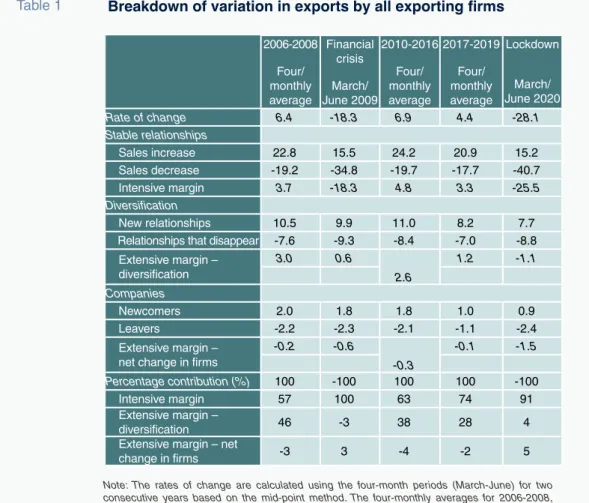
Export markets have been hit hard by COVID-19, which necessitated lockdown measures across numerous countries. In this context, it is useful to analyse the specific effects on Spain’s export industry and compare them to those experienced in the financial crisis, or Great Recession. From March through June 2020, total exports as well as the number of exporting firms fell. However, closer analysis shows that while the collapse in Spanish exports was widespread, it was primarily driven by a drop in the value of goods exported by Spain’s most active exporters. This group includes the nearly 27,000 firms that exported in any of the 12 months prior to both the lockdown and financial crisis. Notably, in both periods, the intensive margin explains more of the contraction in exports, though it is slightly less significant in explaining the lockdown contraction (91% during the lockdown vs. 100%
during the financial crisis). During the lockdown, product and destination mixes were hurt more and there has been a higher number of exiting firms than during the financial crisis. This suggests Spain will experience a tougher recovery this time relative to that observed in the wake of the previous crisis, if the current health crisis causes a prolonged period of uncertainty.
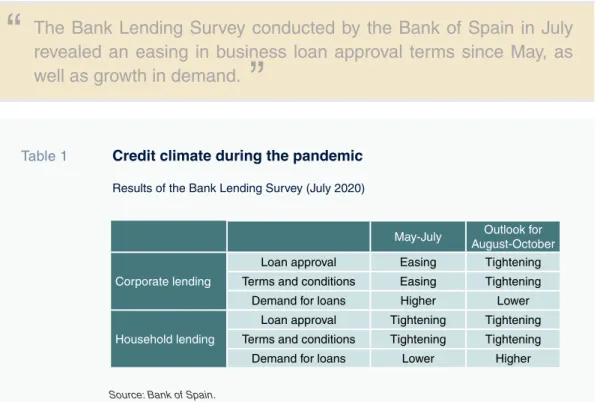
The September issue of SEFO then highlights key developments within the financial sector and perspectives for the fall. While COVID-19 spurred the Fed’s decision to adopt an average inflation targeting regime, the ECB is more constrained in the way it can support the emergence of dynamic business growth. That said, it did launch the 1.35 trillion-euro Pandemic Emergency Purchase Programme (PEPP) and has extended its targeted long-term refinancing operations (TLTROs). This lax monetary environment enabled the Spanish banks to increase their use of the ECB’s long-term financing facilities by 113.66 billion euros between March and July. In parallel, under specific schemes, such as the state-backed guarantees for business
loans, corporate financing increased from a year- on-year rate of 1.1% in March to 6.1% in June. One of the most complex issues facing Spain is how long its extraordinary financing flows should continue so as not to significantly impair overall asset quality.
Although non-performance has held steady at around 4.7%, this metric is expected to deteriorate throughout the rest of 2020 and much of 2021, with the magnitude of the rise in NPLs dependent on the continuation of the furlough scheme, speed of the economic recovery, and lingering uncertainty regarding COVID-19. Nevertheless, the crisis could prove an opportunity for Spain if public and financial intervention results in higher levels of business dynamism.
Taking into account the already challenging operating climate for the banks, as well as the high degree of uncertainty generated by COVID-19, we analyse the existing issues surrounding the EBA’s stress tests, taking into considerations lessons learned from the recent US experience, as well as methodological challenges that need to be addressed. The COVID-19 crisis has emerged as a critical event that affects all aspects of bank management and supervision, including the design and execution of the stress tests — a key oversight tool with a forward-looking approach. In March, the EBA postponed the biennial stress tests originally scheduled for 2020 due to the banks’
operational challenges brought on by the pandemic.
Notably, this decision took place in the context of a growing debate regarding the EBA’s stress testing methodology, especially in light of the failure of two banks in Italy and one in Spain. Unlike the EBA, the Fed went ahead with its stress tests, layering in sensitivity analyses designed to model the various economic scenarios the pandemic could leave in its wake, providing potential insight into how the EBA could improve its 2021 stress tests. The EBA could also adopt a `top down´ approach like the Fed, instead of its ‘bottom up’ method, which makes it harder to discriminate between healthy and weak entities. Whatever the outcome, the stress tests’ impact on the alignment of capital with the risk assumed by the banks has been critical and the continuity of the tests must be assured in the medium- and long-term.
Lastly, for the financial sector, this SEFO focuses on the particularly acute issue of household
resilience to the economic impact of COVID-19.
At first glance, it appears Spain entered the COVID-19 crisis in a relatively good position.
The household leverage rate had fallen below the eurozone average, reducing the amount of income Spanish households earmarked for debt service payments from 11.7% of their disposable income in 2008 to 6.1% at the end of 2019. Yet, 33.9% of Spanish households would be unable to deal with an unexpected expense of only 700 euros, which is higher than the EU-27 average. When analysed based on metrics such as age, gender, household composition, and geography, it becomes clear that there are certain groups particularly vulnerable to the economic effects of COVID-19. For example, among those with a lower secondary education, 47.8% of individuals would be unable to deal with an unexpected expense. Similarly, 53.7% of households headed by a single adult and 46%
of households composed of a single woman would struggle. Notably, those aged between 16 and 24 present the highest percentage of an inability to deal with an unexpected expense, while 31.7% of this group are ‘at risk of poverty or social exclusion’, 6.4 percentage points above the overall average.
For these reasons, targeted government measures that rely on intergenerational generosity would be required to successfully exit this crisis.
The next two SEFO articles drill down on fiscal issues. First, we assess the impact of the pandemic on public finances. COVID-19 has upended the government’s spring forecasts, which included a projected deficit of 10.3% of GDP in 2020. The sharp economic contraction sustained in the second quarter, coupled with the spike in social spending and the automatic drop in tax revenue, have placed significant burdens on the government’s finances and necessitated several downward revisions of spring forecasts. The most recent forecasts available, which date to September, fall within a very wide band, ranging from a contraction of 9%
to one of 14%. Although Spain is set to receive the equivalent of 11% of its GDP from the EU recovery fund, the first round of transfers in 1Q2021 will support structural reforms instead of stimulating the economy in the short-term. Worryingly, the AIReF estimates that it could take Spain until at least 2050 to bring public debt below 60% of GDP. In order to improve its debt sustainability outlook, Spain will need to enact necessary reforms, such as lowering
corporate and personal income tax rates, as well as recalibrating the tax basket to lean more heavily on consumption. The overarching goal must be to preserve the economy’s productive fabric and lock in greater tax revenue over the long-term.
We conclude with a broader assessment and state of play of one of the government’s recently proposed tax measures – the financial transaction tax (FTT). The notion of a financial transaction tax gained popularity in the aftermath of the 2008 crisis as a way of curtailing excessive risk and financial market volatility. Such a tax targets transactions involved in the trading of several types of securities.
Interestingly, the idea first appeared during the Great Depression in the work published by J. M. Keynes, and subsequently in the form of the so-called ‘Tobin Tax’, theorized by James Tobin in 1978. In 2011, the European Commission promoted the adoption of an EU-wide FTT. However, the proposal has attracted numerous criticisms relating to its unintended consequences on transaction volumes and market liquidity, the role of normal hedging activities, and the potential impact on the cost of capital. In the absence of a unilateral agreement across Member States, Spain has sent a draft law for an FTT to Parliament in February. The Spanish FTT proposal would impose a 0.2% tax rate on transactions that covers securities issued by around 60 Spanish firms. However, to be successful, this initiative requires the voluntary cooperation of international parties and other countries. Moreover, as currently conceived, the Spanish FTT would impose a greater tax burden on the financial sector, which already pays a higher tax rate than the corporate sector.
For all these reasons, if an FTT is to eventually be enacted, an EU-level FTT would be preferable to those enacted unilaterally by EU Members States.
This page was left blank intentionally.
What´s Ahead (Next Month)
Month Day Indicator / Event
October 2 Social Security registrants and official unemployment (September) 5 Eurogroup meeting
7 Industrial production index (August) 14 CPI (September)
15 Financial Accounts Institutional Sectors (2nd. quarter) 15-16 European Council meeting
19 Foreign trade report (August) 27 Labour Force Survey (3rd.quarter) 28 Retail trade (September)
29 Preliminary CPI (October) 29 ECB monetary policy meeting
30 Non-financial accounts: Central Government, Regional Governments and Social Security (August)
30 Non-financial accounts, State (September) 30 Balance of payments monthly (August) 30 GDP 3rd. quarter, advance estimate November 3 Eurogroup meeting
4 Social Security registrants and official unemployment (October) 6 Industrial production index (September)
13 CPI (October)
19 Foreign trade report (September)
27 Non-financial accounts: Central Government, Regional Governments and Social Security (September)
27 Non-financial accounts, State (October) 27 Retail trade (October)
30 Preliminary CPI (November)
30 Balance of payments monthly (September) 30 Eurogroup meeting
This page was left blank intentionally.
What Matters
Spain’s macro outlook: Rising COVID-19 cases dampen economic forecasts
In the context of controlled growth in COVID-19 cases and sluggish performance in key sectors, such as tourism, a downward revision of Spain’s forecasts shows a 13% contraction expected for 2020, with pre-COVID growth levels unlikely to return before 2023.
The European recovery fund could support Spain’s recovery, but its impact will be limited and short-lived, unless it is accompanied by key reforms.
Raymond Torres and María Jesús Fernández
The impact of the pandemic on Spain’s housing market
Although home purchases and prices have fallen as a result of COVID-19, it is unlikely that the market will experience a collapse. However, the recovery may be uneven across regions and types of property, with low interest rates and lower average prices relative to peer countries supporting the market in Spain’s urban areas.
Carlos Ocaña Pérez de Tudela and Raymond Torres
5
17
Two episodes of collapse in Spanish exports:
The health crisis vs. the financial crisis Similar to the effects observed during the financial crisis, COVID-19 has significantly disrupted global export markets, with Spain’s total exports and number of exporting firms having fallen during the lockdown. Looking forward, any recovery in Spain’s export sector will depend on the duration of uncertainty and number of firms who survive the crisis.
Juan de Lucio, Raúl Mínguez, Asier Minondo and Francisco Requena
23
Resilience of Spanish households to the economic fallout from COVID-19
Although overall household indebtedness has fallen below the eurozone average in Spain, certain subsegments of Spain’s population remain financially vulnerable. With the Bank of Spain forecasting a rise in the unemployment rate to 22.1%
in 2021 under its worst-case scenario, vulnerable groups such as those with lower levels of education, households headed by a single parent, and youth will require targeted measures to protect them from the adverse consequences of COVID-19.
Joaquín Maudos
49
Redesigning the European stress tests:
Considerations from COVID-19 and the US experience
The EBA’s postponement of the 2020 stress tests due to COVID-19 comes at a time of growing debate about the
effectiveness of their methodology. Unlike the EBA, the Fed went ahead with its stress tests this year, offering potential insight into how the EBA could possibly reform its tests for 2021.
Ángel Berges and Jesús Morales
39
The financial sector and economy in light of COVID-19: Situation and outlook for the autumn
The lax monetary environment, coupled with government initiatives, has enabled Spain’s banks to play a crucial role in tempering the effects of COVID-19. A key concern going forward, however, will be how long such interventions should continue and the extent to which they have fostered the emergence of a more dynamic business environment.
Santiago Carbó Valverde and Francisco Rodríguez Fernández
31
Regulation and Economic Outlook
Recent key developments in the area of Spanish financial regulation
79
Prepared by the Regulation and Research Department of the Spanish Confederation of Savings Banks
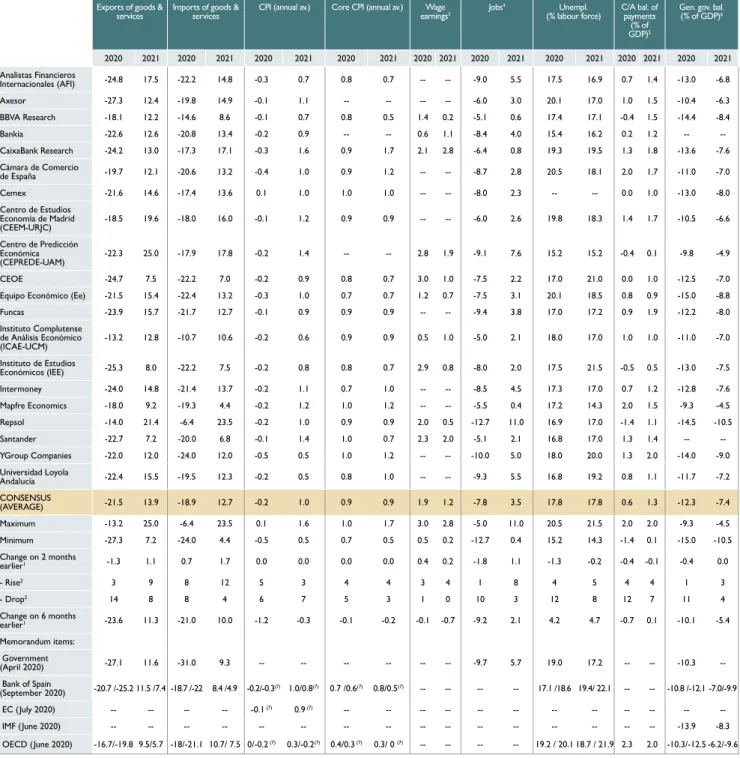
Spanish economic forecasts panel: September 2020
85
Funcas Economic Trends and Statistics Department
Key Facts
Economic Indicators
93
Financial System Indicators
131
Social Indicators
137
Impact of COVID-19 on Spain’s deficit and debt: Greater than initially expected
COVID-19 has resulted in a series of downward revisions of Spain’s economic forecasts, with current projections indicating a sharp rise in both the government deficit and stock of debt. As a result, it could take Spain until 2050 to bring public debt below 60% of GDP.
Desiderio Romero-Jordán and José Félix Sanz-Sanz
Regulating the financial industry through taxation: Consequences of the financial transaction tax
Advocates of a financial transaction tax (FTT) believe it could help curtail excessive risk and market volatility, despite the potential adverse consequences for both investors and financial markets. Recently, some EU Member States introduced their own FTTs, which could imply certain risks and drawbacks compared to an EU-level initiative.
Giulio Allevato and Antonio De Vito
59
71
This page was left blank intentionally.
Spain’s macro outlook: Rising COVID-19 cases dampen
economic forecasts
In the context of controlled growth in COVID-19 cases and sluggish performance in key sectors, such as tourism, a downward revision of Spain’s forecasts shows a 13%
contraction expected for 2020, with pre-COVID growth levels unlikely to return before 2023.
The European recovery fund could support Spain’s recovery, but its impact will be limited and short-lived, unless it is accompanied by key reforms.
Abstract: According to provisional data, Spanish GDP fell by 18.5% in the second quarter. Even after taking into consideration the weight of vulnerable sectors, such as tourism, Spain’s contraction would still exceed that of Germany’s. Looking forward, the economic recovery will be both unequal and surrounded by uncertainty. Assuming controlled growth in COVID-19 cases, an avoidance of lockdown, as well as the prolongation of expansionary macroeconomic policies, GDP is expected to contract by 13% in
2020, which is 3.2 percentage points below the last set of forecasts. Although GDP is forecast to grow by 7.9% in 2021, the economy will not fully recover to pre-COVID GDP levels until at least 2023. The ongoing crisis will adversely impact the number of hours worked, but the furlough scheme and redistribution of work will cushion the blow in terms of jobs.
Significantly, Spain could receive almost 140 billion euros from the European recovery fund. However, the impact of these funds will depend largely on reforms in areas Raymond Torres and María Jesús Fernández
SPANISH ECONOMY
such as the labour market, education, the digital and energy transition, and in general measures that help close Spain’s productivity gap with the EU. Moreover, there are upside and downside risks that could either support or undermine Spain’s recovery, such as the rollout of a vaccine or a rise in NPLs that could reduce banks’ lending capacities.
The recovery stalled in August
According to provisional data, Spanish GDP contracted by 18.5% in the second quarter.
Except for public spending, all components of demand registered hefty declines. Tourist service exports collapsed by an overwhelming 91.6%. On the supply side, only the agriculture sector registered growth. The biggest contractions were sustained, as expected, in the sectors hardest hit by the restrictions imposed to curb the spread of the pandemic, i.e., retail, transport and hospitality, whose
gross value added (GVA) shrank by 40.4%, while artistic, leisure and cultural activities registered a decline of 33.9%.
The contraction in Spanish GDP was among the highest in Europe (Exhibit 1). That is partially attributable to the weight of tourism and other sectors adversely affected by the pandemic.
Those sectors account for 28% of Spanish GDP, which is more than manufacturing, construction and the primary sectors combined. Excluding those vulnerable sectors, Spanish GDP would have contracted by 10.9%, which is still well above the decline registered in other countries, such as Germany.
GDP hit bottom in April and embarked on a recovery from May, as the controls rolled out to curb the pandemic were eased, with momentum peaking in July. However, the reintroduction of restrictions in numerous places due to the proliferation of COVID-19
“ Excluding Spain’s most vulnerable sectors, Spanish GDP would have contracted by 10.9%, which is still well above the decline registered in other countries, such as Germany. ”
98.0
94.8 94.1 94.5
97.8
88.5
77.3
81.1 82.9
75 77.8 80 85 90 95 100
Germany Spain France Italy UK
1Q20 2Q20
Exhibit 1 GDP in the first two quarters of 2020
(Index 4Q19 = 100)
Source: Eurostat.
Spain’s macro outlook: Rising COVID-19 cases dampen economic forecasts
clusters has taken a toll on the recovery in August. GDP may even have contracted again in August judging by the fallback in the PMI readings and confidence indicators as well as the halt in the rebound in spending indicated by card payments (Exhibit 2).
The construction sector, which at the onset of the crisis was second only to the hospitality sector in terms of impact, has been the fastest to recover. The tourism sector, however, following its total shutdown in April and May, has remained very depressed, far below normal levels of activity and also below expectations at the time of our last set of forecasts. That situation has been shaped largely by several countries issuing recommendations not to travel to Spain and introducing quarantines upon return as a result of the rising case numbers. In July, the number of overseas tourist arrivals was 2.5 million, compared to 9.8 million in July 2019.
The number of Social Security contributors also experienced significant growth in July, with people leaving the furlough scheme to return to work. At the end of August, 812,000 employees remained in that scheme, compared to a peak of 3.3 million at the end of April.
In short, GDP growth in the third quarter is estimated at around 11.6%, which would imply the recovery of almost 40% of the activity destroyed during the previous two quarters.
In the most affected sectors, that recovery is expected to be a much lower 13%, compared to 75% for the rest of the economy.
Downward revision of 2020 forecasts
The current forecasts assume controlled growth in COVID-19 case numbers such that a widespread lockdown can be avoided. We
0 10 20 30 40 50 60 70
Jan-20 Feb-20 Mar-20 Apr-20 May-20 Jun-20 Jul-20 Aug-20
Italy UK France Germany Spain
Exhibit 2 Composite PMIs
Source: Markit Economics.
“ GDP growth in the third quarter is estimated at around 11.6%, which
would imply the recovery of almost 40% of the activity destroyed
during the previous two quarters. ”
assume that the virus will, however, continue to dissuade people from travelling and that activity in the sectors most dependent on human contact will continue to suffer. The forecasts assume that the efforts to control the pandemic will prove effective, facilitating a gradual return to a degree of normalcy in 2021, particularly in the tourism sector, but that mass vaccination will not happen before the end of next year, in line with recent statements by the WHO.
The forecasts also assume expansionary macroeconomic policies throughout the projection horizon. Thanks to the ECB’s intervention, interest rates can be expected to remain at low levels and the markets should remain open to public debt placements. We expect fiscal policy to remain expansionary due to the business liquidity and job support measures, and growth in spending in line with the European recovery package (which has been factored into the projections, albeit limited in amount to 14 billion euros in 2021, out of the total of 140 billion euros).
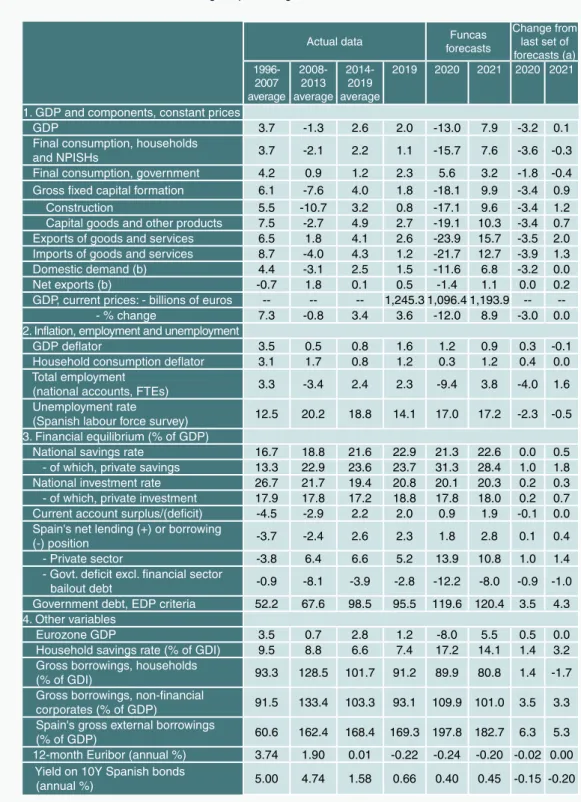
Framed by these assumptions, we are forecasting a GDP contraction of 13% in 2020. That estimate masks two starkly different realities: in the sectors associated with tourism, leisure and culture, GDP will contract by 35.5%, with the rest of the economy shrinking by 4%.
That forecast is 3.2 percentage points worse than in our last set of forecasts (Table 1). As mentioned, the downward revision is the result of the surge in case numbers and the dissuasive effect it has had on foreign tourist arrivals. We are now estimating that tourism will generate 25 billion euros less revenue in 2020 than we were forecasting in July.
The fresh rise in case numbers has also had an adverse effect on business and consumer sentiment due to the fear of a new lockdown.
Altogether, the tourism crisis is responsible for two-thirds of the downward revision to our estimate; the rest is due to the impact of the increased uncertainty on internal demand.
We would single out the sharp estimated contraction in investment, of close to 18%, with heightened turbulence clouding visibility for businesses. Consumption is also set to contract significantly (by around 16%), undermined by falling household income in the context of furloughs and job losses, and an increase in precautionary savings versus expenditure. We expect savings to surpass 17% of disposable household income, a record high. Public expenditure is the only component of demand expected to grow.
External demand is expected to detract from growth due to the downturn in tourism and, to a lesser degree, the drop in exports of goods and non-tourism services. Imports, meanwhile, are also expected to trend lower, although by less than exports.
The rebound anticipated for the end of this year will be felt in 2021. We are forecasting GDP growth of 7.9% in 2021, which is slightly higher than in July. However, by the end of next year, Spanish GDP will still be 3.9%
below pre-COVID levels if those forecasts materialise. In all probability, the economy will not fully recover to pre-COVID GDP levels until 2023, and maybe even 2024, depending on the path of economic policy (more on that below).
Internal demand, led by investment (thanks to fiscal stimulus measures and the European recovery package), is expected to drive the recovery. As the case numbers start to improve and the prospect of a vaccine nears, households and business are likely to become more inclined to spend and replace
“ In all probability, the economy will not fully recover to pre-COVID
GDP levels until 2023, and maybe even 2024, depending on the path
of economic policy. ”
Spain’s macro outlook: Rising COVID-19 cases dampen economic forecasts
Table 1 Economic forecasts for Spain, 2020-2021
Annual rate of change in percentages, unless otherwise indicated
Actual data Funcas
forecasts
Change from last set of forecasts (a) 1996-
2007 average
2008- 2013 average
2014- 2019 average
2019 2020 2021 2020 2021
1. GDP and components, constant prices
GDP 3.7 -1.3 2.6 2.0 -13.0 7.9 -3.2 0.1
Final consumption, households
and NPISHs 3.7 -2.1 2.2 1.1 -15.7 7.6 -3.6 -0.3
Final consumption, government 4.2 0.9 1.2 2.3 5.6 3.2 -1.8 -0.4
Gross fixed capital formation 6.1 -7.6 4.0 1.8 -18.1 9.9 -3.4 0.9
Construction 5.5 -10.7 3.2 0.8 -17.1 9.6 -3.4 1.2
Capital goods and other products 7.5 -2.7 4.9 2.7 -19.1 10.3 -3.4 0.7 Exports of goods and services 6.5 1.8 4.1 2.6 -23.9 15.7 -3.5 2.0 Imports of goods and services 8.7 -4.0 4.3 1.2 -21.7 12.7 -3.9 1.3
Domestic demand (b) 4.4 -3.1 2.5 1.5 -11.6 6.8 -3.2 0.0
Net exports (b) -0.7 1.8 0.1 0.5 -1.4 1.1 0.0 0.2
GDP, current prices: - billions of euros -- -- -- 1,245.3 1,096.4 1,193.9 -- -- - % change 7.3 -0.8 3.4 3.6 -12.0 8.9 -3.0 0.0 2. Inflation, employment and unemployment
GDP deflator 3.5 0.5 0.8 1.6 1.2 0.9 0.3 -0.1
Household consumption deflator 3.1 1.7 0.8 1.2 0.3 1.2 0.4 0.0 Total employment
(national accounts, FTEs) 3.3 -3.4 2.4 2.3 -9.4 3.8 -4.0 1.6
Unemployment rate
(Spanish labour force survey) 12.5 20.2 18.8 14.1 17.0 17.2 -2.3 -0.5 3. Financial equilibrium (% of GDP)
National savings rate 16.7 18.8 21.6 22.9 21.3 22.6 0.0 0.5
- of which, private savings 13.3 22.9 23.6 23.7 31.3 28.4 1.0 1.8 National investment rate 26.7 21.7 19.4 20.8 20.1 20.3 0.2 0.3 - of which, private investment 17.9 17.8 17.2 18.8 17.8 18.0 0.2 0.7 Current account surplus/(deficit) -4.5 -2.9 2.2 2.0 0.9 1.9 -0.1 0.0 Spain's net lending (+) or borrowing
(-) position -3.7 -2.4 2.6 2.3 1.8 2.8 0.1 0.4
- Private sector -3.8 6.4 6.6 5.2 13.9 10.8 1.0 1.4
- Govt. deficit excl. financial sector
bailout debt -0.9 -8.1 -3.9 -2.8 -12.2 -8.0 -0.9 -1.0
Government debt, EDP criteria 52.2 67.6 98.5 95.5 119.6 120.4 3.5 4.3 4. Other variables
Eurozone GDP 3.5 0.7 2.8 1.2 -8.0 5.5 0.5 0.0
Household savings rate (% of GDI) 9.5 8.8 6.6 7.4 17.2 14.1 1.4 3.2 Gross borrowings, households
(% of GDI) 93.3 128.5 101.7 91.2 89.9 80.8 1.4 -1.7
Gross borrowings, non-financial
corporates (% of GDP) 91.5 133.4 103.3 93.1 109.9 101.0 3.5 3.3 Spain's gross external borrowings
(% of GDP) 60.6 162.4 168.4 169.3 197.8 182.7 6.3 5.3
12-month Euribor (annual %) 3.74 1.90 0.01 -0.22 -0.24 -0.20 -0.02 0.00 Yield on 10Y Spanish bonds
(annual %) 5.00 4.74 1.58 0.66 0.40 0.45 -0.15 -0.20
(a) Percentage-point change between the current estimates and the last set of forecasts.
(b) Contribution to GDP growth in percentage points.
Sources: 1996-2019: INE and Bank of Spain; Forecasts 2020-2021: Funcas.
Table 2 Quarterly forecasts for the Spanish economy
Percentage change at constant prices, unless otherwise indicated Forecasts in shaded area
Period GDP Private cons. Public
cons. GFCF Exports Imports Contrib. to growth GDP (1)
Employ.
(2) Unemploy.
rate Domestic
demand Net exports
2014 1.4 1.7 -0.7 4.1 4.5 6.8 1.9 -0.5 1.0 24.4
2015 3.8 2.9 2.0 4.9 4.3 5.1 3.9 -0.1 3.2 22.1
2016 3.0 2.7 1.0 2.4 5.4 2.6 2.0 1.0 2.8 19.6
2017 2.9 3.0 1.0 5.9 5.6 6.6 3.0 -0.1 2.8 17.2
2018 2.4 1.8 1.9 5.3 2.2 3.3 2.6 -0.3 2.5 15.3
2019 2.0 1.1 2.3 1.8 2.6 1.2 1.5 0.5 2.3 14.1
2020 -13.0 -15.7 5.6 -18.1 -23.9 -21.7 -11.6 -1.4 -9.4 17.0
2021 7.9 7.6 3.2 9.9 15.7 12.7 6.8 1.1 3.8 17.2
QoQ change, in % (SCA data) Unemploy.
rate
2018 I 0.5 0.3 0.5 0.2 0.4 0.2 0.4 0.1 0.5 16.7
II 0.5 0.4 0.5 3.5 -0.2 1.2 1.0 -0.4 0.7 15.3
III 0.5 0.2 0.6 0.2 -1.0 -1.4 0.4 0.1 0.7 14.6
IV 0.6 0.2 0.6 -0.5 0.9 -0.2 0.2 0.4 0.7 14.4
2019 I 0.6 0.4 0.6 1.5 1.0 0.9 0.5 0.1 0.6 14.7
II 0.4 -0.1 0.5 -0.8 1.6 0.5 0.0 0.4 0.5 14.0
III 0.4 0.8 0.6 1.1 0.1 1.4 0.8 -0.4 0.1 13.9
IV 0.4 0.1 0.7 -1.2 0.6 -0.8 -0.1 0.5 0.9 13.8
2020 I -5.2 -6.5 1.8 -5.7 -8.2 -6.6 -4.4 -0.8 -1.9 14.4 II -18.5 -20.8 0.4 -22.3 -33.5 -28.8 -16.2 -2.3 -17.7 15.3
III 11.6 12.7 3.4 9.0 19.0 11.9 9.3 2.2 11.4 18.2
IV 1.6 0.8 3.0 2.6 4.9 5.2 1.6 0.0 1.0 19.9
2021 I 2.3 3.0 -1.0 3.5 5.7 5.2 2.1 0.2 1.0 18.9
II 2.7 3.0 0.0 4.5 5.4 5.0 2.5 0.2 1.2 17.3
III 2.7 2.4 0.2 3.6 5.5 4.0 2.1 0.6 1.1 16.5
IV 2.8 2.0 0.3 5.3 5.3 3.9 2.2 0.6 1.2 16.2
YoY change, in % (SCA data)
2018 I 2.8 2.5 1.6 4.5 4.0 4.7 2.8 -0.1 2.6 --
II 2.3 2.1 1.7 7.9 3.1 6.3 3.2 -0.9 2.4 --
III 2.2 1.6 1.9 5.3 1.6 2.5 2.5 -0.2 2.5 --
IV 2.1 1.2 2.2 3.5 0.1 -0.3 2.0 0.1 2.7 --
2019 I 2.2 1.2 2.3 4.8 0.8 0.4 2.1 0.1 2.7 --
II 2.0 0.7 2.3 0.5 2.6 -0.2 1.1 1.0 2.5 --
III 1.9 1.3 2.2 1.4 3.6 2.7 1.5 0.4 1.8 --
IV 1.8 1.2 2.4 0.6 3.3 2.1 1.3 0.5 2.0 --
2020 I -4.1 -5.7 3.6 -6.5 -6.1 -5.5 -3.7 -0.3 -0.6 --
II -22.1 -25.2 3.5 -26.8 -38.6 -33.1 -19.4 -2.7 -18.5 --
III -13.4 -16.3 6.4 -21.1 -26.9 -26.2 -12.6 -0.8 -9.3 --
IV -12.4 -15.8 8.8 -18.0 -23.8 -21.7 -11.2 -1.2 -9.2 --
2021 I -5.5 -7.3 5.8 -10.1 -12.3 -11.8 -5.1 -0.4 -6.5 --
II 19.1 20.5 5.4 21.0 38.9 30.1 16.3 2.7 14.9 --
III 9.6 9.5 2.2 15.0 23.2 20.9 8.6 1.0 4.3 --
IV 10.9 10.8 -0.5 18.0 23.7 19.4 9.2 1.7 4.5 --
(1) Contribution to GDP growth in percentage points.
(2) Full-time equivalent jobs.
Source: INE and Funcas (forecasts).
Spain’s macro outlook: Rising COVID-19 cases dampen economic forecasts
their productive capital. Trade will also make a positive contribution, prompted by the gradual renewal of tourist activity and growth in both exports and imports of goods.
Despite the collapse in tourism, the external accounts are expected to present a surplus throughout the forecast horizon, thanks to the drop in imports triggered by the recession.
Exports should recover in 2021, fuelled by the anticipated rebound in global trade and the gradual normalisation of tourist-related flows.
The deepening of the crisis will affect the number of hours worked, which are expected to trend downward, in line with growth.
However, the impact on jobs is expected to be cushioned by the furlough scheme and the redistribution of work (translating into fewer hours worked per job holder). Nearly 200,000 people are expected to exit the labour market in 2020, due to discouragement and/or the difficulty in finding work during a pandemic. All of which is expected to mitigate the fallout from the crisis on the unemployment rate which is forecast at 17%
in 2020 on average (19.9% in 4Q20). Adding in furloughed employees, whose pace of reincorporation is likely to slow considerably in the fourth quarter (by year-end an estimated 300,000 employees could remain under the scheme), unemployment in the fourth quarter would amount to 21%.
Although the trend in unemployment is significantly less adverse than in earlier recessions, the enabling formulae (furlough scheme and shorter working hours) may eventually result in job losses.
In 2021, business volumes are likely to remain well below pre-pandemic levels at many companies so that when the furlough scheme runs out and firms decide to reinstate
normal working hours, it is foreseeable that a certain number of workers will lose their jobs. However, these job losses will be more than offset by job creation driven by the gradual economic recovery. Consequently, the quarterly trend in job-seeker numbers in 2021 will be shaped by the timing of the withdrawal of that scheme. Assuming that the impact of its withdrawal is gradual, the unemployment rate would trend lower to an estimated 16.2% by the end of 2021, equivalent to around 600,000 job-seekers more than before the crisis. However, the annual average in 2021 could be higher than that of 2020 due to the high level of unemployment projected at the start of the year.
Turning lastly to the public finances in 2020, the surge in public spending (estimated at 26 billion euros) and the collapse in tax revenue (72 billion euros) are expected to drive the public deficit to over 12% of GDP. The 2021 estimates factor in decisions already taken or announced (minimum income scheme, growth in public investment in keeping with the European investment plan). The result of those assumptions, coupled with the interplay of the automatic stabilisers, would be a reduction in the deficit, essentially the cyclical component, to 8% of GDP. Public debt, meanwhile, is expected to stagnate at high levels of close to 120% of GDP.
The European recovery plan
One of the biggest game-changers affecting this set of forecasts is the agreement by the European Council in July on an EU recovery package. By some estimates, of the 750 billion euros earmarked to the plan, Spain could receive around 140 billion euros, more than half in the form of direct grants and the rest in loans [1].
As already mentioned, the forecasts for 2021 factor in the receipt next year of 14 billion
“ In 2020, the surge in public spending (26 billion euros) and the
collapse in tax revenue (72 billion euros) are expected to drive
the public deficit to over 12% of GDP. ”
euros from Europe, which is just a small percentage of the funds Spain may ultimately qualify for. Execution of the programme is expected to accelerate in subsequent years (Table 3) [2] , but the effective size of the disbursements will depend on the Spanish authorities’ management and implementation capabilities and the nimbleness of the European apparatus with respect to the required procedures, usually plagued by bureaucracy that makes them slow, complex and, as a result, unpredictable. An analysis of the current European budget period (2014- 2020) shows that Spain has only spent 34%
of the more than 56 billion euros available in structural funds [3]. Accordingly, in the absence of organisational improvements and project formulation, monitoring and execution process reform, Spain risks only being able to attract a portion of the funds available for 2021-2027.
Elsewhere, the impact of the European grants and loans will depend largely on reforms designed to facilitate their use (in addition to measures aimed at improving fund management in Spain and speeding up bureaucracy in Brussels). These reforms coincide with those needed by Spain to address its main economic and social imbalances (education, job market, pension system and the digital and energy transition). According to a number of studies, the reforms are vital
to closing the productivity gap with the rest of the EU, which is widening by 0.2 percentage points every year.
To analyse the impact of the recovery funds on the economy with and without reforms, we have modelled two scenarios over the budget period: 2021-2027 (Exhibit 3). Both assume administrative improvements to mobilize projects and speed up funding approval in Brussels.
The first scenario —status quo— assumes receipt of the European funds in the absence of reforms aimed at reducing Spain’s economic and social deficits. The aid would lift GDP via fiscal stimulus measures and public investment. However, in the absence of reforms, the growth from the increase in public spending would be transitory, and GDP growth would trend towards its inertial rate (estimated at 1.6% per annum). The result is an incomplete recovery, an unemployment rate above pre-crisis levels until 2024 and continuing steady growth in public debt, which would reach 133% of GDP in 2027.
In the other scenario, in addition to factoring in the European funds, we assume reforms designed to close the productivity growth gap with the rest of Europe and to reduce
“ The forecasts for 2021 factor in the receipt next year of 14 billion euros of grants and loans from Europe. ”
Table 3 EU recovery plan, billions of euros
2021 2022 2023 2024 2025 2026 2027 Total
Total EU 75 139 188 188 111 49 0 750
(% of Spain’s total
distribution) 10.0 18.5 25.1 25.1 14.8 6.5 0.0 100.0 Spain, with reforms 14 25.9 35.1 35.1 20.7 9.1 0 140 Source: For the EU, Miguel Carrión based on EC estimates. For Spain, Funcas estimates.
Spain’s macro outlook: Rising COVID-19 cases dampen economic forecasts
unemployment and job precariousness. As a result, the fiscal stimulus measures would provide GDP with a temporary boost, as in the status quo scenario, but also lift potential output to 1.9% per annum. Unemployment
would come down to 10% by 2027 and the upward trend in public debt would revert, ending the period at an estimated 124% of GDP. Nevertheless, that level is still too high, signalling the need for a budget consolidation
12.2 10.0 13.8
8 10 12 14 16 18
2020 2021 2022 2023 2024 2025 2026 2027
Exhibit 3 Impact of the European recovery plan on GDP, unemployment and public debt
(Funcas scenarios for the Spanish economy, 2021-2027)
Source: Funcas.
A. GDP growth Annual averages
No-reform scenario Reform scenario
2021-2023 4.5 4.9
2024-2027 1.6 1.9
B. Unemployment rate
132.9 124.0
90 100 110 120 130 140
2019 2020 2021 2022 2023 2024 2025 2026 2027
C. Government debt
% of GDP
12,2 10,0 13.8
8 10 12 14 16 18
2020 2021 2022 2023 2024 2025 2026 2027
No-reform scenario Reform scenario 4Q19
plan once the growth trajectory is on solid footing (an effort not modelled in this simulation).
Opportunities and risks
These estimates are marked by a considerable level of uncertainty, with both downside and upside risks. The rollout of a safe and quickly implemented vaccine would dissipate some of the main doubts about the recovery.
Confidence would improve substantially, facilitating a reduction in precautionary savings and growth in both internal and external demand. However, it is likely that the pandemic will have accelerated some of the structural changes that pre-date the crisis:
shifts in consumption patterns, digitalisation, preference for short production cycles and growing climate change awareness. That means that even if the COVID-19 crisis is remedied, the Spanish economy will still face significant structural challenges.
Another potential boon, already referred to, could come from a new state budget designed to foster the recovery and tackle those structural challenges, coupled with the rollout of reforms and a plan for reducing the imbalances in the public finances in the medium-term. That budget will also be crucial to making the most of the European funds.
On the downside, it is important to monitor the impact of the crisis on the financial sector.
An increase in non-performing loans could oblige the banks to step up their provisioning
efforts, thereby reducing already-slim margins and curbing the provision of new credit. The markets could also become less benevolent if, despite the burgeoning deficit, the growth targets fail to materialise. That situation could drive an increase in the country risk premium, making it more expensive for the Treasury to raise debt.
Longer-term, the main threat is that the Spanish economy could fall behind its European partners. Since Spain joined the European Union, growth in its per- capita income has tended to outpace the European average. That convergence came to a halt with the recession of the early 90s and again with the financial crisis, albeit recovering with newfound momentum during recovery phases. On this occasion, however, the effort required is unparalleled. Never before has Spain faced such a huge economic challenge of having to tackle two policy fronts at once.
On the one hand, Spain must manage the uncertainty surrounding the pandemic, an effort that requires curtailing the closure of numerous companies that are on the verge of bankruptcy and the loss of thousands of jobs that are currently being propped up —in an increasing number of cases artificially—
by furloughs and shorter working hours. On the other hand, Spain’s foundations need to be laid for inclusive growth, an effort that requires reforms that were put off during the expansionary period, and improved project management processes so as to make the most of the European funds.
“ According to a number of studies, reforms are vital to closing the productivity gap with the rest of the EU, which is widening by 0.2 percentage points every year. ”
“ It is likely that the pandemic will have accelerated some of the
structural changes that pre-date the crisis: shifts in consumption
patterns, digitalisation, preference for short production cycles and
growing climate change awareness. ”
Spain’s macro outlook: Rising COVID-19 cases dampen economic forecasts
Notes
[1] The breakdown of the recovery funds by country depends on factors that have not been fully defined and the presentation of projects by each country. For an estimate, refer to Zsolt Darvas (Breugel, 2020), https://www.
bruegel.org/2020/07/having-the-cake-how- eu-recovery-fund/
[2] For an estimate of the timing of the fund disbursements between 2021 and 2027, refer to Miguel Carrión (Funcas Europe, 2020), https://www.funcas.es/articulos/the-eu- recovery-plan-funding-arrangements-and- their-impacts/
[3] Refer to https://cohesiondata.ec.europa.eu/
countries/ES
Raymond Torres and María Jesús Fernández. Economic Perspectives and International Economy Division, Funcas
This page was left blank intentionally.
The impact of the pandemic on Spain’s housing market
Although home purchases and prices have fallen as a result of COVID-19, it is unlikely that the market will experience a collapse. However, the recovery may be uneven across regions and types of property, with low interest rates and lower average prices relative to peer countries supporting the market in Spain’s urban areas.
Abstract: The health crisis is affecting the real estate sector, albeit moderately considering the scale of the economic shock. According to the most recent data available at the time of writing this article, home purchases are 33% below pre-COVID levels. Prices have also been affected, falling by close to 1.2% in August. Nevertheless, all signs suggest that unless the economy is once again locked down in response to the second wave of contagions, the market is not on the verge of collapse.
Demand is being underpinned by current and anticipated low interest rates and the scarcity of attractive investment alternatives for buyers. Another factor pointing to a limited correction in prices in Spain is their relatively
low level by comparison with other European countries and the rest of the world. In 2020 as a whole, average prices are expected to contract by between 5% and 8% (considerably less than the contraction anticipated for the overall economy - 13%), going on to stabilise in the first half of 2021 and start to recover thereafter. The trend is, however, likely to be uneven across regions and types of property.
Introduction
The Spanish economy has been one of the hardest hit by the pandemic due to its high exposure to those sectors most dependent on human contact and mobility, as well as Carlos Ocaña Pérez de Tudela and Raymond Torres
REAL ESTATE
shortcomings in the response to the crisis (Torres and Fernández, 2020). In the past, the real estate market has tended to overreact to economic developments, particularly when recessions have been preceded by bubbles, raising the issue of whether the same pattern will prevail in the aftermath of the current crisis.
The goal of this article is to outline the main trends in the housing market since the onset of the pandemic and draw some conclusions about the outlook for the months to come. The analysis builds from the comparative analysis completed at the end of 2019, which detected solid signs of resistance notwithstanding the clear symptoms of slowdown (refer to Ocaña Pérez de Tudela and Torres, 2019).
Transaction volumes are sharply down since the onset of the pandemic Transaction volumes have fallen sharply since the start of the COVID-19 crisis. House purchases sustained an abrupt contraction of around 40% between mid-March and May. In June and July, the market recovered, although only very slightly, such that July transaction volumes were still 33.4% below pre-crisis levels (Exhibit 1).
However, new home mortgages, having also fallen sharply at the onset of the crisis, have rebounded more vigorously, and were just 7% below pre-crisis levels by July. The difference in the trends for new mortgages and transactions is unusual, suggesting that it could be attributable to a lag in solicitor or property registration on account of the
“ New home mortgages, having also fallen sharply at the onset of the crisis, have rebounded more vigorously than transactions, and were just 7% below pre-crisis levels by July. ”
20,000 25,000 30,000 35,000 40,000 45,000 50,000
-33.4%
Exhibit 1 Home purchase volumes
Units
Source: INE.
The impact of the pandemic on Spain’s housing market
lockdown (transaction volumes track sales placed on record with the property registries).
If that were the case, it would mean that the impact of the pandemic on demand for housing has thus far proved moderate, having overcome the interruption induced by the lockdown.
Supply has recovered since the end of the lockdown
On the supply side, construction virtually shut down in March and April but has since rebounded sharply. Construction jobs have recovered quickly (faster than in any other sector), as has cement construction, which, having fallen by half in April, was virtually back at pre-pandemic levels by June (Exhibit 2).
Another positive indicator can be found in the sales recorded by the major construction and developer firms, which in July were back at just 5% below pre-crisis levels. New works permits
also fell sharply in March and April but in May (the last month for which this indicator is available), were already showing signs of recovery.
The overall snapshot suggests that the contraction sustained during the lockdown may be temporary, such that the permanent impact on the market should be moderate.
Some kind of fallout is inevitable given the impact on GDP and unemployment.
Furthermore, the level of uncertainty generated by the health crisis will continue to influence households’ investment decisions.
Prices are suffering but so far not by much
Prices actually increased in the second quarter according to appraiser TINSA and the national statistics office INE, despite the contraction in transaction volumes. Conversely, the Ministry
420 540 660 780 900 1,020 1,140 1,260 1,380 1,500
700 900 1,100 1,300 1,500 1,700 1,900 2,100 2,300 2,500
Permits (000 m²) - LH axis Cement consumption (000 tonnes) - RH axis
Exhibit 2 Supply-side indicators
Absolute levels
Source: Ministry of Public Works and Ministry of Economy.
“ The recovery in transaction volumes since June suggests that the
price correction may well prove limited in scale and duration. ”
of Public Works’ numbers point to a second- quarter price drop (Exhibit 3). TINSA’s numbers show prices correcting in July and August, however. The recovery in transaction volumes since June suggests that the price correction may well prove limited in scale and duration.
A number of factors leads us to believe that, unlike what we have seen in previous economic crises, the impact of this recession on house prices is going to be limited, by which we mean of a smaller scale than the contraction in GDP. The first