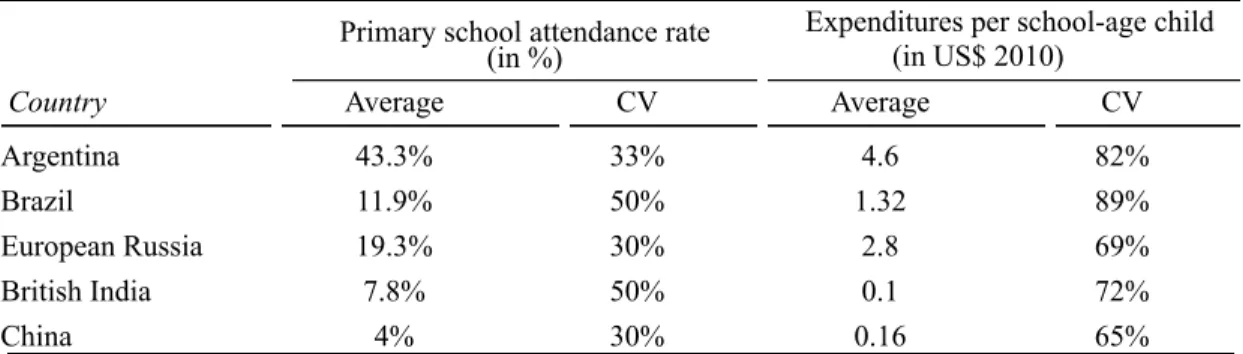
Rather, the thesis aims to contribute to the understanding of the development phenomenon in the Argentine case by investigating the impact of inequality on the development process, a question that does not compete with the aforementioned debates. Modernization meant for Argentina a marked increase in primary education levels during this period.
Brief consideration on the methodological strategy
The large heterogeneity described above makes it feasible to develop each of the chapters in this dissertation as they all exploit local variability. First, there is a greater probability that the unobservables will be identical—or at least consistent—for all observations in this type of approach.
The findings
The results suggest that the degree of urbanization could be part of the explanation, thus supporting the evidence of a similar. All these results together suggest that "structural" inequality in Argentina could be part of the explanation for its development failure.
Migration, population composition and long-term economic development: Evidence from settlements in the pampas. The Economic Journal. In The Cambridge History of Latin America (Vol. V). Bethell, L. The Age of Mass Migration in Latin America.
Wealth inequality and primary education in Argentina (1870-1914)
Introduction
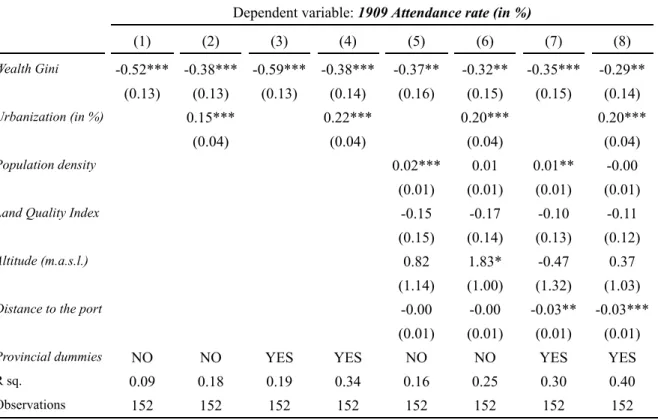
On the demand side, high inequality is associated with a lack of interest in education on the part of the masses. This hypothesis is also validated towards the end of the period (1909 and 1914), once the centralization of the budget in primary education has already taken place.
Literature review
- On the origins of educational systems
- On the influence of inequality in primary education
In the next section, a review of the literature in two large sets of publications is carried out. Peres Cajías (2013) also analyzed the impact of the Bolivian revolution on the provision of public education.
Primary education in Argentina (1870-1914)
- The Argentine primary education system in the international context
- The development of the Argentine primary education system in its origins
- The evolution of regional differences in primary schooling
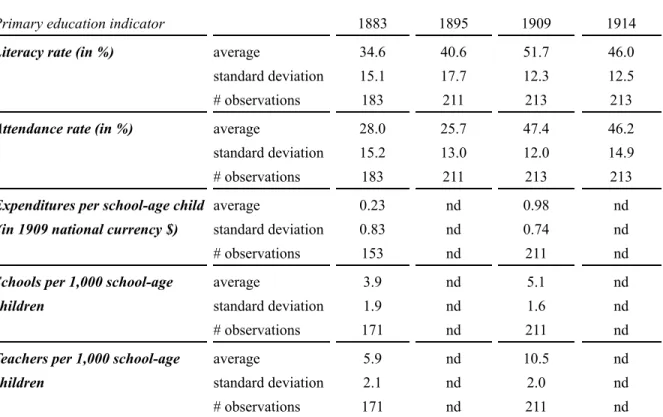
Similarly, there is no evidence that national subsidies increased at the end of the period. According to domestic sources, educational progress in the Argentine primary school took a leap in the first decade of the 1900s, while according to the Mitchell series (2003), the rise in primary education enrollment was continuous.

The model and the data
It only provides information on literacy and attendance of the population between 5 and 14 years of age. It only provides information on literacy and attendance of the population between 5 and 14 years of age.
Descriptive statistics
In the case of primary education expenditure, the correlation is even weaker, probably indicating that supply factors weighed less than demand factors. One could speculate that the demand mechanisms continued throughout the period while the supply side weakened among the channels through which wealth inequality could have affected primary education in early stages of the primary education system.
Regressions
- Baseline regressions and results
- Economic relevance and statistical significance
- Checking for demand mechanisms in 1909
Finally, one variable through which inequality could have affected the demand for education is the proportion of the European population. 24 For the available sample, the linear correlation coefficient between the share of the European population in 1909 and the Gini of wealth is -0.24, significant at the 1% level.

Concluding Remarks
This literature - beginning with the theoretical contributions of Acemoglu, Johnson and Robinson and Engerman and Sokoloff suggests that institutions provide a certain degree of persistence, manifest themselves through inequality, and act on the processes of growth and development through the allocation of public goods. In line with this literature, this chapter examines the influence of inequality, linked to exclusionary institutions, in the origin and initial development of the Argentine primary education system. To do this, the relationship at departmental level in 6 provinces that were part of the national territory between 1884 and 1914 is examined.
Using data from the national population, agricultural and school censuses and the Ginis of wealth estimated from the tax called Contribución Directa, it is found that inequality could have delayed the development of the primary education system in its beginnings and that the its influence was weakened once the centralization of budgets for primary education began. Finally, the results suggest that the influence of inequality was mainly manifested through demand mechanisms and not so much through elites hindering the allocation of schooling. These findings support other empirical research that addresses this relationship (Beltrán Tapia and Martínez-Galarraga, 2018; . Cinnirella and Hornung, 2016).
The main channels identified are related to increased demand, which is the result of urbanization and, to a lesser extent, European immigration. This latter channel may have affected different areas of the country in different ways due to the heterogeneity of settlement patterns among nationalities.
Big BRICs, weak foundations: The beginnings of public elementary education in Brazil, Russia, India and China. Investigations in Economic History. Factor Endowments, Institutions, and Differential Growth Paths Among New World Economies: A View from United States Economic Historians,” in How Latin America Fell Behind. Institutions, Factor Endowments and Development Paths in the New World". Journal of Economic Perspectives.
Inequality in land ownership, the emergence of human capital promoting institutions and large divergence. Review of Economic Studies. The Rise and Fall of Income Inequality in Latin America. The Oxford Handbook of Latin American Economics, 691-714. Economic growth and income inequality. American Economic Review The Legacies of Peasant Bondage: Agrarian Institutions, Human Capital, and Long-Term Development and Democracy in Russia and India”.
Desarrollo económico con oferta ilimitada de mano de obra. Públicos en crecimiento de la Escuela de Manchester: Volumen 1, La historia: gasto social y crecimiento económico desde el siglo XVIII (Volumen 1). Dos siglos de experiencia migratoria: Argentina y España a la luz del Bicentenario”, en Los dos caminos de la Historia: Argentina y España Ezequiel Gallo & Inés Viñuales (coord.), Buenos Aires, Edhasa, pp. 17-31.
Appendix Chapter 2
Land Quality Index Methodology
1909 Demand channels and wealth inequality
Checking for demand mechanisms in 1909 literacy rate
Descriptive statistics for control variables
The impact of agricultural colonization on primary education. Santa Fé, 1887
- Introduction
- Literature review
- Historical Background
- Data and descriptive statistics
- Primary education in Santa Fé colonies
- The demographic pattern
- Estimation strategy and results
- The colony effect on primary education. Baseline regressions
- Addressing endogeneity
- Exploring mechanisms
- Concluding Remarks
- References
The results of the OLS and ATE estimations suggest that the presence of colonies positively affected investment in human capital. First, there is no evidence that the greater predominance of the population of European origin in the Santa Fé colonies constituted a demand channel despite the fact that Europeans in the province had higher levels of human capital. Consistent with recent research on colony effects (González, 2020; Rocha, Ferraz and Soares, 2017), the specification results suggest that this may have been the case.
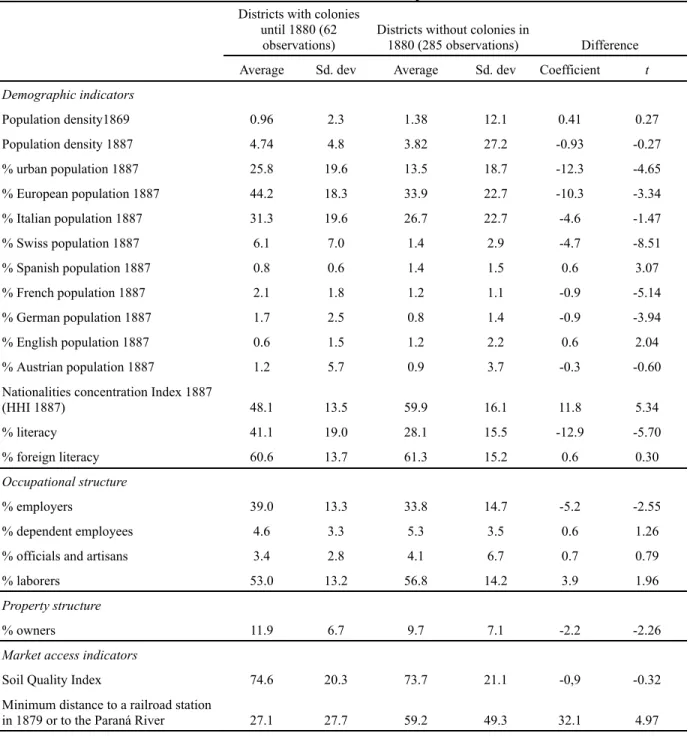
During the second half of the 19th century there was a spectacular process of creation of agricultural colonies. The first two columns of Table 3.3 present the coefficients of the simple regressions for primary schooling indicators in the presence of colonies. The Swiss, French and Germans predominated in colonies, while the Spanish and English tended to settle in the rest of the districts.
These findings therefore provide more confidence to talk about a causal effect of the presence of colonies in the promotion of primary schooling. Although with less robustness, the results of the regressions in Table 3.9 go in the same direction. Traditional historiography pointed to the relatively higher human capital of the European immigrant population (Cortés Conde, 1979), although this hypothesis has been nuanced by more recent historiography (Sánchez Alonso, 2019).
However, when the typical nationalities present in the colonies are included, the value of the coefficient associated with the presence of colonies decreases slightly and loses some of its significance.
Appendix Chapter 3
Soil Quality Index
The effect of 1880 colonies on 1887 primary schooling indicators
The effect of 1880 colonies on 1887 primary schooling indicators
The effect of 1880 colonies on 1887 primary schooling indicators. Land ownership controls
The effect of 1880 colonies on 1887 primary schooling indicators
New evidence on the causation from inequality to development in Latin America: Argentina at the local level 51
- Introduction
- Literature review
- Identification strategy
- First stage
- Exclusion restriction
- Data
- The instrument
- Inequality
- Development outcomes
- Channels of development
- Estimation results
- Main results
- Robustness Check for the Exclusion Restriction: Competing theories
- Robustness Check for the Exclusion Restriction: Wealth Effect
- Conclusions
- References
In subsection 4.5.2 we examine other determinants of development that may be associated with the instrument causing the failure of the exclusionary constraint. Note the strong relationship between this factor endowment suitability indicator and farm size distribution described in Figure 4.A.2 in the Appendix. 63These provinces correspond to the first 14 jurisdictions into which the Argentine territory was divided at the beginning of the 20th century.
This time-invariant characteristic of the relationship between factor endowments and Gini farm size is, we believe, more closely related to the "structural". The fact that factor resources are part of the production function is one of the most prominent weaknesses of our instrument. The relationship between inequality and economic development has attracted the attention of the discipline since its beginnings until today.
As highlighted by empirical studies in other contexts, our results would endorse the human capital mechanism as one of the main channels through which inequality can affect development. Reversal of Fortune: Geography and Institutions in the Making of Modern World Income Distribution. Quarterly Journal of Economics.

Appendix Chapter 4
Figures and Tables
Conclusions
This hypothesis is confirmed for the first part of the period - end of the 19th century - in which the allocation of the budget to primary education was decentralized. In addition, the mechanisms by which inequality would have affected the demand for education at the beginning of the 20th century are examined. Regarding urbanization as a channel connecting the negative effects of inequality on development, the results are in line with other research for the period which suggests that the process of modernization of institutions and economic activities - experienced asymmetrically in different localities in favor of more egalitarian areas - would have been part of the explanation.
On the other hand, the results show that the share of the European population in the 1860s was negatively correlated with wealth inequality, but would also be a driver of the demand for human capital. The main objective of chapter 3 is to investigate the effects of agricultural colonization on primary education in the province of Santa Fé during the process of expansion of the agricultural frontier in the second half of the 19th century. The results suggest that the level of urbanization could be part of the explanation, supporting the evidence of similar studies for the Chilean and Brazilian cases (González, 2020; Rocha, Ferraz, & Soares, 2017).
Second, while it is true that the Europeans in the province of Santa Fé had a greater stock of human capital than the natives, there is no evidence that the higher relative prevalence of Europeans in the colonies was part of the explanation for the colonies' relative success as providers of primary education - at least until 1887. Moreover, estimation results point to the relatively high heterogeneity in terms of nationalities as part of the explanation regarding the relative success of colonies' primary schooling indicators.