Searches for Vector-‐like Quarks, !̅ and tb resonances with the ATLAS Detector
Tim Andeen
Columbia University
on behalf of the ATLAS Collabora1on ICHEP 2014
July 5th, Beyond the Standard Model
v The discovery of the 125 GeV Higgs focuses aIenJon on the hierarchy quesJon.
v The top quark is the largest correcJon to the Higgs mass-‐
squared. Strong moJvaJon for searches for new physics in the top sector.
v Discussed here are ATLAS searches for:
o
Vector-‐like quarks (VLQs) that mix preferenJally with the 3rd generaJon,
o
New vector bosons (Z’, W’, g
kk) that couple to the 3rd generaJon, predicted in many models of new physics: Topcolor, LiIle Higgs,
Composite Higgs, Randall-‐Sundrum (with warped extra dimensions),...
Mo<va<on
H
t
H
t
Notreviewed,forinternalcirculationonly
[GeV]
mT
300 400 500 600 700 800 900 1000
Branching Ratio
0 0.2 0.4 0.6 0.8 1
Wb T →
Zt T →
Ht T →
Wb T →
Zt T →
Ht T → SU(2) Singlet (X,T) Doublet
(T,B) or
PROTOS
(a)
[GeV] mB
300 400 500 600 700 800 900 1000
Branching Ratio
0 0.2 0.4 0.6 0.8 1
Wt B →
Zb B →
Hb B →
Wt B →
Zb B →
Hb B →
Wt B → SU(2) Singlet (B,Y) Doublet (T,B) Doublet
PROTOS
(b)
Figure 2. Vector-like T quark branching ratios (a) to the W b, Zt, and Ht decay modes versus the T quark mass, computed with protos [41] for an SU(2) singlet and two types of doublets.
Likewise, vector-likeB quark branching ratios (b) to theW t, Zb, and Hb decay modes for a singlet and two types of doublets. The X quark in an (X, T) doublet has charge +5/3, and the Y quark in a (B, Y) doublet has charge −4/3.
well as a (T, B) doublet when a mixing assumption of VT b " VtB is made [15]. Note that
220
BR(T → W b) = 0 in the doublet cases. Similarly, Fig. 2(b) shows the branching ratio of a
221
B quark versus mass for the singlet and doublet hypotheses. In the case of a(T, B) doublet,
222
BR(B → W t) = 1. Branching ratio values are also shown in Fig. 2(b) for a (B, Y) doublet,
223
where the charge of the Y quark is −4/3. The charged-current mode, BR(B → W t), is
224
absent in this case.
225
Simulated samples of leading-order (LO) pair production events were generated for the
226
TT¯ and BB¯ hypotheses with protos v2.2 interfaced with pythia [42] v6.421 for parton
227
shower and fragmentation, and using the MSTW 2008 LO 68% confidence level (CL) [37] set
228
of PDFs. These samples are normalized using the Top++ cross section predictions. The
229
vector-like quarks were decayed with a branching ratio of 1/3 to each of the three modes
230
(W, Z, H). Arbitrary sets of branching ratios consistent with the three modes summing
231
to unity are obtained by reweighting the samples using particle-level information. A SM
232
Higgs boson with a mass of 125 GeV is assumed. The primary set of samples span quark
233
masses between 350 GeV and 850 GeV in steps of 50 GeV, and were produced assuming
234
SU(2) singlet couplings. Additional samples were produced at two mass points (350 and
235
600 GeV) using SU(2) doublet couplings in order to confirm that kinematic differences
236
arising from the different chirality of singlet and doublet couplings are negligible in this
237
analysis. The above samples were passed through a fast detector simulation [43], while
238
additional samples with quark masses of 400, 600 and 800 GeV were also produced using
239
full detector simulation [44] to test the agreement.
240
v Higgs observaJon and precision measurements disfavor adding 4
thgeneraJon quarks with SM-‐like chiral couplings.
v Le^ and right-‐handed components of VLQs have idenJcal electroweak gauge transformaJons.
§ Singlets: Doublets:
v Top partner may have a role in regulaJng the Higgs mass divergence.
v Pair producJon (strong interacJon), dominates at low mass (< 1 TeV), only input is m
Q.
v Single producJon (electroweak interacJon)
becomes larger at higher masses, m
Qand coupling (model dependent) as inputs.
v Diverse final states for analysis. (Assume mixing is enJrely 3rd generaJon).
ICHEP 2014 Tim Andeen
Vector-‐like Quarks
3
Notreviewed,forinternalcirculationonly
(a)
[GeV]
mQ
400 500 600 700 800 900 1000
[fb]σ
1 10 102
103
104
105
(Top++) Q Q pp →
= 2 (MG) λT
q, b T pp →
= 0.1 (PROTOS) q, VTb
b T pp →
= 0.1 (PROTOS) q, XBb
b B pp →
= 8 TeV s
(b)
Figure 1. A representative diagram (a) illustrating the pair production and decay modes of a vector-like quark (Q = T, B). The √
s = 8 TeV LHC cross section versus quark mass (b) for pair production, denoted by the solid line, as well as for the T¯bq and B¯bq single production processes, denoted by dashed lines. The pair production cross section has been calculated with Top++[36].
The single production cross sections were calculated with protos [41] and madgraph [47] using different electroweak coupling parameters that are discussed in the text.
increases from 8 to 14% over this mass range. The PDF and αs uncertainties dominate over
207
the scale uncertainty, and were evaluated according to the PDF4LHC recommendations [39].
208
Once produced, the final state topology depends on the decay modes of the new quarks.
209
Unlike chiral quarks, where only the charged-current decay mode occurs at tree-level due
210
to GIM suppression of the neutral-current modes, vector-like quark decays can proceed at
211
tree-level to a W, Z, or H boson plus a SM quark. Additionally, vector-like quarks are
212
often assumed to couple preferentially to third generation SM quarks [11, 40], particularly
213
in the context of naturalness arguments. Thus, Fig. 1(a) depicts a T or a B vector-like
214
quark, represented by Q, decaying to either a SM t or b quark, represented by q or q!, and
215
a Z, H, or W boson. The branching ratios of a T quark versus its mass, as computed by
216
protos v2.2 [15, 41], are shown in Fig. 2(a)2. A weak-isospin (SU(2)) singlet T quark
217
hypothesis is depicted, as well as a T that is part of an SU(2) doublet. The doublet
218
prediction is valid for an (X, T) doublet, where the charge of the X quark is +5/3, as
219
2The branching ratios in Fig. 2 are valid for small mixing between the new heavy quark and the third generation quark. For example, using the mass eigenstate basis notation of Refs. [15, 17, 45], and the relations in Appendix A of Ref. [17], VT b ≈ XtT in the limit of small mixing, and hence these mixing parameters cancel when computing branching ratios using the width expressions in Eq. 22 of Ref. [15].
– 6 –
( ) X T L,R( ) T B L,R( ) B Y L,R
T
L,R, B
L,RVLQ production
Top partner decay
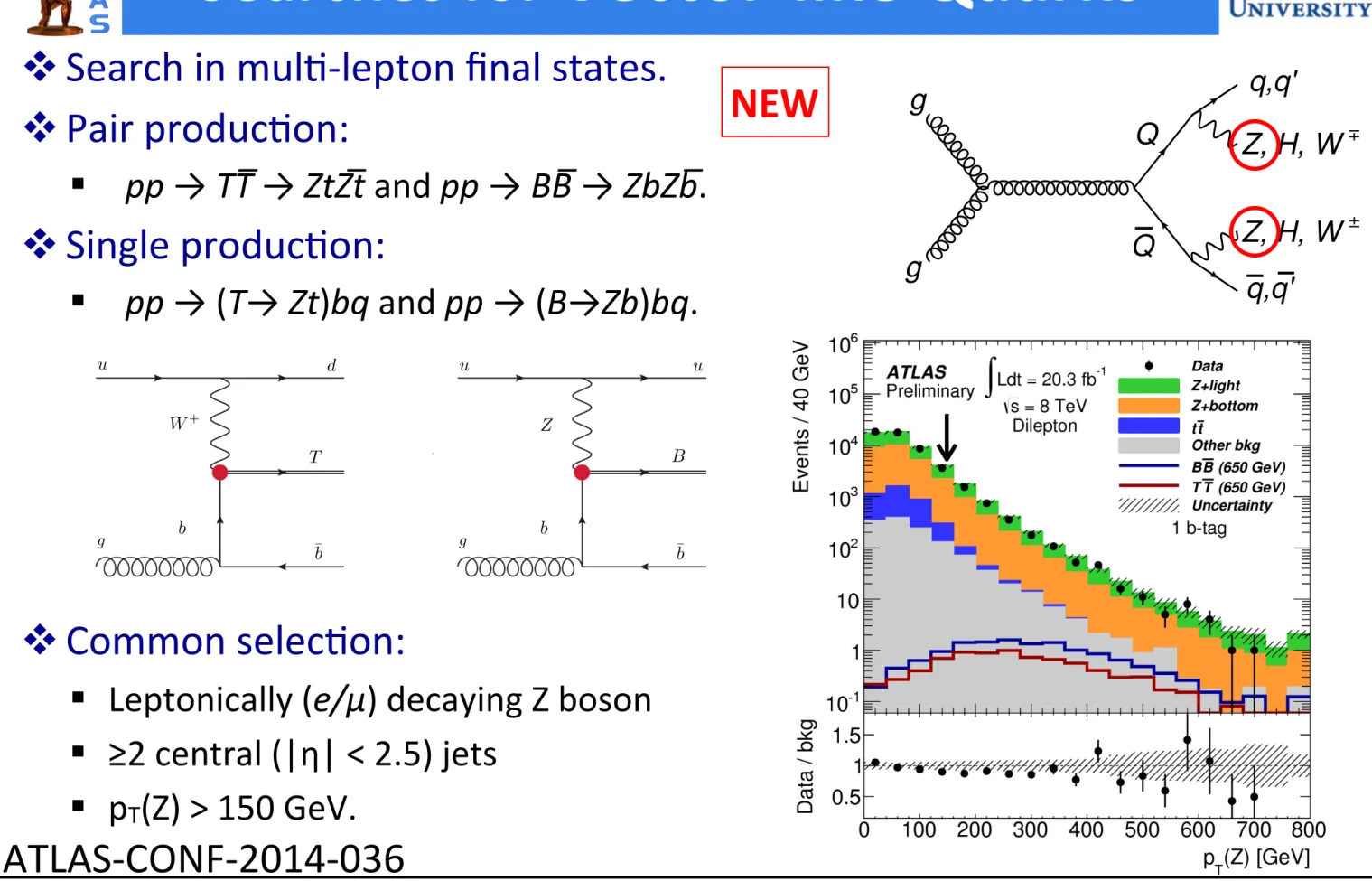
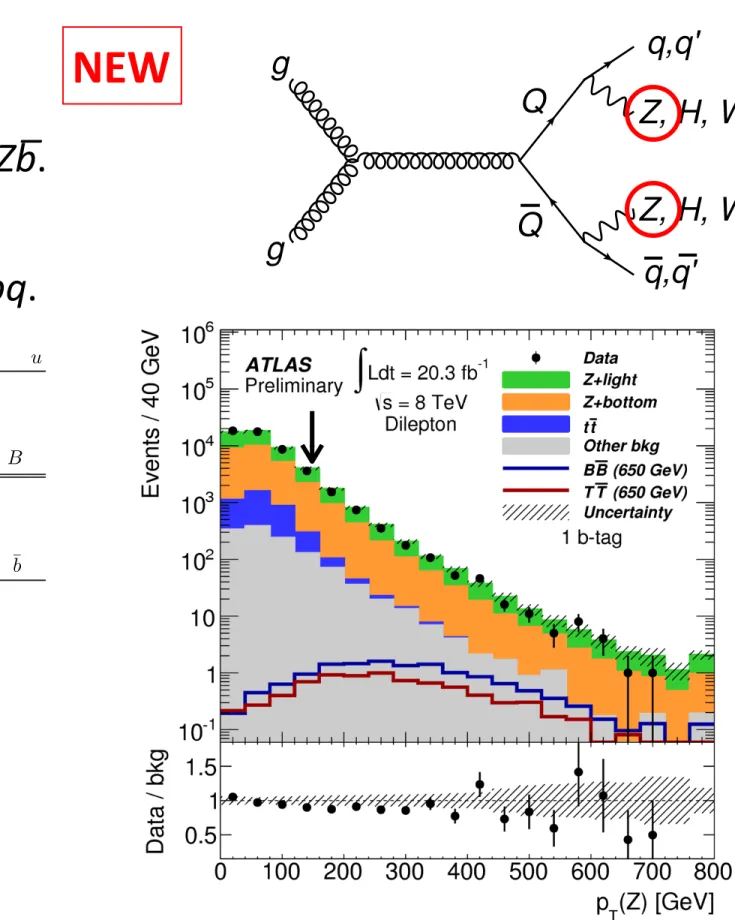
v Search in mulJ-‐lepton final states.
v Pair producJon:
§ pp → TT7 → ZtZt̅ and pp → BB7 → ZbZb7.
v Single producJon:
§ pp → (T→ Zt)bq and pp → (B→Zb)bq.
v Common selecJon:
§ Leptonically (e/μ) decaying Z boson
§ ≥2 central (|η| < 2.5) jets
§ p
T(Z) > 150 GeV.
ICHEP 2014 Tim Andeen
Searches for Vector-‐like Quarks
4
Notreviewed,forinternalcirculationonly
(a)
[GeV] mQ
400 500 600 700 800 900 1000
[fb]σ
1 10 102
103
104
105
(Top++) Q
Q pp →
= 2 (MG) λT
q, b T pp →
= 0.1 (PROTOS) q, VTb
b T pp →
= 0.1 (PROTOS) q, XBb
b B pp →
= 8 TeV s
(b)
Figure 1. A representative diagram (a) illustrating the pair production and decay modes of a vector-like quark (Q = T, B). The √
s = 8 TeV LHC cross section versus quark mass (b) for pair production, denoted by the solid line, as well as for the T¯bq and B¯bq single production processes, denoted by dashed lines. The pair production cross section has been calculated with Top++ [36].
The single production cross sections were calculated with protos [41] and madgraph [47] using different electroweak coupling parameters that are discussed in the text.
increases from 8 to 14% over this mass range. The PDF and αs uncertainties dominate over
207
the scale uncertainty, and were evaluated according to the PDF4LHC recommendations [39].
208
Once produced, the final state topology depends on the decay modes of the new quarks.
209
Unlike chiral quarks, where only the charged-current decay mode occurs at tree-level due
210
to GIM suppression of the neutral-current modes, vector-like quark decays can proceed at
211
tree-level to a W, Z, or H boson plus a SM quark. Additionally, vector-like quarks are
212
often assumed to couple preferentially to third generation SM quarks [11, 40], particularly
213
in the context of naturalness arguments. Thus, Fig. 1(a) depicts a T or a B vector-like
214
quark, represented by Q, decaying to either a SM t or b quark, represented by q or q!, and
215
a Z, H, or W boson. The branching ratios of a T quark versus its mass, as computed by
216
protos v2.2 [15, 41], are shown in Fig. 2(a)2. A weak-isospin (SU(2)) singlet T quark
217
hypothesis is depicted, as well as a T that is part of an SU(2) doublet. The doublet
218
prediction is valid for an (X, T) doublet, where the charge of the X quark is +5/3, as
219
2The branching ratios in Fig. 2 are valid for small mixing between the new heavy quark and the third generation quark. For example, using the mass eigenstate basis notation of Refs. [15, 17, 45], and the relations in Appendix A of Ref. [17], VT b ≈ XtT in the limit of small mixing, and hence these mixing parameters cancel when computing branching ratios using the width expressions in Eq. 22 of Ref. [15].
– 6 –
Notreviewed,forinternalcirculationonly
T W+(
u d(
b
¯b g
(a)
u
Z
u
B
b
¯b g
(b)
Figure 3. Representative diagrams illustrating the t-channel electroweak single production of (a) a T quark via the T¯bq process and (b) a B quark via the B¯bq process.
5.2 Electroweak single production
241
Another source of heavy quark production is singly via the electroweak interaction. The
242
t-channel process provides the largest contribution, as is also the case for SM single top
243
production at the LHC. Figures 3(a,b) illustrate the t-channel 2 → 3 process (four-flavor
244
scheme) producing a vector-like T and B quark, respectively, in association with a b quark3
245
and a light-generation quark. Cross sections as a function of the heavy quark mass are also
246
shown in Fig. 1(b) for the T¯bq and B¯bq processes, with the long-dashed lines indicating the
247
prediction using protos with mixing parameter values [15, 17] of VT b = 0.1 and XbB = 0.1,
248
respectively. These reference values were chosen to reflect the magnitude of indirect upper
249
bounds on mixing [17, 45] from precision electroweak data when assuming a single vector-
250
like multiplet is present in the low-energy theory. No kinematic requirements are placed on
251
the b quark or the light-flavor quark produced in association with the heavy quark. The
252
single production cross sections scale quadratically with the mixing parameter.
253
The indirect constraints on the mixing parameters may be relaxed if several multiplets
254
are present in the low-energy spectrum, as would be the case in realistic composite Higgs
255
models [45]. Several authors have emphasized the importance of the single production
256
mechanism in this context [16, 45, 46], in particular, that it could represent a more favorable
257
discovery mode than the pair production mechanism. Figure 1(b) shows the predicted T¯bq
258
cross section in a specific composite Higgs model [46] that was implemented in madgraph
259
v5 [47] and provided by the model authors. In this model, the W T b vertex is parameterized
260
by the variable λT, which is related to the Yukawa coupling in the composite sector and
261
the degree of compositeness of the third generation SM quarks4. The prediction shown
262
corresponds to λT = 2, and values between 1 and 5 were considered in Ref. [46].
263
3t-channel production in association with a top quark is also possible, but the cross section is over an order of magnitude smaller for the same heavy quark mass, and for the same mixing parameter value.
4The notation of Ref. [46] follows that adopted in Ref. [14], and uses the weak eigenstate basis. For small values of λT, or large heavy quark masses, VT b ≈ (λTv)/(√
2MT), with v = 246 GeV. See footnote 2 of Ref. [14] for more details.
NEW
ATLAS-‐CONF-‐2014-‐036
v Final discriminant in dilepton channel is m(Zb).
§ Exactly 2 leptons, ≥ 2 b-‐tagged jets
o Single producJon -‐ ≥ 1 fwd. jet.
o Pair producJon -‐ HT(jets) ≥ 600 GeV.
DRAFT
v ...in trilepton channel is H
T(leptons+jets).
§ ≥ 3 leptons, ≥ 1 b-‐tagged jets
o Single producJon -‐ ≥1 forward jet(2.5<|η|<4.5).
Searches for Vector-‐like Quarks
Searches for Vector-‐like Quarks
v Limits are set for pair producJon in benchmark singlet and doublet models:
o BB7 singlet/doublet mass 95% CL mass limit 685/755 (679/755) GeV obs. (exp.)
o TT7 singlet/doublet mass 95% CL limit 735/700 (720/700) GeV obs. (exp.) NEW
v 95% CL limits on pair producJon for all possible branching raJos for the three decay modes (Z,W,H), requiring sum of raJos to be 1.
ATLAS-‐CONF-‐2014-‐036
Notreviewed,forinternalcirculationonly
→ Wt) BR (B
0 0.2 0.4 0.6 0.8 1
Hb)→BR (B
0 0.2 0.4 0.6 0.8 1
limit [GeV] BObserved 95% CL m
350 400 450 500 550 600 650 700 750 800 ATLAS 850
Preliminary s = 8 TeV
Status: ICHEP 2014
Summary results:
L dt = 14.3 & 20.3 fb-1
∫
Same-Sign ll
ATLAS-CONF-2013-051
Zb/t + X
ATLAS-CONF-2014-036
Notreviewed,forinternalcirculationonly
→ Wb) BR (T
0 0.2 0.4 0.6 0.8 1
Ht)→BR (T
0 0.2 0.4 0.6 0.8 1
limit [GeV] TObserved 95% CL m
350 400 450 500 550 600 650 700 750 800 ATLAS 850
Preliminary s = 8 TeV
Status: ICHEP 2014
Summary results:
L dt = 14.3 & 20.3 fb-1
∫
Same-Sign ll
ATLAS-CONF-2013-051
Ht+X,Wb+X comb.
ATLAS-CONF-2013-060
Zb/t + X
ATLAS-CONF-2014-036
Searches for Vector-‐like Quarks
v Combine with previous ATLAS searches in single lepton channel and same-‐
sign dilepton channel.
NEW
v 95% CL limits on pair producJon for all possible branching raJos for
the three decay modes (Z,W,H), requiring sum of raJos to be 1.
Searches for Vector-‐like Quarks
v Set first LHC upper limits (95% CL) on cross secJon Jmes branching raJo for single producJon as a funcJon of heavy quark mass (T and B).
ATLAS-‐CONF-‐2014-‐036
Searches for !̅ Resonances
v Search for heavy parJcles decaying into top quark pairs.
v Single lepton signature using exclusive resolved and
boosted categories for low and high mass signal regions.
§
Leptonic top reconstructed from lepton (μ or e), jet and missing E
T.
§ Boosted selecJon: hadronic top reconstructed as one
anJ-‐k
T, radius 1.0 jet.
o Apply jet trimming, jet pT, η, mass, and substructure selecJon to reduce background.
o Large separaJon between hadronic and leptonic components.
§ Resolved selecJon: only events that fail boosted selecJon.
Hadronic top reconstructed as 2 or 3 anJ-‐kT, radius 0.4 jets.
o Minimize χ2 to choose best combinaJon of jets.
➡ See poster by Victoria Sánchez Marsnez!
Z’
v Set 95% CL limits on masses for two models of resonances decaying into >̅.
v Narrow width (Γ/m = 1.2%): Topcolor model, leptophobic Z'.
o 1.8 (1.9) TeV, obs. (exp.)
v Wide width (Γ/m = 15.3%): Randall-‐
Sundrum model, Kaluza-‐Klein gluon.
o 2.0 (2.1) TeV, obs. (exp.)
ATLAS-‐CONF-‐2013-‐052
Final selection, resolved and
boosted categories
Searches for !̅ Resonances
Searches for tb Resonances
v Search for new, charged vector boson W’ decaying into top quark and boIom quark.
v Both leptonic and hadronic top decays considered.
§ Leptonic:
o Top quark reconstructed from lepton (μ or e), jet and missing E
T.
o 2-‐3 jets, ≥1 b-‐tagged.
o Boosted decision tree trained using kinemaJc variables.
§ Hadronic -‐ Boosted:
o Top quark reconstructed as one anJ-‐k
T, radius 1.0 jet.
o Apply jet trimming, jet p
T, η, and
substructure selecJon to tag top quark.
o 1 or 2 b-‐tagged jets, one opposite to top tagged jet ( ΔR > 2.0).
Open Presentation W’ → tb (hadronic), 10.06.2014
Johannes Erdmann 2
Introduction
W’
ATLAS-CONF-2013-050
NEW
Searches for tb Resonances
LINMMON
v 95% CL limits on m(W’) for SM-‐like coupling to fermions (gSM).
v For right-‐handed couplings and m(νR) > m(W’R) (i.e., no decay to SM leptons: 1.8 (1.7) TeV, obs. (exp.)
v For a le^-‐handed couplings, w/o interference (or right-‐
handed with m(νR) << m(W’R)): 1.7 (1.6) TeV, obs. (exp.) v Reinterpret as limits on non-‐SM couplings, g’ (the W’
boson gauge coupling to fermions) in g’/gSM -‐ m(W’) plane for le^ and right handed W’.
to be submitted to EPJC to be submitted to EPJC
NEW
NEW
Summary
v Searches for new physics that couplings preferenJally to the third generaJon are moJvated by a variety of models.
v Presented here is only a selecJon of recent ATLAS analyses of 8 TeV LHC data searching for vector-‐like quarks, >̅ and tb resonances.
o Results are consistent with the SM.
o Exclude (95% CL) vector-‐like top and boIom quarks mass <
700 GeV.
o Exclude (95% CL) >̅ resonances mass < 1.8 TeV (narrow Z’) or < 2.0 TeV (wide KK gluon).
o Exclude (95% CL) tb resonances resonances <1.7 TeV.
v Analyses have developed new techniques with boosted top quarks and jet substructure. This will be even more important as we search for high mass resonances in the coming higher energy LHC run.
Thank you!
Addi<onal Material
ICHEP 2014 Tim Andeen
Searches for Vector-‐like Quarks
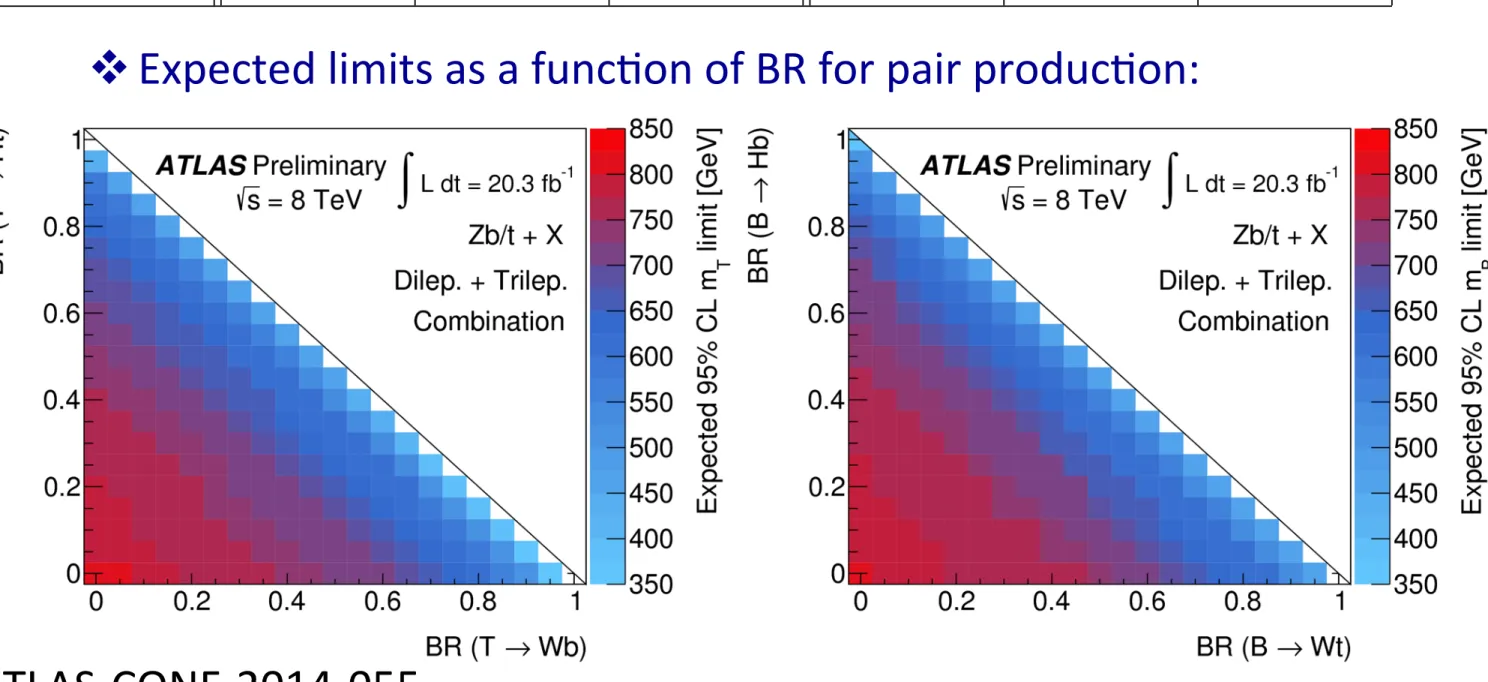
v Expected limits as a funcJon of BR for pair producJon:
Notreviewed,forinternalcirculationonly 15
Singlet mass limit [GeV] Doublet mass limit [GeV]
Hypothesis Dilepton Trilepton Comb. Dilepton Trilepton Comb.
BB¯ 690 (665) 610 (610) 685 (670) 765 (750) 540 (530) 755 (755) TT¯ 620 (585) 620 (620) 655 (625) 705 (665) 700 (700) 735 (720)
Table 8. Observed (expected) 95% CL limits on the T and B quark mass (GeV) assuming the pair production of SU(2) singlet and doublet quarks, and using the dilepton and trilepton channels separately, as well as combined.
the combined T quark mass limits along with the mass limits obtained from the dilepton
611
and the trilepton channels independently. The sensitivity of the two channels is similar,
612
though the trilepton channel is more sensitive in both cases.
613
In addition to lower limits on the quark masses for these benchmark SU(2) singlet
614
and doublets scenarios, limits are also derived using the combination of the dilepton and
615
trilepton channels for all sets of heavy quark branching ratios consistent with the three decay
616
modes (W , Z, and H) summing to unity. Figures 13(a,b) present expected and observed
617
B quark mass limits, respectively, in a two-dimensional plane of branching ratios, with
618
BR(B → Hb) plotted on the vertical axis and BR(B → W t) on the horizontal axis. The
619
sensitivity is greatest in the lower-left corner where the branching ratio to the ZbZb final
620
state is 100%. In this case, the expected B quark mass limit is 800 GeV and the observed
621
limit is 790 GeV. Likewise, Fig. 14(a,b) present the expected and observed T quark mass
622
limits, respectively, in the BR(T → Ht) versus BR(T → W b) plane of branching ratios.
623
In the case of a 100% branching ratio to the ZtZt final state, the expected T quark mass
624
limit 810 GeV and the observed limit is 800 GeV.
625
10.2 Limits on the single production hypotheses
626
Figures 15(a,b) present lower limits on the cross section for the electroweak single production
627
processes pp → B¯bq and pp → T¯bq, respectively, multiplied by the branching to the Z decay
628
mode. The limits on the B¯bq process were obtained using the dilepton channel only, as the
629
trilepton channel is not sensitive to this process. The limits on T¯bq process were derived by
630
combining the dilepton channel and trilepton channels. The sensitivity of the two channels
631
is comparable in the low-mass regime, while the dilepton channel provides the greater
632
sensitivity in the high-mass regime.
633
As an example application of these results, the limits on σ(pp → T¯bq) × BR(T → Zt)
634
are used to constrain the λT parameter of the reference composite Higgs model [46]. Fig-
635
ure 16 presents the upper limits on λT as a function of the SU(2) singlet T quark mass.
636
Viable coupling parameters are excluded for T masses beyond those excluded by the pair
637
production analysis.
638
ATLAS-‐CONF-‐2014-‐055
Searches for Vector-‐like Quarks
v Same-‐sign dilepton search tesJng both TT and BB producJon.
o Ex: Exclude (95% CL) mass of chiral B < 720 (760) GeV exp. (obs.)
ATLAS-‐CONF-‐2013-‐051
Searches for Vector-‐like Quarks
v Single lepton searches for pp → TT7 → WbWb or HtHt.
o Ex: T mass limit of < 670 (675) GeV exp. (obs.)
Searches for Vector-‐like Quarks
v Final discriminant in dilepton channel is m(Zb). Require:
§ Exactly 2 leptons, ≥ 2 b-‐tagged jets
o Pair producJon -‐ H
T(jets) ≥ 600 GeV. o Single producJon -‐ ≥ 1 fwd. jet.
ATLAS-‐CONF-‐2014-‐055
Searches for Vector-‐like Quarks
v Final discriminant in trilepton channel is H
T(leptons+jets). Require:
§ ≥ 3 leptons, ≥ 1 b-‐tagged jets
o Pair producJon. o Single producJon -‐ ≥ 1 fwd. jet.
ATLAS Vector-‐like Top Summary
Notreviewed,forinternalcirculationonly
ATLAS Vector-‐like Top Summary
Notreviewed,forinternalcirculationonly
ATLAS Vector-‐like BoIom Summary
ATLAS Vector-‐like BoIom Summary
Notreviewed,forinternalcirculationonly
Searches for !̅ Resonances
v χ
2variable minimized to chose resolved jets:
v Jet trimming (removal of “so^”, low p
Tcomponents of jet) is done to reduce sensiJvity to pile-‐up.
ATLAS-‐CONF-‐2013-‐052
Searches for !̅ Resonances
v Jet mass and the spli~ng scale are used to select top
candidate jets.
v √(d
12) is the k
Tspli~ng scale
between the final 2 sub-‐jets
a^er re-‐clustering with k
Tjet
algorithm.
Searches for !̅ Resonances
v Final selecJon in μ resolved category and e boosted category.
ATLAS-‐CONF-‐2013-‐052
v √(d
12) is the k
Tspli~ng scale between the final 2 sub-‐jets a^er re-‐
clustering with k
Tjet algorithm.
v τ
ijis raJo of N-‐subje~ness, the compaJbility of a large-‐R jet with N subjets. Peaks closer to 0 for i-‐subjet like jets.
ICHEP 2014 Tim Andeen
Searches for tb Resonances
v Jet substructure variables:
27
Notreviewed,forinternalcirculationonly
This analysis uses a neural network based combination of sev-
148
eral high performance b-tagging algorithms [44] which is ap-
149
plied to small-R jets.
150
Events with reconstructed high-quality electrons or muons
151
are vetoed. Electrons are reconstructed from clusters in the
152
electromagnetic calorimeter with an associated track. Only
153
clusters in the fiducial volume |⌘| < 2.47, but outside of the
154
barrel-endcap calorimeter transition region 1.37 < |⌘| < 1.52,
155
are considered. All clusters are required to fulfil criteria on their
156
shape to be consistent with an electron [45] and have to be iso-
157
lated from surrounding energy deposits and tracks. The trans-
158
verse energy of an electron candidate must be at least 30 GeV.
159
Muons are reconstructed by combining tracks in the inner de-
160
tector with tracks in the muon spectrometer [46]. Muons are
161
required to satisfy |⌘| < 2.5, pT > 30 GeV and have to be iso-
162
lated from surrounding energy deposits in the calorimeter and
163
tracks in the inner detector.
164
4.1. The W0 Top-tagger
165
This analysis searches for W0 bosons in the high mass (mW0 >
166
1.5 TeV) region, where the top-quark and bottom-quark have
167
high transverse momentum. The average distance between the
168
decay products of the top-quark becomes smaller with increas-
169
ing top-quark pT, and their hadronic showers tend to overlap.
170
This high-pT topology, where the decay products of a massive
171
particle can be captured in one single large-R jet, is referred to
172
as “boosted” [47].
173
The cut-based W0 top-tagging algorithm is an optimisation
174
of jet substructure criteria developed to efficiently select W0
175
signal events over the dominant background from multijet pro-
176
duction featuring non-top-quark and gluon initiated jets. The
177
tagger uses three substructure variables: the one-to-two kT-
178
splitting scale p
d12 [48] and two ratios of N-subjettiness (⌧N)
179
variables [49, 50] ⌧32 = ⌧3/⌧2 and ⌧21 = ⌧2/⌧1.
180
The splitting scale pd12 distinguishes jets containing rela-
181
tively pT-symmetric two-body decay products of a heavy par-
182
ticle from pT-asymmetric light jets. It is calculated by reclus-
183
tering the constituents of the large-R jet using the kT algorithm.
184
The kT algorithm clusters the hardest objects last, causing the
185
final clustering step to correspond with the splitting scale of the
186
two hardest subjets, from which p
d12 is calculated:
187
pd12 = min(pT,1, pT,2) ⇥
q( ⌘12)2 + ( 12)2 . For jets from massive particle decays the p
d12 distribution
188
is expected to peak at approximately half the particle mass, and
189
near zero for jets initiated by non-top-quarks and gluons.
190
N-subjettiness is a measure of the compatibility of a large-R
191
jet with a given number of subjets. The ⌧N are calculated by
192
reclustering the large-R jet constituents with the kT algorithm
193
requiring exactly N subjets be found. The ⌧N are then defined
194
by:
195
⌧N = 1 d0
X
k
pTk ⇥ min( R1k, . . . , RNk) ,
with d0 = P
k pTk ⇥ R, where P
k runs over all constituents of
196
parameter of the original jet. The variable Rik is the distance
198
from the ith subjet to the kth constituent. Ratios of the ⌧N (⌧i j =
199
⌧i/⌧j) are then defined to discriminate if a jet is more i- or j-
200
subjet like. The ⌧i j distributions peak closer to 0 for i-subjet
201
like jets and closer to 1 for j-subjet like jets.
202
A top-tagged jet is required to pass the selections shown in
203
Table 2. Figure 1 shows distributions of p
d12 (top), ⌧32 (cen-
204
tre), and ⌧21 (bottom) for jets originating from hadronically de-
205
caying top-quarks and for jets originating from light-quark and
206
gluon jets in MC simulations as each successive selection is ap-
207
plied. The 2 TeV WL0 ! tb signal MC sample was used and a
208
multijet MC sample. The selection efficiency for jets originat-
209
ing from hadronic top-quark decays is estimated in MC simu-
210
lations to be larger than 50% for pT above 500 GeV, while the
211
probability to falsely tag a non-top-quark or gluon jet is below
212
10% [51].
213
Table 2: Substructure requirements for the W0 top-tagger.
Variablep Requirement d12 > 40 GeV
⌧32 < 0.65
⌧21 [0.4, 0.9]
5. Analysis
214
5.1. Event Selection
215
Candidate events are triggered requiring the scalar sum of
216
the pT of the energy deposits in the calorimeters to be at least
217
700 GeV. In order to perform the o✏ine analysis in the fully
218
efficient regime of the trigger, the scalar sum of the transverse
219
momenta of reconstructed small-R jets with pT > 25 GeV and
220
|⌘| < 2.5 is required to be at least 850 GeV. Candidate events
221
must have at least one primary vertex with at least five tracks
222
associated to it and have exactly one large-R W0 top-tagged jet
223
and one small-R b-tagged jet each with at least 350 GeV and
224
an angular separation R =
q( ⌘)2 + ( )2 larger than 2.0 be-
225
tween the high pT large-R and and the high pT small-R jet. The
226
invariant mass of the dijet system (mtb) must be at least 1.1 TeV
227
in order to avoid turn-on e↵ects from the kinematic selection.
228
The events are divided into two categories: the one b-tag cate-
229
gory and the two b-tag category. For the two b-tag category, a
230
small-R b-tagged jet with pT > 25 GeV has to be present within
231
the top-tagged jet by requiring R between the small-R b-jet
232
and the large-R top-tagged jet to be less than the large-R jet
233
radius parameter 1.0. Events that have reconstructed electrons
234
or muons are rejected to remove leptonically decaying tt¯ and
235
to maintain orthogonality with searches for W0 ! tb using the
236
leptonic top-quark decay. The acceptance times selection effi-
237
ciency for the hadronic signal is 11.1% (13.5%) for a 2 TeV WL0
238
(WR0 ) sample with 6.3% (7.2%) in the one b-tag category and
239
Searches for tb Resonances
v Background fit, shown with MC and data driven backgrounds.
Searches for tb Resonances
v 1 and 2 b-‐tag results.
Searches for tb Resonances
v Reinterpret as limits on non-‐SM couplings in g’/gSM -‐ m(W’) plane
for le^ handed W’. V
ijis CKM/diagonal matrix for quarks/leptons.
Searches for !̅ Resonances
v Boosted category improves event selecJon
efficiency in the high mass regions.
![Figure 2. Vector-like T quark branching ratios (a) to the W b, Zt, and Ht decay modes versus the T quark mass, computed with protos [41] for an SU (2) singlet and two types of doublets.](https://thumb-us.123doks.com/thumbv2/123dok_es/12497666.0/3.1536.1015.1410.185.1074/figure-vector-branching-ratios-versus-computed-singlet-doublets.webp)