Inclusive Searches for Squarks and Gluinos with the ATLAS Detector
Jovan Mitrevski
Ludwig-Maximilians-Universität München
for the ATLAS Collaboration
37th International Conference on High Energy Physics (ICHEP)
July 3, 2014
Jovan Mitrevski ICHEP - July 3, 2014
Introduction
• Weak-scale SUSY remains one of the best-motivated extensions of the SM.
• In this talk, we will focus on inclusive strong-production searches, which have the largest cross sections.
2
General LHC SUSY Pheno
• Strongly produced squarks and gluinos dominate
• But weakly-produced SUSY also very important (see later)
• R-parity conservation implies (long) decay
chains containing high-p T :
• Jets (sometimes b-jets)
• Missing E T (due to LSP)
• Possibly leptons
3
Courtesy of Anna Sfyria Model e, µ,τ,γ Jets Emiss
T
!Ldt[fb−1] Mass limit Reference
InclusiveSearches3rd gen. ˜gmed.3rd gen.squarks directproductionEW directLong-lived particlesRPVOther
MSUGRA/CMSSM 0 2-6 jets Yes 20.3 q˜,g˜ 1.7 TeV m(q˜)=m(g˜) 1405.7875
MSUGRA/CMSSM 1e, µ 3-6 jets Yes 20.3 ˜g 1.2 TeV any m(q˜) ATLAS-CONF-2013-062
MSUGRA/CMSSM 0 7-10 jets Yes 20.3 ˜g 1.1 TeV any m(q˜) 1308.1841
˜
qq˜,q˜→qχ˜01 0 2-6 jets Yes 20.3 q˜ 850 GeV m(χ˜01)=0 GeV, m(1stgen.˜q)=m(2ndgen.˜q) 1405.7875
˜
gg˜,g˜→qq¯χ˜01 0 2-6 jets Yes 20.3 ˜g 1.33 TeV m(χ˜01)=0 GeV 1405.7875
˜
gg˜,g˜→qqχ˜±1→qqW±χ˜01 1e, µ 3-6 jets Yes 20.3 ˜g 1.18 TeV m(χ˜01)<200 GeV, m(χ˜±)=0.5(m(χ˜01)+m(g˜)) ATLAS-CONF-2013-062
˜
gg˜,g˜→qq(ℓℓ/ℓν/νν) ˜χ01 2e, µ 0-3 jets - 20.3 ˜g 1.12 TeV m(χ˜01)=0 GeV ATLAS-CONF-2013-089
GMSB (ℓ˜NLSP) 2e, µ 2-4 jets Yes 4.7 ˜g 1.24 TeV tanβ<15 1208.4688
GMSB (ℓ˜NLSP) 1-2τ+ 0-1ℓ 0-2 jets Yes 20.3 ˜g 1.6 TeV tanβ>20 1407.0603
GGM (bino NLSP) 2γ - Yes 20.3 ˜g 1.28 TeV m(χ˜01)>50 GeV ATLAS-CONF-2014-001
GGM (wino NLSP) 1e, µ+γ - Yes 4.8 ˜g 619 GeV m(χ˜01)>50 GeV ATLAS-CONF-2012-144
GGM (higgsino-bino NLSP) γ 1b Yes 4.8 ˜g 900 GeV m(χ˜01)>220 GeV 1211.1167
GGM (higgsino NLSP) 2e, µ(Z) 0-3 jets Yes 5.8 ˜g 690 GeV m(NLSP)>200 GeV ATLAS-CONF-2012-152
Gravitino LSP 0 mono-jet Yes 10.5 F1/2scale 645 GeV m(G˜)>10−4eV ATLAS-CONF-2012-147
˜
g→bb¯χ˜01 0 3b Yes 20.1 ˜g 1.25 TeV m(χ˜01)<400 GeV 1407.0600
˜
g→t¯tχ˜01 0 7-10 jets Yes 20.3 ˜g 1.1 TeV m(χ˜01)<350 GeV 1308.1841
˜
g→t¯tχ˜01 0-1e, µ 3b Yes 20.1 ˜g 1.34 TeV m(χ˜01)<400 GeV 1407.0600
˜
g→b¯tχ˜+1 0-1e, µ 3b Yes 20.1 ˜g 1.3 TeV m(χ˜01)<300 GeV 1407.0600
b˜1b˜1,b˜1→bχ˜01 0 2b Yes 20.1 b˜1 100-620 GeV m(χ˜01)<90 GeV 1308.2631
b˜1b˜1,b˜1→tχ˜±1 2e, µ(SS) 0-3b Yes 20.3 b˜1 275-440 GeV m(χ˜±1)=2 m(χ˜01) 1404.2500
t˜1t˜1(light),t˜1→bχ˜±1 1-2e, µ 1-2b Yes 4.7 ˜t1 110-167 GeV m(χ˜01)=55 GeV 1208.4305, 1209.2102
t˜1t˜1(light),t˜1→Wbχ˜01 2e, µ 0-2 jets Yes 20.3 ˜t1 130-210 GeV m(χ˜01) =m(˜t1)-m(W)-50 GeV, m(t˜1)<<m(χ˜±1) 1403.4853
t˜1t˜1(medium),t˜1→tχ˜01 2e, µ 2 jets Yes 20.3 ˜t1 215-530 GeV m(χ˜01)=1 GeV 1403.4853
t˜1t˜1(medium),t˜1→bχ˜±1 0 2b Yes 20.1 ˜t1 150-580 GeV m(χ˜01)<200 GeV, m(χ˜±1)-m(χ˜01)=5 GeV 1308.2631
t˜1t˜1(heavy),t˜1→tχ˜01 1e, µ 1b Yes 20 ˜t1 210-640 GeV m(χ˜01)=0 GeV 1407.0583
t˜1t˜1(heavy),t˜1→tχ˜01 0 2b Yes 20.1 ˜t1 260-640 GeV m(χ˜01)=0 GeV 1406.1122
t˜1t˜1,t˜1→cχ˜01 0 mono-jet/c-tag Yes 20.3 ˜t1 90-240 GeV m(t˜1)-m(χ˜01)<85 GeV 1407.0608
t˜1t˜1(natural GMSB) 2e, µ(Z) 1b Yes 20.3 ˜t1 150-580 GeV m(χ˜01)>150 GeV 1403.5222
t˜2t˜2,t˜2→t˜1+Z 3e, µ(Z) 1b Yes 20.3 ˜t2 290-600 GeV m(χ˜01)<200 GeV 1403.5222
ℓ˜L,Rℓ˜L,R,ℓ˜→ℓχ˜01 2e, µ 0 Yes 20.3 ℓ˜ 90-325 GeV m(χ˜01)=0 GeV 1403.5294
˜
χ+1χ˜−1,χ˜+1→ℓν(ℓ˜ ν)˜ 2e, µ 0 Yes 20.3 χ˜±1 140-465 GeV m(χ˜01)=0 GeV, m(ℓ,˜ ν˜)=0.5(m(χ˜±1)+m(χ˜01)) 1403.5294
˜
χ+1χ˜−1,χ˜+1→τν(τ˜˜ ν) 2τ - Yes 20.3 χ˜±1 100-350 GeV m(χ˜01)=0 GeV, m(τ,˜ ν˜)=0.5(m(χ˜±1)+m(χ˜01)) 1407.0350
˜
χ±1χ˜02→ℓ˜Lνℓ˜Lℓ(˜νν),ℓν˜ℓ˜Lℓ(˜νν) 3e, µ 0 Yes 20.3 χ˜±1,χ˜0 700 GeV m(χ˜±1)=m(χ˜02), m(χ˜01)=0, m(ℓ,˜ν˜)=0.5(m(χ˜±1)+m(χ˜01)) 1402.7029
2
˜
χ±1χ˜02→Wχ˜01Zχ˜01 2-3e, µ 0 Yes 20.3 χ˜±1,χ˜02 420 GeV m(χ˜±1)=m(χ˜02), m(χ˜01)=0, sleptons decoupled 1403.5294, 1402.7029
˜
χ±1χ˜02→Wχ˜01hχ˜01 1e, µ 2b Yes 20.3 χ˜±1,χ˜0 285 GeV m(χ˜±1)=m(χ˜02), m(χ˜01)=0, sleptons decoupled ATLAS-CONF-2013-093
˜ 2
χ02χ˜03,χ˜02,3→ℓ˜Rℓ 4e, µ 0 Yes 20.3 χ˜02,3 620 GeV m(χ˜02)=m(χ˜03), m(χ˜01)=0, m(ℓ,˜ν˜)=0.5(m(χ˜02)+m(χ˜01)) 1405.5086 Directχ˜+1χ˜−1 prod., long-livedχ˜±1 Disapp. trk 1 jet Yes 20.3 χ˜±1 270 GeV m(χ˜±1)-m(χ˜01)=160 MeV,τ( ˜χ±1)=0.2 ns ATLAS-CONF-2013-069
Stable, stoppedg˜R-hadron 0 1-5 jets Yes 27.9 ˜g 832 GeV m(χ˜01)=100 GeV, 10µs<τ(˜g)<1000 s 1310.6584
GMSB, stableτ˜,χ˜01→τ(˜˜e,µ)˜ +τ(e, µ) 1-2µ - - 15.9 χ˜01 475 GeV 10<tanβ<50 ATLAS-CONF-2013-058
GMSB,χ˜01→γG˜, long-livedχ˜01 2γ - Yes 4.7 χ˜01 230 GeV 0.4<τ( ˜χ01)<2 ns 1304.6310
˜
qq˜,χ˜01→qqµ(RPV) 1µ, displ. vtx - - 20.3 q˜ 1.0 TeV 1.5<cτ<156 mm, BR(µ)=1, m(χ˜01)=108 GeV ATLAS-CONF-2013-092
LFVpp→ν˜τ+X,ν˜τ→e+µ 2e, µ - - 4.6 ν˜τ 1.61 TeV λ′311=0.10,λ132=0.05 1212.1272
LFVpp→ν˜τ+X,ν˜τ→e(µ)+τ 1e, µ+τ - - 4.6 ν˜τ 1.1 TeV λ′311=0.10,λ1(2)33=0.05 1212.1272
Bilinear RPV CMSSM 2e, µ(SS) 0-3b Yes 20.3 q˜,g˜ 1.35 TeV m(q˜)=m(g˜),cτLS P<1 mm 1404.2500
χ˜+1χ˜−1,χ˜+1→Wχ˜01,χ˜01→ee˜νµ,eµ˜νe 4e, µ - Yes 20.3 χ˜±1 750 GeV m(χ˜01)>0.2×m(χ˜±1),λ121!0 1405.5086
˜
χ+1χ˜−1,χ˜+1→Wχ˜01,χ˜01→ττ˜νe,eτ˜ντ 3e, µ+τ - Yes 20.3 χ˜±1 450 GeV m(χ˜01)>0.2×m(χ˜±1),λ133!0 1405.5086
˜
g→qqq 0 6-7 jets - 20.3 ˜g 916 GeV BR(t)=BR(b)=BR(c)=0% ATLAS-CONF-2013-091
˜
g→t˜1t,t˜1→bs 2e, µ(SS) 0-3b Yes 20.3 ˜g 850 GeV 1404.250
Scalar gluon pair, sgluon→qq¯ 0 4 jets - 4.6 sgluon 100-287 GeV incl. limit from 1110.2693 1210.4826
Scalar gluon pair, sgluon→tt¯ 2e, µ(SS) 2b Yes 14.3 sgluon 350-800 GeV ATLAS-CONF-2013-051
WIMP interaction (D5, Diracχ) 0 mono-jet Yes 10.5 M* scale 704 GeV m(χ)<80 GeV, limit of<687 GeV for D8 ATLAS-CONF-2012-147
Mass scale [TeV]
10−1 1
√s= 7 TeV full data
√s= 8 TeV partial data
√s= 8 TeV full data
ATLAS SUSY Searches* - 95% CL Lower Limits
Status: ICHEP 2014
ATLAS
Preliminary√s = 7, 8 TeV
*Only a selection of the available mass limits on new states or phenomena is shown. All limits quoted are observed minus 1σtheoretical signal cross section uncertainty.
Jovan Mitrevski ICHEP - July 3, 2014
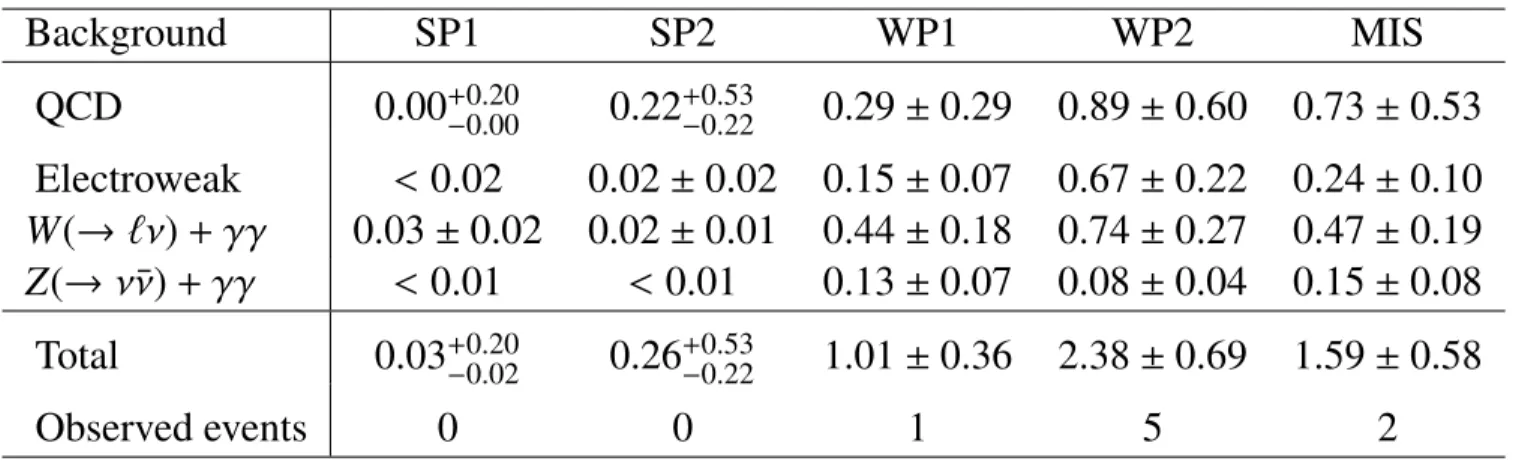
0 leptons + 2-6 jets + E Tmiss
• A “workhorse” SUSY analysis: quite universal in its reach
• Electrons and muons are vetoed to keep orthogonality. (Photons reject by jet quality cut.)
• Optimize in the m(g)-m(q) plane.
• squark pair production should produce at least two jets
• gluino pair production: at least four jets
• New in analysis: Signal regions with boosted Ws.
• Higher jet multiplicities covered in JHEP 10 (2013) 130.
3
arXiv:1405.7875 (submitted to JHEP)
Table 2. Selection criteria used to define each of the signal regions in the analysis. Each SR is labelled with the inclusive jet-multiplicity considered (‘2j’, ‘3j’ etc.) together with the degree of background rejection.
The latter is denoted by labels ‘l-’ (‘very loose’), ‘l’ (‘loose’), ‘m’ (‘medium’), ‘t’ (‘tight’) and ‘t+’ (‘very tight’). TheEmissT /meff(Nj) cut in anyNj-jet channel uses a value ofmeff constructed from only the leading Nj jets (meff(Nj)). However, the final meff(incl.) selection, which is used to define the signal regions, includes all jets withpT >40 GeV. In SR 2jW and SR 4jW a requirement 60 GeV< m(Wcand)<100 GeV is placed on the masses of candidate resolved or unresolved hadronically decaying W bosons, as described in the text.
Requirement Signal Region
2jl 2jm 2jt 2jW 3j 4jW
ETmiss[GeV] > 160
pT(j1) [GeV]> 130
pT(j2) [GeV]> 60
pT(j3) [GeV]> – 60 40
pT(j4) [GeV]> – 40
∆φ(jet1,2,(3),EmissT )min > 0.4
∆φ(jeti>3,EmissT )min > – 0.2
W candidates – 2(W →j) – (W →j) + (W →jj)
ETmiss/√
HT [GeV1/2]> 8 15 –
ETmiss/meff(Nj) > – 0.25 0.3 0.35
meff(incl.) [GeV] > 800 1200 1600 1800 2200 1100
Requirement Signal Region
4jl- 4jl 4jm 4jt 5j 6jl 6jm 6jt 6jt+
ETmiss[GeV] > 160
pT(j1) [GeV]> 130
pT(j2) [GeV]> 60
pT(j3) [GeV]> 60
pT(j4) [GeV]> 60
pT(j5) [GeV]> – 60
pT(j6) [GeV]> – 60
∆φ(jet1,2,(3),EmissT )min > 0.4
∆φ(jeti>3,EmissT )min > 0.2 ETmiss/√
HT [GeV1/2]> 10 –
ETmiss/meff(Nj) > – 0.4 0.25 0.2 0.25 0.15
meff(incl.) [GeV] > 700 1000 1300 2200 1200 900 1200 1500 1700
– 7 –
~ ~
Recent
Jovan Mitrevski ICHEP - July 3, 2014
0 leptons + 2-6 jets + E Tmiss : Results
4
Number of events
1 10 102
103
104
105
Data 2012 SM Total Diboson Multijets W+jets Top Z+jets
=8TeV s
-1, L dt = 20.3 fb
∫
ATLAS
Signal Region
2jl 2jm 2jt 2jW 3j 4jl- 4jl 4jm 4jt 4jW 5j 6jl 6jm 6jt 6jt+
Data/Bkg
0.20 0.40.6 0.81 1.21.4 1.61.8
Gluino mass [GeV]
800 1000 1200 1400 1600 1800 2000 2200 2400
Squark mass [GeV]
800 1000 1200 1400 1600 1800 2000 2200 2400 2600 2800
Squark-gluino-neutralino model
=8 TeV s
-1, L dt = 20.3 fb
∫
0-lepton, 2-6jets ATLASexp) σ 1
± )=0 GeV Exp. limit (
1
χ0
m(∼
theory) σSUSY
1
± )=0 GeV Obs. limit (
1
χ0
m(∼
)=395 GeV Exp. limit
1
χ0
m(∼
)=395 GeV Obs. limit
1
χ0
m(∼
)=695 GeV Exp. limit
1
χ0
m(∼
)=695 GeV Obs. limit
1
χ0
m(∼
)=0 GeV Obs.
1
χ0
) m(∼ 7TeV (4.7fb-1
[GeV]
g~
m
400 600 800 1000 1200 1400
[GeV]0 1χ∼m
0 200 400 600 800 1000 1200 1400
0
χ1
q q ∼ g→ production; ~
~g
~g
=8 TeV s
-1, L dt = 20.3 fb
∫
0 leptons, 2-6 jets
ATLAS Observed limit (±1 σtheorySUSY)
exp) 1 σ Expected limit (±
, 7 TeV) Observed limit (4.7 fb-1
, 7 TeV) Expected limit (4.7 fb-1
No significant excess: extract limits
[GeV]
g~
m
400 600 800 1000 1200 1400
[GeV] t~m
200 300 400 500 600 700 800 900 1000
t forbidden
~t g→
~
) = 20 GeV
1
χ0
,∼
~t
∆m(
1, χ0
ct∼ t →
~t g→ production, ~ g~
- g~
=8 TeV s
-1, L dt = 20.3 fb
∫
0 leptons, 2-6 jetstheory) σSUSY
1
± Observed limit (
exp) σ 1
± Expected limit (
All limits at 95% CL
ATLAS
theory) σSUSY
1
± Observed limit (
exp) σ 1
± Expected limit (
[GeV]
~g
m
200 400 600 800 1000 1200 1400 1600 )0 1χ∼,g~ m(∆)/0 1χ∼, 1± χ∼m(∆x=
0 0.2 0.4 0.6 0.8 1 1.2 1.4
1
χ0
∼
1
χ0
∼ W±
W±
q q q q
1→ χ∼± 1
χ±
q∼ q q q
→ g~
~g Simplified model,
ATLAS
=8 TeV s
-1, L dt = 20.3 fb
∫
0-lepton, 2-6 jets
=60 [GeV]
0 χ1
m∼
, 7 TeV) Observed limit (4.7 fb-1
theory) σSUSY
±1 Observed limit (
exp) 1 σ Expected limit (±
x=1
[GeV]
q~
m
200 300 400 500 600 700 800 900 1000 1100 [GeV]0 1χ∼m
0 100 200 300 400 500 600 700
0
χ1
q ∼ q→ production; ~ q~
q~
=8 TeV s
-1, L dt = 20.3 fb
∫
0 leptons, 2-6 jets
allXsec_
ATLAS Observed limit (±1 σtheorySUSY)
exp) 1 σ Expected limit (±
, 7 TeV) Observed limit (4.7 fb-1
, 7 TeV) Expected limit (4.7 fb-1
q~ 1 non-degen.
’s
~q 8 degenerate
Jovan Mitrevski ICHEP - July 3, 2014
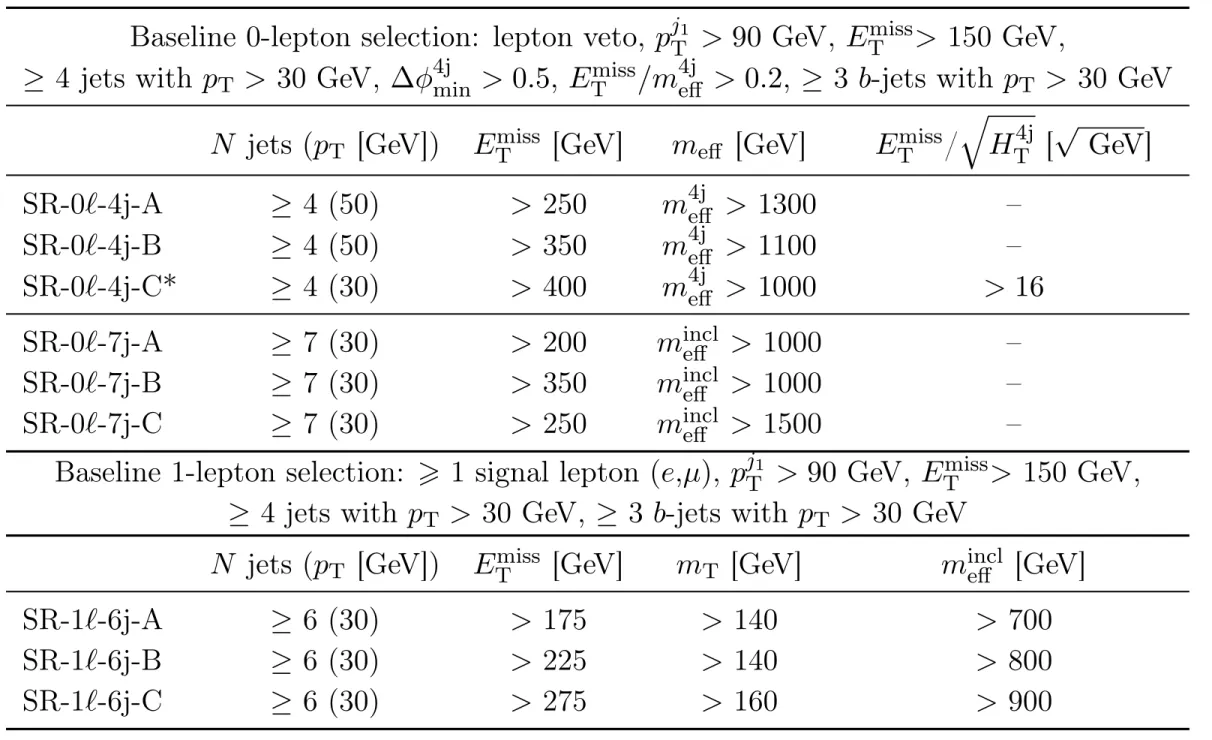
At least 3 b-jets + E Tmiss
• Motivated by naturalness: low mass stop and sbottom.
• Look at stops and sbottoms from gluino decay (incl. off-shell) and direct sbottom production
• Also interpret in mSUGRA/CMSSM scenario that accommodates the Higgs mass.
• Define three 0-lepton 4-jet, three 0-lepton 7- jet, and three 1-lepton (e/μ) 6-jet SRs
• Background dominated by tt+jets
• tt+jets with fake b-jets estimated with matrix method
• tt+b/bb estimated by fit to control region
5
New!
Notreviewed,forinternalcirculationonly
analyses carried out by the ATLAS [23,24] and CMS [25–28] collaborations with the same
74
integrated luminosity at a centre-of-mass energy of 8 TeV.
75
2 SUSY signals
76
In order to confront the experimental measurements with theoretical expectations, several
77
classes of simplified models withb-quarks in the final state are considered. Results from
78
the 0-lepton channel are used to explore all models considered, while the complementarity
79
between the searches in the 0- and 1-lepton channels is used to maximise the sensitivity to
80
models predicting top quarks in the decay chain.
81
In the first class of simplified models, the lightest stops and sbottoms are lighter than
82
the gluino, such that˜b1 and ˜t1 are produced either in pairs, or via gluino pair production
83
followed by˜g →˜b1b or g˜→t˜1t decays. The mass of the χ˜01 is set at 60 GeV consistently
84
for all models, shown in figure1.
85
(a)
(b) (c)
Figure 1. This figure shows the diagrams for the (a) direct–sbottom, (b) gluino–sbottom and (c) gluino–stop scenarios studied in this paper. The different decay modes are discussed in the text.
Direct–sbottom model
86
In this model, the ˜b1 is produced in pairs and is assumed to decay exclusively via
87
˜b1 → b+ ˜χ02. The slepton masses are set above a few TeV and only the configuration
88
mχ˜0 2 > mχ˜0
1+mh with a branching ratio forχ˜02→h+ ˜χ01 of 100% is considered. The mass
89
– 3 –
- -
- -
H ˜
t ˜
L˜ b
L˜ t
R˜ g
natural SUSY decoupled SUSY
W ˜
B ˜
L ˜
i, e ˜
i˜ b
RQ˜1,2,u˜1,2,d˜1,2
FIG. 1: Natural electroweak symmetry breaking constrains the superpartners on the left to be light. Meanwhile, the superpartners on the right can be heavy, M 1 TeV, without spoiling naturalness. In this paper, we focus on determining how the LHC data constrains the masses of the superpartners on the left.
the main points, necessary for the discussions of the following sections. In doing so, we will try to keep the discussion as general as possible, without committing to the specific Higgs potential of the MSSM. We do specialize the discussion to 4D theories because some aspects of fine tuning can be modified in higher dimensional setups.
In a natural theory of EWSB the various contributions to the quadratic terms of the Higgs potential should be comparable in size and of the order of the electroweak scale v ⇠ 246 GeV.
The relevant terms are actually those determining the curvature of the potential in the direction of the Higgs vacuum expectation value. Therefore the discussion of naturalness
7
arXiv:1110.6926
arXiv:1407.0600 (submitted to JHEP)
Jovan Mitrevski ICHEP - July 3, 2014
At least 3 b-jets + E Tmiss : Results
6
[GeV]
4j
meff
400 600 800 1000 1200 1400 1600 1800
Events / 100 GeV
0 2 4 6 8 10 12 14 16 18 20
22 Data 2012
SM total
Reducible bkg (MM) (MC)
b +b/b t t
+Z/h (MC) t
t
= 1100,100 GeV
0
χ1
,m∼ g~
Gtt: m
= 1100,100 GeV
0
χ1
,m∼ g~
Gbb: m
= 8 TeV s
-1, = 20.1 fb Lint
SR-0l-4j-A
ATLAS
) [GeV]
b1
m(~
200 300 400 500 600 700 800 900 1000
) [GeV]0 2χ∼m(
200 300 400 500 600 700 800 900 1000 1100
0
χ2
b+∼
1→ b~ production, b1
-~ b1
~
) = 60 GeV
0
χ1
m( ∼
0
χ1
h + ∼
0 → χ2
∼
)
0
χ2
∼
) < m(b) + m(
b1
~ m(
=8 TeV s
-1, = 20.1 fb Lint
0 lepton + 3 b-jets channel
All limits at 95% CL
ATLAS Expected limit ±1 σexp theory
σSUSY
± 1 Observed limit
) [GeV]
~g m(
700 800 900 1000 1100 1200 1300 1400 1500
) [GeV] 1t~ m(
400 600 800 1000 1200 1400 1600
=7+8 TeV
1 s
~t t1
ATLAS ~
0
χ1
t+∼
1→
~t production,
~g - g~
) = 60 GeV
0
χ1
m( ∼
)
~g ) >> m(
q1,2
m( ~
1)
~t ) < m(t) + m(
~g m(
=8 TeV s
-1, = 20.1 fb Lint
0 and 1 lepton + 3 b-jets channels
All limits at 95% CL
ATLAS Expected limit ±1 σexp
theory
σSUSY
± 1 Observed limit
) [GeV]
~g m(
400 600 800 1000 1200 1400
) [GeV]0 1χ∼m(
100 200 300 400 500 600 700 800 900 1000 1100
)
±
χ1
∼
) < m(b) + m(t) + m(
~g m(
)
~g ) >> m(
q~
±, m(
χ1
+∼ t
→ b g~ production,
~g
~g Lint = 20.1 fb-1, s=8 TeV
0 and 1 lepton + 3 b-jets channels ) = 2 GeV
0
χ1
) - m( ∼
±
χ1
m( ∼
±
χ∼1
ff’ +
±→ χ1
∼ All limits at 95% CL
ATLAS
σexp
±1 Expected limit
theory
σSUSY
± 1 Observed limit
Jovan Mitrevski ICHEP - July 3, 2014
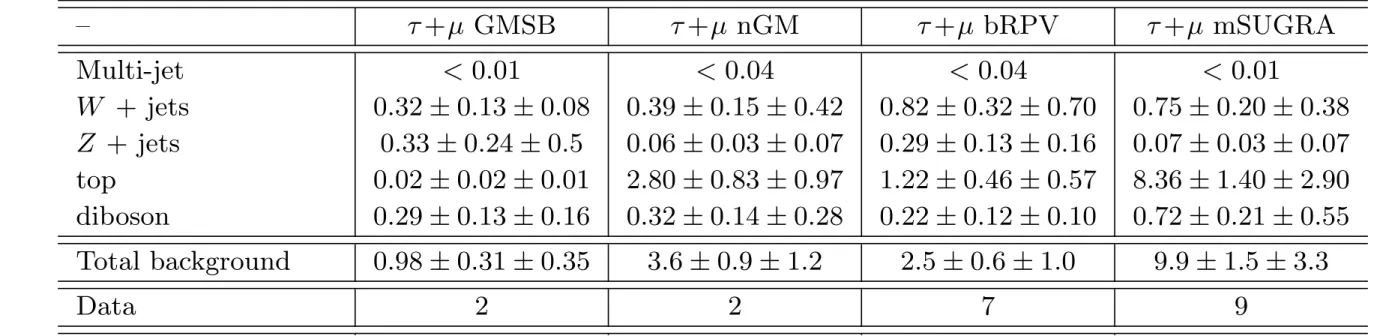
At least one (hadronic) tau + E Tmiss
• Taus are sensitive to a number of scenarios:
• GMSB: studied in both the minimal model (MGM) and in the General Gauge Mediation (GGM) framework: natural Gauge Mediation (nGM).
• mSUGRA/CMSSM: at the co-annihilation point, staus and the LSP have similar mass, resulting in a low p T tau.
• bRPV: modification of the mSUGRA/CMSSM point above.
• Four topologies studied:
• 1τ: exactly 1 tau p T > 30 GeV
• 2τ: two or more taus p T > 20 GeV
• τ + e/μ: one or more taus (p T > 20 GeV) and one exactly one e/μ
• 1τ and 2τ have the following “trigger cuts”: at least two jets with p T > 130 (30) GeV, and E T miss > 150 GeV. τ + ℓ require a lepton p T > 25 GeV.
• Other selections on E T miss , H T , m eff , N jet , and/or Δφ(jet/τ, E T miss )
7
New! arXiv:1407.0603 (submitted to JHEP)
[GeV]
m0
400 600 800 1000 1200 1400 1600 1800 2000 2200 2400 [GeV]1/2m
200 300 400 500 600 700 800
>0
=30, µ , tanβ
=-2m0
Bilinear RPV Model, A0
ATLAS
=8 TeV, 20.3 fb-1
s
Combined Exclusion
theory) σSUSY
1
± Observed limit (
exp) 1 σ Expected limit (± All Limits at 95% CL
[TeV]
Λ
40 50 60 70 80 90 100
βtan
10 20 30 40 50
grav=1
>0, C µ
5=3,
=250 TeV, N GMSB: Mmess
Theory excl.
(1000 GeV)g~ (1200 GeV)g~ (1400 GeV)g~ (1600 GeV)g~ (1800 GeV)g~ (2000 GeV)g~
Theory excl.
ATLAS
=8 TeV, 20.3 fb-1
s
Combined Exclusion
theory) σSUSY
1
± Observed limit (
exp) 1 σ Expected limit (± (different spectrum generator) Combined 7 TeV Exclusion
1) τ∼
OPAL 95% CL ( All Limits at 95% CL
[GeV]
mτ∼
120 140 160 180 200 220 240 260 280 300 320 [GeV] g~m
400 500 600 700 800<