Consultor externo especializado en la aplicación del método del marco lógico y participa en la evaluación de campañas de sanidad vegetal (Huanglongbing, cochinilla rosada, plaga cuarentenaria del aguacate, mosca de la fruta). Representante adjunto de SAGARPA en las reuniones del Fideicomiso del Fondo Nacional de Desarrollo Ejidal (FIFONAFE), perteneciente a la Secretaría de la Reforma Agraria (SRA).
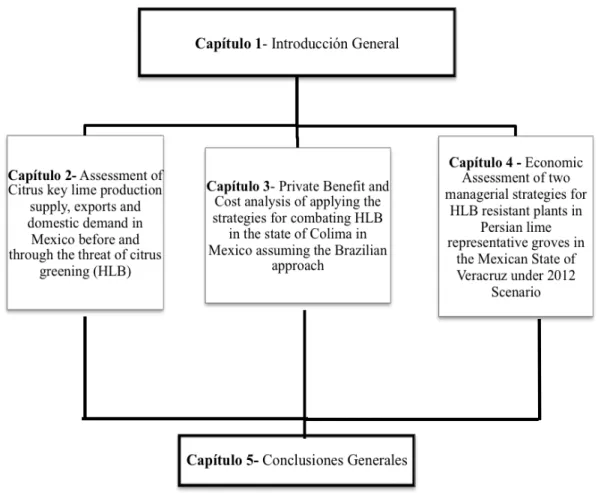
- Introducción general
- Planteamiento del problema
- Justificación de la investigación
- Marco teórico
- Objetivos de la investigación
- Preguntas de investigación e hipótesis
- Contenido de la tesis
Cuantificar el costo-beneficio de la estrategia de tres componentes utilizada en Brasil para el control del HLB, en la producción de limón mexicano en Colima. En este trabajo se evalúa la viabilidad económica (financiera, financiera y de flujo de caja) de dos estrategias de manejo de Huanglongbing (HLB), en Unidades Representativas de Producción (URP) de limón persa, en el municipio de Martínez de la Torre, Veracruz.

Assessment of Citrus key lime production supply, exports and domestic
Introduction
The main objective is to identify relationships between explanatory variables through a simultaneous comparison model for the Mexican citrus key lime supply and demand considering the domestic and US market, such as production, prices, exports, exchange rate and consumption from 2000 to 2012. To to get everything done, at the end of this first section a main objective is stated which aims to identify relationships between explanatory variables through a simultaneous comparison model for the Mexican citrus key lime supply and demand, taking into account the local and US market as production, prices, exports, exchange rate and consumption from 2000 to 2012.
Data and methodology
Plmt-1= Lagged real Mexican key lime price in the domestic central distribution markets in real value at present ($/kg). In the supply equation, a direct relationship between Mexican key lime supply and price was expected. Plm = Real Mexican key lime price in the central distribution markets in real value at the present time ($/kg) at the present time.
Plm t = Key lime price ($/kg) in real terms in the current period in the local market. Plm t = Key lime price ($/kg) in real terms in the current period in the US market. Coefficients β and γ represent estimated parameters, while ω represents the error term either in the demand or the supply side of the model.

Findings
Source: Elaboration using the SAS output. the results of estimating the simultaneous equations model are shown. Nevertheless small discrepancies found in the estimation of the model, the supply function shows a relevant price behavior in the current period and correlated with exchange rate. There is no multicollinearity corrective treatment because all the selected variables are essential for building the model.
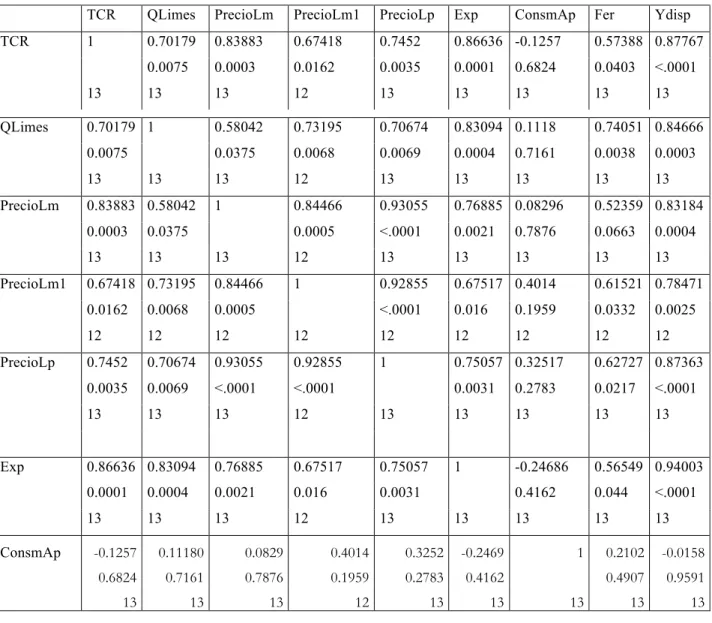
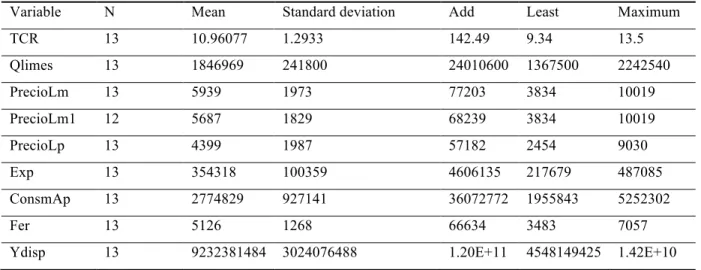
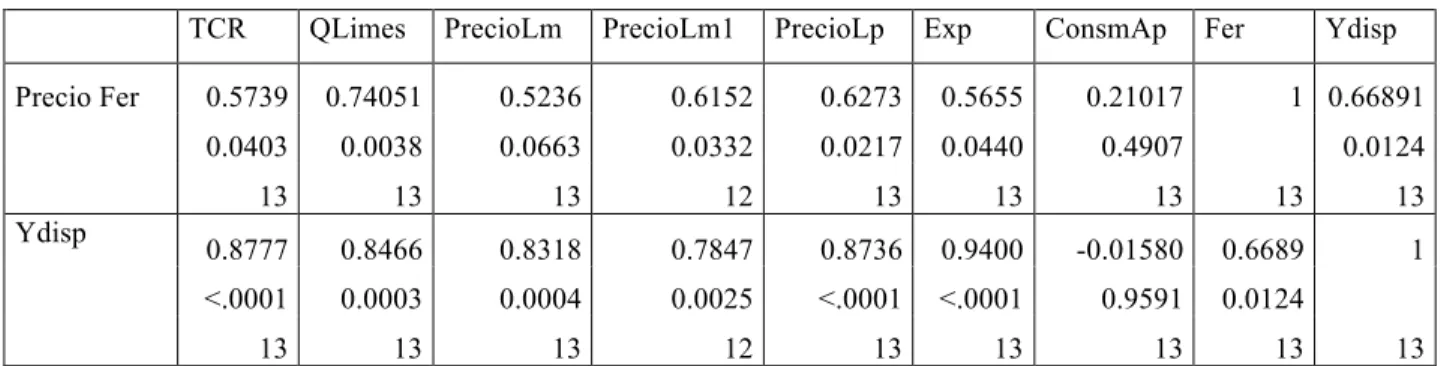
This means that the size of the residue for one case has no effect on the size of the residue for the next case. In this case, the demand equation is affected by multicollinearity (Appendix 1) due to the low statistical significance of its explanatory variables. Given disposable income, lime behaves as a common good as a meat flavor enhancer for the Mexican consumer and also for the consumer seeking citrus lime in the United States.
Conclusions
The result shows that the price of Mexican citrus lime is inversely proportional to the demand equation and that the price of Persian lime behaves as a substitute good. The expected signs on the variables were obtained for the Mexican lime price, the exchange rate, and for the lagged price according to these equations. Finally, it was found that the quantity demanded of Mexican lime was mainly influenced by the market price of key lime, the price of Persian lime and disposable income.
The results showed that the price of Mexican citrus lime is inversely proportional to supply and demand. In terms of disposable income, Key Lime behaved as a normal good as a meat flavor enhancer for Mexican consumer tastes and also as a substitute for US consumers looking for citrus Key Lime. Therefore, we have been unable to reject the hypothesis that key lime producers are sensitive to fluctuations in the price of key lime and fertilizer.
Determining the Economic "Tipping Point" in Citrus Greening Management: Follow Standard Protocol or Switch to an Enhanced Foliar Nutrition Program 18th Methven International Farm Management Congress, Canterbury, New Zealand. SENASICA-SAGARPA campaign against HLB accessed October 2012 -Campaña contra el Huanglongbing de los Cítricos- Consultado October 2, 2012. URL:
SNIIM 2012 – Nailian a Beaureu iti Panagkaykaysa ti Merkado ken Impormasion- ti Sekretario ti Ekonomia Dagiti presio ti lemon a Mehikano ket nakonsulta idi Oktubre 2012. Umuna a report ti kasla Huanglongbing a sakit ti sitrus idiay Estado ti Sao Paulo, Brasil, ken panagtipon ti baro a kita ti Liberibacter, ' . Candidatus Liberibacter americanus’, nga addaan iti sakit. Pribado a benepisio ken panaganalisar ti gastos ti pannakayaplikar dagiti estratehia para iti pananglaban iti HLB iti estado ti Colima, Mexico, no panunoten ti pamay-an ti Brazil.
Private Benefit and Cost analysis of applying the strategies for combating
- Introduction
- Methodology and Data
- Results
- Conclusions
- References
After a century of the appearance of HLB (Greening) in the world, it has been qualified as the most serious disease that has ever occurred in citrus orchards due to its consequences (Bové, 2006). The Benefit Cost Analysis evaluates the differences between scenarios of different levels of application of the Bové approach. With the sum of the present values of benefits and costs, it becomes possible to calculate the benefit-cost ratio.
Therefore, the yield of citrus trees will behave in a similar way to a scenario without the presence of the disease. Over time, however, the orchard regains profits based on reductions in the rate of spread of the disease. Benefits from cooperation are seen as the success in controlling the vector population and consequently the spread of the disease.

Economic Assessment of two managerial strategies for HLB resistant plants
Introduction
Persian lime has gained market share due to the opening of domestic markets due to trade promotion, According to the Mexican Ministry of Agriculture (SAGARPA 2013) Persian lime prices increased 10% from 2010 to 2012. It is also considered an attractive business choice by the decision maker has entered the production and commercialization businesses because Persian lime created an agricultural GDP of 2,227 million pesos. Richardson et al also collaborated with the Mexican Ministry of Agriculture to create the first attempt at building representative farms in order to provide decision makers with an unbiased and objective economic analysis of the impacts of policy alternatives.
In addition to the death of the tree during the process of vascular system blockage, the yield gradually decreases. Citrus growers in the US have forced researchers to think of a solution due to the dramatic increase of diseased trees in Florida, California and Texas. The Mexican state of Veracruz is the main producer of the Persian lime and so far in May 2014 there has been no official report from the Food Safety and Agricultural Food Quality Service (SENASICA) on citrus contaminated with HLB.
Methodology
The floor price is the price necessary to cover all costs determined according to financial accounting standards (taxation and financial statement reporting). It means zero return on operator/family labor, management and equity. Therefore, the floor prices are those required to cover ECC, FINC and FNE under different production scenarios and they are calculated by dividing the total TC cost by the potential yields under optimistic, pessimistic and most likely conditions. These prices are intended to cover the financial, economic and net cash flow cost of production for each URP.
If PCVD>, then URP will be able to cover the withdrawal of variable costs, if <, URP will not be able to cover the withdrawal of variable costs. If >, then the URP will be able to pay the withdrawal of the total costs of the unit; if .. lt;, the URP will not be able to cover the withdrawal of the total costs of the unit. If <, the URP will not be able to cover the total financial cost in order of liquidity. e) Price required to cover all cash payments, fixed costs without withdrawals, family and producer labor without wages, administration and contribution to net capital investments (net working capital, land, infrastructure, machinery and equipment) ( Q5).
Results and Discussion
It is considered an average technical level due to the use of fertilizers, pesticides and frequent cuttings during the year. This concept is not considered part of the net cash flow costs, it is only part of the economic and financial costs of production. In the case of "other costs" the main cost is the one attributed to the manufacturer's withdrawals; they are up to 20,800 pesos per year (Table IV.5).
It is required to invest in the same herbicides, irrigation systems, phytosanitary controls in just the same way as the rest of the orchard in original conditions. VRLP3.5V has higher production costs due to the acquisition of the vaccine and the hiring of the workers trained to apply the vaccine to the tree. As a result, Net income is reduced due to the increase in production costs and the decrease in yield.

Conclusions
The investment increases costs due to obtaining the vaccine and the labor required to apply it in each tree. The vaccine stimulates the tree's immune system so it is expected that the tree will recover in about a year. A good public policy could be to encourage the vaccine treatment through a subsidy program where the producers keep the productive trees but only receive the vaccine for the first year to make them aware of the benefits of the treatment and to realize that once they have healthier trees and restored yields, the treatment pays for itself.
After considering all the above, it is recommended to establish clear priorities and apply treatments to keep the export market to guarantee good economic conditions. Martinez de la Torre municipality is the Persian lime most productive region in the Mexico. It contributes with more brown of 60% of the produced volume, therefore the results in this paper withstand representative production conditions and the feasibility of the scenarios will most likely take place under the given agronomic and phytosanitary assumptions and under the economic conditions during 2012 .
Conclusiones Generales
Literatura Citada General