Inspection of the Eurozone, the Schengen Agreement and the European Union itself suggests the mixed performance of these 'country clubs'. In the existing institutional setup, economic convergence depends mostly on the policies of the member states.
Macroeconomic Conditions and Outlook
INTRODUCTION
CURRENT SITUATION .1 Global Economy
- United States
- Asia
- Latin America and Russia
- Europe Cyclical Situation
Until then, annual GDP growth rates averaged less than 2% since the end of the recession in the second quarter of 2013. Both effects also explain the stagnation of transport investment in the second half of the year.
FISCAL AND MONETARY POLICY .1 Fiscal Policy
- Monetary Conditions and Financial Markets
At the same time, the spread between the United States and the rest of the world would increase. In the aftermath of both the Great Recession and the Euro crisis, the Eurozone economies were clearly underutilized until recently.
MACROECONOMIC OUTLOOK
- Assumptions, Risks, and Uncertainties The forecast is based on the assumption that a barrel
- Global Economy
- United States
- Asia
- Latin America and Russia
- Europe Cyclical Situation
Overall, the world's gross economic output is projected to grow by 3.2% this year. In light of the continued buoyant economy, consumer prices are expected to rise by 1.9% this year.
Forecasting Tables
- INTRODUCTION
- HISTORY
The modern international system is constructed on the principle of the sovereign nation-state whose citizens have taken their destiny into their own hands. But to what extent is that element of coordination compatible with the philosophy of the nation-state, and the choices made by citizens in the national context. There is the United Nations Organization, built on lessons learned from the experience of the League of Nations.
The European Union is also built on the same principle, giving micro-states such as Cyprus, Luxembourg and Malta a formally equivalent voice to France, Germany or Italy in many institutional settings (including the European Central Bank, ECB). Trust between people (individuals) of different nationalities affects social cohesion within Europe and ultimately the formation of an ambiguous and blurred European identity as part of multidimensionality. Mutual trust has also developed as a key legal concept in Europe with a common judicial area known as the Area of Freedom, Security and Justice created by the 1997 Treaty of Amsterdam, which committed member states to mutual recognition, in with other in other words, fully recognize court decisions made in other jurisdictions in the European Union.
In the words of the famous Elvis Presley song: “We can't go on together / With.
Building Trust between Suspicious Minds
- REFORM INITIATIVES AND INTERNATIONAL ORDER
- TRUST AMONG EUROPEANS
- The Impact of Trust on International Trade and Economic Integration
- Trust in Relationships between States
- COORDINATION
- ATTITUDES TOWARDS A MULTI-LEVELLED EUROPEAN
- THE ENLARGEMENT PROCESS
- INTRODUCTION
Smaller nation states in Europe developed a strong sense of identity in the face of challenges from imperial systems. If this argument holds, then the affirmation of the rule of freedom of movement of people, which is codified in the Four Freedoms, is certainly important. This was important in Kohl leading the reunification of Germany and the creation of the European Union.
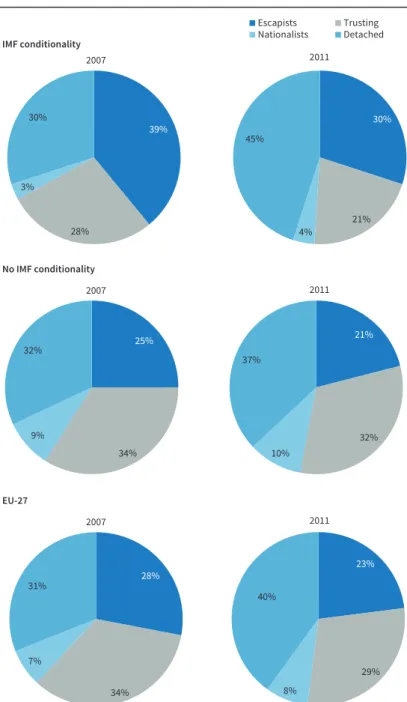
At the same time, the number of people who put their full trust in the European Union fell from 39 to 30%. Percentage of people expressing trust in the European Union in 2007 versus the difference in that trust between 2011 and 2007. We conclude this introduction with a brief commentary on the trade-offs inherent in the European enlargement process.
Bonet (2011), “Institutional trust and multi-level governance in the European Union: congruence or compensation?”, Politics of the European Union.
All Together Now
Originally conceived after the Second World War and evolving into the European Union, the project is not just a collection of intergovernmental treaties and agencies. This very special entity is supposed to take over some of the roles and special rights of all governments along the path of "ever closer union". In the past, such exemptions mostly concerned the UK and a few other countries.
But the idea of explicitly relaxing that rule has often been voiced, especially after the fall of the Berlin Wall and in the run-up to the introduction of the single euro currency. The euro crisis, Brexit and global geo-political trends now make it interesting to review the issue of whether European states may only subscribe to some of the rights and obligations of membership. Like a magician inviting the audience to choose any card, but "Scenario 3: Those who want to do more, do more" in the middle of the deck of five does suggest that it is not the least likely to be the most attractive don't be
We discuss these and other issues in the light of experience and of the theoretical insights and practical analogies associated with considering the European Union and possible subunits within it as "clubs" of countries.
The European Union and the Country Clubs
- GOVERNMENTS AND CLUBS
- What Governments Do and Where
- Club Goods
- Good and Bad Clubs
- COUNTRIES AND CLUBS
- Clubs within States
- Country Clubs in Europe
- The European Union as a Club
- SPEEDS OF EUROPE
- Opt-outs
- Enhanced Cooperation and PESCO
- GEOMETRY VARIATION IN THE PAST
- The Currency Club
- The Borderless Club Geography is a strong determinant
- PATHS FORWARD
- Integration Needs and Ways
- Smaller Clubs
- Defence Anybody?
- A Better and maybe Smaller Club
- INTRODUCTION
They were decided at a European Council meeting in Copenhagen in 1993, when enlargement (and possibly multi-speed) was looming. Denmark and the United Kingdom have formally opted out of the introduction of the euro. However, both potential members and club managers do have a say in the introduction of the euro.
It would be nice if it were easy to see the outline of the Eurozone (or even the European Union) in Figures 3.5 and 3.6. In other respects, the operation of the Schengen club is also similar to the operation of the euro area. Moreover, as in the case of the Eurozone, the crisis has not only weakened the cohesion of the club, but also prompted a review of its operations.
In the debate on the economic and political development of the European Union, the perception of growing economic divergence plays a key role.

It’s OK to Be Different
Article 174 of the Treaty on the Functioning of the European Union states: “The Union shall endeavor to reduce the disparities between the levels of development of different regions and the backwardness of the least favored regions” (European Union, 2012). There is a widespread view that economic convergence between EU Member States made progress until 2008, but that this divergence appears to have prevailed since the outbreak of the global financial crisis and the eurozone debt crisis. There are concerns that these developments could lead to an erosion of what is often called the European model of the welfare state or the 'social market economy', namely an economic system in which government intervention ensures a high level of social protection and limited inequality. .
The convergence issue is also discussed in the context of how the gains from economic integration are distributed. Whether or not convergence is achieved can also have an impact on trust in European and national political actors as well as institutions and political support for maintaining or deepening economic and political integration in the European Union. The usual starting point for debates about convergence is income per capita, which would be an outcome variable.
Are certain forms of convergence related to certain European projects such as the European internal market or the Economic and Monetary Union (EMU).
Policy Coordination and Economic Convergence
- WHAT IS CONVERGENCE?
- OUTCOME CONVERGENCE IN THE EUROPEAN UNION
- CONVERGENCE OF PER CAPITA INCOMES ACROSS EU MEMBER STATES
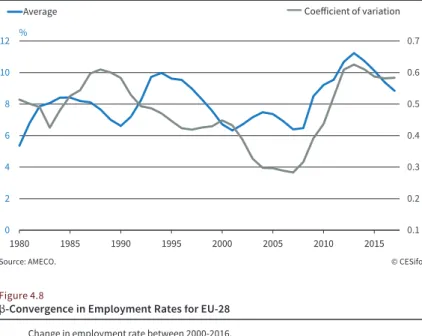
- LABOUR MARKET CONVERGENCE
- INEQUALITY
- CONVERGENCE IN POLICIES AND INSTITUTIONS
- CONVERGENCE IN PUBLIC SECTOR SIZE AND TAX STRUCTURES
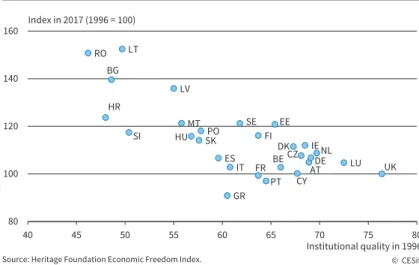
- CONVERGENCE IN INSTITUTIONAL QUALITY In this section we consider convergence in indicators
- ECONOMIC CONVERGENCE IN THE EUROPEAN UNION: WHERE DO WE STAND?
- WHAT DOES THE EUROPEAN UNION DO TO SUPPORT ECONOMIC CONVERGENCE?
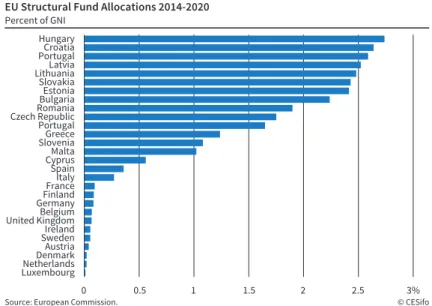
- THE EU BUDGET
- HOW SUCCESSFUL IS THE EU’S COHESION POLICY?
- THE EUROPEAN SEMESTER
- THE EUROPEAN SOCIAL PILLAR
- CONCLUSIONS AND POLICY RECOMMENDATIONS
In a breakdown of the EU-28, Darvas (2016) shows that the increase in average income (income convergence) contributed to the reduction of inequality in the EU-28, while within-country inequality worked in the opposite direction. As in the case of other indicators, Eastern European member states are clearly catching up. In the European Union, economic convergence seems to have worked quite well, especially in relation to the rapprochement process of Eastern European countries, which joined the Union in 2004 and later.
This suggests that the factors causing economic differences between Southern Europe and the rest of the European Union are different. The fact that EU member states are reluctant to implement the recommendations made in the European Semester process does not necessarily mean that the process itself is flawed. The European Semester is a useful process, despite the fact that only a few recommendations are implemented.
In the debate about the lack of convergence in Europe, suggestions are often made to expand the role of the European Union in economic and social policy.
LISTS
He has published and edited several books, most recently Reform Capacity and Macroeconomic Performance in the Nordic Countries, edited by U.
THE MEMBERS OF THE EUROPEAN ECONOMIC ADVISORY GROUP
Most of his research has been on macroeconomics, labor economics and the economics of the welfare state. He is also a visiting professor at Birkbeck College, University of London and a fellow at the Center for Economic Policy Research. Since 2003, Clemens Fuest has been a member of the academic advisory board of the German Federal Ministry of Finance (head of the board from 2007 to 2010).
In addition, Clemens Fuest is a member of the Board of the International Institute for Public Finance (IIPF; Vice President since 2014) and a member of the Minimum Wage Committee of the Federal Republic of Germany and the "High Level Group on Own Resources" (Monti- Commission) of the European Union. Before being appointed ifo President in April 2016, Clemens Fuest was President of the Center for European Economic Research (ZEW) in Mannheim and Professor of Economics at the University of Mannheim. From 2008 to 2013 he was Professor of Business Taxation and Research Director of the Center for Business Taxation at the University of Oxford.
Since 2001 he has been a member of the CESIfo Research Network and since 2003 a Research Professor at the ifo Institute.
PREVIOUS REPORTS
The EEAG Report on the European Economy 2017: Economics of Populism
The EEAG Report on the European Economy 2016: What next?
The EEAG Report on the European Economy 2015: Blurring the Borders
The EEAG Report on the European Economy 2014: The Road towards Cohesion
The EEAG Report on the European Economy 2013: Rebalancing Europe
The EEAG Report on the European Economy 2012: The Euro Crisis
The EEAG Report on the European Economy 2011: Governing Europe
The EEAG Report on the European Economy 2010: Exiting the Crisis
The EEAG Report on the European Economy 2009
The EEAG Report on the European Economy 2008: Europe in a Globalised World
The EEAG Report on the European Economy 2007
The EEAG Report on the European Economy 2006
The EEAG Report on the European Economy 2005
The EEAG Report on the European Economy 2004
The EEAG Report on the European Economy 2003
The EEAG Report on the European Economy 2002
Yale-NUS College, National University of Singapore; and Birkbeck College, University of London Visiting Professor of Social Sciences at Yale-NUS College, National University of Singapore and Visiting Professor at Birkbeck College, University of London. Professor of History and International Affairs, Claude and Lore Kelly Professor of European Studies, and Director of the Program in Contemporary European Studies at Princeton University. President of the Center for International Research on Economic Trend Surveys (CIRET) and editor of the European Journal of Political Economy.
Professor of Finance and Operations Research and Director of the International Master's Program in Quantitative Finance (IMQF) at the University of Belgrade. Professor of Economics and Public Finance at LMU Munich, President of the ifo Institute, Director of the Center for Economic Studies and CEO of CESifo GmbH.