Trabajo Fin de Grado
Grado en Fisioterapia
Ergonomics and videogames: Habits, diseases and health perception of
gamers
Ergonomía y videojuegos: Hábitos,
dolencias y percepción de salud de los jugadores
Christian Esteban Martín Luján
Curso 2014/2015 - Junio
Trabajo Fin de Grado
Grado en Fisioterapia
Ergonomics and videogames: Habits, diseases and health perception of
gamers
Ergonomía y videojuegos: Hábitos,
dolencias y percepción de salud de los jugadores
Christian Esteban Martín Luján
Curso 2014/2015 - Junio
Grado en Fisioterapia Asignatura: Trabajo de fin de Grado
Centro: Facultad de Ciencias de la Salud – Sección de Enfermería y Fisioterapia
Titulación: Grado en Fisioterapia
DATOS ALUMNO/A:
Apellidos Martín Luján Nombre Christian Esteban
DNI / Pasaporte 79060588 C Dirección Calle Icerse, 94 C.Postal
38530 Localidad Candelaria Provincia Santa Cruz de Tenerife Teléfono 639626929 E-mail [email protected]
TÍTULO DE TRABAJO DE FIN DE GRADO:
Ergonomics and videogames: Habits, diseases and health perception of gamers.
LOS/LAS TUTORES
Apellidos: Delgado Rodríguez Nombre: Naira
Apellidos:……….. Nombre………
AUTORIZACIÓN DEL /DE LOS TUTOR/ES
D/Da Naira Delgado Rodríguez profesor/a del Departamento
De Psicología Cognitiva, Social y Organizacional dela Facultad Ciencias de la Salud (Sección Psicología) del campus de Guajara
………...
AUTORIZA a D/Da Christian Esteban Martín Luján a presentar la propuesta de TRABAJO FIN DE GRADO, que será defendida en JUNIO
San Cristóbal de La Laguna, 3 de junio de 2015.
LOS TUTORES
Fdo.: D/Da Naira Delgado Rodríguez
SR. PRESIDENTE DEL TRIBUNAL DE EVALUACIÓN
Abstract
Introduction: The health of computer users has been studied mostly from the office or leisure perspective. However, a new wave of computer usage has emerged, creating videogames into a sport, where the environmental variables as well as motivational factors change. For that reason, it is important to study habits and pain perception of gamers. Objectives: This study tries to determine which variables are the most important for this group of users and which body zones are more affected for playing habits. Methods: A cross-sectional study based on a survey was carried out, including questions about playing habits, injuries and health perception of participants. Results: Results showed that computer is the preferred device, specially the desktop one. Play Station is the most used console. Most of the subjects play every day from 1 to 4 hours. Back and neck problems were higher than others. Most of the subjects consider their health situation as normal. Female subjects suffer more from head and shoulder pains than men players. Those who don’t practice exercise suffer more from shoulder pain that active players feel. When visual support is needed, headache is more common. Neck pain is important in armchair/sofa players and wrist is more common for chair players. Conclusions: This study sets the ground for a more extended research to come in the gaming community. Many facts have been straightened so that we can start to understand the habits and ailments of the gamers.
Key words: Ergonomics, Physiotherapy, Videogames, Postural Hygiene, eSports.
Introducción: La salud de los usuarios de ordenador se ha estudiado desde la perspectiva de la oficina u ocio. Pero la creación de un deporte basado en videojuegos cambia las variables ambientales y los factores motivacionales. Por esa razón, es importante estudiar los hábitos y percepción del dolor de los jugadores.
Objetivos: Este estudio determina qué variables son las más importantes para los jugadores y qué zonas del cuerpo son las más afectadas por sus hábitos. Métodos:
Es un estudio transversal basado en una encuesta llevada a cabo incluyendo preguntas sobre hábitos de juego, las lesiones y la percepción de salud de los participantes. Resultados: Los resultados mostraron que el ordenador es el dispositivo preferido, especialmente el de mesa. Play Station es la consola más utilizada. La mayoría de los sujetos juegan todos los días de 1 a 4 horas. Los problemas de espalda y cuello son los más comunes. La mayoría de los participantes consideran que su estado de salud es normal. Las mujeres sufren más dolores de cabeza y hombros que los hombres. Los sedentarios sufren más de dolor en el hombro que los jugadores activos físicamente. Cuando se necesita apoyo visual, el dolor de cabeza es más común. El dolor de cuello y de muñeca son más comunes jugando en sillón/sofá que en una silla. Conclusiones: Este estudio establece las bases para una investigación más extensa entre los jugadores. Se ha encaminado para que podamos empezar a comprender los hábitos y las dolencias de los jugadores.
Palabras Clave: Ergonomía, Fisioterapia, Videojuegos, Higiene Postural, eSports.
Contents
1. Introduction ... 1
2. Objectives and hypothesis ... 5
2.1 Objectives ... 5
2.2 Hypothesis ... 5
3. Methods ... 6
3.1 Participants ... 6
3.2 Materials ... 6
3.3 Design and Procedure ... 7
3.4 Data Analysis ... 7
4. Results ... 8
4.1 Playing Habits ... 8
4.2 Injuries and health perception ... 9
4.3 Comparisons between groups ... 11
5. Discussion ... 16
5.1 Hypothesis achievement and unexpected results. ... 17
5.2 Main affected areas differentiating by gamer’s characteristics ... 18
5.3 Utility ... 20
5.4 Limitations and future studies ... 21
6. Conclusions ... 22
7. References ... 23
8. Graphics ... 26
9. Appendix ... 27
1 1.
Introduction
Ergonomics has been traditionally described as the study of equipment design for the workplace. Nowadays, this term has been expanded to all those situations where artifacts are design for people to a general use.
There are different kinds of ergonomics. The most known is the physical ergonomics, where mostly posture is involved. This means that every environmental part of the workstation has to be design to help the posture be as natural and healthy as possible, even if people are sitting or standing. There are other kinds of ergonomics, such as the psychological o cognitive ergonomics, which takes care of the stimulus the people receive from their environment, the interaction with their co- workers, the complexity of decisions to take, etc1.
Since computers are mostly seen as working accessory or an amusement tool, lots of papers have been written about how ergonomics can help in the office or ordinary life. Back pain has been the most studied problem because of its’ high relevance concerning the posture while using the computer.
Most researchers have based their studies in different aspects of posture hygiene, which came to conclusions such as how vibrations in the low back could help on long sitting situations, where back support and hand support were found to be important factors due to the posture2.
Other studies have focused on the action of constant rotatory movements in the low back on the chair, which demonstrated to be promising, not being disturbing for the labor and reducing the low back pain3.
It has also been studied how a proper support on the pelvic area helps long sitting patients, which confirmed a decrease of lumbar flattening by using a pillow as lumbar support4.
How the hamstring is related to low back pain in computer-related workers has been researched, where prolonged sitting was found to change the normal pattern of the hamstring muscle activity5.
There is a paper on how the low back responds to different chairs and positions that states that Balance® Multi-Chair draws a more natural lumbar curvature and causes less lumbar flexion. The chair with a forward-tilted seat for a thigh-trunk angle of about 120 degrees to preserve the normal lumbar lordosis it has been found that causes less lumbar flexion in subjects writing at a desk. This seat is believed to be an appropriate adjunct to patient care when less flexion or slight extension of the lumbar spine is indicated in the sitting position6.
It has also been looked into whether reclining a chair really helps with the different curves of the body (cervical, dorsal, lumbar). It has been verified that all intervertebral discs move relative to one another after a change in seating posture. Although the positions in this particular article were defined by the shape of the backrest, high inter-subject variability of the shape of the upper spinal segments has been observed for the sitting positions. Dynamic seating options are considered to play a key role in maintaining spinal health, especially in subjects with desk jobs7.
The upper extremity has also been found to be highly affected from the use of computers.
How different keyboards affect the upper limb has also been considered, and it has been concluded that specific designs for keyboards give a more natural posture8.
2 Even more related to computers, the relationship between mouse use and musculoskeletal symptoms, such as neck and wrist discomfort, has been investigated; finding that mouse use constitutes an additional risk factor for musculoskeletal symptoms, particularly related to the arm posture adopted9.
The risk computer-related jobs have over the forearm has also been considered, and it has been pointed out that mouse use is the biggest risk factor for forearm pain10.
Even though it is known that a huge part of the low back problems comes from prolonged sitting positions11, 12, it is interesting to know that this problems can come from other multiple factors, and not only for the prolonged sitting.11 Change in the pattern of shoulder and pelvic coordination is known to affect subjects with recurrent low back pain. It is believed that clinicians need to apply gender differences in kinematic strategies during trunk axial rotation to cope with underlying problems in subjects with recurrent low back pain13.
This question highlights the fact that the global exploration of the impact that computers have in the health of the population is still under-studied, and more factors such as keyboards, mice or controllers should be taken more in account for. To our knowledge, only an isolated research about how computers can affect the eye has been published, which clearly found a connection between computer use and eye damage14.
Returning to the matter of ergonomics, really few studies have been made about the importance of the application of this science to the subject of computer or console gaming. It has been pointed out that ergonomic consulting is beneficial with other techniques for the neck and the shoulder region, even though by itself is equally effective15. It has also been noted that an interaction between physiotherapists’
specialized in ergonomics and computer-related workers is very beneficial in decreasing discomfort and musculoskeletal strain and pain, even more than educating the workers in ergonomics16. Another point of view has been studied, focusing on the creation of an algorithm that can predict the joint movements17. This prediction can be used to reduce injuries by applying it to the ergonomic design of computer or console accessories such as mouse, keyboard, controller, etc.
Since the sitting position is the one that gamers use the most, it is of use to know that supported arm conditions while sitting reduces the lumbar stress18. There is also evidence that the inclination of the desk can affect the posture of the individual, 10º being known to have the effect of improving the neck and trunk posture19.
Specific postural training has been demonstrated to be very important to activate stabilizing muscles while sitting, being lumbo-sacral stabilizers the most appropriate.
There is evidence that different upright sitting postures result in different trunk muscle activation patterns. When compared to lumbo-pelvic upright sitting, thoracic upright sitting has been defined by increased thoracic lordosis, less lumbar lordosis, and less anterior pelvic tilt. In turn, these results were associated with greater activation of thoracic erector spine and external oblique, and reduced superficial lumbar multifidus and internal oblique activation, leading to the conclusion that postural training is necessary for a healthier back posture20.
It has been also pointed out that sitting back with both feet in a rest and using aired or slow foam cushions reduces the pressure on the seat surface21. Also neck and shoulder pains have been related to lordotic lumbopelvic postures rather than cervicothoracic postures while sitting22.
3 Despite this extensive knowledge, the role of ergonomics in the Electronic Sports (eSports) has not been explored yet. There is not yet an official definition of Electronic Sports, but it can easily be compared to any professional sport such as football, basketball, and others. What involves the eSports involve a huge amount of people playing for long hours in front of a computer or console to achieve the goal of becoming a professional videogame player, and if they succeed, it would imply more hours dedicated to training for real tournaments.
Since the first console was released, until May 2014, 140 million consoles have been sold23. These data implies a huge amount of people sitting in sofas or chairs playing a lot of hours with different controllers for which there are no available studies. The only console study that has been reported is about the Wii console, which is a review of different accidents described in a web site, and its conclusion just states that Wii injuries are not rare, and the most common injury is a hand laceration and/or bruise, attribute to the interface of the console24.
The impact videogames are having in the worldwide population can be illustrated by the following graphics of Electronic Sports active users in Europe from March 2014 until February 2015.
In the graphic below we present a year’s worth of statistics of how many people are playing in the Electronic Sports League competitions per day, which in April 2014 reached around 80.000 players, just in one day.
Graphic 1: Matches per day in the Electronic Sports League on Europe
The next graphic quantifies the number of matches that have been played in a year, which leads to about 22.540.000 from February 2014 to February 2015.
4 Graphic 2: Total Matches in a year in the Electronic Sports League on Europe
To continue the justification of the study, it is important to know that over 2.2 million players play Counter Strike [A first man shooter video game] monthly25, and 67 million play League of Legends [An internet multiplayer game] monthly26. Moreover, a study claims that 59% of the population of the United States plays videogames 27.
Such is the importance of the people playing eSports that The United States government has accepted eSports gamers as professional Athletes28. Even more, universities in the Unites States have started to give scholarships to students with outstanding gaming skills28.
It has also been pointed out that sedentary activities, such as TV related activities, increase health problem risks30, 31. And even though the quantity of activity is not yet established, it is known that physical activity decreases death risks32. There is even proof that exercise is, metabolically speaking, effective to improve general health33. Other studies reveal that it is not necessary to exercise outside the work: even if the job is based on sitting in front a computer, you can exercise by using a sitting- standing workstation that reduce the sitting time and potentially improve your health34,35.
Due to the importance the gaming industry has been reaching lately, it seems logical to think that as part of the health community, physiotherapists should be more conscious of the health risks this area can bring. We should start considering how to prevent them and treat them. We will soon be facing a large number patients referring to symptoms we are not familiar with because they still haven’t been given the importance they have or will have, and we must prepare for this. It is important for physiotherapists to begin studying the possibility that we will have to be present at eSports stadiums as part of the gaming teams as much as we are part of football, basketball, or any other kind of sports team. We also have to prepare ourselves to give advice to keep gamers away from repeating the same injuries they could be exposed to. It is possible that most of the problems will come from repetitive strain injuries, vision problems, postural injuries and sedentary related disease. This is our area and if it is demonstrated that these injuries are relevant, we must be prepared to face them.
5 The first step is to analyze which are the most common injuries in these kind of users and try to connect with the principal sources they come from. It is important for us to learn to interpret the reasons the lesions are made and how we can help to avoid them.
2. Objectives and hypothesis
2.1 ObjectivesThis study has several objectives.
First, this study will try to examine the gaming habits of the players. Specifically, we want to know the percentage of people who prefer computer video games against those who prefer consoles, and how often they play.
The second objective of our study is to analyze which kinds of diseases are more frequent in the general sample, and also as a function of type of player, sex, time spent playing, and physical activity.
With complementary stats we will try to define whether accessory tools are useful to avoid specific ailments, such as type of seat, type of keyboard and mouse, type of table and supplementary objects that should help with the ergonomics.
Globally, we will try to determine which the most painful parts of the body are for gamers and which could be the causes of those injuries.
2.2 Hypothesis
From a physiotherapeutic point of view, it is most likely to be find problems with neck, shoulders and back, due to the sitting position and the type of chair/table, that will force the stabilizing muscles to act more than they should, causing them to contract, which could result in casual pain.
Other possible injuries could come as a result of repetitive strain injury caused by the impact of the fingers against the mouse or keyboard, most likely if they don’t have specific gaming accessories. Compression on the wrist could cause carpal tunnel, which leads to various hand problems.
The sedentary lifestyle can bring also many muscle problems, such as tendon shortening, strength loss, fatigue, and other problems that will give rise to painful situations in any part of the body, for pressure, bloodstream problems, obesity, etc.
Taking into account these aspects, we propose the following hypothesis:
1. Computer players will have more wrist problems than console players.
2. Console players will have more back and neck problems than computer ones.
3. Those who play more days and hours will have more pains in general.
4. Those with vision problems will have more headaches.
5. Those who use armchairs or sofa will have more back and neck problems than those who use chairs.
6. Active players will feel healthier than sedentary players.
6
3. Methods
3.1 ParticipantsThere are a total of 93 game players in the survey, with an average age of 24.34.
There are 66% of men and 32% of women. Also 95.7% were not professional players, against the 4.3% who were professional players.
3.2 Materials
A questionnaire was designed to retrieve as much information as possible from players online. Google Forms® was used to develop the survey. To analyze the data SPSS® 1.9 statistic package was used. The tables and charts were created in Microsoft Office Excel 2010®
The survey designed was very specific so that only regular videogame players could answer it; giving them options that only those who are familiar with the matter could answer.
The first part of the questionnaire covers the essential information of the subjects, such as sex or age, to set the base of the study.
The next part of the survey tries to narrow the relationship of the subjects with videogames, asking whether they are professional videogame players, if they prefer computer or console, which kind of computer (none, desktop computer or laptop computer) and which kind of console (none, X-Box, Play Station or Wii) they use.
They are also asked about the days (1 day per week, 2/3 days per week, 4/5 days per week, Daily), hours per day (0 hours, 1 to 4 hours, 5 to 8 hours, More than 8 hours) and device (computer or console) they spend playing. This way we can slide the variables and focus in particular aspects of the matter.
In third place we include a question about how often (1 Never, 2 Occasionally, 3 Sometimes, 4 Frequently, 5 Daily) some parts of their bodies hurt, the parts being Head, Neck, Shoulder, Elbow, Wrist, Finger, Back, Hip, Leg, Knee and Ankle, and additional questions about which parts hurt while playing (the same ones as the question before), if they have vision problems during the game and whether they need visual support.
Afterwards we try to figure out what their ergonomic furniture and accessories are.
Questions such as what kind of table they use (Trestle board, Desk, Specific computer desk, Standard table), if they sit in a chair or a sofa, the specifics the chair has (It is adjustable in height, It can recline, It has lumbar support, It has head support, It has armrests, It has wheels), whether they have a footrest, type of keyboard and mouse they use (Standard or gaming). This way we can try to understand better where the origin of the problem could be.
The fifth set of questions is useful to assess the sedentary lifestyle of the subjects.
They are questioned about their physical activity habits, how many days per week and hours per day (Same as before) they spend exercising and the pauses they take (No, I rest after every games/rounds/fights, I rest once an hour, I can spend more than two hours without resting, I only stop when something hurts) between games, rounds or fights.
Lastly they are asked to evaluate their health status (1.Really bad, 2.Bad, 3.Normal, 4.Good, 5.Excellent). This will allow us to verify that what they answered before and how they feel like concurs or not.
7 The questionnaire will be displayed on the Appendix.
3.3 Design and Procedure
The questionnaire was launched through the internet thanks to social networks such as Facebook and Twitter in Spain.
Once the number of surveys responses were enough the questionnaire was closed from Google Forms® and the statistical process started.
3.4 Data Analysis
The first block was dedicated to the playing habits of the gamers in a descriptive analysis.
The next block considered the injuries and health perception. The average amount of pain felt in each body part was compared between those who play on computer and those who play on console. Afterwards we compared the same items with the variable of pains while playing. A table with the average responses for the often pain question, with the standard deviation was also put in the study.
The next step in this block was to compare groups in the sample. The tables had the number of subjects, the average and standard deviation of each item and the variance between groups (F) and significance (where <.05 is significant, but taken at least <.085 as potentially significant) of the variables’ datum. First, the gender was considered, then the type of console they use, whether they exercise or not, if they need visual support and how many days a week they play. It was also studied the computer and console players and the hours per day they played, but were not detailed in the paper.
8
4. Results
4.1 Playing Habits
We found that 71% of the subjects prefer to play with computers, the other 29%
preferred to play with consoles. Concerning this data, we found that 70.5% of men prefer computers against 29.5% who prefer consoles. Women prefer computers as well, which represent 71.9% in comparison to the 28.1% who prefer consoles.
Following a general description of the sample, we found that 2.2% of the subjects don’t play with any kind of computer, 44.1% play with laptop computers and 53.8% of the players use desktop computers.
On the other hand, 32.3% don’t use any type of console, 37.6% prefer Play Station, 14% play Wii and 16.1% play X-Box.
In Chart 4.1, it can be seen the days per week the subjects play video games regularly. The highest portion of people play every day, this being 43% of the players.
As we go on, it can be seen that 22% of the people play 2 or 3 days per week, 20%
play in between 4 and 5 days, and in the lower part we have 15% playing 1 day per week.
Chart 4 1 Days per week gamers play
Charts 4.2 and 4.3 show percentages of players per hours played a day, so that we can see how many of them play as much as a work shift, divided between those who play console or computer. The same amount of console subjects plays 0 hours or between 1 and 4 hours, which is 47% for each. Other 6% lies between 5 and 8 hours. In this specific data stat, none of the console players spends more than 8 hours.
15%
22%
20%
43%
How many days per week do you play video games?
1 day per week 2/3 days per week 4/5 days per week Every day
9 Chart 4 2 Hours per day gamers play console videogames
Chart 4 3 Hours per day gamers play computer videogames
Computer players have a more determined preference, where 63% of the player plays from 1 to 4 hours. Those who don’t play at all with computers represent 19% of the answers. Another 17% play between 5 to 8 hours. Only 1% play for more than 8 hours.
4.2 Injuries and health perception
With this data we set the bases of our study, which will now lead us to the most important part of this research: The most common ailments found depending on different factors.
In Chart 4.4 we present the average amount of pain that gamers usually feel in each part of the body for the entire sample, those who play on computers and those who play on consoles.
47%
47%
6%
How many hours do you play with your console?
0 hours 1 to 4 hours
Between 5 and 8 hours
19%
63%
17%
1%
How many hours per day do you play with the computer?
0 hours 1 to 4 hours
Between 5 and 8 hours More than 8 hours
10 Chart 4 4 Pain felt in different body normally parts by the whole sample,
computer sample, and Console sample
The chart shows that the back is the most painful body part, followed by the neck for the three variables, moving between occasionally and sometimes. Then, we can see that computer players have more pain related to the head, suffering from it more than occasionally and console players have more pain in the knee, suffering from it almost occasionally. The rest of the variables are less common to be suffered and are very even between the two kinds of users.
Chart 4.5 explains the relationship between the body part where people feel pain when they are playing and the type of device they use. It also includes the whole sample.
Chart 4 5 Pain felt in different body parts while playing by the whole sample, computer sample, and Console sample
As it can be seen, console players have more pain related to the back than computer players. Neck problems are the second most relevant body part which suffers in their game time. Computer players on the other side experience much less pain while playing, neck being the first problem and the back the second.
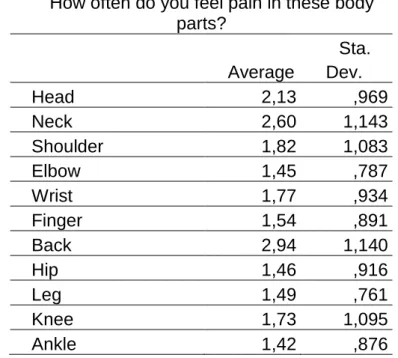
Complementarily to the charts, Table 4.1 presents the average and standard deviation for the types of pain in regular bases.
,00 ,50 1,00 1,50 2,00 2,50 3,00
3,50
General Pain
General Average Computer Average Console Average
,00 ,10 ,20 ,30 ,40 ,50 ,60 ,70
General Average Computer Average Console Average
11 How often do you feel pain in these body
parts?
Average
Sta.
Dev.
Head 2,13 ,969
Neck 2,60 1,143
Shoulder 1,82 1,083
Elbow 1,45 ,787
Wrist 1,77 ,934
Finger 1,54 ,891
Back 2,94 1,140
Hip 1,46 ,916
Leg 1,49 ,761
Knee 1,73 1,095
Ankle 1,42 ,876
Chart 4.6 shows how participants consider their health situation.
Most of the players consider they have a normal health, 47% of them. The next group is makes up 40%, and they consider that they have a good health. Only 6%
think they have a bad health and 2% that they have really bad health. The last 5%
correspond to those who think that their health is excellent.
Chart 4 6 Self health consideration by the whole sample
4.3 Comparisons between groups
Different mean comparisons by using ANOVA were carried out, in order to determine if there were statistical differences in the amount of pain that video-gamers feel in each body part studied, as well as their general health perception.
When we compared console and computer gamers, we found that there were no significant differences between the afflictions reported. There were also no differences between the hours played. No significance was found for the type of mouse or keyboard used either. For that reason we decided not to put the tables in this part of the study.
2% 6%
47%
40%
5%
In general, how do you consider your health?
1. Really bad 2. Bad 3. Normal 4. Good 5. Excelent
Table 4 1 Average and standard deviation of pain assiduousness
12 Concerning the perception of pain depending on gender, we found significance in perception of headache and shoulder pain, which affected more of the female gender than the male gender, as it can be seen in Table 4.2
Table 4.2 Significance on the men-women comparison of pain assiduousness felt
Men Pain (N=61) Women Pain (N=32)
Pain Average Sta. Dev. Average Sta. Dev. F Sig.
Head 1,98 ,940 2,41 ,979 4,125 ,045
Neck 2,49 1,105 2,81 1,203 1,663 ,200
Shoulder 1,54 ,828 2,34 1,310 13,044 ,000
Elbow 1,44 ,786 1,47 ,803 ,023 ,880
Wrist 1,75 ,907 1,81 ,998 ,081 ,776
Finger 1,57 ,957 1,47 ,761 ,289 ,592
Back 2,87 1,103 3,06 1,216 ,603 ,440
Hip 1,44 ,866 1,50 1,016 ,082 ,776
Leg 1,44 ,719 1,59 ,837 ,827 ,366
Knee 1,69 1,025 1,81 1,230 ,267 ,607
Ankle 1,33 ,790 1,59 1,012 1,952 ,166
Health 3,49 ,766 3,25 ,762 2,097 ,151
Regarding the preference of console type and how the subjects perceived pain in different parts of their body, significance was found for variables wrist and hip pains, seen in Table 4.3. Not playing with consoles (computer gamers) seems to increase the pain in the wrist, which is much more painful compared with playing with the X- Box (p=0.013). Also not playing with consoles raises the possibilities of having hip pain, even more if it is contrasted to those who play Wii (p=0.030) and X-Box (p=0.037) respectively.
13 Table 4 3 Significance on the type of console used comparison of pain
assiduousness felt
None (N=30) X-Box (N=15) Play Station (N=35) Wii (N=13)
Pain Average Sta. Dev. Average Sta. Dev. Average Sta. Dev. Average Sta. Dev. F Sig.
Head 2,37 ,999 1,67 ,816 2,11 ,993 2,15 ,899 1,789 ,155
Neck 2,73 1,230 2,60 ,986 2,37 1,140 2,92 1,115 ,946 ,422
Shoulder 2,00 1,287 1,47 ,834 1,80 ,964 1,85 1,144 ,810 ,492
Elbow 1,57 ,817 1,47 ,990 1,40 ,736 1,31 ,630 ,402 ,752
Wrist 2,00 ,983 1,27 ,594 1,74 ,919 1,92 1,038 2,275 ,085
Finger 1,37 ,718 1,60 ,986 1,66 1,027 1,54 ,776 ,594 ,621
Back 3,23 1,194 2,87 1,125 2,83 1,124 2,62 1,044 1,150 ,333
Hip 1,73 1,172 1,13 ,516 1,51 ,887 1,08 ,277 2,436 ,070
Leg 1,47 ,629 1,53 ,990 1,60 ,847 1,23 ,439 ,766 ,516
Knee 1,63 1,033 1,53 ,990 1,97 1,272 1,54 ,776 ,937 ,426
Ankle 1,70 1,055 1,07 ,258 1,40 ,847 1,23 ,832 2,116 ,104
Health 3,17 ,699 3,73 ,458 3,46 ,852 3,46 ,877 2,010 ,118
If the exercise is considered, noted in Table 4.4, again related to the perception of pain, significance was found for shoulder and finger pain. Gamers who do not exercise suffer from shoulder pain the most. Instead, those who do exercise feel more pain in their fingers. There was also a significant difference in how they considered their standard health was, those who exercise rated better than those who don’t.
Table 4 4 Significance on the exercise habits comparison of pain assiduousness felt
Exercise (N=59) Not exercise (N=34)
Pain Average Sta. Dev. Average Sta. Dev. F Sig.
Head 2,10 ,941 2,18 1,029 ,127 ,722
Neck 2,66 1,108 2,50 1,212 ,425 ,516
Shoulder 1,64 ,996 2,12 1,175 4,272 ,042
Elbow 1,42 ,792 1,50 ,788 ,201 ,655
Wrist 1,83 ,874 1,68 1,036 ,584 ,447
Finger 1,71 1,001 1,24 ,554 6,535 ,012
Back 2,80 1,156 3,18 1,086 2,431 ,122
Hip 1,46 ,877 1,47 ,992 ,004 ,948
Leg 1,46 ,773 1,56 ,746 ,379 ,540
Knee 1,73 1,142 1,74 1,024 ,001 ,978
Ankle 1,41 ,853 1,44 ,927 ,033 ,857
Health 3,54 ,703 3,18 ,834 5,094 ,026
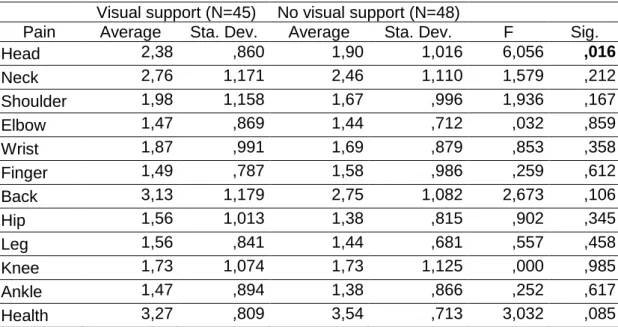
14 When the pain perception is weighted with the visual support need (Table 4.5), it stands out that there is a statistically significant difference in headache: Those who use visual support have more headaches than those who don’t use it.
Table 4 5 Significance on the visual support need comparison of pain assiduousness felt
Visual support (N=45) No visual support (N=48)
Pain Average Sta. Dev. Average Sta. Dev. F Sig.
Head 2,38 ,860 1,90 1,016 6,056 ,016
Neck 2,76 1,171 2,46 1,110 1,579 ,212
Shoulder 1,98 1,158 1,67 ,996 1,936 ,167
Elbow 1,47 ,869 1,44 ,712 ,032 ,859
Wrist 1,87 ,991 1,69 ,879 ,853 ,358
Finger 1,49 ,787 1,58 ,986 ,259 ,612
Back 3,13 1,179 2,75 1,082 2,673 ,106
Hip 1,56 1,013 1,38 ,815 ,902 ,345
Leg 1,56 ,841 1,44 ,681 ,557 ,458
Knee 1,73 1,074 1,73 1,125 ,000 ,985
Ankle 1,47 ,894 1,38 ,866 ,252 ,617
Health 3,27 ,809 3,54 ,713 3,032 ,085
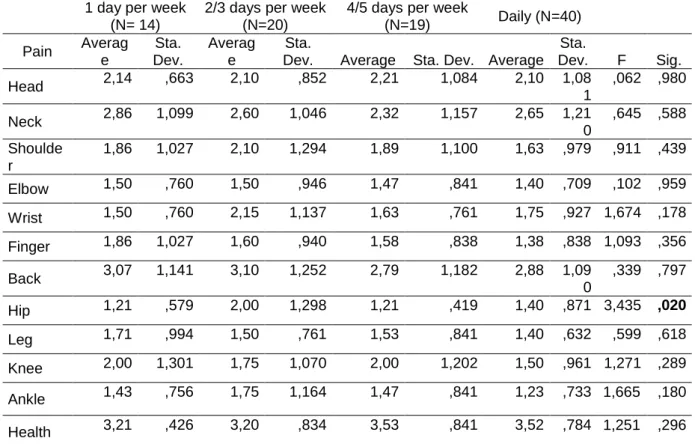
The next Table, 4.6, presents the differences between groups as a function of the days a week gamers played. The only significant difference found was in hip pain:
Those who play 2/3 days a week suffer more from the hip than any other time range players.
Table 4 6 Significance on the days per week played comparison of pain assiduousness felt
1 day per week (N= 14)
2/3 days per week (N=20)
4/5 days per week
(N=19) Daily (N=40) Pain Averag
e
Sta.
Dev.
Averag e
Sta.
Dev. Average Sta. Dev. Average Sta.
Dev. F Sig.
Head 2,14 ,663 2,10 ,852 2,21 1,084 2,10 1,08
1
,062 ,980 Neck 2,86 1,099 2,60 1,046 2,32 1,157 2,65 1,21
0
,645 ,588 Shoulde
r
1,86 1,027 2,10 1,294 1,89 1,100 1,63 ,979 ,911 ,439 Elbow 1,50 ,760 1,50 ,946 1,47 ,841 1,40 ,709 ,102 ,959 Wrist 1,50 ,760 2,15 1,137 1,63 ,761 1,75 ,927 1,674 ,178 Finger 1,86 1,027 1,60 ,940 1,58 ,838 1,38 ,838 1,093 ,356 Back 3,07 1,141 3,10 1,252 2,79 1,182 2,88 1,09
0
,339 ,797 Hip 1,21 ,579 2,00 1,298 1,21 ,419 1,40 ,871 3,435 ,020 Leg 1,71 ,994 1,50 ,761 1,53 ,841 1,40 ,632 ,599 ,618 Knee 2,00 1,301 1,75 1,070 2,00 1,202 1,50 ,961 1,271 ,289 Ankle 1,43 ,756 1,75 1,164 1,47 ,841 1,23 ,733 1,665 ,180 Health 3,21 ,426 3,20 ,834 3,53 ,841 3,52 ,784 1,251 ,296
15 We carried out another ANOVA with scores of pain while participants are playing.
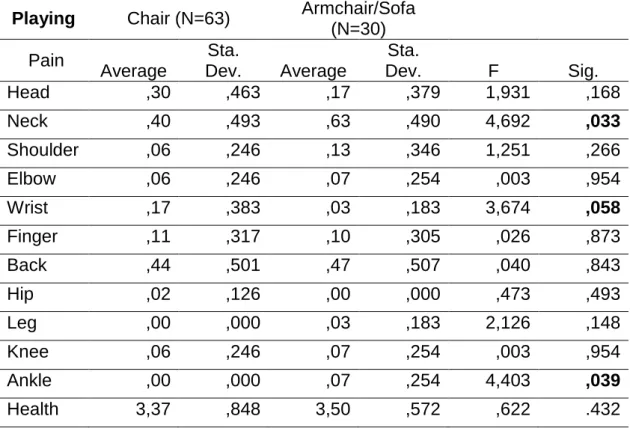
Depending on where they sit, compared with the pains suffered while playing, Table 4.7 refers that neck, wrist and ankle problems were significant. It was evidenced that armchair/sofa players were more likely to be affected from the neck. On the contrary, those who play in a chair usually feel pain in the wrist. The ankle problem was found significant, but not relevant because the size of the sample that answered positively to that question was too small to actually be taken in consideration.
No significance was found comparing the pains to the type of table used by the gamers. There was significance concerning how they considered their health was, but it was referred to a variable that had not enough subjects to consider it valid.
Table 4 7 Significance on the type of chair comparison of pain assiduousness felt
Playing Chair (N=63) Armchair/Sofa (N=30) Pain
Average
Sta.
Dev. Average
Sta.
Dev. F Sig.
Head ,30 ,463 ,17 ,379 1,931 ,168
Neck ,40 ,493 ,63 ,490 4,692 ,033
Shoulder ,06 ,246 ,13 ,346 1,251 ,266
Elbow ,06 ,246 ,07 ,254 ,003 ,954
Wrist ,17 ,383 ,03 ,183 3,674 ,058
Finger ,11 ,317 ,10 ,305 ,026 ,873
Back ,44 ,501 ,47 ,507 ,040 ,843
Hip ,02 ,126 ,00 ,000 ,473 ,493
Leg ,00 ,000 ,03 ,183 2,126 ,148
Knee ,06 ,246 ,07 ,254 ,003 ,954
Ankle ,00 ,000 ,07 ,254 4,403 ,039
Health 3,37 ,848 3,50 ,572 ,622 .432
16
5. Discussion
The purpose of this study was to analyze the effects of videogames on injuries and pain. Our results provide interesting data that shows the relevance of this area for physiotherapists.
In the first place, the data analysis showed that most participants preferred playing with computers than with consoles, with the same proportion when the preference for men and women was studied.
Secondly, results showed that a great number of the sample usually plays every day, for between 1 and 4 hours. This time of exposure to computers/consoles could be compared with part-time work. When looked at the type of specific device used, it was highlighted that desktop computers where the most used and that Play Station or no console at all where the most common choices.
We also found an important amount of players that suffer from back and neck more frequently than from other parts of the body, which is consistent with the fact that most of the articles focus on these problems for computer users.
In this sense, there is a clinical experience that states prolonged sitting acts as a provocative factor for low back pain in patients with specific low back problems, confirmed by the findings of pain increment in their control group of patients who were sitting uninterrupted for 1 hour3.
Using EMG of the hamstring muscle during the full-flexion phase it has been proofed a significantly higher activity in this muscle in a computer work related low back group than in an asymptomatic group. The flexion-relaxing ratio of the hamstring muscle has also been proofed to be significantly increased in a computer work-related low back pain group when compared to an asymptomatic group. Sitting for long periods has been demonstrated to produce a high load on the spine of computer workers, causing low back pain, and this may lead to either muscle shortening or muscle weakness, or hyper- or hypo-mobility of joints5.
Low back pain is known to be a multi-factorial disorder with many possible etiologies. Low back pain has been confirmed to be highly prevalent among both genders and in older age. Also, weakness in the legs, smoking, and prolonged standing and sitting have been stated to have a significant effect on low back pain to the point that it compromises patients’ daily lives and work habits significantly. There are data that support the fact that low back pain continues to be an important clinical, social and economic burden and a public health problem affecting the population of the entire world11.
This trend continued as we change the frequency they felt the pain to what hurt the most while playing. Averagely speaking, the most common body parts affected are neck and back. Even if we talk about the whole sample or we divide the sample into computer and console players.
Moreover, data analysis leads us to define more specific problems for different groups.
Comparisons by gender showed that women suffer more headache and shoulder pains than men. This could be explained by the fact that women and men play with different habits and routines; however, more research would be needed to confirm and understand this result.
Comparisons by type of device revealed that, for none console players, wrist and hip were the major problems, meaning that computer players are more prone to
17 having wrist or hip pain, especially compared to X-Box and Wii players. This gives us a head start for prevention intervention, due to the importance of knowing that not all devices generate the same problems.
For those who practice regular exercise, fingers are more painful than for those who don’t practice exercise. Shoulders were found to be more painful for sedentary players than for active ones. It was also noted that physically active gamers consider their health to be better than those who aren’t active.
Headache was found to be meaningfully more frequent for those who need visual support. This is consistent with the high probability of having headache demonstrated by Logaraj, Madhupriya, and Hegde14
Comparisons by number of days per week playing, hip problems were higher for those who played 2/3 days per week.
Neck and wrist problems were identified as problematic depending on the sitting furniture while playing. Armchairs or sofas are more likely to cause neck problems.
Chairs seem to promote more wrist pains.
Even though this data fulfills most of the objectives, there are some aspects that weren’t determined, such as the difference between the afflictions between the computer players and the console ones or between the hours played, neither for the type of mouse or keyboard used. None of these aspects were found to give any significant results. Future research could help to determine if this result is due to sample limitations or as a consequence of real absence of differences between those groups.
5.1 Hypothesis achievement and unexpected results.
The hypotheses that were suggested were that problems with neck, shoulders and back, repetitive strain injury and sedentary lifestyle would be the major problems.
Also we stated that computer players would have more wrist problems than console players. That console players would have more back and neck problems than computer ones. Those who played more days and hours would have more pains in general. Those with vision problems would have more headaches. Those who used armchairs or sofa would have more back and neck problems than those who used chairs. Active players would feel healthier than sedentary players.
From the hypotheses laid out, it could be said that we partially confirmed them. In a global hypothesis we established that neck, shoulder and back problems would be found. The neck and shoulder problems were found to be significant in some categories. Back problems were not found to be significant in any group, but watching the average pains felt by the whole sample, it was very obvious that back pain was the most common pain felt for nearly all.
Specifically speaking, the first hypothesis was not corroborated. Computer players suffered, averagely speaking, a little more pain than console players, but it was not significant. In the second one we couldn´t confirm the second hypothesis: console players showed a small difference in their favor to be the ones with more neck pain and vice versa with the back, but again, no significant result. This could be caused by the difference in the number of computer and console players in the sample.
On the visual issue, we found that it is true that those with vision support have more headaches than those who don’t.
We also confirmed that those who play on armchair or sofa have more neck pain than those who play on chairs. In this case, there was no significance found for back
18 pains, even though averagely speaking, sofa players had slightly more back pain than chair players.
Lastly, we found that physically active gamers feel healthier than those who are more sedentary.
The most unexpected results were mostly those that were not found. Not finding significant difference between console and computer players, the type of keyboard and mouse used or the time spent playing. As well, not finding significance in back pain in any of the groups compared was unforeseen.
Other unexpected results were related to the group where the pain was found, which was for those who play for 3-4 days per week and not for those who play more days a week. This is difficult to explain. It was also rare to find that for those who exercise finger pain was significantly high.
5.2 Main affected areas differentiating by gamer’s characteristics
These are the most significant affected areas we found throughout the variables we crossed the pain answers with.
Headache
These results could be explained due to the implications of the screen exposure and bad posture of the neck in the case of headache. The use of contact lenses, and not any type of visual support, could also have something to do with this14.
Hip
Pressure on the lower limbs from siting too long and different bad positions while sitting could explain hip problems. The furniture where the person sits could also be relevant. The position the hip takes depending on where one sits can compromise the joint.
Shoulder
Shoulders could have many symptomatic problems because of the posture, that could be forced many times for different reasons, but basically because they spend so much time in front a computer or TV that they have to adjust several times their pose so that they can feel comfortable, which leads to many positions that are very dangerous to the body. The keyboards and the mouse can also be a cause of these problems. Even though we didn’t find evidence in the analysis we made of these variables, it cannot be discarded the possibility that a bad use or a bad choice of tools can affect the shoulders of the players by modifying their posture. The armrests and the tables can also be a factor, even though there was again no evidence in the analysis, they should never be discarded as a possible agent due to their effect on pose. Even the stress that the games cause on the player can be reflected in their shoulders.
Shoulder symptoms have been associated with age, high screen position and shoulder elevation9.
Shoulder pain can be prolonged with an incorrect sitting posture, lasting for 3 months due to lordotic lumbopelvic postures22.
Shoulder pain has also been significantly associated with emotional exhaustion36. Shoulder pains are still believed to pose a major problem among computer office workers because of the somatization tendency and negative expected pain37.
19 Wrist
Lastly, the wrist problems can be explained by the pressure they are exposed to while playing with the computer. Not having a correct chair could cause several poses that can force the position of the hand, making the pressure over the wrist to be too strong. These could also be caused by the keyboard and mouse selection and usage, despite the fact that the analysis did not show relevance in this matter.
Different kinds of keyboards have showed significant increase in wrist extension angle with increasing positive tilt and a large significant decrease in wrist extension with negative tilt for example with an AS keyboard compared with a standard flat keyboard. There is evidence that there is a moderate significant decrease in wrist extension angle with an FA keyboard compared with a standard keyboard. It is also known that there is a small non-significant decrease in wrist extension with an AT keyboard compared with a standard flat keyboard8.
Wrist/hand symptoms have been demonstrated to have as major risks factors the stress and the shoulder elevation9.
Also wrist pain has been associated with older age, lower odds of left/both- handedness, belief that musculoskeletal problems are currently caused by work and time pressures at work37.
Other results given pointed towards to neck and finger pains with minor notoriety.
Neck
Because of where the neck pain was found to be more common, it could be thought that forced posture by sitting in a poorly ergonomically designed furniture such as an armchair or a sofa while playing with video games, not mattering if it is on computer or console, could be the cause.
Related to the examination of the relationship between computer mouse use and musculoskeletal symptoms in the neck, shoulder, wrist/hand and upper back, no relationship has been found between hours of mouse use per day and symptoms. A relationship between the mouse specific variable of arm abduction and musculoskeletal symptoms in the neck was found in addition to relationships between non-mouse-specific risk factors. It has been noted that stress, screen height and shoulder elevation; risk factors previously associated with keyboard use, are also risk factors for mouse users. Neck symptoms have been associated with low or high screen height. Time with the hand positioned on the mouse has been associated to neck symptoms when considered in univariate analysis but not when combined with other significant factors via logistic regression. All of this concludes that mouse use may contribute to neck discomfort9.
There is evidence that neck pain can be prolonged with an incorrect sitting posture, lasting for 3 months. Prolonged neck pain has been associated with more lordotic lumbopelvic postures22.
High prevalence of musculoskeletal pain, especially in the neck and low back, among computer users has been found. Neck pain has been found to be significantly more common in women, at older ages and with somatizing tendency and belief that musculoskeletal problems are commonly caused by work36.
There is evidence that neck pains still pose a major problem among computer office workers and somatization tendency and negative expected pain37.
A research centered on the sitting posture established that a relatively upright posture results from an increase in the vertical location of the screen. This is
20 manifested by the strong significant correlation between neck flexion and neck extensor muscle activity seen when changed the height of the screen38.
A series of experiments have been made to investigate the mechanisms of efficacy of cervical muscle retraining in prolonged sitting computer users, using exercises to train the craniocervical flexor muscles or a endure-strength training regimen for the cervical flexor muscles which demonstrated that an exercise program targeted at retraining the craniocervical flexor muscles, improved the ability to maintain a neutral cervical posture during prolonged sitting39.
Finger
Finger pain was unexpectedly found significantly only in those players who are used to doing physical activity. The only reason that could explain this fact is that maybe these subjects could play less than those who don’t exercise, and because of this, the first kind of players would be less used to the typing, clicking and using console controllers, which could justify their perception of finger pain.
5.3 Utility
This research paper is one of the first steps that contributes to understanding the way eSports players interact with their environmental conditions, such as personal conditions, furniture, gaming tools, health habits, or time spent playing. It also gives a first vision of global pains that gamers feel normally and while playing. The goal of this study was to be able to fill in the blanks there are of the health and primary risk of the eSports players so that in the future the patients that could appear from the exercise of this sport won’t be strangers to us. The data of this research can be illustrative and helps to develop prevention and treatment programs for video-gamers injuries. This study, as other research before, shows that an ergonomic approach is more than justified for the gamers, especially to the eSports athletes.
In this sense, it is possible to apply well documented techniques into these emerging patients.
Combined with other research, this paper could help set the base of new approach lines to prevent ailments. For example, a comparison of changes in objectively measured workplace sitting time following a multi-component intervention, based on a “stand up, sit less, move more” educational program with a height-adjustable workstations versus the installation of height-adjustable workstations alone that resulted in a reduction of office workers’ sitting time during work hours relative to the provision of height-adjustable workstations alone, which concluded that multi- component programs targeting workplace sitting may achieve more substantial reductions in office workers’ sitting time40. Physiotherapist could use both these studies to make use of the health education training they have and create a prevention program.
Other articles suggest a comparison of the effectiveness of two exercises in stretching the hamstring muscle: the passive straight leg raise exercise, and knee extension in sitting, an exercise in which the knee joint is passively extended in the sitting position, which concluded that both exercises were effective at improving forward bending, and the angles of active straight leg raise and knee joint extension, knee extension in sitting being more widely used because it can be done more easily41. If back problems are the most common in video-gamers, this exercise could be implanted in a prevention program as well.
Also a self-modeling training method using webcam photos has been laid out, which was presented on the workers’ computer screens, in order to improve their
21 workplace posture comparing a photo-training intervention with a conventional office ergonomic intervention group and with a control group to evaluate their effectiveness in reducing musculoskeletal risk, both between the genders and over time. The intervention given the office ergonomic training group by an ergonomist included two aspects: 1) personal training on how to improve their posture while working on the computer 2) practical instruction on how to modify their workstation. The self- modeling photo-training group received the office ergonomic training as detailed above and in addition also received self-modeling photo-training feedback. After receiving the office ergonomic training, the participant was asked to sit correctly according to the training. The ergonomist verified that this posture was the optimal working posture. A photograph of this correct posture was taken using the webcam. It proved that it was effective for improving sitting posture of workers at computer work stations42. This research shows the importance of new and innovative methods for postural health. We can come up with an interactive method to remind gamers while playing to maintain their posture upright.
5.4 Limitations and future studies
While trying to cover such a huge amount of fields, very small groups were obtained, and that fact won’t allow us to generalize the results. It would have been interesting to have a larger sample of player who played 6 days a week for at least 8 hours a day, so that we could compare it to actual eSports athletes.
Once this study is reviewed, many specific studies can be followed from here. For instance, from each variable item we asked in the survey there could be a specific study.
Age, gender and employment should be more thoroughly studied, even more if it is with eSports players. In this direction, time spent and type of device used should be as well looked into for eSports players.
Clinical trials should be used to identify the specifics of which injuries are more common and how the furniture and accessories they use affect their health. Digging deeper in this aspect could help even more to prevent many problems that could appear in a very short period of time.
Using the technology shown in a psychometric testing description of a new three- dimensional (3D), portable, non-invasive posture analysis tool which was first tried in Mannequin and then in high school students in a sitting posture and that demonstrated to be valid and reliable43 could also be found to be useful to help to narrow even more the postural habits of videogame players.
Following the previous line of posture research, taking the model of a description of the variability of five postural angles in a cohort of asymptomatic high school students whilst working on desktop computers, in a typical South African school computer classroom placing two 3D-PAT camera units on each side of the student, facing the lateral aspect of the student, calibrated using a pyramid calibration object prior to each data capture. They discovered that angles producing movement in the sagittal plane were either individually or in combination associated with height, weight and body mass index, where trunk flexion was found to be the most variable postural angle measured and increased neck flexion was significantly associated with increased weight44. This information should also be pursued regarding videogame players, which could open a whole new line of investigation and give more information of the postural habits of gamers in order to find ways to ensure their health.