JOS JOS
JOURNAL JOURNAL
OF ECONOMICS OF ECONOMICS JOS
JOS
JOURNAL JOURNAL
OF ECONOMICS OF ECONOMICS
DEPARTMENT OF ECONOMICS, FACULTY OF SOCIAL SCIENCES, UNIVERSITY OF JOS
i Volume 7, No.2, December 2018
© 2018 Department of Economics, University of Jos, P.M.B. 2084, Jos – Plateau State, Nigeria
EDITORIAL BOARD:
Editor-in-chief:
Prof. I. Ogboru Editors:
Prof. A. C. Abimiku Prof. J. H. Landi Prof. W. A. Ademu G. G. Goshit, Ph.D L. J. Ogba, Ph.D
Editorial Consultants:
Prof. (Mrs) E. Amali Prof. D. Irefin Prof. P. Amaza
Business Manager / Secretary:
Mrs R. A. Anga
All rights reserved. No part of this Journal may be reproduced in any form or any means, electronic, mechanical, photocopying, recording or
otherwise, without the written permission of the publishers.
ISSN 0189-0998
Publishers:
Department of Economics, University of Jos, Jos Nigeria.
DOES MONETARY POLICY TRANSPARENCY ENHANCE THE ACHIEVEMENT OF MONETARY POLICY TARGETS IN NIGERIA? A THEORETICAL ASSESSMENT
Gideon Gokum Goshit, Ph.D - - - - - - 1
IMPACT OF GOVERNMENT TAX INCENTIVES ON ENTREPRENEURSHIP PERFORMANCE (GROWTH) IN NIGERIA
Sani Alfred Ilemona ACA, & Awa Felix Nweke, Ph.D - - - - 29 COMPARATIVE ANALYSIS OF THE IMPACT OF CREDIT AND GOVERNMENT
EXPENDITURE ON AGRICULTURAL OUTPUT IN NIGERIA
Faith Onechojo Yusufu & Ishmael Ogboru, Ph.D - - - - 48 IMPACT OF FOREIGN DIRECT INVESTMENT ON THE MANUFACTURING
SECTOR IN NIGERIA
Agunbiade, Olabode & Akomolafe, Augustine Femi - - - 77 ASSESSING EXCHANGE RATE VOLATILITY AND ECONOMIC GROWTH
IN NIGERIA: A VECTOR ERROR CORRECTION MODEL APPROACH
Vincent Chukwuemeka Ayoka & Badayi Mamman Sani, Ph.D - - 101 AN AUTOREGRESSIVE DISTRIBUTED LAGGED (ARDL) APPROACH TO
TRADE OPENNESS ON ECONOMIC GROWTH IN NIGERIA
Jirbo, Boniface Verr & Dickson, Juliana Vonke - - - - 129 EFFECTS OF BEHAVIOURAL FACTORS ON INVESTMENT DECISION -
MAKING IN PROPERTY MARKET IN PLATEAU STATE, NIGERIA
Dashol Ishaya Usman, Ph.D & Chinshaka Ayuba Sitdang, Ph.D - - 152 IMPACT OF MICRO, SMALL AND MEDIUM ENTERPRISES (MSMEs) ON
ECONOMIC GROWTH IN NIGERIA: 1999-2017
Zubairu, Tajo Abdullahi, Ph.D, Tafida Abdullahi, Ph.D & Yusuf Adamu - - 181 ENVIRONMENTAL DEGRADATION AND AGRICULTURAL PRODUCTIVITY
IN NIGERIA: AN ARDL/BOUNDS TESTING APPROACH
Gabriel Attah Adejor & Park Idisi, Ph.D - - - - 200 NIGERIA TRADE FLOWS AND THE EFFECT OF POLITICAL INSTABILITY:
A GRAVITY MODEL APPROACH
Kairo Chinonso Innocent, Ayuba Yilgak’ha & Bitrus Danjuma - - 227 THE RELATIONSHIP BETWEEN FISCAL DEFICITS AND MACROECONOMIC
AGGREGATES: A VECTOR AUTO REGRESSION APPROACH
Ukwueze, Ezebuilo Romanus, Ph.D & Emeraghi, Blessing Ahudiya - - 248
ii
1
Gideon Gokum Goshit, PhD.
Department of Economics University of Jos, Jos – Nigeria Email: [email protected]
Abstract
Transparency has become a prominent feature of monetary policy in economies of the world, but systematic evidence of transparency impact on the economy especially the developing economies (Nigeria inclusive) have been scanty. The paper theoretically assessed the influence of monetary policy transparency on the achievement of policy targets and outcomes in Nigeria. Content analysis was employed and inferential statistics used to describe the influence of monetary policy transparency on monetary targets and outcomes in Nigeria from 1986 to 2015. The use of theoretical approach was informed by the difficulty in finding a suitable proxy for transparency as a variable for quantitative analysis. The study revealed that transparency had a mixed outcome on policy targets during the period under the study. It was discovered that monetary outcomes have been mixed with target misses in most of the years. During the period, growth performance was weak (sluggish output growth rate) and high unemployment rate was recorded. Overall, Central Bank of Nigeria’s experience with monetary targeting was characterized with the problem of target overshooting for the 2004 to 2007. Monetary outcomes were above targets, especially inflation rate in 1995 and monetary aggregates (money supply and bank credit) for most of the years between 2004 and 2012. However, there was a mixed performance in the key target policy as policy targets were substantially missed in 2011 but from 2012 to 2015, the monetary policy targets were substantially attained. The study recommended that for monetary policy to effectively enhance the achievement of its targets, the CBN must formulate sound policy decisions in light of its democratically-set objectives and the information available, engage in communication of the immediate policy decision to all users, must be accountable for its decisions and must foster credibility by being clear about its mandate and how it performs its tasks. However, the paper submitted that the achievement and/or the missing of the policy targets could also be accounted for by other macroeconomic factors other than monetary policy transparency in an economy.
Key words: Monetary Policy, Central Bank Policy, Targets, Outcomes JEL Classification: E50, E52, E58
INTRODUCTION
Policy transparency has become an important concept in central banking and part of the policy debate globally. This is because central banks all over the world have discovered that there is need to provide DOES MONETARY POLICY TRANSPARENCY ENHANCE THE ACHIEVEMENT OF
MONETARY POLICY TARGETS IN NIGERIA? A THEORETICAL ASSESSMENT
2
the general public and the markets with relevant information on their strategies, assessments and policy decisions as well as their procedures in an open, clear and timely manner. This is believed to enhance monetary policy effectiveness of central banks. Most economists consider greater transparency in monetary policy desirable since it enables the private sector to be more effective in decision -making (i.e. to improve welfare) and to make informed decisions (Kondic & Kruskovic, 2012). A transparent economic environment is expected to improve policy effectiveness and market efficiency (Goshit, 2014). Central banks around the world have greatly increased the monetary policy information they have provided the public. For example, many central banks have become more explicit about the longer-run objectives of monetary policy, such as long-run inflation objectives, and provided more detailed information about the monetary policy process (Gordon, 2008). The movement toward increased transparency arises largely from the view that increased transparency has important benefits, including more effective monetary policy. It has also been argued that the level and extent to which monetary policy objectives are achieved by the central bank is depended on the extent to which the central is independent in its decision making and the level of transparency of its decisions (Goshit, 2014). Transparency in monetary policy therefore is expected to enhance the achievement or attainment of the key macroeconomic objectives of the central banks of every economy (Goshit, 2014). Developing and developed economies alike have adopted transparency in monetary policy making process overtime and have benefited immensely from it.
This has been evident in their control of inflation and has led to relative stability in their price levels. However, even though the Central Bank of Nigeria (CBN) has been making frantic efforts to embrace transparency in its monetary policy making process over the years, this seem not to have yielded the desired impact on the attainment of policy targets in
3
Nigeria. Evidence abound in Nigeria that rarely, monetary policy targets are achieved annually. This can be attested to by the wide deviation of the outcomes of inflation rate, exchange rate, output, interest rate and employment rate from their planned targets. This view point of wide deviation of policy outcomes from targets has, however, been largely ignored by researchers.
This study therefore seeks to theoretically assess the influence of the central bank monetary policy transparency on the attainment of policy targets and outcomes in Nigeria for the period 1986 to 2015. This period marked the period that the Structural Adjustment Programme (SAP) was adopted and indirect instruments of monetary policy were used and the financial landscape of the country was significantly influenced.
To achieve the objectives of this paper, the paper has been organized into six sections with the introduction as section one. The remainder of the paper is organized as follows: Section two deals with conceptual clarification, literature review and case for transparent monetary policy. Section three specifies the research design, methodology and sources of data. Section four is a theoretical analysis of monetary policy targets and outcomes in Nigeria. While section five discusses the challenges of monetary policy transparency in Nigeria, section six provides the conclusion and policy recommendation of the paper.
CONCEPTUAL CLARIFICATION AND EMPIRICAL LITERATURE – Monetary Policy Transparency
Given the importance of transparency and the growing international interest in promoting it, it is lamentable (though perhaps not surprising) that there are currently no commonly agreed upon definition of the concept of transparency (Bauhr & Grimes, 2012).
Transparency is a multifaceted concept that is often conflicted with
4
accountability or even corruption, impartiality, and rule of law.
Transparency is sometimes more narrowly defined as the release of information which is relevant for evaluating instituti ons (Bauhr &
Grimes, 2012). Vishwanath and Kaufmann (1999) defined transparency as the increased flow of timely and reliable economic, social and political information, which is accessible to all relevant stakeholders. This perspective emphasizes not only the availability of information, but also its reliability and accessibility to a range of potential agents. To Gordon (2008), transparency means that the central bank provides the general public and the markets with all relevant information on its strateg y, assessment and policy decisions as well as its procedures in an open, clear, and timely manner. Most commonly, transparency implies the absence of asymmetrical information between financial markets and monetary policy makers.
According to Geraats (2002), transparency of monetary policy refers to the absence of information asymmetries between monetary policy makers and the private sector. Transparency in policy exists when the public is familiar with the way in which the information on the situation in the economy is transformed into action. The connection includes relevant information available to the central bank, economic models (if any) that the monetary policy makers use to explain the economy’s functioning, and the way in which decisions are made (Kondic
& Kruskovic, 2012). Friedman (2002) argued that transparency and credibility are code words for inflation targeting, suggesting that “a
‘transparent’ policy means one that the public understands to be
‘credibly’ committed to low inflation;” Therefore, transparency is adopted in this study to refer to the openness or the readiness, unobstructed access to, and availability of data and information from public as well as private sources that is accurate, timely, relevant and comprehensive. It also encom passes tolerance for public
5
debate, public scrutiny and public questioning of political, economic and social policy choices. It is the amount of information about the goals and conduct of monetary policy released to the public.
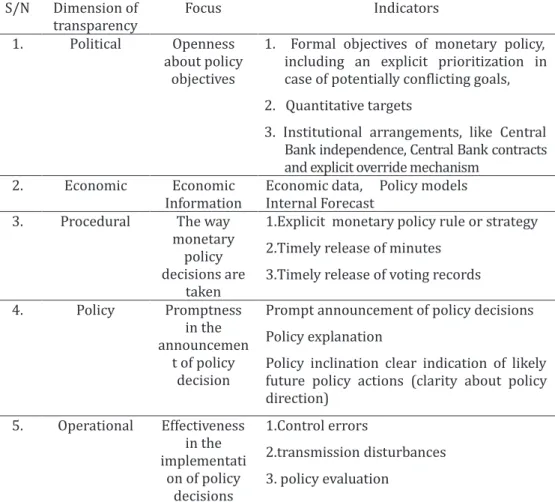
Monetary policy transparen cy has been classified into political, economic, procedural, policy transparency and operational transparency (Eijffinger and Geraats, 2004). Political transparency refers to the openness of policy objectives while economic transparency on the other hand r efers to the availability of economic information necessary for the pursuit of monetary policy. This includes all economic data used by the central bank, models on which the forecasts are made or evaluations of effects of the central bank decisions. Furthermore, policy transparency means prompt (immediate) disclosure of decisions and explanations thereof, but also indications of likely future actions.
Operational transparency concerns the implementation of the central bank decisions. It includes discussions of pas t forecast errors and (unanticipated) macroeconomic deviations that have affected the transmission mechanism of monetary policy (Kondic &
Kruskovic, 2012). Table 1 shows the five dimensions of transparency, the focus and the associated indicators.
6
Table 1: Dimensions of Monetary policy Transparency and the indicators
S/N Dimension of transparency
Focus Indicators
1. Political Openness about policy
objectives
1. Formal objectives of monetary policy, including an explicit prioritization in case of potentially conflicting goals, 2. Quantitative targets
3. Institutional arrangements, like Central Bank independence, Central Bank contracts and explicit override mechanism
2. Economic Economic Information
Economic data, Policy models Internal Forecast
3. Procedural The way monetary
policy decisions are
taken
1.Explicit monetary policy rule or strategy 2.Timely release of minutes
3.Timely release of voting records 4. Policy Promptness
in the announcemen
t of policy decision
Prompt announcement of policy decisions Policy explanation
Policy inclination clear indication of likely future policy actions (clarity about policy direction)
5. Operational Effectiveness in the implementati
on of policy decisions
1.Control errors
2.transmission disturbances 3. policy evaluation
Source: Adopted from Egbuna ( 2011).
EMPIRICAL LITERATURE
A number of empirical studies have investigated monetary policy transparency with the bulk of the studies on developed economies but very scanty studies on developing economies of Africa (Nigeria inclusive). Some of the earlier studies in this area focused on the description of disclosure practices of central banks and making efforts at identifying the effects of changes in disclosure practices on certain financial and economic time series variables. Some of the empirical studies on monetary policy transparency included but not limited to
7
Svensson and Faust (1998), Filardo and Guinigundo (2008), Geraat (2009), Kondic and Kruskovic (2012), Kocheriakota (2012), Warsh (2014) Egbunna (2011) and Usman and Salihu (2016).
Svensson and Faust (1998) investigated “transparency and credibility: Monetary policy with unobservable goals” using “Barro- Gordon framework. Their result revealed that increased transparency makes the bank’s reputation and credibility more sensitive to its action;
This has a moderating influence on the bank’s policy; They submitted that full transparency of the central bank’s intentions is generally socially beneficial, but frequently not in the interest of the bank. Somewhat paradoxically, direct observability of idiosyncratic central bank goals removes the moderating incentive on the bank and leads to the worst equilibrium.
Filardo and Guinigundo (2008) examined transparency and communication in monetary policy in Asian Central Banks. The study adopted a survey research design. The result showed that transparency and communication have not only allowed financial markets and the public to better anticipate the direction of monetary policy, but have also made the task of explaining the stance of monetary policy and the rationale behind it, easier for monetary authorities.
Geraat (2009) investigated the trends in monetary policy transparency across 98 central banks from 1998 to 2006 using the survey method and provided an overview of central bank communication practices. His work revealed that increases in information disclosure have not been confined to inflation targeting but extend to other monetary policy frameworks, although there are significant differences.
His result also showed that greater transparency has been followed by average inflation.
8
Kondic and Kruskovic (2012) did a work on “transparency analysis in the function of central bank objective using the survey method of analysis. It was discovered that an increase in transparency has been greatly influenced by the practice of publishing the inflation report, which is especially common in countries that accepted inflation targeting as their monetary strategy.
Kocheriakota (2012) examined theoretically the changes and challenges of monetary policy transparency in Federal Reserve Bank of Minneapolis. He discovered that changing financial environment requires more transparent Federal Reserve monetary policy. Such transparency would help to establish understandable rules and procedures, to eliminate unnecessary market uncertainties and, to minimize the costs of anti-inflation monetary policy. He submitted that a more transparent monetary policy has the advantages of clarifying policy objectives , improving the workings of financial markets, enhancing central bank credibility, reducing the chances of monetary policies manipulation for political purposes, fostering better monetary policymaking and complement congressional monetary policy oversight responsibilities.
Warsh (2014) made a review of transparency and bank of England’s monetary policy; In his review, he submitted that transparency is not necessarily a virtue in itself, but is virtuous if used in pursuit of important policy objective.
In Nigeria, Egbuna (2011) investigated monetary policy transparency at the Central Bank of Nigeria (CBN) using the index of Central Bank transparency developed by Eijiffinger and Geraats (2006) and Malik and Din (2008). His result showed strong performance in political transparency linked to recent institutional changes such as prompt announcement and clarity about the operational targets of policy and, about the future directions of policy. However, overall performance is
9
weakened by performance in economic transparency linked to lack of timeliness in the dissemination of economic data relevant for monetary policy analysis and the non disclosure of the formal macroeconomic model(s) used for policy analysis. He therefore recommended timeliness in the dissemination of a comprehensive set of economic data relevant to effective monetary policy, and the publication of economic models deployed by the Central Bank.
Usman and Salisu (2016) also did a work on “monetary policy transparency: evidence from Central Bank of Nigeria CBN)”; They employed the Eijjfinger and Geraat transparency index to measure the degree of monetary policy transparency of Central Bank of Nigeria. Their result revealed that the CBN was found to be more transparent in some areas and deficient in others. Precisely, their result showed that the CBN had stronger performance in areas of political, procedural and policy dimensions and less transparent in economic and operational dimensions. However, considering the overall level of performance, they consider CBN as transparent. They submitted that that for greater transparency, the CBN should explicitly provide accurate information on monetary policy decisions in a timely and frequent manner. The findings of Usman and Salihu (2016) confirms and agree with the findings of Egbuna (2011) that revealed that the CBN had a strong performance in political transparency but had a weak performance in economic transparency link to lack of timeliness in the dissemination of economic data relevant for monetary policy analysis.
CASE FOR TRANSPARENT MONETARY POLICY
There has been diverse opinion on why central banks of both developing and developed economies adopt transparency in their operations. Establishing understandable monetary policy goals, informing the public about policy decisions in a timely fashion and explaining how other variables are employed in the policy process have a
10
number of advantages which work to improve monetary policy.
Specifically, a more transparent policy approach would make a number of contributions to the central banks’ monetary policy, to the economy, and to the financial markets.
First, it has been argued that transparency contribute to democracy. The availability of information can fuel the public debate, and help with the process of will formation (Buijze, 2013). In other words, it facilitates public decision making. It enables citizens to determine what the society wants to do. In addition, transparency is considered a necessary, albeit not sufficient, condition for participation whic h allows people to exert influence on different types of governmental activities, and for accountability which ultimately allows people to judge government actions and attach consequences to them. The principle of transparency is intended to secure a more significant role for citizens in the decision - making process and to ensure that the administration act with greater propriety, efficiency and responsibili ty vis-à-vis the citizens in a democratic system. It helps to strengthen the principles of democracy and respect for fundamental rights.
Besides, improved transparency helps to clarify the primary long - term policy objective. A more open, forthright policy process would create powerful incentives for monetary policymakers to carefully outline the primary objectives of monetary policy. This process, in turn, would create incentives to keep attention focused on such goals as well as to adopt procedures, indicators and instruments that would maximize the chances of achieving these objectives. Improved transparency also improves the workings and usefulness of financial markets. Empirical evidences shows that central bank provision of more complete and timely information does not increase the volatility of financial markets.
Instead, financial markets work better when inflation objectives are clarified and more timely and detailed information is readily available. A
11
more open and transparent policy environment improves the workings of financial markets because unnecessary uncertainties and confusion are minimized and market volatility is reduced (Saxton, 1997). More information enables private sector expectations to adjust faster to changes in monetary policy changes, allowing private sector agents to learn faster and minimize disruption of policy change. With a consequent reduction in uncertainty premiums, interest will be lower, bolstering bond and equity markets. The result is improvement of the information content of these financial market prices, and their increased usefulness as conveyers of market sensitive information (Saxton, 1997).
Furthermore, Bauhr and Grimes (2012) posited that transparency increases trust and legitimacy in a nation. Transparency is often thought to increase the legitimacy of the CBN and other institutions as well as the trust that the citizens have in them. This in turn improves the efficiency of the institutions, as people are more inclined to accept their decisions, and enforcement costs will be lowered. Thus, we can say that transparency contributes to legitimacy and to increase faith in public institutions.
Saxton (1997) submitted that a more transparent and open monetary policy also enhances central bank credibility. As monetary policy goals and procedures become well known and understood, the public more quickly learns about changes in policy, and central banks become more committed to achieving their publicly stated goals. As they begin to achieve these goals with greater regularity, central banks achieve enhanced credibility (Saxton, 1997). This improved credibility, in turn, enables expectations to adjust faster to changes in monetary policy, fostering more flexibility in labour and other markets and lowering employment and output costs of disinflation. Goals such as price stability, therefore, can more easily be attained, managed and maintained.
12
Transparency is thought to contribute to quality of governance in several ways. This, according to Demetrtzis and Hughes (2002), high – quality governance requires that government fulfills it tasks in accordance with the norms of the rule of law and democracy and in an honest and impartial way. Transparency can contribute to the observance of rule of law and promote integrity among public officials.
The mere fact that officials know they are being watched, and that the quality of their work can be checked, is thought to improve their performance. Transparency also enables the supervision of public officials, both by their superiors and the courts, and makes it possible to impose consequences on public officials that shirk their duties, or display other undesirable behaviours.
Haldane (1995) also argued that a more transparent monetary policy lessens the chances that policymakers will manipulate policy for political purposes. Open, transparent and well-known policy goals and procedures would allow private analysts and financial markets to constantly monitor the central banks’ actions and readily detect any manipulation of monetary policy for political purposes. Markets would quickly react to such manipulation by immediately revising inflationary expectations, and such action would readily be obvious to everyone.
Consequently, the opportunity for central bankers to surprise the markets with stimulative policy would severely constrained.
Furthermore, Eijffinger and Geraats (2002) have argued that transparency increases economic performance and market efficiency. As economic decision making is dependent on the availability of information, transparency facilitates good decisions. Access to government-held information is of particular importance, because for much of the information relevant to decision makers in political and economic markets, government is in fact the sole repository (and producer of such
13
information). In addition, a transparent government is more predictable, which allows economic actors to make better long- term decisions.
Monetary policy transparency would also work to improve monetary policy in the economy Saxton, 1997). More transparent monetary policy would also encourage and lead to more open debate and criticism, private sector analysts could more openly critique central bankers’ actions, procedures and rationale; Such criticism, in turn, would oblige the monetary authority to defend its policy objectives, decisions and procedures. The Central will be forced to openly confront and reconcile inconsistencies in its policy; incentives would be created for the central bank to get its analysis right. This resulting competition of ideas and more open dialogue would inevitably lead to improved and more informed policymaking.
It has also been argued by several scholars and policy makers that the sole reason for monetary policy transparency is policy effectiveness.
If policy effectiveness could be enhanced by secrecy, policymakers would have an obligation to be secretive. Secrecy and democratic accountability are not compatible. It is also argued that transparency helps the public to understand the CBN’s monetary policy;
Egbuna (2011) posited that transparency improves the predictability of monetary policy actions and outcomes. He argued that that a better understanding of the monetary policy objectives, strategy and decision- making process, combined with information about economic disturbances helps the private sector better forecast the settings of the policy instrument and the effects on inflation and aggregate output. Besides, transparency tends to induce reputation building as it increases the sensitivity of private sector exp ectations to unanticipated policy actions and outcomes. This incentive effect follows
14
from the fact that transparency makes monetary policy actions outcomes a better signal of the Central Bank’s intentions;
Generally speaking, transparency encompasses the information a central bank provides to the public about its policy objectives, its outlook for the economy and the actions needed to reach its objective given the outlook for the economy. Transparency is therefore termed as the amount of information about the goals and conduct of monetary policy released to the public.
METHODOLOGY AND SOURCES OF DATA
The fact that there is disagreement within the theoretical literature over what constitutes transparency implies that any empirical work must first contend with serious measurement issues. On this ground, qualitative method is deemed appropriate for this study. Content analysis is therefore employed and inferential statistics is largely used in this study to describe the influence of monetary policy transparency on monetary targets and outcomes in Nigeria from 1986 -2015. This is because of the difficulty in finding a suitable proxy for transparency as a variable for quantitative analysis. Data for the study were gathered from secondary sources. The secondary data were obtained from CBN publications, Journal articles, policy working papers and research studies.
ANALYSIS OF MONETARY POLICY TARGETS AND OUTCOMES IN NIGERIA
This section attempts a theoretical analysis of the influence of monetary policy transparency on the attainment of policy target in Nigeria. It tried to find out whether transparency actually enhances the attainment of monetary policy targets in Nigeria. Monetary policy targets are specific values of macroeconomic variables, including inflation rate, interest rates, monetary aggregates, exchange rates, domestic output and
15
employment level that a monetary authority pursues in the course of conducting monetary policy. The presumption, based on extensive economic theory, is that attaining monetary policy target subsequently results in achieving one or more of macroeconomic goals. Therefore, the influence of monetary policy transparency on the Nigerian economy could be gauged on the attainment of monetary policy targets within the period of this study. However, it should be pointed out clearly that monetary policy transparency could not be wholly responsible for the attainment or achievement of these target variables, but it can indicate whether or not these targets were achieved or substantially missed during this period.
It is argued that although other factors can affect/influence the achievement of monetary policy targets, it is believed that the extent to which CBN disseminates policy decisions and information to all stakeholders in the economy can influence the attainment of monetary policy targets in the economy.
Consistent with the broad objectives of monetary policy, a number of monetary targets and instruments were adopted during the short-term monetary policy framework (1986-2001). Open Market Operation (OMO), conducted wholly using the Nigerian Treasury Bills (NTBs), continued to be the primary instrument of monetary policy. This was complemented by the cash reserve requirement (CRR) and the liquidity ratio (LR). During the period between 1999 - 2001, most of the monetary and financial targets were substantially missed. As shown on table1, the actual growth rates in broad measure of money supply (M2) and aggregate bank credit for the years, 1999 – 2001, were higher than the targets by wide margins. Although, inflation performed better in two of the three years, aggregate output was sluggish during the period.
16
Table 1: Key Policy Variables (% except otherwise stated)
1999 2000 2001
Target Outcome Target Outcome Target Outcome
M2 10.0 31.4 14.6 48.1 12.2 27.0
M1 4.1 19.9 9.8 62.2 4.3 28.1
Agg. Credit to Economy 18.3 35.5 27.8 (23.1) 15.8 74.8 Net Credit to Govt. 10.2 57.1 37.8 (162.3) 2.6 (94.6) Net Credit to Private
Sector
19.9 27.3 21.9 30.9 22.8 43.5
Inflation 9.0 6.6 9.0 6.9 7.0 16.5
Real GDP 3.0 2.7 3.0 3.8 5.0 4.6
Source: CBN
The period 2004 -2007 in table 2 showed that the outcomes of monetary policy in Nigeria have been influenced by the general macroeconomic environment particularly, the stance of fiscal policy. Over the years, there has been the problem of fiscal dominance which always ran counter to monetary policy especially before 1999. As a result, monetary outcomes have been mixed with target misses in most of the years.
Table 2: Key policy targets and outcomes (Per cent)
2004 2005 2006 2007/1
Target Outcome Target outcome Target Outcome Target outcome Growth in Base
Money
12.8 5.2 6.5 10.2 7.5 20.5 - 6.3 Growth in broad
Money(M2)
16.0 14.0 15.0 16.2 27.0 30.6 19 30.7 Growth in
Narrow Money (M1)
13.4 8.6 11.4 15.9 n.a 20.3 9.43 31.9
Growth in Aggregate bank
credit
22.5 12.0 22.5 21.9 -72.3 -5.0 -29.9 165.6
Growth in bank credit to the private sector
22.0 26.6 22.0 29.3 30.0 28.2 30 96.5
Inflation rate 10.0 10.0 10.0 11.6 9.0 8.5 9.0 6.5 Growth in real
GDP 5.0 6.5 55.0 66.2 7.0 5.6 10 5.6
Source: CBN Bullion, 33(1), 8.
17
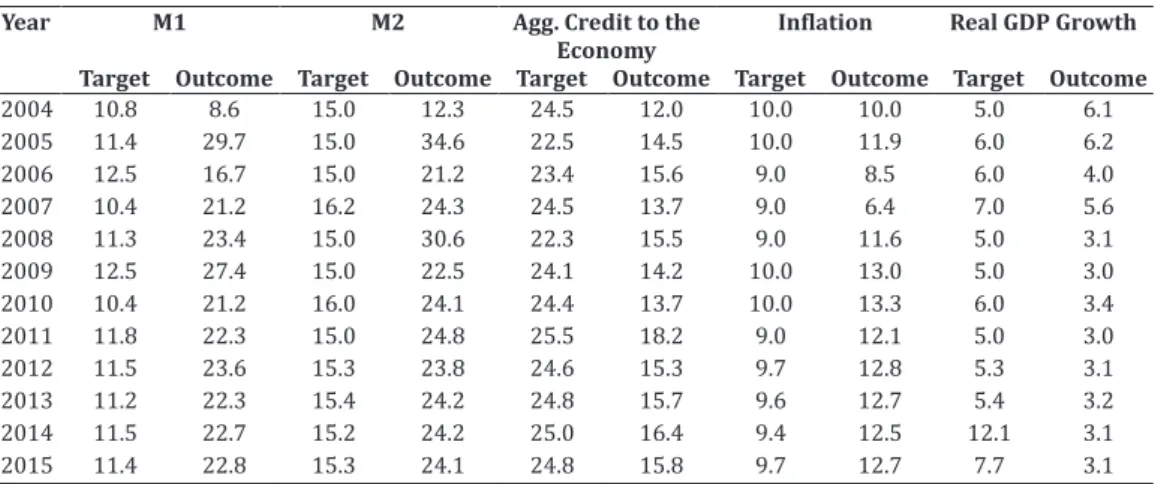
The new monetary policy framework, anchored on the medium term perspective (between 2006 and 2007) appeared plausible, but however, produced mixed outcomes. Monetary outcomes were above targets for most of the years (see Table 3). This could be traced to the impact of fiscal dominance and the technological innovations that have taken place in the financial system and which has affected the hitherto relatively stable relationship between money and domestic output.
Relative to the past, the conduct of monetary policy during the period could be said to be fairly effective. Table 3 showed inflation and growth outcomes were closest to their targets during the period 2006-2007 compared to previous periods.
Table 3: Key variables (% except other wise stated)
Year M1 M2 Agg. Credit to the
Economy
Inflation Real GDP Growth Target Outcome Target Outcome Target Outcome Target Outcome Target Outcome
2004 10.8 8.6 15.0 12.3 24.5 12.0 10.0 10.0 5.0 6.1
2005 11.4 29.7 15.0 34.6 22.5 14.5 10.0 11.9 6.0 6.2
2006 12.5 16.7 15.0 21.2 23.4 15.6 9.0 8.5 6.0 4.0
2007 10.4 21.2 16.2 24.3 24.5 13.7 9.0 6.4 7.0 5.6
2008 11.3 23.4 15.0 30.6 22.3 15.5 9.0 11.6 5.0 3.1
2009 12.5 27.4 15.0 22.5 24.1 14.2 10.0 13.0 5.0 3.0
2010 10.4 21.2 16.0 24.1 24.4 13.7 10.0 13.3 6.0 3.4
2011 11.8 22.3 15.0 24.8 25.5 18.2 9.0 12.1 5.0 3.0
2012 2013 2014 2015
11.5 11.2 11.5 11.4
23.6 22.3 22.7 22.8
15.3 15.4 15.2 15.3
23.8 24.2 24.2 24.1
24.6 24.8 25.0 24.8
15.3 15.7 16.4 15.8
9.7 9.6 9.4 9.7
12.8 12.7 12.5 12.7
5.3 5.4 12.1
7.7
3.1 3.2 3.1 3.1
Source: CBN Bullion and Statistical Bulletin, 2007, 2009, 2011and 2016
Inflation and exchange rates were relatively stable during the period 2004-2015 and the bank’s favoured measure of inflation, the year–on-year headline inflation remained single digit in the post bank consolidation. Likewise, the exchange rate of the naira became fairly stable. The relationship between money, output and prices became more distorted, especially in the second half of 2009, despite the expansionary stance of monetary policy. The macroeconomic environment in 2009
18
presented significant challenges for the attainment of price stability, given the emerging problem of excess liquidity in the banking system.
The inflation rate which peaked at 72.8% in 1995, which was the major problem in the economy during the first half of 1990s, decelerated rapidly from 72.8% in 1995 to 6.6% and 6.9% in 1999 and 2000 respectively. However, the declining trend in the inflation rate was reversed in 2001 when the rate shot up to 18%, owing to excessive government spending of the excess earnings from crude oil exports. The action taken by CBN in 2001 and early 2002 to contain demand pressure led to steady deceleration of the inflation rate to an estimated 13.0 and 11.6% in 2002 and 2003 respectively. In spite of the reforms in the articulation and execution of monetary policy during this period, most of the monetary and financial targets were substantially missed. This is evident from table 4. The actual growth rates in broad measure of money supply (M2) and aggregate bank credit for 1999-2011 were higher than the targets by wide margins. Although, inflation performed better in five of the fourteen years, aggregate output was sluggish during the period.
(Uchendu, 2009).
Table 4: Key variables (% except otherwise stated)
Year M1 M2 Agg.Credit to the Economy Inflation Real GDP Growth Target Outcome Target Outcome Target Outcome Target Outcome Target Outcome
1999 4.1 19.9 10.0 31.4 18.3 35.5 9.0 6.6 3.0 2.7
2000 9.8 62.2 14.6 48.1 27.8 (23.1) 9.0 6.9 3.0 3.8
2001 12.2 27.0 12.2 27.0 15.8 74.8 7.0 16.5 5.0 4.6
2002 12.4 15.9 15.3 21.5 57.9 56.6 9.3 12.9 5.0 3.5
2003 13.8 29.5 15.0 24.1 25.7 58.4 9.0 23.8 5.0 10.2
2004 10.8 8.6 15.0 12.3 24.5 12.0 10.0 10.0 5.0 6.1
2005 11.4 29.7 15.0 34.6 22.5 14.5 10.0 11.9 6.0 6.2
2006 12.5 16.7 15.0 21.2 23.4 15.6 9.0 8.5 6.0 4.0
2007 10.4 21.2 16.2 24.3 24.5 13.7 9.0 6.4 7.0 5.6
2008 11.3 23.4 15.0 30.6 22.3 15.5 9.0 11.6 5.0 3.1
2009 12.5 27.4 15.0 22.5 24.1 14.2 10.0 13.0 5.0 3.0
2010 10.4 21.2 16.0 24.1 24.4 13.7 10.0 13.3 6.0 3.4
2011 11.8 22.3 15.0 24.8 25.5 18.2 9.0 12.1 5.0 3.0
2012 2013 2014 2015
11.6 11.3 11.7 11.5
23.6 22.4 22.8 22.9
15.3 15.4 15.2 15,3
23.8 24.2 24.3 24.1
24.7 24.9 25.0 24.9
15.4 15.8 16.5 15.9
6.3 8.4 7.9 17.3
12.8 12.7 12.5 12.7
5.3 5.4 5.2 5.3
3.1 3.2 3.1 3.1
Source: CBN Bullion and Statistical Bulletin, 2007, 2009, 2011 and 2016
19
Overall, the real GDP growth rate only marginally increased from 3.8% in 2000 to 3.9 % in 2001. In general, the growth performance remained weak due largely to the poor state of economic infrastructure resulting from past neglect, which required more time to correct. The overall growth was, therefore, sluggish with negative consequences for poverty alleviation (Adeoye, 2007).
The data trend showed how government lowered liquidity (or money supply) in the economy. This policy stance was vigorously pursued from 1999 to reduce the high rate of inflation experienced in the previous years. Table 5 showed the outcomes of macroeconomic management, in terms of macroeconomic and monetary performance and how GDP output growth fell below the target of 4%.
Table 5: Macroeconomic Performance Indicators (1996 -2015)
Year GDP Growth
(%) Index of Agric Production
(% Cr)
Index of Industrial Production
(% Cr)
Manufacturin g Capacity Utilization
Inflation Rate
(CPI Cr) BOP Deficits
(Nbn) Unemployment Rate (%)
1996 3.4 3.7 2.5 32.5 29.3 -53.2 3.4
1997 3.8 4.7 2.0 37.2 8.5 11.0 3.2
1998 2.4 3.5 -4.7 32.4 10.0 -75.2 3.2
1999 2.7 3.7 -1.4 34.6 8.0 -304.4 3.0
2000 3.8 3.3 3.4 34.6 6.9 78.3 18.1
2001 3.9 3.9 3.8 42.7 18.9 96.0 13.7
2002 4.63 4.3 2.6 54.9 12.9 50.9 12.2
2003 9.57 7.0 5.6 56.5 14.0 100.7 14.8
2004 6.58 6.3 11.9 55.7 15.0 261.5 13.4
2005 6.51 7.1 9.6 54.8 17.0 444.5 11.9
2006 5.63 7.4 9.3 53.3 8.2 421.6 14.6
2007 5.6 7.4 9.6 53.4 5.3 439.7 10.9
2008 8.8 7.6 9.6 53.8 11.6 497.6 12.8
2009 2.7 8.0 10.0 58.9 13.0 325.3 19.7
2010 4.4 8.0 10.2 54.9 13.3 303.0 21.1
2011 5.3 7.9 10.1 55.9 12.1 375.3 23.9
2012 2013 2014 2015
4.1 4.6 4.7 4.5
8.0 8.0 8.0 8.0
10.1 10.1 10.1 10.1
56.7 55.8 56.1 56.2
12.8 12.7 12.5 12.7
334.5 337.6 349.1 340.4
19.3 21.4 21.5 20.7
Source: a. Monetary Policy Circular No.34
b. CBN Annual Report and Statement of Accounts, various Issues.
c. Central Bank of Nigeria Statistical Bulletin, December, 2010 n.a: Not Available
20
Similarly, unemployment rates f ell below the targeted rate between 1997 and 1999. Output growth fell between 1998 and 2000, averaging 2.6% as against the 3.6% experienced between 1996 and 1997.
The inflation rate fell to 8% in 1999 and down to 6.9% in the year 2000, achieving the single digit figure targeted (see Table 5).
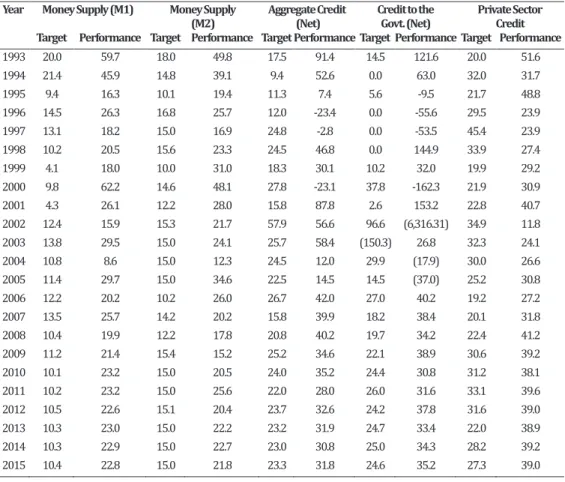
In 1999, the major objectives of monetary policy, as stated in the CBN monetary policy Circular No33 were; stimulation of output and employment growth; sustenance of price and exchange rate stability and strengthening of external sector viability (CBN, 1999). Consequently, monetary targets were set for the growth of monetary aggregates, for instance, monetary targets were set for the growth of aggregate bank credit, the growth of money supply (M1 and M2), the growth of domestic credit to the economy, the growth of bank credit to the private sector, the reduction of the inflation rate, and the growth of GDP (Adam and Folawawo, 2004). However, the objectives of stimulating output and employment growth, price stability were not attained (Adam and Folawawo, 2004); Overall, CBN’s experience with monetary targeting was characterized with the problem of target overshooting as shown on table 6. Nnanna (2002) posited that the fiscal dominance then, in the economy was largely responsible for the non – achievement of targets.
21
Table 6: Monetary Variables, Target and Performance (1993 – 2015)
Year Money Supply (M1) Money Supply (M2)
Aggregate Credit (Net)
Credit to the Govt. (Net)
Private Sector Credit Target Performance Target Performance Target Performance Target Performance Target Performance
1993 20.0 59.7 18.0 49.8 17.5 91.4 14.5 121.6 20.0 51.6
1994 21.4 45.9 14.8 39.1 9.4 52.6 0.0 63.0 32.0 31.7
1995 9.4 16.3 10.1 19.4 11.3 7.4 5.6 -9.5 21.7 48.8
1996 14.5 26.3 16.8 25.7 12.0 -23.4 0.0 -55.6 29.5 23.9
1997 13.1 18.2 15.0 16.9 24.8 -2.8 0.0 -53.5 45.4 23.9
1998 10.2 20.5 15.6 23.3 24.5 46.8 0.0 144.9 33.9 27.4
1999 4.1 18.0 10.0 31.0 18.3 30.1 10.2 32.0 19.9 29.2
2000 9.8 62.2 14.6 48.1 27.8 -23.1 37.8 -162.3 21.9 30.9
2001 4.3 26.1 12.2 28.0 15.8 87.8 2.6 153.2 22.8 40.7
2002 12.4 15.9 15.3 21.7 57.9 56.6 96.6 (6,316.31) 34.9 11.8
2003 13.8 29.5 15.0 24.1 25.7 58.4 (150.3) 26.8 32.3 24.1
2004 10.8 8.6 15.0 12.3 24.5 12.0 29.9 (17.9) 30.0 26.6
2005 11.4 29.7 15.0 34.6 22.5 14.5 14.5 (37.0) 25.2 30.8
2006 12.2 20.2 10.2 26.0 26.7 42.0 27.0 40.2 19.2 27.2
2007 13.5 25.7 14.2 20.2 15.8 39.9 18.2 38.4 20.1 31.8
2008 10.4 19.9 12.2 17.8 20.8 40.2 19.7 34.2 22.4 41.2
2009 11.2 21.4 15.4 15.2 25.2 34.6 22.1 38.9 30.6 39.2
2010 10.1 23.2 15.0 20.5 24.0 35.2 24.4 30.8 31.2 38.1
2011 10.2 23.2 15.0 25.6 22.0 28.0 26.0 31.6 33.1 39.6
2012 2013 2014 2015
10.5 10.3 10.3 10.4
22.6 23.0 22.9 22.8
15.1 15.0 15.0 15.0
20.4 22.2 22.7 21.8
23.7 23.2 23.0 23.3
32.6 31.9 30.8 31.8
24.2 24.7 25.0 24.6
37.8 33.4 34.3 35.2
31.6 22.0 28.2 27.3
39.0 38.9 39.2 39.0
Source: 1) CBN Economic & Financial Review, 40 (3). 2002. Pp.11.(2). CBN Bullion 2011
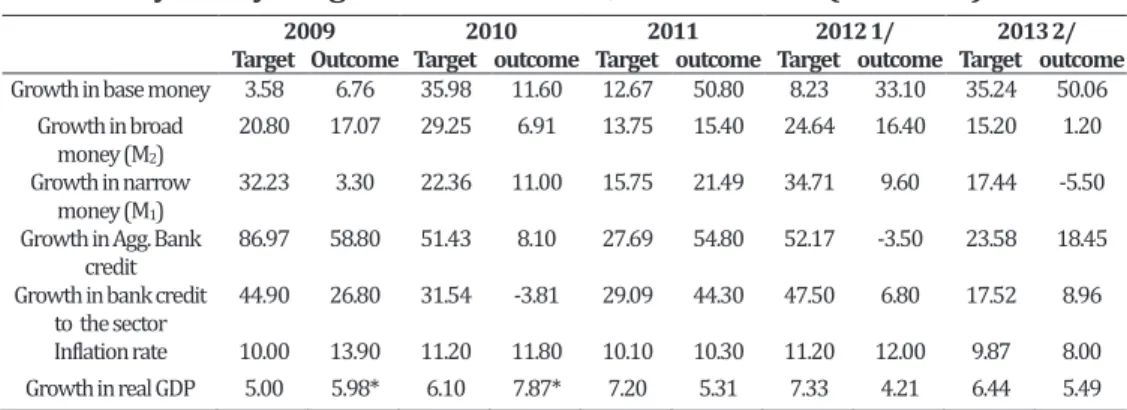
Growth in the major monetary aggregate as subdued and significantly below the indicative benchmark for fiscal 2013 and the rate attained at the end of the corresponding period of 2012, reflecting essentially the tight monetary policy stance of the bank. At the end of December 2012, broad money supply, (M2) grew by 1.2 per cent to N15, 668.95 billion. At that level, M2 was below the indicative growth benchmark of 15.2 per cent for fiscal 2013 and the 16.4 per cent attained at the end of December 2012. The development reflected the respective decline in net foreign assets and other net assets of the banking system, which moderated the increase in net domestic credit.
22
Table 7: Key Policy Targets and outcomes, 2009 – 2013 ( Per cent)
2009 2010 2011 2012 1/ 2013 2/
Target Outcome Target outcome Target outcome Target outcome Target outcome Growth in base money 3.58 6.76 35.98 11.60 12.67 50.80 8.23 33.10 35.24 50.06
Growth in broad money (M2)
20.80 17.07 29.25 6.91 13.75 15.40 24.64 16.40 15.20 1.20 Growth in narrow
money (M1)
32.23 3.30 22.36 11.00 15.75 21.49 34.71 9.60 17.44 -5.50 Growth in Agg. Bank
credit
86.97 58.80 51.43 8.10 27.69 54.80 52.17 -3.50 23.58 18.45 Growth in bank credit
to the sector
44.90 26.80 31.54 -3.81 29.09 44.30 47.50 6.80 17.52 8.96 Inflation rate 10.00 13.90 11.20 11.80 10.10 10.30 11.20 12.00 9.87 8.00 Growth in real GDP 5.00 5.98* 6.10 7.87* 7.20 5.31 7.33 4.21 6.44 5.49
Source: CBN Annual Economic Report, (2013)
Narrow money (M1) fell by 5.5 per cent at end-December 2013, in contrast to the growth of 9.6 per cent at the end of the preceding year.
Aggregate bank credit to the domestic economy grew by 18.5 per cent, in contrast to the decline of 3.5 per cent at the end of December 2012. The development reflected an increase 40.1 per cent in net claims on the Federal Government and 8.96 per cent growth in claims on the private sector. Base money grew by 50.1 per cent at the end of the review period, compared with the indicative growth benchmark of 35.24 per cent for the period and the 33.1 per cent attained at the end of 2012.
Monetary policy was tight in most past of 2015, in response to the challenging global and domestic economic environment. In the domestic front, the challenges included dwindling foreign exchange reserves, arising from low crude oil price in the international market, low fiscal buffers and excess liquidity in the banking system. Growth in the major monetary aggregate was lower than the indicative benchmark for fiscal 2015while broad money supply, M2, grew by 5.9 per cent.
23
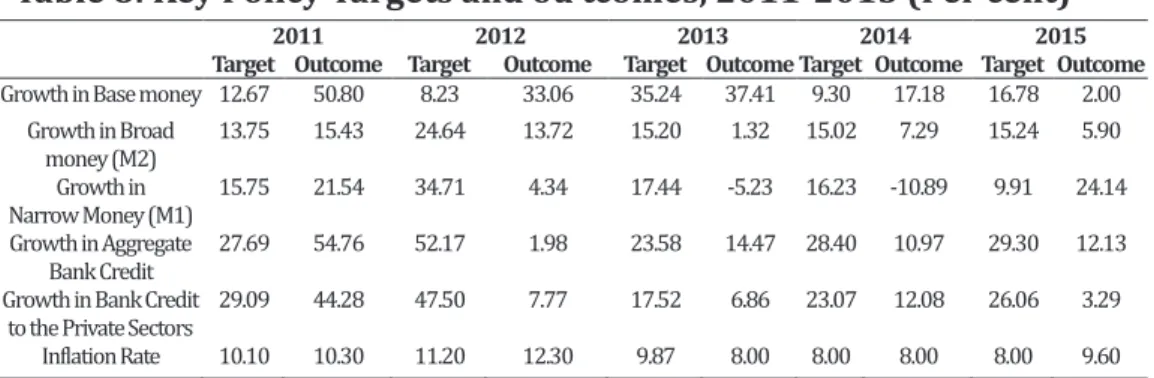
Table 8: Key Policy Targets and ou tcomes, 2011-2015 (Per cent)
2011 2012 2013 2014 2015
Target Outcome Target Outcome Target Outcome Target Outcome Target Outcome Growth in Base money 12.67 50.80 8.23 33.06 35.24 37.41 9.30 17.18 16.78 2.00
Growth in Broad money (M2)
13.75 15.43 24.64 13.72 15.20 1.32 15.02 7.29 15.24 5.90 Growth in
Narrow Money (M1)
15.75 21.54 34.71 4.34 17.44 -5.23 16.23 -10.89 9.91 24.14 Growth in Aggregate
Bank Credit
27.69 54.76 52.17 1.98 23.58 14.47 28.40 10.97 29.30 12.13 Growth in Bank Credit
to the Private Sectors
29.09 44.28 47.50 7.77 17.52 6.86 23.07 12.08 26.06 3.29 Inflation Rate 10.10 10.30 11.20 12.30 9.87 8.00 8.00 8.00 8.00 9.60
Source: CBN Annual Report, 2015
In 2015, excess liquidity in the banking system persisted, buoyed by the huge maturing CBN bills and disbursement of statutory revenue and Value Added Tax (VAT) to the states and local governments. Thus, the thrust of policy, as in the preceding years, was aimed at curbing the level of banking system liquidity to achieve the bank’s mandate of price stability and monetary stability, conducive to sustainable economic growth. However, there was a mixed performance in the key target policy as policy targets were substantially missed in 2011 but in 2012, 2013, 2014 and 2015 the monetary policy targets were substantially attained (see Table 8).
CHALLENGES OF MONETARY POLICY TRANSPARENCY IN NIGERIA While there has been a pronounced increase in the transparency of monetary policy by the CBN over the last decade, considerable challenges remain. Arising from the discussion of the preceding section of this paper, this section discusses the challenges of CBN monetary policy transparency.
The type and nature of information to release: One of the biggest challenges of monetary policy transparency facing the CBN is determining what information to release about the policy process and decisions. One possible, though thoroughly uninformative, answer is all