The purpose of this section is to review some of the most recent and exciting developments. The success of the orbital averaging procedure relies heavily on the analytical solutions for Kepler orbits used in averaging over the orbital time scale. The evolution of the total angular momentumJ averaged over a precession cycle is then given by57.
In high-energy collisions, most of the energy of the center of mass is present in the form of kinetic energy of the colliding object. Numerical simulations of non-rotating, equal-mass, head-on colliding BHs predict,89 that in the ultrarelativistic limit a fraction of 14±3% (recently confirmed and improved to 13±1%90 by the RIT group) of the total energy is radiated into the GW. The energy released into the GW in these grazing collisions can be enormous, exceeding 35% of the total energy.
Spin simulations of BHs105 also show that the influence of spin on the collisional dynamics is washed out in the v → c limit. These symmetry assumptions still accommodate most relevant scenarios in the context of testing TeV gravity or fundamental properties of BH spacetimes.
Compact Objects in Modified Theories of Gravity
Equation (11b) shows that α(ϕ) determines the strength of the coupling of the scalar fields to matter.144,161. In the case of Brans-Dicke theory, the best observational limit (α0 < comes from the Cassini measurement of the Shapiro time delay.162 An interesting feature of the scalar-tensor gravity is the prediction of characteristic physical phenomena that do not occur in GR. Spinning NSs at first order in the Hartle-Thorne slow rotation approximation were studied by Damour and Esposito-Far`ese160 and later by Sotani.187 At first order in rotation, the scalar field affects only the moment of inertia, mass and radius of the NS.
Figure 1 shows representative examples of the properties of NSs in a scalar-tensor theory with spontaneous scalarization at second order in the rotation parameter. Under these conditions, numerical simulations have also recently revealed the possibility of "dynamic scalarization"—a growth of the scalar field that can affect the waveform close to fusion significantly and potentially be detectable.192-196. An interesting feature of the Bowers-Liang models is that it allows for stellar configurations with compactness approaching the Schwarzschild limit = 2M.
When the matter action SM can be neglected, the Einstein framework formulation of the theory corresponds to GR minimally coupled to a scalar field. A natural generalization of the Bergmann-Wagoner formulation (8) consists in including more than one scalar field coupled with gravity. TMS theories are more complex than theories with a single scalar field, since the geometry of the target space can affect the dynamics.
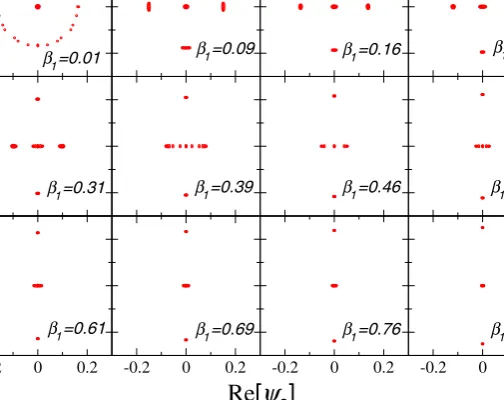
In this case, we found solutions only when the real or imaginary part of the scalar field has a non-trivial profile; these theories are effectively equivalent to one-scale theories. Scalar field amplitude in full TMS theory. Real and imaginary part of the scalar field amplitude at the stellar center ψ0 for stellar models with β0 =−5,|α|= 0.001 and fixed baryon mass MB= 1.8M. The symmetry is broken (the solution "circles" turns into "crosses") when β1 |α|, and the transverse form of the scalarized solutions in the plane (Re[ψ0], Im[ψ0]) collapses to a set of solutions. on the vertical line Re[ψ0] = 0 for larger values of β1 (lower panels in Fig. 3).
Besides the obvious addition of one or more scalar field(s), another possibility to generalize Bergmann-Wagoner-type scalar-tensor theories has recently attracted much attention. In other words, EdGB gravity is consistent for any value of the coupling constant, while other quadratic gravity theories should only be considered in the weak coupling limit. These solutions describe stationary BHs for all values of the mass and spin, and for all values of the coupling parameter in the allowed region (31).

Implications of Superradiant Instabilities for Fundamental Physics and Astrophysics
The amplitude of the superradiative enhancement of an incident wave depends on the rotation Ω, on the wave frequencyω and on the field that is scattered.242,258. Since Kerr BHs are unstable against sufficiently low frequency modes of a huge bosonic field, a relevant question is: what is the endpoint of the instability. Furthermore, these BHs are continuously connected to the Kerr solution, and as such they are called Kerr BHs with scalar209,210,276 or Proca hair.277 They are clearly related to the phenomenon of superradiation, as they exist at the threshold of the inequality (33), and Int. Downloaded from www.worldscientific.com.
In the present case, an assumption in many of the no-hair theorems, including those of Bekenstein, is that the metric and the matter field share the same symmetries. These coordinates reduce to prolatespheroidal coordinates (instead of the more familiar spheroidal ones, obtained in the flat spacetime limit of the Boyer-Lindquist form of the Kerr metric) in an appropriate Minkowski limit.277 A simple analysis shows that rH = const . From the numerical solutions it turns out that ΩHisθ-independent and r=rH is a Killing horizon of the Killing vector fieldξ=∂t+ ΩH∂ϕ.
A test field analysis shows the existence of stationary, everywhere regular (on and off the horizon) solutions of the scalar or Proca field277 on Kerr BH spacetime:stationary scalar or Proca clouds around Kerr BHs. This state is interpreted as a null state for the superradiative instability, which sets in for R(ω)< mΩH, giving I(ω)>0. The construction of Kerr BHs with scalar and Proca hair adapted the technology already in use for (rotating) boson stars.286,287 Scalar boson stars can be constructed with ansatz (34)–(35) takingrH = 0, and will thus be a limiting case of the corresponding Kerr BHs with scalar hairs. f The Einstein-Klein-Gordon system of equations gives five coupled nonlinear PDEs for the five unknown functions plus two "constraint" equations (which are variously related to the remaining ones) .
Regular and outer=rH solutions can be found, and they correspond to Kerr BHs with Proca hairs.277 The rH = 0 limit yields rotating Proca stars, 288 spin-1 cousins of the aforementioned boson (scalar) stars. Exploring the physical and phenomenological properties of these new families of hairy BHs associated with Kerr solutions is an ongoing quest. These are also anchored in a similar state between the scalar field frequency and the angular velocity of the horizon. 293,294 InD = 5 asymptotically flat spacetime, vacuum Myers–Perry BHs are not, however, affected by the superradiative instability. field.
The evolution of the superradiant instability of massive scalars and vectors has recently been treated taking into account gravitational radiation, superradiant accretion and the effects of a putative accretion disc around BH,297, but in an adiabatic approximation (rather than a fully non-linear numerical evolution ).
Analog Gravity
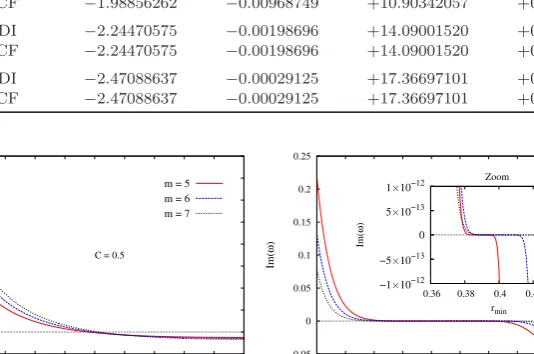
The instability of ergoregions318 in acoustic systems has recently been studied for a hydrodynamic vortex, both for incompressible319 and compressible fluids.320 Here we will review the investigation of the instability of a hydrodynamic vortex consisting of an incompressible fluid.319 (The numerical results shown here are obtained for higher values of the azimuthal number m, which complement those shown in Ref.319). Using the line element (47) in the Klein–Gordon equation (41) and assuming a field decomposition Φ as These instabilities develop within the ergoregion, i.e. for r <|C|.319 In order to obtain the QNM frequencies of the hydrodynamic vortex, we can use various numerical techniques to integrate Eq. Some results for QNM frequencies are shown in Table 1 for various Int. Downloaded from www.worldscientific.com.
QNM frequency ω for different values of azimuth number and rotation C = 0.5, obtained numerically from DI and CF estimations. Real (left) and imaginary (right) components of QNM fundamental frequencies plotted as a function of rmin, for C = 0.5 and m = 5,6,7. The real and imaginary parts of the QNM frequencies are plotted in Fig. 4 as functions of rmin for different values of the azimuth number m obtained using the CF method, taking into account the circulation C= 0.5.
From the results shown in Table 1, it can be seen that as the azimuthal number of min increases (decreases), the size of the real (imaginary) part of the QNM frequencies increases (decreases). Furthermore, from the graphs shown in Figure 4, we find that as rmin decreases, the magnitude of the real and imaginary parts of the QNM frequencies increases (decreases) for the unstable (stable) modes. This behavior of the imaginary part is clearly visible in the inset of the right panel of Figure 4.
In Fig.5, we analyze the behavior of acoustic clouds by presenting the values of the boundary location r0 as a function of the angular velocity in the horizon ΩH,. Similar figures but with different choices of cloud quantum numbers can be found in Benoneet al.321,322. We see that, for a fixed position r0 of the barrier, acoustic clouds occur for smaller values of ΩH as we increase the value of em.
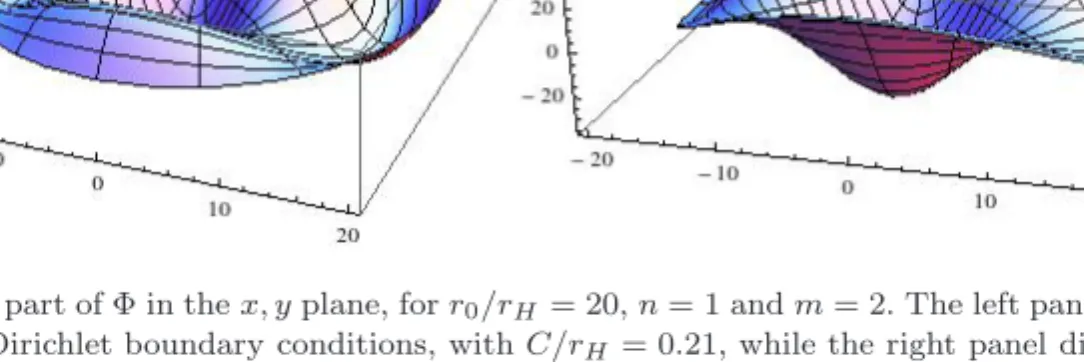
Three-dimensional plots of the radial and azimuthal profiles of acoustic clouds are shown in Figs. 6 for Dirichlet (left panel) and Neumann (right panel) boundary conditions.

Concluding Remarks
The left panel shows the case for Dirichlet boundary conditions, with C/rH = 0.21, while the right panel shows the case for Neumann boundary conditions, with C/rH= 0.17. Research at the Perimeter Institute is supported by the Government of Canada through Industry Canada and by the Province of Ontario through the Ministry of Economic Development and Innovation. PHY-090003, Cambridge High Performance Computing Service Supercomputer Darwin, using Strategic Research Infrastructure Funding from HEFCE and STFC, and DiRAC's Cosmos Shared Memory system through BIS Grant No.
Bona-Casas, Elements of Numerical Relativity and Relativistic Hydrodynamics (Springer, Dordrecht Heidelberg, London, New York, 2009). Wald, Gravitational collapse and cosmic censorship, in Black Holes, Gravitational Radiation and the Universe, ed. Sampaio, Radiation from a D-dimensional collision of shock waves: An insight allowed by the D parameter, in Proc.
13th Marcel Grossmann Meeting on Recent Developments in Theoretical and Experimental General Relativity, Astrophysics and Relativistic Field Theories (MG13) (Stockholm, Sweden, 2015), p. Coelho, Radiation from a D-Dimensional Collision of Gravitational Shock Waves, PhD Thesis, University of Aveiro, Portugal (2015). Tunyasuvunakool, Dimension reduction in numerical relativity: modified cartoon formalism and regularization, in 3rd Amazonian Symp.