REFERENCE BOOK ON
GEOTHERMAL DIRECT USE
REFERENCE BOOK ON
GEOTHERMAL DIRECT USE
Prepared for
U.S. Department of Energy Geothermal Division
Prepared by
P. J. Lienau, J. W. Lund, K. Rafferty and G. Culver
Geo-Heat Center
Oregon Institute of Technology 3201 Campus Drive
Klamath Falls, OR 97601 Ph: 503-885-1750 Fax: 503-885-1754
August 1994
DISCLAIMER STATEMENT
This report was prepared with the support of the U.S. Department of
Energy (DOE Grant No. DE-FG07-90ID 13040). Any opinions, findings,
conclusions, or recommendations expressed herein are those of the
author(s) and do not necessarily reflect the view of DOE.
TABLE OF CONTENTS
1.0 Introduction... 1
2.0 Geothermal Heat Pumps... 6
3.0 Geothermal Energy for Buildings... 6
4.0 Geothermal Energy for Industry... 7
5.0 Conclusions... 9
6.0 References... 10
LIST OF FIGURES Figure 1. Growth of direct use industry... 3
Figure 2. Generalized map of geothermal resources showing locations of geothermal district heating systems... 5
Figure 3. Application temperature range from some industrial processes and agriculture applications... 8
LIST OF APPENDICES
Appendix A. Fact Sheets on Direct Use Projects Appendix B. Direct Use Database
Appendix C. Comparative Cost Analysis Between Geothermal System and Gas-Fired Boiler System
Appendix D. Geo-Heat Center Publications
1.0 INTRODUCTION
Enormous potential exists in the United States for geothermal direct use and geothermal heat pumps to make a significant contribution to our national energy needs while offsetting the use of fossil fuels. Geothermal projects reduce gaseous emissions and acid rain from the combustion of fossil fuels that impact our environment. Geothermal direct use has practically zero emission of greenhouse-type gases and essentially no thermal pollution.
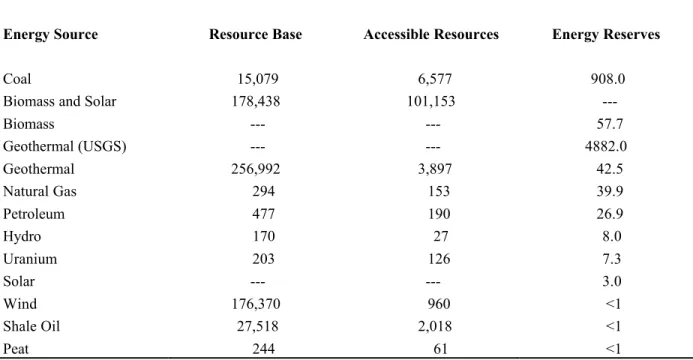
The low-to-moderate temperature (<150oC) geothermal resource base (38,900 Quads) is much more plentiful and widespread than the high-temperature (>150oC) resource base (4,800 Quads). A recent report prepared for DOE by Meridian Corporation (Meridian, 1989) compares the magnitudes of the energy resource base in the U.S., as shown in Table 1. There is nearly 20 times more geothermal energy than the energy we could derive from burning all of the coal in the U.S., and 300 times the energy available in oil and gas. Geothermal energy is a domestic resource that contributes to our national energy security and decreases our trade deficit while saving petroleum for higher priority uses.
It is important to note the last column--Energy Reserves in Table 1 (also called the Resource in United States Geological Survey [USGS] publications). In general, Energy Reserves is the energy that can be economically and legally extracted under current or near-term economic and technological conditions. That definition, however, is subject to different interpretations by individuals and/or agencies, and as economics and technology change one must carefully consider the assumptions.
In the case of geothermal energy, the USGS Energy Reserves estimates are taken from Circular 790 (1978) and Circular 892 (1982). Circular 790 considers those resources above 90oC; while, Circular 892 addresses those resources between 90oC and 10oC above mean-annual air temperature (about 25oC for much of the US) and having a temperature gradient of 25oC/km with depth. Although Circular 790 considered depths of from 3 km to 10 km, only the 3 km depth is reported in Table 1. The USGS estimates consider both identified and what they considered at the time a reasonable amount of undiscovered resources.
The Meridian report is based on USGS estimates, modified by a study by the National Academy of Sciences--that gave a much more conservative estimate (about 100 times lower). The lowest temperature Meridian considered was 40oC and according to their definition of reserves, they considered only identified resources. Meridian's economics considers
$18/bbl oil prices; whereas, when Circular 790 was written in 1978, prices were about 1-1/2 times higher, and predicted to climb even higher. Neither of these studies considered the vast amount of geothermal energy available for use by heat pumps which can utilize 4oC ground temperatures with no groundwater being required.
The 40oC lower limit is not a bad estimate for direct use. There are greenhouses and space heating applications utilizing 33oC geothermal fluids and aquaculture projects (one of the fastest growing US industries) utilizing 24oC fluids. Their contribution to the overall energy consumption is small; but, it does demonstrate that the technology is available, and the economics are good.
1
Table 1. U.S. Energy Resources (BBOE)*
Energy Source Coal
Biomass and Solar Biomass
Geothermal (USGS) Geothermal
Natural Gas Petroleum Hydro Uranium Solar Wind Shale Oil Peat
Resource Base 15,079 178,438
--- --- 256,992
294 477 170 203 --- 176,370 27,518 244
Accessible Resources 6,577 101,153
--- --- 3,897 153 190 27 126 --- 960 2,018 61
Energy Reserves 908.0
--- 57.7 4882.0
42.5 39.9 26.9 8.0 7.3 3.0 <1 <1 <1 * Billion Barrels of Oil Equivalent.
USGS reported gigawatts electric and gigawatts thermal available for 30 years. This was probably based on the expected life of a fossil fueled power plant and on some temperature drop across the system based on entering fluid temperature. Unfortunately, this gives the impression that heat would be "mined" down to some minimum useable temperature and the resource abandoned. While this has apparently been true in some electrical production facilities, it has not been true in direct use installations. Geothermal district heating systems and heating of homes, schools, businesses, etc., have been ongoing for 100 years or more with no diminishing of temperature or flow rates. Profiteers may consider this under-utilization of a resource--others consider it good management. The earth has been giving off heat since its formation. It seems unlikely that it will cease in 30 years.
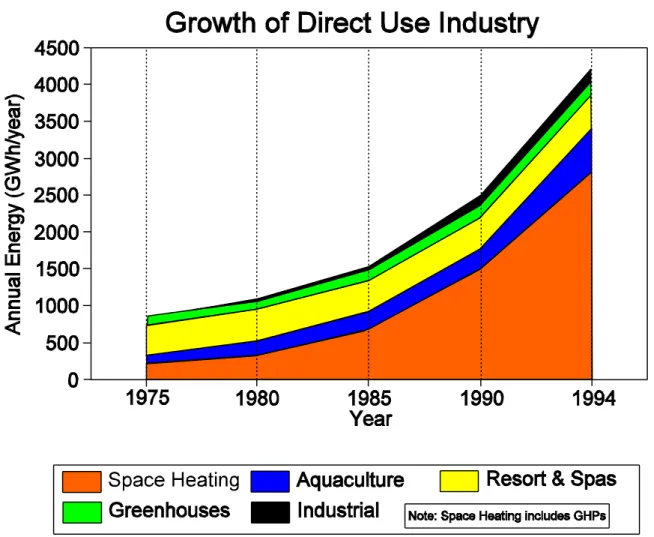
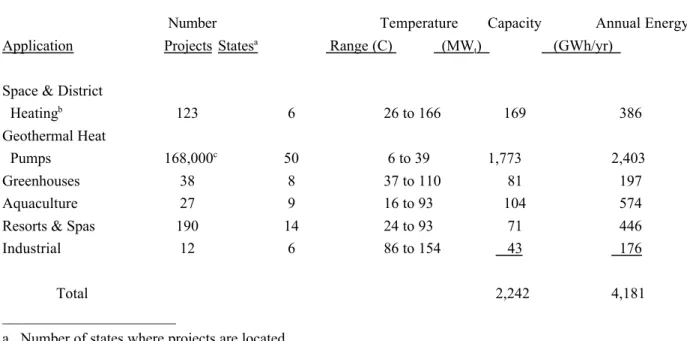
Lack of an adequate resource data base, risk of failure in exploration and drilling and lack of a dedicated industry have prevented geothermal direct use from achieving its full potential. Development of these resources can lead to space conditioning of buildings, greenhouse heating, aquaculture and other industrial applications. The current status is that an estimated annual energy contribution of over 4,181 GWh/yr (14.3 x 10¹² Btu/yr) can be attributed to the direct use industry. This represents only a small fraction of the potential (Lund, et al., 1990). Table 2 gives the relative annual energy use for each direct heat application, and Figure 1 the growth rate of the direct use industry since 1975.
Appendix A contains factsheets on 14 example direct use applications and Appendix B gives a tabulation of the direct use database of known U.S. projects.
2
Figure 1. Growth of direct use industry.
3
Table 2. Annual Energy Supplied for Major Direct Use Applications
_______________________________________________________________________________________________
Number Temperature Capacity Annual Energy
Application Projects Statesa Range (C) (MWt) (GWh/yr) Space & District
Heatingb 123 6 26 to 166 169 386
Geothermal Heat
Pumps 168,000c 50 6 to 39 1,773 2,403
Greenhouses 38 8 37 to 110 81 197
Aquaculture 27 9 16 to 93 104 574
Resorts & Spas 190 14 24 to 93 71 446
Industrial 12 6 86 to 154 43 176
Total 2,242 4,181
_______________________
a. Number of states where projects are located.
b. Differs from 1990 inventory (Lund, 1990) because Mammoth Lakes and Bridgeport geothermal district heating systems were not built; therefore, they are not included in this inventory.
c. Number of equivalent 3-ton geothermal heat pump units.
_______________________________________________________________________________________________
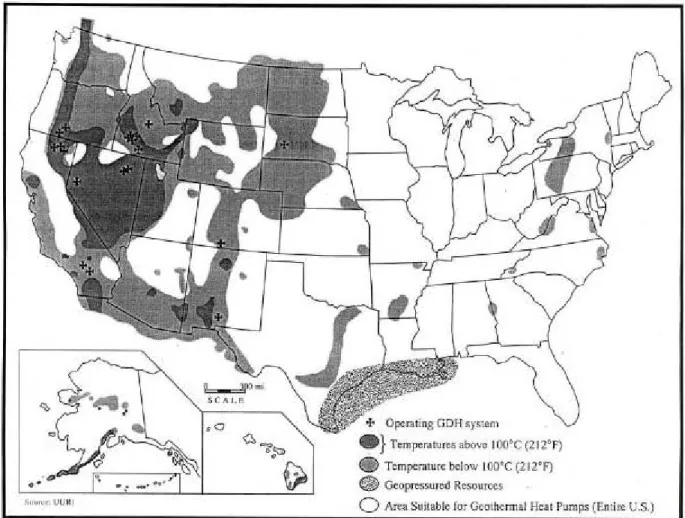
Low-to-moderate temperature resources in the United States are widespread (Figure 2) and can provide a source for many direct heat applications. In contrast to other renewable resources, geothermal energy is not hindered by a cyclical output as in the case of wind and solar. It is a base load (constant output) resource which does not require sophisticated storage strategies for application. Geothermal energy in the low temperature range can have a significant impact on U.S. energy consumption, especially for space heating.
For example, one way to illustrate the economic impact of a geothermal system compared to a gas-fired boiler is to calculate the total energy delivery cost for both systems. The analysis (Appendix C) includes amortization of the capital costs, operation, and maintenance of both systems. The results of the energy cost for the geothermal systems is $0.0042/kWh ($1.24/106 Btu) compared to $0.017/kWh ($4.99/106 Btu) for the gas-fired boiler, both supplying 5.9 MWt (20 x 106 Btu/hr) peak load to an application. The cost of energy from the geothermal system is only one-fourth (25%) that of the gas-fired boiler system.
Space heating in the 48o to 77oC range is by far the largest single U.S. energy use, representing 45 percent of all energy use below 260oC. Matching geothermal resources to meet these space heating requirements would result in much better use of U.S. energy reserves and reduced emissions from fossil fuels.
4
Figure 2. Generalized map of geothermal resources showing locations of geothermal district heating systems.
5
Opono"l! GDH ').'''''
e}
T ...p',"· .... ..,...
IiJ(fC VI;:'')• T,., ... " b<1,..l00"C{2lrF)
·.
-~. (il~" "" R""",,,,,
2.0 GEOTHERMAL HEAT PUMPS
Geothermal heat pumps (GHP) represent the largest potential use of geothermal energy. Geothermal heat pumps have national appeal because stable temperatures in the range of 4o to 21oC occur nationwide at depths below 9 m (Braud, 1992). GHPs do not necessarily require that water be pumped from the ground. Closed-loop systems utilize only the heat that is being transferred to and from the earth. The GHP is the highest efficiency heating and cooling system available, provides much lower energy costs for the consumer and greatly reduces electric peak demand for the utility.
GHPs represent a demand-side management option for utilities to avoid building new power plants. A typical home equipped with a GHP will shave about 5 kW off winter peak heating demand and about 1.0 kW from summer demand.
Thus, 200,000 homes using GHPs would offset a new 1,000 MW power plant with its associated emissions of CO2, NOx, and SO4. Although the incremental cost of the ground coupled closed loop adds an average of about $2000 to the cost of a residential heating system, paybacks occur in 3 to 5 years from money saved on utility bills. Specific costs and savings depend on conditions at the site of interest.
Currently, the main GHP use is in midwestern and southeastern states; however, the geothermal heat pump industry is poised for tremendous growth in the entire nation during the 1990s, with the opportunity to displace 2.7 Quads of energy by the year 2030 (EIA, 1990). Unfortunately, there is a lack of data and understanding by utilities and the public as to the long-term benefits of geothermal heat pumps.
3.0 GEOTHERMAL ENERGY FOR BUILDINGS (Other than by heat pumps)
Geothermal energy for space heating of residential, commercial and institutional buildings is primarily applicable in the western half of the United States (see Figure 2). The potential for geothermal space heating is large. Geothermal resources (>50oC) are collocated within 7 km of 254 western cities that have a combined heat load estimated at 386 GWh/yr (1,317 x 109 Btu/yr). Geothermal district heating systems, currently operating in 20 cities, save customers 30 to 50% in heating bills compared to conventional fuels.
A showcase of a successful geothermal district heating system is that of the city of San Bernardino, California. The system consists of two production wells with an average combined flow of 5,211 L/min of 54oC water in 19 km of insulated pipelines. The system currently serves 33 buildings including government offices, the county jail, the new blood bank facility and other private buildings. Other uses include heating for the anaerobic digester at the sewage treatment plant and disinfections for the city animal shelter. In all, the buildings used 11 GWh/yr (37.5 x 10⁹ Btu/yr) in FY92. By the end of 1993, there were three more facilities connected to the heating district, including two large laundries, that will triple the total heat load of the district.
The Department of Defense is looking for a place to locate a new accounting facility. San Bernardino made a proposal that included three locations in which geothermal energy could service the facility. Using geothermal energy would save approximately 18.8 x 10¹² J per year (5.2 thousand BOE), or about $90,000 in first-year operating costs.
6
San Bernardino's successful implementation of a geothermal space heating system in its mild climate is noteworthy.
This development demonstrates the very favorable prospects in the hundreds of other geothermal sites located in much colder climates. This technology represents considerable savings to customers while helping to meet clean air standards, especially in the Los Angeles Basin and scenic recreational areas.
To date, most geothermal direct use projects have been developed at or near previously proven resources (hot springs or areas of historic use). If geothermal direct use is to achieve even a small percentage of its great potential, two issues must be addressed:
• Energy engineers must be comfortable with direct use designs.
• The vast reserve of "masked" or hidden resources must be successfully accessed.
4.0 GEOTHERMAL ENERGY FOR INDUSTRY
Geothermal direct uses for industrial processes in the U.S., thus far, includes: gold mining, food processing, milk pasteurizing, grain drying, mushroom culture, sludge digester heating, greenhouse heating, and aquaculture. The estimated geothermal energy use for industry in the U.S. to date is 947 GWh/yr (3,232 x 109 Btu/yr). Direct use for industrial processes grew over four-fold during the 23-year period from 1970 to 1993 and continues to grow.
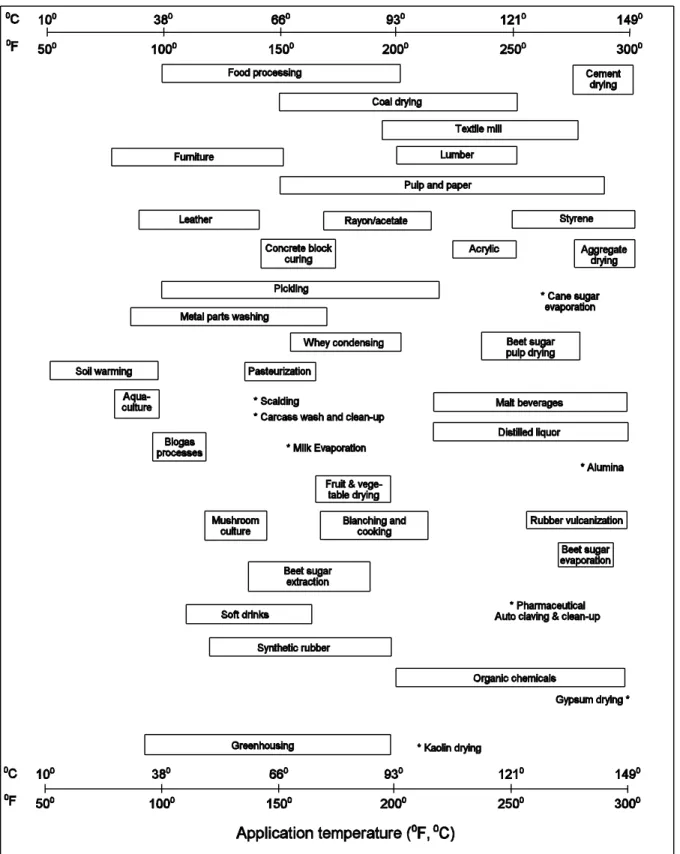
Figure 3 identifies other industrial and agricultural applications that can use geothermal energy.
Geothermal food processors, such as the vegetable dehydration plant at Brady, Nevada, can utilize sites with resource temperatures greater than 104oC for dehydration of fruits and vegetables. There are many sites in this temperature range near agriculture production areas in western states. A new dehydration plant near Gerlach, NV, began production in January 1994.
Greenhouses can utilize geothermal temperatures as low as 40oC. There are many such resources, but little is known about many of them. Most growers agree that despite the cost of wells, pumping, and the higher cost of heating equipment, geothermal saves about 5 - 8% of heating costs. While this adds to the profit margin, the main reasons for moving all or part of their operation from an urban location to a rural geothermal area include clean air with more sunlight, fewer disease problems, clean fresh water, more stable work force, and in some cases, lower taxes.
Aquaculture is one of the fastest growing industries. Catfish processing increased 21% last year. Although, only a small part of that increase involves geothermal facilities, it is well known that growth rates and food conversion are greatly enhanced with geothermal aquaculture. Geothermal aquaculture projects have obtained 50 to 300 percent growth rate increases in aquatic species as compared to solar heated ponds. Aquaculture can utilize geothermal resource temperatures as low as 21o to 27oC and can be cascaded from other uses. Current geothermal aquaculture use is 574 GWh/yr (1,960 x 109 Btu/yr) at 27 sites, and their number continues to increase.
7
San Bernardino's successful implementation of a geothermal space heating system in its mild climate is noteworthy.
This development demonstrates the very favorable prospects in the hundreds of other geothermal sites located in much colder climates. This technology represents considerable savings to customers while helping to meet clean air standards, especially in the Los Angeles Basin and scenic recreational areas.
To date, most geothermal direct use projects have been developed at or near previously proven resources (hot springs or areas of historic use). If geothermal direct use is to achieve even a small percentage of its great potential, two issues must be addressed:
• Energy engineers must be comfortable with direct use designs.
• The vast reserve of "masked" or hidden resources must be successfully accessed.
4.0 GEOTHERMAL ENERGY FOR INDUSTRY
Geothermal direct uses for industrial processes in the U.S., thus far, includes: gold mining, food processing, milk pasteurizing, grain drying, mushroom culture, sludge digester heating, greenhouse heating, and aquaculture. The estimated geothermal energy use for industry in the U.S. to date is 947 GWh/yr (3,232 x 109 Btu/yr). Direct use for industrial processes grew over four-fold during the 23-year period from 1970 to 1993 and continues to grow.
Figure 3 identifies other industrial and agricultural applications that can use geothermal energy.
Geothermal food processors, such as the vegetable dehydration plant at Brady, Nevada, can utilize sites with resource temperatures greater than 104oC for dehydration of fruits and vegetables. There are many sites in this temperature range near agriculture production areas in western states. A new dehydration plant near Gerlach, NV, began production in January 1994.
Greenhouses can utilize geothermal temperatures as low as 40oC. There are many such resources, but little is known about many of them. Most growers agree that despite the cost of wells, pumping, and the higher cost of heating equipment, geothermal saves about 5 - 8% of heating costs. While this adds to the profit margin, the main reasons for moving all or part of their operation from an urban location to a rural geothermal area include clean air with more sunlight, fewer disease problems, clean fresh water, more stable work force, and in some cases, lower taxes.
Aquaculture is one of the fastest growing industries. Catfish processing increased 21% last year. Although, only a small part of that increase involves geothermal facilities, it is well known that growth rates and food conversion are greatly enhanced with geothermal aquaculture. Geothermal aquaculture projects have obtained 50 to 300 percent growth rate increases in aquatic species as compared to solar heated ponds. Aquaculture can utilize geothermal resource temperatures as low as 21o to 27oC and can be cascaded from other uses. Current geothermal aquaculture use is 574 GWh/yr (1,960 x 109 Btu/yr) at 27 sites, and their number continues to increase.
7
Figure 3. Application temperature range from some industrial processes and agricultural applications.
8
The most recent new industrial use is to increase the efficiency of heap leaching for gold and other metals in Nevada.
Geothermal energy provides more efficient leaching because of higher temperature and lengthening the period during which outdoor leaching may be done. The gold and other metals were originally deposited by geothermal water-- epithermal deposits--and in some cases, geothermal heat is still available to extract them. At least 10 applicable sites have been located in Nevada and similar geologic conditions occur in other states.
5.0 CONCLUSIONS
The potential for geothermal direct use in the U.S. is very large. As noted earlier, there is a difference in the estimates of reserves by the NAS and USGS of approximately two orders of magnitude. The actual number probably is about midway between the two. A current project (funded by USDOE and being carried out by the Geo-Heat Center at OIT, University of Utah Research Institute and the Idaho Water Resources Research Institute) to update information on geothermal resources has identified more than twice as many wells and springs as reported in USGS Circulars 790 (1978) and 892 (1982). These findings support the USGS theory of undiscovered hidden resources (i.e., no surface manifestations), and were discovered by geologic inference and subsurface investigations. Undoubtedly, a large number of resources remain yet to be discovered.
There has been a steady increase in geothermal direct heat utilization. Impediments to faster expansion are:
1. Lack of information about the resources, particularly low-temperature resources, which have been ignored by the larger developers who are interested in high temperature electric power production.
2. Lack of infrastructure (i.e., architects, engineers, drillers and construction companies) to capitalize on the availability and application of low-temperature direct uses.
3. The relatively high risk and high initial costs of starting geothermal direct uses compared to conventional fuels.
Continued work on resource assessment and success of installed projects will reduce both the real and perceived risks of direct use projects. Assuming this takes place, the infrastructure will expand. Conventional fuel prices will rise as reserves (both domestic and foreign) are depleted in the future. This will drive expanded use of geothermal resources.
9
Heat Pumps
As shown in Figure 1, heat pumps have been the fastest growing sector of low-temperature geothermal. There is good reason for this. The resource is almost universally available, and in most areas of the U.S. (depending on weather and power costs), they are more cost effective over the life span than any other heating and cooling system. The main impediments to faster growth are:
1. Lack of infrastructure (i.e., lack of experienced installation contractors, some lack of experience and knowledge by architects.
2. The current higher initial installation costs; despite lower life-cycle cost.
3. Consumer acceptance due to lack of knowledge.
6.0 REFERENCES
Braud, H. J., 1992. "Ground-Coupled Heat Pump Applications and Case Studies", Geo-Heat Center Quarterly Bulletin, Vol. 14, No. 1, Klamath Falls, OR.
Energy Information Administration (EIA), 1990. "Renewable Energy Excursion: Supporting Analysis for the National Energy Strategy", report prepared for National Energy Strategy: Washington, D.C.
Freeston, D. H., 1990. "Direct Uses of Geothermal Energy in 1990", GRC Bulletin, Vol. 19, No. 7: Davis, CA.
Lienau, P. J. and J. W. Lund. Testimony presented to House Subcommittee on Environment.
Lund, J. W.; P. J. Lienau, and G. Culver, 1990. "The Current Status of Geothermal Direct Use Development in the United States, Update: 1985 - 1990", presented at GRC International Conference: Davis, CA.
Meridian Corporation, 1989. "Characterization of U.S. Energy Resources and Reserves", prepared for U.S.
Department of Energy: Alexandria, VA.
10
APPENDIX A
Factsheets on Direct Use Projects
AUBURN, NY SCHOOLS HEATING SYSTEM
System Type: Direct-use/Cogeneration - Space Heating
Location: Auburn, NY
Construction Date: 1983
Building or Process Size: 24,900 m2 (268,108 ft2), 2 buildings Resource Temperature: 52oC (125oF)
Well(s) Depth: 1600 m (5250 ft) production, 1560 m (5122 ft) injection Disposal Method: Injection
Capacity: 572 kW
Annual Energy: 0.9 GWh/yr (3.1 x 10⁹ Btu/yr)
Project Summary
The Auburn project is unique in a number of respects: it is one of the few direct-use project in the eastern U.S., it employs the deepest direct-use wells of any project in the U.S., and it extracts both heat and natural gas from the well.
The system, which provides space heating for a community college and a junior high school, uses a 3-stage approach to providing heat energy from the well. In the first stage, heat is transferred from the geothermal fluid through a heat exchanger similar to most other direct-use systems. The second stage consists of extracting heat from the geothermal fluid using a heat pump. The third stage delivers heat by burning methane, produced from the well, in an engine/generator. Waste heat from the engine is delivered to the hydronic loop and electricity is used to operate the various pumps necessary to operate the loop. Under normal operating conditions, the first stage provides 335 kW, the heat pump stage 69 kW and the natural gas stage 163 kW.
COMMONWEALTH BUILDING
System Type: Groundwater heat pump
Location: Portland, Oregon
Construction Date: 1948
Building or Process Size: 22,850 m2 (246,000 ft2) Resource Temp.: 17o to 18oC (62oF to 64oF) Well Depth(s): 46 m to 152 m (150 ft to 500 ft)
Disposal Method: Injection
Capacity: Orig. 1900 kW (540 tons), current 2460 kW (700 tons) Annual Energy: 4.8 GWh/yr (16.5 x 10⁹ Btu/yr)
Project Summary
The Commonwealth Building (originally known as the Equitable Building) was a project characterized by a great many innovative design features for its day. Among these were the first all fluorescent lighting; the first tinted, fixed double glazing and the first use of natural color aluminum exterior skin. In addition, the HVAC system featured the first use of a groundwater heat pump system in the northwest. Designed by Portland engineer J. Donald Krosker, the original system operated without heat exchangers to isolate groundwater from the building system. Exchangers were added in 1958. A large chiller was added in 1964 and a second chiller was replaced in 1975. The design includes a novel "pre-conditioning coil to temper ventilation air. Total building energy use varies between 199 and 227 kWh/m2 yr (63,000 and 72,000 Btu/ft2 yr).
ELKO HEAT COMPANY GEOTHERMAL DISTRICT HEATING SYSTEM
System Type: Direct-use geothermal, district heating
Location: Elko, NV
Construction Date: 1981
Building or Process Size: 17 buildings (1989) Resource Temperature: 79oC (175oF)
Well(s) Depth: 250 m (820 ft)
Disposal Method: Surface
Capacity: 2450 L/min (650 gpm), 3.8 MWt
Annual Energy: 6.5 GWh/yr (22.2 x 10⁹ Btu/yr), 50% cost savings to customers
Ownership: Private - Elko Heat Company
Project Summary
This system is noteworthy in several respects. It is one of the few geothermal district systems operated by a private entity and serving a primarily private customer base. Growth of the customer base between initial construction in 1981 and 1988 had resulted in the available capacity being fully subscribed.
A single well provides 79oC (175oF) water to the distribution system which serves the downtown Elko area. Disposal during the warmer part of the year provides irrigation to a local golf course.
The production well for the system was completed under the USDOE Program Opportunities Notice (PON). Under this program, the government participated in the cost of exploratory well drilling. The percentage of the government participation in this project was $827,404 or 43.6% of the total of the original project. The Elko Heat Company financed the remaining
$1,070,765.
Supply and return lines and control valves for laundry in Elko.
ENHANCED GOLD PROCESSING
System Type: Direct use geothermal, industrial process, heap leaching
Location: Round Mountain Gold Corp. is 50 miles north of Tonnopah, NV and Pegasus Gold Corp. is 50 miles north of Lovelock, NV.
Construction Date: 1990
Building/Process Size: 40,000 tons/day (ore), 286,000 oz/yr (gold) Resource Temperature: 86oC and 114oC (186oF and 238oF) Well(s) Depth: 305 m (1000 ft), two wells
Disposal Method: Injection
Capacity: 4164 L/min (1100 gpm), 16.1 MWt Annual Energy: 70 GWh/yr (240 x 109 Btu/yr)
Ownership: Private
Project Summary
Gold mining is a major industry in Nevada with a total of 32 mines in operation as of 1987. Many of these mines employ a process known as heap leaching to remove gold from the low-grade ore. This process involves sprinkling the leaching solution over a large outdoor ore pile. Prior to the development of geothermal enhanced processing, the cold climate prevented operation during the coldest portions of the year (mid-October to mid-March). Using geothermal to provide low-cost process heating allows year-round operation of the mines.
Due to the low temperature of the process, vast quantities of heat can be removed from the geothermal fluids (82o supply, 27oC exit). Geothermally enhanced processing is taking place currently at two sites; but, at least 1/3 of the mines in Nevada have the potential to employ geothermal resources.
Crushing
Open-Pit
Conveyor
Leach
Drag-Drip Heap
Irrigation
Moving Conveyor
1500ft
Pregnant
Pond Barren Pond
Cooling
Holding Pond
Pond
Geothermal
Process Wells
Plant
I-80
FLINT GREENHOUSES
System Type: Direct use - space heating/greenhouses
Location: Near Buhl, Idaho
Construction Date: Continuing over several years, beginning in 1980. Six-tenth acre added last summer (1993).
Current Size: 3 1/4 acres of greenhouses, 3 homes, office and swimming pool
Resource: Three wells - total peak flow 2650 L/min (700 gpm). Wells are 44o, 47o and 48oC (112o, 116o and 118oF). Depths are 183 m, 213 m and 274 m (600 ft, 700 ft and 900 ft). All wells are artesian Disposal: Surface to Snake River
Project Summary
The Flints family operated several greenhouses in Utah for a number of years. When looking for expansion sites, they located near Buhl, Idaho. Three artesian wells had been drilled when they acquired the property. The greenhouses are gutter connected with double polyethylene-film roof and fiberglass sides. They utilize three types of heating systems--overhead air, under bench air, and water tubes on bench. They grow indoor potted plants--varieties depend on the season. About 460,000 plants are grown annually.
Plants are trucked to their Utah operations where loads are made up for markets in Utah, Colorado, Washington, Oregon, Nevada, Montana and Wyoming. Their main markets are grocery stores, malls and wholesale florists.
Flints do the preliminary design work in-house since they know their intentions. Final design and construction is done by greenhouse A&E firms. Despite the use of automatic soil mixers, pot fillers and conveyors, the operation requires 13 full-time employees.
Being experienced growers, the start-up time was short--about 3 months from acquisition to production. Further expansion is questionable due to a moratorium on increased water usage in the area.
Geothermal heating savings ranges from 5% to 8% of total cost of a potted plant. That is enough to make a difference in the economics, reports David Flint - operator.
GALT HOUSE HOTEL, APARTMENT & OFFICE COMPLEX
System Type: Geothermal Heat Pump
Location: Louisville, KY
Construction Date: 1972 initial - Geothermal systems 1984 Building Size: 154,000 m2 (1,658,000 ft2) - 5 Buildings Resource Temperature: 14oC (58oF)
Well(s): Three, each producing 2,650 L/min (700 gpm)
40 m (130 ft) deep - 24 m (80 ft) pumping level
Disposal Method: River
Capacity: 15.8 MWt (4,500-tons)
Project Summary
The original Galt House was built in 1992. The heating system consisted of gas-fired boilers and cooling towers supplying warm and cool water to 5-ton to 20-ton heat pumps conditioning the lower three floors--which are primarily meeting and public space.
Hotel rooms above the 3rd floor were electrically heated with through-the-wall air conditioners for cooling. The lower three floors heat pumps were trouble-free.
When new expansion was planned (construction started 1984), the experience with the water loop heat pumps was an important influencing factor. The systems for the expansion including the Galt House East Hotel, the Galt Apartments, two 25-story office and 15-story office complex were designed as geothermal heat pump systems. An aquifer at 42 m (130 ft) was utilized to provide both heating and cooling eliminating the need for boilers and cooling towers. This resulted in both lower initial installation cost and lower operating cost.
The original Galt House Hotel and Galt House East Hotel are essentially identical. Typical summer operating costs for the Galt House is $75,000; while, the all geothermal Galt House East is $27,000 with the same occupancy rate.
The wells are pumped to a 140,000-gallon tank which in turn supplies plate-and-frame heat exchangers in each building. The building loops of fresh-treated water supply the individual heat pumps by means of two pumps serving half of each building.
One extra pump serves as a spare for either of the two main pumps.
Buildings using geothermal heat pumps.
KLAMATH FALLS, OREGON GEOTHERMAL DISTRICT HEATING SYSTEM
System Type: Direct-use geothermal, district heating
Location: Klamath Falls, OR
Construction Date: 1981
Building or Process Size: 18 buildings (Dec. 93)
Resource Temperature: 103oC and 106oC (218oF and 222oF) Well(s) Depth: 112 m and 274 m (367 ft and 900 ft) Disposal Method: Injection
Capacity: 3,790 L/min (1000 gpm), (5.9 MWt) Annual Energy: 5.9 GWh/yr (20 x 109 Btu/yr)
Ownership: Public
Project Summary
The Klamath Falls system which was installed in a city characterized by heavy previous geothermal development (500 existing geothermal wells) had a rocky start. Existing well owners concerned about the affect of the new city system on their wells successfully prevented operation of the district system for many years. Eventually, extensive testing along with the establishment of a local geothermal advisory board overcame the difficulties in 1983 and the system has operated successfully ever since. The advisory board approach has become a model for effective communication during development.
The system was originally designed to serve a major portion of the city; but, the customer acceptance was slow.
Recently, an aggressive marketing program has boosted the customer base for the system by 40% in one year. Additional capacity is still available and will likely be subscribed in the next few years.
Plate heat exchangers on circulation pumps.
MASSON GREENHOUSES
System Type: Direct use - greenhousing Location: Near Las Cruces, NM Construction: On-going
Size: Currently 8 acres - available for 40 acres or more.
Resource: Three production wells - 68o, 72o and 77oC (155o, 162o and 171oF), 34 m to 55 m (110 ft to 180 ft) deep with pumped production of 568 - 1325 L/min (150 - 350 gpm).
Disposal: Injection - 2 wells
Project Summary
Masson moved a part of their operations to New Mexico to take advantage of: 1) sunlight, 2) dry atmospheric conditions, 3) availability of dependable labor, and 4) economical geothermal heating energy--in that order. The high amount of sunlight provides better growing. Dry atmospheric conditions provide less costly cooling. The rural setting provides more dependable labor. It is interesting that cheap energy was the last on the list; however, it was a consideration in site selection. Wells are shallow with low drilling costs and pumping levels are relatively shallow providing low pumping costs.
Masson grows various potted plants planned to satisfy markets at several times of the year, i.e., Christmas, Valentines Day, Memorial Day, etc. Plants are marketed directly to supermarkets and florists throughout a nine-state area. The current 8 acres provide for 8 full-time employees at the site plus truckers, etc.
Greenhouses have double polyethylene-film roofs with polycarbonate sides and ends. Engineering for the houses is pretty much in-house with construction done by greenhouse suppliers. Several heating system types are employed--radiant floor, fin-tube radiation and under-bench heating depending on plant preference. Heating costs using geothermal are about 50% of heating costs at their other operations.
Operator Alex Masson reports it took about 1-1/2 years from inception to production--much of the time waiting for permits.
Assistance was provided by Jim Witcher geologist at New Mexico Energy Institute and geothermal-system design ideas from Kevin Rafferty at the Geo-Heat Center at Oregon Institute of Technology.
MILGRO
System Type: Direct use - greenhousing
Location: Near Newcastle, Utah
Construction Date: Started June 1993 - production September 1993 Resource Temp.: 88oC (190oF)
Well Depth: 183 m (600 ft)
Disposal: Injection well - 183 m (600 ft) deep
Capacity: 1136 L/min (300 gpm), more possible (5.7 MWt) Annual Energy: 12.6 GWh/yr (42.9 x 10⁹ Btu/yr)
Project Summary
Milgro, a wholesale grower, moved to this site from Oxnard, California, primarily to take advantage of good light and good fresh water. Geothermal heating, a stable work force, and lower taxes are added advantages. They currently grow potted blooming plants in twenty 8 m by 91 m (27 ft by 300 ft) connected houses. Houses have double polyethylene-film roofs with fiberglass sides. The heating system consists of a plate-and-frame heat exchanger supplying 82oC (180oF) closed loop water to 12.7 mm (1/2 inch) diameter tubes under expanded metal benches. The low humidity permits misting cooling with vents at the ends of the houses eliminating the need for the normal evaporative cooling pad house. They also have a 280 m2 (3,000 ft2) refrigerated cooler for storage.
Milgro currently utilizes 16 full-time employees. They market directly to supermarkets all over the U.S.
Milgro likes the rural desert area and are thinking of expanding by adding 16,700 - 33,450 m2 (180,000 -360,000 ft2). They are an experienced greenhouse operator and all A&E work is done in-house.
PACIFIC AQUAFARMS
System Type: Direct Use - Aquaculture
Location: Niland, California
Construction Date: 1982
Process Size 12 acres
Resource Temperature: 61oC (142oF)
Well(s): 146 m (480 ft), produces 4164 L/min (1100 gpm) artesian
Capacity: 14.2 MWt
Annual Energy: 49.8 GWh/yr (170 x 109 Btu/yr)
Product: Primarily tilapia, a few shrimp, 340,200 kg/yr (750,000 lb/yr)
Employees: 8
Project Summary
The business was started in 1982 on a very small scale. The site was selected because it had geothermal water. Currently, there are 48 one-quarter acre ponds for a total of 12 acres with room and enough water for expansion. Fish are fed commercial tilapia pellets and the ponds are aerated with paddle wheel aerators.
Once a week, fish are harvested using a fish pump and size sorter. Small fish are returned to the pond and those large enough for sale go to a holding tank. From the holding tank, fish are pumped into trucks every morning and shipped live to markets in Los Angeles, San Diego and San Francisco, where they are sold live primarily to Asian customers. Live tilapia draw premium prices--approximately twice the average farm-gate price of catfish.
ROCKY MOUNTAIN WHITE TILAPIA
System Type: Direct use - Aquaculture
Location: Near Alamosa, CO
Building/Process Size: Two greenhouse-type structures with four 9-m diameter and six 6-m diameter tanks, plus outdoor tanks 12 to 30 m diameter.
Resources: Three wells - Well-1 at 39oC 540 m (87oF 2100 ft) deep, Well-2 at 31oC 549 m (87oF 1800 ft) deep, and Well-3 at 41oC (105oF 2800 ft) deep. Total available flow about 6057 L/min (1600 gpm), 5-hp pump in one well, the others artesian.
Disposal Method: To surface with percolation.
Project Summary
As the project's name implies, the major product is white tilapia, a food fish rapidly gaining popularity in the U.S.
About 90,718 kg per year (200,000 lb per year) are shipped to Toronto, Canada and New York City. Also because of the availability of economical heat, about 1 million tilapia fingerlings are over wintered and sold in the spring.
Tilapia thrive in 29o - 32oC water, survive at 18oC, but die at about 13oC. Fingerlings are shipped by tank truck to grow-out facilities located primarily in the south and southwest U.S.
In addition to the tilapia, alligators are grown in outdoor ponds in the tail race water. Currently (Dec. 1993), there are about 80 gators, 6 - 9 ft in length. The plan is to sell small gators and/or eggs. The current gators are not sexually mature and although they produce eggs, they are not fertile. That will take several more years.
The sight of alligators basking in the sun in a snow bank is unusual and attracts so many visitors, that the owners hired two additional employees to give guided tours of the facility. They report they had 20,000 visitors last year at
$2.00 each--a nice addition to the tilapia sales.
SAN BERNARDINO GEOTHERMAL DISTRICT HEATING SYSTEM
System Type: Direct-use geothermal, district heating
Location: San Bernardino, CA
Construction Date: 1983
Building or Process Size: 202,000 m2 (2,174,000 ft2), 37 buildings Resource Temperature: 56oC (133oF)
Well(s) Depth: 335 m and 284 m (1100 ft and 931 ft)
Disposal Method: Surface
Capacity: 14,000 L/min (3700 gpm), 12.8 MWt
Annual Energy: 22.0 GWh/yr (75 x 109 Btu/yr)
Project Summary
This system, operated by the San Bernardino Water System, is one of the most successful geothermal district heating systems in the nation. Despite its location in a region generally considered to have minimum heating requirements and in spite of the use of very low-temperature geothermal water, the system has experienced substantial growth over the years.
The project began as a small system to provide the digestors at the local water treatment plant with heat. The success of this initial design was expanded with funding from the California Energy Commission to the first phase of the district heating system. Several extensions have been added in recent years and the system currently serves 37 buildings comprising a total area of 202,000 m2 (2,174,000 ft2).
Much of the funding for development of this system came in the form of loans from the California Energy Commission.
Funding for the program accrues from royalties paid by developers of geothermal electric power projects in other parts of the state. User fees pay back the loan from CEC.
SAN EMIDIO RESOURCES INC.
System Type: Direct use - Food dehydration, greenhousing, soil warming, wetlands enhancement
Location: Near Empire, Nevada
Construction Date: Dehydration in process (Dec. 1993) - others to follow Resource Temp: 150oC (300oF)
Well Depth: 150 m (492 ft)
Disposal: Surface
Flow Rate: 11,400 L/min (3,000 gpm) from existing single well
Project Summary
San Emidio Resources Inc. will sell hot water to Integrated Ingredients (a spice and condiments production and distribution company) who are in the process of constructing a food dehydration facility. The dehydration process involves a 3-stage continuous belt dryer built by National Dryers of Philadelphia, PA. Operation is expected to start in January 1994. Primary products will be various flaked, ground, and powdered onions, and garlic. Capacity will be 6.8 million kg (15 million pounds) of dried product per year.
Empire Farms, a corporation related to--but separate from San Emidio, will pick up the effluent at 71oC to heat greenhouses and for soil sterilization. Effluent from the greenhouses and sterilization facility in turn will be used for outdoor soil warming.
A special hybrid strawberry is being considered as the crop. With soil warming, this variety will produce berries most of the year.
Effluent from the soil warming will be used to enhance and keep ice-free a wetland area for migratory and resident water fowl, fishes, etc.
RESIDENTIAL GEOTHERMAL HEAT PUMPS
System Type: Vertical Horizontal
Location: Stanchfield, MN Zimmerman, MN
Construction Date: 1989 1989
Building Size: 260 m2 (2800 ft2 ) 260 m2 (2800 ft2) Loop Temperature: 1o to 21oC (34o to 69oF) -3o to 32oC (27o to 90oF)
Well(s)/Resource: Five 46 m (150 ft) boreholes 549 m (1800 ft) of pipe in horizontal trench
Capacity: 14 kW (4-ton) 18 kW (5-ton)
Annual Energy (kWh): GHP* ASHP** GHP* ASHP**
12,182 17,476 12,235 16,036
Savings: 30% 24%
Installed Cost: $6700 $6500
* Geothermal heat pump
** Air-Source heat pump Project Summary
The thermal energy of the earth and groundwater can be used to heat and/or cool homes. One effective way to tap the energy in the ground is by using ground coupled coils. Coils are polyethylene or polybutylene pipes filled with water and antifreeze solution, which is pumped through pipes and into the house.
There are basically two configurations for ground-coupled systems: horizontal or vertical. Vertical boreholes are drilled 150 to 200 ft/ton, connected in parallel with the closed-loops to the heat pump. In the horizontal configuration, closed-loop pipes are buried in a trench, about 43 m/kW (500 ft/ton), from 1 to 2 m (4 to 6 ft) deep. Horizontal loops are affected by seasonal temperature changes and solar radiation; whereas, vertical loops have a more stable temperature environment controlled by the mean-annual temperature of the ground and the geothermal gradient.
Both homeowners and electric utility company benefit from geothermal heat pumps, which are the most efficient electric heating, cooling and domestic hot water system available today. In the case of the two Minnesota homes, the vertical GHP had an annual energy cost savings of 30% and the horizontal 24% over the air-source heat pumps. The GHP had energy cost savings of 4% compared to natural gas. The peak winter day demand reduction was 7.4 kW for the vertical and 5.7 kW for the horizontal system.
APPENDIX B Direct Use Database
Temp Flow Capacity Annual Energy
SITE LOCATION (C) (L/min) (MWt) (GWh/yr)
DISTRICT HEATING
CA Calistoga DH (planning) Calistoga 106 NA NA NA
CA Lake Elsinore DH (unused) Lake Elsinore, CA 57 NA NA NA
CA Litchfield Correctional Center Near Susanville 77 4548 6.15 13.48
CA Mammoth Lakes (wells drilled/planning) Momo Co. 166 6519 NA NA
CA San Bernardino District Htg San Bernardino 59 14023 12.83 21.97
CA Susanville District Heating Susanville, CA 77 1137 5.57 3.37
CO Ouray DH (planning) Ouray 69 2956 NA NA
CO Pagosa Springs District Htg. Pagosa Springs 60 3032 5.13 4.81
ID Boise City Geo. Dist. Heating Boise 79 15160 31.15 19.40
ID Fort Boise Veteran's Hosp. Boise 72 NA 1.76 3.55
ID Idaho Capitol Mall Boise 76 2842 3.31 18.69
ID Ketchum District Heating Ketchum 70 3892 0.88 1.93
ID Warm Spgs. Water District Boise 80 6064 3.60 8.79
NM New Mexico State University Las Cruces 61 1580 2.18 13.45
NV Elko County School District Elko 88 1137 4.25 4.60
NV Elko Disrict Heat Elko 79 2464 3.81 6.27
NV Warren Estates Reno 98 3790 1.05 2.31
NV Warren Properties Reno 100 2691 3.63 21.18
OR City of Klamath Falls DH Klamath Falls 99 2729 4.39 8.32
OR Oregon Institute of Tech. Klamath Falls 89 2824 5.13 11.22
SD Philip District Heating Philip 68 1137 2.46 5.22
Subtotal 97.29 168.56
SPACE HEATING
AK Baranof 20 mi E of Sitka 66 379 0.03 0.21
AK Bell Island 40 mi N. of Ketchikan 72 114 0.15 0.73
AK Chena Hot Springs 70 mi NE Fairbanks 57 841 0.97 4.54
AK Circle Hot Spring 137 mi NE of Fairbanks 60 493 0.67 3.22
AK Manley Hot Springs Manley 59 663 0.76 3.69
AK Melozi Yukon Region 55 493 0.38 2.11
AK Ophir Creek SW Region 63 853 0.03 0.06
AR Hot Springs National Park Hot Springs 59 948 0.35 2.02
AZ Buckhorn Mineral Wells Mesa 60 NA NA NA
CA Arrowhead Hot Springs 8 mi. N.E. of San Bernardino 88 1895 NA NA
CA Avila Hot Springs Near San Luis Obispo 55 190 0.15 1.44
CA Calistoga High Sch (unused) Calistoga 93 NA NA NA
CA Cedarville Elem. & High School Cedarville, CA 57 436 0.41 1.41
CA Desert Hot Springs Desert Hot Springs 93 1326 0.67 5.86
CA Fales Hot Springs 61 1137 NA NA
CA Ft. Bidwell (Indian Res) Ft. Bidwell 96 5685 1.88 6.86
CA Indian Springs School Big Bend (Plumas Co) 53 1137 0.59 1.32
CA Indian Valley Hospital Greenville 43 364 0.18 0.38
CA LDS Church Susanville 53 341 0.26 0.59
CA Miracle Hot Spring N.E. of Bakersfield 50 57 NA NA
CA Modesto Memorial Hospital Modesto 26 3430 NA NA
Temp Flow Capacity Annual Energy
SITE LOCATION (C) (L/min) (MWt) (GWh/yr)
CA Modoc High Sch. Alturas 73 2464 0.59 1.29
CA Shoshone Motel & Trailer Park Near So. entrance of Death Va. 34 758 0.09 0.56
CA Surprise Valley Hospial Cedarville 42 163 0.21 0.64
CA Tecopia Hot Springs Inyo Co. 42 758 NA NA
CA Twenty-Nine Palms (City of) San Bernardino Co 60 NA NA NA
CA Vichy Hot Springs Near Ukiah 32 246 0.03 0.06
CA Warner Springs Ranch (Resort) 45 mi. NE of San Diego 58 493 1.76 10.84
CA White Suphur Springs Plumas Co. 29 148 0.12 0.79
CO Box Canyon Motel Ouray 43 57 0.06 0.32
CO Canon City Area Canon City NA NA NA NA
CO Cottonwood Hot Springs West of Buena Vista 48 38 0.06 1.85
CO Glenwood Hot Springs Lodge Glenwood Springs 51 NA 0.76 1.70
CO Health Spa Glenwood Springs 46 23 0.03 0.12
CO Hot Sulphur Springs Hot Sulphur Springs 44 227 0.21 1.44
CO Jump Steady Resort Buena Vista 48 341 0.29 2.05
CO Mount Princeton Area Mount Princeton 56 NA 0.09 0.18
CO Ouray Municipal Pool Ouray 69 682 0.41 2.81
CO Pagosa Springs Private Wells Pagosa Springs 49 2558 1.46 3.81
CO Pinkerton Hot Springs La Plata Co. in SW CO 34 292 0.09 0.62
CO Salida Hot Springs(Poncha Spr) Salida 71 758 0.23 1.44
CO Twin Peaks Motel Ouray 43 57 0.06 0.32
CO Waunita Hot Springs Ranch Near Gunnison 79 379 0.73 3.81
CO Wiesbaden Motel & Health Res. Ouray 47 227 0.21 1.11
GA Roosevelt Warm Springs Inst. Warm Springs 31 3032 0.32 1.00
ID Banbury Hot Springs Buhl 55 303 0.23 0.67
ID Bergdorf Hot Spring Idaho County 45 614 0.12 0.35
ID Corral Camas County 75 117 0.18 0.35
ID Del Rio Hot Springs Preston 93 76 0.12 0.26
ID Hooper Elementary School 27 NA NA NA
ID Lava Hot Springs Bannock County 44 6822 0.88 1.93
ID LDS Church Almo 34 303 0.12 0.26
ID Miracle Hot Springs Buhl 59 190 0.21 0.85
ID Schutz's Hot Spring Crouch 80 2274 0.94 3.16
ID Twin Springs Resort Boise 82 NA NA NA
MT Boulder Hot Springs Boulder 76 1895 0.29 1.29
MT Bozeman Hot Springs Bozeman 55 3703 0.59 1.70
MT Broadwater Athletic Club & HS Helena 67 379 0.41 1.64
MT Fairmont Hot Springs Resort Anaconda 71 758 0.88 4.25
MT Hillbrook Nursing Home Clancy 56 379 0.06 0.18
MT Jackson Hot Springs Lodge Jackson 58 982 0.15 0.85
MT Lolo Hot Springs Missoula County 44 682 0.53 3.69
MT Warm Springs State Hospital Warm Springs 68 341 0.56 4.28
MT White Sulfur Springs White Sulfur Springs 58 1743 0.15 0.38
NM Jemez Springs 74 NA 0.18 0.38
NV Aqua Caliente Trailer Park Caliente 67 758 NA NA
NV Medical Center Caliente 75 174 0.21 0.44
NV Peppermill Inn & Casino Reno 56 4548 7.03 18.46
NV Reno-Moana Area (300) Reno 49 NA 5.27 11.54
NV Salem Plaza (proposed) Reno 71 NA NA NA