Blended Online Course (BOC): A Blended Learning Project to Train Indonesian Female Migrant Workers Who Work in Hong Kong
Antonius Tanan Student Number: 3052941
Athabasca University
A Dissertation Submitted to the Faculty of Graduate Studies in Partial Fulfillment of the Requirements for the Degree of Doctor in Distance Education.
Centre for Distance Education Athabasca University Athabasca, Alberta [August, 2017]
The work is licensed under a Creative Commons Attribution 4.0 International License.
2
Dedication To Jeni Putri
My wonderful blessing from God Thank you
Very much
3
Acknowledgement
There are many people who have contributed to this dissertation. I am very pleased to acknowledge them in this dissertation. I am thankful to Dr. Rory McGreal who came to Bali in October 2011 for the 24th ICDE World Conference on Open and Distance Learning who inspired me to enroll in Athabasca University and be my supervisor for this
dissertation. I deeply appreciate your continual quick response to my email, your strong commitment to be my advocate in the Research Ethics Board process and for guiding me from the very beginning until the end of the process. I am thankful for the presence of Dr.
Terry Anderson; I am very proud to have you as the member of the supervisory committee in my research project. You have challenged my thinking, and at the same time, you offered directions and solutions. Thank you very much for all comments and questions from you during my learning journey in Athabasca University. I want to mention as well Dr. Tian Belawati, I am thankful for and deeply appreciate or your presence in the candidacy
examination. You are an important scholar of distance education of Indonesia and I am very proud to have you in my candidacy examination. I am indebted to all the lecturers of Athabasca University Centre of Distance Education. My doctoral journey began in August 2012, and since the first day of the program, my life was enriched by each one of you.
Thank you very much. I am blessed by the kind-hearted friends of Cohort 5 in this doctoral program. English is my second language, and it is not easy for me to express my thought clearly and quickly. I appreciate the patience, understanding, and support of Cohort 5 friends. I want to express my thankful heart to Ciputra Group too, the company has connected me to the IFMWs and gave me a great opportunity to train the IFMWs and the training experience has inspired me to do this research project. I have a very good learning experience with my students; they were the Indonesian female migrant workers in Hong Kong who attended my entrepreneurship training. Thank you very much for being my
4
students and allowing me to learn from you all as well. Last but not least, my wife Jeni Putri, my son Johan, and my daughter Iona are always with me and back me up in this long process of the doctoral program. Without the understanding and support of my family, this dissertation would not have been completed. Thank you and thank God for having all of you in my life. I love you all.
5
Abstract
This dissertation is a study of an application of CoI (Community of Inquiry) and Connectivism in a blended learning program for IFMWs (Indonesian Female Migrant Workers) in Hong Kong who learn business opportunity identification. The name of the learning delivery method is BOC (Blended Online Course). It is a blended learning because the learning delivery combines online digital media with face-to-face meetings. Design- based research (DBR) is the methodology used in this research. The purpose of the research project is to design and develop an intervention to improve the current entrepreneurship training program and to develop one or more learning design principles relevant to this context. The research questions cover the effectiveness of the new program on the
achievement of the students by comparing a pre-test and post-test, on the satisfaction of the students on their learning experience especially on whether they experience deep and meaningful learning through their experience with Cognitive Presence, Social Presence and Teaching Presence of CoI and “connectivity” with the Content (Internet-based content and tutors), the Co-learners and the Community of Practitioners.
Keywords: BOC (Blended Online Course), face-to-face meeting, IFMWs, domestic helpers, CoI, Connectivism, empowerment, entrepreneurship learning, instructional strategies.
6
Table of Contents
Dedication ... 2
Acknowledgement ... 3
Abstract ... 5
List of Tables ... 9
List of Figures ... 11
List of Terms ... 12
Chapter 1 Introduction ... 13
Purpose Statement ... 14
Problems Related to IFMWs ... 15
Problem Statement ... 18
Proposed Solutions and Research Questions ... 19
Chapter 2 Literature Review ... 22
Opportunity Identification Theory ... 22
Connectivism and CoI Model ... 26
Chapter 3 Theoretical Framework and Conceptual Framework ... 33
Rationale of Combining the CoI with Connectivism ... 34
From Conceptual Framework to the Operational Implementation ... 41
Facilitation ... 48
Chapter 4 Methodology ... 52
Pragmatism Paradigm ... 52
Design-Based Research (DBR) ... 53
Validity ... 58
Some Ethical Considerations ... 59
7
Participants ... 61
Data Collection and Data Analysis ... 61
Sample Size ... 63
Following Up the Data Collection ... 63
Delimitations ... 66
Limitations... 67
Chapter 5 Findings ... 69
Research Project ... 69
Iterations ... 69
Some Examples of Weekly Assignments and Discussion ... 71
Data Collection Process ... 72
Pre-test and Post-test ... 73
Likert Scale Type Questionnaires ... 78
Qualitative Research ... 87
Student Perception on the Benefits of the Training ... 88
Student Satisfaction with Social Learning Environment. ... 94
Student Satisfaction with Teaching Presence. ... 95
Connecting Students to the Website. ... 96
Connecting Students to the Closed Facebook Group ... 97
Connecting Student to the Recorded Video of the Trainer in the Facebook ... 99
Connecting Students to the Trainer Through Facebook Live ... 101
Connecting Students to the Train Tutors ... 103
Connecting Students to the Co-Learners ... 105
Connecting Students to the Place of the Practitioners ... 106
Connecting Students to the Practitioners Face-to-Face ... 107
Challenges and Difficulties ... 108
Qualitative Data Collection from Questionnaire ... 109
8
Validity ... 112
Chapter 6 Discussion ... 114
Research Question Number One ... 114
Research Question Number Two ... 116
Research Question Number Three ... 118
New Conceptual Framework ... 120
Further research ... 122
Conclusions ... 124
Chapter 7 Conclusion ... 127
Design Principles ... 130
Appendix A: Pre-Test ... 135
Appendix B: Student Evaluation ... 157
Appendix C: Student Evaluation Likert Scale ... 167
Appendix D: Tutor Evaluation Likert Scale ... 174
Appendix E: FGD Guide for Students & Tutors ... 180
Appendix F: Contents of the Whole Entrepreneurship Program ... 185
Appendix G: Selected Transcript from the Qualitative Data Collection ... 193
Appendix F: Research Ethic Board Approval……….223
References ... 224
9
List of Tables
Table 1. Role of Teachers and Teaching Presence ... 37
Table 2. CoI, Connectivism and BOC ... 39
Table 3. Matrix for the Development of Instructional Strategies ... 44
Table 4. "Desiring" and the Network Presence in the BOC ... 44
Table 5. "Discovering, Developing and Demonstrating" and the Network Presence in BOC ... 45
Table 6. Social Presence and Network Presence ... 46
Table 7. Online Resources ... 48
Table 8. Facebook Accounts ... 50
Table 9. Elements of CoI and the Integration with Assessment for Educational Interventions ... 54
Table 10. Activities in Curricular Development Research ... 56
Table 11. Research Questions and the Data Collection ... 64
Table 12. Consistency of the Research Process ... 65
Table 13. Resume of the Interations ... 70
Table 14. Schedule of the Data Collection and Training ... 72
Table 15. Result of Pre-Test and Post-Test ... 75
10
Table 16. Mean, Mode, Maximum and Minimum... 77
Table 17. Result of Normality Test... 77
Table 18. Non-Parametric Test of Wilcoxon (Wilcoxon Signed Ranks Test) ... 78
Table 19. Questions and the Theme of Questions ... 79
Table 20. Result of the Likert Scale Type of Questionnaires ... 81
Table 21. Result of the Questionnaire with Multiple-Choice Answer... 109
Table 22. Network Presence for the BOC ... 120
Table 23. Process of Inquiry and Student Outcome ... 131
Table 24. Process of Inquiry and Connectivity ... 132
11
List of Figures
Figure 1. Community of Inquiry/CoI (Garisson, 2011, p.23) ... 30
Figure 2. The Conceptual Framework for the Research Project ... 34
Figure 3. "Nodes" of Connectivity: Content, Co-learners and Community of Practitioners 36 Figure 4. 6Ds of Desiring, Discovering, Developing, Demonstrating, Documenting and Disseminating ... 42
Figure 5. 6Ds and Connectivity (The Learning Design Framework) ... 43
Figure 6. The Process to Develop Design Principles ... 58
Figure 7. The Revision of the Conceptual Framework ... 121
12
List of Terms
BMC : Business Model Canvas is a name chosen by the founders of the community for the group of learners studying about entrepreneurship.
They are all Indonesian female migrants workers who work as domestic helpers in Hong Kong.
BOC : Blended Online Course is a specific blended learning project to train Indonesian female migrant workers who work in Hong Kong.
BPU : Berburu Peluang Usaha is the Indonesian name of the blended training program for the subject of business opportunity identification.
CoI : Community of Inquiry
Co-Learners : The students in the study group IFMWs : Indonesian Female Migrant Workers F2F : Face-to-face
FB ; Facebook
MOOCs : Massive Open Online Courses
UC : Universitas Ciputra or The University of Ciputra
UCEC : Universitas Ciputra Entrepreneurship Center. In the year 2017, after the research project was finished, the board of the foundation changed the name of UCEC to CEC (Ciputra Entrepreneurship Center).
UCEO : Universitas Ciputra Entrepreneurship Online
13
Chapter 1 Introduction
The purpose of Chapter 1 is to explain the purpose of the research project, to elaborate the features of BOC, to show the purpose statement, to explain the problem of IFMWs (Indonesian Female Migrant Workers), to propose the solution and to show the research questions. Chapter 2 discusses the literature review for the intervention strategy;
this chapter discusses the recent trend of MOOCs (Massive Open Online Courses), one theory on opportunity identification and two theories on education (CoI andand
Connectivism). Chapter 3 discusses the theoretical framework for the research project especially on combining the CoI and Connectivism theory to serve a pragmatic purpose of this research project. Chapter 4 is on research methodology and will elaborate the
application of mixed methods and DBR (Design-based research) in this research project.
Chapter 5 discusses the findings from the research project with both quantitative and qualitative data. Chapter 6 discusses how the finding answers the research questions, the conceptual framework after the research project and further areas of research. Chapter 7 is the conclusion; it discusses the characteristics of the BOC and the design process.
This research project investigated the intervention program to improve the present entrepreneurship training program for the Indonesian Female Migrant Workers (IFMWs) who work in Hong Kong as domestic workers. This new method of training is a
combination of face-to-face (F2F) meetings and online learning or blended learning. This Blended Online Course or BOC has these nine distinctive features:
1. It is delivered in Bahasa Indonesia (Indonesian language).
2. It is a “blend” of online learning and regular meet-up sessions of students and local tutors.
14
3. The online learning part is an open course; all content is posted on the Internet without password protection and thus is open to the public. All learning
materials are on the website, and anybody connected to the Internet can register and be a student without any fee.
4. The specific research project of the BOC is only for the IFMWs in Hong Kong.
5. The online course is delivered by UCEO (Universitas Ciputra Entrepreneurship Online). The specific online learning website of UCEO is
www.ciputrauceo.com. UCEO is part of UC (Universitas Ciputra) a private university of Indonesia, the organization receives funding from the Ciputra Group Company to provide free, online learning about entrepreneurship for Indonesians.
6. It requires students of the BOC to form a small study group of five to ten people in F2F meetings and online collaboration.
7. It requires a meeting place for the students to watch the videos, meet and learn together at least once in a week.
8. It requires the presence of at least one tutor in every meet-up session.
9. It does not offer a formal degree.
Purpose Statement
There are four purposes in the research project:
1. To improve the present training program by doing interventions in the design process.
2. To develop an instructional development framework for the implementation of CoI and Connectivism for this entrepreneurship training program.
15
3. To contribute to the body of scientific knowledge by validating educational theories of CoI and Connectivism in a contextual setting.
4. To generate one or more learning design principles. Herington and Reeve (2011, p.598 ) stated that it is possible to “capture” design principles as “the sharable, published output from the research in order to inform future development and implementation decisions.”
The researcher is the senior trainer and president of UCEC or Universitas Ciputra Entrepreneurship Center (http://www.ciputra.org). UCEC has been training IFMWs in Hong Kong for the last six years and has provided F2F trainings for more than 6,000 IFMWs. The UCEC received funds from the Ciputra Group Company and Bank Mandiri to do entrepreneurship training for IFMWs in Hong Kong. In the year 2015, Bank Mandiri ended its cooperation with UCEC, and after that, the Ciputra Group Company was the only donor for the project. The training usually was conducted on Sunday in a big hall, and more than 500 IFMWs attended the training in one Sunday. This program produced many
alumnae, and in the year 2015, a group of alumnae developed an independent community of learners. They named this community BMC or Business Model Canvas. The BMC
community met every Sunday in a public park in Hong Kong. They learned
entrepreneurship and some vocational skills from each other. Two senior alumnae became the leaders and mentors for this community. This research project was conducted within the BMC. Presently CEC (Ciputra Entrepreneurship Center or the new name of UCEC) still works together with the BMC to train the IFMWs in Hong Kong on entrepreneurship subjects.
Problems related to IFMWs
According to WIEGO (2011), over the past three decades, the number of women among international migrants has increased dramatically. Approximately half of the
16
estimated 200 million migrants worldwide are women and most work as domestic helpers.
Asia is a large resource of international migrants working as domestics both within Asia and beyond. Kontan (2010) reported there were about six million Indonesian migrant workers, and in 2010, they sent about ten billion US dollars (USD) to their families in Indonesia. There was a significant increase compared to previous years. In 2006, they sent 5.6 billion USD, and in 2007, it was about 6 billion USD. Then it reached 6.6 billion USD in 2008. Djelantik (2011) wrote the number of IFMWs was about 69% of the total number Indonesian migrant workers, and the money they sent accounted for 22% of the Indonesian foreign exchange. In Hongkong, there were about 150,000 IFMWs (Liputan6, 2012). They represented 99.9 % of all Indonesian migrant workers in Hong Kong (Liputan6, 2012). The number of Indonesian male migrant workers in Hong Kong was only 0.1 % of the total migrant workers.
Poverty, lack of jobs, and the absence of entrepreneurial skills in the home country are the major driving forces behind many women migrant workers leaving their country and their families to work as a domestic helper. They go to work abroad and send remittances to Indonesia to support their family financially and become a source of foreign exchange for Indonesia. Living abroad as a domestic helper is not their dream job. As Djelantik (2011, p.2) stated, “Indonesian women migrant workers are mostly uneducated and have no options rather than working as domestic servants or other low-income jobs (cleaning service, waiters, or in some cases, prostitutes) under poor working conditions.” The Asia Pacific Forum on Women, Law and Development (APWLD 2010, p.8) made a report on the laws of domestic workers in ten countries of origin and of destinations in Asia. It was mentioned that “in summary, labor laws of most countries do not recognize domestic workers as workers, resulting in the denial of their basic labor and human rights.” The same report also stated that domestic workers routinely work 16-18 hours a day, every day of the
17
week, are denied holidays, are underpaid or not paid at all for long periods, are abused, harassed, confined in the house, restricted from contact with families members and friends, and are terminated without notice (APWLD 2010, p.8).
Eni Lestari, one of the writers of the handbook, a Domestic Worker and Domestic Worker Rights Activist (APWLD, 2010), who was also the President of the Association of Indonesian Migrant Workers Association in Hong Kong (ATKIHK) described her
experience as follows:
I am a domestic worker. Like many of my sisters and brothers, I was forced to leave my country and my family to engage in work that is widely considered as a “3D” job – dirty, dangerous and difficult. I have also been through the harrowing experience of getting victimized by overcharging, underpayment and denial of rest days. I have experienced the vulnerability brought about by being a live-in domestic worker; the insecurity perpetrated by policies that make domestic workers powerless and voiceless; the lack of services of governments to those in distress; and the deficient mechanisms that are supposed to protect the human, labour and gender rights of domestic workers. (APWLD, 2010, p.5)
There are at least three problems related to the Indonesian women who work abroad as domestic helpers. First, there is no effective empowerment program yet that can assist the large number of IFMWs to achieve long-term welfare. Many of them become the main source of income for the family, and it makes the migrant work a long and permanent job for them even though they are not proud of the position as a domestic helper. Second, many of the women who work abroad are women with a family, and as domestic workers, they have to sign a two-year work contract. It means they only visit their family once every two years. It also creates other family problems for them as a wife or a mother. Tempo Interaktif (2008) reported that in Jember, East Java Province about 50 cases or 25% of all divorce
18
cases in a month were from the family of Indonesian migrant workers. Third, some serious problems have been created in Indonesia by the extended absence of mothers. Antara News (2012) reported that the children of Indonesian migrant workers dominated the youth crimes in Kediri, East Java Province. In conclusion, seeking an economic solution for the family by going abroad and leaving the family is not an ideal solution; it should be a temporary
solution. There should be a way to make the tenure of these migrant workers as short as possible, and after they do this service, they must have a new capacity to continue their life in Indonesia. An online entrepreneurship learning program to empower these IFMWs to create businesses for themselves in Indonesia may offer an important solution for their future.
Problem Statement
There has been a training program with IFMWs in Hong Kong for more than six years, and after various evaluations and internal discussions, the UCEC concluded that innovation and major improvements were needed. These are the three problems with the current training program:
UCEC found out that some of our best alumnae were unsuccessful in sustaining their businesses in Indonesia. They discontinued their work contract and started a business in Indonesia, but the business could not survive, and they had to go back to Hong Kong again and work as domestic workers. The UCEC hypothesized that the causes of the
“failures” were a lack of consistent and continual F2F training programs (due to the budget limitation), lack of theory-based curriculum development and lack of mentoring from trainers in the post-training era (the number of trainers is very limited). These findings showed that a new solution was needed.
19
There was also a problem with the quality of teaching in Hong Kong even though professional trainers were already provided. The number of students who attended the training was over 500. Only a few students had opportunities to ask questions; the
involvement and engagement of students, especially those who sit at the back, wasas low.
Also, there was no post-test in any of the trainings.
The present delivery system could not accommodate the need of empowerment for all Indonesian migrant workers. Indonesia has more than six million migrant workers in more than one hundred countries (Nurhayat, 2013, March 14). These findings suggest that UCEC needs to have a new strategy that allows the large number of Indonesian migrant workers in many parts of the world to experience a high-quality, contextualized training program.
Proposed Solutions and Research Questions
The proposed solution for this research project is a new approach to blended learning. Garrison and Kanuka (2004, p.97) stated, “The real test of blended learning is the effective integration of the two main components (face-to-face and Internet technology) such that we are not just adding on to the existing dominant approach or method.” The solution of blended learning provides at least three important solutions for IFMWs. First, online learning facilitation can provide IFMWs a 24-hour connection to the content; students can open, read and learn together in the online discussion forum any time and at any place.
Second, the service area can go beyond Hong Kong; it can reach Indonesian migrant workers all over the world. Third, the meet-up sessions can help if students have questions or need further explanation.
However, for the case of IFMWs, the students of online learning have specific obstacles. One, they live inside the house of the employer with limited space for personal activities. Few of them have a private room. In many cases, they have to sleep in the same room with the children or the employer, especially when they have to take care of the
20
elderly. Two, they have a limited time to learn. There are no formal working hours for a domestic worker; they can wake up early and work until late into the night. Some of the domestic workers said that their “study time” starts at 10:00 P.M. Three, many of them left school years ago and have not continued the habit of studying. In conclusion, becoming an online learner was not easy for most of the IFMWs.
Blended learning can provide solutions for the above problems. In the weekly meet- up sessions, students and tutors can watch the video together, have a collaborative learning experience, discuss with tutors, role play, visit certain places together, meet with
practitioners, observe and explore the market place together, and take a pre-test and post-test together, etc. Holmberg (2003) stated, “Central to the learning and teaching in distance education are personal relations between the parties involved, study, pleasure, and empathy between students and those representing the supporting organization.” The facilitation of meet-up sessions can provide opportunities for students to experience personal relations, study, pleasure and empathy.
The primary activity of this research was to research an application model of CoI (Community of Inquiry) and Connectivism Theory for entrepreneurship learning in the subject of business opportunity identification for IFMWs who worked in Hong Kong as domestic helpers. These are the research questions:
1. What impact does this intervention have on student learning as evidenced by pre-test and post-tests of student achievement?
2. What effect does the new training of BOC have on student satisfaction in the learning experience?
3. What “connections” do students need to be facilitated to learn business opportunity discovery?
21
The first research question focuses on the effectiveness of the new method related to the student outcome. The second research question deals with the learning experience of students; how satisfied students were with the learning experience. The researcher investigated student experience with the elements of CoI (Cognitive Presence, Teaching Presence, and Social Presence) and Connectivism. The third question relates to learning resources, to which learning resources trainers should direct students to connect. The research project introduced the connections to the Content, the Co-learners and the
Community of Practitioners as the main “nodes” of knowledge acquisition in the BOC for entrepreneurship training. Siemens (2004, p.7) mentioned that learning could be defined as actionable knowledge, and learning can reside within an organization or data base or outside ourselves and therefore learning “is focused on connecting specialized information sets, and the connections that enable us to learn more are more important than our current state of knowing.”
This research project did not cover all subjects of entrepreneurship; it focused only on the topic of opportunity identification due to the limitation of time. However, the design principle from this research project can be used to improve all modules of entrepreneurship learning with an aim to raise the quality of the whole process of learning. This research may help the alumnae to sustain their business in Indonesia. In conclusion, this chapter explains and elaborates the significance of the problem of IFMWs and proposes an educational intervention for the solution by applying the CoI model and Connectivism theory.
22
Chapter 2 Literature Review
This literature review explores the research that discusses the theoretical background to develop solutions for the problems, and these are the three major theoretical grounds to be reviewed:
1. Theory for opportunity identification: this review has the purpose of describing topics that need to be covered for learning opportunity identification.
2. Community of Inquiry Theory (CoI): this review has the purpose of
elaborating and applying the theory to improve the result and the quality of the learning experience of students.
3. Connectivism theory: the theory will be reviewed for the application in the program.
Opportunity Identification Theory
Luor, Lu, Yu, and Chang (2014) noted that Shane and Venkataraman were the first and second of the top seven most frequently cited entrepreneur articles from the year 1996 to June 2012. The authors reviewed 5,476 academic articles on entrepreneurship; all articles were published in the 522 Social Sciences Citation Index and Science Citation Index
journals from 1996 to June 2012. These were the particular articles that Shane and Venkataraman had published:
The article of Shane and Venkataraman (2000) on “The promise of entrepreneurship as a field of research” has been cited 1,063 times.
The article of Shane (2000) on “Prior knowledge and the discovery of entrepreneurial opportunities” has been cited 559 times.
In brief, Dr. Shane and Dr. Venkataraman are recognized scholars of entrepreneurship, and their theories on the subject have been discussed and cited by many other scholars.
23
Shane and Venkataraman (2000, p.220) stated, “To have entrepreneurship you must first have entrepreneurial opportunities.” In a previous article, Venkataraman (1997, p.120) also noted that opportunity was the key issue in entrepreneurship. The author stated,
“Entrepreneurship as a scholarly field seeks to understand how opportunities to bring into existence future goods and services are discovered, created, and exploited, by whom, and with what consequences.” Sanyang and Huang (2005) noted that three of the most
frequently mentioned functional roles of entrepreneurs are risk seeking, innovativeness and opportunity seeking. In brief, the study of entrepreneurship must put opportunity as an important topic and a starting point to learn entrepreneurship.
Venkataraman (1997, p.121) provided a further explanation on opportunity as a key issue. The author proposed the key questions for the study of opportunity and stated, “Why, when, and how some are able to discover and exploit these opportunities while others cannot or do not.” Venkataraman (1997) also mentioned three differences of people in perceiving opportunity; the author shows that knowledge (and information) differences, cognitive differences, and behavioral differences create the differences. The findings of Venkataraman (1997) suggested that in practical entrepreneurship training the students must acquire a new set of knowledge, a new way of thinking, and also a new set of behaviors. In conclusion, the topic of opportunity identification is a specific topic of the training of entrepreneurship, and the topic is complex enough to be discussed in one specific course.
Shane (2000) took the idea of Venkataraman (1997) on the importance of prior knowledge in discovering opportunities and showed that entrepreneurs could discover opportunities without intentionally searching for them since the entrepreneurs have prior knowledge in their specific interest and knowledge of the industry related to their interest.
In conclusion, the author showed that prior knowledge was crucial in opportunity identification and students of entrepreneurship learning might know how to acquire the
24
prior knowledge related to their interest. Shane’s (2000) paper on “prior knowledge” for opportunity identification offered guidance for the development of the curriculum on opportunity identification in this research project:
1. Prior knowledge, closely related to the passion of students, was crucial for students in identifying opportunities. Students might understand their passion and how passion could be the “lens” to identify opportunity.
2. Students need the type of information that entrepreneurs usually had when they identified opportunities. Shane (2000) proposed in his writing that there were three important components of prior knowledge, and they are prior knowledge about the market, prior knowledge about how to serve the market, and prior knowledge about customer problems.
Ardichvili, Cardozo, and Ray (2003) proposed a comprehensive theory of entrepreneurial opportunity identification and development. The authors included prior knowledge (Venkataraman, 1997; Shane, 2000) as one of the units in their theory. The authors built the theory based on the existing theoretical and empirical studies on
entrepreneurial opportunity identification and development. The authors utilized the theory- building framework of Dubin’s (1978) to develop their theory and focused their study on the work of serial entrepreneurs, those entrepreneurs who had experience in the creation of multiple businesses.
Rushing (1990) reflected on the entrepreneurship education movement in the US and stated that, since 1980, entrepreneurship had emerged as an important element in the dynamics of modern economies. As a result, entrepreneurship education had become an important issue. Rushing (1990) pointed out that entrepreneurs had certain “qualities”
which should be part of the objectives of education itself. He believed that some entrepreneurial qualities could be enhanced through formal education by implementing
25
active programs. This article showed that an understanding of the importance of learning by doing for entrepreneurship education has been the subject of discussions for many years.
Fayolle (2006) stated that pedagogy can serve entrepreneurship teaching objectives as there are a wide range of pedagogical methods, approaches and modalities. He stated that there is no universal pedagogical recipe to teach entrepreneurship; however, he agreed that
“learning by doing” or real-life situations and learning methods directly in the field for new venture creation training should be preferred.
Gibb (2007) defined entrepreneurship as a set of behaviors, attributes, and skills that allow individuals and groups to create change and innovation, to cope with and even enjoy higher levels of uncertainty and complexity. The author argued that it was not “business- like” in the formal administrative sense. Entrepreneurial approaches in the classroom would demand high levels of teacher competence. Gibb (2007) concluded that the challenge of entrepreneurship education was to allow young people to experience and feel the concept rather than just learn about it in the conventional sense. This leads to emphasis upon a pedagogy that encourages learning by doing; by exchange; by copying (and learning from the experience); by experimentation; by risk taking and ‘positive’ mistake making; by creative problem solving; by feedback through social interaction; by dramatization and role playing; by close exposure to role models; and, in particular, interaction with the
outside/adult world.
Frederick (2007) tried to answer a bold question of, “What are the key content areas and pedagogical interventions around which to build a blended learning method for
entrepreneurship students (as opposed to other business students)?” He conducted various investigations and his conclusion is packaged into the Etappe Method of Training
Entrepreneurs. In essence, blended learning in entrepreneurship education was a
combination of educational interactions/interventions: (1) live face-to-face (formal) (e.g.
26
instructor-led classroom); (2) live face-to-face (informal) (e.g. work teams; role modeling);
(3) virtual collaboration/synchronous (e.g. live e-learning classes); and (4) virtual collaboration/asynchronous (e.g. web learning modules, video and audio CDs/DVDs;
knowledge databases). Blended learning focuses on optimizing achievement of learning objectives by applying the “right” learning technologies; to match the “right” personal learning style; to transfer the “right” skills; to the “right” person; at the “right” time. The author shows that blended learning could be a learning method for entrepreneurship education.
Connectivism and CoI model
The Connectivism theory of Siemens (2008) and CoI (Community of Inquiry) theory of Garrison, Anderson, and Archer (2001) were applied in this research project for two reasons. First, the authors behind the theories are credible scholars in online learning (Garrison, Anderson Archer & Siemens). Second, the theories have been presented, discussed, tested, criticized and still endured. Swan and Ice (2010, p.2) testify, “Since its initial formulation, the CoI framework has been adopted and adapted by educators worldwide. It has been used in a variety of ways to inform both research and practice in online and blended learning.” For Connectivism, the IRRODL (International Review of Research on Open and Distance Learning), a leading journal on distance education dedicated Vol 12, Number 3 (2011), edited by Siemens and Conole, solely to articles on Connectivism.
Connectivism. Downes (2012, p.7) stated that the heart of Connectivism, “is the thesis that knowledge is distributed across a network of connections, and therefore that learning consists of the ability to construct and traverse those networks.” He explained again that, “Knowledge is literally the set of connections formed by actions and experience.” Siemens (2005, p.5) stated as well, “Connectivism is the integration of
27
principles explored by chaos, network, and complexity and self-organization theories.”
This new theory in education was established as a response to the trends and needs of the 21st century, these were related to the progress of technology and the importance of networking.
Siemens (2005) concluded that behaviorism, cognitivism, and constructivism, the three major learning theories that were most often utilized in the creation of instructional environments, could not accommodate all impacts of technological progress because these theories were developed at a time when learning technology had not impacted the learning experience as much as today. He proposed an alternative theory of Connectivism. It was a theory that includes technology and connection -making as important learning activities.
This new theory transforms the role of both learners and teachers. Learners should not be silent and passive, but they should take on a greater role to be information producers. The role of connectivist teachers are not only as information providers; but rather, they have a greater role as Master Artists, Network Administrators, Concierges, and Curators for their learners (Siemens, 2008). In Connectivism, both learners and teachers had a responsibility to manage and utilize the, “Knowledge that is distributed across a network of connections”
if they wanted to get the most benefit of being 21st-century learners. Siemens (2008) also mentioned that these four models blend the educator's expertise with learner’s
constructions. The key attributes of instructivist and constructivist are both included in the learning through connections.
The context of the theory has become much more important since MOOCs (Massive Open Online Learning) have been introduced to the world. George Siemens and Stephen Downes were the pioneers of MOOCs (in the year 2008, they offered an open online course on Connectivism and Connective Knowledge (Siemens, 2012)). Rodriguez (2013)
28
mentioned that Stephen Downes introduced the c- and x-MOOCs terminology. The purpose of the terminology was to create a distinction between Connectivist MOOCs and the others that had a very different pedagogical framework. The “x” itself came from MITx and EdX.
Rodriguez (2013) also cited (Downes, 2008, 2010; Siemens, 2012b) and mentioned there was a different pedagogical style between c-MOOCs and x-MOOCs. The c-MOOCs was based on the philosophy of Connectivism and networking, but the x-MOOC was based on behaviorist approaches.
MOOCs as an innovation have been facilitating the delivery of quality content to millions of people free of charge for several years. However, they have their limitations.
Dolan (2014) mentioned several weaknesses of MOOCs: maintaining students until the end of courses; providing meaningful interaction between teachers and students; and the
disadvantages of peer grading. He also cited Lane and Kinser (2012) who mentioned
“McDonaldization” of MOOCs or one size fits for all education and in MOOCs there was no customized feedback from teachers to students. Kemi and Naidu (2014) listed three criticisms of MOOCs as follows:
Homogenization and depersonalization of education;
Corporate influences on the academy; and
Lack of attention to the findings from decades of research on distance education and online learning
Bates (2014) an expert on online and distance education with 45 years of experience complained that, “All the research and study I and many others had done on what makes for successful learning online were totally ignored.” There were four conclusions. One, the application of online learning theories was still ignored in most of the MOOCs programs.
Two, there was a need for MOOCs that could serve the least educated people, especially those who live in developing countries. Three, there was a need of more “contextualized”
29
MOOCs that could serve particular needs of various groups of people in the world. Four, a combination of MOOCs with F2F meeting or meet-up facility with tutors and other learners could raise the “personalization” and social interactions in the course.
This research project, named BOC, although retaining some MOOC features, was not an MOOC. The research was located in Hong Kong for a limited number of students.
However, there are two “connections” between the BOC with MOOCs. First, other students from all over the world, who were not included in the BOC project in Hong Kong, could register at www.ciputrauceo.com and access all content of the program for free as an MOOC, but there was no facilitation or meet-up sessions. Second, the BOC program had a potential of becoming a variant of MOOCs, where local tutors can provide assistances to students in a regular meet-up sessions. This kind of approach might help students to access quality teaching from top lecturers or trainers of the world through the assistance of tutors who had previously finished the course. The tutors can be trained teachers or student mentors who have been trained.
CoI (Community of Inquiry). Garrison (2011) and Garrison, Anderson and Archer (2001) introduced CoI or Community of Inquiry as a learning theory for a deep and
meaningful learning experience. There are three interdependent elements that overlap each other: cognitive presence, teaching presence, and social presence. First is the teaching presence. Anderson, Rourke, Garrison & Archer (2001) noted that “in the CoI framework, teaching presence is defined as ‘the design, facilitation, and direction of cognitive and social processes for the purpose of realizing personally meaningful and educationally worthwhile learning outcomes’.” The teaching presence has a greater meaning, including all the processes before and after the teaching itself occurs. The authors provided a conceptual framework of the theory as presented in the following figure:
30
Figure 1. Community of Inquiry/CoI (Garisson, 2011, p.23)
Connectivism theory enriches the teaching presence of CoI; in this theory the roles of teachers are not only as an information provider. They have a greater role to be Master Artists, Network Administrators, Concierges and Curators for their learners (Siemens, 2008). In Connectivism, both learners and teachers have a responsibility to manage and utilize the “knowledge that is distributed across a network of connections” if they want to get the most benefit of being 21st-century learners. Garrison (2011, p.31) stated, “Social presence is the ability of participants to identify with a group, communicate purposely in a trusting environment, and develop personal and affective relationships progressively by way of projecting their individual personalities.” The program designer together with the
teachers must design a “climate setting” and program a “supporting discourse” to promote a meaningful and deep learning. Connectivism theory does not address the roles of teachers promoting social networking However, for Network Administrators in a setting of
31
collaborative learning, the social aspects of learning cannot be avoided and should be
“administered.”
The third element of CoI is Cognitive Presence.. Garrison (2011, p.24) explained that “In the CoI framework, cognitive presence is defined as the extent to which learners are able to construct and confirm meaning through sustained reflection and discourse.”
Garrison (2011) proposed the four phases of CoI for the practical inquiry process:
Triggering event is the phase when teachers trigger the interest of learners by sharing issue, problem or dilemma that needs resolution.
Exploration is the phase when learners search for relevant information that can provide insight into the challenge at hand.
Integration is the phase when learners make connections and search for a viable explanation.
Resolution is the final phase of the inquiry process when learners select and test the most viable solution.
The Connectivism theory also mentions four major activities for learning. The comparison of CoI learning activities with Connectivism learning activities will be discussed in a separate section.
There are four conclusions for this Chapter 2. First,, the MOOCs program for the IFMWs to learn entrepreneurship was not seen as an effective solution. A literature review suggested difficulties in maintaining students until the end of the course and no meaningful interaction inside the course (Dolan, 2014). Kemi and Naidu (2014) pointed out
“Homogenization and depersonalization of education,” and Bates (2014) complained that many research findings in distance education are not applied in the MOOCs. In brief, there was a need to create a new intervention based on research findings. Second, the theory of opportunity identification of Ardichvili, Cardozo and Ray (2003) provided a model for the
32
content of the program and authors of Fayolle (2006), Gibb (2007) and Frederick (2007) suggested that the pedagogy of entrepreneurship learning must include instructional strategies beyond “traditional classroom.” Third, Connectivism theory (Siemens, 2005) provides guidance for this intervention program in designing a technological “connectivity”
for students to learn from the content, from each other, from the practitioners, and from the market place. Fourth, the CoI model of Garrison, Anderson and Archer (2001) provided guidance for the designer/trainer in planning and implementing meaningful and deep learning for students.
33
Chapter 3 Theoretical Framework and Conceptual Framework
The purpose of this chapter is to elaborate and explain how both theories of CoI and Connectivism were implemented in this research project. The researcher combined CoI and Connectivism in two ways. First, by enriching the conceptual framework of CoI (Figure 2) with the elements of Connectivism. Second, by integrating four major activities of Downes (2012) with the four inquiry phases of CoI in Garrison (2011). In the last part of this chapter, some practical guidance for learning intervention in the form of model and table were created.
Anderson, Rourke, Garrison & Archer (2001) noted that a theoretical framework frames the research context. In this research project, the researcher used the term of conceptual framework rather than theoretical framework. There are two reasons; first, this research project had a pragmatic purpose of improving the present entrepreneurship learning program and not to create a new theory. Second, this research project does not claim that the framework represents a proper combination of the CoI model and
Connectivism theory; the framework is created only for the operational purpose of the researcher. The purpose was to improve the current learning program; it was to create a local solution to solve a local challenge.
The researcher considered the different aspects of CoI and Connectivism suitable with the requirements for the solution and integrated them together into a learning program of BOC. Figure 2 shows the conceptual framework of the BOC when the research project was realized.
34
Figure 2. The Conceptual Framework for the Research Project
The Rationale of Combining the CoI with Connectivism
First, CoI offers a “deep learning” experience (Garrison, Arbaugh, 2007) for a community of learners to learn together collaboratively, and it is suitable for the BMC community of IFMWs in Hong Kong – a self-initiated community of learners who meet regularly on Sunday in a park in Hong Kong. Collective and collaborative learning exist in the BMC.
Second, Connectivism provides a concept that can enrich the learning experience of students. The theory can help students to experience “wide learning” by connecting students to various sources of knowledge curated by the designer. Siemens (2006) mentioned that knowledge is distributed across networks of individuals; it is not owned only by one person.
The author also mentioned that creating networks of nodes is the process of learning. Nodes consist of external entities to form a network; nodes can be people, organizations, web sites,
35
written documents, visual expression, audio sources or any other source of information.
Third, the “deep” learning of CoI and “wide” learning of Connectivism in one
framework offer a model to develop a learning experience for students who have limitations and yet still need a meaningful learning experience. Many of the IFMWs in Hong Kong have a limited time for learning as most of them live in the house of the employer and work six days in a week. A “classical type” of F2F learning will narrow their learning
opportunities. However, by applying Connectivism instructional designers can “widen” the learning experience of students. Students can be connected to the practitioners and the place of the practitioners. The practitioners are a community of entrepreneurs who can share their business experiences. The place of practitioners are the various market places where
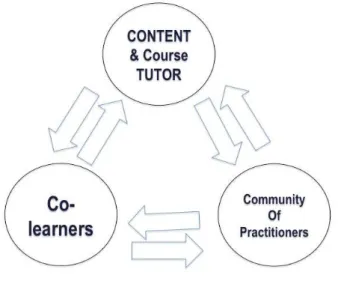
learners can make observations and conduct explorations. This model as implemented allowed students to experience meaningful learning at any time on the Web from the available resources. This is possible because the designer of BOC created three nodes of “Content,” “Co-learners” and “Community of Practitioners” as the nodes that students need to be connected. The Content includes all the content in the website, the linked files, the assigned tutors for the class, learners in the small study group, and all the participants in the course.
Fourth, these three nodes of “Content,” “Co-learners” and “Community of Practitioners” can be utilized by the designer to enrich the Cognitive Presence and the Social Presence of CoI. The designer can provide direction for students to start their
learning journey from a “node” and then move to another “node” and after that can go to the next “node” or come back to the first one (Figure 3). The program designer has a
responsibility to create a learning journey that will maximize the learning experience by
“constructing and traversing the network” (Siemens, 2011).
36
Figure 3. "Nodes" of Connectivity: Content, Co-learners, and Community of Practitioners
Fifth, the four roles of the teacher in Connectivism can be positioned to enrich the Teaching Presence. The designer can develop facilitations based on the role of teachers as Master Artists, Network Administrators, Concierges and Curators (Siemens, 2008). As a Master Artist Siemens (2008) took the inspiration of an art studio, the place of open space where students do their work, and each student’s work can be seen by other fellow
students. In this case, students will learn from each other and not solely from the instructor.
In the BOC, students were encouraged and instructed to post their learning experiences on a social media platform. As a Network Administrator, teachers help students in constructing their learning network by providing direction, assistance, and guidance for students to learn from the network. As a Concierge, teachers direct students to find out learning resources that they may not know. As a Curator, teachers act as experts who know the domain of the knowledge and can provide a “map” for students to explore and connect. By acting as a Curator, the teachers help students to experience an effective and efficient learning journey without sacrificing the freedom of an individual student. The idea of teachers as Master Artists, Network Administrators, Concierges and Curators will help a program designer in preparing the teaching presence; it will enrich the program design in promoting a teaching
37
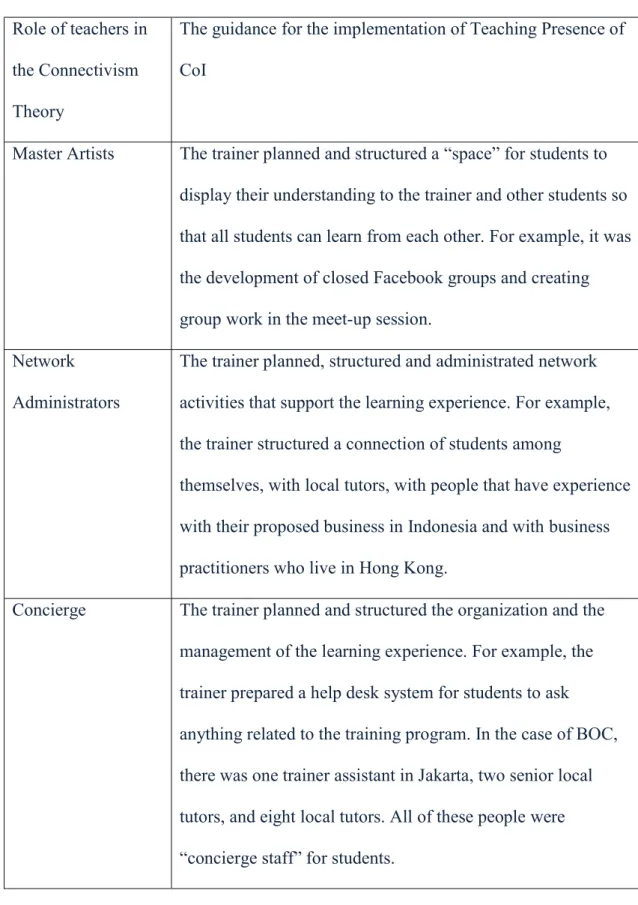
presence “connected” to the networks of resources. The following table shows how the Teaching Presence of CoI is enriched by the four roles of teachers from Connectivism.
Table 1. Role of Teachers and Teaching Presence Role of teachers in
the Connectivism Theory
The guidance for the implementation of Teaching Presence of CoI
Master Artists The trainer planned and structured a “space” for students to display their understanding to the trainer and other students so that all students can learn from each other. For example, it was the development of closed Facebook groups and creating group work in the meet-up session.
Network Administrators
The trainer planned, structured and administrated network activities that support the learning experience. For example, the trainer structured a connection of students among
themselves, with local tutors, with people that have experience with their proposed business in Indonesia and with business practitioners who live in Hong Kong.
Concierge The trainer planned and structured the organization and the management of the learning experience. For example, the trainer prepared a help desk system for students to ask anything related to the training program. In the case of BOC, there was one trainer assistant in Jakarta, two senior local tutors, and eight local tutors. All of these people were
“concierge staff” for students.
38
Curators The trainerr planned, selected, and structured the content for students. For example, the trainer browsed the Internet and selected suitable content to be postedit in the Facebook Groups.
Sixth, there is an opportunity also to combine the idea of the four major learning activities of Connectivism with the four inquiry phases of CoI. This “merging” of ideas provides a direction for students’ learning journey in this research project. Downes (2012, p.495) mentioned that a connectivist course is based on four major types of activities.
1. Aggregation: Learners receive access to a wide variety of things to read, play with, or watch.
2. Remixing: Learners should mix the information they receive with the information they already have. Learners will have their own “collections” of information according to their own interest and passion.
3. Repurposing: Learners should create something of their own.
4. Feeding Forward: Learners should share their work with other people in the course and with the community at large.
Comparing the four major activities of Downes (2012) with the four inquiry phases of CoI in Garrison (2011), the researcher can conclude that both theories can be “integrated”
because of their similarities. There are close similarities between aggregating and exploration, between remixing and integration and between repurposing and resolution.
Downes (2012) suggested the activity of feeding forward which was something that was not proposed in Garrison (2011), and Garrison (2011) suggested the activity of triggering event that was not proposed by Downes (2012). This research project will “combine” these two theories by taking the “triggering event” of Garrison (2011) as the first practical inquiry
39
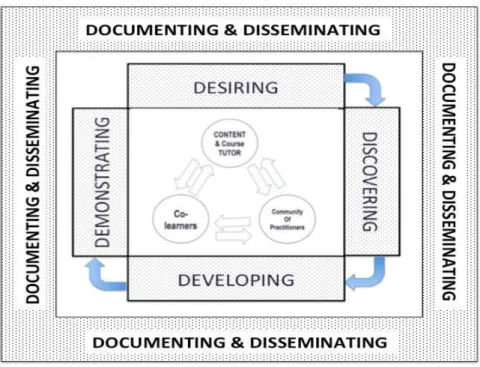
process and “feeding forward” of Downes (2012) as the activity that will always occur together with the other inquiry processes. In this model, all the key activities of learning are named as Desiring, Discovering, Developing, Demonstrating, and Documenting and
Disseminating.
Table 2 shows the comparison of Connectivism key activities of Downes (2012) with activities of Cognitive Presence of Garrison (2011) and the last column is the proposed key activities of learning.
Table 2. CoI, Connectivism and BOC
CoI Connectivism
BOC Triggering event: It is
the starting point of the inquiry process. It is initiated by
presenting an issue, problem or dilemma that needs resolution
Desiring: It is the process of briefing the Co-learners about the topic followed by a
triggering event to open up the issue, problem, challenge and possible result. It is an inspirational moment and a selection process.
Exploration: It is a the process of
searching for relevant information that can provide insight into the problem or challenge at hand.
Aggregation: It is the process to gather information from a wide variety of things by reading, playing with, or watching.
Discovering: It is the process of searching for and gathering the information on the subject from the available Content, discussion with Co-learners and by observing or
40
interviewing the Community of Practitioners.
Integration: After the idea is crystallized, learners move to this process to create connections to search for for a viable explanation
Remixing: In this process, learners draw connections. The idea is to associate the materials (or parts of the materials) with each other, and with materials from elsewhere
Developing: It is the process of integrating the passion of learners (or personal interest) to the subject (topic).
Learners must explore examples from Co-learners and the Community of Practitioners and do a reflective journey to
understand the challenge and the criteria in integrating the topic into their passion.
Resolution: The final process of CoI to select and test the most viable solution.
Repurposing: In this process, learners use materials to compose new thoughts and new understandings of the material. Learners aggregate, remix online and create something, to actively participate in the discipline.
Demonstrating: It is the process of showing and demonstrating the integration of the subject with passion or personal application. Learners will explain and defend as well.
41
Feeding Forward:
Learners share their work and creation with other people in the course, and with those outside the course, or even with the world at large.
Documenting and
Disseminating: Learners must document the assignment and their reflections and post it at the designated Web 2.0 location. By doing this, learners will disseminate information and insight to people anywhere in the world that are connected to the Internet.
From Conceptual Framework to the Operational Implementation
Taken together, desiring, discovering, developing and demonstrating is a step-by- step process to facilitate a deep and meaningful learning experience. Documenting and disseminating are the final parts of the process. Through documenting the experiences and lesson learned and then disseminating it, the learners not only share with others but also open their experiences to be enriched and sharpened by others. Figure 4 shows the elements of 6Ds and their relationship.
42
Figure 4. 6Ds of Desiring, Discovering, Developing, Demonstrating, Documenting and
Disseminating
Connectivity with “resources” will provide students with a “wider” learning experience. Since the theory directs learners to experience “knowledge that is distributed across a network of connections”. Students do not learn only from teachers and information owned by the teachers, they can learn from many other resources that are connected with the subject. In every key activity of learning, the program designer can connect students with the “nodes” of resources to extend the learning experience beyond the classroom.
43
Figure 5. 6Ds and Connectivity (The Learning Design Framework)
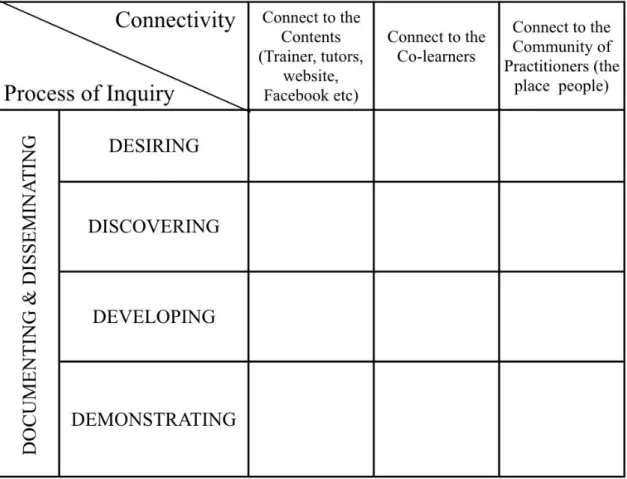
At the operational level, the above model (Figure 5) must be elaborated into a framework that can lead a program designer to develop instructions and facilitations for students. These are the products of teaching presence since the teaching presence is concerned with “the design, facilitation and direction of cognitive and social processes for the purpose of realizing personally meaningful and educationally worthwhile learning outcomes” (Anderson, Rourke, Garrison and Archer (2001). Instruction is the key instrument of the program designer to direct learners to have an effective learning experience, and facilitation is developed after the instruction is created. The function of facilitation is to serve the instruction. Table 3 shows the proposed framework for the development of instructions base on the design principle for BOC.
44
Table 3. The Matrix for the Development of Instructional Strategies
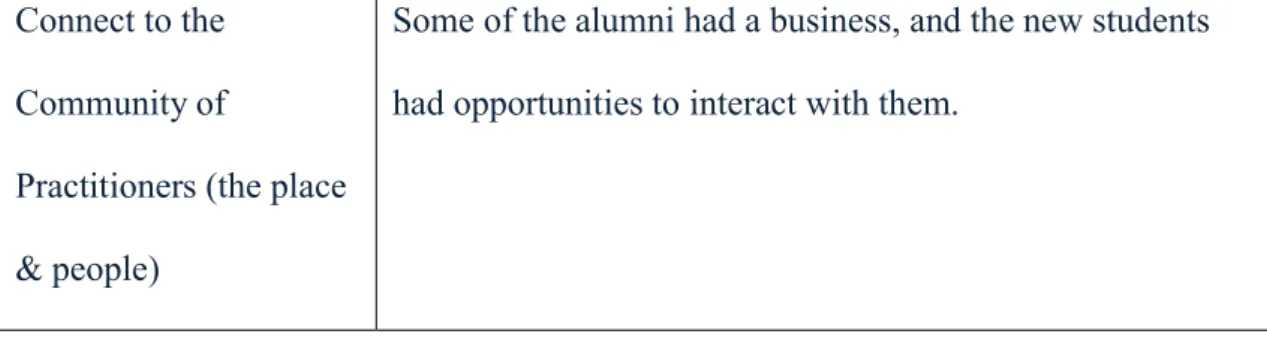
Table 4 shows examples of the process of inquiry of Desiring in the BOC program.
Table 4. "Desiring" and the Network Presence in the BOC Learning facilitation
Connect to the Contents (Trainer, tutors, website, Facebook etc)
The trainer led a public seminar in Hong Kong on August 9, 2016 and spoke on the subject “Why Entrepreneurship can change the future of IFMWs.”
Connect to the Co- learners
In that seminar, new students met with the alumnae of the program, and they could listen to the experiences of the alumnae.
45
Connect to the Community of
Practitioners (the place
& people)
Some of the alumni had a business, and the new students had opportunities to interact with them.
Table 5 shows how the trainer facilitated students to experience “Discovering, Developing and Demonstrating” using the Network Presence.
Table 5. "Discovering, Developing and Demonstrating" and the Network Presence in BOC Learning facilitation
Connect to the Contents (Trainer, tutors, website, Facebook etc)
The trainer provided written digital contents and videos on the subject. A website and two Facebook groups were available.
The trainer provided an online discussion on the quiz every day.
The trainer was available every day and posted message or answered questions.
The trainer showed himself in a Facebook Live every weekend
Connect to the Co- learners
The trainer provided an online forum (Facebook group) for students to express their understanding and to receive feedback from others.
There was a meet-up session every Sunday at a park for discussion, question and answer, presentation or doing group assignments together.
46
Connect to the Community of Practitioners (the place & people)
The trainer provided an opportunity for students to interact with tutors who had experiences in starting a business or other practitioners for students to check or enrich their understanding.
The inquiry process of the “Documenting and Disseminating” element was facilitated in the development of specific social media – a Facebook group. The trainer created and
moderated two closed Facebook groups for students to document and disseminate their knowledge. The first Facebook group is only for BPU students and the second one is open for those who are interested in entrepreneurship learning. Some students posted their learning experiences on their personal Facebook.
The Social Presence in BOC happened in two ways. First, there was a direct F2F meetings with the trainer. The meeting occurred on the “promotional day” of the program as well as at the end of the program when an assistant of the trainer from Jakarta flew to Hong Kong to meet with students. Second, there was the utilization of social media in promoting Social Presence especially in the using of emoticons and Facebook Live. Table 6 shows the activities of “Social Presence” in the context of the Network Presence applied in BOC.
Table 6. Social Presence and Network Presence
Face to face Online
Connect to the Contents (Trainer, tutors, website, Facebook etc)
The trainer met with students during the first meeting.
47
Students met the tutors directly in the Sunday meet-up session.
A senior trainer from Jakarta flew to Hong Kong to resume the program and administer the post-- testFacebook provided emoticons for users to express their emotions.
The trainer lead and encouraged informal discussion.
The weekly Facebook Live with students.
Connect to the Co- learners
Students met each other directly in the Sunday meet-up session.
Students communicated with tutors, their co-
learners and community of learners at large through a Facebook Group.
Students and tutors had a Whatsapp group without the presence of the trainer.
Connect to the Community of
Students met the tutors who had business experience and also
The trainer invited an alumnus who had started a
48
Practitioners (the place &and people)
those who were invited to the meet-up session to share the experience.
Students and tutors observed market places together.
business in Indonesia to share her testimony in the Facebook group and answer questions of students.
Facilitation
Anderson, Rourke, Garrison, and Archer (2001) noted that Teaching Presence included the act of facilitation, and the authors stated “Teaching presence begins before the course commences as the teacher, acting as instructional designer, plans and prepares the course of studies, and it continues during the course, as the instructor facilitates the discourse and provides direct instruction when required.” Before the program, the trainer already prepared certain “places” in social media for students to read or watch the content, to publish their content, to receive comments, to ask questions about or discuss the content.
Table 7 shows the specific online resources for BPU students.
Table 7. Online Resources 1. Specific website of UCEO
(University Ciputra
Entrepreneurship Online) at https://ciputrauceo.com.
This MOOC was developed to promote entrepreneurship for Indonesians specifically.
This social venture was funded by the Ciputra company in Indonesia.
BPU content was included as one of the subjects in this MOOC. The researcher was the creator and the trainer in the BPU.
The whole written and video content of BPU were stored on the website. Students could
49
check the content from the beginning until the end of the program on the website.
2. Closed Facebook Group for students: BPU HK August 2016 (https://www.facebook.com/search/t op/?q=bpu%20hk%20agustus%2020 16).
This was a closed Facebook group only for students of BPU and the tutors who enrolled in the BPU for the research project.
The trainer communicated with the members every day during the BPU course.
3. Closed Facebook Group for tutors:
TUTOR BPU UCEO
(https://www.facebook.com/search/t op/?q=tutor%20bpu%20uceo).
This was a closed Facebook group only for tutors of BPU for the research project.
The trainer communicated with the members at least oncece a week during the BPU course.
4. Closed Facebook Group of UCEC Sekolah Kehidupan
(https://www.facebook.com/groups/
ucecsekolahkehidupan/)
It was a closed Facebook group created and moderated by the trainer and this Facebook group focused on promoting and sharing entrepreneurship.
Any Indonesians who were interested in entrepreneurship could ask for permission to join the group. Most of the members were Indonesian migrant workers.
It was created in the year 2014 and at the end of 2016 the number of members was almost 3,000.
50
It was a virtual space for students to disseminate and discuss their ideas or experiences in a larger community.
The trainer also created some Facebook accounts that represented the trainer and his assistants in communication with students or the public on Facebook. Table 8 shows the various Facebook accounts.
Table 8. Facebook Accounts Ucec Tki
(https://www.facebook.com/ucec.tki)
This was the Facebook account owned by the trainer to communicate with the students.
Pustaka UCEO
(https://www.facebook.com/search/to p/?q=pustaka%20uceo)
This was the Facebook account for the assistant of the trainer for quiz discussion in the BPU program.
The assistant posted a quiz in the morning and let students discuss it; in the afternoon. The assistant would share the questions and explain the answers.
Ucec Gudang Ilmu
(https://www.facebook.com/search/to p/?q=ucec%20gudang%20ilmu)
This was the Facebook account for the assistant of the trainer. She helped the trainer in sharing entrepreneurship information in the Facebook group that has a large number of members.
There are three conclusions to consider from this chapter. First, both theories of CoI and Connectivism can be elaborated into practical facilitation and instructional strategies for entrepreneurship learning. Second, there is an opportunity to combine these two theories to create a different conceptual model that can be a guide for the planning of entrepreneurship learning in a blended-learning environment. Third, the conceptual model of combining CoI