Short communication
Modifications of the non-linear parameters of the heart rate variability
related to the systematic practice of physical exercise
Victor Ernesto González-Velázquez1*
Lázaro Ibraín Cobiellas-Carballo2
Roxana María Rebustillo-Escobar3
Walfrido Semanat-Gabely4
David de J. Bueno-Revilla5
Erislandis López-Galán5
Miguel E. Sánchez-Hechavarría5,6
Salvador Escalante Batista2
1 Universidad de Ciencias Médicas de Villa Clara. Cuba.
2 Universidad de Ciencias Médicas de Holguín. Cuba.
3 Universidad de Ciencias Médicas de Granma. Cuba.
4 Universidad de Ciencias Médicas de Guantánamo. Cuba.
5 Universidad de Ciencias Médicas de Santiago de Cuba. Laboratorio de Ciencias Básicas
Biomédicas. Cuba.
6 Catholic University of the Most Holy Conception. Chile.
*Autor para la correspondencia: [email protected]
ABSTRACT
Introduction: In recent years, the relationship between the systematic practice of
physical exercise, cardiovascular dynamics and the functioning of the autonomic nervous
Objective: To determine the modifications that non-linear parameters undergo in the
autonomic cardiovascular regulation of the heart rate variability with the systematic
practice of physical exercise.
Methods: A retrospective cohort analytical study was conducted from February 2016 to
August 2018. Population and sample: 36 individuals (Group 1: 18 high- performance
baseball athletes; Group 2: 18 medical students). The data were collected in the
Biomedical Basic Sciences Laboratory at Medical school 1, University of Santiago de
Cuba, through the 8-channel PowerLab polygraph, and stored using the Kubios Software
version 3.0.4 Premium.
Results: Statistically significant differences between means were found in heart rate
values (p = 0.000); SD1 (p = 0.025); SD2/SD1 ratio (p = 0.007); sample entropy
(p = 0.011); short-term fluctuations α 1 (p = 0.019); mean line length (p = 0.016); max
line length (p = 0.001); recurrence rate (p = 0.034); determinism (p = 0.010) and Shannon
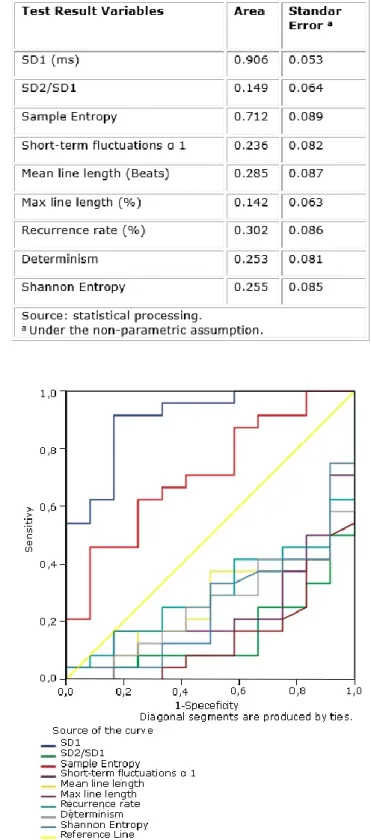
entropy (p = 0.015). The parameters of SD1 (C = 0.906) and sample entropy (C = 0.712)
were significantly associated with a heart rate ≤ 70 beats per minute.
Conclusions: With the systematic practice of physical exercise, the non-linear parameters
of the autonomic cardiovascular regulation of the heart rate variability undergoes
modifications that respond to a better adaptability of the autonomic nervous system, and
to a greater capacity to regulate cardiovascular function.
Keywords: heart rate variability, non-linear parameters, physical exercise, high-
performance athletes.
INTRODUCTION
The recording of cardiac activity usually refers to the number of beats at a precise
moment or previously determined time period. However, the time between beats is
variable. This variation from beat to beat refers to the concept of Heart Rate Variability
(HRV). The traditional method for measuring this variation is based on the calculation of
The mechanism responsible for the regulation of HRV is the autonomic nervous system,
with HRV being proposed as an indicator of its status.(2)
The autonomic nervous system is organized into two subsystems or branches with
opposite but complementary functions: sympathetic and parasympathetic or vagal. Both,
by chronotropic, dromotropic and inotropic effect, act on the depolarization of the cardiac
muscle and condition the sinoatrial node function. The sympathetic branch
(noradrenaline) stresses the system increasing the heart rate and decreasing the HRV
whereas the parasympathetic (acetylcholine) decreases the heart rate and increases the
HRV. Both are interconnected by thousands of neurons and hundreds of ganglia that
make up what some call the Cardiac Intrinsic Nervous System or cardiac brain.(3)
The relation "autonomic nervous system-cardiac function" must be considered, as a
whole, by the great interaction that exists between both elements.
To evaluate the action of the autonomic nervous system, HRV has been used, which
analyzes a time series of the variation in the duration of a beat with respect to the next. In
addition, due to the use of digital signal processing systems, these time series can be
analyzed by characteristics of its spectrum and by non-linear methods. Similarly, both
HRV and heart rate at rest account for cardiovascular adaptations such as left ventricular
hypertrophy and increased parasympathetic tone.(4)
Most studies of HRV in the field of sports have analyzed HRV responses to different
training stimulations with the ultimate aim of maximizing training effectiveness and
benefits. Some authors3,5 have shown how HRV is a useful tool for maximizing adaptive
responses and prescribing daily exercise.
During physical exercise, the sympathetic-vagal balance depends on the intensity and
duration of the exercise.3 In high-performance athletes or individuals who practice
physical exercise systematically, there is a preconditioning of the autonomic nervous
system to this activity, with a better cardiovascular adaptability to changes in rhythm and
heart rate.
While records in recreational athletes or well-trained athletes suggest that HRV might be
with a long sports history are not consistent. In this type of population, it has been
observed how parasympathetic activity levels are reduced during rest periods.(5)
It is currently accepted that physical exercise has important cardio-protective effects.
These have been associated with the activation of various mechanisms aimed at restoring
myocardial function and reversing the autonomic imbalance. However, it has not been
fully clarified if physical exercise actually improves the HRV and restores the autonomic
balance.(6)
The variations experienced by non-linear parameters of Heart Rate Variability with the
systematic practice of physical exercise have not been clearly determined. Their
knowledge can contribute to establishing cut-off points for an ideal cardiac function both
in elite athletes and in people who do not practice sports according to non-linear
parameters of heart rate variability.
Objective
To determine the modifications that non-linear parameters undergo in the autonomic
cardiovascular regulation of Heart Rate Variability with the systematic practice of
physical exercise.
METHODS
A retrospective cohort analytical study was conducted from February 2016 to August
2018, in the Laboratory of Basic Biomedical Sciences, Medical School 1 of the
University of Medical Sciences of Santiago de Cuba.
The study population was made up of young male individuals between the ages of 17 and
19, who were high-performance baseball athletes from the youth team of Santiago de
Cuba and first- and second-year medical students at the University of Medical Sciences
of that province (N = 36).
Two groups were established for each variable, one that was composed of the athletes of
the youth baseball team as a group exposed to the systematic practice of physical exercise
(n = 18) and another composed of medical students as a group not exposed to the
matched by age and sex with the first one, and selected in a stochastic way through a
simple random sampling so that a 1:1 ratio was obtained, which avoid the biases inherent
in the selection.
Exclusion criteria
Individuals with current diseases that could interfere with the physiological
cardiovascular dynamics or the regulation of this by the Autonomic Nervous
System.
Individuals who did not agree to participate in the study.
Definition of the independent variable
Systematic practice of physical exercise, which was collected as background in all
high-performance baseball athletes of the youth team of the province of Santiago
de Cuba
Variables
Heart rate (in beats per minute) (beats/min), Standard Desviation 1 (SD1), Standard
Desviation 2 (SD2), Relationship Standard Desviation 2 / Standard Desviation 1
(SD2/SD1), Approximated Entropy, Sample Entropy, Short-term fluctuations α 1,
Long-term fluctuations α 2, Correlation Dimension, Mean line length (in Beats), Recurrence
rate (in percentage), Determinism, Shannon Entropy, Multi-Scale Entropy Minimum,
Multi-Scale Entropy Maximum and exposure to the systematic practice of physical
exercise.
Experimental procedure and collection of data
Data were collected during February and March 2016 in the Laboratory of Basic
Biomedical Sciences, Medical School 1 of the University of Medical Sciences of
Santiago de Cuba, through the 8-channel PowerLab® polygraph (ADInstruments), and
stored by Kubios® Software version 3.0.4 Premium. This period of coincides with the
pre-competitive stage of the athletes of the provincial youth baseball team who were
training to participate in the XXXIII National School Games, and with the start of the
Each measurement was recorded by the same person in the Body-Level Measure section
of the already mentioned laboratory of Basic Biomedical Sciences, with the purpose of
minimizing the errors of methodology.
At the beginning of the session of the electrocardiographic recordings in the morning
(08:30- 12:00 hours), the subjects were placed on a comfortable stretcher, located in a
room with controlled temperature between 24 and 27 degrees Celsius and dim light.
Under these conditions, they were allowed to rest for 10-15 minutes until achieving a
better adaptation to the conditions of the room.
The electrodes corresponding to the limb leads were placed to record the
electrocardiographic tracing for 5 minutes. The electrical signal was collected by the
8-channel PowerLab® polygraph of Australian production by the company ADI
instruments (2016); then it was digitized at a sample rate of 1000 samples/second (1 kHz)
using the Software Kubios®, version 3.0.4 Premium (2018), of Finnish production. This
software package enables the tabulation and export of the records to the MatLab 2016®
programming package of the MathWork Company, and its file in PDF format for easier
analysis and interpretation of the information.
Statistical Analysis
The data obtained were stored and processed in the statistical package "StatisticalPackage
for Social Sciences" (SPSS) version 21 for Windows. The means were compared through
the Mann Whitney U test assuming that the distribution of the variables was different
from the normal distribution by the sample size. The results are shown as mean plus
standard deviation (Mean + SD). It was decided that there were statistically significant
differences between the means of each variable when the value of p < 0.05.
The discriminatory capacity of each variable that proved to be statistically significant to
be associated with a heart rate less than or equal to 70 beats per minute was valued
because this value means an optimal cardiovascular state since the heart is capable of
pumping the blood to all body tissues with a low number of beats per minute, but within
normal limits, which denotes an adequate force of contraction of the ventricles and an
integrity of the cardiovascular system. This was proved through the C statistic (area under
associative capacity. For the C statistic estimation, the authors used the ROC curve
processing technique, in the SPSS Software. All data processing was made with a
reliability of 95%.
Ethics
The research was approved by the ethics committee of the lead institution. All ethic
principles were rigorous accomplishead according to the Helsinki principles. Each
individual signed an informed statement and personal identification data was not
published.
RESULTS
Table 1 shows the comparison of the means of the non-linear parameters of HRV
analyzed in athletes and students according to the Mann Whitney U test. There were
significant differences between the two groups in the variables Heart Rate, Standard
Desviation 1 (SD1), SD2 / SD1, Sample Entropy, Short-term fluctuations α 1, Mean line
length (Beats), Max line length (%), Recurrence rate (%), Determinism and Shannon
Entropy.
The discriminatory capacity of each variable that proved to be statistically significant to
be associated with a heart rate less than or equal to 70 beats per minute (≤ 70 beats/min)
was assessed by analyzing the area under the ROC curve, which can be seen in the Fig. 1
It is observed that the values corresponding to the areas under the curve are different from
each other. Values under the curve above 0,70 can be considered as a significant
associative value. The value of SD1 was established at 0,906, showing an excellent
associative capacity for a heart rate ≤ 70 beats/min. The value corresponding to Sample
Table 1- Areas under the ROC curve corresponding to the statistically significant
parameters associated with a lower heart rate (≤ 70 beats/min)
Fig. 1- ROC curves corresponding to the statistically significant parameters associated
DISCUSSION
The results of the present study show the modifications that some non-linear parameters
of the HRV undergo in relation to the systematic practice of physical exercise.
Reimers et al 7 reported that neither an increase in resting parasympathetic tone nor a
decrease in response to beta-adrenergic stimulation contribute to the decrease in HRV
after regular exercise or systematic physical activity in humans, so that the authors of the
present study consider that the differences between means of the variables analyzed
respond to a change in the cardiovascular dynamics of the group exposed to systematic
physical exercise, conditioned by a better balance of autonomic nervous system, and not
to an autonomic cardiovascular imbalance in the group not exposed to regular physical
activity.
When taking into account the psychic stress, it would be logical to conclude that the
group of medical students presents higher levels of stress, due to the constant exposure to
exams and evaluations, but the period in which the measurements were made coincides
with the beginning of the semester, moment that constitutes the least stressful of the
school year. However, this period coincides with the critical precompetitive stage, in
which athletes must perform athletically to the maximum, since their performance in this
stage depends on their participation in National Scholar Games, which is a stressful
element in this group of individuals.
Deschodt-Arsac et al 8 in a recently published study showed that anxiety states and
autonomic function might be improved by short-lasting cardiac coherence training, which
brings improved resistance to stressful situations.
SD1 was significantly different in both groups of individuals. Weippert et al 9 mentioned
that the significant differences of absolute spectral powers of the increase of SD also
demonstrates the distinct autonomic heart rate modulation under the different contraction
modes. Together, these results speak for an increased dual autonomic cardiac modulation
under regular exercise goad.
Multiscale measures of HRV have generated a great deal of interest, but a systematic
the early identification of diseases of clinical importance to the practitioner.10 In the
present study, differences were found between the means of these non-linear
measurements, as well as Shannon Entropy and Multi-Scale Entropy Maximum.
Sample Entropy was significantly associated with a better cardiac function, so it is
concluded that this parameter is affected when the heart is exposed to better autonomic
regulation. These results do not coincide with Weippert's 9, which indicated that a change
of sympatho-vagal balance towards a sympathetic dominance increases regularity and
thus reduces entropy values.
CONCLUSIONS
With the systematic practice of physical exercise, the non-linear parameters of the
autonomic cardiovascular regulation of the Heart Rate Variability undergo changes in the
values of: Heart Rate, Standard Desviation 1 (SD1), SD2/SD1 ratio, Sample Entropy,
Short-term fluctuations α1, Mean line length, Recurrence rate, Determinism and Shannon
Entropy, which respond to a better adaptability of the autonomic nervous system, and to a
greater capacity to regulate the cardiovascular function.
Acknowledgment
The research was conducted in the First International Research Scholarship in
Cardiovascular Psychophysiology "Iván Pavlov".
REFERENCES
1. Márquez JMO, Garrido RER, Chaves GAC, Mendo AH. Variabilidad de la frecuencia
cardíaca: investigación y aplicaciones prácticas para el control de los procesos
adaptativos en el deporte. Rev Iberoam Psicol Ejerc El Deporte [Internet]. 2018 [cited
February 22 nd, 2019];13(1):121-30. Available at:
2. Moreno Sánchez J, Parrado Romero E, Capdevila Ortís L. Variabilidad de la
frecuencia cardíaca y perfiles psicofisiológicos en deportes de equipo de alto
rendimiento. Rev Psicol Deporte. 2013;22(2):0345-352.
3. Manso JMG. Aplicación de la variabilidad de la frecuencia cardiaca al control del
entrenamiento deportivo: análisis en modo frecuencia. Arch Med Deporte.
2013;30(1):43-51.
4. León-Ariza HH, Botero-Rosas DA, Zea-Robles AC, León-Ariza HH, Botero-Rosas
DA, Zea-Robles AC. HEART RATE VARIABILITY AND BODY COMPOSITION AS
VO2MAX DETERMINANTS. Rev Bras Med Esporte [Internet]. agosto de 2017 [cited
February 22nd, 2019];23(4):317-21. Available at:
http://www.scielo.br/scielo.php?script=sci_abstract&pid=S1517-86922017000400317&lng=en&nrm=iso&tlng=en
5. Ortigosa-Márquez JM, Reigal RE, Portell M, Morales-Sánchez V, Hernández-Mendo
A. Observación automatizada: la variabilidad de la frecuencia cardíaca y su relación con
las variables psicológicas determinantes del rendimiento en nadadores jóvenes. An Psicol
[Internet]. octubre de 2017 [cited February 22 nd, 2019];33(3):436-41. Available at:
http://scielo.isciii.es/scielo.php?script=sci_abstract&pid=S0212-97282017000300002&lng=es&nrm=iso&tlng=en
6. Segovia V, Manterola C, González M, Rodríguez-Núñez I, Segovia V, Manterola C, et
al. El entrenamiento físico restaura la variabilidad del ritmo cardiaco en la insuficiencia
cardiaca. Revisión sistemática. Arch Cardiol México [Internet]. diciembre de 2017 [cited
February 22nd, 2019];87(4):326-35. Available at:
http://www.scielo.org.mx/scielo.php?script=sci_abstract&pid=S1405-99402017000400326&lng=es&nrm=iso&tlng=es
7. Reimers A, Knapp G, Reimers C-D. Effects of Exercise on the Resting Heart Rate: A
Systematic Review and Meta-Analysis of Interventional Studies. J Clin Med [Internet]. 1
de diciembre de 2018 [cited February 24 th, 2019];7(12):503. Available at:
8. Deschodt-Arsac V, Lalanne R, Spiluttini B, Bertin C, Arsac LM. Effects of heart rate
variability biofeedback training in athletes exposed to stress of university examinations.
PLOS ONE [Internet]. 26 de julio de 2018 [cited February 24th, 2019];13(7):e0201388.
Available at: https://journals.plos.org/plosone/article?id=10.1371/journal.pone.0201388
9. Weippert M, Behrens M,Rieger A, Behrens K. Sample Entropy and Traditional
Measures of Heart Rate Dynamics Reveal Different Modes of Cardiovascular Control
During Low Intensity Exercise. Entropy [Internet]. 2014 [cited February 24th,
2019];16,5698-5711. Available at:
https://res.mdpi.com/entropy/entropy-16-05698/article_deploy/entropy-16-05698
10. Cornforth D, Jelinek HF, Tarvainen M. A Comparison of Nonlinear Measures for the
Detection of Cardiac Autonomic Neuropathy from Heart Rate Variability. Entropy
[Internet]. 2015 [cited February 24 th, 2019]; 17, 1425-1440. Available at:
https://res.mdpi.com/entropy/entropy-17 01425/article_deploy/entropy-17-01425
Conflicts of interest
The authors declare no conflicts of interest.
Author Contributions
Victor Ernesto González-Velázquez: conception and design of the study, analysis of the
data, interpretation of the data, drafting the article. Lázaro Cobiellas-Carballo: conception
and design of the study, analysis of the data, interpretation of the data, critical revision of
the manuscript. Roxana María Rebustillo-Escobar: interpretation of the data, critical
revision of the manuscript. Walfrido Semanat-Gabely: interpretation of the data, critical
revision of the manuscript. David de J. Bueno-Revilla: collection of data, critical revision
of the manuscript. Erislandis López-Galán: collection of data, critical revision of the
manuscript. Miguel E. Sánchez-Hechavarría: conception and design of the study,
collection of data, critical revision of the manuscript. All authors have read and approved