Suicide ideation and behavior
in Mexico: Encodat 2016*
Guilherme Borges, D en Epidemiol,(1) Ricardo Orozco, D en Epidemiol,(1) Jorge Villatoro, Psic,(1)
Maria Elena Medina-Mora, D en Psicol,(1) Clara Fleiz, D en Psicol,(1) Jessica Díaz-Salazar, Psic.(1)
* Funding: The Encodat 2016 was partially sponsored by the National Commission Against the Addictions. The National Institute of Psychiatry and the National Institute of Public Health elaborated the survey study design and were jointly responsible for the data collection.
(1) Instituto Nacional de Psiquiatría Ramón de la Fuente Muñiz. Mexico City, Mexico.
Received on: December 28, 2017 • Accepted on: May 14, 2018
Corresponding autor: Dr. Guilherme Borges. Instituto Nacional de Psiquiatría Ramón de la Fuente Muñiz. Calzada México Xochimilco 101 col. San Lorenzo Huipulco. 14370 Mexico City, Mexico.
E-mail: [email protected]
Borges G, Orozco R, Villatoro J, Medina-Mora ME, Fleiz C, Díaz-Salazar J. Suicide ideation and behavior in Mexico: Encodat 2016. Salud Publica Mex. 2019;61:6-15.
https://doi.org/10.21149/9351
Abstract
Objective. To provide updated information regarding the
12–month prevalence and associated sociodemographic fac-tors for suicide ideation and behavior (plan and attempts) to substantiate preventive programs in Mexico. Materials and
methods. Cross-sectional nationally representative survey,
conducted during 2016 (n=56 877) among those 12–65 years old living in rural, urban and metropolitan dwellings. Results. The prevalence of suicide ideation in the last 12-months was 2.3%, 0.8% of the sample reported a plan and 0.7% reported a suicide attempt. All three outcomes were about two times more common among females and suicide plan and attempt were less common among the elderly (50-65 years old). Suicide attempts were more common in urban than in rural areas. The state of Tabasco showed an increased prevalence of ideation, plan and attempts when compared to national average rates. Conclusions. Public health measures to diminish and treat suicidal behavior are urgently needed all over the country.
Keywords: suicide; health surveys; Mexico
Borges G, Orozco R, Villatoro J,
Medina-Mora ME, Fleiz C, Díaz-Salazar J.
Ideación e intento de suicidio en México: Encodat 2016. Salud Publica Mex. 2019;61:6-15.
https://doi.org/10.21149/9351
Resumen
Objetivo. Dar información actualizada sobre la prevalencia
de 12 meses y los factores sociodemográficos asociados para la ideación y el comportamiento suicida (plan e intentos) para fundamentar programas preventivos en México. Material
y métodos. Encuesta transversal representativa a nivel
nacional, por sexo y grupos de edad, realizada durante 2016 (n = 56 877) entre personas de entre12 y 65 años de edad en zonas rurales, urbanas y metropolitanas. Resultados. La prevalencia de ideación suicida en los últimos 12 meses fue de 2.3%, 0.8% de la muestra informó un plan y 0.7% informó un intento de suicidio. Los tres resultados fueron aproximadamente dos veces más comunes entre las muje-res y el intento de suicidio fue menos común entre los más viejos (50 a 65 años). Los intentos de suicidio fueron más comunes en las zonas urbanas que en las rurales. El estado de Tabasco mostró una mayor prevalencia de ideas, planes e intentos en comparación con las tasas promedio nacionales.
Conclusiones. Es urgente y necesario que existan medidas
de salud pública para disminuir y tratar el comportamiento suicida en todo el país.
7
salud pública de méxico / vol. 61, no. 1, enero-febrero de 2019
Suicide ideation and behavior in Mexico ArtículooriginAl
W
hile the suicide death rate is declining overall around the globe by 26%, suicide has been grow-ing in Mexico durgrow-ing the last decade or so (a 16.6% in-crease between the years 2000 and 2012).1 This increaseis more noticeable among Mexican females (a 55.1% increase) compared to males (a 10.0% increase),1 and
among youth (10-19 years old) and those between 30 and 49 years of age.2 New data available through the Global
Burden of Disease study 20153 also shows that the age
standardized suicide death rate in Mexico increased by 22% between the years 2000 to 2015, more so for women (a 37% increase) than for men (a 18.4% increase). The increase was also more apparent among those aged 15 to 49 years (a 28.8% increase). In the year 2010, suicide ranked in the 11th place for cause of disability adjusted
life years in Mexico.4
We know much less about suicide ideation and behavior during this period of increased suicide rates in the country. The last national sample of Mexican adults that reported on suicide ideation and behavior (plan and attempts), the Mexican National Comorbid-ity Survey (M-NCS; Borges and colleagues, 2007)5 was
conducted in 2001-2002. Although in the year 2005, a large survey for adolescents (12-17 years old) living in the great Mexico City metropolitan area reported on suicide ideation and behavior,6,7 this survey was
geographically restricted. A summary of these surveys dates from year 20108 and it clearly shows the
limita-tions of both surveys to report on 12-month prevalence of suicide ideation and behavior because of the rarity of these phenomenon in Mexico and elsewhere.9 Since a
prior suicide ideation and attempt are among the most powerful risk factors for suicide,1,10 understanding the
dynamics of these outcomes is crucial for preventive efforts in Mexico.
Large datasets reporting on 12-month prevalence suicidal ideation and behavior with national representa-tiveness are sorely needed to substantiate public health programs in this area. Here, we report the 12-month prevalence and associated sociodemographic factors of suicide ideation, plan and attempt for a large nationally representative survey among those 12 to 65 years old living in rural, urban and metropolitan dwellings. The survey was conducted during 2016 (n=56 877).
Materials and methods
DatasetsThe dataset is the 2016 Encuesta Nacional de Consumo de Drogas, Alcohol y Tabaco (Encodat 2016, for its acronym
in Spanish - National Survey on Consumption of Drugs, Alcohol and Tobacco),11 previously called the National
Addiction Survey (ENA). This survey is the latest in a series of nationally representative household surveys that focus on alcohol, tobacco and drug use behavior that have been conducted approximately every five years in the general population, conducted previously in 1988, 1998, 2002, 2008 and 2011.12 The response rate
of the Encodat 2016 was 74%. The 2016 survey was planned as representative of national urban and rural households. The sampling procedure for the Encodat 2016 was probabilistic, multistage and stratified. The selection of sample units was carried out in multiple stages. In the first stage of sampling, Basic Geostatisti-cal Areas (AGEBs) or loGeostatisti-calities (similarly to the US ZIP codes) were selected within each stratum. In the second stage, localities within the Rural AGEB and contiguous sets of dwellings within the locations were chosen. In the Urban and Metropolitan strata, blocks (“manzanas”) within the AGEB and housing inside the blocks were selected. Lastly, individuals were selected from households with an adolescent aged 12 to 17 or an adult aged between 18 and 65. All selections were probabilistic. Weights were generated to account for the selection process and the survey is representa-tive of the national population within the age and geographical areas. The Encodat interviewed a total of 56 877 respondents. While the goals of the Encodat 2016 are to generate information on the prevalence of tobacco, alcohol and drug use,13 it also includes other
outcomes of interest for the country, such as the scale of 12-month prevalence of suicide ideation, plan and attempt, that is comparable to the scale used before in the M-NCS. The survey questionnaire was applied through a face-to-face interview, where sections of the individual questionnaire which might cause under-reporting (the most sensitive ones) were applied via a computer assisted audio program with headphones (ACASI system) self-administered by the respondent, under the direction of the interviewer to ensure an atmosphere of confidentiality while contextual topics were explored through face-to-face interviews. Ethical considerations
Variables
Suicide ideation, plan and attempt
As mentioned above, the Encodat used the same scale for recent suicide ideation and behavior as the MNC-S, and prior reports of prevalence and associated factors for suicidal behaviors in the M-NCS surveys have been extensively published before.5,14 For this report,
we are interested in estimating the prevalence of three outcomes, suicide ideation, suicide plans and suicide attempts (suicidal behavior) in the year 2016. Because of limitations in the length of the questionnaire and interview time, we did not include non-suicidal self-in-jury behavior in the Encodat. Respondents were asked about 12-month experiences of suicidal ideation (‘Have you seriously thought about committing suicide?’), suicide plans (‘Have you made a plan for committing suicide?’), and suicide attempts (‘Have you attempted suicide?’). Those positive for a 12-month suicide at-tempt were further asked whether: 1. Whether this attempt led to a hospitalization or medical treatment for the injuries, and 2. To characterize if: (a) if the at-tempt was serious and it was only because of luck that they did not die; (b) if the attempt was serious but they knew the method was not foolproof, and (c) if the at-tempt was a cry for help and they did not want to die. Because self-administered surveys have been shown to yield higher rates of reporting of embarrassing be-haviors than interviewer-administered surveys,15 these
experiences were listed in a self-administered booklet and referred to by letters (events ‘A’, ‘B’ and ‘C’) for respondents who were able to read. In the Encodat 2016, these experiences were gathered by the use of the Audio Computer-Assisted Self-Interview Software (ACASI) system. The ACASI technology allows respon-dents to listen to prerecorded survey questions through headphones and record responses using a touch screen or keypad or, alternatively, they may simultaneously read the questions from a tablet, or they may close or hide the screen for complete privacy.
Sociodemographic factors
Sociodemographic factors previously shown to be re-lated to suicidal behaviour,14 such as sex, age/cohort:
adolescents (12-17 years old), adults (18-49 years old) and mature adults (50-65 years old), years of educa-tion (in four categories: 0–6, 7–9, 10–12 and 13+), oc-cupation (paid job, student, homemaker, retired and other), marital status (married/cohabiting, separated/ divorced/widowed and never married), country region:
North-west (Baja California, Baja California Sur, Nayarit, Sinaloa and Sonora), North (Coahuila, Chihuahua, Durango, Nuevo León, San Luis Potosí, Tamaulipas and Zacatecas), Central-west (Aguascalientes, Colima, Guanajuato, Jalisco and Michoacán), Central-east (Ciu-dad de México, Guerrero, Hidalgo, Estado de México, Morelos, Puebla, Querétaro and Tlaxcala) and South-east (Campeche, Chiapas, Oaxaca, Quintana Roo, Tabasco, Veracruz and Yucatán) and geographical area (rural, urban and metropolitan), were used to report on common associated factors for these three outcomes.
Analyses
First, we compared the distribution of key individual (age and sex) and demographic (geographical area, country region and state level) variables and the preva-lence of the outcomes (suicide ideation, plan and at-tempt) for the Encodat 2016. Significance tests for these cross-tabulations were conducted using design-based Pearson χ2 tests. Next, we estimated model-adjusted
prevalence ratios (PRs) based on Generalized Linear Models (GLM) with log link and binomial distribu-tion.16 Thus, PRs (the prevalence rate in the exposed
divided by the prevalence rate in the unexposed), were computed for each type of suicidal behavior in adjusted models with all sociodemographic variables, in the total population. The Encodat 2016 is also the first survey with a large enough sample size per national jurisdictions (i.e, states) that will allow us to report the prevalence of suicidal behavior by state level and to test whether differences in prevalence existed when compared to national averages. For this variable (state level), instead of using one single state as the reference category, we used the grand mean, so that each state is compared against the national average prevalence rates for ideation, plan and attempt. Thus, PRs for each state are interpretable as statistically different (an increase or decrease) from the marginal national mean prevalence.* All analyses incorporated weights developed for these surveys, as described above. For our GLM models, we estimated standard errors and 95% confidence intervals (CIs) using the Taylor series linearization method with STATA version 13 1to adjust for the design effects, stratification, clustering, and unequal weighting of the observations.‡
* Stata 13 Base Reference Manual. College Station, TX: Stata Press, 2013. https://www.stata.com/manuals13/r.pdf
‡ Stata Corp. Stata 13 survey data reference manual. College Station,
9
salud pública de méxico / vol. 61, no. 1, enero-febrero de 2019
Suicide ideation and behavior in Mexico ArtículooriginAl
Table I
SociodemographiccharacteriSticSandSuicide ideationandbehavior (planandattempt).
(n=56 877) encodat mexico, 2016
n % (S.E.) Sex
Male 23 820 48.3 (0.4)
Female 33 057 51.7 (0.4)
Age category (years)
12-17 12 436 16.8 (0.2)
18-49 32 710 64.0 (0.3)
50-65 11 731 19.2 (0.3)
Education (years)*
0-6 16 102 25.0 (0.4)
7-9 22 114 35.3 (0.4)
10-12 12 449 25.6 (0.4)
13+ 6 104 14.1 (0.4)
Marital status
Married/cohabiting 29 371 53.6 (0.4)
Separated/divorced/widowed 5 214 6.8 (0.2)
Never married 22 292 39.6 (0.4)
Occupation
Paid job 24 054 46.3 (0.4)
Student 11 895 19.6 (0.3)
Homemaker 15 727 24.3 (0.3)
Retired 763 1.4 (0.1)
Other 4 438 8.4 (0.3)
Geographical area
Rural 15 783 22.3 (0.3)
Urban 12 816 18.8 (0.3)
Metro 28 278 58.9 (0.4)
Country region
North-west 9 135 9.4 (0.2)
North 12 303 17.8 (0.3)
Central-west 8 844 16.9 (0.3)
Central-east 14 213 36.2 (0.5)
South-east 12 382 19.7 (0.3)
Ideation
No 55 380 97.7 (0.1)
Yes 1 497 2.3 (0.1)
Plan
No 56 345 99.2 (0.1)
Yes 532 0.8 (0.1)
Attempt
No 56 380 99.3 (0.1)
Yes 497 0.7 (0.1)
Unweighted n’s; weighted percentages * 108 missing values
S.E. - Standard error
Role of the funding source
The funder of the study had no role in study design, data collection, data analysis, data interpretation, or writing of the report. The corresponding author had full access to all the data in the study and had final responsibility to submit for publication.
Results
Table I shows the distribution of Encodat by key demo-graphic factors and the overall prevalence of suicide ideation, plan and attempt. The overall prevalence of suicide ideation was 2.3%, 0.8% reported a plan and 0.7% reported a suicide attempt.
Table IIa presents the distribution of outcomes by sex and age groups. All three prevalences among males were about half the size of the corresponding preva-lences among females. Among males, the prevalence of ideation, plan and attempts were somehow similar across all age groups, with a non-significant tendency for lower prevalences of plan and attempts among the older males. For females, there was a decreased prevalence of ideation, plan and attempts (all statistically significant) in older females compared to younger females. Among those with a suicide ideation (table IIb) 35.8% made a plan, and 32.4% made an attempt. Among those that reported an ideation and a plan, 68.2% made an attempt. Among those that attempted suicide, 27.3% (112/497) were attempts leading to some form of medical treat-ment. A large percentage of attempts, 75% (373/497) were planned attempts.
We examined the distribution of medical con-sequences, self-rated intent and methods used in the attempt (data not showed). In summary: among those with a planned attempt (n=373) 31.2% had some form of medical treatment and among those with an unplanned attempt (n=124) 15.4% had some form of medical treatment (p=0.019). The attempts were self-rated by their intent as: (a) serious (34.9%) (b) serious but not foolproof (26.9%) and (c) a cry for help (38.2%) (data not shown). While we observed a trend, there was not a statistically significant relationship between intent and medical consequences: 35.3% of all serious attempts lead to medical treatment, 26.2% of serious but not foolproof lead to medical treatment and 20.8% of those considered a cry for help lead to medical treat-ment (p=0.283).
A
rtícul
o
origin
A
l
salud pública de méxico / vol. 61, no. 1, ener
o-febr
er
o de 2019
Bor
ges G y col.
a. Ideation, plan and attempt in the full sample (n=56 877)
Ideation Plan Attempt
N n % X2 p n % X2 p n % X2 p
Total 56 877 1 497 2.3 - - 532 0.8 - - 497 0.7 -
-Males
Age category (years)
12-17 6 299 100 1.5 4.1 0.706 40 0.7 20.0 0.077 35 0.5 13.4 0.154
18-49 12 767 235 1.6 75 0.5 71 0.5
50-65 4 754 88 1.8 16 0.2 16 0.2
Sub-total 23 820 423 1.6 131 0.5 122 0.4
Females
Age category (years)
12-17 6 137 324 5.0 160.9 <0.001 148 2.1 109.4 <0.001 144 2.2 137.6 <0.001
18-49 19 943 569 2.6 202 1.1 179 0.8
50-65 6 977 181 2.3 51 0.6 52 0.7
Sub-total 33 057 1 074 3.0 401 1.2 375 1.0
b. Plan, attempt (planned and unplanned) and medical treatment among ideators (n=1 497)
Plan Attempt Attempt among planners Attempt among ideators without a plan Attempt with medical treatment
n n % X2 p n % X2 p n % X2 p n % X2 p n % X2 p
Sub-sample 1 497 532 35.8 - - 497 32.4 - - 373 68.2 - - 124 12.4 - - 112 8.9 -
-Males
Age category (years)
12-17 100 40 45.0 2 268.3 0.007 35 37.1 1 558.9 0.030 27 67.4 93.3 0.883 8 12.3 495.4 0.245 3 2.7 317.6 0.447
18-49 235 75 30.5 71 30.7 50 72.8 21 12.2 20 8.5
50-65 88 16 13.6 16 13.6 11 68.3 5 5.0 6 7.0
Sub-total 423 131 29.1 122 27.9 88 71.0 34 10.2 29 7.2
Females
Age category (years)
12-17 324 148 42.6 861.0 0.049 144 43.0 650.5 0.093 112 80.9 1 883.0 0.096 32 14.9 309.8 0.448 22 9.1 135.6 0.563
18-49 569 202 41.2 179 31.8 140 60.6 39 11.6 48 10.7
50-65 181 51 24.6 52 30.4 33 67.5 19 18.3 13 6.5
Sub-total 1 074 401 39.1 375 34.6 285 67.2 90 13.7 83 9.7
11
salud pública de méxico / vol. 61, no. 1, enero-febrero de 2019
Suicide ideation and behavior in Mexico ArtículooriginAl
from high places or transit injuries, all of them with prevalences below 10%. Serious attempts were more likely among those who tried to overdose with con-trolled drugs compared to those not overdosing (45.8
vs 32.6%; p=0.013); a similar tendency was observed among those who tried hanging vs not (54 vs 31.6%;
p=0.032).
As per table IIb female ideators were more likely to make a plan (39.1%) than male ideators (29.1%) (p=0.05), but not an attempt (27.9 vs 34.6%, p=0.17). We found no differences by sex or age groups in these two variables of medical consequence and intent. Among those that had an ideation, adolescents (12-17 years) were more likely to make a plan than those in the 50-65 age group (43.2 vs 19.9%, p=0.0007) and were more likely to make an attempt (41.7 vs 23.2%, p=0.0105). When compared to adolescents (12-17 years old), those in the older age group (50-65) were less likely to make a plan or attempt, but among those that attempted suicide, their attempt was as likely to lead to medical treatment (18.4 vs 29.0%,
p=0.1995). Some differences by sex and age groups were found among methods for attempt suicide (data not shown). Males were more likely to try to hang them-selves or use firearms, while females were more likely to overdose with either controlled or over the counted drugs. The only difference by age group was observed among those using stabbing/puncture objects, who were younger (data not shown).
Table III presents the distribution of prevalences by three levels of geographical aggregation, which is by geographical area, in 5 regions and at the state level. Inspecting the crude prevalences, we found no differ-ences by geographical area. At the regional level, there were no differences of ideation (marginal non-significant at p=0.076), plan (marginal non-significant at p=0.069) and attempt. On the other hand, when we disaggregate these prevalences by state level, we found significant dif-ferences for ideation (borderline significant at p=0.051), plan and attempt.
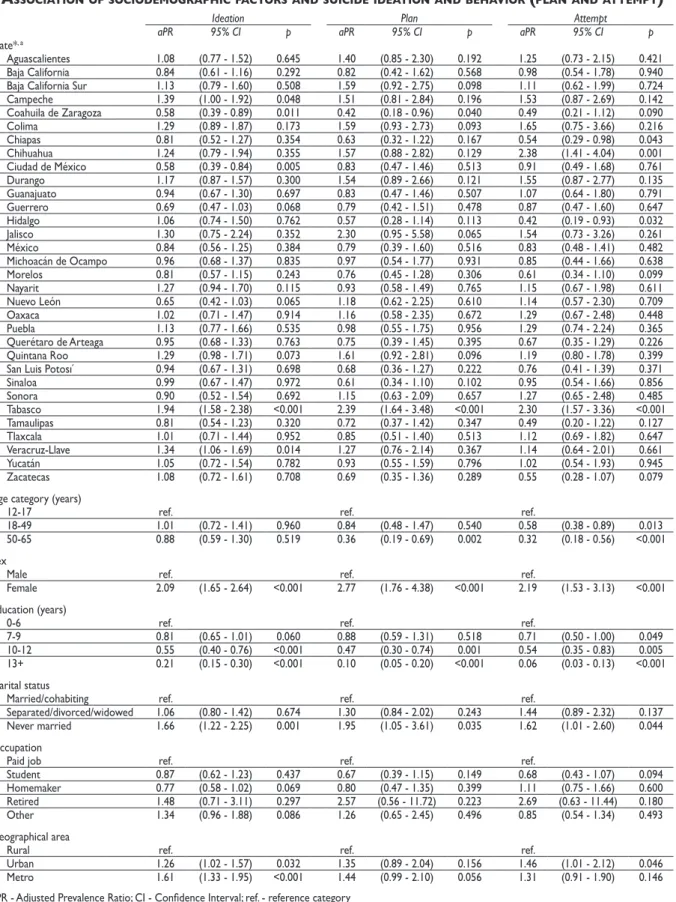
Table IV presents the results of a multivariate model for the prevalence of suicide ideation, plan and attempt using our key individual variables and the information on geographical area information and the state. As ap-parent from this table, males had a consistently lower prevalence ratio compared to females in all outcomes; those more educated had consistently lower prevalence ratios and those “never married” consistently higher prevalence ratios. Those in the older age group had lower prevalence ratios of plan and attempt (as those between 18-49 years old). While those in rural areas had similar crude prevalences, the prevalent ratio was of statistical significance for ideation and attempt among urban areas. The states of Campeche, Tabasco and
Ve-racruz had higher prevalence ratios of ideation when compared to the national average, while Coahuila and Mexico City had lower prevalence ratios. Tabasco had an increased prevalence ratio and Coahuila had a lower prevalence ratio for a plan. For attempt, Chihuahua and Tabasco had increased prevalence ratios while Chiapas and Hidalgo had had lower prevalence ratios.
Discussion
SummaryThe main findings of this study were that: (1) the overall prevalence of suicide ideation was 2.3%, 0.8% reported a plan and 0.7% reported a suicide attempt; (2) the prevalences among males were about half the size of the corresponding prevalences among females, and the prevalences were higher among the younger females, and (3) in general, after statistical adjustments, there remained few differences in prevalence of the three outcomes across the country, but Tabasco still remained as the Mexican state with the highest rates for all outcomes. Our data on the distribution of suicide attempt by medical consequences (27.3% of all attempts lead to medical treatment), intent (34.9% were serious attempts) and methods (stabbing/puncture object was mentioned by 38% of all attempts), have the potential to help to calculate more precisely the burden of suicide for Mexico and to formulate public policies.
The Encodat 2016 is the largest survey ever done in Mexico reporting on the national (metropolitan, urban and rural) and state level data on suicide ideation, plan and attempts. There is simply no prior study in Mexico that fully allows us to compare our results. Neverthe-less, a prior report shows that in year 2001-2002 the prevalence of suicide ideation, plan and attempts among urban setting respondents within 18-65 years old were 2.4% for suicide ideation, plan was 0.9% and attempt was 0.5%.5 On another national survey, that used some
slightly different questions for suicide ideation,17 the
prevalence of any suicidal ideation was reported to be 8.8% (ranging from 4.2 to 6.2%, depending on the ques-tion used), the prevalence of a suicide plan was 1.22%, and 0.79% of the sample reported to attempt suicide within the past 12 months, with the prevalence of suicide attempts that required medical attention being 0.13%. Because of differences in the scope of the population sampled and age groups included we cannot make a direct comparison between these prevalences. There is, nevertheless, some limited evidence that suicidal behavior, among the young adults in the Metropolitan Mexico City, is increasing.18 Monitoring changes in the
Table III
prevalenceofSuicideideationandbehavior (planandattempt), byState, countryregionandgeographicalarea
Ideation Plan Attempt
N n % X2 p n % X2 p n % X2 p
State
Aguascalientes 1 857 52 2.7 88.2 0.051 19 1.1 105.9 0.030 17 0.9 69.2 0.029
Baja California 1 833 45 2.2 11 0.7 14 0.7
Baja California Sur 1 872 44 2.4 21 1.2 14 0.8
Campeche 1 722 56 3.1 18 1.1 17 1.1
Coahuila de Zaragoza 1 702 32 1.4 9 0.3 9 0.3
Colima 1 580 59 3.2 24 1.2 14 1.1
Chiapas 1 852 35 1.7 13 0.5 12 0.4
Chihuahua 1 714 56 3.3 19 1.3 22 1.7
Ciudad de México 1 724 34 1.4 16 0.6 13 0.5
Durango 1 886 57 2.8 25 1.3 23 1.1
Guanajuato 1 921 45 2.4 17 0.7 20 0.8
Guerrero 1 957 37 1.5 13 0.6 15 0.6
Hidalgo 1 732 40 2.2 9 0.4 6 0.3
Jalisco 1 593 49 3.3 17 1.9 17 1.1
México 1 716 45 2.1 15 0.6 15 0.6
Michoacán de Ocampo 1 893 46 2.2 16 0.8 14 0.7
Morelos 1 887 42 2.0 16 0.6 10 0.4
Nayarit 1 747 55 2.8 16 0.7 17 0.7
Nuevo León 1 595 37 1.6 19 0.9 17 0.8
Oaxaca 1 630 39 2.2 14 0.9 15 1.0
Puebla 1 630 47 2.6 17 0.8 19 1.0
Querétaro de Arteaga 1 776 43 2.3 12 0.6 12 0.5
Quintana Roo 1 652 61 3.2 25 1.3 18 0.8
San Luis Potosí 1 880 46 2.1 13 0.5 14 0.5
Sinaloa 1 854 42 2.1 13 0.4 15 0.6
Sonora 1 829 36 2.1 15 0.9 15 0.9
Tabasco 1 960 78 3.9 35 1.6 34 1.5
Tamaulipas 1 656 33 2.0 10 0.6 6 0.3
Tlaxcala 1 791 53 2.3 18 0.6 22 0.8
Veracruz-Llave 1 867 64 2.9 18 0.9 18 0.8
Yucatán 1 699 50 2.5 18 0.7 13 0.7
Zacatecas 1 870 39 2.4 11 0.5 10 0.4
Country region
North-west 9 135 222 2.2 25.3 0.076 76 0.7 35.9 0.069 75 0.7 11.89944649 0.219
North 12 303 300 2.1 106 0.8 101 0.8
Central-west 8 844 251 2.8 93 1.3 82 0.9
Central-east 14 213 341 2.0 116 0.6 112 0.6
South-east 12 382 383 2.7 141 0.9 127 0.8
Geographical area
Rural 15 783 348 2.0 8.7 0.111 121 0.7 4.0 0.459 118 0.7 6.0 0.193
Urban 12 816 348 2.3 144 0.9 127 0.9
Metro 28 278 801 2.4 267 0.8 252 0.7
Chi-square tests for State with 31 d.f.; Country region with 4 d.f. and Geographical area with 2 d.f.
Unweighted n’s; weighted percentages
13
salud pública de méxico / vol. 61, no. 1, enero-febrero de 2019
Suicide ideation and behavior in Mexico ArtículooriginAl
Table IV
aSSociationofSociodemographicfactorSandSuicideideationandbehavior (planandattempt)
Ideation Plan Attempt
aPR 95% CI p aPR 95% CI p aPR 95% CI p
State*, a
Aguascalientes 1.08 (0.77 - 1.52) 0.645 1.40 (0.85 - 2.30) 0.192 1.25 (0.73 - 2.15) 0.421
Baja California 0.84 (0.61 - 1.16) 0.292 0.82 (0.42 - 1.62) 0.568 0.98 (0.54 - 1.78) 0.940
Baja California Sur 1.13 (0.79 - 1.60) 0.508 1.59 (0.92 - 2.75) 0.098 1.11 (0.62 - 1.99) 0.724
Campeche 1.39 (1.00 - 1.92) 0.048 1.51 (0.81 - 2.84) 0.196 1.53 (0.87 - 2.69) 0.142
Coahuila de Zaragoza 0.58 (0.39 - 0.89) 0.011 0.42 (0.18 - 0.96) 0.040 0.49 (0.21 - 1.12) 0.090
Colima 1.29 (0.89 - 1.87) 0.173 1.59 (0.93 - 2.73) 0.093 1.65 (0.75 - 3.66) 0.216
Chiapas 0.81 (0.52 - 1.27) 0.354 0.63 (0.32 - 1.22) 0.167 0.54 (0.29 - 0.98) 0.043
Chihuahua 1.24 (0.79 - 1.94) 0.355 1.57 (0.88 - 2.82) 0.129 2.38 (1.41 - 4.04) 0.001
Ciudad de México 0.58 (0.39 - 0.84) 0.005 0.83 (0.47 - 1.46) 0.513 0.91 (0.49 - 1.68) 0.761
Durango 1.17 (0.87 - 1.57) 0.300 1.54 (0.89 - 2.66) 0.121 1.55 (0.87 - 2.77) 0.135
Guanajuato 0.94 (0.67 - 1.30) 0.697 0.83 (0.47 - 1.46) 0.507 1.07 (0.64 - 1.80) 0.791
Guerrero 0.69 (0.47 - 1.03) 0.068 0.79 (0.42 - 1.51) 0.478 0.87 (0.47 - 1.60) 0.647
Hidalgo 1.06 (0.74 - 1.50) 0.762 0.57 (0.28 - 1.14) 0.113 0.42 (0.19 - 0.93) 0.032
Jalisco 1.30 (0.75 - 2.24) 0.352 2.30 (0.95 - 5.58) 0.065 1.54 (0.73 - 3.26) 0.261
México 0.84 (0.56 - 1.25) 0.384 0.79 (0.39 - 1.60) 0.516 0.83 (0.48 - 1.41) 0.482
Michoacán de Ocampo 0.96 (0.68 - 1.37) 0.835 0.97 (0.54 - 1.77) 0.931 0.85 (0.44 - 1.66) 0.638
Morelos 0.81 (0.57 - 1.15) 0.243 0.76 (0.45 - 1.28) 0.306 0.61 (0.34 - 1.10) 0.099
Nayarit 1.27 (0.94 - 1.70) 0.115 0.93 (0.58 - 1.49) 0.765 1.15 (0.67 - 1.98) 0.611
Nuevo León 0.65 (0.42 - 1.03) 0.065 1.18 (0.62 - 2.25) 0.610 1.14 (0.57 - 2.30) 0.709
Oaxaca 1.02 (0.71 - 1.47) 0.914 1.16 (0.58 - 2.35) 0.672 1.29 (0.67 - 2.48) 0.448
Puebla 1.13 (0.77 - 1.66) 0.535 0.98 (0.55 - 1.75) 0.956 1.29 (0.74 - 2.24) 0.365
Querétaro de Arteaga 0.95 (0.68 - 1.33) 0.763 0.75 (0.39 - 1.45) 0.395 0.67 (0.35 - 1.29) 0.226
Quintana Roo 1.29 (0.98 - 1.71) 0.073 1.61 (0.92 - 2.81) 0.096 1.19 (0.80 - 1.78) 0.399
San Luis Potosí 0.94 (0.67 - 1.31) 0.698 0.68 (0.36 - 1.27) 0.222 0.76 (0.41 - 1.39) 0.371
Sinaloa 0.99 (0.67 - 1.47) 0.972 0.61 (0.34 - 1.10) 0.102 0.95 (0.54 - 1.66) 0.856
Sonora 0.90 (0.52 - 1.54) 0.692 1.15 (0.63 - 2.09) 0.657 1.27 (0.65 - 2.48) 0.485
Tabasco 1.94 (1.58 - 2.38) <0.001 2.39 (1.64 - 3.48) <0.001 2.30 (1.57 - 3.36) <0.001
Tamaulipas 0.81 (0.54 - 1.23) 0.320 0.72 (0.37 - 1.42) 0.347 0.49 (0.20 - 1.22) 0.127
Tlaxcala 1.01 (0.71 - 1.44) 0.952 0.85 (0.51 - 1.40) 0.513 1.12 (0.69 - 1.82) 0.647
Veracruz-Llave 1.34 (1.06 - 1.69) 0.014 1.27 (0.76 - 2.14) 0.367 1.14 (0.64 - 2.01) 0.661
Yucatán 1.05 (0.72 - 1.54) 0.782 0.93 (0.55 - 1.59) 0.796 1.02 (0.54 - 1.93) 0.945
Zacatecas 1.08 (0.72 - 1.61) 0.708 0.69 (0.35 - 1.36) 0.289 0.55 (0.28 - 1.07) 0.079
Age category (years)
12-17 ref. ref. ref.
18-49 1.01 (0.72 - 1.41) 0.960 0.84 (0.48 - 1.47) 0.540 0.58 (0.38 - 0.89) 0.013
50-65 0.88 (0.59 - 1.30) 0.519 0.36 (0.19 - 0.69) 0.002 0.32 (0.18 - 0.56) <0.001
Sex
Male ref. ref. ref.
Female 2.09 (1.65 - 2.64) <0.001 2.77 (1.76 - 4.38) <0.001 2.19 (1.53 - 3.13) <0.001
Education (years)
0-6 ref. ref. ref.
7-9 0.81 (0.65 - 1.01) 0.060 0.88 (0.59 - 1.31) 0.518 0.71 (0.50 - 1.00) 0.049
10-12 0.55 (0.40 - 0.76) <0.001 0.47 (0.30 - 0.74) 0.001 0.54 (0.35 - 0.83) 0.005
13+ 0.21 (0.15 - 0.30) <0.001 0.10 (0.05 - 0.20) <0.001 0.06 (0.03 - 0.13) <0.001
Marital status
Married/cohabiting ref. ref. ref.
Separated/divorced/widowed 1.06 (0.80 - 1.42) 0.674 1.30 (0.84 - 2.02) 0.243 1.44 (0.89 - 2.32) 0.137
Never married 1.66 (1.22 - 2.25) 0.001 1.95 (1.05 - 3.61) 0.035 1.62 (1.01 - 2.60) 0.044
Occupation
Paid job ref. ref. ref.
Student 0.87 (0.62 - 1.23) 0.437 0.67 (0.39 - 1.15) 0.149 0.68 (0.43 - 1.07) 0.094
Homemaker 0.77 (0.58 - 1.02) 0.069 0.80 (0.47 - 1.35) 0.399 1.11 (0.75 - 1.66) 0.600
Retired 1.48 (0.71 - 3.11) 0.297 2.57 (0.56 - 11.72) 0.223 2.69 (0.63 - 11.44) 0.180
Other 1.34 (0.96 - 1.88) 0.086 1.26 (0.65 - 2.45) 0.496 0.85 (0.54 - 1.34) 0.493
Geographical area
Rural ref. ref. ref.
Urban 1.26 (1.02 - 1.57) 0.032 1.35 (0.89 - 2.04) 0.156 1.46 (1.01 - 2.12) 0.046
Metro 1.61 (1.33 - 1.95) <0.001 1.44 (0.99 - 2.10) 0.056 1.31 (0.91 - 1.90) 0.146
aPR - Adjusted Prevalence Ratio; CI - Confidence Interval; ref. - reference category
* Global Adjusted Wald Tests for State are: Ideation F(31, 1752)=2.57, p<0.001; Plan F(31, 1752)=1.89, p=0.002; Attempt F(31, 1752)=1.93, p=0.002
in suicide death, is a next step in the analyses of the Encodat 2016.
The main associated factors explored in this report, female sex, young age groups, those with fewer educa-tion and those never married, were similar to previous reports in Mexico8 and elsewhere.19 As has been argued
recently,10 individual risk factors for suicide have poor
predictive power. Efforts to create risk indexes, adapt-able for specific populations, seem like a better and more fruitful approach.17 While we have focused here
on the impact of sociodemographic factors on suicide ideation and suicidal behavior, other factors such as family influences, psychological traits, mental disorders and substance abuse, among others, should be consid-ered. The use of the large array of associated factors for suicidal behavior in the Encodat 2016 will be a matter of a future report from our group.
This is the first time that a household survey in Mexico is capable of reporting state level information for suicide ideation, plan and attempt. After statistical controls, few differences in these prevalences remained. The most consistent of these findings was the excess of prevalence for all outcomes in the State of Tabasco, a state that has had for a long time one of the highest rates of death by suicide in the country.8 While a few
reports have delved into the increase risk for suicide in Tabasco,20,21 to the best of our knowledge the Encodat
2016 is the first report to show that suicidal behavior is also increased in this state. Future work in this area should try to explore the special circumstances and as-sociated factors that may be present in Tabasco, but this is beyond the scope of the current report.
Limitations
While this is the largest study so far in Mexico on the prevalence of suicide ideation, plan and attempt, the small 12-month prevalence of these behaviors prevented us from carrying out additional subgroup analyses.9,22
Since there is no data in the country that compares sui-cide in urban and rural places, this matter is speculative at the moment. Future work in the country should pay much more attention to rural areas, where also larger percentages of traditional local ethnicities live. The Encodat 2016 used in some of their respondents the ACASI system module of interview. Given the small prevalence of suicide ideation and behavior reported here, we cannot rule out that these changes played a part in our findings. Future work from our group will delve into possible similarities or differences in the sample by method of interview, but this is beyond the scope of this current work. Suicide ideation and behavior is
a complex and multi-causal phenomena and research including a broader array of determinants, besides the sociodemographics considered here, are needed. Conclusion
Suicidal behavior was widely spread all over the country with very few locations standing out as at higher risk. A national program for suicide prevention, instead of local short-term activities, is needed. Our results may help to substantiate some key points for such preven-tive program. While focusing in prevenpreven-tive activities on more specific groups as detected here, such as the youth, females, single people and those with lower educational attainment may yield better results, efforts to reach ev-eryone are needed. At least one in every four attempts will lead to medical treatment and one in every three attempts is self rated as serious, suggesting that physi-cians and other clinical personnel could be trained as in important gatekeeper to prevent that attempts latter develop into a fatal incident.
Declaration of conflict of interests. The authors declare that they have no conflict of interests.
References
1. World Health Organization. Preventing suicide: a global imperative. Geneva: WHO, 2014. Available from: http://apps.who.int/iris/bitstream/ handle/10665/131056/9789241564779_eng.pdf;jsessionid=EDAA480817E 21E5F8BE7CAE465F1227B?sequence=1
2. Borges G, García-Pacheco JA, Borsani L. Epidemiology of suicidal behavior in Mexico. In: Pan American Health Organization (ed). Prevention of suicidal behavior. Washington, DC: Pan American Health Organization, 2016:48-56. Available from: http://iris.paho.org/xmlui/bitstream/hand le/123456789/31166/9789275119198-eng.pdf?sequence=1&isAllowed=y 3. Institute for Health Metrics and Evaluation. Global burden of disease study 2015. Seattle: Institute for Health Metrics and Evaluation, 2015. [accessed August 14,2017]. Available at: http://ghdx.healthdata.org/gbd-results-tool
4. Lozano R, Gómez-Dantés H, Garrido-Latorre F, Jiménez-Corono A, Campuzano-Rincón J, Franco-Marina F, et al. Burden of disease, injuries, risk factors and challenges for the health system in Mexico. Salud Publica Mex. 2013;55(6):580-94. https://doi.org/10.21149/spm.v55i6.7304 5. Borges G, Nock MK, Medina-Mora ME, Benjet C, Lara C, Chiu WT, et al. The epidemiology of suicide-related outcomes in Mexico. Suicide Life Threat Behav. 2007;37(6):627-40. https://doi.org/10.1521/ suli.2007.37.6.627
6. Benjet C, Borges G, Medina-Mora ME, Zambrano J, Aguilar-Gaxiola S. Youth mental health in a populous city of the developing world: results from the Mexican Adolescent Mental Health Survey. J Child Psychol Psychiatry. 2009;50(4):386-95. https://doi.org/10.1111/j.1469-7610.2008.01962.x
15
salud pública de méxico / vol. 61, no. 1, enero-febrero de 2019
Suicide ideation and behavior in Mexico ArtículooriginAl
8. Borges G, Orozco R, Benjet C, Medina-Mora ME. Suicide and suicidal behaviors in Mexico: Retrospective and current status. Salud Publica Mex. 2010;52(4):292-304.
9. Borges G, Nock MK, Haro JM, Hwang I, Sampson N, Alonso J, et al. Twelve month prevalence of and risk factors for suicide attempts in the WHO World Mental Health Surveys. J Clin Psychiatry. 2010;71(12):1617-28. https://doi.org/10.4088/JCP.08m04967blu
10. Franklin JC, Ribeiro JD, Fox KR, Bentley KH, Kleiman EM, Huang X, et al. Risk factors for suicidal thoughts and behaviors: a meta-analysis of 50 years of research. Psychol Bull. 2017;143(2):187-232. https://doi. org/10.1037/bul0000084
11. Secretaría de Salud, Instituto Nacional de Psiquiatría Ramón de la Fuente Muñiz, Instituto Nacional de Salud Pública, Comisión Nacional contra las Adicciones. Resumen metodológico. In: Secretaría de Salud, Instituto Nacional de Psiquiatría Ramón de la Fuente Muñiz, Instituto Nacional de Salud Pública, Comisión Nacional contra las Adicciones. Encuesta nacional de consumo de drogas, alcohol y tabaco 2016-2017. México: Secretaría de Salud, 2017 [cited 2017 Aug 14]. Available from: https://www.gob.mx/cms/uploads/attachment/file/234804/RESUMEN_ME-TODOL_GICO.pdf
12. Villatoro J, Medina-Mora ME, Fleiz BC, Moreno-López M, Robles NO, Bustos-Gamiño M, et al. El consumo de drogas en México: resultados de la Encuesta Nacional de Adicciones, 2011. Salud Ment. 2012;35(6):447-57. 13. Secretaría de Salud, Instituto Nacional de Psiquiatría Ramón de la Fuente Muñiz, Instituto Nacional de Salud Pública, Comisión Nacional contra las Adicciones. Consumo de drogas: prevalencias globales, tenden-cias y variaciones estatales, In: Secretaría de Salud, Instituto Nacional de Psiquiatría Ramón de la Fuente Muñiz, Instituto Nacional de Salud Pública, Comisión Nacional contra las Adicciones. Encuesta nacional de consumo de drogas, alcohol y tabaco 2016-2017. Ciudad de México: Secretaría de Salud, 2017 [cited 2017 August 14]. Available from: https://www.gob.mx/ cms/uploads/attachment/file/234856/CONSUMO_DE_DROGAS.pdf
14. Nock M, Borges G, Ono Y. Suicide: global perspective from the WHO World Mental Health Surveys. New York: Cambridge University Press, 2012. 15. Turner CF, Ku L, Rogers SM, Lindberg LD, Pleck JH, Sonenstein FL. Ado-lescent sexual behavior, drug use, and violence: increased reporting with computer survey technology. Science. 1998;280(5365): 867-73. https://doi. org/10.1126/science.280.5365.867
16. Cummings P. Methods for estimating adjusted risk ratios. Stata J. 2009;9(2):175-96.
17. Borges G, Medina-Mora ME, Orozco R, Oueda C, Villatoro J, Fleiz C. Distribución y determinantes sociodemográficos de la conducta suicida en México. Salud Ment. 2009;32(5): 413-25.
18. Borges G, Benjet C, Orozco R, Medina-Mora ME. The growth of suicide ideation, plan and attempt among young adults in the Mexico City metropolitan area. Epidemiol Psychiatr Sci. 2017;26(6):635-43. https://doi. org/10.1017/S2045796016000603
19. Nock MK, Borges G, Bromet E, Cha CB, Kessler RC, Lee S. Suicide and suicidal behavior. Epidemiol Rev. 2008;30(1):133-54. https://doi. org/10.1093/epirev/mxn002
20. Fresán A, González-Castro TB, Peralta-Jiménez Y, Juárez-Rojop I, Pool-García S, Velázquez-Sánchez MP, et al. Gender differences in socio-demographic, clinical characteristics and psychiatric diagnosis in/ of suicide attempters in a Mexican population. Acta Neuropsychiatrica. 2015;27(3):182-8. https://doi.org/10.1017/neu.2015.6
21. Aguilar-Velázquez DG, González-Castro TB, Tovilla-Zárate CA, Juárez-Rojop I, López-Narváez ML, Fresán A, et al. Gender differences of suicides in children and adolescents: Analysis of 167 suicides in a Mexican population from 2003 to 2013. Psychiatry Res. 2017;258:83-7. https://doi. org/10.1016/j.psychres.2017.09.083
22. Kessler RC, Berglund P, Borges G, Nock M, Wang PS. Trends in suicide ideation, plans, gestures, and attempts in the United States, 1990-1992 to 2001–2003. JAMA. 2005;293(20):2487-95. https://doi.org/10.1001/