
The perceptions of English teachers about the English lessons in the current education system of Turkey
13
0
0
Texto completo
(2) Andarab, 2019). Many regulations and changes in different areas have been done to bring effectiveness in education system. English language teaching is one of those areas. Işık (2008) states that despite so many efforts and resources, English language teaching hasn’t reached to the desired point yet (Celik & Yavuz, 2018). For this reason, different regulations and changes have been brought to English language teaching through the history. Some of them have had positive effect on English Language teaching, some not. 4+4+4 Education Policy is one of those regulations. With this policy, necessary 8-year continuous education system was converted into 4+4+4 discontinuous education system. The first 4 years refer to primary school, the second 4 years refer to secondary school and the last four years refer to high school (Güven, 2010). English started to be taught at the second year instead of the fourth year of the Primary school. The effect of age factor lies under this change; because, it is believed that the earlier foreign language teaching/learning starts, the more effective it will be (Abrahamson & Hytenstam, 2009; Perani, et al., 1996; Mekkaoui & Mouhadjer, 2019) Undoubtedly, among the most important addressees of English language teaching are English teachers. Regulations and changes in education system are the concern of teachers in the first order as the changes and regulations are implemented by them. The thoughts of teachers are non-ignorable for the development of language education; Evaluating students and teachers’ perceptions in learningteaching processes can provide great benefits (Gelisli & Kazykhankyzy, 2019). So, this study aims to reveal the perceptions of private school and state school teachers about the English lessons of primary and secondary schools in the current education system of Turkey. 2. THE CHANGES AND REGULATIONS OF FOREIGN LANGUAGE EDUCATION THROUGH THE HISTORY English Language Education has passed through different stages through the history. Sarıçoban (2012) addresses three periods of foreign language education which consists of Tanzimat Period (1839-1876), Republican Turkey (1923-1997) and 1997 Education Reform. 4+4+4 Education Policy which started to be implemented in 2012 can be considered as another period of the regulation of foreign language teaching. As stated in Sarıcoban (2012), English as a foreign language started to take place in Turkish education system in Tanzimat period (1839-1876) which refers to the westernization process and renewal efforts. French used to be taught as a foreign language in that period because of the close relations with France. As another step of renewal efforts, Robert College was founded by Cyrus Hamlin in İstanbul in 1863 and it was the first educational institution which used English as a medium of instruction (Sarıcoban, 2012). Foreign language used to be taught by anyone who knew foreign language in the Imperial period. Teacher training for foreign language teaching started in The Schools of Teachers (Darulmuallimin) in 1848 for the first time (Işık, 2008). Tanzimat period was followed by Republican Turkey (1923-1997); different reforms were done in terms of national, social, cultural and educational levels by Mustafa Kemal Atatürk, the founder of republic. In that period, Middle East Technical University, Boğaziçi University, Medicine Faculties of Hacettepe and Cerrahpaşa Universities were. THE PERCEPTIONS OF ENGLISH TEACHERS ABOUT THE ENGLISH LESSONS IN THE CURRENT EDUCATION SYSTEM OF TURKEY Gunes, S. Encuentro 28, 2020, ISSN 1989-0796, pp. 71-83. 72.
(3) higher education institutions that started to teach in English (Çelebi, 2006). With 1997education reform, Ministry of National Education regulated the curriculum of Primary schools. English began to be taught in the 4th grade of primary school instead of 6th grade (that is, at the age 10, rather than at the age 12). This decision was based on a belief in the necessity of beginning English at early ages (Gunes, 2011). On the other hand, the ratio of English among other foreign languages was 22,30% in 1943-1944; but this ratio increased to 97,49% in 1998-1999 academic year (Genc, 2003). As it is seen English has had more and more important role in our education system through the years. This increasing importance leaded the authorities to the new regulations through the history. In 2012 Ministry of National Education did another regulation in education system named 4+4+4. English began to be taught at the second year of the Primary School instead of 4th year to reach the advantages of early ages. As cited in Han (2004), Lenneberg states that there is a period during the human life span from infancy to puberty (age 2 to 13) that is critical to language learning, during which learning is successful and after which it is marginal. For this reason, Ministry of National Education decided to increase the duration for Foreign Language Education (FLE) and make the students start FLE at an earlier age in order to reach the advantages of the starting to learn a Foreign Language at an early age (Bayyurt, 2013). 3. METHODOLOGY This study aims to reveal the perceptions of English teachers about English lessons in secondary and primary schools in relation to the current education system which has been 4+4+4 since 2012. This research was conducted at six state schools and four private schools in Diyarbakır. Thirty-five English teachers who teach in primary and secondary schools were included in this study (See Table 1 for the profile of the participants). Number of Teachers Gender Occupational Experience Type of School. Male:11 1-5 years: 14 11-15 years: 8 State School: 16. Female: 24 6-10 years: 10 15+ years: 3 Private School: 19. Table 1. The profile of the participants. A Likert scale prepared by the researcher was used for data collection process. Mazanek and others (2018) also used a 5 point Likert type scale in his study. Before the preparation of the scale, an interview was done with two English teachers in order to indicate the key points that would take place in the scale. Those teachers were not included in the study in order not to affect the reliability of the scale. The reliability coefficient was revealed by means of Cronbach’s Alpha value by using SPSS. The results showed that the instrument used for the research is a highly reliable tool (Cronbach’s Alpha value = ,909). To collect data, the questionnaires were implemented to the teachers in the schools where they were working and in a face-to-face environment.. THE PERCEPTIONS OF ENGLISH TEACHERS ABOUT THE ENGLISH LESSONS IN THE CURRENT EDUCATION SYSTEM OF TURKEY Gunes, S. Encuentro 28, 2020, ISSN 1989-0796, pp. 71-83. 73.
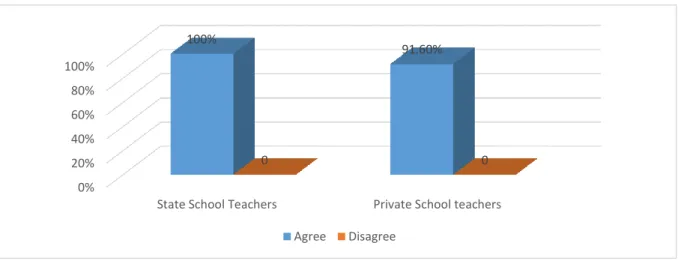
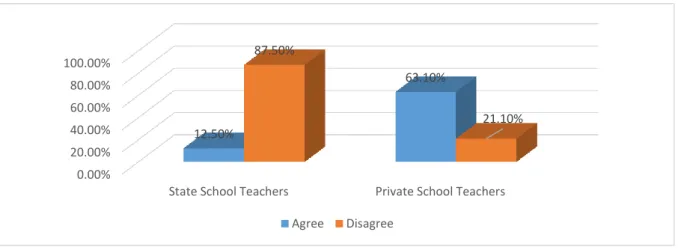
(4) 4. RESULTS The data collected from the scales were analyzed quantitatively by using SPSS. In this section, data gathered from the state school teachers and private school teachers will be compared in relation to the items included in the likert-scale. For each item of the questionnaire, there were five options (totally agree, agree, no idea, disagree, totally disagree). The results will be presented through the graphs in which the similar choices are combined; the results for totally agree and agree; and the results for totally disagree and agree will be presented together. 4.1 An Item-based Comparison of the perceptions of state and private school teachers As the first item of the questionnaire, the teachers were asked whether they believe in that teaching English at an early age is effective for the learners or not; because the reason behind the current foreign language education policy was to benefit from the positive effect of early ages. As seen in Figure 1, the advantages of starting to learn English at an early age are believed by nearly all of the language teachers. The ratio of state school teachers who believe the effect of early ages in terms of teaching English was 100% and this ratio was 91, 6% for the private school teachers. In fact, the advantages of starting to learn a foreign or second language at an early age are commonly known and believed. This item was included in the questionnaire in order to see whether the English teachers are aware of this point which lies behind the current English teaching policy.. 100%. 91.60%. 100% 80% 60% 40% 20%. 0. 0. 0% State School Teachers. Private School teachers Agree. Disagree. Figure 1. Teaching English in the second year of Primary school is useful for language development in terms of learners.. The second item was about the physical structures of the schools. The English teachers were asked whether the physical structures of the schools are appropriate for teaching English at an early stage or not. The results present the differences between two groups for this item. Only 12,5% of the state school teachers agree that the physical structures of the schools are appropriate for teaching English at an earlier stage, whereas this ratio 63,1% for the private school teachers. 87,5 of state school teachers disagree with this idea, on the other hand 21,1% of the private school teachers disagree (See Figure 2).. THE PERCEPTIONS OF ENGLISH TEACHERS ABOUT THE ENGLISH LESSONS IN THE CURRENT EDUCATION SYSTEM OF TURKEY Gunes, S. Encuentro 28, 2020, ISSN 1989-0796, pp. 71-83. 74.
(5) 87.50%. 100.00%. 63.10%. 80.00% 60.00% 40.00%. 21.10% 12.50%. 20.00% 0.00% State School Teachers. Private School Teachers Agree. Disagree. Figure 2. The physical structures of the schools are appropriate for teaching English at an earlier stage.. As another item, the teachers were asked whether the class size (the number of the students) is appropriate to implement the current curriculum in an effective way. Interesting results are revealed in terms of the class size (the number of the students). As seen in Figure 3 given below, none of the state school teachers see the class sizes as appropriate for the implementation of the new system in an effective way and 81,3 % of them see this issue as problematic. On the other hand, 73,7 % of the private school teachers think that the class sizes are appropriate and only 5,3% of them disagree with this idea. As stated previously the data were collected from 16 teachers working in six different state schools; none of the teachers of six different state schools indicate a positive perception related to the class size. Students in most of the state schools are taught English in crowded classrooms; this may hinder the effectiveness of language education (see Figure 3).. 81.30%. 1. 73.70%. 0.8 0.6 0.4 0.2. 5.30%. 0. 0 State School Teachers. Private School Teachers Agree. Disagree. Figure 3. The class size (the number of the students) of the primary schools is appropriate to implement the current curriculum in an effective way.. THE PERCEPTIONS OF ENGLISH TEACHERS ABOUT THE ENGLISH LESSONS IN THE CURRENT EDUCATION SYSTEM OF TURKEY Gunes, S. Encuentro 28, 2020, ISSN 1989-0796, pp. 71-83. 75.
(6) Another important issue related to the English lessons is related to the class hours. The teachers were asked whether the class hours for English are adequate or not. As seen in Figure 4 given below, interesting results are presented for the issue of whether the class hours are sufficient or not. 100% of the state school teachers think that the class hours for English are not sufficient, but 52,6% of the private school teachers think that the class hours are adequate for teaching English. This may be because of the foreign language teaching policy of the private schools; they have more class hours for English than the state schools. In the state schools, the students in 2nd, 3rd and 4th grades have 2 hours of English in a week; this increases to 3 hours for 5th and 6th grades and 4 hours for 7th and 8th grades. The state school teachers need to complete the subjects placed in the curriculum in those class hours; so, all of the state school English teachers state that the class hours are not adequate for teaching English. 100.00% 100.00%. 52.60%. 80.00%. 31.60%. 60.00% 40.00%. 0.00%. 20.00% 0.00% State School Teachers. Private school Teachers Agree. Disagree. Figure 4. The class hours for English lessons are sufficient.. As 5th item of the questionnaire, the teachers were asked whether they have adequate time to conduct supplementary activities in addition to the ones placed in the curriculum. As it is seen in Figure 5, only 12,5% of the state school teachers think that they have adequate time for supplementary activities and 88,5% of them do not agree with this item. On the other hand, 52,6% of the private school teachers think that they have time for additional activities in addition to those in the curriculum. As stated above, private schools have more class hours for English; so, it is more probable to find time to do additional activities to reinforce what is taught.. 88.50%. 100.00% 80.00%. 52.60%. 60.00% 40.00%. 26.30% 12.50%. 20.00% 0.00% State School Teachers. Private School Teachers Agree. Disagree. Figure 5. English teachers have adequate time to conduct supplementary activities in addition to the ones placed in the curriculum.. THE PERCEPTIONS OF ENGLISH TEACHERS ABOUT THE ENGLISH LESSONS IN THE CURRENT EDUCATION SYSTEM OF TURKEY Gunes, S. Encuentro 28, 2020, ISSN 1989-0796, pp. 71-83. 76.
(7) The next item was about the basic language skills. While teaching a foreign language, it is important to have the knowledge of language as a whole; that is, all of the language skills (reading, writing, speaking and listening) should be included in the curriculum and given adequate importance. Within this study, the teachers were also asked whether the content of the current curriculum provides opportunities to improve all of the language skills or not. The results show that a bigger number of private school teachers have positive perception than the state school teachers about including all of the language skills into the curriculum.. 73.70% 80.00%. 43.80%. 60.00%. 31.30% 15.80%. 40.00% 20.00% 0.00% State School Teachers. Private school Teachers Agree. Disagree. Figure 6. The content of the current English curriculum provides opportunities to improve all of the language skills (reading, writing, speaking, listening).. The seventh item of the questionnaire was about whether the content of the current English curriculum is appropriate for the level of the students or not. The ratio of teachers who believe in that the content of English curriculum is appropriate for the level of the students is not low for both groups. 62,6% of the state school teachers and 79% of the private school teachers agree with this idea. As seen the ratio of private school teachers who agree with this idea is higher than state school teachers’; this may stem from the level of private school students. They are thought to be better at English because of the intensity of English Language education. 79% 80.00% 60.00%. 62.60% 31.30% 10.60%. 40.00% 20.00% 0.00% State School Teachers. Private School Teachers Agree. Disagree. Figure 7. The content of current English curriculum is compatible with the level of the students.. THE PERCEPTIONS OF ENGLISH TEACHERS ABOUT THE ENGLISH LESSONS IN THE CURRENT EDUCATION SYSTEM OF TURKEY Gunes, S. Encuentro 28, 2020, ISSN 1989-0796, pp. 71-83. 77.
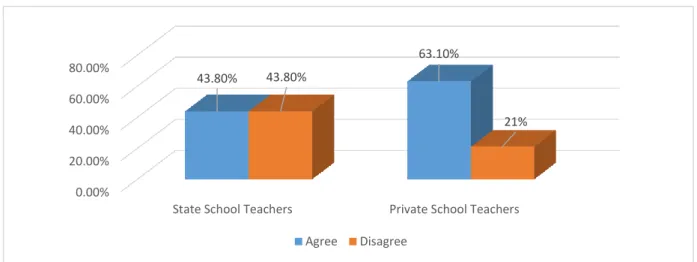
(8) The 8th item was about whether English Language teachers have required knowledge and skills for implementing the content of the current English curriculum or not. The results show that 43,8% of the state school teachers and 63,1 of the private school teachers think that English language teachers have required knowledge and skills for the implementation of the new curriculum. On the other hand, 43,8% of the state school teachers and 21% of private school teachers disagree with this idea. The ratio of state school teachers who disagree with this item is higher than the private school teachers.. 63.10% 80.00%. 43.80%. 43.80%. 60.00% 21%. 40.00% 20.00% 0.00% State School Teachers. Private School Teachers Agree. Disagree. Figure 8. English teachers have required knowledge and skills for implementing the content current curriculum.. As the last item of the questionnaire, the teachers were asked whether they think that the students do not have any difficulties to keep up with the lessons prepared according to the current English curriculum. 31,3% of the state school teachers and 47,4 of the private school teachers agree with this item. What is interesting with the results of this item is that 62,5% of the state school teachers disagree; this means that more than half of the state school teachers think that the students have difficulties in terms of the English lessons. There may be different background factors that influence their learning; these factors may be either related to students’ own personal life or related to the school itself such as crowded classrooms, teacher’s way of teaching or the deficiency of materials. The ratio of private school teachers who disagree with this item is 31,6%. The difference between state and private school teachers can be based on the level of the students; as indicated before, the levels of the private school students may be better than the state school students because of the intensity and quality of the language education. The students in private schools have more English classes and use various materials for English education. All these may affect students’ learning English.. THE PERCEPTIONS OF ENGLISH TEACHERS ABOUT THE ENGLISH LESSONS IN THE CURRENT EDUCATION SYSTEM OF TURKEY Gunes, S. Encuentro 28, 2020, ISSN 1989-0796, pp. 71-83. 78.
(9) 62.50% 70.00% 47.40%. 60.00% 50.00% 40.00%. 31.60% 31.30%. 30.00% 20.00% 10.00% 0.00% State School Teachers. Private school Teachers Agree. Disagree. Figure 9. The students do not have any difficulties to keep up with the lessons prepared according to the current English curriculum.. 5. CONCLUSION AND DISCUSSION The aim of the current study is to reveal and compare the perceptions of state school teachers and private school teachers in terms of the English lessons in the current education system of Turkey. The results show English teachers working in private schools have more positive perceptions than the state school teachers about the English lessons in the current education system which has been 4+4+4 since 20122013 academic year. The points about which the state school teachers mostly indicated negative perceptions are as following: Class size (the number of the students), class hours for English lessons, schools’ physical structures, language skills which are included in the curriculum and teachers’ finding adequate time to do additional activities in addition to those stated in the curriculum. The biggest difference between the perceptions of English teachers occurred in terms of the class size; none of the state school teachers indicated a positive opinion for this item whereas the ratio of positive perception was 73,7% for the private school teachers. This result directs us to think about the number of the students in English classes at state schools. It should not be forgotten that English is a language that is used for communication; it may not be possible to practice language skills especially the speaking skill in overcrowded classrooms which seem to be a big problem for the state schools. As another item of the questionnaire which may be related to the class size, the teachers were asked whether their students have problems to keep up with the content of the lessons or not. 62,5 % of the state school teachers think that their students have problems in terms of keeping up with the lessons; whereas the ratio is 31,6 for the private school teachers. This may be related to the class size (the number of the students). It may be difficult to be aware of the weaknesses and strengths of the students in an overcrowded classroom and additionally, each student may not have the equal opportunity for attending the lesson and having feedback. All these may affect students’ learning or catching the subjects.. THE PERCEPTIONS OF ENGLISH TEACHERS ABOUT THE ENGLISH LESSONS IN THE CURRENT EDUCATION SYSTEM OF TURKEY Gunes, S. Encuentro 28, 2020, ISSN 1989-0796, pp. 71-83. 79.
(10) Another big difference between two groups was seen in terms of the class hours; none of the state school teachers think that the class hours are adequate for teaching English. This result may be relatable to the result of the item which asks whether the teacher have adequate time to do additional activities in addition to those in the curriculum. As indicated before, the students have 2 hours for English lesson in 2nd, 3rd and 4th grades and 3 hours in 5th and 6th grades and 4 hours in 7th and 8th grades. None of the state school teachers think that these class hours are adequate for teaching English and doing additional activities in order to reinforce what is taught. As for the physical structures of schools, the perceptions of the state and private school teachers vary again; only a small rate (12,5%) of state school teachers think that schools’ physical structures are appropriate for teaching English at earlier grades and this rate is 63,1% for the private school teachers; it is higher as expected. But the role of physical structures of learning environments should not be ignored especially for the young learners. The belief behind the current foreign language education policy was related to the advantages of learning a foreign language at early ages. If the required learning environment is not provided for the young learners, then the policy may not serve its purpose. As a result of another item, 40% -difference was seen between the teachers of two groups in terms of the item asking whether all of the language skills (listening, speaking, reading, writing) are included in the curriculum or not. 43,8% of the state school teachers and 73,7% of private school teachers indicate a positive perception about this item. More than half of the state school teachers have negative perception. Indeed, when the English curriculum of 2018 is looked through, it is seen that English language teaching is based on listening and speaking in the 2nd, 3rd and 4th grades of the primary school. In the 5th and 6th grades, the focus is on speaking and listening again; reading is added in a limited way. In the 7th and 8th grades, listening and speaking are primary skills again and reading and writing are stated as secondary skills. When the English curriculum is considered as a whole for primary and secondary schools, it is seen that teaching all of the language skills is promoted. On the other hand, when the curriculum is considered for a certain grade of primary or secondary school, it is possible to state that the focus is on certain language skills. The teachers were also asked whether they think that the English teachers have required knowledge and skills in order to implement the current English curriculum; 21% of the private school teachers disagreed with this item, whereas the ratio was 43,8% for the state school teachers who disagreed. The education system for teaching English as a foreign language has been regulated to reach the best. It may not be very easy to be adapted; so, some of the teachers may have difficulty to implement the curriculum as it is required. For example, the English curriculum of 2nd, 3rd and 4th grades of the primary schools is based on listening and speaking skills for which the use of technology is required; some of the teachers may have difficulty in terms of using technology. Technology is very effective in language learning (Uzunboylu & Ozcinar, 2009; Ceker & Keser, 2019; Tavoosy & Jelveh, 2019; Tajgozari, 2019). The researcher demonstrated the ease of learning English with the flipped learning method in technology (Yavuz & Ozdemir, 2019).. THE PERCEPTIONS OF ENGLISH TEACHERS ABOUT THE ENGLISH LESSONS IN THE CURRENT EDUCATION SYSTEM OF TURKEY Gunes, S. Encuentro 28, 2020, ISSN 1989-0796, pp. 71-83. 80.
(11) As seen, there are big differences between the perceptions of private school teachers and state school teachers especially about the issues mentioned above. That is no doubt that all these issues affect the students’ foreign language learning. It may be difficult to catch the same level for the students in private and state schools. In fact, private schools’ having better conditions in terms of foreign language education and private school teachers’ having more positive perceptions about English lessons are expected, but there is something else which should not be ignored: In order to study at a good high school, all of the students have the same examination at end of the secondary school regardless of their type of primary or secondary school. 5.1. Suggestions Considering the results, the following suggestions can be stated: . Class size (the number of the students) is seen as a big problem for teaching English. The number of the students in an English class should be appropriate for providing the students with practicing the language skills; the number of students in overcrowded classrooms should be decreased.. . The class hours for English lesson may be increased both in primary and secondary school in order to provide English teachers with having more time to reinforce what is taught.. . Schools’ physical conditions should be improved in order to teach English to the young learners in an effective way.. . The teachers may be provided with more in-service teacher trainings in order not to have difficulty or problems for the implementation of English curriculum.. . In order to provide a balance between state and private school students, their conditions for foreign language learning should be close to each other as they will have the same examination at the end of the secondary school.. REFERENCES Abrahamsson, N., & Hyltenstam, K. (2009). Age of onset and nativelikeness in a second language: Listener perception versus linguistic scrutiny. Language Learning, 52(2), 249-306. Alanazi, K., & Thompson, C. (2019). Using social networking technologies to promote language socialisation: English as foreign language teachers’ perceptions in Saudi Arabia. Global Journal of Foreign Language Teaching, 9(3), 122-136. https://doi.org/10.18844/gjflt.v9i3.4129 Bayyurt, Y. (2013). 4+4+4 Eğitim sisteminde erken yaşta yabancı dil eğitimi. Symposium book of 1st Foreign Language Education Symposium at Hacettepe University. Ankara. THE PERCEPTIONS OF ENGLISH TEACHERS ABOUT THE ENGLISH LESSONS IN THE CURRENT EDUCATION SYSTEM OF TURKEY Gunes, S. Encuentro 28, 2020, ISSN 1989-0796, pp. 71-83. 81.
(12) Ceker, E., & Keser, H. (2019). Research study trends in web-supported evaluation tools for assessing inspectors, teachers, and students. Contemporary Educational Researches Journal, 9(1), 38-55. https://doi.org/10.18844/cerj.v9i1.3736 Çelebi, D. (2006). Türkiye’de anadil eğitimi ve yabancı dil öğretimi. Erciyes Üniversitesi Sosyal Bilimler Enstitüsü Dergisi Sayı : 21 Yıl : 2006/2, 285-307. Celik, G., & Yavuz, F. (2018). Integrating a process-based challenging lesson plan framework into the syllabus for gifted EFL learners. International Journal of Innovative Research in Education, 5(3), 62-73. https://doi.org/10.18844/ijire.v5i3.3951 Demir, S., B., Doğan, S., & Pınar, M., A. (2013). 4+4+4 Yeni eğitim sisteminin yansımaları: Sürecin brans öğretmenlerinin görüşleri doğrultusunda değerlendirilmesi. International Periodical For The Languages, Literature and History of Turkish or Turkic, 8 (9), 1081-1098. Genç, A. (2003). Türkiye’de geçmişten günümüze Almanca öğretimi. Ankara: Seçkin. Gelisli, Y., & Kazykhankyzy, L. (2019). Investigation of students’ perceptions of national identity. New Trends and Issues Proceedings on Humanities https://doi.org/10.18844/prosoc.v6i1.4198. and. Social. Sciences, 6(1),. 451-463.. Güneş, S. (2011). The background factors that influence learners’ English proficiency. (MA Thesis), Bilkent Üniversitesi, Ankara. Güven, İ. (2010). Türk Eğitim Tarihi. Ankara: Naturel. Han, Z. (2004). Fossilization in Adult Second Language Acquisition: Clevedon: Multilingual Matters Ltd. Işık, A. (2008). Yabancı dil eğitimimizdeki yanlışlıklar nereden kaynaklanıyor? Journal of Language and Linguistic Studies.4 (2). Mazanek, L., Vraniak, L., Murinova, A., & Konecny, S. (2018). Significant leadership competencies at large industrial companies: Results of exploratory quantitative research. Global Journal of Business, Economics and Management: Current Issues, 8(1), 30-37. https://doi.org/10.18844/gjbem.v8i1.3297 Mekkaoui, G., & Mouhadjer, N. (2019). Addressing air traffic controllers’ English language proficiency needs: Case of Zenata Airport. Global Journal of Foreign Language Teaching, 9(3), 167-183. https://doi.org/10.18844/gjflt.v9i3.4245 Perani, D., Dehaene, S., Grassi, F., Cohen, L., Cappa, S. F., Dupoux, E., ... & Mehler, J. (1996). Brain processing of native and foreign languages. NeuroReport-International Journal for Rapid Communications of Research in Neuroscience, 7(15), 2439-2444. Saricoban, G. (2012). Foreign language education policies in Turkey. Procedia-Social and Behavioral Sciences, 46, 2643-2648. Solhi Andarab, M. (2019). The content analysis of the English as an international language-targeted coursebooks: English literature or literature in English? Cypriot Journal of Educational Sciences, 14(1), 69-79. https://doi.org/10.18844/cjes.v14i1.3930. THE PERCEPTIONS OF ENGLISH TEACHERS ABOUT THE ENGLISH LESSONS IN THE CURRENT EDUCATION SYSTEM OF TURKEY Gunes, S. Encuentro 28, 2020, ISSN 1989-0796, pp. 71-83. 82.
(13) Tajgozari, M. (2019). The effect of watching captioned TV series on speaking accuracy of Iranian advanced EFL learners. Global Journal of Foreign Language Teaching, 9(3), 157-166. https://doi.org/10.18844/gjflt.v9i3.4221 Tavoosy, Y., & Jelveh, R. (2019). Language teaching strategies and techniques used to support students learning in a language other than their mother tongue. International Journal of Learning and Teaching, 11(2), 7788. https://doi.org/10.18844/ijlt.v11i2.3831 Uzunboylu, H & Ozcinar, Z. (2009). Research and Trends in Computer-assisted Language Learning during 19902008: Results of a Citation Analysis. Eurasian Journal of Educational Research, 8(34), 133-150. Yavuz, F., & Ozdemir, S. (2019). Flipped classroom approach in EFL context: Some associated factors. World Journal on Educational Technology: https://doi.org/10.18844/wjet.v11i4.4296. Current. Issues, 11(4),. 238-244.. THE PERCEPTIONS OF ENGLISH TEACHERS ABOUT THE ENGLISH LESSONS IN THE CURRENT EDUCATION SYSTEM OF TURKEY Gunes, S. Encuentro 28, 2020, ISSN 1989-0796, pp. 71-83. 83.
(14)
Figure


+4


Documento similar
UNIVERSIDAD DE CUENCA FACULTAD DE FILOSOF?A, LETRAS Y CIENCIAS DE LA EDUCACI?N CARRERA DE LENGUA Y LITERATURA INGLESA "Teachers? Perceptions on Inclusive Education for High School
Mauricio Vargas Gutierrez rd Music embedded in English lessons: A case study with a group of 3 graders in a public school.. MUSIC EMBEDDED IN ENGLISH LESSONS: A CASE STUDY WITH A
BENEM?RITA UNIVERSIDAD AUT?NOMA DE PUEBLA FACULTAD DE LENGUAS Facultad de Lenguas MEXICAN ENGLISH TEACHERS? NARRATIVES ABOUT THE TEACHING OF ENGLISH IN PUBLIC PRIMARY SCHOOLS A
learning process in the schools in the sample are: the level of education teachers have, their proficiency in English, the usage of the language in the classroom, the class size,
fact that having a small class allows them practice the listening skill in their daily classes. The same happens with teachers; 100% of teachers agree or totally agree that having
Questionnaire: 12th of august 2015 This is an ambiguous example of teachers´ beliefs on the important role that has the mother tongue in English class, where she believed that
Factors in Teachers’ Awareness of Pedagogical Gestures as Enhancement Technique Among English Teachers in Secondary Schools in Enugu State, Nigeria Nkechinyere Iwe Michael Okpara
GENERAL DESCRIPTIVE STATISTICS OF PROFESSIONAL DEVELOPMENT ATTITUDE A Comprehensive Questionnaire on the Professional Development Attitude of Middle School English Teachers Revised is
