Ecological land management in the oil municipalities of Region
V North, Chiapas: limits and perspectives of participatory
community workshops
Received: 19 August 2009. Final version accepted: 19 August 2009.
Omar Rojas García*
Abstract.The present article discusses the importance of community participation in workshops conducted in the oil municipalities of Region V North, Chiapas, as part of the process of drawing up an environmental agenda for the region. The main concerns of the population are analysed, including those relating to changes in land use caused by livestock production and their effects on the environment, as well as those related to the oil industry. The article also
discusses the lack of action on the part of the various go-vernmental agencies in resolving the social, economic and environmental problems associated with the municipalities; this lack of action can affect the implementation of an environmental proposal.
Key words: Environmentalland use management, partici-patory planning, environmental agenda.
*Departamento de Geografía Económica, Instituto de Geografía, Universidad Nacional Autónoma de México, Circuito de la Investigación Científica, Cd. Universitaria, 04360, Coyoacán, Mexico, D. F. E-mail: [email protected]
Resumen. En este artículo se discute la importancia de los talleres de participación comunitaria, realizados en los municipios petroleros de la Región V Norte de Chiapas, como parte del proceso para obtener una agenda ambiental de dicha región. Se analizan las principales inquietudes de la población, en las que se incluye lo relacionado al cambio de uso del suelo ocasionado por la ganadería y sus impac-tos al ambiente, así como los relacionados con la actividad
petrolera. Asimismo, se discute la falta de acción por parte de las diferentes instancias gubernamentales para resolver los problemas sociales, económicos y ambientales inherentes a los municipios y que, por ende, puede repercutir en la instrumentación de alguna propuesta ambiental.
Palabras clave: Ordenamiento ecológico del territorio, planeación participativa, agenda ambiental.
INtRoduCtIoN
The government of the State of Chiapas, through the Institute of Natural History and Ecology (IHNE), decided to promote a project designated ‘Ecological territorial regulation of the oil-pro-ducing zone of Region V in northern Chiapas’, which was assigned to the Institute of Geography (IG) of the National Autonomous University of Mexico (UNAM). This proposal stemmed from a need identified by the Inter-institutional Com-mission on the Environmental Problems of the oil zones of the state of Chiapas created under the auspices of the Governor in December 2003. The proposal of Ecological Territorial Regulation (OET)
that was drawn up included among its objectives the formulation of a Territorial Agenda in which would be identified areas for priority attention from the environmental point of view; this would contribute elements identified by consensus for the definition of a Model of Ecological Territorial Regulation (MOET).
A basic element in achieving these objectives was the setting up of participatory workshops with the various stakeholders involved in the use, exploi-tation and management of the land in the study area, as will be explained in more detail below.
Geographical characteristics of the study area
Region V North of the state of Chiapas comprises 23 municipalities with a total area of 6098.5 km2,
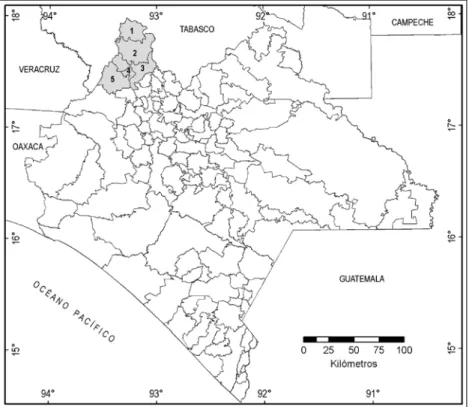
equivalent to 8% of the surface area of the state of Chiapas (IHNE, 2005). Within this economic region of the state are five oil-producing munici-palities adjacent to the state of Tabasco that are in-cluded in the OET, namely Pichucalco, Ostuacán,
Reforma, Juárez and Sunuapa (Figure 1). The total area of the land relevant to the OET is 2 456.88 km.
The city of Pichucalco is the socio-economic capital of the area studied, with a population of 324 273, representing 8.27% of the population of Chiapas.
Figure 1. Study area in Region V North of the state of Chiapas. Municipalities involved:1. Refor-ma, 2. Juárez, 3. Pichucalco, 4. Su-nuapa and 5. Ostuacán.
At the municipal level, the capitals of Reforma, Pichucalco, Juárez, Ostuacán and Sunuapa1
toge-ther constitute the urban system of the region; the rest of the localities are rural and are classified as such according to their resources of public services in the areas of education, health, commerce, su-pplies and public administration. Of these, the mu-nicipal capitals of Reforma and Pichucalco, which are the most important urban centres, contrast with the infrastructure and services of the other localities of the region. This urbanization process has given rise to problems such as the pollution of water bodies and soil contamination through the discharge of municipal discharges or sewage and of municipal wastes, as well as by openly exposed rubbish dumps.
The principal economic activity has for decades been agriculture, and this has in the past 20 years begun to undergo considerable change as a result of the expansion of livestock production over crop land, and of the environmental damage produced by oil activities. As an alternative to the issues confronting the crop production sector, livestock production represents the best option for part of the population. However, the expansion of lives-tock production has incorporated considerable areas at the expense of forested areas and those de-dicated to crops, and these areas are not always the most suitable in terms of their physico-geographic characteristics; this has implications in the deterio-ration and degradation of the natural resources. In cocoa production, yields have fallen during the past 20 years owing to the misuse of agrochemicals, to the ageing of the plantations (50–60 years), to the lack of organization and of competitive commer-cialization and entrepreneurial vision, and to the spread of Monilia disease2.
The quality of surface and ground waters in the territory was at an ‘acceptable’ level in the 1980s, with their composition being within the permit-ted standards. However, the first ‘warning lights’
1 The total population of the municipality of Sunuapa approaches 2800 inhabitants. According to INEGI, a popu-lation is considered to be rural when it has fewer than 2500.
2 A fungal disease, caused by Moniliophthora roreri, which
affects the cocoa plantations.
have already begun to attract attention, with in-dications of a fairly severe ecological deterioration through pollution of the water and sedimentation of hydrocarbons, provoked by the functioning and marked development of the oil industry, as demons-trated by results of studies undertaken in Laguna Limón3 (Leal, 2009) and in the San Miguel lake
system (CINVESTAV-IPN, 2002). In the study area at present there are 18 oilfields with plants for the separation and production of petrochemicals, with some 5–25 wells per oilfield for the extraction of crude oil and natural gas (PEMEX, 1998, 2005). The public have no access to information regarding the existence of treatment plants for residual waters in these fields, nor to the chemical analyses of ground waters in the areas occupied by this industry.
Environmental planning in Mexico
Environmental politics —in particular, territorial planning— appeared in the Mexican national de-velopment systems in the 1970s. At the beginning of that decade, actions directed at dealing in an comprehensive manner with the demands of the populace (civil associations and non-governmental organizations) began to take shape in relation to the deterioration of natural resources and the pollution of air, water and soils, in both urban and rural areas (INE, 2000). In particular, the first actions with respect to territorial planning focused on human settlements, such that in 1976 the General Law of Human Settlement (LGAH) was enacted, and the term ‘territorial regulation’ appeared for the first time, in a reference to an instrument of territorial regulation applied to the urbano-rural environment (INE, 2006). In 1982 the Law for Environmental
Protection arose; this included for the first time the concept of ‘ecological planning’, related to environmental diagnosis and to the management and conservation of natural resources. The Federal Law for Environmental Protection and the Law of Planning (1983) formed the basis for the creation of the General Law of Ecological Equilibrium and Environmental Protection (LGEEPA) of 1988. This 3 Information obtained from ‘Ecological planning in the
law represents the central legal basis of national environmental politics, with general powers as re-gards planning and coordination in environmental matters (Rosete, 2006).
Social participation in decision making LGEEPA establishes in article 157 the obligation of the federal government to promote the active participation of society in the planning, execution, evaluation and monitoring of environmental poli-tics and of natural resources. Article 158 establishes that to comply with the obligation above, the Secretariat of the Environment, Natural Resources and Fisheries (SEMARNAT) is authorized to
con-vene diverse sectors of society. Article 159 antici-pated the integration of consultative organs that function in assessment, evaluation and pursuance as regards environmental politics, and which can issue opinions and observations that are considered pertinent.
In Mexico the link between planning bodies and those responsible for the implementation of programmes of regulation has frequently been weak or absent. Hence, these are normally devi-sed as a requirement for justifying investments, receiving budgets, loans, etc., but not as a guide for achieving the fulfilment of these. This is one of the great risks that face the politics of territo-rial regulation, since, although the plans may be technically well formulated, they are not carried out and, also, they do not have administrative or legal means that sanction this non-fulfilment; in addition, they suffer from democratic processes of planning, and the participation of the society is limited to innocuous consultations, these being demagogic acts (Massiris 2003). For this reason, the
OET is a challenge for Mexico and other countries
of Latin America (Rodríguez et al., 1996; Medina and Espinosa, 1998).
Participatory planning
In contrast to this type of planning, there are examples of successful community participation in planning; here, in the face of governmental policies that have deliberately opposed the para-digm of community forestal development, it is stakeholders who have had to fight against these,
in order to impose their vision and their desire to conserve their territory and their living on its natural resources (Bray and Pérez, 2005). To cite some examples, the authors mention the practices accomplished in Oaxaca, Michoacán, Quintana Roo and Puebla, which have demonstrated that this approach is valid for defining internal politics of land use at community level, for segregating areas for production and protection in a consensual manner, and for reaching agreements in order to give viability to the decisions that are taken. The participatory planning of the use of the territory has evolved by a route of its own, focusing basically on developing the social instruments of environmental management that make most democratic and just the form in which decisions are taken with respect to land use (Corbett and Keller, 2006).
Therefore, the objective of a statute will not only be to make ‘legitimate’ a decree of the same, but also that, as noted by Azuela (2007), the stake-holders who take relevant decisions or who can influence others can formulate their expectations on the basis of those stipulated by OET, or where appropriate some other decree.
The participatory workshops conducted in the study area
The procedure that the Institute of Geography at
UNAM developed for the formulation of a Model of Ecological and Territorial Regulation (MOET) at the municipal level comprised five consecutive stages: Stage I, Characterization; Stage II, Inte-grated diagnosis; Stage III, Prospective phase; Stage IV, MOET proposal; and Stage V, Implementation.
The proposed method was in accordance with the regulations established in the ‘Términos de Refe-rencia para la elaboración del Programa Municipal de Ordenamiento Ecológico y Territorial (PMOET)’
[Terms of reference for elaboration of the municipal programme of ecological and territorial regulation], which was published by SEMARNAT-INE-SEDESOL
and Pichucalco, with the installation of 16 work groups (Table 1). The invitation to the workshops was issued by means of the municipal presidents, in conjunction with the Institute of Natural History and Ecology of Chiapas.
The workshops involved SMART (Simple multi-attribute rating technique; Goodwin and Wright, 2000). This technique consists in listing the pro-blems that arise in the zone (the participants define them in work groups), and these are organized according to various criteria (social, environmen-tal, economic and political context). Then the problems are classified according to the frequency with which they are mentioned and each is assigned a weighting according to its importance. The most important problem is given a weight of 100, and the least important a weight of 0. Subsequently, the weights obtained are summed and normalized, and a standardized weight is obtained, which oscillates
between 0 and 1, with 1 being the value that indi-cates that the criterion is the most important, and with the value nearest to 0 indicating the criterion with the least importance. In this way, the problems are first arranged in a hierarchy and then placed in a scale of 0 to 100.
It must be emphasized that the analysis is per-formed on the basis of the perception of the po-pulace regarding the inherent problems of the municipality in question, and of the productive necessities of the sectors involved. For each mu-nicipality the reports and the results of the work groups are reviewed, and the tables of results are drawn up. On the basis of the table of weighting of each work group, the most important problems are selected (social, environmental, economic), in-dependently of the group that has proposed them, and for each municipality are obtained weights and frequencies that reflect its specific situation. The
No. participants
Municipality Sector Date Group No. Workshop Municipality Important themes
Cocoa Economic
Social Social
Social Economic
Social
Livestock Economic
Crops & Livestock Economic
Crops & Livestock Environmental
Environmental
Social Environmental
Economic
Institutional Environmental
Social
Crops & Livestock Environmental
Economic
Crops & Livestock Social
Environmental
Source: Rojas et al., 2006.
present article describes the discussion of the most frequent results from the work groups, with the aim of demonstrating the local perception of the general problems of the study zone. It is considered that the analysis of frequencies helps to identify the problems that most preoccupy the inhabitants of the region, without distinguishing the productive sector, community, religion, socio-economic level or any other type.
Social participatory workshops and the design of the Model of territorial occupation (MoEt)
The design stage of the MOET considers the
en-vironmental issues of the municipalities at the level of landscapes or unities of environmental management4, as the point of departure for
set-ting out preventive or corrective proposals during the prescription of the various scenarios of spatial reorganization but, above all, for the formulation and design of the desired viable scenario, as the point of departure for drawing up the proposal of the model of occupation of the territory. Of course, this environmental issue needs to remain based on the present model of use; the main conflicts of the multidirectional interactions between nature and society that have become clear during the discussions in the social participatory workshops, whether these were municipal or sectorial, are re-called as criteria for the execution of this final stage of the process. The perception of the communities concerning the state of the environment not only enriches by its objectivity the detection of the pro-blems and situations of conflict, but also constitutes one of the main requisites of a study for the OET,
where the satisfaction of the expectations of the population of the territory studied becomes one of the key objectives of the success of the proposal and application of the model of regulation.
The design of the Model of Territorial Deve-lopment or Model of Occupation of the Territory
4 A UGA is the minimum territorial unit for which apply both
environmental features and strategies –of territorial politics– combined with schemes for management of natural re- sources, i.e. criteria or fine features of management of these resources, oriented to the development that progresses to sustainability.
that is proposed for the study zone took into ac-count the Methodology Guide for the preparation of State Programmes for Territorial Regulation developed by the Institute of Geography of the Autonomous University of Mexico in 2002, as well as the methodological experiences of the Group of Geo-ecology and Landscape of the Faculty of Geography of the University of Havana (personal communication5), which has worked on various
Projects for Ecological Regulation and Territorial Regulation in Mexico and other countries of Latin America. One of the analyses employed (in addition to the social participation workshops) for drawing up proposals for use of eco-geographic landscapes was the spatial interpretation of diffe-rent social and economic indicators of Stages I and II of this project of territorial ecological regulation.
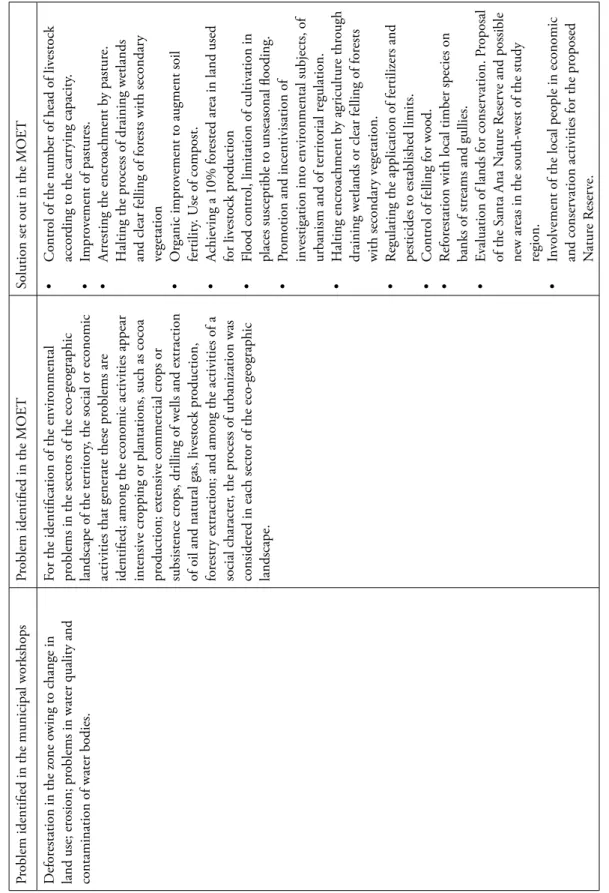
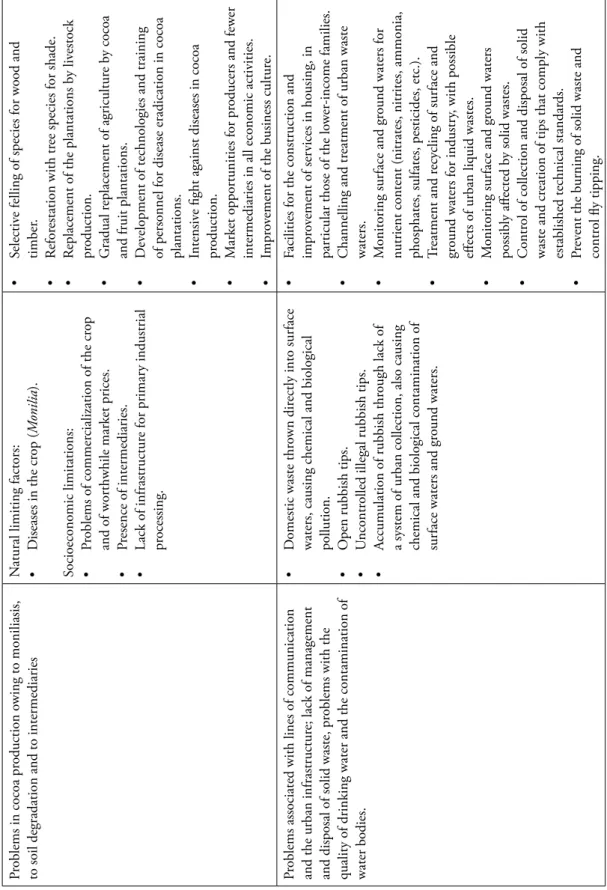
Table 2 presents a comparative overview of those problems identified on the basis of the deli-berations during the social participation workshops that do not conflict with those obtained by means of analysis and diagnosis performed during Stages I and II of the MOET. The social, environmental and economic problems are not the same for every municipality, but they do offer a comprehensive overview of the local in the context of the regional generality.
dISCuSSIoN
Although it is true that territorial regulation is a function whose impetus, planning and manage-ment is appropriate for public administration, it is pertinent to involve in this process the needs identified by the stakeholders themselves whose activities affect the territory; hence, it should be developed in a concerted and participatory manner (Vega 2008:3). However, as noted by Negrete and Bocco (2003:9), this process still requires much effort in order to achieve a participatory planning that integrates all sectors of a population and that considers the great cultural and eco-geographic diversity that characterizes our country. The pro-cess of translating these theoretical postulates into
Table 2. Corr
elation betw
een the r
esults obtained in the social par
ticipation wor
kshops with inputs for the design of the
MOET
Pr
oblem identified in the municipal wor
kshops
Pr
oblem identified in the MOET
Solution set out in the MOET
D
efor
estation in the z
one o
wing to change in
land use; er
osion; pr
oblems in water quality and
contamination of water bodies.
For the identification of the envir
onmental
pr
oblems in the sectors of the eco-geographic
landscape of the territor
y, the social or economic
activities that generate these pr
oblems ar
e
identified; among the economic activities appear intensiv
e cr
opping or plantations, such as cocoa
pr oduction; extensiv e commer cial cr ops or subsistence cr
ops, drilling of w
ells and extraction
of oil and natural gas, liv
estock pr
oduction,
for
estr
y extraction; and among the activities of a
social character
, the pr
ocess of urbanization was
consider
ed in each sector of the eco-geographic
landscape.
•
Contr
ol of the number of head of liv
estock
accor
ding to the carr
ying capacity
.
•
Impr
ov
ement of pastur
es.
•
Arr
esting the encr
oachment b
y pastur
e.
H
alting the pr
ocess of draining w
etlands
and clear felling of for
ests with secondar
y vegetation • O rganic impr ov
ement to augment soil
fer
tility
. U
se of compost.
•
Achieving a 10% for
ested ar
ea in land used
for liv
estock pr
oduction
•
Flood contr
ol, limitation of cultiv
ation in
places susceptible to unseasonal flooding.
•
Pr
omotion and incentivisation of
inv
estigation into envir
onmental subjects, of
urbanism and of territorial r
egulation. • H alting encr oachment b y agricultur e thr ough draining w
etlands or clear felling of for
ests
with secondar
y v
egetation.
•
Regulating the application of fer
tiliz
ers and
pesticides to established limits.
•
Contr
ol of felling for wood.
•
Refor
estation with local timber species on
banks of str
eams and gullies.
•
Ev
aluation of lands for conser
vation. P
roposal
of the S
anta Ana N
atur
e R
eser
ve and possible
ne
w ar
eas in the south-w
est of the study
region.
•
Inv
olv
ement of the local people in economic
and conser
vation activities for the pr
Pr
oblems in cocoa pr
oduction o
wing to moniliasis,
to soil degradation and to intermediaries
N
atural limiting factors:
•
D
iseases in the cr
op (
M
onilia
).
Socioeconomic limitations: •
Pr
oblems of commer
cialization of the cr
op
and of wor
thwhile mar
ket prices.
•
Pr
esence of intermediaries.
•
Lack of infrastr
uctur
e for primar
y industrial
pr
ocessing.
•
Selectiv
e felling of species for wood and
timber
.
•
Refor
estation with tr
ee species for shade.
•
Replacement of the plantations b
y liv estock pr oduction. • G radual r
eplacement of agricultur
e b y cocoa and fr uit plantations. • D ev
elopment of technologies and training
of personnel for disease eradication in cocoa plantations.
•
Intensiv
e fight against diseases in cocoa
pr oduction. • M ar ket oppor
tunities for pr
oducers and fe
w
er
intermediaries in all economic activities.
•
Impr
ov
ement of the business cultur
e.
Pr
oblems associated with lines of communication
and the urban infrastr
uctur
e; lack of management
and disposal of solid waste, pr
oblems with the
quality of drinking water and the contamination of water bodies.
•
D
omestic waste thr
own dir
ectly into sur
face
waters, causing chemical and biological pollution.
• O pen r ubbish tips. • U ncontr
olled illegal r
ubbish tips.
•
Accumulation of r
ubbish thr
ough lack of
a system of urban collection, also causing chemical and biological contamination of surface waters and gr
ound waters.
•
Facilities for the constr
uction and
impr
ov
ement of ser
vices in housing, in
par
ticular those of the lo
w
er-income families.
•
Channelling and tr
eatment of urban waste
waters.
•
M
onitoring sur
face and gr
ound waters for
nutrient content (nitrates, nitrites, ammonia, phosphates, sulfates, pesticides, etc.).
•
Tr
eatment and r
ecy
cling of sur
face and
gr
ound waters for industr
y, with possible
effects of urban liquid wastes.
•
M
onitoring sur
face and gr
ound waters
possibly affected b
y solid wastes.
•
Contr
ol of collection and disposal of solid
waste and cr
eation of tips that comply with
established technical standar
ds.
•
Pr
ev
ent the burning of solid waste and
contr
ol fly tipping.
Relation of the oil industr
y with its envir
onmental
and social effects
Action: •
Exploitation of hy
dr
ocarbons b
y means of
drilled w
ells.
•
Installations for r
ecy
cling the extracted fuel.
•
Pr
ocessing of hy
dr ocarbons. Envir onmental pr oblems: •
Contamination of the soil and of sur
face and
gr
ound waters b
y hy dr ocarbons. (I ntensity: M edium.) •
Escape of to
xic gases into the atmospher
e.
(I
ntensity: M
edium.)
•
Spillage of hy
dr
ocarbons into the
envir onment. (I ntensity: M edium.) • M
onitor the quality of sur
face and gr
ound
waters and the soils in r
elation to possible
spillage of hy
dr
ocarbons, in par
ticular in the
pumping stations and in the pipelines.
•
M
onitor the quality of air in r
elation to the
emission of gases, in w
ells, pipelines or other
installations.
•
Constant contr
ol of compliance with the
technical standar
ds established for each
installation of the oil industr
y in the territor
y.
•
Contr
ol of the pr
ocess of extraction of
danger
ous wastes during drilling operations.
•
Av
oid any type of activity on the sur
face of
land under which ther
e ar
e pipes.
Pr
oblems of insufficient medical ser
vices and rights
of access to these; unemplo
yment as a limiting factor
in the dev
elopment of the r
egion; lack of education
and envir
onmental awar
eness.
•
M
edium rate of general morbidity
.
•
M
edium rate of access to medical ser
vices.
•
Insufficient pr
ovision of household ser
vices,
from lo
w to medium.
•
M
edium lev
el of o
ver cr ow ding. • Incr
ease general public awar
eness of the
envir
onment and of sustainable forms of land
use, b
y means of the media and the education
and health systems.
•
Raise the lev
el of education of the population,
decr
ease illiteracy and encourage pupils to
remain at school for longer
.
•
Impr
ov
e the health ser
vices and access to
primar
y car
e, in par
ticular for pr
egnant
women and the elderly
.
•
Facilities for the constr
uction and
impr
ov
ement of ser
vices in the dw
ellings, in
par
ticular for lo
w-income families
Pr
oblems r
elated to the lack of finances for
pr
oduction of liv
estock and cr
ops; technical
consultancy for pr
oductiv
e pr
ojects; technical
training.
Insufficient financial suppor
t of social and
agricultural pr
ojects.
Lo
w mar
ket prices for liv
estock pr
oducts.
Lo
w pr
oductivity of milk and meat, r
eflecting the lo w lev el of mechanization and inv estment in most liv estock businesses. Lo w lev
el of inv
estment in the z
one.
M
edium to high lev
els of marginalization of
localities. Problems of prices, intermediaries and mar
kets,
lack of business cultur
e and of organization.
Lo
w to medium pr
oductivity
, with a
pr
edominance of maiz
e and bananas.
Pr
esent agricultural dev
elopment in conditions of
lo
w competition.
Little div
ersification of the ter
tiar
y sector
.
•
Sear
ch for the gr
eatest efficiency in the
application of pr
ogrammes of suppor
t for liv estock pr oduction, agricultur e and aquacultur e. • M ar
ket facilities for pr
oducers with a decr
ease
in intermediaries in all economic activities. Impr
ov
ement of the business cultur
e. • D ev elopment of aquacultur e in the long term. • D ev
elopment of technical suppor
t systems for
cr
op and liv
estock pr
oduction.
•
D
iv
ersification of the ter
tiar
y sector in
par
ticular in r
elation to envir
onmental
ser
vices.
•
Stimulation of inv
estment in the territor
y.
•
D
ev
elopment of the secondar
y sector in
the industr
y linked to cr
op and liv
estock
pr
oduction.
Par
ticipation of the organs of go
vernment and
inv
olv
ement in compr
ehensiv e pr ojects. • Impr ov
e the planning and coor
dination
existing betw
een the div
erse stakeholders
and economic sectors that take par
t in the
regulation of the territor
y and pr
omote the
activ
e par
ticipation of the society in the
actions in this ar
ea.
•
Establish coor
dinated actions and shar
ed
responsibility betw
een the v
arious lev
els of
go
vernment for the pr
otection, conser
vation
and r
ehabilitation of the natural capital and
natural r
esour
ces.
•
Pr
omote the generation of inter-institutional
actions and of the civil society for the preser
vation of the flora and fauna of the
State, both on land and in water
.
Sour
ce: personal deriv
ation fr
om the data fr
om S
tages III and IV of the
MOET
for the oil-pr
oducing z
one of R
egion V N or th ( ZPR VN ).
spatial reality for each society is not simple, since the process of environmental planning is faced with specific environmental conditions and with diverse political, economic and social interests.
On the basis of our own experience, it is compli-cated to knit together the points of view of different economic sectors involved in the management of a territory to generate proposals for their use and conservation.
In analysing the results of the workshops, it is pertinent to stress the worrying aspect of requesting more economic support for livestock production, when the practice of this is in itself the cause of many of the impacts with which the region is con-fronted. Livestock farmers who own large ranches and who operate mainly in the municipalities in the north of the state contaminate the rivers and the wells by their use of agrochemicals and also by the wastes (dung) of the animals themselves. Paradoxically, the greatest economic benefits of livestock production are distributed mainly in the large ranches of the municipalities of Juárez and Reforma, and do not remain in Chiapas but in Tabasco, the State of origin of the ranchers of the region.
This disparity in economic aid contrasts also with the component granted for a small number of head of animals in the municipalities of Ostuacán and Pichucalco, and in Sunuapa, which is also a reflection of the differences in the type of livestock production that is practised in these, i.e. more capitalized and intensive in the municipalities in the north, mainly in Juárez, and more extensive or pastoral in the municipalities in the south of the region.
Also, the natural grasslands have gradually been replaced, above all in the municipalities of the north of the region, by pastures cultivated with species of higher quality, classified as good rangeland, which makes them preferable for the de-velopment of livestock. The elimination of the na-tural plant cover for the seeding of pastures has had major ecological consequences for the region: in the first place, it decreases the collection of water that feeds the aquifers, and with this, the availability of underground water resources; in addition, the gra-dual reduction in atmospheric humidity changes
the regional atmospheric characteristics, and this also produces changes in the dynamics and in the available volume of surface water (running water and standing water bodies). This occurs above all in the municipalities of Juárez and Reforma, where there are already considerable problems of collection of water. Particularly in the municipality of Reforma, the problem of contamination of the lakes is exacerbated by contamination by agro-chemicals and by waste waters from the populace. These above-mentioned processes of environmental change, as a result of the many diverse human ac-tivities that occur, can threaten the survival of the various species (Dirzo and Raven, 2003).
There is a relationship between public policies and soil degradation, since in politics there is no analysis of the effect that these policies have on the stability of the environment and, hence, on the loss of animal and plant species. Many of the establis-hed programmes, such as the spread of livestock production, the practice of monoculture with high consumption of agrochemicals and the in-tense deforestation, accentuate the problem of soil degradation. As noted by Tarrio et al. (1985), an advantage that permits livestock production to be competitive is the practice of extensive pro-duction, since it lowers the costs of production and allows profits that correspond more to a rent for the soil than to an investment. Nevertheless, it represents a considerable social cost, since with the incorporation of a very small workforce (one cowhand can look after more than 30 head of cattle), it can achieve an increased productivity per man employed as unskilled cheap labour in these large operations. One of the conclusions of the participatory workshops alluded to this problem in mentioning, as has already been noted above, that many of the owners of extensive lands do not live in Chiapas but in Tabasco; taking advantage of the lack of employment within the region or of the low productivity of the land, they employ the local populace who find themselves obliged to work as cattle hands with low salaries. Some work groups referred to this practice as ‘slave labour’.
confinement of crop production by livestock pro-duction are processes that mutually reinforce each other and contribute in an important manner to the agro-food crisis and to defining the underdeve-lopment of rural Mexico. On its part, crop produc-tion requires the use of herbicides and fertilizers, which has markedly transformed the landscape. In conjunction with livestock production it has eliminated almost all natural forests, so that the biological system has partially lost the capacity to achieve its geo-ecological functions and has lowe-red productivity. According to Ortiz et al. (1994), this process has been defined as ‘the lowering or destruction of the biological potential of natural resources caused by the poor use and management of these, which has as a consequence degenerative processes of the physical, economic and social environment of the populations involved within its confines’; according to testimonies of the local inhabitants, monilia disease has clearly intensified because the land does not have ‘the ability to fight it’. The area of labour has been reduced relatively, above all by the expansion of the surface area oc-cupied by pastures and the consequent spread of the area of livestock production at the cost of land for both crop production and forestry.
The abandonment of crop production in the Mexican countryside can be explained by the fact that the productive potential of the peasants has historically been underestimated within the agra-rian politics of Mexico (Appendini, 1995), owing to the predominating official vision which consi-ders the peasants as inefficient producers and not apt for modernization (Morett, 2003). The changes realized in the political and institutional context include the adoption of free trade, a reduction in subsidies, elimination of price control and reform of the legal framework that regulates the ownership of the land in the farming cooperatives (Fritscher, 2004). The combined effect of the reforms together with the recurrent economic crises has put at risk the productive viability of the peasantry as a whole (Bartra, 1995).
The policies of subsidization and of productive modernization implemented since the second half of the 20th century sidelined crop production by peasants in favour of the private sector (Paz, 1995),
nurturing thereby an unbalanced development of Mexican agriculture that leads to a progressive deterioration in the productive conditions of the peasants (Mackinlay 1996).
For example, for cocoa production there are three basic problems that work against family in-comes and the standard of living of the producers, these being the current low price of cocoa, the presence of intermediaries in its commercialization, and the lack of a business culture, in addition to deficient organization of production and to the problem of Monilia disease; this has led to a change in the use of the soil to favour the elimination of the plantations in order to introduce livestock. A situation that prejudices this sector economically is the absence of an infrastructure encouraging processing, and this favours commercialization of the product in its raw state, without added value.
With respect to oil production, it is remarkable how this has had repercussions within the region, not only through environmental impacts inherent in the drilling and extraction of oil but also through its influence on the dynamics of economic and social activities.
In the environmental sphere, there is an ob-vious vulnerability to contamination of soils, and in consequence of ground water, by the products derived from the oil industry (by the infiltration of meteoric water, via the soil or by direct injection of the treated water) in the zones near the PEMEX
batteries. Particularly noticeable is the general perception of the contamination of the air, which manifests itself in the form of acid rain, and in various lacustrine bodies6 that can not support any
activity for man (provision of drinking water) or beast (watering holes).
In the economic and social sphere, the munici-palities have undergone a change in dynamic ste-mming from the arrival of PEMEX; there has been
a markedly unbalanced development with a con-centration of the oil industry in the urban centres. On the basis of the growth pole theory of Perroux (1988), it can be seen principally in the
6 The highest contamination index is observed in the lakes El
Reforma municipality how the economic activities organize themselves in the geographic space. Pe-rroux argued that, like a force field, ‘economic space consists of centres (or poles or foci) from which centrifugal forces emanate and to which centripetal forces are attracted, but with a development it is thrown off balance’(Ibid.:11). The focus of growth is defined principally by an industrial complex and dominated by a driving or propelling industry that ends up being the engine of development through its capacity for innovation and stimulation, and for dominating other industries. In the words of Perroux: ‘Growth does not occur everywhere at the same time; it appears in nodes or poles of growth of various intensities, it spreads by various ways and with differing effects on the economy as a whole’ (Parr, 1999:17).
The municipality of Reforma is characterized by having grown as a consequence of the migrations to the region during the 1970s and 1980s, owing to the existence of the sources of employment generated by the presence of PEMEX. However, since the state-owned company relies on its own permanent workforce, it only offers the local people temporary, low-grade work since it maintains that they do not have adequate qualifications for their employment in the oil industry. The nucleus of development of the zone is centred on Reforma, which is the most dynamic, and which in con-junction with Juárez and Pichucalco, which are in this same area, forms a north–south corridor and represents a development potential for the zone. Ostuacán forms a weak nucleus in the territories in the south of these municipalities and has relations with the more disperse localities. With regard to the density of the population and the level of de-velopment, the better equipped territories possess a greater population density, while the municipalities with very low densities are those that have a lower index of social integration.
According to Sánchez and Casado (2006:24), the Reforma municipality is classified as having very high economic development (the highest in the State), a level only achieved elsewhere in Chia-pas by the municipalities of Tuxtla Gutiérrez and Tapachula, in that order; within the study zone, Pichucalco and Juárez occupy an intermediate
position in terms of incomes, and Ostuacán and Sunuapa, the most rural municipalities of the zone and with a greater proportion of work in the fa-mily plot, have the lowest incomes and the highest proportion of their economically active population who are occupied without receiving income.
There is a cultural clash between the local popu-lace and those who come in from the neighbouring states and from the other oil-producing regions of the country (the skilled workforce of the oil industry). The arrival of this population, as well as bringing about an increment in the cost of living in the oil-producing zones of Chiapas and Tabasco on account of the higher wages of the PEMEX workers
in relation to the average for the region, has also favoured the proliferation of establishments such as bars, restaurants, cafes, etc., which generate an economic turnover at the local level, to the detri-ment of other types of services more necessary for the populace (schools of various levels and types, diverse health services, cultural and recreational services for families, etc.).
In the case of the oil-producing zone of Region V North of Chiapas, the social appropriation of OET (Territorial Ecological Regulation) as a political instrument has a long way to go, since there has still not been an initiative on the part of the municipalities involved (Reforma, Sunuapa, Pichucalco, Juarez and Ostuacán) to take up any of the alternatives proposed by the government for ‘putting the land in order’. In addition, each of these municipalities has very specific ‘priorities’ that need to be discussed at the local and then the regional level. This is a considerable barrier encountered by the territory analysed here, since, as mentioned above, its complexity is manifested not only in the diverse uses and priorities of land use, but also in the social and economic disparity existing between one municipality and another, as well as in the participation of the various stakehol-ders involved in the process of implementing any
MOET proposal.
For the World Bank, participation requires that the interested stakeholders take control over those decisions that are going to affect them (World Bank, 1996); it is also a process of empowerment of the communities that shows transparency in the decision proposal (Xiaojun et al., 2008). However, in practice, nearly all the decisions are inflexible and rapidly reached by high levels of government, without sufficient consideration of the hetero-geneity of the rural environment or the effective participation of the local population.
Talking of participation is not exactly an ideolo-gical term in the sense that it deals with politics of public relations or of mechanisms for legitimizing a proposal without its necessarily being followed through (Briceño, 1998). In this case, after more than three years of presenting the MOET before the IHNE and the government of the state of Chiapas,
it has not yet been implemented. This is probably because of the great economic and social complexi-ty of the zone and the interests of the strongest economic sectors which bring their influence to bear in a decisive way by opposing the measures proposed by the MOET.
CoNCLuSIoNS
In general, in the region there is a separation bet-ween the distinct levels of government in a vertical sense and among the various entities of each of their dependencies in a horizontal sense. In addition, there is a lack of coordination between the plans and the sources of finance needed to bring about the proposed actions; these are not focused on zones or problems worthy of priority attention, or else the authorities of the various levels of go-vernment do not add efforts that allow a synergy in the economic and human resources destined to support and back up the work of the institutions.
The oil industry has left a negative imprint on the territory, whether it be as impacts on the natural resources or on the health of the inhabitants: the dynamics of oil production (phases of extraction of hydrocarbons and processing of natural gas) has not strengthened the traditional regional economy; it has not uniformly consolidated the infrastructure
and urban services, nor the diversification and ame-lioration of the quality of the social and economic services; nor has it resulted in substantial impro-vement in the levels of wellbeing of the populace. The solution to these shortcomings is simply the embodiment of the culture of planning and execution of comprehensive projects of territorial regulation drawn up and applied with the partici-pation of all sectors of the society.
The subject of social participation has been dealt with in the scientific literature in a wide variety of disciplines, and the taking of decisions as an outcome of public consultations can be defined as the essential manifestation of the exercise of political power; hence the necessity of including these procedures in the democratic system. The participation of the citizens in the decision-making acquires, for this zone, a special importance in the municipal environment because it is at this level that the process of social reproduction takes place and where decisions are taken that have the greatest effect on the daily life of the citizens.
The participatory workshops that were conduc-ted certainly achieved the objective of designing an Environmental Agenda that will serve as a basis for developing the corresponding MOET proposal. However, there is still a long way to go before the
MOET proposal is truly viable, by virtue of the fact that this tool of environmental politics considers social participation as an indispensable element in implementing and making transparent the process of territorial planning.
The SMART technique can be a useful tool for
communicating and directing the participation of the people involved in a proposal for development; the organization and the participants are indispen-sable, since in order for the process to be valid it is essential that the various stakeholders who live in a territory are represented.
de-velopment of Stage IV; finally, this leads to the formulation of the model of territorial ecological regulation (MOET), the desired scenario that will be viable for a sustainable socio-productive reorga-nization of the territory of the oil-producing zone of Region V North of the state of Chiapas.
ACKNoWLEdGEMENtS
Thanks to the workshop participants and to the municipal presidents for their support in dissemi-nating the invitations, and providing the premises for the workshops, the sound recording facilities and the catering. In addition, thanks to the person-nel of the Institute of Natural History and Ecology of the State of Chiapas, for logistic coordination and help both before and during the workshops. To Dr María Teresa Sánchez Salazar for her invaluable help in the final revision of the document, and to Drs Atlántida Coll-Hurtado and José María Casado Izquierdo of the Institute of Geography, UNAM.
REFERENCES
Azuela, A. (2007), El ordenamiento ecológico del territorio en México: génesis y perspectivas,SEMARNAT, México. Appendini, K. (1995), “La transformación de la vida
económica del campo mexicano”, en Prud’homme, J. (coord.), El impacto social de las políticas de ajuste en el campo mexicano, Plaza y Valdés, México, pp. 31-91. Bray, B. and M. Pérez, (2005), La experiencia de las
comunidades forestales en México. Veinticinco años de silvicultura y construcción de empresas forestales comu-nitarias, 1ª. reimp., Secretaría de Medio Ambiente y Recursos Naturales, Instituto Nacional de Ecología, Consejo Civil Mexicano para la Silvicultura Sosteni-ble, Fundación Ford, México.
Bartra, A. (1995), “Los nuevos campesinos”, en Prud’homme, J. (coord.), El impacto social de las po-líticas de ajuste en el campo mexicano, Plaza y Valdés, México, pp. 169-219.
Briceño, L. (1998), “The political context for community participation in Latin America Cad.”, Saúde Pública, Rio de Janeiro, 14(Sup. 2), pp. 141-147.
CINVESTAV-IPN (2002), Evaluación de la calidad ambien-tal del Sistema Lagunar San Miguel (Fase II), Informe final, Centro de Investigación y Estudios Avanzados
del Instituto Politécnico Nacional-Unidad Mérida, Departamento de Recursos del Mar, Mérida. Corbett, J. and P. Keller (2006), “Overview mapping for
change - the emergence of a new practice in partici-patory learning action”, Participatory Learning and Action, London, vol. 54, pp. 21-28.
Dirzo, R. and P. Raven (2003), “Global states of biodi-versity and loss”, Annual Review of Environmental and Resources, no. 29, pp. 137-167.
Fritscher, M. (2004), “Reorientación en la acción estatal del campo mexicano: un balance del periodo (1980-1993)”, ALTERIDADES, no. 14, pp. 13-29. Goodwin, P. and G. Wright (2000), “Decision Analysis
for Management Judgement”, International Journal of Forecasting, John Wiley & Sons, Chichester, vol. 9(2), pp. 147-161.
INE (2000), El Ordenamiento Ecológico del Territorio. Logros y retos para el desarrollo sustentable. 1995 -2000, Instituto Nacional de Ecología, México.
INE (2006), Planeación territorial, México.
INHE (2005), Bitácora ambiental. Programa de Orde-namiento Ecológico Territorial del Estado de Chiapas [http://www.bitacora.ihne.chiapas.gob.mx/oet_reg_ norte2.html].
Leal, M.T., S. Miranda, E. Otazo, F. Prieto and A. Gor-dillo (2009), “Metals polution in El Limón Lagoon”, Tropical and Subtropical Agroecosystems, no. 10, pp. 415-421.
Mackinlay, H. (1996), “El agro en México: un futuro incierto después de las reformas”, en Mackinlay, H. y E. Boege (coord.), El acceso a los recursos naturales y el desarrollo sustentable, Plaza y Valdés, México, pp. 21-40.
Massiris, Á. (2003), Políticas latinoamericanas de ordena-miento territorial: realidades y desafíos, tesis de Doctor en Geografía, México.
Medina, C. and M. Espinosa (1998), La toma de decisio-nes en un mundo posmoderno: de la racionalidad al caos. Gestión y estrategia [http://www-azc.uam.mx/ges-tion/ num8/doc10.htm. consulta diciembre 2007]. Morett, J. (2003), Reforma agraria: del latifundio al
neo-liberalismo, Plaza y Valdés, México.
Negrete, G. and G. Bocco (2003), “El ordenamiento ecológico comunitario: una alternativa de planeación participativa en el contexto de la política ambiental de México”, Gaceta Ecológica, núm. 68, México. Ortiz S., M. L. M., M. Anaya G. and J. Estrada (1994),
Parr, J. B. (1999), “Growth-pole strategies in regional economic planning: a retrospective view”, Origens and Advocacy, Parte I en Urban Studies, enero, vol. 36, no. 7, pp. 1195-1215, en Arroyo y Bracamontes (2006), “El desarrollo regional en el estado fronterizo de Sonora, México”, Estudios Fronterizos, vol. 7, núm. 14, julio-diciembre, pp. 55-80.
Paz, M. (1995), “Selvas tropicales y deforestación. Apuntes para la historia reciente del trópico húmedo mexicano”, en Paz, M. (coord.), De bosques y gente. Aspectos sociales de la deforestación en América Latina, CRIM, UNAM, México, pp. 53-88.
PEMEX (1998), Instalaciones de Producción Estado de Chiapas. Archivo Integral MUSPAC, PEMEX, Explo-ración y Producción, Región Sur, Tuxtla Gutiérrez, México.
PEMEX (2005), “Pozos a perforar en el Programa 2005-2100 del Archivo Integral MUSPAC” (mapa), PEMEX, Dirección Corporativa de Administración, Tuxtla Gutiérrez, México.
Pérez Hernández, L. and M. Prieto Valdéz (1999), Valo-ración del municipio en la organización del Estado en función de un proyecto de ley de los municipios para la República de Cuba, Informe de investigación, Facultad de Derecho, Universidad de La Habana, Cuba, p.17. Perroux, F. (1988), “The pole of development’s new place
in a general theory of economic activity”, in Fletes H. (2006), Cadenas, redes y actores de la agroindustria en el contexto de la globalización. El aporte de los en-foques contemporáneos del desarrollo regional, Espiral, Estudios sobre Estado y Sociedad, vol. XIII, no. 37. Ramón, G. (1995), “Metodologías participativas: el esta-do de la cuestión en América Latina”, Bosques, árboles y comunidades rurales, núm. 25, pp. 4-11.
Rodríguez, S., R. Camarena and J. Serrano (coords.; 1996), Desarrollo Regional en México, Colección: LA REGIÓN HOY de la AMECIDER, 1ª. reimp. l998, Asociación Mexicana de Ciencias para el Desarrollo Regional (AMECIDER, A. C.), IIEc-UNAM y Univer-sidad Autónoma de Querétaro, México.
Rojas, O., A. Mendoza and O. García (2006), “Etapa III. Resultados de los talleres municipales de parti-cipación”, Proyecto “Ordenamiento ecológico de la zona petrolera de la Región V Norte de Chiapas”, IHNE-UNAM, México.
Rosete, F. (2006), Semblanza histórica del ordenamiento ecológico territorial en México,Instituto Nacional de Ecología (INE-Semarnat), México.
Sánchez, M. T. and J. M. Casado (2006), Ordenamiento ecológico territorial de la zona petrolera de la región V de la zona norte del estado de Chiapas 2006, Gobierno del Estado de Chiapas.
SEMARNAT, INE, SEDESOL (2005), Términos de refe-rencia para la elaboración del Programa municipal de ordenamiento ecológico y territorial (PMOET), México. Soto, C. (1992), “Fundamentos de la autonomía
muni-cipal”, en Revista Interamericana de planificación, vol. XXV, no. 97, Guatemala.
Tarrio, M., L. F. Ortiz y M. C García (1985) “Desarrollo de cultivos forrajeros”, en Economía: teoría y práctica, UAM, núm. 5, México.
Santana, J. R., M. Bollo, A. P. Méndez and M. Figueroa (2009), “Formación y morfogénesis del relieve del ex-tremo noroccidental del estado de Chiapas, México”, Investigaciones Geográficas, Boletín, núm. 68, Instituto de Geografía, UNAM, pp. 25-40.
Thompson, J. (1997), “Del diagnóstico participativo a la práctica participativa: considerando la capacitación como parte de un proceso más amplio de desarrollo institucional” [http://tdgatoguelph.ca/
nur/jthom-ponlinnil: consulta enero 2008].
The World Bank (1996), The World Bank participation sourcebook, Washington, The World Bank.
Vega, D. (2008), Plan de ordenamiento territorial parti-cipativo para la microcuenca del río Sesesmiles, tesis, Honduras, Costa Rica.