Antiagregación plaquetaria
Rafael Porcile
[email protected]
D E P A R T A M E N T O D E C A R D I O L O G I A
C Á T E D R A D E F I S I O L O G ï A
Universidad Abierta Interamericana
COMPRENDER ESTOS
MECANISMOS CAMBIO
RADICALMENTE LA
MORTALIDAD EN
INFARTO AGUDO DE
MIOCARDIO , EN LA
ANGINA INESTABLE Y EN
EL ACCIDENTE
EXISTEN TRES PASOS IMPORTANTES
1.- contracción del músculo liso de la pared del
vaso lesionado.
2.- adherencia de las plaquetas circulantes y
posterior agregación. originando el tapón
plaquetario.
LESIÓN VASCULAR
VASOCONSTRICCIÓN
COAGULACIÓN
EXPOSICIÓN DEL SUBENDOTELIO
(COLÁGENO)
ADHESIÓN PLAQUETARIA
CAMBIO DE FORMA
AGREGACION PRIMARIA (LAXO)
REACCIÓN DE LIBERACIÓN
si el tapón plaquetario no se consolida por el tapón de fibrina la
hemorragia puede reaparecer.
depósito de fibrina ocurre por la coagulación
HEMOSTASIA SECUNDARIA:
PERMITE EL MANTENIMIENTO DEL TAPÓN HASTA LA
CICATRIZACIÓN COMPLETA.
EL TAPÓN SE REABSORBE POR “FIBRINOLOSIS”,
REEMPLAZO POR TEJIDO ORGANIZADO.
Siempre, todo
daño endotelial
cursa con
vasoconstriccíon
Siempre… todo
síndrome
coronario
Dialogo químico entre plaquetas y endotelio
Serotonina
EXISTEN TRES PASOS IMPORTANTES
1.- contracción del músculo liso de la pared del
vaso lesionado.
2.- adherencia de las plaquetas circulantes y
posterior agregación. originando el tapón
plaquetario.
3.- coagulación de la sangre.
EXISTEN TRES PASOS IMPORTANTES
1.- contracción del músculo liso de la pared del
vaso lesionado.
2.- adherencia de las plaquetas circulantes
y posterior agregación. originando el
ACTIVACIÓN Y RESPUESTA PLAQUETARIA
1.- ACTIVACIÓN POR DIFERENTES “INDUCTORES”
(TROMBINA, COLÁGENO, ADP).
PARCIALMENTE ACTIVADAS: POR SUST.EXTRAÑAS
(
VIDRIO)
U OTRAS PLAQUETAS.
2.-RESPUESTA PLAQUETARIA: SIMILAR PARA TODOS LOS
INDUCTORES.
a) CAMBIO DE FORMA
b) AGREGACIÓN (SE ACUMULAN)
c) 3 PROCESOS SECRETORIOS DIFERENTES (ADP)
COMPRENDER ESTOS
MECANISMOS CAMBIO
RADICALMENTE LA
MORTALIDAD EN
INFARTO AGUDO DE
MIOCARDIO , EN LA
ANGINA INESTABLE Y EN
EL ACCIDENTE
CEREBROVASCULAR
LESIÓN VASCULAR
VASOCONSTRICCIÓN
COAGULACIÓN
EXPOSICIÓN DEL SUBENDOTELIO
(COLÁGENO)
ADHESIÓN PLAQUETARIA
CAMBIO DE FORMA
AGREGACION PRIMARIA (LAXO)
REACCIÓN DE LIBERACIÓN
LESIÓN VASCULAR
VASOCONSTRICCIÓN
COAGULACIÓN
EXPOSICIÓN DEL SUBENDOTELIO
(COLÁGENO)
ADHESIÓN PLAQUETARIA
CAMBIO DE FORMA
AGREGACION PRIMARIA (LAXO)
REACCIÓN DE LIBERACIÓN
La adhesión y
las
La enfermedad de Glanzmann o trombastenia
es una
enfermedad hereditaria
con un patrón
de herencia de tipo
autosómico recesivo
en la
que el recuento de
plaquetas
es normal, pero
aparecen aisladas sobre el frotis de
sangre
. El
tiempo de sangrado
es prolongado, la
retracción del
coágulo
está ausente o
disminuida y las plaquetas no se aglutinan al
agregar
ADP
. La cifra de
fibrinógeno
plaquetario es baja. Se presenta una alteración
de la disponibilidad del
factor plaquetario 3
El Síndrome de Bernard-Soulier
también llamado distrofia trombocítica
hemorrágica
[1]
es una
enfermedad rara
genética de herencia autosómica
recesiva que afecta la correcta
coagulación
debido a la deficiencia de
la
glicoproteína
Ib, receptor para el
La acrivación
y la
ACTIVACIÓN Y RESPUESTA PLAQUETARIA
1.- ACTIVACIÓN POR DIFERENTES “INDUCTORES”
(TROMBINA, COLÁGENO, ADP).
PARCIALMENTE ACTIVADAS: POR SUST.EXTRAÑAS
(
VIDRIO)
U OTRAS PLAQUETAS.
2.-RESPUESTA PLAQUETARIA: SIMILAR PARA TODOS LOS
INDUCTORES.
a) CAMBIO DE FORMA
b) AGREGACIÓN (SE ACUMULAN)
c) 3 PROCESOS SECRETORIOS DIFERENTES (ADP)
ADP
DE LOS GRÁNULOS DESENCADENA LA DESCARGA
DE LOS GRANÚLOS EN OTRAS PLAQUETAS
Se produce la liberación del ac. araquidónico de los fosfolípidos de
membrana que se metaboliza en dos endoperóxidos cíclicos por
acción de ciclooxigenasa
: PGH2 Y PGG2
COMPRENDER ESTOS
MECANISMOS CAMBIO
RADICALMENTE LA
MORTALIDAD EN
INFARTO AGUDO DE
MIOCARDIO , EN LA
ANGINA INESTABLE Y EN
EL ACCIDENTE
PREGUNTAS Y CAFÉ
Todo comienza
con el acido
araquidónico
Antiagregantes plaquetarios
ACIDO
ACETIL
SALICILICO
ASPIRINA
PARA INFARTO
AGUDO DE
Second International
Study of Infarct
Survival
ISIS-II (Second International Study of Infarct Survival)
collaborative group. Randomized trial of intravenous
streptokinase, oral aspirin, both or neither among 17187
cases suspected acute myocardial infarction:ISIS-II.
Lancet1988;2: 349-60
En base a estas evidencias resulta
claro el valor de la aspirina en la
prevención del infarto agudo de
miocardio fatal y no fatal en
pacientes con angina inestable o
infarto no Q, y por esta razón su
empleo sistemático en estos
Randomized trial of intravenous
streptokinase, oral aspirin, both, or
neither among 17,187 cases of
suspected acute myocardial
infarction: ISIS-2
En base a estas evidencias resulta
claro el valor de la aspirina en la
prevención del infarto agudo de
miocardio fatal y no fatal en
pacientes con angina inestable o
infarto no Q, y por esta razón su
empleo sistemático en estos
En el ensayo ISIS-II, en los enfermos
que recibieron estreptoquinasa y
aspirina, la mortalidad fue bastante
menor al compararla con el grupo
placebo. Si sólo se daba aspirina o
estreptoquinasa, la mortalidad también
era menor al compararla con el grupo
control. La aspirina en este grupo de
pacientes intenta prevenir la reoclusión
durante la fase aguda del infarto
Aspirin significantly reduced
non-fatal reinfarction (1·0% vs
2·0%) and non-fatal stroke (0·3%
vs 0·6%), and was not associated
with any significant increase in
cerebral haemorrhage or in
En base a estas evidencias resulta
claro el valor de la aspirina en la
prevención del infarto agudo de
miocardio fatal y no fatal en
pacientes con angina inestable o
infarto no Q, y por esta razón su
empleo sistemático en estos
En base a estas evidencias resulta
claro el valor de la aspirina en la
prevención del infarto agudo de
miocardio fatal y no fatal en
pacientes con angina inestable o
infarto no Q, y por esta razón su
empleo sistemático en estos
pacientes es universalmente
aceptado
ACC/AHA STEMI Focused Update: Acute
Medical Therapy
General treatment
measures
Aspirin, nitrates, oxygen, analgesics
a(morphine)
Infarct size limitation
β-blockers (not for acute use in patients
with evidence of heart failure)
Reperfusion
Thrombolysis (within 30 min) or primary PCI
(within 90 min)
Anticoagulant
and antiplatelet
therapy
UFH or enoxaparin or fondaparinux
b
Clopidogrel 75 mg/d added to aspirin for
patients undergoing fibrinolysis; 300 mg
loading dose for patients <75 y who receive
fibrinolytic therapy or who do not receive
reperfusion therapy
If PCI: clopidogrel, GP IIb/IIIa inhibitors
a Patients routinely taking NSAIDs (except for aspirin), both nonselective as well as COX-2 selective agents, before
STEMI should have those agents discontinued at the time of presentation with STEMI because of the increased risk of mortality, reinfarction, hypertension, heart failure, and myocardial rupture associated with their use.
ASPIRINA
PARA
PREVENCION
PRIMARIA
Escores de Framingham
Prevención
secundaria
Angina
Inestable y
aspirina
El Estudio de la Administración de Veteranos
Se incluyeron 1266 pacientes masculinos y se empleó
una dosis de 324 mg. diarios de aspirina
La incidencia de infarto de miocardio o muerte a las
12 semanas fue un 51 % menor en el grupo tratado
con aspirina: 31 pacientes (5 %), comparado con 65
(10.1 %); p = 0.0005
.
El infarto de miocardio no fatal fué 51 %
Grupo de Investigación de Inestabilidad en la
Arteriopatía Coronaria ( RISC )
911 pacientes masculinos con angina inestable o
infarto de miocardio no Q, fueron randomizados a
placebo o baja dosis de aspirina ( 75 mg. por día ).
El análisis de los 796 pacientes mostró una
reducción de muerte e infarto a los 5 días del
5,7 % a 2,5 %,
( riesgo relativo = 0.43; intervalo de
confianza = 0.21-0.91), a los 30 días de 13,3 % al 4,2
%, (riesgo relativo = 0.31, intervalo de confianza =
0.18-0.43) y a los 90 días del 17 % al 6,5 % ( riesgo
relativo 0.36, intervalo de confianza = 0.23- 0.57
Recomendaciones para el uso de la
aspirina en angina inestable
1.Comenzar con aspirina (250-500 mg. en
forma masticable o soluble )
2.Continuar con aspirina ( 75-125 mg.
recubierto o preparación buffer) diariamente
y por tiempo indefinido si es bien tolerada.
.
Stent
Intracoronario
Aspirina y
angioplastia
CHARISMA trial, a subgroup of 9,478
patients with prior MI, stroke, and
symptomatic peripheral arterial disease
did appear to benefit from dual
RECONOCIMIENTO A
NUESTROS MAYORES
Julio César Palmaz
Julio César Palmaz
Nacido el 13 de diciembre de 1945 en
La Plata, Argentina
Estudió en la Universidad Nacional de La Plata, obteniendo su
título de médico en 1971.
Realizó sus prácticas en la especialidad de radiología en el
Hospital Interzonal General de Agudos San Martín de La
Plata, antes de trasladarse a Estados Unidos.
Es conocido por inventar el
stent expandible
, por el que
obtuvo una patente en 1988 En 2013 recibió la Mención
RESISTENCIA A LA ASPIRINA
Date of download: 12/18/2014
Copyright © The American College of Cardiology. All rights reserved.
From: The Role of Aspirin in Cardiovascular Prevention: Implications of Aspirin Resistance
J Am Coll Cardiol. 2008;51(19):1829-1843. doi:10.1016/j.jacc.2007.11.080
Role of COX-1–Related and Nonrelated Mechanisms of Aspirin Resistance in Several Clinical Conditions Figure illustration by Rob Flewell. COX = cyclooxygenase; CRP = C-reactive protein.
Figure Legend:
La persistencia del foramen oval permeable (FOP) en
adultos es un hallazgo común, del que se ha descrito
una
prevalencia del 25% en la población general
.
Es un hallazgo casual sin repercusiones clínicas.
Sin embargo, se ha señalado la
posible relación del FOP
con accidentes cerebrovasculares embólicos
, el
síndrome platipnea-ortodesoxia
,
la embolia gaseosa de los buceadores o las migrañas.
El tratamiento de elección del FOP todavía no está
definido, y muchos de los estudios publicados presentan
resultados contradictorios.
Platipnea-ortodesoxia
Disnea y desaturación arterial
sentado o parado
;
mejorando cuando se adopta la posición de decúbito
dorsal (DD).
Esta dado por shunt de
derecha a izquierda
a través
de un foramen oval permeable
Esto es permitido por un cambio en la arquitectura
VOLVAMOS A LO
NUESTRO…
¿ASPIRINA EN
FORAMEN
OVAL
PERMEABLE?
Antithrombotic and thrombolytic therapy for
valvular disease: Antithrombotic Therapy and
Prevention of Thrombosis, 9th ed: American
College of Chest Physicians Evidence-Based
Clinical Practice Guidelines
Chest. 2012;141(2 Suppl):e576S
In patients with patent
foramen ovale
(PFO)
and stroke or transient ischemic attack, we
recommend initial aspirin therapy (Grade
1B) and suggest substitution of VKA if
ASPIRINA EN
REEMPLAZO
VALVULAR
Antithrombotic and thrombolytic therapy for
valvular disease: Antithrombotic Therapy and
Prevention of Thrombosis, 9th ed: American
College of Chest Physicians Evidence-Based
Clinical Practice Guidelines
Chest. 2012;141(2 Suppl):e576S
In the first 3 months after
bioprosthetic valve implantation,
we recommend aspirin for aortic
valves (Grade 2C)
ASPIRINA EN
PASTICAS
Antithrombotic and thrombolytic therapy for
valvular disease: Antithrombotic Therapy and
Prevention of Thrombosis, 9th ed: American
College of Chest Physicians Evidence-Based
Clinical Practice Guidelines
Chest. 2012;141(2 Suppl):e576S
In valve repair patients, we
suggest aspirin therapy
(Grade 2C)
Antithrombotic and thrombolytic therapy for
valvular disease: Antithrombotic Therapy and
Prevention of Thrombosis, 9th ed: American
College of Chest Physicians Evidence-Based
Clinical Practice Guidelines
Chest. 2012;141(2 Suppl):e576S
The addition of
clopidogrel to aspirin if the
aortic valve is
Meta-analysis: antithrombotic therapy to prevent stroke in
patients who have nonvalvular atrial fibrillation.
AUHart RG, Pearce LA, Aguilar MI
SOAnn Intern Med. 2007;146(12):857.
Adjusted-dose
warfarin
and
antiplatelet agents
reduce stroke by
approximately
60%
and by approximately
20%,
respectively, in
patients who have atrial fibrillation.
Warfarin is substantially more efficacious (by approximately 40%) than
antiplatelet therapy
.
Major extracranial hemorrhage associated with antithrombotic therapy
in participants from the trials included in this meta-analysis were less
than the absolute reductions in stroke. Judicious use of antithrombotic
therapy importantly reduces stroke for most patients who have atrial
fibrillation.
CAFÉ Y PREGUNTAS
ACTIVACIÓN Y RESPUESTA PLAQUETARIA
1.- ACTIVACIÓN POR DIFERENTES “INDUCTORES”
(TROMBINA, COLÁGENO, ADP).
PARCIALMENTE ACTIVADAS: POR SUST.EXTRAÑAS
(
VIDRIO)
U OTRAS PLAQUETAS.
2.-RESPUESTA PLAQUETARIA: SIMILAR PARA TODOS LOS
INDUCTORES.
a) CAMBIO DE FORMA
b) AGREGACIÓN (SE ACUMULAN)
c) 3 PROCESOS SECRETORIOS DIFERENTES (ADP)
d) LIBERACIÓN DE AC.ARAQUIDÓNICO (PG Y TX. A
2)
ADP
DE LOS GRÁNULOS
DESENCADENA LA DESCARGA
DE LOS GRANÚLOS EN OTRAS
PLAQUETAS
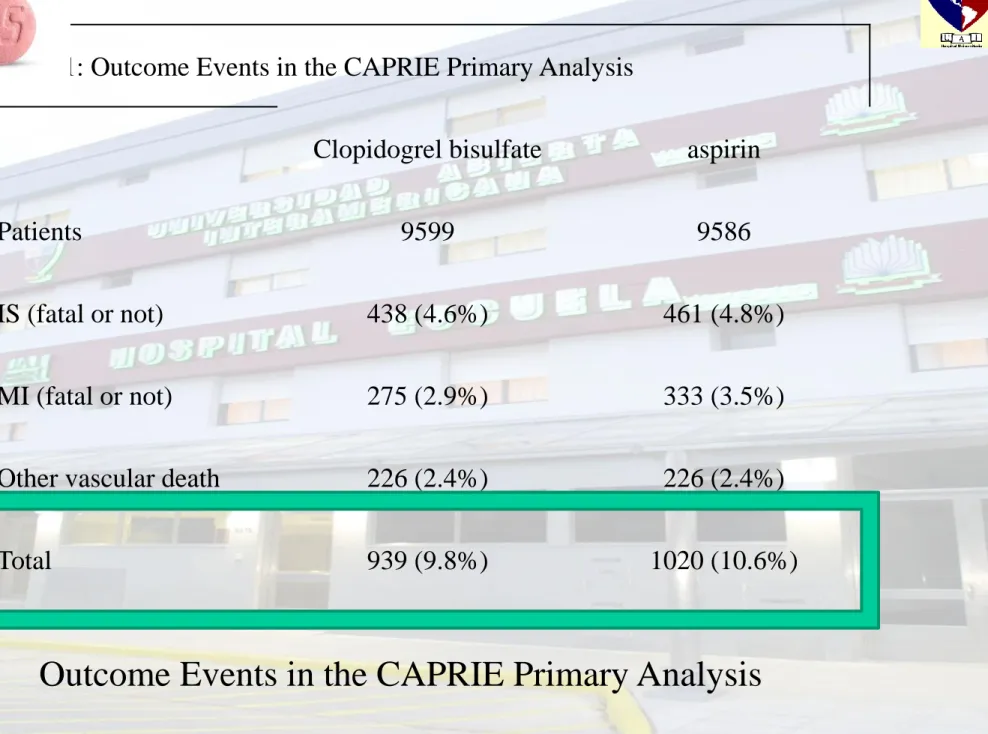
TIENOPIRIDINAS
Y
TRIAZOLOPIRIDINAS
INHIBIDORES DE P2Y12
TIENOPIRIDINAS
Clopidogrel
Prasugrel
y nuevos Greles
Date of download: 12/19/2014
Copyright © The American College of Cardiology. All rights reserved.
From: Resistance to clopidogrel: A review of the evidence
J Am Coll Cardiol. 2005;45(8):1157-1164. doi:10.1016/j.jacc.2005.01.034