
Entrepreneurship, ties and relational networks: the case of a public-private cross-border tourism product
453
0
0
Texto completo
(2) Universitat de Girona. Departament d’Organització, Gestió Empresarial i Disseny del Producte. Facultat de Ciències Econòmiques i Empresarials Facultat de Turisme. TESI DOCTORAL. Entrepreneurship, ties and relational networks: the case of a public-private cross-border tourism product Joan SOLÉ PLA. Direcció: Dr. Jaume Guia Julve Dr. Germà Coenders Gallart.
(3)
(4) El Dr. Jaume Guia Julve i del Departament d’Organització, Gestió Empresarial i Disseny del Producte i el Dr. Germà Coenders Gallart, del Departament d’Economia de la Universitat de Girona,. Certifiquem:. Que el Sr. Joan Solé Pla ha realitzat la tesi doctoral anomenada “Entrepreneurship, ties and relational networks: the case of a public-private cross-border tourism product” sota la nostra direcció.. I perquè així consti, signem el present certificat.. Dr. Jaume Guia Julve. Dr. Germà Coenders Gallart. Director. Director. Joan Solé Pla Doctorand.
(5)
(6) Agraïments. Haver escrit aquesta tesi doctoral ha estat una experiència enriquidora en molts sentits. En primer lloc, perquè m’ha fet créixer personalment. M’ha ajudat a dominar estats d’ànim diferents, donant-me una fortalesa per treballar de forma constant sense defallir. La tesi, ha estat com una carrera de fons, amb les seves pujades i baixades, amb moments d’esgotament i moments d’eufòria que portaven poc a poc a la configuració d’aquest treball tal com avui el veieu.. En segon lloc, la realització d’aquesta tesi doctoral m’ha confirmat una intuïció: la d’estar envoltat de moltes persones que no “només” estan disposades a donar un cop de mà, que ja té prou valor per si mateix. Al llarg de tot aquest temps he pogut constatar que he estat, i estic, envoltat de persones que m’han deixat sentir el seu ànim constant. Persones que si en algun moment he flaquejat, m’han donat coratge per seguir fins al final; persones que, en definitiva, m’han demostrat contínuament que entre nosaltres hi ha un vincle total i no tan sols un vincle econòmic.. Voldria deixar constància del meu agraïment a totes aquestes persones, a totes i tots vosaltres que, de moltes maneres diferents, heu fet possible la realització d’aquesta tesi.. En primer lloc vull agrair als meus directors de tesi, els Doctors Jaume Guia Julve i Germà Coenders Gallart haver dirigit aquesta recerca. M’han ensenyat que el treball pot ser ben fet i rigorós i que aquesta màxima no ha d’estar renyida amb el fet d’estar en un ambient agradable, vora el mar o al voltant d’una bona taula tant si és a Eslovènia com a qualsevol raconet entranyable de les comarques gironines. Hem passat junts llargues estones de debats. Les seves observacions i ajut han estat vitals per, poc a poc, anar configurant i escrivint aquesta tesi..
(7) També vull agrair a la Doctora Ma. Teresa Anguera el seu suport i ajut desinteressat per ensenyar-me amb paciència la utilització de les metodologies qualitatives de recerca.. Al Doctor Josep Anguera qui, un dia llunyà de fa ja uns anys, em va suggerir la idea de fer recerca sobre l’emprenentatge.. Al Dr. José Luis Garcia Duran qui també em va dedicar estones per suggerirme possibles tractaments de l’emprenedoria.. A la Dra. Marga Sánchez-Candamio que va haver de deixar la vida quan encara no tocava i que em va iniciar en el món de la recerca qualitativa.. A totes les persones que formen part del grup de recerca Xarxes organitzatives, innovació i desenvolupament d’estratègies i productes turístics (ONIT), per haver compartit estones de reflexió, feed back i també per haver-nos enriquit mútuament, tant acadèmica, com personalment. De forma especial, a la Dra. Raquel Camprubí per l’ajut, suport constant, i pels seus comentaris crítics i lúcids a més d’haver-me dedicat temps de forma desinteressada.. Als companys de Departament, Carme Cañizares i Alex Madrid, per l’ajut rebut per dissenyar i construir una base de dades ACCESS que respongués a totes les preguntes plantejades en la recerca.. A Pilar Presas i a Cristina Martín pels seus hàbils suggeriments i idees, a més del seu treball i esforç en el tractament de les dades.. A Isabel Rojas pels nombrosos suggeriments bibliogràfics, per introduir-me en la història i el món convuls en que va tocar viure a les dones i homes càtars orientant-me cap a la lectura de bona literatura.. A totes les persones entrevistades. Sense el seu testimoni i ajut, aquesta recerca no hauria estat possible. Especialment mencionar a Jordi Garcia Petit, i Esperança Holgado, que m’han dedicat molt de temps a més d’haver posat al.
(8) meu abast tota la documentació que conserven d’aquells anys en que anaven donant forma al Camí dels Bons Homes.. Als Serveis Informàtics de la Facultat de Turisme, per l’ajut en que aquest document sigui tractable pels ordinadors. Als Serveis Informàtics de les Facultats d’Econòmiques i de Turisme, per tenir sempre hardware i software en condicions.. Als les persones que han tingut la paciència d’estar al meu costat en moments bons i dolents al llarg de tot aquests anys; a la Ma. Carme, la meva companya, a qui pot ser no sempre he sabut explicar prou bé què és fer una tesi doctoral, però que tot i així, ha seguit al meu costat; als meus fills, Llorenç i Roger que han estat creixent junt amb la tesi i vivint-ho tot pas a pas; a la mare que sempre m’ha donat suport i al pare que no ha pogut viure fins aquí per veure el treball fet durant aquest temps.. A la gent que m’hagi pogut deixar, sense de cap manera haver-ho volgut, a totes i tots, gràcies!.
(9) Contribucions a congressos derivades d’aquesta tesi doctoral Solé, J. & Guia, J. (2007). Social Network Analysis in Complex Evolutionary Processes: a Multimethod Approach to Analysing Complex Entrepreneurial Ventures. XXVII International Sunbelt Social Network Conference, 1 al 6 de maig de 2007: Corfu, (Greece).. Solé, J. & Guia, J. (2004). Social Network Dynamics and Entrepreneurship: the Relevance of Complemen-tary Assets. XXIV International Sunbelt Social Network Conference, 12 al 16 de maig de 2004. Portorož, (Slovenia)..
(10) Taula de continguts Extended abstract ....................................................................................... 1. 1. Research interest and importance …………………………………………. 1. 2. Research aims ……………………………………………………………...... 6. 3. Theoretical background ……………………………………………………... 7. 4. Methodology ………………………………………………………………….. 9. 5. Stages of the research …..………………………………………………...... 11. Introducció .................................................................................................. 13. 1. Interès i rellevància de la investigació ..................................................... 13. 2. Objectius de la investigació ..................................................................... 18. 3. Fonaments teòrics de la investigació ...................................................... 19. 4. Mètodes de recerca ................................................................................. 21. 5. Etapes de l’estudi i estructura del treball ................................................. 23. Capítol 1: Marc teòric ................................................................................. 25. 1. Introducció ............................................................................................... 25. 2. El concepte d’emprenedoria, alguns trets de la seva evolució històrica. 26. 3. Les xarxes relacionals ............................................................................. 35. 3.1. Introducció ........................................................................................ 35. 3.2. Concepte de xarxa relacional ........................................................... 36. 3.3. Nivells d’anàlisi de les xarxes relacionals ......................................... 38. 3.4. El vincle, el que dóna contingut a la xarxa relacional ....................... 40. 4. Xarxes relacionals i creació d’empreses ................................................. 48. Capítol 2: els processos d’emprenedoria des d’una perspectiva relacional: un model evolutiu d’anàlisi ............................................... 57. 1. Introducció ............................................................................................... 57. 2. Els processos d’emprenedoria: models evolutius ................................... 58. 3. El model de Larson & Starr ..................................................................... 60. 3.1. Presentació del model ...................................................................... 60. I.
(11) 3.2. El model de Larson & Starr en llenguatge d’anàlisi de xarxes relacionals ......................................................................................... 67. 4. Preguntes de recerca .............................................................................. 72. Capítol 3: Vincles relacionals: una proposta de marc conceptual ........ 77. 1. Introducció ............................................................................................... 77. 2. Elements d’anàlisi i classificació dels vincles segons les seves característiques ....................................................................................... 78. 3. Construcció de la tipologia de vincles a partir de les seves característiques ....................................................................................... 82. 4. Tipologia de vincles segons les característiques contingut, signe i dimensió a més de les seves combinacions ........................................... 87. 4.1. Vincles unidimensionals ................................................................... 88. 4.2. Vincles bidimensionals ..................................................................... 111. 4.3. Vincles tridimensionals o totals ........................................................ 149 5. Biografies de vincles ............................................................................... 167. Capítol 4: Disseny de l’estudi empíric ...................................................... 177. 1. Introducció .............................................................................................. 177 2. El paradigma de la recerca qualitativa i la metodologia d’estudi de cas. 178. 2.1. El paradigma de la recerca qualitativa ............................................. 178 2.2. La metodologia d’estudi de cas ........................................................ 181. 3. El cas d’estudi “El Camí dels Bons Homes” ........................................... 184 4. Mètodes d’obtenció de dades ................................................................. 195. 4.1. Fonts d’informació ............................................................................ 195. 4.2. Mètodes d’obtenció de dades ........................................................... 196. 4.2.1. Entrevistes en profunditat ....................................................... 196. 4.2.2. Presa de contacte i descripció del treball de camp ................ 199 4.2.3. Model d’entrevista i qüestions plantejades ............................. II. 200.
(12) 5. Tractament de la informació ................................................................... 203 5.1. Anàlisi qualitatiu ................................................................................ 204. 5.1.1. Anàlisi del contingut ................................................................ 204. 5.1.2. Anàlisi de contingut del cas d’estudi Camí dels Bons Homes. 206. 5.1.3. Processament i gestió de la informació per a la reconstrucció de la biografia dels vincles del Camí dels Bons Homes ........................................................................................ 211. 5.2. Anàlisi quantitatiu ............................................................................. 213 5.2.1. Composició interna de la xarxa relacional .............................. 217. 5.2.2. Anàlisi de la centralitat dels actors ......................................... 217 5.2.3. Anàlisi de l’estructura de la xarxa relacional ........................... 220. 5.2.4. Procés de preparació de la informació per a l’anàlisi relacional .................................................................................... 224. Capítol 5: Anàlisi biogràfica de vincles .................................................... 233. 1. Introducció .............................................................................................. 233 2. Descripció estadística global .................................................................. 234 3. Biografies de vincles ............................................................................... 238. 3.1. Vincles amb biografia estable al llarg del temps .............................. 239 3.2. Vincles amb biografia canviant al llarg del temps ............................. 249. 4. Conclusions de l’anàlisi de les biografies dels vincles ............................ 271. Capítol 6: Anàlisi relacional ...................................................................... 275 1. Introducció .............................................................................................. 275 2. Evolució de la composició interna de la xarxa relacional ........................ 276. 3. Anàlisi de la centralitat dels actors i la seva evolució ............................. 287 3.1. Centralitat dels actors ....................................................................... 287. 3.1.1. El grau de centralitat (degree of centrality) ............................. 287. 3.1.2. Poder d’intermediació (betweenness centrality) ..................... 290. 3.1.3. Proximitat (closeness centrality) ............................................. 291. 3.2. Altres aspectes relacionats amb la centralitat dels actors ................ 292. 3.2.1. Evolució conjunta de les tres mesures de centralitat per als actors principals ......................................................................... III. 292.
(13) 3.2.2. Evolució de la centralitat dels actors en funció de la institució i tipus de rol representat ............................................. 303 4. Anàlisi de l’evolució de l’estructura de la xarxa relacional ...................... 314. 4.1. Extensió de la xarxa ......................................................................... 314. 4.1.1. Volum segons diàmetre de la xarxa i average path length ..... 314. 4.1.2. Forma segons closeness centralization .................................. 317. 4.2. Evolució de la densitat o intensitat en la connectivitat interna ......... 318 4.3. Evolució de la modularitat de la xarxa en termes de connectivitat interna: core/periphery i factions ...................................................... 321 5. Resum dels principals resultats de l’anàlisi relacional ............................ 356. CAPÍTOL 7: Conclusions de la recerca (Versió en Català) ...................... 363. 1. Objectius i qüestions tractades en la recerca …………………………….. 363. 2. Resultats obtinguts …………………………….......................................... 369. 3. Contribucions i propostes de la recerca per a l’anàlisi dels vincles de les xarxes relacionals .............................................................................. 378. CAPÍTOL 7: Conclusions of the research (English Version) .................... 381. 1. Objectives and questions explored in the research.……………………... 381 2. Results obtained …………………………………………………..……….... 387. 3. Contributions and proposals of the research for the analysis of relational network ties ……………………………………………………….. 395. Bibliografia ………………….…………………………………………………... 397. ANNEXOS .................................................................................................... 411. 1. Guions entrevistes .................................................................................. 411 1.1. Entrevista a actors principals ............................................................ 411. 1.2. Entrevista a empresaris i altres informadors .................................... 413. 1.3. Entrevista a grup de persones .......................................................... 414. 2. Manual de codis ...................................................................................... 417. IV.
(14) Índex de taules Taula 1.1:. Característiques dels vincles forts i/o relacionalment incrustats ............................................................................... 42. Taula 3.1:. Aspectes de notació .............................................................. 89. Taula 3.2:. Vincles unidimensionals, codificació i definició ..................... 89. Taula 3.3:. Notacions dels vincles entre actors ....................................... 104. Taula 3.4:. (a-f) Vincles Latents, Escenari 1: vincle latent sobre vincles no existents ........................................................................... 105. Taula 3.5:. Resum dels vincles unidimensionals ..................................... 111. Taula 3.6:. Vincles bidimensionals .......................................................... 112. Taula 3.7:. Vincles Bidimensionals Personal-Econòmic No Mediats ...... 113. Taula 3.8:. Vincle Personal-Econòmic_(+,+) ........................................... 113. Taula 3.9:. Vincle Personal-Econòmic_(+,─) ........................................... 114. Taula 3.10:. Vincle Personal-Econòmic_(–,+) ........................................... 115. Taula 3.11:. Vincle Personal-Econòmic_(─,─) .......................................... 116. Taula 3.12:. Resum vincles Personal-Econòmic ....................................... 117. Taula 3.13:. AB. Vincles mediats positius (t_31) que comporten ∆t (+) ó tAB(–) ................................................................................... Taula 3.14:. 122. Vincles mediats negatius (t_30) que comporten tAB(+) ó ∆tAB(–)..................................................................................... 122. Taula 3.15:. Vincles bidimensionals mediats ............................................. 123. Taula 3.16:. Vincle Personal-Mediat_(+,+) ................................................ 125. Taula 3.17:. Vincle Personal-Mediat_(+,–) ................................................ 128. Taula 3.18:. Vincle Personal-Mediat_(–,+) ................................................ 131. Taula 3.19:. Vincle Personal-Mediat_(−,−) ................................................ 134. Taula 3.20:. Resum dels vincles Personals-Mediats ................................. 135. Taula 3.21:. Vincle Econòmic-Mediat_(+,+) .............................................. 138. Taula 3.22:. Vincle Econòmic-Mediat_(+,–) .............................................. 141. Taula 3.23:. Vincle Econòmic-Mediat_(–,+) .............................................. 144. Taula 3.24:. Vincle Econòmic-Mediat_(–,–) .............................................. 147. Taula 3.25:. Resum vincles Econòmic-Mediats ......................................... 148. Taula 3.26:. Vincles Totals ........................................................................ 149. V.
(15) Taula 3.27:. Vincle Total_(+,+,+) ............................................................... 151. Taula 3.28:. Vincle Total_(+,+,−) ............................................................... 153. Taula 3.29:. Vincle Total_(+,−,+) ............................................................... 155. Taula 3.30:. Vincle Total_(+,−,−) ............................................................... 157. Taula 3.31:. Vincle Total_(−,+,+) ............................................................... 159. Taula 3.32:. Vincle Total_(−,+,−) ............................................................... 161. Taula 3.33:. Vincle Total_(−,−,+) ............................................................... 163. Taula 3.34:. Vincle Total_(−,−,−) ............................................................... 165. Taula 3.35:. Resum vincles Totals ............................................................ 166. Taula 4.1:. Empreses vinculades al producte turístic Camí dels Bons Homes ................................................................................... 194. Taula 4.2:. Codi Família: CF_People ...................................................... 207. Taula 4.3:. Codi Família: CF_Institutions ................................................ 207. Taula 4.4:. Codi Família: CF_Ties ........................................................... 208. Taula 4.5:. Codi Família: CF_ Works ...................................................... 209. Taula 4.6:. Codi Família: CF_Stages ...................................................... 210. Taula 4.7:. Codi Família: CF_Misc .......................................................... 211. Taula 4.8:. Informació aportada per les taules de la base de dades relacional del CBH ................................................................. Taula 4.9:. 212. Preguntes a les que pot donar resposta la base de dades relacional del CBH ................................................................. 213. Taula 4.10:. Els tipus de dades en recerca i les seves característiques ... 213. Taula 4.11:. Detall de la participació en el temps dels diferents actors del CBH ................................................................................. 226. Taula 4.12:. Llegenda tipus de vincles de la xarxa relacional del CBH ..... 229. Taula 4.13:. Llegenda tipus de institucions a les que pertanyen les persones que formen els nodes de la xarxa relacional del CBH ................................................................................. 230. Taula 5.1:. Procés de discriminació de la informació en el CBH ............. 235. Taula 5.2a:. Nombre de vegades que dos actors A i B diuen tenir vincle inicial tipus t_xy ..................................................................... 237. Taula 5.2b:. Freqüència aparició del vincle t_xy a cada una de les fases. 237. Taula 5.3:. Vincles estables al llarg del temps ........................................ 240. VI.
(16) Taula 5.4:. Vincles amb canvis al llarg del temps .................................... 249. Taula 5.5:. Del vincle t_11 al vincle t_112131 i al vincle t_1131 ............. 250. Taula 5.6:. Del vincle t_31 al vincle t_2131 ............................................. 252. Taula 5.7:. Del vincle t_2031 al vincle t_2131 ......................................... 253. Taula 5.8:. Del vincle t_2031 al vincle t_2131 ......................................... 254. Taula 5.9:. Del vincle t_2131 al vincle t_31 ............................................. 256. Taula 5.10:. Del vincle t_2131 al vincle t_2130 ......................................... 257. Taula 5.11:. Del vincle t_2131 al vincle t_2130 ......................................... 260. Taula 5.12:. Del vincle t_2131 al vincle t_2030 ......................................... 262. Taula 5.13:. Del vincle t_2131 al vincle t_2030 ......................................... 263. Taula 5.14:. Del vincle t_2131 al vincle t_102130 ..................................... 265. Taula 5.15:. Del vincle t_2131 al vincle t_112131 ..................................... 266. Taula 5.16:. Del vincle t_2131 al vincle t_102030 ..................................... 268. Taula 5.17:. Del vincle t_102131 al vincle t_112131 ................................. 270. Taula 5.18:. Resum dels vincles que canvien i anys en que ho fan .......... 273. Taula 6.1:. Tipus d’actors del CBH .......................................................... 278. Taula 6.2:. Tasques per a la creació i actualització del CBH .................. 281. Taula 6.3:. Rànquing d’actors amb major degree a cada moment del temps del procés de creació del CBH ................................... Taula 6.4. Rànquing d’actors major betweenness a cada moment del temps del procés de creació del CBH ................................... Taula 6.5. 290. Rànquing d’actors amb major closenness a cada moment del temps durant la creació del CBH ........... Taula 6.6. 288. 291. Persones que apareixen com a centrals a la xarxa durant la fase III ordenades en funció de la seva continuïtat i no en funció de l’ordre decreixent de la mesura .............................. Taula 6.7. 297. (a – e) Actors centrals de la xarxa relacional del CBH de cada any (fases I a III) i segons degree, betweeness i closenness normalitzats ........................................................ Taula 6.8. 298. Centralitat persones pertanyents al Consorci de Formació i Iniciatives de Cercs Berguedà ............................................... 306. Taula 6.9. Centralitat persones pertanyents a Diputació Barcelona ...... 308. Taula 6.10:. Centralitat persones pertanyents a l’àmbit polític .................. 309. VII.
(17) Taula 6.11:. Centralitat persones pertanyents al Parc Natural de Cadí Moixeró .................................................................................. 310. Taula 6.12:. Centralitat persones que treballen com a historiadors .......... 310. Taula 6.13:. Centralitat persones pertanyents al Conseil Générale de l’Ariège i a Ariège Expansion ................................................. Taula 6.14:. Centralitat persones pertanyents al Consell Regulador del Camí dels Bons Homes ......................................................... Taula 6.15:. 311 312. Centralitat persones pertanyents a empreses que col·laboren en la creació del CBH però que no són empresaris del CRCBH ......................................................... Taula 6.16:. Centralitat persones pertanyents al grup d’empresaris que formen part del CRCBH ......................................................... Taula 6.17:. 317. Average Degree ó evolució de la densitat o intensitat en la connectivitat interna ............................................................... Taula 6.20:. 315. Forma de la xarxa segons Network Closeness Centralization ......................................................................... Taula 6.19:. 313. Volum de la xarxa relacional del CBH segons diàmetre i average path length ............................................................... Taula 6.18:. 312. 319. Agrupació dels actors de la xarxa relacional del CBH en 2 i 3 factions i tenint en compte la institució per a la que treballaven l’any 1999 ............................................................ 328. Taula 6.21:. (a-d) Anàlisi de l’existència de core/periphery ....................... 329. Taula 6.22:. Significativitat de l’anàlisi core/periphery i valor de densitats. 334. Taula 6.23:. Significativitat de l’anàlisi faccions (cas de 2 factions) i valor de densitats ........................................................................... Taula 6.24:. Significativitat de l’anàlisi faccions (cas de 3 factions) i valor de densitats ........................................................................... Taula 6.25:. 338. Evolució de la composició dels nodes que formen la periphery entre 1992 i 1997 ................................................... Taula 6.27:. 336. Evolució de la composició dels nodes que formen el core entre 1992 i 1997 ................................................................... Taula 6.26:. 335. 338. Distribució per institucions dels nodes de les 3 factions de l’any 1999 .............................................................................. VIII. 344.
(18) Taula 6.28:. Composició dels nodes que formen el core i la periphery l’any 2000 ............................................................................. Taula 6.29:. Distribució per institucions dels nodes per a 3 factions de l’any 2000 .............................................................................. Taula 6.30:. 355. Nombre d’actors de la xarxa i actors més centrals en el temps .................................................................................... Taula 6.34:. 351. Distribució per institucions dels nodes per a 3 factions de l’any 2006 .............................................................................. Taula 6.33:. 350. (a-b) Evolució de la composició dels nodes que formen el core i la periphery entre 2002 i 2005 .................................... Taula 6.32:. 347. Distribució per institucions dels nodes de les 3 factions de l’any 2001 ............................................................................. Taula 6.31:. 346. 357. Centralitat segons institucions a les que pertanyen els actors ..................................................................................... IX. 358.
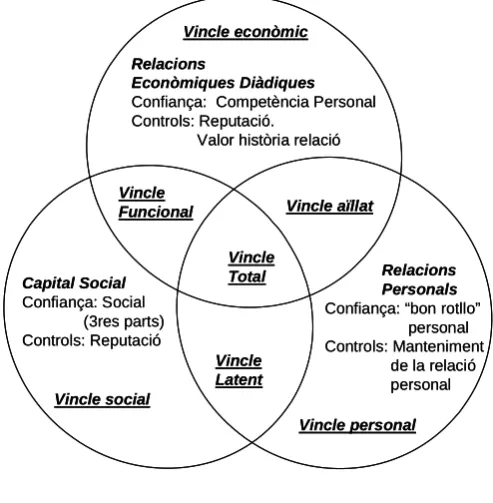
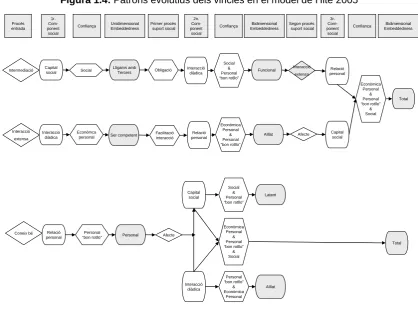
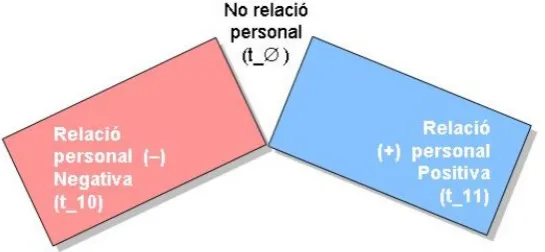
(19) Índex de figures Figura 1.1:. Nivells d’anàlisi de les xarxes relacionals ............................. Figura 1.2:. Grau de cohesió i centralitat dels actors en una xarxa. 39. relacional ............................................................................... 40. Figura 1.3:. Tipus de vincles en el model de Hite 2003 ........................... 43. Figura 1.4:. Patrons evolutius dels vincles en el model Hite 2005 ........... 47. Figura 1.5:. La xarxa social com a variable independent i la xarxa social com a variable depenent ............................................ Figura 2.1:. 51. La xarxa relacional de l’emprenedor en el moment inicial del procés de creació de la nova start-up (esquerra) i en el moment final (dreta) .............................................................. Figura 2.2:. Evolució de la xarxa relacional de l’emprenedor/a a la fase I .................................................................................. Figura 2.3:. 69. Evolució de la xarxa relacional de l’emprenedor/a a la fase II ................................................................................. Figura 2.4:. 63. 70. Evolució de la xarxa relacional de l’emprenedor/a a la fase III ................................................................................ 71. Figura 3.1:. Representació del vincle personal positiu ............................. 91. Figura 3.2:. Vincle de Relació Personal ................................................... 92. Figura 3.3:. Vincle de Relació Personal com a variable ternària .............. 93. Figura 3.4:. Representació del vincle personal negatiu ........................... 94. Figura 3.5:. Representació del vincle econòmic positiu ........................... 96. Figura 3.6:. Representació del vincle econòmic negatiu .......................... 98. Figura 3.7:. Vincle de Relació Econòmica ................................................ 98. Figura 3.8:. Vincle de Relació Econòmica com a variable ternària .......... 99. Figura 3.9:. Vincle de Relació Latent. Ventall de possibles valors del Vincle Latent ......................................................................... 103. Figura 3.10: Vincle de Relació Latent com a variable ternària .................. 103. Figura 3.11: Escenaris amb vincle latent .................................................. 120. Figura 3.12: Resum de les possibilitats de comportament del mediador/a en els vincles bidimensionals mediats ............... 121. Figura 3.13: Vincle Personal-Mediat_(+,+) ................................................ 124. X.
(20) Figura 3.14: Vincle Personal-Mediat_(+,–) ................................................ 126. Figura 3.15: Vincle Personal-Mediat_(–,+) ................................................ 129. Figura 3.16: Vincle Personal-Mediat_(–,–) ................................................ 132. Figura 3.17: Vincle Econòmic-Mediat_(+,+) .............................................. 136. Figura 3.18: Vincle Econòmic-Mediat_(+,–) .............................................. 139. Figura 3.19: Vincle Econòmic-Mediat_(–,+) .............................................. 142. Figura 3.20: Vincle Econòmic-Mediat_(–,–) .............................................. 145. Figura 3.21: Mapa de possibles recorreguts dels vincles possibles establerts en un cas d’estudi determinat ............................... 170. Figura 3.22: Camins evolutius: del vincles de relació personal, (vincle t_11) i del vincle de relació econòmica (vincle t_21) cap el vincle personal-econòmic; t_1121) ....................................... 171. Figura 3.23: Del vincle Personal_(+) al vincle Total_(+,+,+) segons el model Hite (2005) .................................................................. 172. Figura 3.24: Camins evolutius: del vincle de relació personal, vincle t_11 que evoluciona cap a les formes de vincle personalmediat t_1131 ó personal-econòmic t_1121, per acabar en vincle total t_112131......................................................... 172. Figura 3.25: Del vincle Econòmic_(+) al vincle Total_(+,+,+) segons el model Hite (2005) .................................................................. 173. Figura 3.26: Camins evolutius: Del vincle de relació econòmica, (vincle t_21) que evoluciona cap a la forma de vincle aïllat (ó personal-econòmic; t_1121) per acabar en vincle total (t_112131) ............................................................................. 173. Figura 3.27: Del vincle Mediat_(+) al vincle Total_(+,+,+) segons el model Hite (2005) .................................................................. 174. Figura 3.28: Camins evolutius: del vincle de relació mediada, (vincle t_31) que evoluciona cap a vincle funcional (ó econòmicmediat, t_2131) per acabar en vincle total (t_112131) ......... Figura 4.1:. 174. Logotip identificatiu del producte turístic Camí dels Bons Homes ................................................................................... XI. 185.
(21) Figura 4.2:. Recorregut i situació geogràfica del sender GR 107 sobre el que s’estableix la ruta del Camí dels Bons Homes ........... 185. Figura 4.3:. 1999: Codi Família: CF_People ............................................ 206. Figura 4.4:. Codi Família: CF_Institutions ................................................ 208. Figura 4.5:. Codi Família: CF_Ties .......................................................... 209. Figura 4.6:. Codi Família: CF_Works ....................................................... 210. Figura 4.7:. Codi Família: CF_Stages ...................................................... 210. Figura 4.8:. Codi Família: CF_Misc .......................................................... 211. Figura 4.9:. Tipus de dades i d’anàlisi ...................................................... 214. Figura 4.10: Matriu d’adjacència ............................................................... 215. Figura 4.11: Exemple de sociograma ........................................................ 216. Figura 4.12: Graf per a il·lustrar la idea de centralitat en una xarxa relacional ............................................................................... 218. Figura 4.13: Graf per il·lustrar el poder d’intermediació en una xarxa relacional ............................................................................... 218. Figura 4.14: Graf il·lustratiu de la major proximitat de l’actor A al la resta d’actors .................................................................................. 219. Figura 4.15: Graf il·lustratiu dels tres components de la centralitat .......... 220. Figura 4.16: Exemple de diàmetre i average path lengh en una xarxa relacional ............................................................................... 221. Figura 4.17: Exemple de xarxes relacionals amb closeness centralization 0 i 1 ................................................................. 221. Figura 4.18: Macro-modularitat de la xarxa basada en l’algoritme core/periphery ....................................................................... 223. Figura 4.19: Macro-moduratritat de la xarxa basada en l’algoritme factions .................................................................................. 223. Figura 4.20: Mostra de la informació introduïda a la base de dades ACCESS ............................................................................... 225. Figura 4.21: Vincles de l’actor E09 a cada moment del temps ................. 228. Figura 4.22: Matriu relacional dels actors del CBH per a l’any 1995 ........ 228. Figura 4.23: Matriu relacional dels actors del CBH per a l’any 1995 recodificada ........................................................................... XII. 230.
(22) Figura 4.24: Exemple de gràfic de matriu relacional dels actors del CBH per a l’any 1997 .................................................................... Figura 5.1:. 231. Xarxa relacional del Camí dels Bons Homes amb tipus de vincles l’any 1993, relació t_21 entre el tècnic E20 del CFI i l’historiador E33 ...................................................... Figura 5.2:. 241. Xarxa relacional del Camí dels Bons Homes amb tipus de vincles l’any 1992, relació t_1131 entre els polítics E11 de Catalunya i E908 de l’Arieja .................................................. Figura 5.3:. Xarxa relacional del Camí dels Bons Homes amb tipus de vincles l’any 2001 .................................................................. Figura 5.4:. 247. Xarxa relacional del Camí dels Bons Homes amb tipus de vincles l’any 2005 .................................................................. Figura 5.9:. 246. Xarxa relacional del Camí dels Bons Homes amb tipus de vincles l’any 1995 .................................................................. Figura 5.8:. 245. Xarxa relacional del Camí dels Bons Homes amb tipus de vincles l’any 1999 .................................................................. Figura 5.7:. 244. Xarxa relacional del Camí dels Bons Homes amb tipus de vincles l’any 2000 .................................................................. Figura 5.6:. 243. Xarxa relacional del Camí dels Bons Homes amb tipus de vincles l’any 1997 .................................................................. Figura 5.5:. 242. 248. Xarxa relacional del Camí dels Bons Homes amb tipus de vincles l’any 1995, en el moment en que el CFI fa el contacte amb els empresaris candidats a formar part del futur Consell Regulador del CBH .......................................... 248. Figura 5.10: Del vincle t_11 al vincle t_112131 i al vincle t_1131 ............. 250. Figura 5.11: Xarxa relacional del CBH entre 1997 i 1999, en el moment en que E21 i E29 mantenen el vincle t_112131 .................... 251. Figura 5.12: Del vincle t_31 al vincle t_2131 ............................................. 251. Figura 5.13: Xarxa relacional del CBH l’any 1997 en el moment en que E09 i E11 mantenen el vincle t_2131 .................................... 252. Figura 5.14: Del vincle t_2031 al vincle t_2131 ......................................... 253. Figura 5.15: Xarxa relacional del CBH l’any 1995 en el moment en que E02 i E08 mantenen el vincle t_2031 .................................... XIII. 254.
(23) Figura 5.16: Xarxa relacional del CBH l’any 1997 en el moment en que E02 i E921 mantenen el vincle t_2031 .................................. 254. Figura 5.17: Del vincle t_2131 al vincle t_31 ............................................. 255. Figura 5.18: Xarxa relacional del CBH l’any 2001; vincle t_31 entre E24 i els empresaris pertanyents al Consell Regulador (E801) ... 256. Figura 5.19: Del vincle t_2131 al vincle t_2031 amb pas pel vincle t_21 .. .......................................................................... 257. Figura 5.20: Xarxa relacional del CBH l’any 1997 quan E02 i E21 mantenen el vincle t_2130 Figura 5.21 Del vincle t_2131 al vincle t_2130 ......................................... 259 260. Figura 5.22: Xarxa relacional del CBH l’any 1993, vincle t_2130 entre E12 i E32 ............................................................................... 261. Figura 5.23: Del vincle t_2131 al vincle t_2030 ......................................... 261. Figura 5.24: Xarxa relacional del CBH l’any 1998, vincle t_2030 entre E28 i E901 ............................................................................. 263. Figura 5.25: Xarxa relacional del CBH l’any 1998, vincle t_2030 entre E15 i E901 ............................................................................. 264. Figura 5.26: Del vincle t_2131 al vincle t_102130 ..................................... 264. Figura 5.27: Xarxa relacional del CBH l’any 1997 vincle t_102130 entre E09 i E22 ............................................................................... 265. Figura 5.28: Del vincle t_2131 al vincle t_112131 ..................................... 266. Figura 5.29: Xarxa relacional del CBH l’any 2002 vincle t_112131 entre E06 i E34 ............................................................................... 267. Figura 5.30: Del vincle t_2131 al vincle t_102030 ..................................... 268. Figura 5.31: Xarxa relacional del CBH l’any 1993 vincle t_102030 entre E02 i E12 ............................................................................... 269. Figura 5.32: Del vincle t_102031 al vincle t_112131 ................................. 270. Figura 5.33: Xarxa relacional del CBH l’any 1996 vincle t_112131 entre E02 i E34 ............................................................................... 271. Figura 6.1:. (a-c) Evolució del sociograma del CBH. Fase I, II i III ........... 283. Figura 6.2:. Càlcul de densitats de 2 i matriu d’adjacències per a l’anàlisi core/periphery i any 1999 ......................................... XIV. 322.
(24) Figura 6.3:. Xarxa relacional del CBH amb anàlisi core/periphery per a l’any 1993 .............................................................................. Figura 6.4:. Càlcul de densitats de 2 factions i matriu d’adjacències per a l’any 1999 ........................................................................... Figura 6.5:. 327. (a-c) Xarxa relacional del CBH amb anàlisi core/periphery (fase I) ................................................................................... Figura 6.9:. 326. Xarxa relacional del CBH amb anàlisi de 3 factions per a l’any 1999 .............................................................................. Figura 6.8:. 325. Càlcul de densitats de 3 factions i matriu d’adjacències per a l’any 1999 ........................................................................... Figura 6.7:. 324. Xarxa relacional del CBH amb anàlisi de 2 factions per a l’any 1999 .............................................................................. Figura 6.6:. 323. 339. (a-c) Xarxa relacional del CBH amb anàlisi core/periphery (fase II) .................................................................................. 340. Figura 6.10: Xarxa relacional del CBH amb anàlisi core/periphery per a la fase III ................................................................................ 341. Figura 6.11: Xarxa relacional del CBH any 1998 amb anàlisi factions 3 (fase III) ................................................................................. 342. Figura 6.12: Xarxa relacional del CBH any 1999 amb anàlisi factions 3 (fase III) ................................................................................. 345. Figura 6.13: Xarxa relacional del CBH amb anàlisi core/periphery l’any 2000 (fase III) ........................................................................ 346. Figura 6.14: Xarxa relacional del CBH amb anàlisi factions 3 l’any 2000 (fase III) ................................................................................. 348. Figura 6.15: Xarxa relacional del CBH amb anàlisi factions 2 (fase III) .... 350. Figura 6.16: Xarxa relacional del CBH amb anàlisi core/periphery (fase III) ................................................................................. 352. Figura 6.17: Xarxa relacional del CBH amb anàlisi core/periphery (fase III) ................................................................................. 353. Figura 6.18: Xarxa relacional del CBH amb anàlisi factions 3 l’any 2006 (fase III) ................................................................................. XV. 355.
(25) Índex de gràfics. Gràfic 5.1a: Representació de les freqüències d’aparició dels vincles al CBH ....................................................................................... 238. Gràfic 5.1b: Representació de les freqüències d’aparició dels vincles al CBH excloent t_2131 ............................................................. 238. Gràfic 6.1:. Evolució del nombre d’actors per tipus .................................. 280. Gràfic 6.2:. Evolució del grau de centralitat dels 5 actors amb major degree of centrality ................................................................ Gràfic 6.3:. Evolució del poder d’intermediació (betweenness centrality) dels 5 actors amb major degree of centrality ......................... Gràfic 6.4:. 290. Evolució del grau de proximitat (closeness centrality) dels 5 actors amb major degree of centrality ......................... Gràfic 6.5:. 289. 291. (a-e) Actors centrals de la xarxa relacional del CBH de cada any (fase I) i segons degree, betweeness i closenness normalitzats ........................................................ Gràfic 6.6:. (a – d) Centralitat persones pertanyents al Consorci de Formació i Iniciatives de Cercs Berguedà ............................. Gràfic 6.7:. 298 307. (a – d) Centralitat persones pertanyents a Diputació de Barcelona .............................................................................. 308. Gràfic 6.8:. (a – d) Centralitat persones pertanyents a l’àmbit polític ...... 309. Gràfic 6.9:. Centralitat persones pertanyents al Parc Natural de Cadí Moixeró .................................................................................. 310. Gràfic 6.10: Centralitat persones que treballen com a historiadors .......... 310. Gràfic 6.11: (a – c) Centralitat persones pertanyents al Conseil Générale de l’Ariège i a Ariège Expansion ............................ 311. Gràfic 6.12: (a – b) Centralitat persones pertanyents al Consell Regulador del Camí dels Bons Homes ................................. XVI. 312.
(26) Gràfic 6.13: (a – b) Centralitat persones pertanyents empreses que col·laboren en la creació del CBH però que no són empresaris del CRCBH ......................................................... 312. Gràfic 6.14: (a – f) Centralitat persones pertanyents al grup d’empresaris que formen part del CRCBH ............................ 313. Gràfic 6.15: Volum de la xarxa relacional del CBH segons diàmetre i average path length ............................................................... 315. Gràfic 6.16: Forma de la xarxa segons Network Closeness Centralization ......................................................................... 317. Gràfic 6.17: Representació de la mesura Average Degree o evolució de la densitat o intensitat en la connectivitat interna .................................................................................... 319. Gràfic 6.18: Significativitat de l’anàlisi core/periphery i valor de densitats ............................................................................... 334. Gràfic 6.19: Significativitat de l’anàlisi faccions (cas de 2 factions) i valor de densitats ........................................................................... 335. Gràfic 6.20: Significativitat de l’anàlisi faccions (cas de 3 factions) i valor de densitats ........................................................................... XVII. 336.
(27) Nomenclatura i Abreviatures més utilitzades. AE: Abrège Expansion ALTRI : Altres institucions ASS: Associació CBH: Camí dels Bons Homes CCE: Consell Comarcal Cerdanya CCAL: Altres Consells Comarcals CGA: Conseil General Abrège CRBH: Consell Regulador del Camí dels Bons Homes DIBA: Diputació Barcelona DIAL: Altres diputacions FEEEC: Federació Entitats Excursionistes de Catalunya EMP: Empresaris HIST: Historiador/a PARC: Parc Natural Cadí Moixeró SNA: Social Network Analysis. XVIII.
(28) Extended Abstract. Extended Abstract 1. Interest and relevance of the research This. research. aims. to. contribute. to. an. understanding. of. so-called. entrepreneurship processes, or the processes involved in creating a new business initiative in the form of new companies and/or new products.. An observation of the environment leads to a realisation that an enterprise initiatives (and, one could say, any form of initiative undertaken by individuals) necessarily passes through a process of progressive specification from the point at which it is conceived of as an idea in the mind of its creator until it ultimately becomes an independent object perceived by other people or by society as a whole.. This thesis is based on the idea that entrepreneurship processes are essential in the economic and social development and continuity of regions and their enterprises. It is an idea which has been highlighted both in the field of economics and business administration, and in other social sciences.. 1.
(29) Extended Abstract. Although entrepreneurship is a phenomenon which has been fairly widely analysed in the academic literature (Douhan et al., 2007), we find that there are certain aspects which have received less attention on the part of researchers.. The first of these aspects is borne out of an appreciation that the bulk of research efforts have focused on an analysis of the individual characteristics of entrepreneurs, to the detriment of studies into entrepreneurship processes. The second aspect is connected with the fact that research into entrepreneurship tends to limit its approach to enterprise initiatives in the private sector (Dean et al., 2007; Pereira, 2007), traditionally overlooking broader definitions of the concept of entrepreneurship, which would include similar behaviour within the context of a pre-established organisation. This organisation could be a private enterprise, a public body or a combination of public and private agents. Lastly, the third aspect is the result of the fact that many of the models referring to how enterprise initiative development processes come about assume that they are linear (Larson and Starr, 1993, Shaw and Carter, 2007), and do not focus their analysis on cases involving a large number of actors, which could for example belong to a range of institutional contexts, and which could in turn be headed by one or more public authority bodies.. This thesis aims to perform research taking this literature as its starting point. The research intends to explore further an analysis of entrepreneurship processes, adopting at all times a broad meaning of the concept, in other words the idea that "enterprise" is confined not only to private agents but that entrepreneurs could also include agents belonging to a public authority, as will be seen over the course of the text.. The research is developed through an in-depth study of one specific case: El Camí dels Bons Homes. It analyses the process of entrepreneurship which took place from 1993 onwards and during the years immediately following for the creation of the cross-border tourism product known as the Camí dels Bons Homes or Route of the Cathars. The study reveals how, by the end of this process, the Route of the Cathars had become a finished tourism product which can essentially be presented, in the words of its creators "as a tourist route 2.
(30) Extended Abstract. driven by public institutions to create an environment to foster regional development".. It is a route which runs from the Queralt shrine in the district of Berguedà, in the autonomous region of Catalonia in Spain, to Montsegur Castle in the French region of Ariège, "following the pathways which in the 12th and 13th centuries became the routes of migration for the Cathars in their exile from France" 1 . The Camí dels Bons Homes route and brand are overseen by a Regulatory Council, a body which brings together the public agents which created the product and the companies offering services connected with the route. Altogether this constitutes a compact product with a brand image which combines, among other aspects, issues connected with hiking, history and gastronomy. It is a product which is constantly being renewed and updated, with the progressive addition of aspects beyond those listed above, such as for example the Cathar Visitor Centre in the town of Bagà, which forms a part of the route.. The decision to study the tourism and walking product Route of the Cathars is based on the interest and novelty which this thesis aims to offer. It was decided to analyse the process of creating the Route of the Cathars essentially for two reasons. First, because it challenges the linear approach always applied to entrepreneurship processes. Over the course of this research the linear nature of such processes is questioned, in particular in the case of particularly complex instances (Koh, 2006; Weiermair et al., 2006).. Secondly, because the very fact of viewing the creation of the Route of the Cathars as an entrepreneurship process serves to broaden the meaning traditionally given to this concept in the literature, as it does not represent the creation of a typical enterprise but is a case which constantly and permanently involves public and private actors which meanwhile belong to a range of bodies with differing levels of dependence on the various regional authorities (the former) and different sectors (the latter). The creation of the Route of the. 1. Holgado, E. (1998) Introduction to the 1st edition of El Camí dels Bons Homes. Topoguia de la ruta dels càtars. GR-107. Foreword by Antoni Dalmau. Ed. Altaïr. Barcelona and Consorci Formació i Iniciatives Cercs-Berguedà. 3.
(31) Extended Abstract. Cathars became possible, then, thanks to the joint efforts of these different types of actor, which furthermore belong to the two aforementioned crossborder regions in Southern Europe: Catalonia and Ariège.. We are, then, here faced with a case study which, as mentioned, has been the subject of little academic analysis. A case which serves as an example illustrating how the different bodies which belong to the public authorities tied to cross-border regions, with different concepts and management approaches regarding their respective regions, can collaborate and work together to embark on the creation of a new "enterprise" initiative, this being the definition given in this thesis to the creation of the Route of the Cathars tourism product. A product designed to catalyse the economy of these regions, which would meanwhile not have been possible or viable without the active participation of actors outside these "entrepreneurial" bodies, such as the business people and/or companies which also took on varying degrees of risk in creating or providing assets complementing the Route of the Cathars product.. In order to analyse the entrepreneurship process involved in the Route of the Cathars, this thesis leaves to one side the issue of the individual characteristics of the entrepreneur, and instead adopts a relational network perspective through a twofold approach: first of all individually analysing the ties within the network, and secondly analysing the network of social relationships from an overall network dynamic perspective.. In order to analyse the network ties the aim is to establish the nature of the specific ties occurring at any given time among the different agents belonging to the entrepreneurship process involved in the new initiative, and how they evolve (Greve and Salaff, 2003; Hite, 2005).. A study of the ties illustrates that each one has its own life cycle and makes its own specific contribution to the evolution of social relationships within the relational network. This means that the evolution of the network as a whole is closely tied to the evolution of the ties and their nature.. 4.
(32) Extended Abstract. The analysis of the relational network from an overall network dynamic perspective is performed with reference to the aforementioned Larson & Starr model. The said authors focus on the way in which, across the different phases through which the new enterprise project passes, the entrepreneur, performing a selection of contacts (or actors contacted), gradually creates a network of ties which at the outset are characterised by one single content, before gradually acquiring new contents as the process gradually runs its course.. Larson and Starr's contribution may be viewed as significant in the literature, as illustrated by the words of Hoang and Antoncic, who in 2003 invited researchers to pursue the line of study of the authors' article, writing: “[Larson & Starr] remains the most complete piece of theorizing about network processes in the entrepreneurial context” before subsequently stressing their view that “More appropriate research methods should be undertaken to test and extend the network development theory developed by Larson and Starr (1993) 2 .. In this regard, the relational network which progressively developed in the process of creating the Route of the Cathars tourism project is analysed as a whole from an overall network dynamic perspective, studying and observing its evolution, in other words its creation, promotion and maintenance.. As will be seen over the course of the thesis, this is a network which is associated with the nature of the product creation initiative and the need to obtain different types of resource at each stage of the process. Meanwhile, the ability on the part of "entrepreneurial" actors to secure the resources which form part of the initiative is related to their ability to create, maintain or abandon social ties.. In summary, then, a study is performed of the network of social relationships from a tie analysis perspective at the individual level, and from an overall network dynamic perspective.. 2. Hoang, H., & Antoncic, B. (2003). Network-based research in entrepreneurship. A critical review. Journal of Business Venturing, 18, pp. 179 and 180 5.
(33) Extended Abstract. The text adopts a specific vision or approach to reality. For the author of this thesis, reality is constantly being constructed by human action. "Enterprise" initiatives are undertaken by specific men and women who have successfully negotiated the internal contradictions of the systems constructed by humanity.. Research can help present recommendations for those in charge of regional development policies at the local level or for a specific area, in order to help foster and catalyse their economic and social growth.. 2. Research aims This thesis employs the conceptual framework of Larson & Starr (1993) and the postulates of J. A M. Hite (Hite, 2003, 2005) with regard to ties. It assesses the extent to which their contributions can explain how the different bodies which belong to public authorities tied to a specific geographical zone succeed in embarking on the creation of a new "enterprise" initiative, which in this research takes the form of a tourism product. A tourism product conceived of with the aim of making a successful contribution in catalysing the economy of the regions where it is established.. The idea, then, is to explore the evolution of the significant ties within the relational network and the evolution of the structure of that network.. The results obtained in this thesis could be used for the subsequent analysis of other cases and also to make policy recommendations for local authorities about how to make a more effective contribution in catalysing the economic and social growth of a given area.. In response to the central question posed by the research, the proposal is to perform the following tasks:. 6.
(34) Extended Abstract. 1. Research the different types of relational network ties. Establish a systematic classification for the entrepreneur's different ties during the process, along with the potential trajectories which these ties could follow. 2. Link the life cycles of the network ties to the evolution of the network as a whole. 3. Employ social network analysis methodology to establish maps of the entrepreneur's relationships and their evolution during the process of creating the initiative. Examine how changes occur, and hence how the relational network structure of the Route of the Cathars evolves. Analyse the structure and the evolution of the structure during the institutionalisation of the initiative and at the point immediately after this institutionalisation. 4. Question the linearity of this process and study this by analysing the evolution of the social network created for this purpose. 5. Identify which aspects of the Larson & Starr model should be adapted in order to increase its ability to explain entrepreneurship processes with characteristics similar to those seen in the creation of the Route of the Cathars.. 3. Theoretical basis for the research The approach adopted by this thesis is based on the article by Larson and Starr (1993), “A Network Model of Organisation Formation” published in the journal Entrepreneurship, Theory and Practice. The authors propose a model which dictates that entrepreneurship processes follow a three-stage sequence. An initial stage, characterised by the entrepreneur's attempts to create a preliminary relational network of actors, whose contributions will in principle be vital for the continuity of the initiative; a second stage in which some of these relationships become stronger in economic and social terms while others are discarded, and a third stage of crystallisation during which the initiative moves on to a phase of clear institutionalisation.. 7.
(35) Extended Abstract. This thesis questions the linearity of the entrepreneurship process as presented by Larson & Starr and begins with the supposition that, in complex contexts, these entrepreneurship processes follow a non-linear evolutionary trajectory and dynamic, with the result that the more conventional prescriptions applied to entrepreneurship processes are of limited applicability.. What is more, it questions whether the widespread application of this type of model is feasible in those cases where it proves necessary to create or develop complementary and idiosyncratic assets; in other words, cases where the product or enterprise created depends on other complementary assets in order to be viable.. The Larson & Starr model also makes contributions regarding the content of the ties formed by the entrepreneur's network. Meanwhile, their study into the content of these ties is seminal, representing an initial approach later explored by Hite (2003, 2005), and which this thesis aims to develop by proposing a new conceptual framework collating the contributions made by the literature while also presenting novel aspects such as, for example, the introduction of operations with negative ties.. In terms of the methodological approach, it should be pointed out that it was conceived for the purpose of analysing relational processes. It furthermore combines the use of relational network methodology and biographical analysis of the ties within those networks as part of a process which draws on a combination of the use of qualitative and quantitative methodologies. The use of both types of methodology helps capture all aspects explaining the evolution of a social process such as that which occurs in the case analysed, or in general occurs in cases of the creation of an enterprise initiative.. Below are described the steps followed throughout the research in analysing the process of creating the Route of the Cathars. Following a review of the literature, the decision was taken to work on the basis of the conceptual structure of the 1993 Larson & Starr model set out above. However, this model 8.
(36) Extended Abstract. does not take into consideration the social or social capital dimension which is nonetheless provided by Hite (2003, 2005).. Meanwhile, the Hite model, while casting light on the social or social capital dimension, barely focuses in its approach on the issue of social "antirelationships", or negative social relationships.. In an analysis of the case of creating the Route of the Cathars, consideration must be given to these aspects since both may be observed in the process of its creation. In order to cover both, the text proposes a rewriting or transformation of the Larson & Starr model in terms of a social network model employing the terminology inherent in the literature, expanding the phases proposed by the authors and generating tools for the subsequent analysis of complex cases of entrepreneurship. The above all combines to analyse as a whole the evolution of the relational network structure in the case examined based on measurements of its structure and internal configurations.. 4. Research methods This section cites the research methods employed in the thesis, which will all be presented in detail in Chapter 4.. In order to analyse the creation of the Route of the Cathars tourism product the initial step is to employ the case methodology, clearly establishing the type of case to be analysed, the perspective to be adopted, and, as recommended (Creswell, 1998), the physical and temporal limits to which the analysis is to extend.. Following on from specifications of the case study and its limits, the next step is the approach to the reality of the Route of the Cathars. This reality is identified with the individuals and institutions involved in its creation, in other words the actors who were or are at any time or times tied to the relational network arising. 9.
(37) Extended Abstract. over the course of the process researched. The approach applied to the reality studied involves 36 semi-structured (or "loosely structured") interviews with key actors involved in the project. In these interviews the role of the interviewer was to modulate the information being received from the interviewee.. The output of the interviews is subjected to a textual content analysis in order to perform a coding process assisted by the specific Atlas-ti application (version 5). The codes derived from this process are employed to feed the theoretical framework of the thesis in an iterative process running back and forth between the theoretical proposal and the qualitative information derived from the interviews.. The management and storage of all information arising out of the fieldwork was performed through the creation of a relational database using the ACCESS computer program (2003 version).. On the basis of the information processed and saved using the software, information can be extracted about all the ties emerging from the fieldwork, their nature and individual and collective evolution.. Lastly, in order to obtain the data allowing for an analysis of the network structure of the Route of the Cathars at each point of the process of its creation, the relational information was recoded in order to convert it into a format which could be read by the specific relational network analysis software, namely the Ucinet package (version 6).. 10.
(38) Extended Abstract. 5. Stages of the study and structure of the work The analysis of the process of creating the Route of the Cathars tourism product is presented in the chapters detailed below.. The first chapter focuses on a review of the literature providing the foundations for. the. research. here. presented.. On. the. one. hand,. literature. on. entrepreneurship, and on the other literature linking this concept to a relational network methodology. Taking this as the central point, the relational analysis is handled from the perspectives of network structure analysis and an analysis of the content of ties.. The second chapter presents the theoretical discussion regarding the linearity or non-linearity of entrepreneurship models, before moving immediately on to an analysis of the Larson & Style (1993) model, which is meanwhile re-written in relational network terms. Lastly, the questions to be answered by this research are presented.. The third chapter focuses on a detailed presentation of the new conceptual framework of types of relational tie. This tool has been constructed with the aim of being employed both in the analysis of the Route of the Cathars tourism project and other types of social process.. The fourth chapter deals with an explanation of the methodology employed in performing the empirical study. It clearly establishes and presents the case study analysed, identifies the population studied and explains the methods employed to obtain the data (in-depth interviews and content analysis). The variables employed in responding to the questions raised in the research are then summarised.. The fifth chapter sets out the results obtained through the tie biography analysis. An overall statistical description is given of the different types of tie. 11.
(39) Extended Abstract. found in the Route of the Cathars, before moving on to an analysis of their biographies, both in those cases where they remain stable over time and those where they change. The chapter concludes with a summary of the main outcomes obtained.. The sixth chapter presents the results of the relational analysis. The evolution of the relational network structure is analysed, measuring its extent in terms of diameter and volume. An analysis is also performed of its centrality and the evolution of its modularity examined in terms of internal connectivity. The chapter ends with a summary of the main outcomes obtained.. Lastly, the seventh chapter focuses on presenting the main conclusions reached in this thesis on the basis of a review of the academic literature, the creation of the conceptual model and analysis of the chosen case study.. 12.
Figure


+7




Documento similar
Indicadores municipales de sostenibilidad: Tasa de afiliación a
Fuente de emisión secundaria que afecta a la estación: Combustión en sector residencial y comercial Distancia a la primera vía de tráfico: 3 metros (15 m de ancho)..
A diferència del que es podria pensar, les fases de regeneració del bosc presenten un important creixement dels I A S , resultat de l'existència d'una economia mixta, així com
En nuestra opinión, las cuentas anuales de la Entidad Pública Empresarial Red.es correspondientes al ejercicio 2010 representan en todos los aspectos significativos la imagen fiel
En nuestra opinión, las cuentas anuales de la Entidad Pública Empresarial Red.es correspondientes al ejercicio 2012 representan en todos los aspectos
La Intervención General de la Administración del Estado, a través de la Oficina Nacional de Auditoría, en uso de las competencias que le atribuye el artículo 168
La Intervención General de la Administración del Estado, a través de la Oficina Nacional de Auditoría, en uso de las competencias que le atribuye el artículo
La campaña ha consistido en la revisión del etiquetado e instrucciones de uso de todos los ter- mómetros digitales comunicados, así como de la documentación técnica adicional de
