Prevalence of hepatitis B and C markers in a population of an
urban university in Rio de Janeiro, Brazil: a cross-sectional study
Félix P.D. Pinto,* Orlando C. Ferreira Jr.,|| Daniele B. Olmedo,†,‡ Patrícia M. Precioso,§ Fernanda R.S. Barquette,*,† Magda C. Castilho,§ Suely G.C. Silva,*,¶ Luís Cristóvão Pôrto*,§
* Master Program in Health, Laboratory Medicine and Forensic Technology.
† Clinical Pathology Service, Policlínica Piquet Carneiro. ‡Human and Experimental Biology Program (BHEx), Roberto Alcantara Gomes Institute. § Histocompatibility and Cryopreservation Laboratory, Roberto Alcantara Gomes Institute, Rio de Janeiro State University, Rio de Janeiro, Brazil.
|| Molecular Virology Laboratory, Biology Institute, Federal University of Rio de Janeiro, Rio de Janeiro, Brazil. ¶ Serology/NAT Laboratory, Hemotherapy Service, Instituto Nacional de Câncer José de Alencar da Silva, Rio de Janeiro, Brazil.
ABSTRACT
Background and rationale. Epidemics of hepatitis B and C are a public health burden, and their prevalence in Brazil varies among regions. We determined the prevalence of hepatitis markers in an urban university population in order to support the development of a comprehensive program for HBV immunization and HBV/HCV diagnosis. Students, employees, and visitors (n = 2,936, 31 years IQR 24.5-50, female = 69.0% and 81.1% with at least 12 years of education) were enrolled from May to November 2013. Antibodies against hepatitis B surface antigen (anti-HBs), against hepatitis B core antigen (anti-HBc), and hepatitis B surface antigen (HBsAg) were detected with enzyme immunoassays and anti-hepatitis C virus (anti-HCV) antibodies with a chemiluminescence immunoassay. The results were confirmed with polymerase chain reaction for HCV and nucleic acid amplification test for hepatitis B virus (HBV). Results. The overall preva-lence of markers among the participants was 0.136% (95% confidence interval [CI]: 0.003-0.270) for HBsAg, 6.44% (95% CI: 5.55-7.33%) for anti-HBc, 50.8% (95% CI: 48.9-52.7%) for anti-HBs > 10 mIU/mL, and 0.44% (95% CI: 0.20-0.68) for anti-HCV. Almost 30.4% had anti-HBs titers > 100 mIU/mL. Participants with a detectable HCV viral load (n = 9) were infected with genotype 1a. Conclusions. In an urban university population, in which 80% of participants had > 11 years of education, prevalence increased with age, and self-declared ethnicity for anti-HBc and with age, marital status and professional activity for anti-HCV antibodies. A periodical offer of HCV rapid testing should be implemented, and HBsAg rapid testing should be offered to individuals above 20 years of age.
Key words. Epidemiology. HBsAg. Anti-HBs. Anti-HCV. Risk factors.
Correspondence and reprint request: Luís Cristóvão Pôrto, M.D., ScD. Laboratory of Histocompatibility and Cryopreservation, Rio de Janeiro State University, Av. Marechal Rondon, 381 São Francisco Xavier,
CEP: 20.950-003, Rio de Janeiro, RJ, Brazil. E-mail: [email protected]
Manuscript received: January 26, 2015. Manuscript accepted: March 22, 2015.
BACKGROUND
Hepatitis B and hepatitis C viral infections are a serious public health problem that affects millions of people worldwide.1,2 The global distribution
pat-terns of the infections are heterogeneous due to regional transmission characteristics combined with differences in the quality and availability of health services.2-4
The hepatitis B virus is a DNA virus, character-ized by its high infectivity. The WHO fact sheet from July 2014,5 and also Gerlich6 mention that
more than 240 million people have chronic (long-term) liver infections and more than 780,000 people die every year due to the acute or chronic conse-quences of hepatitis B. Although many drugs are now available to treat HBV chronic infections, ulti-mately, control of hepatitis B infection will only be achieved through universal vaccination of infants and adolescents.7
The hepatitis C virus is an RNA virus, of relative mutability, that is mostly transmitted through blood transfusion and sharing infected syringes by inject-ing drug users. WHO fact sheet from July 20145
informs that 130-150 million people globally have chronic hepatitis C infection, although Gower, et al.8 estimated a total global viraemic HCV infections
at 80 (64-103) million. A significant number of those
who are chronically infected will develop liver cir-rhosis or liver cancer and 350,000 to 500,000 people die each year from hepatitis C-related liver diseases.5
No vaccine is currently available for hepatitis C, but for many individuals treatment can be successful and results in virus clearance.9
The estimated population of the Rio de Janeiro city in 2014 is of 6,453,682 inhabitants. In the last Brazilian demographic census (IBGE-2010), 2,960,954 were men (46.82%) and all were consid-ered an urban population. In the National House Population Sample,10 individuals (color/race-self
declaration) were White 53.6% (6,207,702); Mixed 33.6% (3,891,395); Black 12.3% (1,424,529); and Asian or Brazilian native (Amerindians) 0.5% (57,908).
A Brazilian nationwide cross-sectional survey of the prevalence and epidemiological patterns of hepa-titis B and C infections conducted in 2010, have shown an heterogeneous distributions of these infec-tions in the country.11 The Southeast region, where
the State of Rio de Janeiro is located, has been cate-gorized as low HBV endemic area while ranked sec-ond on HCV prevalence (1.27%) among the five regions of the country.
The Brazilian national vaccination program against HBV initiated candidly in the early 90’s with regional vaccination campaigns implemented in the Amazon region. In the following years, it was expanded to states with high endemicity of HBV in-fection and then to health care professionals. In 1998, vaccination of children under one year of age has been included in Brazil’s national infant immu-nization calendar. Since then, the national immuni-zation program has expanded vaccination to individuals up to 49 years old.12
HCV screening for blood donations was intro-duced in Brazil in 1993, and since then blood banks have remained the most important source for HCV diagnosis. Patients presenting with signs and symp-toms of liver disease are also tested for HCV infec-tion in the health care units. However, in most instances this diagnosis is too late, as patients may have advanced liver disease or is too old to initiate therapy. The Brazilian government has recently launched a program to expand HCV diagnosis in the country by implementing HCV rapid testing in pri-mary health units. This initiative aims to make an early diagnosis of HCV infection and consequently reduce the time to HCV treatment initiation.13
Aligned with these government initiatives, the Rio de Janeiro State University (Universidade do Estado do Rio de Janeiro, UERJ) has planned to
launch a program to prevent HBV infection and to provide HCV diagnosis for the University com-munity members.
As a first step to this approach, a cross-sectional study was developed to analyze hepatitis B and C in-fections and the associated socio-demographic and behavioral data amongst students, faculties, and servants of the University. Therefore, the aim of this study is to provide the University with reliable background information to support the development of a comprehensive program for HBV immunization and HBV/HCV diagnosis. These two interventions are pillars to prevent HBV infection, and to intro-duce proper HCV treatment among the university community. Once implemented, this program may serve as a model to policy makers and will cer-tainly contribute to the country effort to mitigate the serious consequence of an advanced liver disease on the Brazilian public health care system.
MATERIAL AND METHODS
Study design and data collection
During the period between May and November 2013, 3,044 individuals were enrolled on the study. Students, employees, and faculties of the UERJ cam-pus in the Maracanã neighborhood, Rio de Janeiro, compose the study population. The campus is located in a privileged area of the municipality and about 15,000 people pass through it each day.
Of the 3,044 individuals enrolled, 108 (1.4%) with incomplete data were excluded from the study: 26 participants did not have enough sample volume to perform anti-HBs (n = 17) or anti-HBc (n = 9) as-says; 17 individuals did not give information of the date of birth and; 65 participants returned the self-declared questionnaire with more than 10 blank an-swers out of 15 total questions.
Serological and molecular tests
A sample containing 5 mL of anticoagulated whole blood was collected and processed to obtain about 2 mL of plasma that was aliquoted in two vials (1 mL each) and stored at -70 oC until
test-ing. All samples were initially screened for: anti-HCV antibodies by an indirect chemiluminescence immunoassay, VITROS Anti-HCV assay (Ortho Clinical Diagnostics, Raritan, New Jersey, USA); antibodies against the hepatitis B core antigen (anti-HBc) by a competitive enzyme immunoassay, Bioelisa Anti-HBc (Biokit S.A., Barcelona, Spain) and antibodies against the hepatitis B surface anti-gen (anti-HBs) by a quantitative sandwich enzyme immunoassay, Bioelisa Anti-HBs (Biokit S.A., Barcelona, Spain). Participants with anti-HBs antibodies level above 10 IU/mL were considered immune against HBV.
Samples reactive on HCV screening assay were further tested by a second sandwich electrochemilu-minescence immunoassay, Anti-HCV II immu-noassay (Roche Diagnostics GmbH, Mannheim, Germany) on the Cobas analyzer. Discordant samples between anti-HCV assays were considered non-reactive. Samples reactive on both immunoassay were then tested by an HCV viral load assay, Abbott Real Time HCV assay (Abbott Molecular Inc., Des Plaines, IL, USA). Regardless of the HCV viral load result, individuals with dual reactive samples on the immunoassays were considered infected. Detectable HCV levels on the viral load assay were interpreted as current HCV infection while undetectable levels of HCV viral load were interpreted as past and/or current infection, as a single negative HCV RNA re-sult cannot determine infection status on individuals having intermittent viraemia.
All anti-HBc reactive samples were also tested by a second sandwich electrochemiluminescence immu-noassay, HBsAg II immunoassay (Roche Diagnos-tics GmbH, Mannheim, Germany) on the Cobas analyzer. Discordant results between HBsAg immu-noassays were considered a false-positive result of the first assay and no further testing was carried
out. Dual reactive samples however were additionally tested by an HBV viral load assay, Abbott Real Time HBV assay (Abbott Molecular Inc., Des Plaines, IL, USA). Samples reactive on two immunoassays and with detectable level of HBV DNA on the viral load assay were interpreted as carrying HBV.
Statistical analysis
The study sample size was mainly based on the expected prevalence for anti-HCV in the Brazilian southeast region (anti-HCV prevalence was the smallest estimated prevalence among serological pa-rameters). Desired width of one-half of the CI was estimated as the 30% of the prevalence. Prevalence with 95% confidence intervals (95% CI) was calcu-lated for each serological parameters.
A database was created with data from the 2,936 study participants on a Microsoft Excel spreadsheet and analyzed with the Epi InfoTM version 7.1.4.0
(Centers for Disease Control and Prevention, Atlan-ta, GA, US, 2014). For univariate analysis, chi-square test and Fisher’s exact test were used to compare serological parameters (HBc, anti-HBs, and anti-HCV) with risk factors and demo-graphic variables. Variables that were associated with the serological parameters (p < 0.18) were fur-ther analyzed in a stepwise logistic regression model to identify those that were independently associated with outcome. Results were considered statistically significant when p-value < 0.05.
Ethical issues
The study was approved by the local Research Ethics Committee of Pedro Ernesto University Hos-pital (number 500.169). After written consent forms had been obtained, signed interviews and collection of blood sample were collected. During interview participants received and a unique participant number which allows them to access testing results (negative result only) on a study site at the internet after two weeks of enrollment. In case of positive re-sults, participants were contacted by telephone and invited to come to the clinical pathology laboratory of the Policlinica Piquet Carneiro where they were counseled and referred to the infectious disease unit of the UERJ for further clinical evaluation.
RESULTS
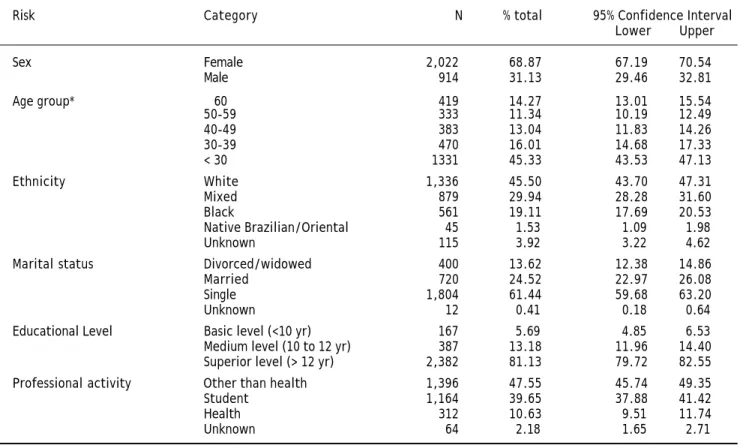
data set were available and analyzed for 2,936 par-ticipants that were tested for hepatitis markers: anti-HCV, anti-HBs, anti-HBc and HBsAg for those that were anti-HBc reactive. Social and demographic data for those individuals are shown on table 1. Briefly, the median age was 31 years (IQR 24.5-50), and 69.0% of the population was female. All the participants self-reported their skin color/ethnicity as: White (45.5%), Mixed (29.9%), Black (19.1%), and 1.5% consider themselves as native Brazilian and/or Oriental’s descendants. Also, 61.4% were sin-gle, 24.5% were married and 13.6% either divorced or widowed; 81.1% of the participants had at least 12 years of education, and 13.2% and 5,7% had be-tween 10 and 12 or less than 10 years of education. Finally, 10.6% were healthcare workers, 39.7% were students and 47.6% had professional activities other than healthcare.
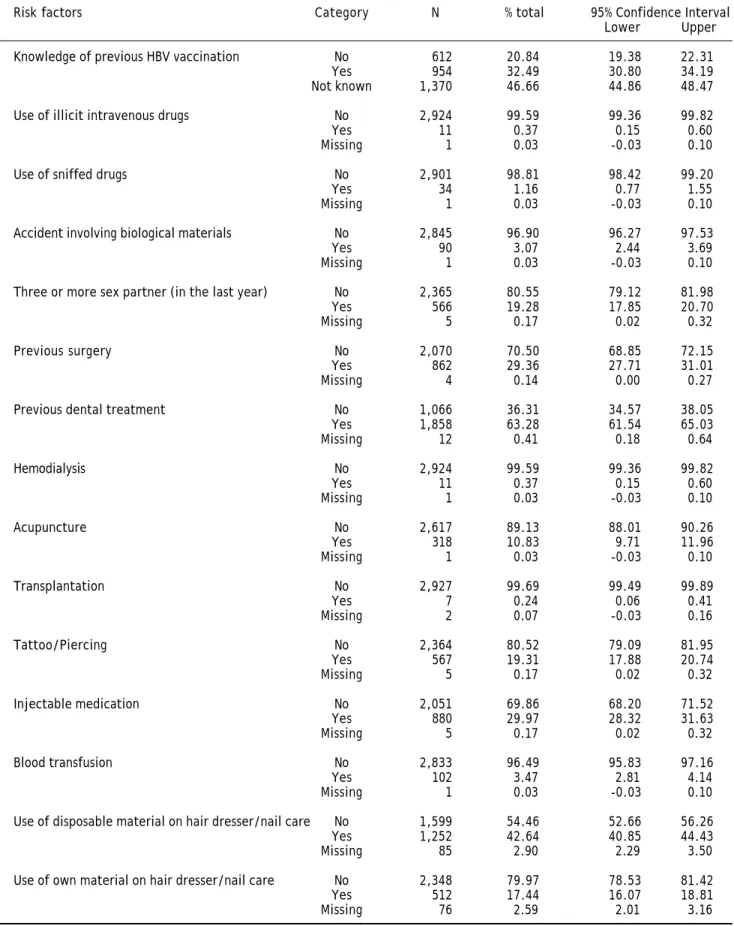
Questions relative to the self-declared questionnaire are shown on table 2. Five questions (use of intrave-nous drug, use of inhaled drugs, have undergone hemodialysis, blood transfusion or transplant), however, were excluded from the analysis of risk factors associated with anti-HBc and HCV reactivity because
the number of individuals acknowledging risk factors were small and therefore variables did not have enough power (80%) to give a significant result.
Screening for anti-HBc to assess hepatitis B infection
Of the total 2,936 individuals analyzed, 189 were positive for anti-HBc antibodies, corresponding to a prevalence of 6.44% (95% CI: 5.55-7.33%). Of the re-active anti-HBc, 156 (82.5%) had anti-HBs levels greater than 10 IU/mL and therefore the HBV infec-tion was considered resolved. Four individuals (2.1%) were chronically infected, as they carried HBsAg antigen and were negative for anti-HBs (< 10 IU/mL), resulting in an overall prevalence of HBV chronic infection of 0.136% (95% CI: 0.003-0.270). A group of 28 individuals (14.8%) had reac-tivity against anti-HBc only, representing a prevalence of 0.95% (95% CI: 0.60-1.31). For these individuals, it was not possible to test samples for HBV DNA to rule out the possibility of an occult hepatitis B infection (OBI) as well as for a second anti-HBc assay as an attempt to rule out a false-positive Table 1. Social demographic characterization of the 2013 UERJ Hepatitis Screening Campaign population.
Risk Category N % total 95% Confidence Interval Lower Upper
Sex Female 2,022 68.87 67.19 70.54
Male 914 31.13 29.46 32.81
Age group* ≥ 60 419 14.27 13.01 15.54
50-59 333 11.34 10.19 12.49
40-49 383 13.04 11.83 14.26
30-39 470 16.01 14.68 17.33
< 30 1331 45.33 43.53 47.13
Ethnicity White 1,336 45.50 43.70 47.31
Mixed 879 29.94 28.28 31.60
Black 561 19.11 17.69 20.53
Native Brazilian/Oriental 45 1.53 1.09 1.98
Unknown 115 3.92 3.22 4.62
Marital status Divorced/widowed 400 13.62 12.38 14.86
Married 720 24.52 22.97 26.08
Single 1,804 61.44 59.68 63.20
Unknown 12 0.41 0.18 0.64
Educational Level Basic level (<10 yr) 167 5.69 4.85 6.53 Medium level (10 to 12 yr) 387 13.18 11.96 14.40 Superior level (> 12 yr) 2,382 81.13 79.72 82.55 Professional activity Other than health 1,396 47.55 45.74 49.35 Student 1,164 39.65 37.88 41.42
Health 312 10.63 9.51 11.74
Unknown 64 2.18 1.65 2.71
Table 2. Self-questionnaire answers of the 2013 UERJ Hepatitis Screening Campaign population.
Risk factors Category N % total 95% Confidence Interval Lower Upper
Knowledge of previous HBV vaccination No 612 20.84 19.38 22.31 Yes 954 32.49 30.80 34.19 Not known 1,370 46.66 44.86 48.47
Use of illicit intravenous drugs No 2,924 99.59 99.36 99.82
Yes 11 0.37 0.15 0.60
Missing 1 0.03 -0.03 0.10
Use of sniffed drugs No 2,901 98.81 98.42 99.20
Yes 34 1.16 0.77 1.55
Missing 1 0.03 -0.03 0.10
Accident involving biological materials No 2,845 96.90 96.27 97.53
Yes 90 3.07 2.44 3.69
Missing 1 0.03 -0.03 0.10
Three or more sex partner (in the last year) No 2,365 80.55 79.12 81.98 Yes 566 19.28 17.85 20.70 Missing 5 0.17 0.02 0.32
Previous surgery No 2,070 70.50 68.85 72.15 Yes 862 29.36 27.71 31.01 Missing 4 0.14 0.00 0.27
Previous dental treatment No 1,066 36.31 34.57 38.05 Yes 1,858 63.28 61.54 65.03 Missing 12 0.41 0.18 0.64
Hemodialysis No 2,924 99.59 99.36 99.82
Yes 11 0.37 0.15 0.60
Missing 1 0.03 -0.03 0.10
Acupuncture No 2,617 89.13 88.01 90.26
Yes 318 10.83 9.71 11.96 Missing 1 0.03 -0.03 0.10
Transplantation No 2,927 99.69 99.49 99.89
Yes 7 0.24 0.06 0.41
Missing 2 0.07 -0.03 0.16
Tattoo/Piercing No 2,364 80.52 79.09 81.95 Yes 567 19.31 17.88 20.74 Missing 5 0.17 0.02 0.32
Injectable medication No 2,051 69.86 68.20 71.52 Yes 880 29.97 28.32 31.63 Missing 5 0.17 0.02 0.32
Blood transfusion No 2,833 96.49 95.83 97.16
Yes 102 3.47 2.81 4.14
Missing 1 0.03 -0.03 0.10
Use of disposable material on hair dresser/nail care No 1,599 54.46 52.66 56.26 Yes 1,252 42.64 40.85 44.43 Missing 85 2.90 2.29 3.50
Table 4. Univariate analysis (excluding anti-HBc positive individuals) of vaccination for hepatitis B virus (anti-HBs ≥ 10 IU/mL) of the 2013 UERJ Hepatitis Screening Campaign population.
Risk Category N = 2,806 Total anti-HBs % 95% Confidence p-value
≥ 10 IU/mL anti-HBs+ Interval Lower Upper
Sex Female 1,954 1,013 51.84 49.63 54.06 0.0363 Male 852 405 47.54 44.18 50.89
Age group < 30 1,315 917 69.73 67.25 72.22 < 0.001 30-39 447 210 46.98 42.35 51.61
40-49 358 138 38.55 33.51 43.59 50-59 308 92 29.87 24.76 34.98
≥ 60 378 61 16.14 12.43 19.85
Ethnicity Black 515 275 53.4 49.09 57.71 0.1302 Mixed 845 444 52.54 49.18 55.91
White 1,282 613 47.82 45.08 50.55 Native Brazilian/Oriental 43 23 53.49 38.58 68.4
Unknown 121 63 52.07 43.16 60.97
Marital status Married 674 247 36.65 33.01 40.28 < 0.001 Single 1,745 1,076 61.66 59.38 63.94
Divorced/widowed 370 89 24.05 19.7 28.41 Unknown 17 6 35.29 12.58 58.01
Educational level Basic level (<10 yr) 149 32 21.48 14.88 28.07 < 0.001 Medium Level (10 to 12 yr) 352 132 37.5 32.44 42.56
Superior Level (> 12 yr) 2,293 1,248 54.43 52.39 56.47
Unknown 12 6 50 21.71 78.29
Professional activity Student 1,132 750 66.25 63.5 69.01 < 0.001 Other than health 1,173 424 36.15 33.4 38.9
Health 296 195 65.88 60.48 71.28 Unknown 205 49 23.9 18.06 29.74
Knowledge about No 561 114 20.32 16.99 23.65 < 0.001 previous HBV vaccination Yes 911 685 75.19 72.39 78.00
Not known 1,334 619 46.4 43.73 49.08 Table 3. Anti-HBc-Multivariate analysis (n = 2,936) of the 2013 UERJ Hepatitis Screening Campaign population.
Risk factor Odds Ratio 95% CI p-Value
Sex
Female 1.0 — —
Male 1.644 1.205 - 2.244 0.0017
Age group
≥ 60 1.0 — —
50-59 0.563 0.354 - 0.895 0.0152
40-49 0.476 0.300 - 0.755 0.0016
30-39 0.362 0.228 - 0.575 < 0.0001
< 30 0.136 0.087 - 0.212 < 0.0001
Ethnicity
White 1.0 — —
Mixed 1.140 0.782 - 1.663 0.4946
Black 1.993 1.363 - 2.912 0.0004
Native Brazilian/Oriental 1.031 0.240 - 4.440 0.9669
reactivity. Nevertheless, 14/28 samples has a CO/DO ratio above 2.0 and 10/28 had a CO/DO ratio above 5.0. In one individual (0.5%), all three HBV mark-ers were positive (HBsAg, anti-HBc and anti-HBs) and further testing by NAT confirmed the presence of HBV DNA in this individual’s sample.
The univariate analysis conducted with all 189 anti-HBc reactive individuals showed that all demo-graphic variables (namely; sex, age group, educa-tional level, marital status, ethnicity, and professional activity) in addition to tattooing or whether ever had an acupuncture session were asso-ciated with anti-HBc reactivity (data not shown). However, on the logistic regression analysis the only variables that remained independently associat-ed with anti-HBc reactivity were the demographic variables: sex, age group and ethnicity (Table 3). Overall, a black male at older age carries a greater risk of having had an HBV infection. Adjusted for age, and compared to the white female reference group, the black male group has a 3.28 greater like-lihood to be anti-HBc positive.
Screening for anti-HBs to assess hepatitis B vaccination’s status
To figure out the number of HBV vaccinated indi-viduals in study population, all anti-HBc positive in-dividuals were removed from the analysis. In these individuals, the presence of anti-HBs is likely due to a resolved HBV infection. However, anti-HBs attrib-uted to HBV vaccination could not be formally
ex-cluded, therefore and to avoid confusion in the anal-ysis of the HBV vaccination correlates, the whole anti-HBc positive individuals were left out. Of the 2,747 individuals that had never been exposed to HBV, 1,395 (50.8%, 95% CI: 48.9-52.7%) had anti-HBs levels above 10 IU/mL, and 836 individuals (30.4%, 95% CI: 28.7-32.2%) had anti-HBs levels above 100 IU/mL.
Approximately half of the total individuals, 1,445/ 2,747 (52.6%) have responded the question about knowledge of their vaccine status. Among the indi-viduals, which answered that, they knew they were vaccinated against HBV 75.4% had anti-HBs levels above 10 IU/mL while among individuals that an-swered they had not been vaccinated, and 79.8% in-deed were not vaccinated (Table 4).
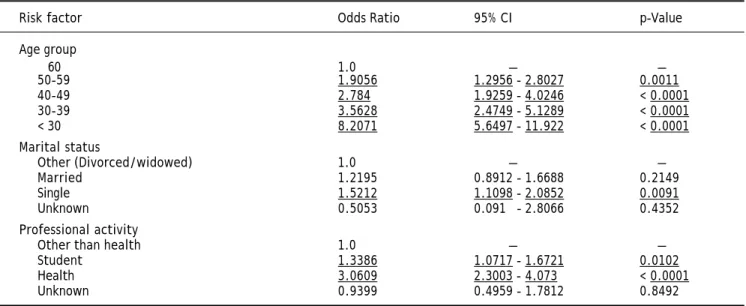
Demographic variables were analyzed against HBV vaccine status and all of them came out asso-ciated with HBV immunity. The logistic regression analysis however retained only age group, marital status and professional activity as independent variables associated with HBV immunity (Table 5). Being a single student or a health care worker at younger age were associated with anti-HBs pos-itivity and therefore to protection against HBV in-fection. For instance, when adjusted for age, and compared to the widow/divorced person whose professional activity is other than a health care reference group, a single health care worker or a single student groups have a 4.66 and 1.43 greater chance to be protected from HBV infection, respectively.
Table 5. Anti-HBs - Multivariate analysis* (n = 2,747) of the 2013 UERJ Hepatitis Screening Campaign population.
Risk factor Odds Ratio 95% CI p-Value
Age group
≥ 60 1.0 — —
50-59 1.9056 1.2956 - 2.8027 0.0011
40-49 2.784 1.9259 - 4.0246 < 0.0001 30-39 3.5628 2.4749 - 5.1289 < 0.0001 < 30 8.2071 5.6497 - 11.922 < 0.0001 Marital status
Other (Divorced/widowed) 1.0 — —
Married 1.2195 0.8912 - 1.6688 0.2149
Single 1.5212 1.1098 - 2.0852 0.0091
Unknown 0.5053 0.091 - 2.8066 0.4352
Professional activity
Other than health 1.0 — —
Student 1.3386 1.0717 - 1.6721 0.0102
Health 3.0609 2.3003 - 4.073 < 0.0001
Unknown 0.9399 0.4959 - 1.7812 0.8492
HCV infection status
The initial screening with the VitrosECi anti-HCV EIA resulted in 35 repeat reactive samples, the majority of which with a low optical density/cutoff (OD/CO) ratio. All these samples were further test-ed by the Roche anti-HCV EIA and only 13 were positive in both assays. Interestingly, all 13 samples had a high OD/CO ratio on the initial VitrosECi screening assay. Overall, the HCV prevalence was 0.44% (95% CI: 0.20-0.68%).
The thirteen samples were submitted to the Ab-bott HCV viral load assay (AbAb-bott Real Time HCV assay) and nine (69.2%) had detectable HCV-RNA with a median of 5.41 Log IU/mL (ranging from 3.00 to 6.28 Log IU/mL). Five samples were genotyped as 1a, but for the other four there was not enough sample left for genotyping.
Variables associated with HCV positivity on the univariate analysis were age (as continuous varia-ble), educational level, professional activity, previous surgery, previous dental treatment, accident involv-ing biological materials, and use of disposable materi-al on hair dresser/nail care. Although most of these variables had been previously associated with HCV infection, the only two variables that kept independ-ent association with HCV infection on the logistic re-gression final model were age and use of disposable material on hair dresser/nail care (Table 6). Surpris-ingly, use of own disposable material increases the risk for HCV infection, a result that is counter com-mon sense. We may suppose that these individuals had previous knowledge of their HCV status, so had used their own material to protect others.
We then repeated the logistic regression analysis excluding this variable but again the only variable that remained associated with HCV infection was age (OR 1.06, 95% CI: 1.03-1.09). Accordingly, the estimated odds ratio for an increase of 10 years in age is 1.75 (95% CI: 1.29-2.36).
Finally, one 61 years-old woman has markers as-sociated with both HCV and HBV infections. While
she is an HCV chronic carrier with 6.27 log IU/mL and genotype 1a, she is anti-HBc and anti-HBs (greater than 100 IU/mL) positive, and therefore has resolved the HBV infection.
DISCUSSION
The population sampled for the study certainly differs from the general Brazilian population, and by color/race from the Rio de Janeiro census of 2010, but is clearly representative of the University com-munity as characterized by: 45% of individual’s age range from 16 to 30 years, 61% are single and most (81%) has more than 12 years of education. In the last 10 years, the University has implemented a system to privilege access to Black/Mixed popula-tion, therefore the proportion of these groups is higher than the Rio de Janeiro population (19.1 x 12.3%). This young and well-educated population stratum gives a good opportunity to implement edu-cation and preventive measures aiming to curb HBV and HCV infections.14 Moreover, it represents a
larger sample (n = 2,936) than that projected by Ximenes, et al.11 for an estimated Rio de Janeiro
population between 20 and 69 years old of 4,174,528 individuals (n = 1,300).
The prevalence for HBsAg marker was 0.136% (95% CI: 0.003-0.270) and may represents chronic infections because all individuals also carries anti-HBc antibodies and are negative for anti-anti-HBc IgM. This prevalence is about half of the one described for first time blood donors in two southeast cities, São Paulo and Belo Horizonte in 2013, with 0.213% and 0.279%, respectively.15 Clearly, difference in
in-dividuals aged under 30 years (46 and 44% for Belo Horizonte and São Paulo, respectively) does not ex-plain the difference in HBsAg prevalence between blood donors and this study population. However, female gender (36 and 38% for Belo Horizonte and São Paulo, respectively) which is about half of the one described for the population under study, as well as other factors may account for this difference.
Table 6. Anti-HCV - Multivariate analysis of the 2013 UERJ Hepatitis Screening Campaign population.
Risk factor Odds Ratio 95% CI p-Value
Age (continuous) 1.0571 1.0257 - 1.0894 0.0003
Use of disposable material on hair dresser/nail care
No 1.0 — — Yes 15.5181 4.2307 - 56.919 < 0.0001
The prevalence for anti-HBc antibody was 6.44% (95% CI: 5.55-7.33%), a value that is comparable with the 6.33% found for the southeast region, ac-cording to the nationwide cross-sectional survey conducted in Brazil in 2010. 16 In this survey, the frequency of anti-HBc + anti-HBs antibodies was not described but in the university community, 156 out of 2,936 individuals (5.31%) had both antibod-ies, suggesting that 82.5% of the anti-HBc positive individuals had recovered from HBV infection. In addition, 28 individuals had anti-HBc only antibod-ies and at least 14 had a CO/DO ratio above 2.0. For the remaining half with CO/DO ratio below 2.0, it was not possible to rule out anti-HBc false-reactivi-ty but waning anti-HBc titer of a resolved HBV in-fection should be considered. Therefore, it is likely that a fraction of these 28 individuals with anti-HBc only antibodies may represent an OBI.
We have also found an individual carrying three HBV serological marker (HBsAg, HBc and anti-HBs) in addition to HBV DNA. The combination of these markers is not frequently found but has been described by others.17,18 However, the biological
ba-sis for this phenomena is still under dispute but mechanisms include:
• The convalescent phase after acute HBV infection when declining levels of HBsAg may coexist with rising levels of anti-HBs.
• Presence of HBsAg escape mutant19 and
• Presence of low affinity non-neutralizing anti-HBs antibodies.20
Unfortunately, it was not possible to follow up the disease course or to obtain a new sample from this individual in order to clarify the mecha-nism that led to this serological profile.
Whether the presence of anti-HBc only marker is a false-positive result or an OBI, vaccination of these individuals may help clear the virus for those with OBI, as has been shown by others21,22 and
like-wise induce immunity for those that were indeed anti-HBc false-positive.
Factors associated with anti-HBc positivity, male gender (OR = 1.64), black ethnicity (OR = 2.0) and a trend toward increasing age, have previously been reported to be associated with HBV infection in Bra-zil.16,23,24 In this particular, the university
commu-nity is no different from the Brazilian general population.
Of the total of 2,747 individuals anti-HBc nega-tive, nearly half (50.8%) has anti-HBs antibodies above 10 IU/mL and 30.4% has HBs
anti-bodies above 100 IU/mL. This is relevant, because the vaccine coverage among the vaccinated popula-tion in southeast of Brazil is 39.83%.11 Factors
inde-pendently associated with HBV vaccination were being single (OR = 1.52), student (OR = 1.34), health worker (OR = 3.06) and a trend toward low-er ages.
The question whether participants have knew their HBV vaccine status had a reliable result for those answering that has never been vaccinated (negative predictive value of 79.8%), therefore, from the programmatic point of view, vaccination, with-out any anti-HBs testing may be justifiable and cost effective.
In this study, the prevalence of anti-HCV was 0.44% (95% CI: 0.20-0.68%), whereas in a nation-wide cross-sectional survey the prevalence for HCV in Southeast Brazil was 1.27%.25 Age (as
continu-ous variable) was the only variable independently associated with HCV infection and therefore this 2.9 times difference in the HCV prevalence can be attrib-uted to lower age of the university community par-ticipants. In fact, we have not found any HCV-infected individuals with ages lower than 30 years old, an age range that represents 45.3% of the study participants.
Of the variable that came out associated with the serological parameters after the multivariate analy-sis, it is noteworthy to mention the increasing risk for HBV (anti-HBc) and HCV infection with age, as has been reported in the Brazilian nationwide cross-sectional survey11 and also in the international
lit-erature.2,6 Moreover, consistently with the
increasing HBV infection risk with age, was de-creasing anti-HBs positivity with inde-creasing age.
In addition to age, other variables associated with anti-HBc and anti-HBs seropositivity, allowed us to propose strategies for HBV vaccination, and for HBV and HCV testing and eventually treatment, within the university, as discussed below.
The national immunization program for young adults has initiated only in 1998, thus, individuals above 16 years of age may not have had the opportu-nity to be vaccinated against HBV.7,26-30 This
One of the study limitations was the data report-ed and that were collectreport-ed by self-declarreport-ed question-naires. Lack of sufficient privacy may have induced participants to give false or no answer to sensitive risk questions. This was particularly relevant for the two drug use related questions, which had to be excluded from the risk analysis due to small number of individuals that admitted to belong to these risk categories. In addition, questions related to the previous history of blood transfusion, trans-plantation or hemodialysis did not reach reasona-ble number of answer, but in this case due to the low risk event in this rather young study popula-tion. Finally, even though it was a linked study (all tests results were available to all participants) it was difficult obtaining a second blood sample from most seropositive individuals. Access to second sample would have allowed performance of HBV and HCV viral load to confirm chronic HCV infection and to access the presence of occult hepa-titis B infection for those with reactivity to anti-HBc only.
In spite of these limitations, this study provided some important information to develop a more comprehensive health-directed infection-prevention policies, including immunization, education, screening, and treatment within the university.14,27
These new policies will help expand the program that has recently begun which includes offering bi-annual anti-HBs testing to all healthcare profes-sionals and to demand the hepatitis B vaccine status to students entering training in the clinical pathology service.
When conceived, the hepatitis B and C prevention program for the University community had this study as the first approach to acquire baseline as well as demographic information of the target popu-lation. This decision proved to be correct and the in-itial program design will now be adjusted according to the data gathered from the study. We hope this program building strategy can become a model to other communities at large.
The ultimate goals of these programs are to prevent infection and control disease progression for those already infected and, consequently, improve the quality of life of those infected by HBV or HCV as well as decrease costs for the public health sector.
A recently launched national program to expand hepatitis B and C diagnosis aims to initiate early treatment31 and therefore reduce liver disease
pro-gression. Aligned with this national initiative, a pe-riodical offer of HCV rapid testing in the university
campus should be implemented, especially to those at older age. This is the group likely to be infected and testing would be the first step to access health-care, and ultimately to treatment. As for HCV, HB-sAg rapid testing should be offered to individuals above 20 years of age, as they have less likelihood to have been vaccinated at birth. The black male sub-group would deserve a closer attention due to their greater chance to be HBV infected.
ABBREVIATIONS
• anti-HBc: antibodies against hepatitis B core
antigen.
• anti-HBs: antibodies against hepatitis B surface
antigen.
• anti-HCV: antibodies against hepatitis C virus.
• HBsAg: hepatitis B surface antigen.
• HBV: hepatitis B virus. • HCV: hepatitis C virus.
• HLA-UERJ: Laboratory of Histocompatibility
and Cryopreservation, UERJ.
• UERJ: Rio de Janeiro State University.
CONFLICTS OF INTERESTS
The authors have no conflicts of interest to de-clare.
ACKNOWLEDGEMENTS
We thank the laboratory staff of Serviço de Pato-logia Clínica da Policlinica Piquet Carneiro (CAP-SULA), da Universidade do Estado do Rio de Janeiro, and Laboratório de Virologia Molecular da Universidade Federal do Rio de Janeiro.
We thank Brazil Health Ministry - Departamento de DST, AIDS e Hepatites Virais for providing reagents and kits to the campaign. This study was partly funded with grants from Brazil Research Council (CNPq) and Rio de Janeiro Research Agency (FAPERJ).
REFERENCES
1. Lee MH, Yang HI, Yuan Y, L’Italien G, Chen CJ. Epidemiol-ogy and natural history of hepatitis C virus infection.
World J Gastroenterol 2014; 20; 9270-80.
2. Te HS, Jensen DM. Epidemiology of hepatitis B and C virus-es; a global overview. Clin Liver Dis 2010; 14; 1-21. 3. Mohd Hanafiah K, Groeger J, Flaxman AD, Wiersma ST.
Glo-bal epidemiology of hepatitis C virus infection; new esti-mates of age-specific antibody to HCV seroprevalence.
4. Bruggmann P, Berg T, Ovrehus AL, Brandao Mello CE, Rou-dot-Thoraval F, Marinho RT, Sherman M, et al. Historical epidemiology of hepatitis C virus (HCV) in selected coun-tries. J Viral Hepat 2014; 21(Suppl. 1); 5-33.
5. WHO Fact sheet N°204. Available at: http:// www.who.int/mediacentre/factsheets/fs204/en/ 6. Gerlich WH. Medical virology of hepatitis B; how it began
and where we are now. Virol J 2013; 10: 239.
7. Lavanchy D. Viral hepatitis; global goals for vaccination. J
Clin Virol 2012; 55: 296-302.
8. Gower E, Estes C, Blach S, Razavi-Shearer K, Razavi H. Glo-bal epidemiology and genotype distribution of the hepati-tis C virus infection. J Hepatol 2014.
9. Wedemeyer H, Duberg AS, Buti M, Rosenberg WM, Franko-va S, Esmat G, Ormeci N, et al. Strategies to manage hep-atitis C virus (HCV) disease burden. J Viral Hepat 2014; 21: 60-89.
10. IBGE; Censo Demográfico 2010. Características da Popu-lação e dos Domicílios. Resultados do Universo. In: Rio de Janeiro; IBGE, 2011.
11. Ximenes RA, Pereira LM, Martelli CM, Merchan-Hamann E, Stein AT, Figueiredo GM, Braga MC, et al. Methodology of a nationwide cross-sectional survey of prevalence and epi-demiological patterns of hepatitis A, B and C infection in Brazil. Cad Saude Publica 2010; 26; 1693-704.
12. Domingues CMAS, Lins Neto AA, Verotti MP, Burgos Filho R. Ampliação da oferta da vacina de Hepatite B para a faixa etária de 30 a 49 anos em 2013. In: Vigilância das Doenças Transmissíveised. Brazil; Ministério da Saúde, 2013. 13. Ribeiro JE, Oliveira RSM, Hallal RC. Protocolo clínico e
dire-trizes terapêuticas para hepatite viral C e coinfecções In; DST, Aids e Hepatites viraised. Brasilia; Minisério da Saúde, 2011.
14. Carvalho P, Schinoni MI, Andrade J, Vasconcelos Rego MA, Marques P, Meyer R, Araujo A, et al. Hepatitis B virus prevalence and vaccination response in health care work-ers and students at the Federal Univwork-ersity of Bahia, Bra-zil. Ann Hepatol 2012; 11: 330-7.
15. de Almeida-Neto C, Sabino EC, Liu J, Blatyta PF, Men-drone-Junior A, Salles NA, Leao SC, et al. Prevalence of se-rologic markers for hepatitis B and C viruses in Brazilian blood donors and incidence and residual risk of transfu-sion transmistransfu-sion of hepatitis C virus. Transfutransfu-sion 2013; 53: 827-34.
16. Pereira LM, Martelli CM, Merchan-Hamann E, Montarroyos UR, Braga MC, de Lima ML, Cardoso MR, et al. Population-based multicentric survey of hepatitis B infection and risk factor differences among three regions in Brazil. Am J
Trop Med Hyg 2009; 81: 240-7.
17. Tabor E, Gerety RJ, Smalwood LA, Barker LF. Coincident hepatitis B surface antigen and antibodies of different subtypes in human serum. J Immunol 1977; 118: 369-70. 18. Gerlich WH.The enigma of concurrent hepatitis B surface
antigen (HBsAg) and antibodies to HBsAg. Clin Infect Dis 2007; 44: 1170-2.
19. Lada O, Benhamou Y, Poynard T, Thibault V. Coexistence of Hepatitis B surface antigen (HBsAg) and HBs
anti-bodies in chronic hepatitis B virus carrier: influence of “a” determinant variants. J Virol 2006; 80: 2968-75. 20. Zhang J-M, Xu Y, Wang X-Y, Wu X-H, Weng X-H, Lu M.
Co-existence of Hepatitis B surface antigen (HBsAg) and het-erologous subtype-specific antibodies to HBsAg among patients with chronic hepatitis B virus infection. Clin
In-fect Dis 2007; 44: 1161-8.
21. Minuk GY, Huynh C, Uhanova J, Osiowy C. Establishing diag-nostic criteria for occult hepatitis B virus infections in community based populations. J Med Virol 2014; 86: 156-61. 22. de la Fuente RA, Gutierrez ML, Garcia-Samaniego J, Fern-andez-Rodriguez C, Lledo JL, Castellano G. Pathogenesis of occult chronic hepatitis B virus infection. World J
Gas-troenterol 2011; 17: 1543-8.
23. Rosini N, Mousse D, Spada C, Treitinger A. Seroprevalence of HbsAg, Anti-HBc and anti-HCV in Southern Brazil, 1999-2001. Braz J Infect Dis 2003; 7: 262-7.
24. Lewis-Ximenez LL, do OK, Ginuino CF, Silva JC, Schatz-mayr HG, Stuver S, Yoshida CF. Risk factors for hepatitis B virus infection in Rio de Janeiro, Brazil. BMC Public
Health 2002; 2: 26.
25. Pereira LM, Martelli CM, Moreira RC, Merchan-Hamman E, Stein AT, Cardoso MR, Figueiredo GM, et al. Prevalence and risk factors of Hepatitis C virus infection in Brazil, 2005 through 2009; a cross-sectional study. BMC Infect
Dis 2013; 13: 60.
26. Braga WS, Castilho MC, Borges FG, Martinho AC, Rod-rigues IS, Azevedo EP, Scazufca M, et al. Prevalence of hepatitis B virus infection and carriage after nineteen years of vaccination program in the Western Brazilian Am-azon. Rev Soc Bras Med Trop 2012; 45: 13-7.
27. Fernandes L, Burnett RJ, Francois G, Mphahlele MJ, Van Sprundel M, De Schryver A. Need for a comprehensive, consistently applied national hepatitis B vaccination poli-cy for healthcare workers in higher educational institu-tions; a case study from South Africa. J Hosp Infect 2013; 83: 226-31.
28. Saffar H, Ajami A, Saffar MJ, Shojaei J, Sotudeh-Anvari M, Shams-Esfandabad K, Khalilian AR. Prevalence of hepatitis B virus seromarkers in young adults vaccinated at birth; impact on the epidemiology of hepatitis B infection in Iran. Hepat Mon 2014; 14; e17263.
29. Amponsah-Dacosta E, Lebelo RL, Rakgole JN, Burnett RJ, Selabe SG, Mphahlele MJ. Evidence for a change in the epi-demiology of hepatitis B virus infection after nearly two decades of universal hepatitis B vaccination in South Afri-ca. J Med Virol 2014; 86: 918-24.
30. Oliveira SAN, Hacker MA, Oliveira MLA, Yoshida CFT, Telles PR, Bastos FI. A window of opportunity; declining rates of hepatitis B virus infection among injection drug users in Rio de Janeiro, and prospects for targeted hepatitis B vaccination. Rev Panam Salud Publica 2005; 18: 271-7. 31. Ribeiro JE, Hallal RC. Protocolo Clínico e Diretrizes