UNIVERSIDAD DE CANTABRIA
Departamento de Ingeniería de Comunicaciones
TESIS DOCTORAL
Cryogenic Technology in the Microwave Engineering:
Application to MIC and MMIC Very Low Noise
Amplifier Design
Juan Luis Cano de Diego
Chapter VIII
Summary, Conclusions and Outlook
8.1. Summary
This dissertation has presented an outline of different issues related with the cryogenic technology in the microwave engineering specially dedicated to the reduction of thermal noise in very sensitive receivers for radio astronomy applications.
The thesis has been structured as a pyramid in which base the cryostats design can be found. It is clear that the study of circuits under cryogenic conditions requires the availability of those cryostats; therefore, since at the beginning there was not any cryogenic system at the DICOM laboratory then this work was started with the design and set up of the cryogenic facility that is now available. The DICOM laboratory has now two independent and reliable working cryostats that enable to make the required tests for the applications of interest.
At the next level the measurement procedures need to be analyzed. Once the measurement equipment is ready and before making any test the best way to characterize the different parameters has to be considered. The measurement techniques applied at room temperature are useless or have to be conveniently modified to be used
at cryogenic temperature. This document has presented different methods to measure both S-parameters and noise temperature of devices and circuits, and a comprehensive study of the most suitable techniques has been given. For the noise characterization at cryogenic temperatures a new attenuator design is presented which, together with the cold-attenuator technique, provides improved accuracy for very low noise amplifier measurement.
This thesis focuses in the design of very low noise amplifiers since they are main circuits that take advantage of the low temperatures. Before the design of any circuit this work deals with the effect of a cryogenic environment in the microwave devices such as transistors, capacitors and resistors focusing in the indium-phosphide transistor technology, which produces the best noise results today. This study is carried out through DC, S-parameters and noise measurements.
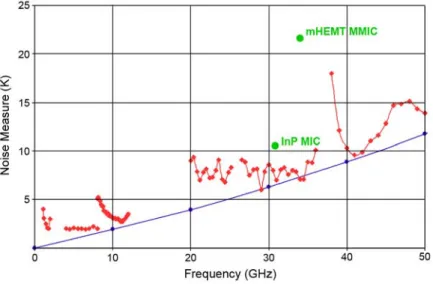
Moving up one level in the pyramid now everything is ready for the design of very low noise amplifiers. In this work two amplifiers have been designed in the Ka-band: the first one is made using InP transistors from HRL in hybrid technology whereas the other circuit is designed with the mHEMT technology from OMMIC foundry. Obviously the noise of the hybrid amplifier is lower that the monolithic circuit since the InP technology is less noisy than mHEMT today and losses in the monolithic substrate are higher than in the hybrid substrate; however the measured results can be considered as satisfactory and they are close to the best reported results as shown in Fig. 8.1.
Fig. 8.1. Comparison between the prediction for the minimum noise measure of a 100 nm gate length cryogenic HFET (1992) in blue and the best results reported to 2009 for cryogenic amplifiers in red. The
measured results obtained in this thesis have been included with green dots.
Finally, at the top of the pyramid, this thesis focuses in one of the main applications of the cryogenic low noise amplifiers: the radiometers. After a short
8.1. Summary
introduction to different radiometer configurations, the work details the receiver designed for the QUIJOTE project. This project is aimed for characterizing the polarization of the cosmic microwave background and hence a very sensitive receiver is needed. During these years the collaboration in the project has been carried out at different levels; especially the polar modulators and the orthomode transducers of all channels, and the back-end modules of the 26 – 36 GHz channel have been partially or totally designed within the project at the DICOM.
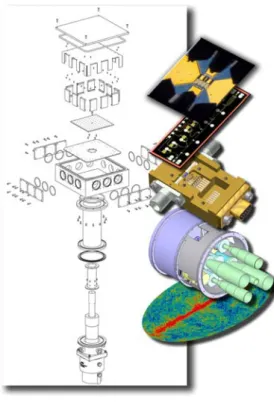
Figure 8.2 illustrates the different levels covered in this thesis, from the device level to the final application, and everything surrounded by the cryogenic technology.
Fig. 8.2. Summary image of the thesis including the main points covered through this work.
8.2. Conclusions
The study of microwave electronics under cryogenic temperatures requires specific hardware and measurement techniques. The commercially available cryostats need to be conveniently adapted to be able to be used for microwave applications; these modifications are mainly related with the Dewar and feedthroughs design. About the measurement techniques, there are two main problems at cryogenics that need to be overcome: the desired reference planes for the measurements are not directly accessible, and the power levels involved in the noise measurement need to be greatly reduced to be comparable to the measured noise powers. In this thesis a modified procedure for the TRL technique is proposed for the S-parameters measurement, and the cold-attenuator
technique is considered as the best option for fast and accurate noise characterization at cryogenics in the used frequency ranges.
Low temperatures produce the variation of microwave devices performance at different levels. From the DC point of view, transistors suffer from reduction of gate leakage current, increase of transconductance, increase of trapping mechanism like the kink-effect, and a shift of the threshold voltage towards more positive values when the temperature is reduced. These measurements also show that capacitors for this kind of applications need a low dielectric constant (below 100 would be advisable) otherwise their performance could be unpredictable. The high frequency measurements on transistors have shown a small increase of gain and a great reduction of noise; this reduction is around an order of magnitude for InP well-behaved transistors.
Two different amplifiers in Ka-band have been designed using hybrid and monolithic technologies, thus a comparison of both technologies can be established. MMIC circuits are suitable for mass production, for high frequencies (above 30 GHz), and they are more repeatable, but the best results today in terms of noise are still achieved with hybrid technology, which enables tuning for optimum performance. For some applications like antenna arrays where many circuits with very low noise are required the best option may be the combination of the MMIC cheaper technology with a first MIC stage composed of a high performance transistor and a low loss input matching network.
Cryogenic amplifiers are used in applications such as radio astronomy where very sensitive receivers are required. In these receivers, or radiometers, all the subsystems before the cryogenic amplifier should be cooled if possible in order to reduce their contribution to the total noise. Following this amplifier, the remaining subsystems in the receiver chain are not cooled since their contribution to the radiometer noise is negligible if the cryogenic amplifier has a high gain (greater than 20 dB).
8.3. Outlook
Although this thesis has covered a wide field of knowledge some ideas can be suggested as future lines to continue and improve this work.
Measurement techniques, specially related with the S-parameters measurement without a cryogenic probe station, could be further analyzed. For example, the proposed procedure in this thesis could be adapted to other calibration techniques such as LRM (Line-Reflect-Match) which enables to cover a wider bandwidth with the same number of standards.
8.3. Outlook
The study of the effect of low temperatures on microwave transistors should be extended to different device structures with the aim of optimizing their performance for low noise applications. This study should be carried out in direct collaboration with the foundry to enable a short period for processing, measurement, analysis, and re-design.
Finally, since different radio astronomy projects around the world are demanding cheaper and more sensitive receivers, the combination of the MIC and MMIC technologies in the same amplifier should be explored in a future work. The good results of the mHEMT technology (cheaper than InP technology) suggest its suitability for being used in combination with an InP transistor before the monolithic chip. The resulting amplifier would have shorter assembly time than a full MIC circuit and lower noise than a full MMIC amplifier.
Capítulo VIII
Resumen, Conclusiones y Perspectiva
8.1. Resumen
Esta tesis ha presentado un esbozo de diferentes asuntos relacionados con la tecnología de criogenia en la ingeniería de microondas especialmente dedicados a la reducción del ruido térmico en receptores muy sensibles para aplicaciones de radio astronomía.
La tesis se ha estructurado como una pirámide en cuya base se puede encontrar el diseño de los criostatos. Está claro que el estudio de circuitos bajo condiciones criogénicas requiere la disponibilidad de esos criostatos; por tanto, debido a que al principio no había ningún sistema criogénico en el laboratorio del DICOM, este trabajo se comenzó con el diseño y configuración de la instalación criogénica disponible actualmente. El laboratorio del DICOM cuenta en estos momentos con dos criostatos funcionando de manera independiente y fiable que permiten realizar las pruebas necesarias para las aplicaciones de interés.
En el siguiente nivel es necesario analizar los procedimientos de medida. Una vez que el equipo de medida está preparado y antes de realizar ninguna medida se tiene que examinar la mejor forma de caracterizar los diferentes parámetros de interés. Las
técnicas de medida que se aplican a temperatura ambiente son inútiles o necesitan ser convenientemente modificadas para ser usadas a temperatura criogénica. Este documento ha presentado diferentes métodos para medir tanto los parámetros-S como la temperatura de ruido de dispositivos y circuitos, y ha proporcionado un extenso estudio de las técnicas más adecuadas. Para la caracterización del ruido a temperatura criogénica se ha presentado un nuevo diseño de atenuador el cual, junto con la técnica del atenuador frío, proporciona una mayor precisión en la medida de amplificadores de muy bajo ruido.
Esta tesis se centra en el diseño de amplificadores de muy bajo ruido debido a que son los principales beneficiarios de las bajas temperaturas. Antes del diseño de ningún circuito este trabajo trata el efecto que un ambiente criogénico produce en los dispositivos de microondas como transistores, condensadores y resistencias haciendo hincapié en los transistores de tecnología de fosfuro de indio, la cual produce los mejores resultados de ruido hoy en día. Este estudio se lleva a cabo a través de medidas de DC, parámetros-S y ruido.
Ascendiendo un nivel en la pirámide ahora todo está preparado para el diseño de amplificadores de muy bajo ruido. En este trabajo se han diseñado dos amplificadores en la banda-Ka: el primero está hecho usando transistores de InP de HRL en tecnología híbrida mientras que el otro circuito se diseña con la tecnología mHEMT de la fundición OMMIC. Obviamente el ruido del amplificador híbrido es más bajo que en el circuito monolítico ya que la tecnología de InP es menos ruidosa que la tecnología mHEMT hoy en día, y las pérdidas del sustrato monolítico son mayores que en el caso híbrido; sin embargo los resultados medidos se pueden considerar como satisfactorios y se encuentran cerca de los mejores resultados publicados como se indica en la Fig. 8.1.
Fig. 8.1. Comparación entre la predicción para la medida de ruido mínima de un HFET criogénico de 100 nm (1992) en azul y los mejores resultados publicados hasta 2009 para amplificadores criogénicos
8.3. Perspectiva
Finalmente, en la cima de la pirámide, esta tesis se centra en una de las principales aplicaciones de los amplificadores criogénicos: los radiómetros. Después de una pequeña introducción a las diferentes configuraciones de radiómetros, el trabajo detalla el receptor diseñado para el proyecto QUIJOTE. Este proyecto tiene como objetivo la caracterización de la polarización del fondo cósmico de microondas y por tanto es necesario un receptor muy sensible. Durante estos años la colaboración en el proyecto se ha llevado a cabo a diferentes niveles; especialmente los moduladores polares y los ortomodos de todos los canales, y los módulos posteriores del canal de 26 – 36 GHz se han diseñado parcial o totalmente en el DICOM.
La Fig. 8.2 ilustra los diferentes niveles que se han cubierto en esta tesis, desde el dispositivo hasta la aplicación final, y todo ello rodeado por la tecnología criogénica.
Fig. 8.2. Imagen resumen de la tesis que incluye los puntos principales tratados a lo largo del trabajo.
8.2. Conclusiones
El estudio de las microondas bajo temperaturas criogénicas requiere equipamiento y técnicas de medida específicas. Los criostatos disponibles comercialmente necesitan ser convenientemente adaptados para poder ser usados para aplicaciones de microondas; estas modificaciones están principalmente relacionadas con el diseño del Dewar y los pasamuros. Sobre las técnicas de medida, existen dos problemas principales en criogenia que tiene que ser corregidos: los planos de referencia deseados para las medidas no son directamente accesibles, y los niveles de potencia que intervienen en la medida de ruido tienen que ser reducidos en gran medida para ser comparables a las
potencias de ruido medidas. En esta tesis se ha propuesto un procedimiento modificado para la técnica TRL en la medida de parámetros-S, y la técnica del atenuador frío se ha considerado como la mejor opción para una rápida y precisa caracterización del ruido en criogenia dentro del rango de frecuencias usado.
Las bajas temperaturas producen la variación del funcionamiento de los dispositivos de microondas a diferentes niveles. Desde el punto de vista de DC, los transistores sufren una reducción de la corriente de fugas de puerta, un incremento de la transconductancia, un incremento de los mecanismos de trampas como el efecto-kink, y un desplazamiento de la tensión umbral hacia valores más positivos cuando se reduce la temperatura. Estas medidas también muestran que los condensadores para este tipo de aplicaciones han de tener una baja constante dieléctrica (por debajo de 100 es recomendable), en otro caso su comportamiento podría ser impredecible. Las medidas de alta frecuencia sobre los transistores han demostrado un pequeño incremento de la ganancia y una gran reducción del ruido; esta reducción está alrededor de un orden de magnitud para buenos transistores de InP.
Se han diseñado dos diferentes amplificadores en banda-Ka con las tecnologías híbrida y monolítica, de este modo se puede establecer una comparación entre dichas tecnologías. Los circuitos MMIC son adecuados para producción en masa, para altas frecuencias (por encima de 30 GHz), y son más repetitivos, pero los mejores resultados en términos de ruido actualmente se consiguen aún con la tecnología híbrida, la cual permite la sintonía para un funcionamiento óptimo. Para algunas aplicaciones como las agrupaciones de antenas donde se requieren muchos circuitos con muy bajo ruido la mejor opción es la combinación de la tecnología monolítica más barata con una primera etapa MIC compuesta por un transistor de gran rendimiento y una red de adaptación de entrada con bajas pérdidas.
Los amplificadores criogénicos se utilizan en aplicaciones como la radio astronomía donde se requieren receptores muy sensibles. En estos receptores, o radiómetros, todos los subsistemas antes del amplificador criogénico deberían estar enfriados si es posible para poder reducir su contribución al ruido total. A continuación de este amplificador, los subsistemas restantes en la cadena receptora no se enfrían ya que su contribución al ruido del radiómetro es despreciable si dicho amplificador tiene una alta ganancia (mayor de 20 dB).
8.3. Perspectiva
Aunque esta tesis ha cubierto un amplio campo de conocimiento se pueden sugerir algunas ideas como líneas futuras para continuar y mejorar este trabajo.
8.3. Perspectiva
Las técnicas de medida, especialmente las relacionadas con la medida de parámetros-S en ausencia de una estación de sondas criogénica, se podrían analizar más profundamente. Por ejemplo, el procedimiento propuesto en esta tesis se podría adaptar a otras técnicas de calibración como la LRM (Line-Reflect-Match) la cual permite cubrir anchos de banda mayores con el mismo número de estándares.
El estudio del efecto de las bajas temperaturas sobre los transistores de microondas se debería extender a diferentes estructuras con el objetivo de optimizar su funcionamiento para aplicaciones de bajo ruido. Este estudio se debería llevar a cabo en colaboración directa con el fabricante para permitir cortos periodos de tiempo en el procesado, medida, análisis y rediseño.
Finalmente, debido a que los diferentes proyectos radio astronómicos alrededor del mundo demandan receptores más baratos y sensibles, se debería explorar en un trabajo futuro la combinación de las tecnologías MIC y MMIC en el mismo amplificador. Los buenos resultados de la tecnología mHEMT (más barata que la tecnología de InP) sugieren su idoneidad para ser usada en combinación con un transistor de InP delante del chip monolítico. El amplificador resultante tendría un tiempo de ensamblaje más corto que un circuito completo híbrido y un ruido menor que un amplificador completo en tecnología monolítica.