(Septiembre, 2016). Vol. 1, No.9 pp. 96-113 DOI: https://doi.org/10.33890/innova.v1.n9.2016.98 URL: http://revistas.uide.edu.ec/index.php/innova/index Correo: [email protected]
Primary education in Nigeria at a glance: statistical overview of the subsector
Resumen de la educación primaria en Nigeria: panorama estadístico del
subsector
Andrés Alberto Chávez Eras
Universidad Internacional del Ecuador, Ecuador
Autor para correspondencia: [email protected]
Fecha de recepción: 30 de Agosto de 2016 - Fecha de aceptación: 28 de Septiembre de 2016
Resumen
El siguiente estudio se enfoca en la educación primaria en Nigeria. Primeramente analizaremos los antecedentes políticos, económicos y sociales del país. Para con esto, poder tener un mejor entendimiento del sistema educativo. Se analizara los problemas con las finanzas, acceso y calidad de la educación.
Palabras claves: sistema educativo; áfrica; calidad educación
Abstract
The following study focuses on primary education in Nigeria. First we analyze the political, economic and social history of the country. For this, to have a better understanding of the education system. problems with finances, access and quality of education are analyzed.
Introduction
Nigeria is the most populated country in Africa, with an estimated 174,507,539 people as of July 2013. Within this population, there are over 250 ethnic groups and 500 languages.
Political Indicators
Nigeria adopted a new constitution in 1999 that transitioned the country from military rule to a civilian government (Federal Republic of Nigeria, 2013). Now, the Federal Republic of Nigeria is a federal constitutional republic similar to the United States, with executive,
legislative, and judicial branches. General elections are held every four years to choose a president (Federal Republic of Nigeria, 2013). Despite the official government setup, Nigeria’s scores on the Democracy Index indicate that the country is still far from functioning as a democracy, as seen in Table 1. All scores are out of a possible 10.0 (Philip & Ojeka, 2011).
Table 1 Democracy Index for Nigeria
Year Rank Overall
Score
Electoral Process and Participation
Functioning of Government
Political Participation
Political Culture
Civil Liberties
2006 124 3.52 3.08 1.86 4.44 4.38 3.82
2008 124 3.53 2.92 3.21 3.33 4.38 3.82
2010 123 3.47 3.83 3.21 3.33 3.13 3.82
Note. From “Democracy and Development: An Appraisal of Nigeria’s Position in the Democracy Index” by C.
Philip & S. Ojeka, 2011, Research Journal of Finance and Accounting 2(2), p.4.
According to the Corruption Perceptions Index, Nigeria ranks 137 out of 176 countries, with a score of 27 out of 100. People perceive the police and political parties to be the most corrupted institutions (Transparency International, 2013).
Economic Indicators
GDP per capita in Nigeria increased to 1,555.41 (US$) in 2012. However, external debt stocks have risen as well. Nigeria was forgiven $30 billion of debt in 2006, but has continued to accumulate debt since that time and had external debt stocks of $13,108 billion in 2011 (World Bank, 2013).
In recent years, the amount of aid that Nigeria has received for education has increased significantly. As shown in Table 2, the amount received in 2010 was almost five times that which was received in 2002-2003.
Table 2 Total Aid to Education
Constant 2010 US$ millions
2002–2003 annual average 2009 2010
35 133 165
Note. From EFA Global Monitoring Report 2012: YOUTH AND SKILLS Putting education to work p.402, by
Table 3 shows the facts about the wellbeing of Nigeria’s people. Over half of the population lives in absolute poverty, a significant percentage of people live in unsanitary conditions, and the life expectancy rate is much lower than that of developed nations. Additionally, only half of the population is literate.
Table 3 Nigeria Poverty Indicators
Poverty Indicator 2011
Life expectancy at birth 53yrs % of pop with access to improved water 58%* % of pop with access to improved sanitation 31%* % of pop with access to electricity* 51% Living in absolute poverty 60.9%* Children under 5 underweight 26.7**
Literacy 50.4%
(72.1%male) (50.4% female) Unemployment rate 21% est.
Note. From Poverty in Nigeria, Noble Mission Organization, 2013 *2010, **2008
Social Development
The leading causes of death in Nigeria are HIV/AIDS, lower respiratory infections, malaria, diarrheal diseases, and measles, all of which are preventable or curable with the proper medicine and education (WHO, 2013). Lack of available and affordable treatments contribute to Nigeria’s low life expectancy of 53 years, and the overwhelmingly young population shown in Figure 1. Many children become orphans at a young age and are forced to work and support siblings, which provides a barrier to participating in education.
Figure 1 Nigeria Population Pyramid Graph. Adapted from “International Programs - Region Summary - U.S.
Census Bureau”, 2013, U.S. Census Bureau. Copyright 2013 by U.S Census Bureau Reprinted.
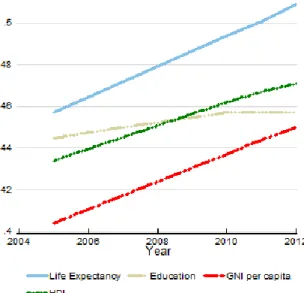
and Income was 0.450 (HDR, 2013). As shown in Figure 2, gains in education have been the slowest and have leveled off in recent years.
Figure 2. Trends in Nigeria’s HDI component indices 2005-2012. Adapted from “Human Development Report
2013 Nigeria” 2013, Human Development Report. (HDR). Copyright 2013 by Human Development Report. Reprinted.
The Education System
The formal educational system in Nigeria presents various paths that students can take, starting with secondary education. At 12 years of age, children start either junior secondary or vocational enterprise institutions programs. If they attend the former, they receive a junior secondary school certificate upon completion; if they attend the latter, they receive a certificate of proficiency. At 15 years of age, students who have received a junior secondary school certificate may attend either senior secondary or secondary technical schools programs. Less than one-third of students who begin school in Nigeria go on to enroll in senior secondary school (Nigerian Education Profile, 2013).
Then, at age 18, the number of options increases for those students who completed senior secondary school and received either a West African senior school certificate or National
examinations council certificate. However, in order to proceed to a tertiary institution, students must pass the Senior School Leaving Certificate; in 2010, 80% of students failed this certificate due to inability to pass English and Mathematics, among other subjects (Nigerian Education Profile, 2013). Students who are still deficient in some courses do have the opportunity to attend classes that will allow them to later matriculate in a university. There are also short certificate courses available that are oriented towards the labor market. Students may choose to enroll in bachelor programs, college and polytechnic programs, teacher training schools, or the school of nursing. Students who complete these programs may also be eligible to pursue further education, such as master programs, the higher national diploma, or a doctorate program. There are no post-secondary options available for students who complete vocational enterprise institutions
Table 4 presents the statistics for student enrollment in Nigeria. It is evident that although both primary and secondary education are labeled as compulsory, there are far fewer students participating in secondary education than those in primary education. The table also shows that despite the 500 languages that are spoken in Nigeria, children are instructed in three local languages at the beginning of their primary schooling, and then only in English after their third year of primary education.
Table 4 Nigeria: Country and Education System Vital Stats
Population 174.5 million
Language of Instruction English (Hausa, Ibo and Yoruba in the first 3 years of primary)
Compulsory Education Primary & Lower Secondary School (Grades 1-9)
Academic Year September to July
Number of Universities 128 (51 private)
Number of Students -Primary (6-12): 20,682,000
-Secondary (12-17): 9,057,000 -Tertiary (18+): 1,700,000
Lower Secondary Gross Enrollment Ratio 47%
Secondary Gross Enrollment Ratio 44%
Tertiary Gross Enrollment Ratio 10%
Note: From “An Overview of Education in Nigeria” by N. Clark & C. Ausukuya, 2013, World Education News &
Reviews, p.1.
The tracking system in Nigeria makes it difficult for many students to progress in the education system. Those who enroll in vocational programs at age 12 have no opportunity to receive the necessary certificates to one day participate in tertiary education. Much of these students’ future is already decided from this young age, and it will be difficult for them to change their course once they are set in this path. The same is true for those students that begin technical programs at age 15 instead of attending senior secondary school.
Indicators for the Subsector Education Finance
There is little reliable information available for financial expenditures in Nigeria. As one researcher found, even in official reports by UNESCO and World Bank “educational expenditure data for Nigeria are either totally omitted or are recorded for the Federal Government alone” (Hinchliffe, 2002). Another author warned, with regards to studies in Nigeria, that “it is important to remember that expenditure estimates are made on partial, often inadequate, data” (World Bank, 2008). With that in mind, the following represents the most recent available data from the region.
Families contribute to the cost of education across all sectors. Table 5 shows the amount of money that families from varying socioeconomic backgrounds pay for different aspects of education, such as fees and books, as well as the percentage of families that pay for each
category. It is notable that 93% of even the poorest families in Nigeria have to pay some type of expenditure for their children’s education. Although primary education is supposed to be
compulsory and free in Nigeria, almost half of the poorest families are still paying fees just so their children can attend primary school.
Table 5 Expenditures in Primary School, by Level of per Capita Expenditures
Quintile and Indicator
Fees
Parent-Teacher association
Uniforms
Book and supplies
Transportation
Room and Board
Other Total
Amount spent (naira)
Poorest 1,193 221 469 517 721 1,413 319 1,807
II 1,566 179 585 539 1,169 1,910 618 2,217
III 1,690 270 526 731 1,866 1,376 671 2,671
IV 2,403 390 637 932 1,908 1,781 827 3,814
Richest 5,351 442 817 1,354 2,999 3,089 1,590 7,718
Percentage paying
Poorest 46 53 75 76 7 10 28 93
II 45 53 75 81 8 8 30 95
III 49 55 77 82 12 9 34 96
IV 50 56 79 85 17 14 40 95
Richest 67 53 81 85 22 13 44 96
Total 51 54 77 82 13 11 35 95
Note. From “Nigeria A Review of the Costs and Financing of Public Education”by World Bank, 2008, Human
Development Unit Africa Region, 2, p.117.
Teachers in Nigeria are paid different amounts depending on the states in which they teach. Table 6 shows that there is a significant gap between these wages, ranging from 151,000 naira in Kaduna to 518,000 naira in Lagos. This difference equals approximately $2,295 in US currency, and shows that teachers in some states make less than one-third of teachers in another.
Table 6 Average Annual Pay for Public Primary and teachers in SEPER States, 2005/06
Annual Pay (naira thousand rounded)
As a percent of state per capital household expenditure
As a percent of per capital national GDP
State
Borno 266 721 244
Cross River
196 529 180
Enugu 304 613 279
FCT 307 728 282
Jigawa 155 899 142
Kaduna 151 332 139
Kano 153 385 140
Kwara 201 893 185
Lagos 518 1,374 476
Note. From “Nigeria A Review of the Costs and Financing of Public Education”by World Bank, 2008, Human
Development Unit Africa Region, 2, p.102.
The enrollment figures for each education sector are shown below in Table 7. Primary and secondary education are compulsory in Nigeria; as evidenced in the chart, primary school enrollment is quite high at around 83% of the population of children who are primary school age. However, the chart indicates that many students drop out before enrolling in secondary
schooling. Only about 44% of students who enroll in primary education continue on to receive secondary education. It is interesting to note the rise in students who enroll in private schools at this age. Less than 3% of those students who begin primary education enroll in tertiary
education.
Table 7 Education Enrollment by different Sectors
Education Sector
Age Group
School-age population
Total Enrolment
2010
Enrolment in private institutions as % of total enrolment - Median
Pre-Primary 3-5 --- 2,021,000 27 Primary 6-11 24,835,000 20,682,000 8 Secondary 12-17 20,560,000 9,057,000 22
Tertiary* 18 - 605,068 7.74
Note. From EFA Global Monitoring Report 2012: YOUTH AND SKILLS Putting education to work p.370, by
UNESCO, 2012, Paris: UNESCO. And From “Educational Financing Reforms in Nigeria: A Survey-Based Cost Implications Analysis for University Education” by S. Akinyemi, I. Ofem, & O. Adebisi, 2012, International
Journal of Humanities and Social Science, 2(15) p.162.
Table 8 shows the average percentage of students who drop out in each grade during the 6 years of primary education. Dropout percentages are almost 6% higher for male students.
Table 8 Nigeria Dropout %
Duration of primary education Dropout all grades (%)
Total Male Female
6 20.1 22.7 17.0
Note. From EFA Global Monitoring Report 2012: Youth And Skills Putting education to work p.362, by UNESCO,
2012, Paris: UNESCO.
This data seems to contradict the data presented in the previous table, which shows that less than half of the students enrolled in primary education continue on to secondary education. One possible explanation for this discrepancy is that a large number of students quit attending school upon completion of the primary school years.
There are fewer girls than boys enrolled in school in all sectors, but the gap decreases as the students progress through the education system. In 2010, there were 1,388,191 fewer girls enrolled in primary schools, and 359,959 fewer girls enrolled in secondary schools (see Appendix D).
Appendix E shows more detail about how these inequities are spread across residence, region, and gender.
Figure 3Primary and Secondary Net Attendance Ratio, by Economic Status Quintile Note. From Nigeria
Demographic and Health Survey (DHS) EdData Profile 1990, 2003, and 2008: Education Data for
Decision-Making. 2011 p.57-58, by National Population Commission (Nigeria) and RTI International, 2011, Washington, DC:
National Population Commission and RTI International.
Quality of Education
Over the last 20 years, there has been an increase in teachers in Nigeria, which has resulted in a decreased pupil/teacher ratio, as can be seen in Table 9. This is a positive change that can lead to increased quality of education, but it is not enough. The 2010 ratio of 36 students per teacher is still quite high.
Table 9 Pupil-Teacher Ratio
Teaching Staff Pupil/teacher ratio
1990 2010 1990 2010
432000 574000 41 36
Note. From EFA Global Monitoring Report 2012: Youth And Skills Putting education to work p.378, by UNESCO,
2012, Paris: UNESCO.
The percentage of qualified teachers in the workforce varies greatly by state in Nigeria. As seen in Table 10, there is an extremely low percentage of qualified teachers working in the rural areas of the Federal Capital Territory, whereas a fairly high percentage of teachers are qualified in the urban areas of the same region. Jigawa has the lowest overall percentages of qualified teachers, while Enugu and Lagos have the overall highest. As shown earlier in this paper in Table 6, teachers in Jigawa are among those who earn the least amount of money in Nigeria, and teachers in Enugu and Lagos make significantly more. This is an indication that students who live in poorer areas are less likely to be instructed by qualified teachers.
Table 10 Qualified Primary Schoolteachers in Select States, by Location 2005
Primary State and gender Rural Urban
Borno
Female 41 47 Male 30 34
Cross River
Female 42 63 Male 46 53
Enugu
30
51 71
78 82
12 27
44 59
73
Female 66 82 Male 61 69
FCT
Female 10 90 Male 17 72
Jigawa
Female 21 22 Male 17 32
Lagos
Female 66 69 Male 53 53
Note. From “Nigeria A Review of the Costs and Financing of Public Education”by World Bank, 2008, Human
Development Unit Africa Region, 2, p.179.
Nigeria participated in the MLA project in the 1990s along with 21 other Sub-Saharan and North African countries. Out of all the participating countries, the primary school students in Nigeria received the lowest scores, with an average of 30 percent. A comparison of their scores with the rest of the participants is shown in Figure 4.
Figure 4 Monitoring Learning Achievement in Sub-Saharan and North African Countries in
1990s
Figure 4. Monitoring Learning Achievement in Sub-Saharan and North African Countries in 1990s. Language,
Literacy, and Learning in Primary Schools Implications for Teacher Development Programs in Nigeria (2007).
Note: From Africa Human Development Series, The World Bank, 96, p.6 by O. Adekola. Reprinted
These low scores indicate that Nigeria’s education system is lacking. The students performed a full 10% below the next-lowest performing countries, which represents the largest gap between any two countries that participated. When the tests were administered again in the 2000s, results showed that Nigerian students made some slight improvements in the area of literacy, but otherwise continued to perform poorly (see Appendix F for scores from the 2003 exam). This lack of improvement indicates that the quality of education did not improve much over that decade.
Proposed Focus of Subsector Review & Limitations of Data
Some of the deficiencies in the education system that contribute to this problem are an insufficient amount of teachers, a lack of qualified teachers, required expenses that many families in poverty cannot afford, and instruction in a language (English) that children do not understand. These problems are more complex than they initially appear, and addressing them will obviously require collaboration with local stakeholders, but there are several possible ways to address these obstacles. These might include policies that would raise teacher salaries and provide incentives for teachers to become qualified. It may also be feasible to decrease the cost of education for families by eliminating school fees and providing textbooks free of charge. Additionally, policies regarding language of instruction could be altered in order to allow for more classes to be taught in students’ native languages so that they feel more confident to succeed.
There are issues in Nigerian family life that contribute to the dropout rate as well. The life expectancy in Nigeria is only 53, so many children become orphans at a young age and are unable to continue their education. Additionally, with over half of the population living in extreme poverty, many families need their children to work and are unable to spare this extra income by sending them to school. Some possible solutions to these issues include improving access to health care and medicine in the country, as well as sanitary living conditions, so that the life expectancy can be increased. Also, there could be some changes made to the education system that would give poor families financial incentives to send their children to school, so that eventually they can become empowered to break the cycle of poverty through their education.
There is limited data available regarding budgets and finances in Nigeria, so it will be difficult to determine how the government can reallocate funds to address the issues that I have mentioned in this section. Most of the available data refer only to estimates rather than actual figures, and it is therefore unlikely that I will be able to present a clear picture of how the country is currently using its funds to support education, health reforms, and families in poverty.
Bibliography
Adekola, O. (2007). Language, Literacy, and Learning in Primary Schools Implications for Teacher Development Programs in Nigeria. Africa Human Development Series, The World
Bank 96, 1-78. Retrieve October 4, 2013 from
https://openknowledge.worldbank.org/handle/10986/6737
Akinyemi S., Ofem I. B., and Adebisi O. (2012) Educational Financing Reforms in Nigeria: A Survey-Based Cost Implications Analysis for University Education , International Journal of Humanities and Social Science, 2(15) 155-165.
Clark, N., & Ausukuya, C. (2013) World Education News & Reviews (WENR). An Overview of Education in Nigeria. Retrieved October 20, 2013, from http://wenr.wes.org/2013/07/an-overview-of-education-in-nigeria/
Hinchliffe, K. (2002). Public Expenditures on Education in Nigeria: Issues, Estimates and Some Implications Keith Hinchliffe Africa Region. Abuja: Human Development Sector Africa Region The World Bank. Retrieve October 4, 2013 from http://siteresources.worldbank.org/ AFRICAEXT/Resources/no_29.pdf
Human Development Report. (HDR). (2013). Human Development Report 2013 Nigeria. Retrieved October 17, 2013, from hdrstats.undp.org/images/explanations/NGA.pdf
Mamedu, A., & Wetheridge, L. (2013). Transforming education for girls in Nigeria: Endline research summary report. Abuja: ActionAid.
National Population Commission (Nigeria) and RTI International. (2011). Nigeria Demographic and Health Survey(DHS) EdData Profile 1990, 2003, and 2008: Education Data for Decision-Making. 2011. Washington, DC: National Population Commission and RTI International.
Nigerian Education Profile - United States Diplomatic Mission to Nigeria. (2013). United States Diplomatic Mission to Nigeria. Retrieved October 20, 2013, from http://nigeria.usembassy.gov/nigeria_education_profile.html
Noble Mission Organization. (2013). Poverty in Nigeria. Retrieved October 20, 2013, from http://www.noblemissions.org/index.php/program-news/21-poverty-in-nigeria
Onyukwu, J. (2012). World Education News & Reviews (WENR). The Educational System of Nigeria. Retrieved October 20, 2013, from http://wenr.wes.org/2011/08/wenr-julyaugust-2011-practical-information/
Philip, C. O., & Ojeka, S. A. (2011). Democracy and Development: An Appraisal of Nigeria’s Position in the Democracy Index. Research Journal of Finance and Accounting, 2(2), 1-6.
Transparency International. (2013). Transparency International. Retrieved October 18, 2013, from www.transparency.org/country#NGA
U.S. Census Bureau. (2013). International Programs - Region Summary - U.S. Census Bureau.
Retrieved October 20, 2013, from
http://www.census.gov/population/international/data/idb/region.php?N=%20Results%20& T=12&A=separate&RT=0&Y=2013&R=-1&C=NI
UNESCO. (2012). EFA Global Monitoring Report 2012: Youth And Skills Putting education to work. Paris: UNESCO. Retrieve October 4, 2013 from http://unesdoc.unesco.org/images/0021/ 002180/218003e.pdf
World Bank. (2008). Nigeria A Review of the Costs and Financing of Public Education. World Bank - Human Development Unit Africa Region, 2, 1-190.
World Bank. (2013). International Debt Statistics 2013. Washington, D.C.: World Bank.
World Health Organization (WHO). (2012). WHO Nigeria. WHO African Region: Nigeria.
Retrieved October 18, 2013, from
Appendix A
Nigeria ISCED Mapping
Note. From ISCED MAPPINGS, UNESCO Institute for Statistic, by UNESCO, 2013.
Appendix B
Education System and Qualification Structure
Note. From The Educational System of Nigeria, by J. Onyukwu, 2012, World Education News & Reviews (WENR)
Appendix C
Federal Government and ETF Allocations to Education, 2001-07 real 2006 naira, billions, unless otherwise noted
Indicator 2001 2002 2003 2004 2005 2006 2007
Total federal education budget allocation
Education Trust Fund
17.7 31.2 14.2 14.2 24.3 23.7 -
Total federation allocation to education
194.3 181.9 157.2 140.6 192.5 238.9 -
Total federal
government budgeta
1,648.5 1,748.8 1,237.1 1,217.2 1,430.0 1627.1 1,849.2
GDP 10,082.5 9,422.4 11,051.1 12,214.7 14,059.9 15,260.7 16,691.0
Total federal education budget as a percent of total budget
10.7 8.6 11.6 10.4 11.8 13.2 12.5
Total federal education allocation as a percent of total budget and
Education Trust Fund
11.7 10.2 12.6 11.4 13.2 14.5 -
Total federal government allocation to education as a percent of GDP
1.8 1.6 1.3 1.0 1.2 1.4 1.4
Total federation allocation to education as a percent of GDP
1.9 1.9 1.4 1.2 1.4 1.6 -
Note. From “Nigeria A Review of the Costs and Financing of Public Education”by World Bank, 2008, Human
Development Unit Africa Region, 2, p.117.
Appendix D
National enrolment in public primary and junior secondary schools over time
Primary Schools Junior Secondary
Year Male Female Male Female
2007 11,086,997 9,382,398 1,688,295 1,310,077
2008 10,252,000 8,728,395 1,899,060 1,552,018
2009 10,154,860 8,663,684 2,081,305 1,676,788
2010 10,215,179 8,826,988 2,260,585 1,864,626
Note. From Transforming education for girls in Nigeria: Endline research summary report. P.7, by A. Mamedu &
L. Wetheridg, 2013, Abuja: ActionAid.
Appendix E
Primary school net and gross attendance ratios
Primary net attendance ratios (NAR), gross attendance ratios (GAR), and the gender parity index (GPI) for the de jure household population age 5–24, by sex, according to background characteristics, 2008 NDHS
Background Characteristics Net Attendance Ratio (NAR) Gross Attendance Ratio
(GAR)
Gender Parity Index Male Female Total Male Female Total
Urban 75.7 73.0 74.4 101.4 96.7 99.0 0.95 Rural 58.5 52.2 55.4 85.0 73.6 79.3 0.87
Region
North Central 67.7 65.2 66.4 99.5 92.8 96.1 0.93 North East 43.5 38.0 40.8 64.7 53.3 59.0 0.82 North West 46.7 35.5 41.0 68.2 48.9 58.5 0.72 South East 80.3 80.0 80.1 112.5 112.1 112.3 1.00 South South 79.3 79.9 79.6 110.7 111.7 111.2 1.01 South West 90.2 78.0 79.1 105.4 101.9 103.6 0.97
Economic status quintile
Lowest 34.0 26.7 30.5 52.7 40.1 46.4 0.76 Second 55.4 47.5 51.4 83.8 68.6 76.2 0.82 Middle 73.9 68.1 71.1 106.6 97.1 101.8 0.91 Fourth 79.9 76.3 78.1 109.2 103.1 106.1 0.94 Highest 82.1 81.0 81.6 103.5 101.9 102.7 0.98
Total 63.5 58.4 61.0 89.8 80.5 85.1 0.90
Note. From Nigeria Demographic and Health Survey (DHS) EdData Profile 1990, 2003, and 2008: Education Data
for Decision-Making. 2011 p.58, by National Population Commission (Nigeria) and RTI International, 2011,
Washington, DC: National Population Commission and RTI International.
Appendix F
UBEC National Assessment of Learning Achievement in Grades 4, 5, and 6 in 2003
Grade 4 Grade 5 Grade 6
English language 25 25 21
Mathematics 37 37 36
Primary Science 40 39 40
Social Studies 25 26 21
Note: From “Language, Literacy, and Learning in Primary Schools Implications for Teacher Development