
Amal plastics S A R L
48
0
0
Texto completo
(2) Abstract The present work focuses on the development of a business project in order to act as a distributor in Morocco. This idea is designed in two stages and a middle/long-term period of time. In the first stage, the company will act as a distributor of oxo-biodegradable plastic bags in Morocco, importing them from Játiva, a Valencian city. This will be directed to small companies to satisfy their supply needs regarding this product, and to face the new Moroccan government regulations banning the commercialisation of plastic bags made with non-deteriorative materials. Once these are set up in the sector, having acquired the necessary competences, and being sure about our purpose, the next stage will take place. The second stage involves the construction of a manufacturing plant to cover all the market sectors where the company can compete. Keywords: oxo-biodegradable bags, Morocco, polythene, importation, distribution, 2015 regulations. 2.
(3) TABLE OF CONTENT. INTRODUCTION .......................................................................................................... 6 1. OBJECTIVES ........................................................................................................... 8 1.1. General objectives .............................................................................................. 8 1.2. Specific objectives .............................................................................................. 9 2. EXTERNAL ANALYSIS .......................................................................................... 11 2.1. PEST Analysis.................................................................................................. 11 2.1.1. Political factors ............................................................................................. 11 2.1.2. Economic factors ........................................................................................... 12 2.1.3. Sociocultural factors ...................................................................................... 13 2.1.4. Technological factors..................................................................................... 14 2.2. Sector analysis ................................................................................................. 15 2.2.1. Threat of substitute products ......................................................................... 15 2.2.2. Threat of new competitors ............................................................................. 15 2.2.3. Negotiation power of the competitors ............................................................ 16 2.2.4. Negotiation power of the purchasers ............................................................. 16 2.2.5. Market rivalry and competition ....................................................................... 17 3. INTERNAL ANALYSIS ............................................................................................ 18 4. CONCLUSIONS: SWOT ......................................................................................... 18 4.1. Weaknesses ..................................................................................................... 18 4.2. Strengths .......................................................................................................... 19 4.3. Opportunities .................................................................................................... 19 4.4. Threats ............................................................................................................. 20 5. MARKETING PLAN ................................................................................................ 20 5.1. Mission ............................................................................................................. 20 5.2. Vision ............................................................................................................... 21 5.3. Objectives ........................................................................................................ 21 5.4. Reference market ............................................................................................. 21 5.5. Relevant market ............................................................................................... 21 5.6. Competition analysis ........................................................................................ 22 5.7. Segmentation ................................................................................................... 24 5.7.1. Frequency of use ........................................................................................... 25 5.7.2. Geographical ................................................................................................. 25 5.7.3. Consumption habits ....................................................................................... 25 3.
(4) 5.8. Positioning........................................................................................................ 25 5.9. Marketing strategies ......................................................................................... 26 5.9.1. Competitive strategy ...................................................................................... 27 5.9.1.1. Regarding the environment ..................................................................... 27 5.9.1.2. Regarding the competitors ...................................................................... 28 5.9.1.3. Growth strategies .................................................................................... 28 5.10. Marketing mix ................................................................................................. 28 5.10.1. Product policy .............................................................................................. 28 5.10.2. Prices policy ................................................................................................ 29 5.10.3. Distribution .................................................................................................. 31 5.10.4. Advertising and communication policy ......................................................... 33 6. OPERATIONAL PLAN ............................................................................................ 34 6.1. Extrusion .......................................................................................................... 36 6.2. Printing ............................................................................................................. 36 6.3. Cutting and making .......................................................................................... 36 7. FINANCIAL PLAN ................................................................................................... 38 8. CONCLUSIONS REGARDING THE PROPOSED OBJECTIVES ........................... 46 9. REFERENCES ....................................................................................................... 47. LIST OF FIGURES Figure 1. Street market in Tetuán................................................................................ 17 Figure 2. Levels of competition ................................................................................... 23 Figure 3. Market segmentation ................................................................................... 24 Figure 4. Variety of bags ............................................................................................. 29 Figure 5. Custom, gift and reusable bags.................................................................... 30 Figure 6. Characteristics of perforated handle bags .................................................... 30 Figure 7. Custom, gift and reusable bags.................................................................... 30 Figure 8. Distribution channels in Morocco ................................................................. 32 Figure 9. Distribution channels of Amal Plastics.......................................................... 33 Figure 10. Operational plan – second phase of the project ......................................... 35. 4.
(5) LIST OF TABLES Table 1. Growth indicators of Morocco during the past 5 years ................................... 13 Table 2. External and internal trade of Morocco .......................................................... 13 Table 3. Balance sheet of Amal Plastics ..................................................................... 38 Table 4. Result of the first order .................................................................................. 39 Table 5. Units sold during the first year ....................................................................... 40 Table 6. Imported bags in 5 years ............................................................................... 40 Table 7. Cash flow - First year .................................................................................... 41 Table 8. Cash flow - Second year ............................................................................... 41 Table 9. Cash flow - Third year ................................................................................... 42 Table 10. Cash flow - Fourth year ............................................................................... 42 Table 11. Cash flow - Fifth year .................................................................................. 43 Table 12. Net profits - 5 years ..................................................................................... 43 Table 13. Fixed expenses ........................................................................................... 44 Table 14. Investment recovery .................................................................................... 45. 5.
(6) INTRODUCTION After studying several proposals for carrying out my bachelor’s thesis, I have decided to direct it towards a current issue that affects in a negative way our society, and more specially our environment. Polythene plastic bags are easy to made, with a short shelf life, but take a long time to disintegrate. The vast majority of these bags end being thrown away uncontrollably, polluting cities and natural ecosystems. Moreover, it is known beforehand that plastic bags and their by-products kill birds and animals in general. We can see how whales, turtles, dolphins and seals end up being preys of polythene plastic bags made by the human being. Once these bags are eaten, they cannot be digested or expelled, and thus they remain in the intestines. Besides, plastic can avoid the animal digestion and causing it a slow and painful death. According to the negative aspects of this type of bags, I have developed my business project in order to find a solution against the effects of polythene plastic on the environment. Therefore, I am going to commercialise and distribute oxo-biodegradable plastic bags characterised by their non-pollutant effects and their degradable nature. This problem is hard to fight, but if the society supports the cause then positive objectives can be accomplished. Thus, the present business project focuses on the creation of a company which imports oxo-biodegradable plastic bags from Spain to Morocco for the subsequent distribution and commercialisation in the Moroccan market, specifically in the North area of the country. This idea emerged due to the new proposed bill sanctioned by the Moroccan government banning the production and commercialisation of plastic bags in the local market in order to limit the negative effects on the environment. Hence, the project has two phases in which the experience acquired in the first one will provide the basis for developing the second one. First of all, we will act as a company distributing oxo-biodegradable bags to small and medium-sized businesses. Then, once the client portfolio has been created and the company has been perfectly settled in the country, the second phase will take place. This will involve the development of a plastic production plant, trying to cover all the sectors of the Moroccan market. It is worth mentioning that one of the key motivational factors for the selection of this project is the fact that by studying the Business Administration degree, I have 6.
(7) acquired the appropriate knowledge and necessary abilities to detect business opportunities. Besides, with the growing Moroccan regulations, I have found an effective alternative commercialising the already existent product but made with less harmful materials to not affect the environment. Another factor that has influenced my proposal is a family store, now inactive, where I could establish my own business. Thus, I am going to use this project as a personal business idea since the capital contribution is not an obstacle because it does not require a high inversion. Finally, the goal of the bachelor’s degree in Business Administration is to teach future entrepreneurs, providing them with knowledge and abilities to be able to detect business opportunities, and offering them innovative techniques and awareness about the internationalisation of markets. Regarding the present project, I offer a new and modern idea that reflects all the knowledge acquired during the degree.. 7.
(8) 1. OBJECTIVES 1.1. General objectives Our actuation plan as a new company is to develop our activity as a middle-term distributor company, and once settled in the market, we are going to build our own production plant with a global view of the sector needs. We have used a PEST analysis (Political, Economic, Social and Technological) to analyse the macro-environment of the company. In addition, we have carried out the Porter’s analysis (Porter, M., 2009) to identify the main potential competitors, the threat of new or substitute products, as well as the customers and suppliers power over the company. With this analysis, our aim is to get a market analysis and thus try to adapt ourselves to our objective public needs. Based on the study carried out regarding both internal and external factors, the conclusions drawn have been reflected in the SWOT analysis (Miranda Oliván, T. 2004). The following step is the marketing plan (Westwood, J., 2016) of our company, describing the mission, vision, objectives, key markets, and positioning and division of the market. The marketing strategies being adopted as a distributor company are included too. We have analysed the growth strategies regarding the environment and the customers, and we have chosen those which adapt better to our needs. With regards to the marketing mix (Armstrong, G., 2003) we have detailed the product that we are going to offer, the price, its distribution, advertising and communication. Besides, an analysis of the products has been done in order to understand better the purpose of our company, as well as the social benefit originated by the acquisition of our product. Dealing with the distribution, we have design the best strategy to bring our products to Morocco, analysing all the steps for their transport, the documents needed for going through customs, and the means of transport that is going to be used. Finally, concerning the operational plan, it is going to be explained in detail from the acquisition of the product to the point of sale. Then, the second stage of the plan will involve the way of production, the process, the equipment, and its cost.. 8.
(9) 1.2. Specific objectives The proposal of the present business project has been developed in two stages. In the first place, we are going to direct our activity to the importation of Spain and the subsequent commercialisation of oxo-biodegradable plastics for all kinds of retail stores in North Morocco (Tangier-Tetuan). The second stage would be implemented after having detailed information about the market and having acquired the competences regarding the business areas by previous commercialisation experience, with a deep view of the market, and a client portfolio that allows economic flexibility. This stage consists in building a production plant and involving more niche markets, aiming to compete in all the national market. One of the factors influencing the chosen location is the important economic growth taking place in this part of Morocco, which is mainly due to state policies seeking to help the establishment of companies in the area and to increase their economy in order to support the city of Tangier to stay among the three more important cities of the country. Added to all this is the geographical proximity to Spain and to the Tangier-Med port, which will make the company more efficient in terms of logistics during the first stage and reducing the transport costs of the product. Both the area of operation and the physical location will be in the same area because there are industrial zones created by the state and directed to new companies, offering them different types of grants, especially those related to the environment. During the past two years, the Moroccan government has been fighting against the negative effects over the environment by implementing large-scale projects regarding renewable energies. An example of the Moroccan involvement is the opening of the first stage of the world’s largest solar power plant1 some months ago collaborating with Spanish companies. Importing a product from a country that supports the renewable energies and defends the environment as it is the case of Morocco, is the proof that the product’s vision and impact will be favourable. In the case of Morocco, there is a need to adopt relevant measures. For instance, polythene plastic must be replaced by biodegradable. 1. http://www.elconfidencial.com/tecnologia/2016-02-05/planta-solar-marruecosuarzazate_1146721/. 9.
(10) bags due to the lack of sensitivity among the population and the negative effects in the country. According to the information of the Moroccan government, Morocco is the second country that consumes the most amount of plastic bags in the world.2 The estimates made by the Mawarid3 association of environment and technology show that in the country there is a waste of over 3 million plastic bags per year, with an average of 11.7 kg/year per inhabitant4. The livestock sector has been taken into account too, since it is affected by this disastrous situation caused by the “use and throw away culture” which kills the livestock. On the other hand, there are lots of small businesses, corner or grocer’s shops, known as souks (bazaars), that give plastic bags to their customers for free. This results in dirty streets, and bags that take about 100 years to biodegrade, harming our ecosystem. Therefore, this project is directed to the common good, producing oxobiodegradable plastic bags using renewable resources as potatoes, which are 100% natural and not harmful5. Those companies producing this product can create these bags in order for them to decompose faster, using non-chemical products (ecological and recycled).. 2. http://www.bladi.net/sacs-plastiques-maroc.html http://www.ecologie.ma/tag/association-mawarid/ 4 http://www.efeverde.com/noticias/marruecos-prohibe-el-uso-de-las-bolsas-de-plastico/ 5 https://www.veoverde.com/2013/02/la-papa-como-materia-prima-del-bioplastico/ 3. 10.
(11) 2. EXTERNAL ANALYSIS 2.1. PEST Analysis In this section, we are going to carry out an analysis of the environmental factors that the company has to take into consideration. It is a key step taking place before the SWOT analysis, that will give us a better understanding of the market, the business position, and the influence of those factors in the implementation of our project in Morocco. The factors included in the PEST analysis are: . Political factors. . Economic factors. . Sociocultural factors. . Technological factors. 2.1.1. Political factors Morocco is a North-African country separated from the European continent by the Gibraltar strait. Its king is Mohamed IV and the head of government is Abdelilah Benkiran, the leader of the Justice and Development Party. Regarding the stability of the country, Morocco is one of the most secure countries in Africa, characterised by both political and economic stability with high growth rates, with a 3.5% average increase in the past four years6. The Arab Spring did not go unnoticed and left strong protests (20 February Movement), without forgetting about the police repression against any disagreement. Nevertheless, the protests did not affect the country, as it did happen in the neighbouring countries, due to the policies adopted by the government, which extended the civil rights after the first protest. Concerning the legal factors that can determine the development of our purposes in the country, we can say that there is no difficulty when creating a company, since procedures can be processed online, and the minimum capital is just 1 dirham (10 euro cents).. 6. http://www.exteriores.gob.es/documents/fichaspais/marruecos_ficha%20pais.pdf. 11.
(12) Regarding the type of companies that can be constituted in Morocco, we can highlight the following ones: . S.A.R.L (Société À Responsabilité Limitée): amount of 1 dirham.. . S.A.R.L A.U (Société À Responsabilité Limitée Associé Unique): amount of 1 dirham.. . S.A (Société Anonyme): capital investment of 30,000 euros.. We have decided to operate as a S.A.R.L, working in both Spain and Morocco, complying with all customs formalities to introduce the products in the country. To do so, we use the ADIL system (Assistance au Dédouanement des Marchandises à l'Importation en Ligne) to assist and register online the imported goods. It is a readily available computerised procedure that helps companies with the importation process. As for the level of corruption in the country, it is a factor affecting almost every sector, but thanks to the media, the society is mobilising to face this phenomenon using social networks. Furthermore, the policies carried out by the government are having an effect to, as for instance awareness campaigns with non-governmental organisations, and the opening of a green line for reporting cases of corruption. The government is aware that the fight against this situation is essential in order to have acceptable levels of security and not dispel foreign investors.. 2.1.2. Economic factors According to the African Economic Outlook (AEO) estimates, Morocco registered a growth rate of the DGP between 4.5 and 5% in 2015, with declining rates to the 3% in 20167. Another relevant aspect is that Morocco began its opening procedure in 1987 with the accession to the GATT (General Agreement on Tariffs and Trade) and later to the WTO (World Trade Organisation) in 1994. An equally relevant matter is the Association Agreement with the EU signed in 1996, for the continuing installation of a free industrial trade zone that ended in March 2012. Thanks to this agreement, any industrial goods (under 10 years) made in the EU can be exported to Morocco without importation rights.. 7. www.lemonde.ma. 12.
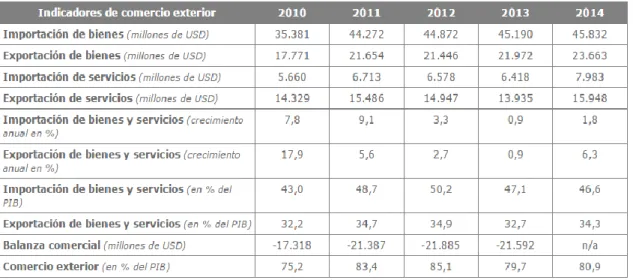
(13) Table 1 shows the growth indicators of the country during the past 5 years, and table 2 makes reference to the external and internal trade. Table 1. Growth indicators of Morocco during the past 5 years. Source: IMF-World Economic Outlook Database 2015 Table 2. External and internal trade of Morocco. Source: IMF-World Economic Outlook Database 2015. Besides, we must highlight the launch of an industrial strategy in 2014 to attract the attention of foreign companies and fight against unemployment. This measure has had a 18,000 million euros’ fund8.. 2.1.3. Sociocultural factors The population of Morocco has, according to the census, 33.1 million inhabitants, which is mainly characterised by its young population and low-skilled workforce. With regards to pre-school education, literacy is total nowadays, which will help us develop. 8. http://www.lemoci.com/fiche-pays/maroc/. 13.
(14) our business in a future because future generations will be more aware of the problem. Besides, illiteracy still affects around a 28% of the population older than 10 years. Morocco is a Muslim country with a 99% of the population being of Muslim confession. In addition, it should be said that it is a traditional and conservative society. The population is known as being consumers where the modernisation of the country offers the creation of needs and a consumerist attitude.. 2.1.4. Technological factors With regard to the business that we are going to handle, the Moroccan government has been using a number of policies that can benefit us as a new company, and also in relation to the commercialisation of not harmful products to the environment. The government offers a system of financial and fiscal incentives to the investment in the sector. These investments have a long-term horizon to encourage the economic activity in the country. Among the measures adopted in the last years, we can highlight the following ones: . National plans and projects regarding the environment. . National Strategy for Environmental Protection (NSEP). . National Strategy for Sustainable Development (NSSD). . Maroc Vert Plan. . National Plan for preventing the Global Warming. . Deposit and Management Fund (DMF). All these measures are actions taken by the government with regards to the technological contribution and their contributions to the business activity. We are going to analyse one of these measures, as for instance the DMF. This is an agreement to finance business projects of both Spain and Morocco. There is the opportunity to finance or guarantee investment projects for SMEs on both sides of the strait in order to promote the economic relations between both countries. Once all the PEST analysis factors have been analyses, we can conclude that we have favourable aspects regarding the influence of those factors in the creation of our company. The large number of subsidies and grants that we have at our disposal 14.
(15) and the Free Trade Agreement (FTA) between Morocco and the European Union make the importation of this product quite attractive. In addition, the geographic proximity of both countries is also an advantage.. 2.2. Sector analysis The industry analysis is going to be carried out following Michael Porter’s model (2009), which will allow us to analyse the sector where we are going to work. The external analysis will give us a clear vision regarding the level of competition and rivalry existing in the sector. This will provide us with the opportunity to perform the necessary marketing actions in order to overtake other companies. Moreover, by analysing the sector, we will have a guide to detect threats in the sector that can affect the survival of our project. Therefore, we are going to examine current and future threats for developing preventive measures that will favour our global vision regarding the detection of existing opportunities in the market.. 2.2.1. Threat of substitute products First of all, we discard the competition with Moroccan plastic companies in shortterm, since they have not adapted their technologies due to the recent regulation banning the commercialisation of plastic bags made with long-degradation materials as the polythene. Since we are dealing with retail businesses, we want to visit directly the customer, and offer him the product and a solution to the conventional plastic bags in order for him to participate in the eradication of these bags. There will always be the uncertainty that the biodegradable plastic bags will remain in the market, but we have a good perspective because the sector is still new to both the competition and the society in general, so that is why awareness actions will take place. The threat of substitute products is quite low since the material must be oxobiodegradable, and any substitute product to the conventional plastic bags must fulfil that condition.. 2.2.2. Threat of new competitors We will take into account any company that wants to orient its business line towards the distribution of oxo-biodegradable plastics, although the bags from the Asian market can be a threat. Regarding national companies, they are mostly in Casablanca (Morocco) and they carry out their business offering their products to multinationals. 15.
(16) rather than to retail businesses, as for instance the Union Plastique Maroc9 company. An example of this is the list of customers of this company: . Amendis: water and electric company.. . Irrys Sys: specialised in the irrigation of greenhouses.. . Ramsa: sanitation and distribution of water.. Since the retail businesses are not taken into consideration, we see the situation as an advantage to introduce our product in this market although there is a big threat regarding new competitors because the dominant companies reinvent themselves quickly and adapt their technology in order to commercialise similar products. The threat of products from Asia should be taken into account too because they are characterised by their low prices.. 2.2.3. Negotiation power of the competitors The possibility of a forwards-integration of the suppliers must be also borne in mind because they can also provide products to the final customer. In our case, since we have a small budget, we have at our disposal a number of potential suppliers and we will buy the product to the company selling the cheapest one. On the other hand, we will promote loyalty to our customers given them a product according to the standards established by the regulations. We will also make them aware that they are supporting the environment, creating a good relationship to increase the degree of loyalty. Therefore, we face a minimum threat because the plastic companies in Spain are very developed, and thus we have a large number of potential suppliers.. 2.2.4. Negotiation power of the purchasers The Moroccan society uses plastic bags even when buying a baguette because they are reluctant to show what they acquire, and thus, they will always need plastic bags to try to hide what they buy. Almost all the citizens go to the bazaars (street markets) for the daily shopping and in the area where we are going to act, the supermarkets are far from the city centre.. 9. http://www.unionplastique.com/HistoryAndOutlook. 16.
(17) Therefore, we will offer our products in the bazaars, where there are more customers. This indicates that there is almost no threat because the Moroccan society is going to need these plastic bags for their daily shopping. Figure 1. Street market in Tetuán. Source: secondary. 2.2.5. Market rivalry and competition Since the new regulation suggests the change to biodegradable bags, this implies a big investment to national plastic companies and time to adapt to the environment needs. Now, they do not accept this change and they still commercialise non-degradable bags. For this reason, we have seen an opportunity to offer a new product with positive future expectations to try to provide positive aspects to the ecosystem and to society in general. Thus, there is a high threat regarding market rivalry and competition because lots of people try to take advantage of others’ business ideas to develop their own company. Since this project does not require much investment, it is easy for others to copy the idea. Moreover, the already established companies will try to cover the market costs that they had before the new regulations. The conclusion to which we have come is that we face a low threat that will help us achieve a high competitive position in the sector. 17.
(18) 3. INTERNAL ANALYSIS In relation to the internal analysis, we will analyse the resources and abilities that we have which can help to reach an effective development and add value to our business idea. First, the scarcity of producers and distributors of a similar product, due to the current regulation banning non-degradable plastic bags, implies an advantage to our company because it is not available to everyone. The relevance of our product adds positive value too because we are going to offer a new product, different from the rest, that benefits the environment and respects the law. Another key aspect is the acquisition of a business premises because we would have to focus just on the expenses regarding the activity development. The amount of money to create the company has implied a minimum investment, just 1 dirham (10 euro cents). Moreover, the Morocco-EU Free Trade Agreement is a positive factor because it eliminates the barriers and implies less money wasted when taking the product to Morocco.. 4. CONCLUSIONS: SWOT Based on the previous data, we are going to carry out a SWOT analysis of the situation of our company that will help us to focus our business idea on the future.. 4.1. Weaknesses . First, we emphasize the importance of the price, since offering a biodegradable product increases the price compared to the conventional plastic bags made with polythene.. . Secondly, the difficulty to obtain customers from department stores: in the later stage to the creation of our company we are not going to have a list of customers buying our product in big lots (in supermarkets, clothing shops, etc).. . Logistics costs: the costs of importing the product can be a weakness for a new company which does not have many financial resources.. . Competition: plastic companies must adapt the product to the legislation if they want to stay in the business. In addition, if they adapt their technology in the production of biodegradable plastics, it would mean more competition in the market. 18.
(19) 4.2. Strengths . An attractive aspect of Morocco is the workforce cost, because we can hire workers for distributing the product to a quite low price, compared to the European salaries.. . Another key aspect is the rise of the middle class, which implies an increase of the consumption market.. . The country’s banking system is well developed, so we will not have problems in the payment to the suppliers.. . There are many reforms that support investment.. . Political stability as a result of the Arab Spring that led to the reform of the Constitution in 2011.. . Good economic situation of the country despite de international crisis.. . Our product is made from non-pollutant materials.. . Reusable products. 4.3. Opportunities Our business will become one of the innovating ones in the area regarding the protection of the environment. The support opportunities offered by the government are shown below: . National plans and projects regarding the environment. . National Strategy for Environmental Protection (NSEP). . National Strategy for Sustainable Development (NSSD). . Maroc Vert Plan, Rawaj 2020 Plan.. . National Plan for preventing the Global Warming. . There are several reforms supporting investment.. . The fiscal incentives and advantages offered by the country to new companies and foreign investment.. . Progressive liberalisation of the economy and improvement of the business environment.. . Excellent geostrategic situation and the Morocco-EU Free Trade Agreement. 19.
(20) Among the opportunities offered, we are going to analyse a proposal developed by the government, which is the Rawaj 2020 Plan10, in which we highlight: . Establishment of 600 large and medium-size surfaces.. . Construction of 15 shopping centres, taking in over 3,100 shops as franchises.. . Creation of 15 outlets. . Growth of the distribution sector by an 8% annually.. 4.4. Threats . Informal competition: although the law bans to those not obeying the regulations, there will always be companies that will continue producing normal plastics, illegally.. . Competition increase caused by the arrival of foreign companies due to the economic crisis in Europe.. . Excessive energy dependency.. . Commercial liberalisation that pushes the companies towards the superior links in the production chain.. . Few entry barriers to marketing companies.. . Products from the Asian market.. 5. MARKETING PLAN 5.1. Mission The mission of our business project is the importation, commercialisation and distribution of biodegradable plastics to retail stores in Morocco. The idea is to satisfy our potential customers offering them all the necessary products to develop their activity according to current regulations. Our mission is to distribute plastic bags to small stores, clothing shops, and people selling in the retail. This also implies a way to raise awareness in the use of nonpollutant products.. 10. http://lavieeco.com/news/la-vie-eco-carrieres/rawaj-vision-2020-un-plan-pour-booster-lesfranchises-100-marocaines-14279.html. 20.
(21) 5.2. Vision Once stablished in the market, the second stage will consist in setting up a production plant, offering all the varieties of the product in order to try to cover a high market share, focusing on department stores, locally, nationally and continentally (Africa). A long-term vision would be to become a model company in the sector, as well as competitive and innovative, committed to its customers, workers and the environment.. 5.3. Objectives The main objective is the commercialisation of oxo-biodegradable plastic bags in the Moroccan market. Some key aspects are: . First, acting as a distributor. . Then, building a plant for this material in order to cover all the existing sectors in the market.. 5.4. Reference market The reference market, in this case, will combine the products market and the geographical market. In this reference one, we are going to satisfy the stores’ needs providing them with oxo-biodegradable plastic bags that obey the current regulations established by the Moroccan government protecting the environment. Our challenge is to cover the basic needs of our potential customers, without excluding the possibility of other product line in medium-term depending on the market needs.. 5.5. Relevant market We are going to offer a new and original product in the country, environmentally responsible and obeying the required regulations. Our specialisation strategy is based on the technological dimension since we offer a new product where the plastic production companies have not invest technologically to adapt themselves to the change. Moreover, our products are going to be attractive to our customers. There is a lot of competition in the regional market of conventional plastic bags made with polythene, but we are going to enter the sector offering something different, which will give us advantage over the others. 21.
(22) 5.6. Competition analysis The Moroccan plastics industry sector is represented by 650 companies and generates 45,000 direct jobs and 300,000 indirect ones. Moreover, it should be noted that 71% of the existing companies work in the production of the product, and the 29% work in the distribution11. Besides, according to the Ministry of Industry, Trade and New Technologies, Mounia Boucetta, the turnover fluctuates around 900 million euros12. Nowadays, 550,000 tons of this product are produced, which manage to cover around 60% of the demand. The Moroccan plastic companies distribute their total production as follows: . 38% of the total production to plastic packaging. . 14% to agriculture. . 14% to construction. . 10% to technical equipment. . 28% other. Now, we are going to carry out an analysis of the most competitive companies in the Moroccan sector. . Unibag Maghreb. It is a oxo-biodegradable plastic bags factory of approximately 5,000 m2. It acts as a supplier of large and medium-sized supermarkets and offers employment to 60 workers. Besides, its monthly production ranges the 600 tons of plastic bags for consumption, industry, advertising, and so on.. . Union Plastique Maroc. Plastics company created in 1968. Its long-term presence in the Moroccan market has allowed it to meet and attend the needs of the market, which allows it to anticipate and understand the needs of its customers. The company helps its customers to choose the product that best meets those needs, especially those related to the agriculture and construction sectors. Its main customers are big companies such as: Amendis (water and electric company); Irrys Sys (specialised in the irrigation of greenhouses); and Ramsa (sanitation and distribution of water).. 11. http://plastiques-caoutchoucs.com/Le-Maroc-terre-de-plasturgie.html http://www.maghrebemergent.com/economie/maroc/46412-maroc-casablanca-accueillera-enjuin-le-plus-grand-salon-africain-de-la-plasturgie.html 12. 22.
(23) This does not imply an important threat to our business because they direct all their energies to meet the needs of potential customers that we are not interested on. . Cmb Plastique Maroc. Its activity is directed to the food and agriculture sector, and among its products, we highlight: stoppers and washers (plastic and rubber stoppers); packaging and their plastic materials (bottles); plastics in transformation. (injection. moulding,. blow. moulding,. mechanical. plastic. production); quality certificate ISO 9000. We could analyse all the companies of the sector, but the main peculiarity among them is that they compete among themselves to satisfy the needs of important customers with high turnovers and an interest on other product lines, showing no interest in oxobiodegradable bags and retails stores. As a result of the level of competition study, we have analysed our possible closest competitors, and thus we underline four forms of competition (Ignacio Cruz Roche, 1999) that we are going to face as a new company: . Competition in the form of product. . Competition in the product category. . Generic competition. . Competition at the level of budget Figure 2. Levels of competition. • Produc t form. • Generi c. • Product category Amal plastics vs small distributor s. Oxobiodegrad able bags vs plastic bags. Any subtitute biodegrad able palstic bags. Asian countries. • Budget. Source: own elaboration. 23.
(24) Regarding the competition in the form of product, we are going to face to companies that distribute the same products. The new regulation that bans the commercialisation and distribution of polythene plastic bags is a positive point for us because national producers have not adapted their technology to the environment, so we will have a strong competition in a short-term. Concerning the competition in the product category, there is always the uncertainty of unfair competition, offering plastic bags made with polythene and not oxobiodegradable bags. On the other hand, the generic competition refers to every product form or category that meet the basic needs of the customers (substitute products). In this case, we have as possible competitors, any substitute of our biodegradable bags, so the actions that we are going to perform will be offering a wide range of products to cover the customers’ needs and try to minimise the competition. Finally, the competition at the level of budget refers to those products or services that fight for the same consumer’s budget. We can always face problems regarding budget, finding new distributors that import the same bags but from Asian countries. Besides, the unfair competition regarding the conventional plastic bags would result in a problem because the production cost is lower, so as the sale.. 5.7. Segmentation In Amal plastics, we have decided to divide the market into three different forms (Armstrong, Gary, 2013) to increase our chances of success, although they are related to each other and to the sector we are directing to. The three forms are: . Segmentation for frequency of use. . Geographical segmentation (Tangier-Tetuan). . Segmentation for consumption habits Figure 3. Market segmentation. Segmentation. Frequency of. Greographical. use Source: own elaboration. 24. Consumption habits.
(25) 5.7.1. Frequency of use The Moroccan society is characterised by daily shopping since they look for fresh products, and because they have a negative opinion about frozen products.. 5.7.2. Geographical The area where we are going to operate is Tangier-Tetuan, with 2,586,000 inhabitants and a surface area of 11,290 km2. The region, in North of Morocco, is bathed by the Atlantic Ocean and the Mediterranean Sea, and it has border with the autonomous city of Ceuta in the North. A characteristic of this area is that it is not the benchmark industry of the country, so people depends on agriculture. This point is in our favour, because the farmers themselves sell their products in the markets and thus, they will be our potential customers. Moreover, it is also an area where there is a lot of food smuggling from Ceuta, so there are small supermarkets and grocery stores that could be potential customers too.. 5.7.3. Consumption habits The Moroccan society is characterised by its consumerism and resistance to change because, although there are more and more supermarket chains, their daily shopping keeps being traditional, avoiding the supermarkets and buying from small businesses.. 5.8. Positioning The strategy to position ourselves in the Moroccan market is given by the competitive advantage provided by our differentiating product. this will allow our customers to adapt themselves to the legislation requirements and, at the same time, to provide them with greater social benefit products. The strategy to position ourselves in the mind of the customers is thanks to the benefits of the environment impact that the attributes of our product have, such as 100% oxo-biodegradable and reusable. Since the market has been already segmented, we know that our company is going to compete thanks to the differentiating of the product, because it has been technologically developed to meet needs. Although there are large plastic companies, they are more interested in covering other market sectors related to industry. Besides, our three key attributes would be: . Quality 25.
(26) . Affordability. . Location The quality offered by our product, together with the affordability regarding prices,. is a positive point for us since we are offering an innovative and beneficial product at a price that is not that different from the conventional plastic bags’ price. Regarding the location, we have established our company in North Morocco, trying to supply products to all our customers.. 5.9. Marketing strategies First of all, and before talking about the strategy followed as a company, it is worth mentioning that the trade sector in Morocco is developed in two lines: the traditional market, and the modern market (more European style). The modern market is characterised by large and medium-sized stores, such as supermarkets, but since we are going to work with the traditional one, we are not going to go into detail regarding this line because it does not fit within our sector of interest. Regarding the traditional market, there are figures that stipulate that there are about 850,000 points of sale, bazaars, municipal markets and street vendors. 88% of these represent the traditional trade, so we have a broad margin for operating, because they are small stores scattered around the neighbourhoods of the city offering all kinds of products. The idea of commercialising plastic bags has result from the number of stores in Morocco, where we can operate. In Spain, this type of establishments is known as corner shops. Analysing the markets where we are going to supply the product, we must point out that they are usually located in the city centres, where the number of customers can range from 300 to 1000, depending on the day. The explanation to this small traders’ influx is that it does not require a specific training to develop the activity, neither a license. And because of the low initial investment. These traders are retailers who sell directly to the final consumer, so they will be part of our potential customers. We know that in order to achieve a competitive advantage and overcome our competitors, wholesalers and retailers of plastic bags, we must differentiate ourselves from them. Thus, we are going to develop a focus or specialisation strategy. Our goal is to focus all our efforts on serving a few market segments. This will help us learn more about these segments and strive to be leaders, in prices too thanks to subsidies and agreements implemented by the government for new companies. 26.
(27) We are going to carry out effective marketing actions to meet our customers’ needs appropriately, offering them a wide range of products, both generic and custommade. The customised products are a great way of advertising and we believe that they would be attractive to our potential customers. Moreover, we should emphasise that, in Spain, having custom-made bags is normal, but, in Morocco, this trend has not been implemented by many companies and is an innovation that the customers will like. Finally, it is a way of contributing to our customers, both personally and legally, by helping them in their businesses’ advertising and facilitating the regulations compliance.. 5.9.1. Competitive strategy 5.9.1.1.. Regarding the environment. Amal Plastics will act using an analysis strategy characterised by a constant attitude towards the pursuit of new opportunities, without forgetting the distribution of oxo-biodegradable bags, which is our main task. Furthermore, acting with this strategy will allow us to know the essence of our business, but without neglecting the potential opportunities that the environment can offer us. In addition, as we have already mentioned, our long-term aim is the construction of an oxo-biodegradable plastic production plan, hence the use of this strategy. Moreover, we are well aware that companies using explorer strategies, which are the first to detect the market needs, have overtaken us. Nevertheless, this has not been in great volume because they have still not adapted their technology to create our product. however, we must bear in mind that they will be operating on the market in a medium-term to dominate it. As a new creation company with low budget, and having studied the different options, we believe that this it’s the right attitude to consolidate ourselves on Moroccan soil in the long-term. For this reason, we will try to show a high level of flexibility with our customers, providing them with all the necessary mechanisms to develop their activity in good conditions. Besides, in order to act in the market using this strategy, one needs to have information about the market and trends in order to be able to carry out a process of constant innovation. After analysing a product scarcity on the Moroccan market, we have seen the opportunity to cover the customers’ needs with an innovative product in the country. Moreover, we are going to try to get one of the top distributors in North Morocco, using our unique, custom and competitive price product.. 27.
(28) 5.9.1.2.. Regarding the competitors. Our goal is to specialise in the distribution and commercialisation of oxobiodegradable bags for small businesses, and this strategy tends to be optimal when used to operate in a specific region, which in our case is the Tangier-Tetuan area. We are going to operate, first, regarding geographical reasons, given that in the North of the country there is no industry facilitating the immediate purchase of the product. The products are usually purchased in the main cities of the country and then distributed by wholesalers and retailers in the North. In Amal Plastics, we are going to carry out the same task, but offering high quality products that are responsible with the society and the environment. Moreover, we have the exclusivity of having high technology products obeying the current regulations, with attractive prices. 5.9.1.3.. Growth strategies. In Amal Plastics, we chose the development of products for current markets as a growth strategy, which is suitable when the company has outstanding R&D (Research and Development) resources. We are going to commercialise high-tech products, thus causing a positive impact on the environment. The alternatives that have conditioned the adoption of this growth strategy are that we are going to add other attributes to our products than the already available in the market, adding social awareness and better quality. Furthermore, our plastic bags can be reusable and they do not harm the environment. Our wide range of products, models, and sizes contribute to the adoption of this strategy.. 5.10.. Marketing mix. 5.10.1.. Product policy. The oxo-biodegradable bags that we are going to offer will have different models, designs and sizes. Besides, our products are composed of materials that decompose through a multistage process using chemical additives to initiate the degradation. The products range that we offer is: . T-shirt type bags. . Perforated handle bags. . Custom bags. 28.
(29) We must emphasise that the range of products will be extended once installed in the sector, especially plastic bags for clothing shops, offering them a custom product. The variety and versatility of our products are our strongest point. Depending on the function given to the bag and the material being carried in it, the customer can choose the product that best suited his needs. In addition to the oxo-biodegradable bags, there are also reusable bags according to the UNE 53942 norm, which are those commonly found in large supermarkets. In Amal Plastics, we have focused the concept of our product on the consumers’ needs, since, in our case, they are going to buy our products because of the problems these can solve. ‘Our customers buy benefits, not products’ The products offered are classified as a convenience good because they are daily acquired, at a low price and with ease. We are in the phase of introduction and growth of our products in Moroccan soil, whose market is in full increase and expansion of the products we offer, because of the regulations requirements and the lack of producers with the necessary technology. This whole situation will help us to achieve a competitive advantage in the short/medium-term.. 5.10.2.. Prices policy. We have included the products list of our supplier Plaset SL (company located in Játiva, Valencia) that we are going to commercialise in Morocco. Figure 4. Variety of bags. Source: Boddy Castellon bags. 29.
(30) Figure 5. Characteristics of t-shirt type bags. Figure 6. Characteristics of perforated handle bags. Figure 7. Custom, gift and reusable bags. Source: Plaset SL. 30.
(31) Regarding custom, gift and reusable bags, we have contacted with a company in Castellón (www.bolsasboddy.com) where we can find a great variety of ecologic products that will be taken into account when expanding our product line. In this case, we are referring to paper bags and gift bags that can be customised.. 5.10.3.. Distribution. In this section, we are going to deal with how the product is going to be taken to Morocco. We in Amal Plastics know that our product is sensitive to the price, so a good logistics policy has to be carried out to not face unexpected difficulties and raise the price of the product complicating our financial viability. As a new company, we must look for the adequate channel and design it to be more efficient when distributing the product to the final destination. In order to design our distribution channel, we have followed the following steps. With regards to the method of payment to our suppliers, we take advantage of the agreement between the Spanish bank ‘Banco Santander’ and its Moroccan counterpart ‘AttijariWafa Bank’. This agreement facilitates the international connectivity and supports companies in their international development13. Moreover, it allows the provision of services to clients of Banco Santander in Morocco and vice versa, thus giving support to all clients of AttijariWafa Bank, where the other bank operates. Our plan is to have two current accounts in those banks to facilitate all our procedures. A key aspect is the support that we are going to receive by these banks, which allow us to accelerate the customs procedures because they have staff responsible of part of the import process. Concerning the import process of our products, we are required to sign a commitment on form “Commitment for import, import license, preliminary import declaration”. This commitment must be issued in 5 samples and accompanied by a proforma invoice in 5 copies specifying14: . The unit price expressed in ex-works value, FOB, FAS.. . Quantity expressed in units of appropriate measures.. . Trade description of the goods Then, we must present it for domiciliation to our bank. After domiciliation, the. bank gives us a copy and two more in a closed envelop intended for the customs office. 13 http://www.gruposantander.es/docs/exterior44_09.pdf 14. http://www.negociomarruecos.com/doc/cooperacion/guia_import_export_marruecos.pdf. 31.
(32) This Commitment for Import is valid for 6 months as from the date of its domiciliation and facilitates our products to pass through customs. Finally, an application for exemption from customs duties 15 is necessary for the free import to be allowed as duty-free within the framework of the tariff and commercial agreements signed by Morocco and other countries for the products that have tariff quotas envisaged in the Association and Free Trade Agreement between Morocco and the EU, and between Morocco and the States of the European Free Trade Association (EFTA), and for products having tariff quotas envisaged in the Multilateral Agreements. This application for exemption has to be made in 4 copies on a form entitled “Customs Exemption Application” and accompanied by a proforma invoice in 3 copies, specifying: . The unit price expressed in ex-works value, FOB, FAS.. . Quantity expressed in units of appropriate measures.. . Trade description of the goods This application has to be deposited in the Ministry of Foreign Trade and it is. delivered after consultation with the concerned Ministry. The decision to accept or refuse the exemption is notified to the concerned party and then, the exemption is valid for a maximum of 6 months as from the date of the Ministry for Foreign Trade stamp. Regarding the transport of our product to its destination, due to the geographical closeness between Morocco and Spain, we had the option of transport it by sea, from the port of Valencia. However, we have preferred the land transport until Algeciras, and then to the Tangier-Med port. We consider this option as more viable because our company is located at 25 km from the Tangier port. As for the distribution way in Morocco, according to the ICEX Spain Exports and Imports, distribution channels are characterised by their weak structure, in which the number of intermediaries makes the channel to be 4 or 5 levels long. These are developed as follows: Figure 8. Distribution channels in Morocco Producer. Importer. Distributor. Intermediary. Point of sale. Source: own elaboration. 15 https://es.santandertrade.com/gestionar-embarques/marruecos/tramites-aduaneros-. importacion. 32.
(33) In Amal Plastics, we are going to reduce these levels to 3, in order to have a wider margin of benefits and compete for prices if it is required by the market and competition. We will contact directly with the producer, acting as importers, distributers and intermediaries, and then we will provide the products directly to the point of sale. Therefore, the substitution of two levels will imply a competitive advantage. Figure 9. Distribution channels of Amal Plastics. Producer. Amal Plastics. Point of sale. Source: own elaboration. We will act as retailers because we are directed to the final consumer. Moreover, we can also offer our products to any person that acts as retailer too. Finally, dealing with the distribution strategy, we will use a segmentation strategy, with an extensive and exclusive distribution since we offer an innovative product obeying the regulations.. 5.10.4.. Advertising and communication policy. Our main effort is to try to make our customers understand the quality of our products compared to the competition. We will present them the truths and the positive effect of these products on the environment, making them aware of the benefits and the economic sanctions in case of not obeying the law. Our way of acting will consist in introducing us as a oxo-biodegradable plastic commercialising company, at a reasonable price and a common benefit: protection of the environment. We will go store by store presenting our products catalogue and offering our business card. As we are going to commercialise our products to Muslim customers mainly, we will mention what the Holy Quran says about protecting the environment. We think that this will be an effective strategy since it will make them more aware about the importance of purchasing our products. As we are focusing on the traditional market, which is characterised by being conservative, we will introduce us as a local company concerned with improving the service of our clients and with the environment, aiming at establishing long-term relationships. We already have the first client portfolio covered since our first buyers are family and friends which will support us and advertise our products since, in the traditional market, the spread by word of mouth can help us to position ourselves in the sector. 33.
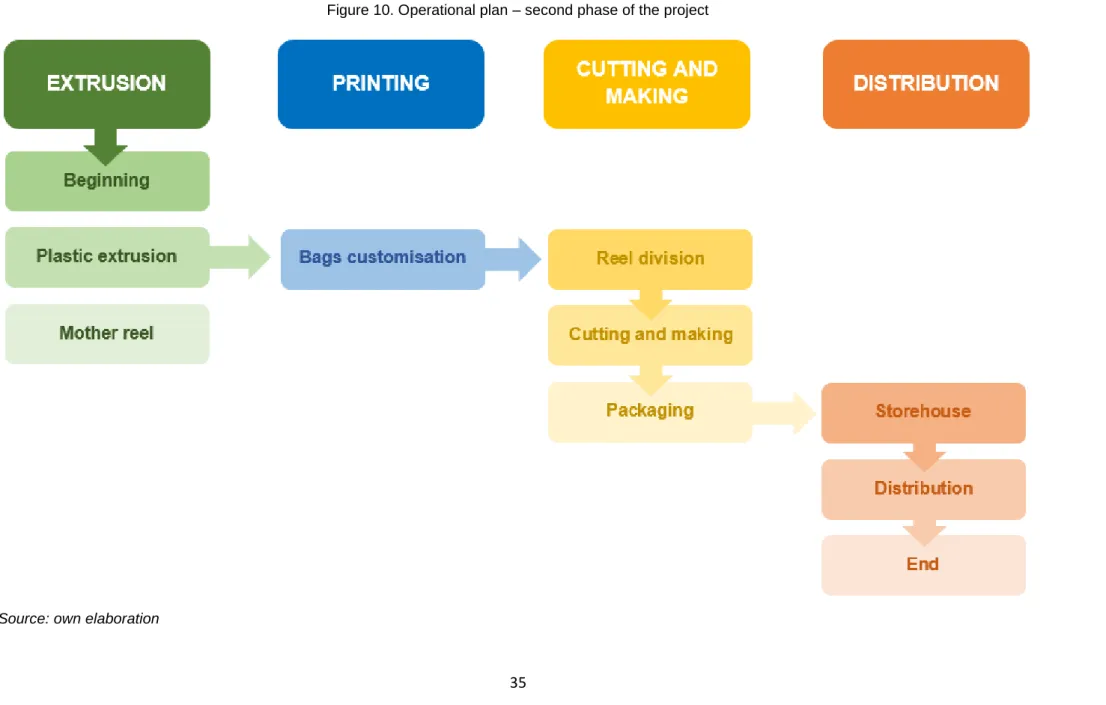
(34) 6. OPERATIONAL PLAN As we have previously described, we are going to commercialise and distribute oxo-biodegradable plastic bags. This is the first step where we establish a new company. Then, once established in the market, we are going to take the second step which has to do with the construction of a production plant. By acting as retailers, our operational plan is very simple, because we are going to act as a distribution channel of 3 levels, contacting with the producer and then offering the product to the final customer. Although it may seem very simple, our action plan implies a reduction of costs, since the distribution process in Morocco can have up to 5 levels. The elimination of two levels gives us more negotiation power by reducing the number of intermediaries, which in turn implies a competitive advantage and could help us to be different regarding prices. Now, we are going to explain the second stage of our business project. The availability of premises for the production of our product means a large reduction regarding the capital to invest, since it would suppose about 250,000 euros. The premises are equipped with all the necessary mechanisms for its operating, as well as with the proper license for the exploitation of a business activity. From the consulted information, we known that the oxo-biodegradable plastic production process consists of four phases: . Extrusion. . Printing. . Cutting and making. . Distribution The process of production is a simple process where the intervention of specific. machinery is minimal and the workforce does not require great expertise.. 34.
(35) Figure 10. Operational plan – second phase of the project. Source: own elaboration. 35.
(36) 6.1. Extrusion First of all, we have to know the details of the bags that we are going to produce in terms of size, model, and so on. In the extrusion process, the raw material is added to the extruders’ hopper in order to begin the process. Once programmed, the material mixes and additives are checked in order to carry out the order. To obtain a specific colour, other additives must be added since the raw material of the product is transparent. Once mixed into the extruders’ hopper, it passes through a nozzle, and here starts the process of extrusion, with the formation of a plastic balloon that comes out the next nozzle due to the force to which the material is subjected. As the input goes out the nozzle, it is cooled and collected in the form of a coil. This result receives the name of ‘mother reel’. For those products that have some sort of printing, the following process is the printing one, while generic bags go directly to the cutting process.. 6.2. Printing At first sight, this process seems simple, because it is a machine the one performing the printing in an automatized way. A film enters this machine with the printing format desired and thus the process begins. The main disadvantage of this stage has to do with the previous training of the employees, since a variation in the ink proportions, speed or trying time, can cause a different result in the desired printing.. 6.3. Cutting and making Having printed the bags, the next step is to program the cutting machine to format the give format to the product in terms of size, dimensions, model, and so on (t-shirt type, perforated handle, envelop, etc.). After cutting the product regarding the specified programming, the making process depends on the desired final product, since a t-shirt type bag is different from a perforated handle bag, so each one is programmed in a different way. Then, having concluded the cutting and making process, the machine outputs the final product in packages that are later transported on a conveyor belt to the hand of the operator. Defective products resulting from the extrusion, printing and cutting and making processes are reused in the production of garbage bags. 36.
(37) Dealing with the distribution process, we will easily face this new challenge because of the prior experience that we have as importers. We would use the same channels that we used as distributors to bring our product to the final customer, but we would focus on large chains to promote our products. We would strive to promote our product as a company that protects the environment. The change implied by moving from a distributor to a producer company is a great leap, but we are optimistic because we have previous experience in the commercialisation of the product. In relation to this second stage, we will rather focus on the advertising and communication of our company, making it recognizable through commercialisation actions. The actions regarding the advertising and the recruitment of potential customers will be the following ones: . Webpage: the creation of a corporate website for those users that are interested in contacting us or knowing about our company and products. The website will be in French, because it attracts more attention, and with the option of selecting Arabic and Spanish. In addition, we will incorporate a section for the management of orders that can help the users to buy online.. . Direct marketing: we will devote part of our budget to position our company in specialised search engines that can help us to improve our presence on the Internet.. . Regular mail: this will facilitate the contact with potential customers, introducing ourselves as a national company, adapted to the needs of the sector and with an extensive experience in the sector.. . We will write a cover letter including our email address, location and phone number. Then, having established the contents, the next step will be sending a catalogue with our products and prices.. . Commercial visits are very important and thus we will strive to contact the potential customers by telephone for a posterior visit.. 37.
(38) 7. FINANCIAL PLAN As for the balance sheet of the company, we have received a capital of 30,000 euros thanks to family support, to invest in the proposed business idea. Moreover, the fact of having an activity-enabled premises is an important capital reduction, and that is why we have not had to resort to banking loans. The amount of money for the purchase of stocks is 10,000 euros. 9,000 euros in fixed assets, acquiring a commercial vehicle for the distribution process, tools, supplies and furniture. The acquisition of a sales management program helps us to maintain a quality service and control the orders as well as the available stock. The amount remaining will be for provision of funds. Now, we are going to explain in detail the calculations. Of the initial 10,000 euros for the purchase of stocks, the figure has been reduced when contacting with a supplier that offers fairly affordable prices. Table 3. Balance sheet of Amal Plastics. INVERSIÓN. INICIAL. ACTIVO FIJO Inmovilizado Inmaterial. FINANCIACIÓN RECURSOS PROPIOS. 1.500,00 Capital. Patentes, licencias y marcas. Subvenciones. Derechos de traspaso. RECURSOS AJENOS. Aplicaciones informáticas. 1.500,00 Préstamos. Otros Inmovilizado Material. 30.000,00 -2.900,00 -2.900,00. 9.000,00 Otras deudas TOTAL FINANCIACIÓN. Construcciones Maquinaria Herramientas y útiles. 500,00. Mobiliario. 500,00. Equipos informáticos. 1.000,00. Elementos de transporte. 7.000,00. Otros Inmovilizado Financiero. 0,00. Fianzas ACTIVO CIRCULANTE 10.000,00. Existencias Deudores. 0,00. Clientes Previsión de fondos. 6.600,00. Tesorería. 6.600,00. TOTAL INVERSIONES Source: own elaboration. 30.000,00. Proveedores de inmovilizado. Terrenos. Existencias. INICIAL. 27.100,00. 38. 27.100,00.
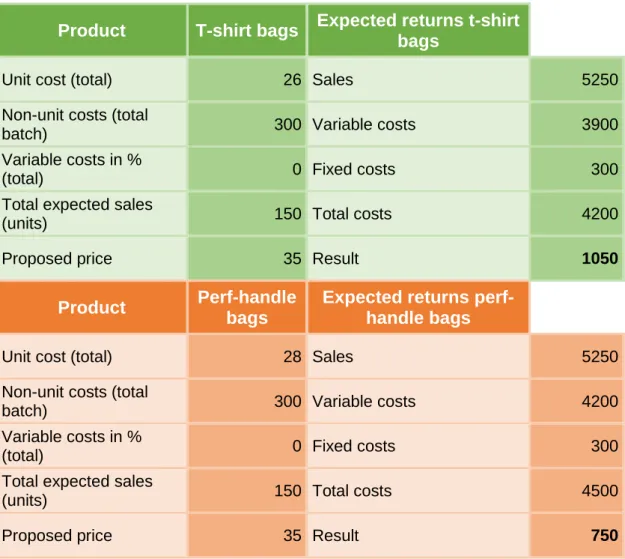
(39) We have earmarked approximately 8,700 euros to stocks, acquiring 150 units of t-shirt bags and 150 perforated handle bags during the first order. The price of each unit is 26 euros the first type, and 28 euros the second one. For the shipping and customs costs, we have added a value of 2 euros per unit whose sale price in Morocco will be 35 euros. (1 unit = 1000 plastic bags) From the first order on, that will take us approximately a month to distribute, we consider an increase of a 5% monthly for the batch of our imported products. Table 4. Result of the first order. Product Unit cost (total). T-shirt bags. Expected returns t-shirt bags. 26 Sales. 5250. Non-unit costs (total batch). 300 Variable costs. 3900. Variable costs in % (total). 0 Fixed costs. 300. 150 Total costs. 4200. Total expected sales (units) Proposed price. Product Unit cost (total). 35 Result. Perf-handle bags. 1050. Expected returns perfhandle bags. 28 Sales. 5250. Non-unit costs (total batch). 300 Variable costs. 4200. Variable costs in % (total). 0 Fixed costs. 300. 150 Total costs. 4500. Total expected sales (units) Proposed price. 35 Result. Source: own elaboration. 39. 750.
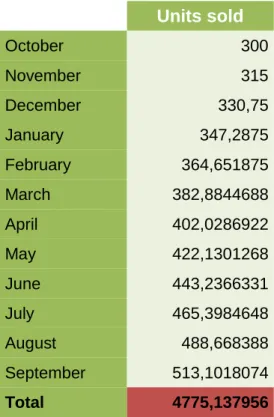
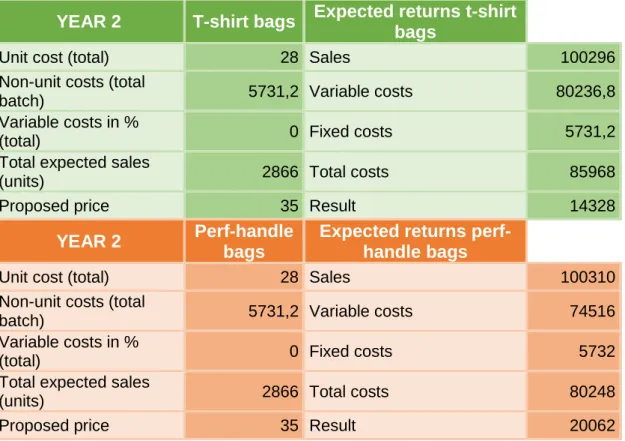
(40) Beginning our activity in October of 2016, we think that during the first year we would have taken around 4,776 units to Morocco. Table 5. Units sold during the first year. Units sold October. 300. November. 315. December. 330,75. January. 347,2875. February. 364,651875. March. 382,8844688. April. 402,0286922. May. 422,1301268. June. 443,2366331. July. 465,3984648. August. 488,668388. September. 513,1018074. Total. 4775,137956. Source: own elaboration. Regarding the following years, we have stipulated that in the second year there will be a 20% of increase of our units over the previous year; a 25% the third year over the second one; a 35% the fourth year; and a 50% the fifth year because will be specialised in our sector. At the end of the fifth year, the approximate number of units imported will be 41,000 units approximately. Table 6. Imported bags in 5 years. Value in units. Totals. st. T-shirt. Perf-handle. 1 year. 4776. 2388. 2388. 2nd year. 5731. 2866. 2866. 3rd year. 7164. 3582. 3582. 4 year. 9313. 4657. 4657. 5th year. 13970. 6985. 6985. th. Total. 40954,2. Source: own elaboration. Now, we are going to calculate the expected cash flows of our investment project during a five-year period of time, without taking into account the variable and fixed costs.. 40.
(41) Table 7. Cash flow - First year. YEAR 1 Unit cost (total) Non-unit costs (total batch) Variable costs in % (total) Total expected sales (units) Proposed price. YEAR 1 Unit cost (total) Non-unit costs (total batch) Variable costs in % (total) Total expected sales (units) Proposed price. T-shirt bags. Expected returns t-shirt bags. 26 Sales 4776 Variable costs. 83580 62088. Fixed costs. 4776. 2388 Total costs. 66864. 35 Result. Perf-handle bags. 16716. Expected returns perfhandle bags. 28 Sales 4776 Variable costs. 83580 66864. Fixed costs. 300. 2388 Total costs. 67164. 35 Result. 16416. Source: own elaboration Table 8. Cash flow - Second year. YEAR 2 Unit cost (total) Non-unit costs (total batch) Variable costs in % (total) Total expected sales (units) Proposed price. YEAR 2 Unit cost (total) Non-unit costs (total batch) Variable costs in % (total) Total expected sales (units) Proposed price. T-shirt bags. Expected returns t-shirt bags. 28 Sales 5731,2 Variable costs. 100296 80236,8. 0 Fixed costs. 5731,2. 2866 Total costs. 85968. 35 Result. Perf-handle bags. 14328. Expected returns perfhandle bags. 28 Sales 5731,2 Variable costs. 100310 74516. 0 Fixed costs. 5732. 2866 Total costs. 80248. 35 Result. Source: own elaboration. 41. 20062.
(42) Table 9. Cash flow - Third year. YEAR 3 Unit cost (total) Non-unit costs (total batch) Variable costs in % (total) Total expected sales (units) Proposed price. YEAR 3 Unit cost (total) Non-unit costs (total batch) Variable costs in % (total) Total expected sales (units) Proposed price. T-shirt bags. Expected returns t-shirt bags. 28 Sales 7164 Variable costs. 125370 100296. 0 Fixed costs. 7164. 3582 Total costs. 107460. 35 Result. Perf-handle bags. 17910. Expected returns perfhandle bags. 26 Sales Variable costs. 125370 93132. 7164 Fixed costs. 7164. 3582 Total costs. 100296. 35 Result. 25074. Source: own elaboration Table 10. Cash flow - Fourth year. YEAR 4 Unit cost (total) Non-unit costs (total batch) Variable costs in % (total) Total expected sales (units) Proposed price. YEAR 4 Unit cost (total) Non-unit costs (total batch) Variable costs in % (total) Total expected sales (units) Proposed price. T-shirt bags. Expected returns t-shirt bags. 28 Sales 9313,2 Variable costs. 162981 130384,8. 0 Fixed costs. 9313,2. 4657 Total costs. 139698. 35 Result. Perf-handle bags. 23283. Expected returns perfhandle bags. 26 Sales 9313,2 Variable costs. 162981 121071,6. 0 Fixed costs. 9313,2. 4657 Total costs. 130384,8. 35 Result. Source: own elaboration. 42. 32596,2.
(43) Table 11. Cash flow - Fifth year. YEAR 5 Unit cost (total) Non-unit costs (total batch) Variable costs in % (total) Total expected sales (units) Proposed price. YEAR 5. Expected returns t-shirt bags. T-shirt bags. 28 Sales. 244471,5. 13969,8 Variable costs. 195577,2. 0 Fixed costs. 13969,8. 6985 Total costs. 209547. 35 Result. Perf-handle bags. Unit cost (total) Non-unit costs (total batch) Variable costs in % (total) Total expected sales (units) Proposed price. 34924,5. Expected returns perfhandle bags. 26 Sales. 244471,5. 13969,8 Variable costs. 181607,4. 0 Fixed costs. 13969,8. 6985 Total costs. 195577,2. 35 Result. 48894,3. Source: own elaboration. On the other hand, the clash flows during the five-year period will be: . First year: 23,712 euros. . Second year: 23,086 euros. . Third year: 29,419.2 euros. . Fourth year: 39,601.44 euros. . Fifth year: 64,285.49 euros. When calculating the price for selling the product, and deducting the fixed and variable costs, we have the following results: Table 12. Net profits - 5 years. Cash flows. Expenses. Net profits. 1st year results. 33132. 9420. 23712. 2nd year results. 34390. 11304. 23086. 3rd year results. 42984. 13564,8. 29419,2. 4th year results. 55879,2. 16277,76. 39601,44. 5th year results. 83818,8. 19533,312. 64285,488. Source: own elaboration. 43.
Figure


+7


Documento similar
[r]
DECRETO FECHA GLOSA R.U.T.. DECRETO FECHA
hidrocefalia, insuficiencia renal, enfermedades respiratorias crónicas, cáncer, desnutrición y trastornos de la deglución (Torres, 2016). Según la experiencia de la Asociación
Los accidentes tienen costos directos subjetivos como el sufrimiento de la gente, del accidentado, de sus familiares, sufre la propiedad (maquinaria y equipos) y costos
Parameters and Selection Filters First Grouping: NONE. NONE
Tercera.- La convocatòria de les entrevistes personals s’ha fet per rigurós ordre de nota i tenint en compte el nombre total de vacants ofertades.. No obstant, es poden
Ensayo completo de un ladrillo, para su utilización en fábricas a revestir, con la determinación de la existencia de defectos estructurales, según UNE 67019, las
12,13 In the framework of two multicenter studies, the AVENA [Alimentación y Valoración del Estado Nutricional de los Adolescentes Españoles (Food and Assessment of the
