
New species, new combinations and new distributions in neotropical species of Elaphoglossum (Lomariopsidaceae)
38
0
0
Texto completo
(2) 970. REVISTA DE BIOLOGÍATROPICAL. TABLE 1 The new species described and the new combinations in the present paper are organized in sections and subsections SECTION. SUBSECTION. SPECIES. Elaphoglossum. Pachyglossa. Lepidoglossa. Microlepidea. Polytrichia. Muscosa Pilosa Hybrida. E. paramicola E. pseudoherminieri E. caridadae E. curvans E. betancuri E. macdougalii E. beitellii E. kessleri E. solomonii E. adrianae E. eutecnum E. glabromarginatum E. paxense. Setosa Undulata. Setosa. Botanical Garden (NY), Universidad Autónoma Metropolitana, Iztapalapa (UAMIZ), University of California (UC) and Smithsonian Institution (US). The names according with index herbariorum in (Anonimous 2002). The types that I saw are indicated with admiration marks, the holotypes that I could not see are indicated with -n.s. as abbreviation of not seen. Some herbaria that probably have a specimen cited here but not revised are indicated with interrogation marks. The countries indicated in bold represent the new distribution no previously reported, the countries indicated between quotation marks represent the known distribution of the synonyms (if this is different to valid species distribution).. NEW SPECIES Elaphoglossum adrianae A. Rojas, sp. nov. (Fig. 1). Type: COSTA RICA. Cartago: Cantón de Paraíso, Parque Nacional Tapantí, Cuenca del Reventazón, Orosi, Sendero Palmitos o T6, 9° 43’35” N, 83° 46’ 28” W, 1 450-1 600 m, A. Rojas & R. Delgado 3793 (Holotype: INB; Isotype: CR, MO, NY, UC, US). Ab E. curtii rhizomatis squamis lon gioribus; lamina linear-oblanceolatis cum. basin atenuatis et crenulatis marginen, magis distantibus venis, et reddish stipitis laminaeque squamis distans. Terrestrial; rhizomes 1.5-2 mm diam., compact; rhizome scales 2.0-3.5 x 0.2-0.5 mm, linearlanceolate, brown, lustrous, marginally entire; fronds (6-) 9-18 (-25) cm, approximate; phyllopodia absent; stipes 1/4-1/3 of the frond length; stipe scales 1-3 x 0.05-0.20 mm, subulate, dark reddish brown to atropurpureous, patent, lustrous, disperse, marginally dispersedly denticulate, mixed with glandular hairs; blades (4-) 12-16 x 1.2-1.8 (-2.7) cm, linear-oblanceolate (rarely narrowly elliptic), papiraceous, basically cuneate to attenuate, apically cuspidate to attenuate, marginally undulate; blade scales 2.5-4.0 x 0.2-0.5 mm, subulate, dark reddish brown to atropurpureous, lustrous, patent, dispersedly in both surfaces, marginally entire to undulate; veins evident, free, simple or rarely 1-forked, 2-3.5 mm apart, diverging at ca. 50-60° angle from costa; hydathodes present; fertile fronds 8-14 cm; stipes 2/3-4/5 of the frond length; fertile blades 2-4 x 0.8-1.1 cm, lanceolate narrowly elliptic, basically cuneate, apically acute to acuminate; intersporangial scales 3-5 x 0.2-0.4 mm, subulate, dark reddish brown to atropurpureous, patent, lustrous, dispersed, entire margin. Distribution: Costa Rica and Panama, only on Cordillera de Tilarán, Cordillera Central and atlantic slope of Cordillera de Talamanca, at (850-) 1 000-1 900 m..
(3) INTERNATIONALJOURNAL OF TROPICALBIOLOGYAND CONSERVATION. 971. Fig. 1. Elaphoglossum adrianae (A. Rojas and R. Delgado 3793, INB): a) Type specimen. b) Rhizome scale. c) Stipe scales. d) Costal scale. e) Blade scale. (scales b-e: 25x).. Paratypes: COSTA RICA. Alajuela: near La Laguna, 6 to 8 km S of Villa Quesada, 1 200 m, A. Molina et al. 17515 (CR). Cartago: Reserva Tapantí, 1 300-1 800 m, L.. Gómez 18838 (NY, UC), muestra mixta con E. curtii, L. Gómez 19408 (UC); Paraíso, Orosí, Parque Nacional Tapantí, subiendo por Quebrada Segundo hasta la cabecera del Río.
(4) 972. REVISTA DE BIOLOGÍATROPICAL. Taurito, 1.800im, G. Herrera 5756 (CR); along trail leading eastward into mountains from road into Tapantí Reserve, ca. 1 km S of jct. of Quebrada Salto and Río Grande de Orosi, 9° 43’ N, 83° 47’ W, 1 500-1 800 m, A. Smith et al. 2161 (CR,UC). Guanacaste: La Cruz, Parque Nacional Guanacaste, Estación Cacao, 10° 55’38” N, 85° 29’38” W, 1 100 m, R. Es pinoza 322 (CR, INB); Las Nubes de Tilarán, along Quebradas Valdivia and Azul, 10° 23’ N, 84° 52’W, 1 000-1 150 m, C. Ivey & W. Haber 136 (CR); a 2 km NE de Tilarán, 850 m, A. Jiménez 1341 (CR). Heredia: Sarapiquí, Virgen del Socorro, 800-1 000 m, L. Gómez 18216 (CR); along ridge between Río Sardinal and near waters of Quebrada Arrayanes, N Slope of Volcán Barva, 10° 12’N, 84° 07’W, 1 850-2 000 m, M. Grayum 7310 (CR); 0.51 km W of the Río Las Vueltas (Río Patria), 0.5 km NE of Cerro Chompipe, ca. 11 km NNE of Heredia, ca. 1 950 m, D. Lellinger & J. White 983 (F, US); road to Volcán Barva, R. Lloyd 4127 (NY); Volcán Barva, at top of saddle, 8 300 ft., R. Lloyd 4206 (NY), R. Lloyd 4211 (NY); 10 km N of San Rafael de Heredia onVolcán Barva, 1 950 m, J. Mickel 3017 (NY); end of the Rte. 113, where road crosses Río Patria, about 100-200 m upstream, R. Moran 3084 (F); Cerro de Las Lajas, N of San Isidro, 2 000-2 400 m, P. Standley & J. Valerio 51623 (US); Cerro Las Caricias, N of San Isidro, 2 000-2 400 m, P. Standley & J. Valerio 52123 (US); along Río Vueltas (upper Río Patria), at end of Rte. 113, 9 km N of Angeles, 10° 06’N, 84° 04’W, 1 900 m, R. Stolze 1624 (F). Limón: Bratsi, Amubri, Alto Lari, Kivut, siguiendo la fila divisoria entre Ríos Lari y Dapari, cuenca superior de ambos, 9° 22’ 45” N, 83° 06’ 15” W, 1 900 m, G. Herrera 5462 (INB, MO); Cantón de Talamanca, Bratsi, Amubri, Alto Lari, Kivut, siguiendo la fila divisoria entre Ríos Lari y Dapari, cuenca superior de ambos, 9° 22’ 45” N, 83° 06’ 15” W, 1 900 m, G. Herrera 5480 (INB, MO); Cantón de Limón, El Progreso, cabeceras del Río Cariei, Fila Matama, Valle de La Estrella, 9° 47’ 80” N, 83° 08’ 18” W, 1 400 m, G. Herrera & A. Chacón 2812a (CR, INB, MO).. Puntarenas: atlantic facing ridge beyond the Monteverde Forest Reserve near road across the ridge, ca. 1600 m, D. Lellinger et al. 1762 (US). San José: ca. 10 km N of San Rafael de Heredia, on Volcán Barva, 1 950 m, D. Lellinger 645 (US). PANAMA. Bocas del Toro/Chiriquí: trail along continental divide to ca. 3 km E of Cerro Pate Macho, 8° 49’ N, 82° 23’ W, 2 000-2 200 m, A. Smith et al. 2429 (MO), A. Smith et al. 2431 (MO). Elaphoglossum adrianae differs of E. cur tii Rosenst. in having longer (2.0-3.5 mm vs. 12 mm) rhizome scales; longer [4-12 (-16) vs. 26 cm] and linear-oblanceolate (vs. oblong-elliptic) blades; attenuate (vs. broadly cuneate) blade base; crenulate (vs. entire or nearly so) blade margin; veins 2.0-3.5 mm [vs. 1-2 (-3)] apart; longer (2.5-4.0 mm vs. 2.0-2.5 mm) and atropurpureus (vs. reddish) stipe scales; and longer (2-3 mm vs. 1-2 mm) and atropurpureus (vs. reddish) blade scales. This species is dedicated to my daughter Adriana María. Elaphoglossum betancuri A. Rojas, sp. nov. (Fig. 2). Type: COLOMBIA. Antioquia: Mpio. San Luis, Piedra del Castrillón, Cordillera Central, ladera oriental, 6° 4.30’ N, 74° 59.74’ W, 1 500-1 700 m, J. Betancur et al. 650 (Holotype: UC). Ab E. lepidothrix frondibus minoribus, stipitis squamis minoribus, lamina minoribus ovata cum basi truncata vel cordata diversa. Epiphytic; rhizomes 3-5 mm diam., compact, radial; rhizome scales 3-6 x 0.3-0.5 mm, linear, dark brown, lustrous, marginally entire; fronds 7-10 cm, approximate; phyllopodia 2-4 mm; stipes 2/5-1/2 of the frond length; stipe scales 2-5 x 0.5-1.5 mm, ovate to lanceolate, black with brown margin, patent, lustrous, dense, long ciliate marginally and in few times medially, the cilia to 0.5 mm long; blades 3-5 x 1.82.9 cm, ovate, chartaceous, basically truncate to cordiform, apically rounded; costal scales 2-4 x ca. 1 mm, lanceolate, orange to reddish-brown, ciliate margin; blade scales 1-3 x ca. 1 mm, ovate to lanceolate, orange to reddish-brown,.
(5) INTERNATIONALJOURNALOF TROPICALBIOLOGYAND CONSERVATION. 973. Fig. 2. Elaphoglossum betancuri (J. Betancur et al. 650, UC): a) Type specimen. b) Rhizome scale. c) Stipe scale. d) Costal scale. e) Blade scale. (scales b-e: 25x).. marginally ciliate, deciduous adaxially, more dense in the margin; blade surface darker adaxially; veins evident, free, 1-2-forked, ca. 1 mm apart; hydathodes absent; fertile fronds 9 cm; stipe ca. 3/5 of the frond length; fertile blade 4 x 0.9 cm, elliptic, basically cuneate, apically obtuse; costal scales 1-2 mm diam., ovate to skeletonized, marginally long ciliate; intersporangial scales absent. Distribution: Apparently endemic to Colombia at 1 500-1 700 m. Known only from the type collection.. This species is similar to E. lepidothrix Mickel in the rhizome and blade scales, but differs in shorter (7-10 cm long vs. 12-31 cm) fronds; shorter (2-5 x 0.5-1.5 mm vs. 58 x 0.5-1.0 mm) and ovate to lanceolate (vs. linear) stipe scales; shorter (3-5 x 1.8-2.9 cm vs. 8-16 x 3.0-4.3 cm) and ovate (vs. lanceolate-oblong) blade with truncate to cordiform (vs. broadly cuneate to rounded) base. This species is dedicated to Julio Betancur, Colombian botanist and collector of the type..
(6) 974. REVISTA DE BIOLOGÍATROPICAL. Fig. 3. Elaphoglossum caridadae (A. Rojas and L. Mejía 1374, INB): a) Type specimen. b) Rhizome scale. c) Stipe scale. d) Costal scale. e) Blade scales. (scales b-e: 25x).. Elaphoglossum caridadae A. Rojas, sp. nov. (Fig. 3). Type: COSTA RICA. Cartago: Paraíso, Orosi, Estación de Biología Tropical Río Macho y alrededores, 10° 06’ 20” N, 83° 50’40” W, 1 300 m, A. Rojas & L. Mejía 1374 (Holotype: INB; Isotype: CR).. Ab E. cuspidato squamis rhizomatis lon gioribus pallidioribus, squamis stipitis costae que rotundatis (iis stipitis basin autem lanceola tis), laminae basi plerumque longe cuneata vel atenuata, somate centrali minuto aurantiaco, necnon lamina squamis abaxialiter longius cil iatis differt..
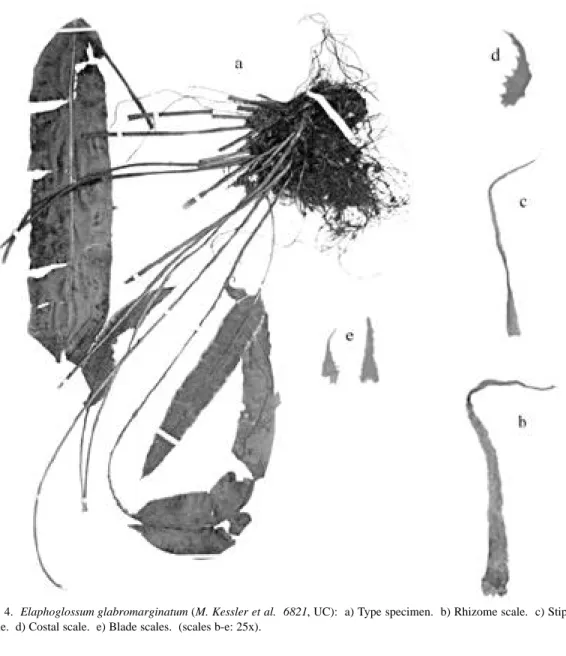
(7) INTERNATIONALJOURNALOF TROPICALBIOLOGYAND CONSERVATION. Epiphytic; rhizomes 3-4 mm diam., shortcreeping, dorsiventral; rhizome scales 3-5 x ca. 0.5 mm, linear-lanceolate, brown to atropurpureous, marginally ciliate-dentate, the cilia 0.3-0.5 mm long; phyllopodia 7-10 mm long; fronds 34-53 cm long; stipes 1/4-1/3 of the frond length; stipe scales 0.5-1 mm long (to 2.5 mm on the first 1 (-3) cm of the stipe base with scales lanceolate or linear-lanceolate), ovate to rounded, black, marginally ciliate, with long-ciliate margin and small central body; blades 1537 x 1.2-2.8 cm, linear-elliptic, chartaceous to subcoriaceous, basicaly cuneate to attenuate, apically acuminate; abaxial blade scales ca. 0.5 mm diam., rounded, peltate, stellate, concolorous, orange-yellowish to brown, with long cilia margin and small central body, persistent; adaxial blade scales 0.5-0.7 mm diam., rounded, peltate, stellate, concolorous, in two types, orange-yellowish to whitish mixed with blackish, with small to large central body; veins evident, free, simple or more commonly 1-(2) forked, ca. 1 mm apart, diverging at ca. 80° angle from costa; hydathodes absent; fertile fronds 38-44 cm long; stipes 1/3-3/5 of the frond length; fertile blades 20-25 x 0.6-1.1 cm, linear, basically cuneate to obtuse, apically acute; intersporangial scales not seen. Distribution: Known only from Costa Rica in Valle de Orosí, at the northern extreme of the Cordillera de Talamanca at 1 300-1 700 m. Paratype: COSTARICA. Cartago: Paraíso, Valle del Reventazón, Estación de Biología Tropical Río Macho y alrededores, 9° 46’ N, 83° 52’W, 1 580-1 700 m, A. Rojas & L. Mejía 1406 (INB, MO). This species is similar to E. cuspidatum (Willd.) T. Moore in its blade shape, dentate stipe and costal scales and persistent scales on the abaxial blade, but differs in having longer (35 mm vs. 1.5-2.5 mm) and paler rhizome scales; rounded (except lanceolate on the stipe base) [vs. ovate to lanceolate] stipe and costal scales; commonly long-cuneate to attenuate (vs. widely cuneate to obtuse) blade base; and stellate (vs. ciliate-denticulate to erose) scales with a small central body and long-ciliate margins on the abaxial blade. It is similar to E. furfuraceum. 975. (Mett. in Kuhn) H. Christ in its rhizome scales and blade size and shape, but differs in having shorter (3-5 mm vs. 5-8 mm) and dentate (vs. subentire to deciduously dentate) rhizome scales; rounded and dentate [vs. ovate to lanceolate and ciliate-denticulate] stipe and costal scales; commonly long-cuneate to attenuate (vs. widely cuneate) blade-base, more linear blades; and persistent (vs. deciduous) abaxial blade scales. This species is dedicated to my mother Caridad Alvarado, for her unconditional support and help. Elaphoglossum glabromarginatum A. Rojas, sp. nov. (Fig. 4). Type: BOLIVIA. Cochabamba: Prov. José Carrasco Torrico, 112 km antigua carretera Cochabamba-Villa Tunari, 17° 08’S, 65° 38’W, 2 700 m, M. Kess ler et al. 6821 (Holotype: UC; Isotype: LPB?). Ab E. albescenti frondibus longioribus, laminae basi cuneata, laminae squamis nigris sparcis, laminae fertili facie abaxiali cum mar gine nudum abiens. Epiphytic; rhizome 4-8 mm diam., compact, radial; rhizome scales 1.5-3.0 x 0.20.4 mm, lanceolate, brown to blackish, marginally dentate; phyllopodia absent; fronds (35-) 50-85 cm long; stipes 1/4-2/5 of the frond length; stipe scales 2-4 x 0.3-0.6 mm, linearlanceolate, brown, sometimes with darker center, patent, marginally dentate; blades (20-) 3060 x 4-7 cm, oblong to oblong-elliptic, papiraceous, basically cuneate, apically cuspidate; blade scales 1-3 x 0.3-0.7 mm, ovate to lanceolate, dark brown to blackish, dispersed, marginally dentate; veins 1-2-forked, ca. 2-3 mm apart, diverging at 70-80° angle from costa; hydathodes evident, dark brown to blackish; fertile fronds 37-55 cm long; stipes 3/4-4/5 of the frond length; stipe scales 1-3 x 0.3-0.7 mm, ovate to lanceolate, blackish, peltate, marginally dentate; fertile blades 10-18 x 1.8-2.8 cm, lanceolate, basically cuneate to obtuse, apeically acuminate; intersporangial scales ca. 1 mm, ovate, black, marginally dentate; blade margin without scales or sporangia in 1-2 mm marginal..
(8) 976. REVISTA DE BIOLOGÍATROPICAL. Fig. 4. Elaphoglossum glabromarginatum (M. Kessler et al. 6821, UC): a) Type specimen. b) Rhizome scale. c) Stipe scale. d) Costal scale. e) Blade scales. (scales b-e: 25x).. Distribution: Apparently endemic to Bolivia at 2 500-3 050 m. Paratypes: BOLIVIA. Cochabamba: Prov. José Carrasco Torrico, 108 km antigua carretera Cochabamba-Villa Tunari, 17° 09’ S, 65° 38’ W, 2 950 m, M. Kessler et al. 6593 (LPB?, UC); Prov. José Carrasco Torrico, 107 km antigua carretera Cochabamba-Villa Tunari, 17° 10’S, 65° 38’W, 3 050 m, M. Kessler et al. 6672 (LPB?, UC); Prov. José Carrasco Torrico, 110 km antigua carretera Cochabamba-Villa Tunari, 17° 08’ S, 65° 38’ W, 2 800 m, M.. Kessler et al. 6798 (LPB?, UC); Prov. José Carrasco Torrico, 115 km antigua carretera Cochabamba-Villa Tunari, 17° 08’S, 65° 38’W, 2 500 m, M. Kessler et al. 6959 (LPB?, UC). This species is similar to E. albescens (Sodiro) H. Christ, but its different in longer [(35-) 50-85 cm long vs. 16-40 cm] fronds; blade base cuneate (vs. broadly cuneate to rounded), black (vs. brown) abaxial blade scales and more dispersed; 1-3 m long (vs. 3-5 mm long), black (vs. blackish with brown margin) and concolorous (vs. bicolorous) costal scales;.
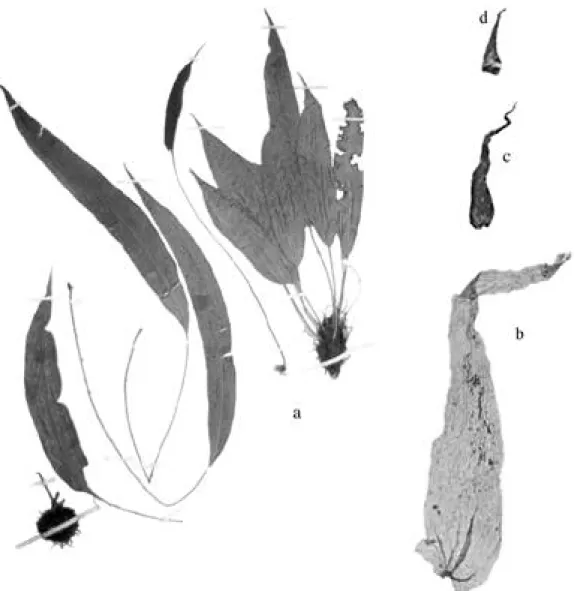
(9) INTERNATIONALJOURNALOF TROPICALBIOLOGYAND CONSERVATION. 977. Fig. 5. Elaphoglossum kessleri (M. Kessler et al. 7345, UC): a) Type specimen. b) Rhizome scale. c) Stipe scale. d) Blade margin scale. (scales b-d: 25x).. and glabrous in 1-2 mm (vs. completely covered with sporangia) fertile blade margin. The name refers to fertile blade without scales or sporangia in the 1-2 mm marginal. Elaphoglossum kessleri A. Rojas, sp. nov. (Fig. 5). Type: BOLIVIA. Cochabamba: Prov. José Carrasco Torrico, 137 km antigua carretera Cochabamba-Villa Tunari, 17° 06’S, 65° 34’W, 1700 m, M. Kess ler et al. 7345 (Holotype: UC; Isotype: LPB?).. Ab E. erinaceo stipitis squamis planata cum basi ciliata, lamina angustiori textura tenui, costa squamis minoribus planata, iis mar ginalisque minoribus abstat. Epiphytic; rhizome 5-8 mm diam., compact, radial; rhizome scales 6-10 x 0.5-1.0 mm, linear-lanceolate, yellowish to brown, flaccid, marginally entire; phyllopodia 2-5 mm; fronds (16-) 35-65 cm long; stipes ca. 1/3 of the frond length; stipe scales 2-4 x 0.4-0.6 mm, lanceolate, atropurpureous to black, dispersed, plane, with few long cilia at the base and entire apex;.
(10) 978. REVISTA DE BIOLOGÍATROPICAL. blades (11-) 22-43 x 2.0-3.6 cm, papiraceous, narrowly elliptic to oblong-elliptic, basically narrow to broadly cuneate, apically acuminate; costal scales same as stipe scales; abaxial blade scales 0.1-0.2 mm diam., as stellate hairs, black, few dense, with long cilia margin; adaxial blade scales same as abaxial but with shorter cilia; marginal scales 1.0-1.5 x 0.3-0.6 mm, lanceolate, dark brown, rolled, dense; veins simple to 1-forked, 1-2 mm apart; hydathodes absent; fertile fronds 25-37 cm long; stipes 2/5-2/3 the frond length; fertile blades 8-16 x 1.2-2.3 cm, elliptic-lanceolate, basically cuneate, apically acuminate; interporangial scales absent. Distribution: Apparently endemic to Bolivia at 1 700-2 200 m. Paratypes: BOLIVIA. Chiquisaca: Sud Cinti Province, base oriental del Cerro Bufete, aprox. 200 m al E del Campamento Rinconada del Bufete, 20° 49’ 49” N, 64° 22’ 28” W, 2 000 m, L. Arroyo et al. 917 (USZ, UC). Cochabamba: Prov. José Carrasco Torrico, 130 km antigua carretera Cochabamba-Villa Tunari, 17° 07’S, 65° 36’ W, 2 200 m, M. Kessler et al. 7247 (LPB?, UC). This species is similar to E. erinaceum (Fée) T. Moore rhizome scales and blade distribution scales, but different in plane (vs. rolled) with ciliate base (vs. entire) stipe scales; narrower [2.0-3.6 cm wide vs. (4-) 5-9 (-11.5) cm] and thinner texture (papiraceous vs. chartaceous to subcoriaceous) blade; shorter (2-4 mm long vs. 3-6 mm) and plane (vs. rolled) costal scales; and shorter (1.0-1.5 mm long vs. 2-4 mm) marginal blade scales. This species is dedicated to German ecologist Michael Kessler, collector of the type material and many others ferns from Bolivia. Elaphoglossum macdougalii A. Rojas, sp. nov. (Fig. 6). Type: COLOMBIA. Antioquia: Mpio. Urrao, Páramo de Prontino, between Llano Grande and Churrumblum, 6° 28’ N, 76° 05’ W, 3 3203 550.m, J. MacDougal et al. 4339 (Holotype: MEXU; Isotype: MO).. Ab E. petiolato rhizomatis squamis latioribus, necnon frondibus, phyllopodiis stipi tisque magnis, costae squamis ovata cum mar gine integra absimilis. Epiphytic; rhizome 3-5 mm diam., compact to short creeping, dorsiventral; rhizome scales 4-7 x 0.3-0.5 mm, linear, black, lustrous, marginally entire; phyllopodia 5-10 mm long; fronds (20-) 36-55 cm long; stipes 3/52/3 the frond length; stipe scales ca. 1 x 0.51.0 mm, ovate, brown, dispersed, marginally entire, mixed with resinous dots; blades (8-) 15-22 x 1.5-2.5 cm, chartaceous, narrowly elliptic to oblong-elliptic, basically cuneate, apically long acuminate; costal scales 1-2 x ca. 1 mm, ovate, pale yellowish, dispersed, opaque, marginally entire to erose, basically cordate; abaxial blade scales absent or very few, with abundant resinous dots; adaxial blade scales 0.5-1.0 x 0.5-1.0 mm, pale yellowish, opaque, marginally entire to few erose; veins simple to 1-forked, 1.0-1.5 mm apart; hydathodes absent; fertile fronds 25-30 cm long; stipes 2/3-3/4 the frond length; fertile blades 8-10 x 1.4-1.7 cm, elliptic, basically cuneate, apically acute; interporangial scales absent. Distribution: Apparently endemic to Colombia. Known only for the type collection. Differs from E. petiolatum (SW. ) Urb. in broader (0.3-0.5 mm wide vs 0.05-0.20 mm) rhizome scales; longer [(20-) 36-55 cm long vs. (10-) 15-30 (-40) cm] fronds; longer (5-10 mm long vs. 2-3 mm) phyllopodia; longer [3/5-2/3 the frond length vs. (1/5-) 1/4-1/3] stipe, ovate (vs. linear-lanceolate), pale yellowish (vs. orange-yellowish) and entire to erose (vs. ciliate) costal scales. Also is similar to E. angustius Mickel in fronds shape and size, but differs in longer [3/5-2/3 the frond length vs. 1/6-1/3] stipe; entire to erose (vs. ciliate) stipe and costal scales; and resinous (vs. scaly) abaxial surface. In the entire to erose stipe and costal scales is similar to E. huacsaro (Ruíz) H. Christ, but differs in compact to short-creeping (vs. ascending) rhizome; and acuminate to caudate (vs. obtuse to rounded) blade apex..
(11) INTERNATIONALJOURNALOF TROPICALBIOLOGYAND CONSERVATION. 979. Fig. 6. Elaphoglossum macdougalii (J. MacDougal et al. 4339, MEXU): a) Type specimen. b) Rhizome scales. c) Stipe. d) Costal scale. (scales b-d: 25x).. This species is dedicated to John MacDougal botanist at the Missouri Botanical Garden and collector of the type material. Elaphoglossum paramicola A. Rojas, sp. nov. (Fig. 7). Type: COLOMBIA. Tolima: Nevado del Ruiz Massiff, ESE of. Manizales, 5 000 m, J. Archibald 4015 (Holotype: F). Ab E. atrosquamato lamina ovata cum basi obtusa et apice obtusa vel rotundata divergens. Terrestrial; rhizome 1-2 mm diam., long creeping, dorsiventral, branched each 1.54 cm; rhizome scales 2-5 x ca. 1 mm, linearlanceolate, orange to brown, sometimes with.
(12) 980. REVISTA DE BIOLOGÍATROPICAL. Fig. 7. Elaphoglossum paramicola (J. Archibald 4015, F): a) Type specimen. b) Rhizome scale. c) Stipe scale. d) Blade scale. (scales b-d: 25x).. blackish apex, marginally entire to occasionally dispersed dentate; phyllopodia 8-30 mm long; fronds 4.5-11.0 cm long, 1.5-3.0 cm distant; stipes (1/2-) 2/3-3/4 the frond length; stipe scales 1-3 x ca. 1 mm, same as rhizome scales; blades (1.5-) 2.5-5.5 x (1.0-) 1.5-2.5 (-3.0) cm, coriaceous, ovate to rhomboid, basically broadly cuneate, apically obtuse to rounded,. marginally commonly revolute; costal scales 0.5-2.5 mm ovate to stellate, dark brown to blackish, dentate to ciliate margin; blade scales 0.2-1.0 x 0.2-0.5 mm, deltate to stellate, dark brown to blackish, dispersed, marginally dentate to ciliate; veins simple to 1-forked, ca. 1 mm apart, diverging at 65-70° from costa; hydathodes absent; fertile fronds 8-13 cm.
(13) INTERNATIONALJOURNAL OF TROPICALBIOLOGYAND CONSERVATION. long; stipes ca. 3/4 the frond length; fertile blades 2-4 x 1-2 cm, ovate to rhomboid, basically cuneate to obtuse, apically obtuse to rounded; interporangial scales absent. Distribution: Apparently endemic to Colombia at 4 000-5 000 m. Paratype: COLOMBIA. Pasto (Nariño): Volcán Galeras, 4 000 m, T. Plowman 1948 (F). This species is similar to E. atrosquamatum Mickel in creeping rhizome, black and dense rhizome scales and shorter fronds, but is distinct. 981. in branched (vs. not branched) rhizome, fronds 1.5-3.0 cm distant (vs. 0.5-1.5 cm), ovate (vs. elliptic) blade, with broadly cuneate (vs. attenuate) base and obtuse to rounded (vs. acuminate) apex. Also is similar to E. affine (M. Marten et Galeotti) T. Moore in its creeping rhizome and blade size, but differs in longer (2-5 vs. 2-3 mm) and linear-lanceolate (vs. ovate) rhizome scales with blackish apex (vs. blackish center); ovate to rhomboid (vs. elliptic), basically broadly cuneate (vs. cuneate) and apically obtuse to rounded (acute to obtuse) blades; and bigger. Fig. 8. Elaphoglossum paxense (J. Solomon 14954, F): a) Type specimen. b) Stipe scale. c) Costal scale. d) Blade scale. (scales b-d: 25x)..
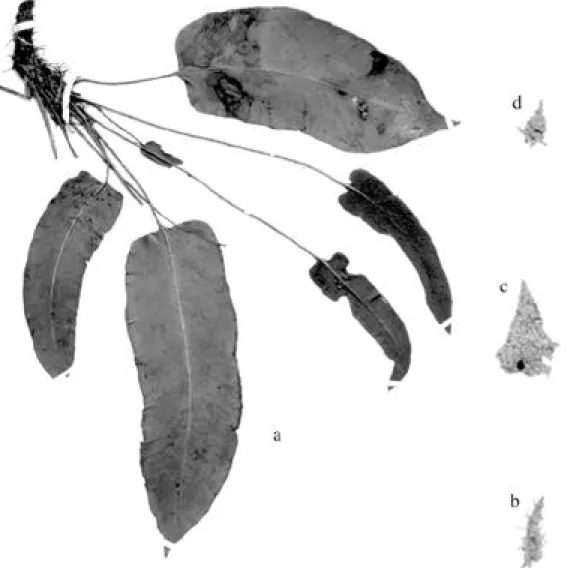
(14) 982. REVISTA DE BIOLOGÍATROPICAL. (0.2-1.0 x 0.2-0.5 mm vs. 0.2-0.4 mm diam.) and dark brown to blackish (vs. orange-yellowish) blade scales. The name refers to habitat of the species. Elaphoglossum paxense A. Rojas, sp. nov. (Fig. 8). Type: BOLIVIA. La Paz: Nor Yungas Province, 10 km NE of Chuspipata on the road to Coroico, 16° 16’ S, 67° 47’ W, 2 300 m, J. Solomon 14954 (Holotype: F; Isotypes: UC, MO). Hac combinatione distinguendum: lamina lanceolata, textura crassiori, laminae basi trun cata, hydathodiis manifestis induto.. Epipetric; rhizome 5-7 mm diam., compact, ascending; rhizome scales 1-3 x ca. 1 mm, ovate, yellowish to brown, marginally entire; phyllopodia absent; fronds (16-) 25-33 cm long; stipes 2/9-2/5 the frond length; stipe scales 1-2 x ca. 0.5-1.0 mm, ovate, brown, opaque, dispersed, marginally entire; blades 12-21 x 4-7 cm, lanceolate, chartaceous to spongiosus, basically truncate equilateral to inequilateral, apically acute to acuminate; costal scales 1-2 x 0.51 mm, ovate, brown, dispersed, marginally entire to erose; blade scales 0.5-1 x 0.2-0.4 mm, ovate, light brown, dispersed, basically erose to ciliate; veins few evident, simple to 1-forked, 12 mm apart, diverging at 60-70° from costa;. Fig. 9. Elaphoglossum pseudoherminieri (R. Moran 5083, F): a) Type specimen. b) Rhizome scale. c) Stipe scale. d) Costal scale. e) Blade scale. (scales b-e: 25x)..
(15) INTERNATIONALJOURNALOF TROPICALBIOLOGYAND CONSERVATION. hydathodes very evident, black; fertile fronds 25-36 cm long; stipes 2/3-3/4 the frond length; fertile blades 9-12 x 2.3-2.7 cm, lanceolate to lanceolate-oblong, basically truncate to cordiform, apically acute; interporangial scales ca. 1 mm, ovate to rounded, dispersed, marginally ciliate. Distribution: Apparently endemic to Bolivia at 2 300 m. Known only for the type material. Elaphoglossum pseudoherminieri A. Rojas, sp. nov. (Fig. 9). Type: PANAMA. Darién: Cerro Pirre Massif, ridge trail up from Cana, 700-900 m, R. Moran 5083 (Holotype: F; Isotype: MO). Ab E. herminieri rhizomatis squamis minoribus, stipitis squamis margine integra, lamina lineari vel lineari-oblanceolata angus tiori, laminae squamis minoribus diversa. Epiphytic; rhizome 3-5 mm diam., compact, dorsiventral; rhizome scales 5-10 x ca. 1imm, linear, yellowish to gold, marginally entire to dispersedly long ciliate; phyllopodia 13 mm (not visible for the scales); fronds 30-75 cm long; stipes absent or less than 1/15 (rarely to 1/6) the frond length; stipe scales 1.5-4.0 x ca. 0.1-0.2 mm, linear to subulate, dark brown, dispersed, marginally entire; blades 28-70 x 0.72.2 cm, linear to linear-oblanceolate, chartaceous to spongiosus, blue-green, basically attenuate, apically acuminate, margin revolute; blade scales absent or 0.1-0.3 mm diam., deltate to stellate, orange, dispersed, marginally ciliate; veins no evident; hydathodes absent; fertile fronds not seen. Distribution: Panama and Colombia? at 700-900 m. Paratypes:PANAMA. Darién: Cerro Pirre Massif, ridge trail up from Cana, 700-900 m, R. Moran 5085 (F, MO), R. Moran 5089 (F, MO). Is similar to E. herminieri (Bory ex Fée) T. Moore in frond size and blue-green blade, but E. pseudoherminieri have shorter (5-10 mm long vs. 15-40 mm) and yellowish to gold (vs. orange) rhizome scales, entire (vs. dentate to ciliate) stipe scales, narrower (0.7-2.2 cm wide. 983. vs. 1.7-4.0 cm) and linear to linear-oblanceolate (vs. linear-elliptic) blade, and smaller (0.10.3 mm diam. vs. 0.2-1.0 x 0.2-0.5 mm) blade scales. Elaphoglossum solomonii A. Rojas, sp. nov. (Fig. 10). Type: BOLIVIA. La Paz: Murillo Province, Valle del Río Zongo, 36.7 km al N (abajo) de La Cumbre, ca. 2 km al N de la Planta Hidroeléctrica Chururaqui, 16° 05’S, 68° 03’W, 1 800 m, J. Solomon 18827 (Holotype: UC; Isotype: LPB?, MO). Ab E. cordifolio rhizomatis squamis minoribus, frondibus minoribus, stipitis squamis sparcis, lamina ovata, fronde fertili iis sterilibus breviori differt. Epipetric; rhizome 2-3 mm diam., compact, dorsiventral; rhizome scales 2-3 x 0.2-0.4 mm, linear-lanceolate, atropurpureous to black, lustrous, marginally entire; phyllopodia 1-3 mm long; fronds (3.5-) 6.0-15.0 cm long; stipes 2/53/4 the frond length; stipe scales 2-4 x 0.20.4 mm, linear, rolled, atropurpureous to black, patent, dispersed, marginally entire, mixed with hairs 0.1-0.2 mm, glandular, yellowish; blades (2-) 4-9 x (1.5-) 2.0-3.0 cm, ovate, papiraceous, basically cordiform, apically acute to acuminate; abaxial blade scales 0.1-0.3 mm diam., stellated to arachnoid, black, dispersed, margin long ciliate; costal and marginal scales 1-2 x 0.1-0.3 mm, linear, rolled, atropurpureous to black, dense, marginally denticulate, mixed with glandular hairs; adaxial blade surface only with glandular hairs; veins 1-2-forked (rarely simple), 1.5-2.0 mm apart; hydathodes absent; fertile fronds 3-10 cm long; stipes 3/5-4/5 the frond length; fertile blades 0.7-2.5 x 0.5-1.2 cm, ovate to lanceolate, basically cordiform, apically acute to obtuse; interporangial scales absent, with scales only on costa; blade margin without scales or sporangia in 1 mm marginal. Distribution: Endemic to Bolivia at 1 8003 200 m. Paratypes: BOLIVIA. Cochabamba: Incayaita, Pocona, 3 000 m, J. Steinbach 8675 (F). Unduavi: Nord Yungas, 3200 m, O. Buchtien 415 (F)..
(16) 984. REVISTA DE BIOLOGÍATROPICAL. Fig. 10. Elaphoglossum solomonii (J. Solomon 18827, UC): a) Type specimen. b) Rhizome scale. c) Stipe scale. d) Costal scale. e) Blade margin scales. (scales b-e: 25x).. This species differs from E. cordifolium by shorter (2-3 mm long vs. 4-7 mm) rhizome scales, shorter [(3.5-) 6.0-15.0 cm long vs. 12-25 cm) fronds, dispersed (vs. dense) stipe scales, ovate (vs. lanceolate) blade, and fertile fronds shorter than the sterile (vs. longer than the sterile). This species is dedicated to James Solomon, collector of the type material.. NEW COMBINATIONS WITH RANGE EXTENSION Elaphoglossum beitelii (Mickel) A. Rojas, st. nov. E. crispatum Mickel var. beitelii Mickel, Brittonia 39 (3): 316. 1987. Type: Venezuela, Amazonas, J. Beitel 85133 (Holotype: NY!; Isotype: MO!)..
(17) INTERNATIONALJOURNALOF TROPICALBIOLOGYAND CONSERVATION. Distribution: Previously known only from Venezuela, but now also from Colombia. Material of new distribution: COLOMBIA. Comisaría del Putumayo, above Sibundoy, 2 500 m, A. Alston 8368 (MO). Elaphoglossum curvans (Kunze) A. Rojas, comb. nov. Acrostichum curvans Kunze, Linnaea 9: 30. 1834. Lectotype: Perú, Pampayaco, E. Poeppig 1115 (MO!). (designated here). Elaphoglossum nigrocostatum Mickel, Brittonia 39: 322. 1987. Type: Venezuela, Táchira, J. Steyermark & R. Liesner 118270 (Holotype: MO). Distribution: Previously known from “Venezuela” and Perú, but now also from Colombia and Ecuador. Material of new distribution: COLOMBIA. Valle del Sombrerito, 1 400 m, L. André 2330 (F). Antioquia: Mpio. Urrao, Parque Nacional Natural Las Orquídeas, Vereda Calles, margen derecha con el Río Calles, 6° 32’N, 76° 19’ W, 1 450-1 500 m, J. Pipoly et al. 17347 (MO); Cauca: Yumbo, S. Herrera 879 (F); Parque Nacional Munchique, km 50-55 along road above Uribe, 1 875- 2 256 m, J. Luteyn et al. 7482 (NY); Morales S of Morales, 1 6801 720 m, F. Pennell & E. Killip 8297 (US); Mpio. Ciclito, West Cordillera, 1 600 m, Xhyan der 2384 (F). Cundinamarca: carretera entre Aguabonita y Fusagasuga, 2 000 m, J. Duque 3306 (MEXU). El Valle: La Cumbre, Cordillera Occidental, 1 600-1 800 m, E. Killip 5677 (NY), 1 700-2 200 m, E. Killip 5690 (NY, US). Huila: La Plata, 2 800 m, K. Sneidern 2166 (NY). Nariño: Río San Juan near junction of Río San Juan drainage, Río Puelmambi, 1 540 m, J. Ewan 16045 (UC). San Francisco: Corregimiento Aquitamia, 1 150-1 250 m, Fon negra et al. 4345 (MO). Santa Marta: H. Smith 11337 (MO). Santander Norte: along road between Pamplona and Chorro Colorado, Via Chiquira at km 128, marker, 7° 22’ N, 72° 38’ W,. 985. 2.580 m, T. Croat 56412 (MO, NY). ECUADOR. Cerro “Ilalo”, M. Acosta 14054 (F). Carchi: Maldonado, 1 500 m, M. Madison 3908 (NY); Carretera entre Maldonado y Chical, frontera con Colombia, 0° 56’ N, 78° 08’ W, 1 500 m, W. Palacios & Rubio 7265 (MO, QCNE?, UC). Loja: trails ca. 5 km ENE of San Pedro de Vilcabamba, from “El Bosque” to Quebrada Romerillos and Banderilla, 4° 14’ S, 79° 10’ W, 2 000-2 200 m, B. Øllgaard & H. Nava rrete 105956 (AAU?, NY, QCA?). MoronaSantiago: Morona Cantón, near city of Macas, 2° 20’S, 78° 08’W, 1 100 m, A. Fay & L. Fay 4083 (MO, UC). Napo: Quijos Cantón, Baeza, 0° 30’S, 77° 50” W, 2 000 m, A. Fay & L. Fay 2658 (MO); El Chaco Cantón, on the Baeza-Lago Agrio road, turn E to the bridge over Río Quijos to Sala Honda, near the bridge, 0° 24’ S, 77° 49’ W, 1 560 m, A. Fay & L. Fay 3905 (MO); Archidona Cantón, Southern slopes of Volcán Sumaco, along Hollín-Loretp road, 0° 35’ S, 77° 40’W, 1 200 m, R. Moran & Rohr bach 5163 (MO, UC), R. Moran & Rohrbach 5171 (MO, UC). Pichincha: km 10 Nono-Tandayapa, 2 320 m, C. Dodson & W. Clendenin 10754 (F); Quito-Santo Domingo via Chiriboga, km 30, 2 950 m, C. Dodson & W. Clendenin 10868 (F); Quito-Santo Domingo via Chiriboga, km 82, 1 400 m, C. Dodson & W. Clendenin 10981 (F). Elaphoglossum eutecnum (Mickel) A. Rojas, st. nov. Elaphoglossum boryanum (Fée) T. Moore var. eutecnum Mickel, Brittonia 37 (3): 266. 1985. Type: Trinidad, Tucuche, Britton et al. 1300 (Holotype: NY!; Isotype: NY). Distribution: Previously known from Venezuela, Granada, Guadalupe, Monserrat and Trinidad, but now also from Colombia. Material of new distribution: COLOMBIA. Nariño: Mpio. Ricaurte, Corregimiento de Altaquer, 13-16 km W de Ricaurte, ca. 1° 1414’ N, 78° 1-3’W, 1 045-1 175 m, H. Churchill et al. 18313 (NY)..
(18) 986. REVISTA DE BIOLOGÍATROPICAL. NEW RECORDS Elaphoglossum acrocarpum (Mart.) T. Moore, Index Fil. 4. 1857. Acrostichum acrocarpum Mart., Icon. Pl. Crypt. 85, t. 23. 1834. E. gamboanum A. Rojas, Brenesia 47-48: 3. 1997. Type: Costa Rica, Limón, A. Rojas et al. 2364 (Holotype: INB!; Isotypes: CR!, MO, NY, US). Distribution: Previously known from “Mexico”, “Costa Rica”, Venezuela and Brazil, but now also from Ecuador and Perú. Material of new distribution: ECUADOR. Zamora-Chinchipe: New road Loja-Zamora, trail to Podocarpus patch at Quebrada del Diablo, 2 000-2 400 m, H. Werff & W. Palacios 9253 (MO, UC). PERU. Junín: Satipo, Gran Pajonal, E of Chequitavo on trail to Kotampaz, 10° 45’ S, 74° 23’W, D. Smith 6733 (MO, UC). The Mexican specimen (J Rzedowsky & R. McVaugh 10, ENCB) is different from others because the fertile fronds scales are orange-yellowish (vs. blackish). Elaphoglossum amazonicum Atehortúa ex Mickel, Fieldiana Bot., n. s. 27: 122. 1991. Type: Perú, San Martín, Zepelacio, near Moyobamba, G. Klug 3330 (Holotype: US!; Isotypes: BM, MO!, NY!). Distribution: Previously known only from Perú, but now also from Ecuador. Material of new distribution: ECUADOR. Napo: Cantón Putumayo, Río Aguarico, town on Dureno, 1 500 ft., T. Plowman et al. 4017 (US). Elaphoglossum ambiguum (Mett. ex H. Christ) Alston, J. Wash. Acad. Sci. 48: 234. 1958. Acrostichum ambiguum Mett. ex H. Christ, Neue Denkschr. Allg. Schweiz. Ges. Gesammten Naturwiss. 36: 60. 1899. Type: Venezuela, A. Fendler 283 (US!). Distribution: Previously known from Panama?, Colombia, Venezuela, Ecuador and Bolivia, but now also from Perú and Brazil.. Material of new distribution: PERU. Cundinamarca: Contumazá, Bosque Cachil, 2 500 m, A. Sagástegui et al. 15907 (F). BRAZIL. Paraná: Jáguariahyva su Silvila, 760 m, P. Dusén s. n. (F). Grayum (pers. comm.) think that this species is not valid (art. 34 of International Code of Botanical Nomenclature) because was published as a synonym of Acrostichum flaccidum, on this case is necessary a new name for this species. Elaphoglossum andicola (Fée) T. Moore, Index Fil. 5. 1857. Acrostichum andicola Fée, Mém. Foug., Hist. Acrostich. 2: 28, t. 2, F. 1. 1845. Distribution: Previously known from Costa Rica, Colombia and Venezuela, but now also from Ecuador, Perú and Bolivia. Material of new distribution: ECUADOR. Galápagos Island, Albemarie Island, 3150 ft., A. Stewart 775 (US). Bolivar: Simiatug, Had. Talahua, 2 300 m, C. William & R. Summers 656 (F). Cotopaxi: W and N of Pilaló, on Quevedo-Latacunga road, 0° 56’ S, 76° W, 2 350-2 450 m, L. Holm et al. 3394 (AAU?, UC); around Pilalo, 0° 57’ S, 79° 02’ W, 2 400m, L. Holm & S. Jeppesen 1368 (F). PERU. Amazonas: Luya, Jaipe, Fundo El Paraíso, 1 780 m, C. Díaz & J. Campos 3616 (MO); ca. 12-18 trail km E of La Peca in Serranía de Bagua, 1 800-1 950 m, A. Gentry et al. 22886 (F); Prov. Chachapoyas, Cerros Calla Calla, west side, 45 km above Balsas, midway on the road to Leimebamba, 3 100 m, P. Hutchison & J. Kennet 5796 (F, MO, UC). Cajamarca: Prov. Cutervo, La Pucarilla, entre Socota y San Andrés, 2 500 m, I. Sánchez et al. 5991 (F). Cusco: Urubamba, Machu Pichu, on a hillside above the Río Mandor, 3 km from km 114 of the Urubamba Railroad, 2 450 m, B. Peyton & S. Peyton 1304 (MO). Junin: Tarma, Agua Dulce, 1 900 m, Woytkowski 35437 (UC). Pasco: Oxapampa, San Alberto, Cordillera de Yanachaga, 2 300-2 500 m, H. Werff et al. 8426 (MO). BOLIVIA. Cochabamba: Prov. José Carrasco Torrico, 8 km de Empalme hacia Siberia, 17° 46’ S, 64° 48’ W, 2 900 m, M. Kessler et al. 9191 (LPB?, UC). La Paz: North.
(19) INTERNATIONALJOURNAL OF TROPICALBIOLOGYAND CONSERVATION. Yungas Prov., off the La Paz- Yolosa Road, along road, about 1 km E of Cotapata Gas Station, and on a trail on left (from La Paz), roughly north, 16° 17’ N, 67° 50’W, 3 200 m, A. Fay & L. Fay 2995 (MO). Elaphoglossum angustius Mickel, Fieldiana Bot., n. s. 27: 124. 1991. Type: Perú, San Martín, Zepelacio, near Moyobamba, G. Klug 3503 (Holotype: NY!; Isotypes: F!, GH, K). Distribution: Previously known from Perú and Bolivia, but now also from Colombia, Ecuador and Brazil. Material of new distribution: COLOMBIA. Duult 2462 (F). ECUADOR. Carchi: environs of Chical, 12 km below Maldonado on the Río San Juan, 1° 04’N, 78° 17’W, 1 200 m, M. Madison et al. 4183 (F, SEL?). BRAZIL. Rondonia: along Río Dos Pacoás Novas, just above and below the first Cachoeira, ca. 220 m, W. Anderson 12274 (F). Elaphoglossum atrobarbatum Mickel, Novon 2: 368. 1992. Type: Panama, Panamá, I. Valdespino & J. Aranda 167 (Holotype: NY!; Isotype: UC!). Distribution: Previously known only from Panama, but now also from Colombia. Material of new distribution: COLOMBIA. Antioquia: Mpio. San Francisco, Corregimiento Aquitamia, 1 150-1 250 m, Fonnegra et al. 4345 (MO). Elaphoglossum atrorubens Mickel, Brittonia 39: 314. 1987. Type: Venezuela, Mérida, L. Ruiz and M. López 1754 (Holotype: NY!). Distribution: Previously known only from Venezuela, but now also from Colombia and Ecuador. Material of new distribution: COLOMBIA. Cauca: Parque Nacional Nevado del Huila, ca. 23-31 km E of Tocueyo, 3° 2’N, 76°. 987. 2’ W, 3 075-3 300 m, J. Luteyn et al. 10324 (NY). ECUADOR. Napo: Oyacachi, 5 km después del paso, 0° 12’S, 78°06’ W, 3 500 m, H. Navarrete 1373 (AAU?, NY, QCA?), H. Navarrete 1402 (AAU?, NY, QCA?). Pichincha: Ruminahui Cantón, Bosque Protector Pasochoa, linea de cumbre de Pasochoa, 0° 22’ S, 78° 27’ W, 3 870-3 900 m, Cerón & Alar cón 12337 (QCNE?, MO). Elaphoglossum atrosquamatum Mickel, Brittonia 39: 315. 1987. Type: Venezuela, Táchira, J. Steyermark et al. 98348A (Holotype: NY!; Isotype: MO!). Distribution: Previously known from Colombia, Venezuela and Perú, but now also from Costa Rica and Domincan Republic. Material of new distribution: COSTA RICA. Cartago: Cantón de Paraíso, investigation area of the CATIE, 9° 33’30” N, 83° 41’ 30” W, 2 600-2 700 m, J. Bittner 142 (CR); southern slopes of Volcán Turrialba, near the finca del Volcán Turrialba, 2 000-2 400 m, P. Standley 35252 (US), P. Standley 35253 (US), P. Standley 35310 (US); Volcán Turrialba, 3.300 m, A. Torres 24 (US), A. Torres 134 (US). Limón: Cordillera de Talamanca, southwestern foot of Cerro Kámuk, 9° 16’ N, 83° 02’ 30” W, 3 200-3 350 m, G. Davidse et al. 25953 (CR, MO, UC). Cartago/San José: Cantones de Paraíso/Pérez Zeledón, Carretera Interamericana, entre Cerro Estaquero y la entrada a las torres, 9° 33’35” N, 83° 45’25” W, 3 100-3 300 m, A. Rojas 4522 (INB); road from Cartago to San Isidro del General (Pan American HWY, Rt 2), km 87-88, ca 1 km NW of Asunción, 3 200 m, A. R. Smith & T. Béliz 2021 (UC); Interamerican Hwy., ca. 1.5 km NW of Restaurant La Georgina, 3 100 m, J. Utley & K. Utley 2967 (CR). San José: Cerro Chirripó, SW slopes, along trail from Canaán to summit, nr. La Caverna, 9 800-10 300 ft., A. Evans et al. 88 (US). DOMINICAN REPUBLIC. La Vega, ca. 13 km from Valle Nuevo on road to San José de Ocoa, 2 500 m, G. Gastony et al. 717 (US)..
(20) 988. REVISTA DE BIOLOGÍATROPICAL. Elaphoglossum auricomum (Kunze) T. Moore, Index Fil. 7. 1857. Acrostichum auricomum Kunze, Linnaea 9:28. 1834. Type: Perú, Poeppig s. n. (fragm. P!). Distribution: Previously known from Mexico, Guatemala, Honduras, Costa Rica, Colombia, Venezuela, Ecuador, Perú, Bolivia and La Española, but now also from French Guyana. Material of new distribution: FRENCH GUYANA: Mont Atachi Bacca: Région de l’Inini, cam II, 3° 33’N, 53° 55’W, 500 m, G. Cremers et al. 1989 (B?, CAY?, MO, NY, P?, U?, US), G. Cremers et al. 10161 (B?, CAY?, MO, NY, P?, U?, S?). Elaphoglossum balansae C. Chr., Index Fil. 303. 1905. Type: Paraguay, B. Balansa 390 (Holotype: P-n.s.). Elaphoglossum tenerum (Baker) H. Christ, Mon. Elapho.: 62. 1899. Acrostichum te nerum Baker, J. Bot. 302. 1878. (no Kunh, Linnaea 36: 52. 1869). Distribution: Previously known from Brazil and Paraguay, but now also from Colombia. (probably also in Venezuela). Material of new distribution: COLOMBIA. Antioquia: Mpio. Urrao, Parque Nacional Natural Las Orquídeas, Quebrada Honda, en el filo al NW de la Cabaña Calles, 6° 27’ N, 76° 14’ W, 1 330 m, J. Pipoly et al. 16933 (JAUM?, MO); Mpio. Urrao, zona limitrofe del Parque Nacional Natural Las Orquídeas, Vereda Calles, Alto de Palmitas, ca. 1 km de la Cabaña de Calles del INDERENA, 6° 32’ N, 76° 19’ W, 1 300-1 400 m, J. Pipoly et al. 17456 (JAUM?, MO), J. Pipoly et al. 17502 (JAUM?, MO), J. Pipoly et al. 17521 (JAUM?, MO); Mpio. Urrao, Parque Nacional Natural Las Orquídeas, Vereda Calles, 6° 32’ N, 76° 19’ W, 1 3501 450 m, J. Pipoly et al. 17741 (JAUM?, MO). Elaphoglossum boquetense Mickel, Novon 2: 369. 1992. Type: Panama, Chiriquí, J. Dwyer & W. Hayden 7706 (Holotype: NY!; Isotype: MO!).. Distribution: Previously known only from Panama, but now also from Venezuela. Material of new distribution: VENEZUELA. Trujillo: road to peak above Bocono Mun. Park, 9 000 ft., A. Fay 1602 (MO), A. Fay 1603 (MO); Páramo de Guaramacal, F. Ortega 2632 (MO); al S de Boconó, en la vertiente N de Guaramacal, en los alrededores de la Laguna de los Cedros, en la toma de agua de INOS, F. Or tega et al. 2957 (MO); Boconó, 22 km SE of Boconó, road to Guaramacal, ca. 9° 12’ N, 70° 10’ W, 2 300 m, A. Smith et al. 1526 (MO, UC). Elaphoglossum burchellii (Baker) C. Chr., Index Fil. 304. 1905. Acrostichum burchellii Baker, Syn. Fil. 401. 1868. Type: Brazil, W. Burchell 5155 (Holotype: K!). Distribution: Previously known from Colombia and Brazil, but now also from Costa RicaVenezuela, Perú and Dominan Republic. Material of new distribution: COSTA RICA. Puntarenas: Buenos Aires, Cordillera de Talamanca, Río Kuiyé, near by the camp upstream, 9° 17’30” N, 83° 16’00” W, 1 530 m, J. Bittner 1722 (CR, MO, NY); Buenos Aires, Escalera, camino a Olán, 9° 15’50” N, 83° 13’ 30” W, 1 600 m, M. Valerio 64 (CR, MO). San José: San Pablo, Cerro Abejonales, M. Chavarría & G. Herrera 24 (MO). VENEZUELA. H. Cristiana 13563 (F). PERU. Amazonas: Bangara, 8 km above Pedro Ruiz (Jazan) on road to Pomacocha, 5° 55’S, 77° 55’ W, 1 500-1 600 m, S. Knapp & Alcorn 7550 (MO). DOMINICAN REPUBLIC. M. Coneja s. n. (US). Elaphoglossum castaneum (Baker) Diels, Nat. Pflanzenfam 1: 333. 1899. Acrostichum castaneum Baker, J. Linn. Soc. Bot. 15: 166. 1877. Type: Ecuador, Corazón, L. Sodiro s. n. (Holotype: K-n.s.; Isotypes: B, S, US!). Distribution: Previously known from Costa Rica, Panama, Colombia, Ecuador, Perú and Bolivia, but now also from Venezuela..
(21) INTERNATIONALJOURNAL OF TROPICALBIOLOGYAND CONSERVATION. Material of new distribution: VENEZUELA. Táchira: Montaña of Río Táchira at base of Páramo de Tamá, between Betania and Tamá, by Colombian-Venezuelan boundary, 2 430 m, J. Steyermark 57179 (F). Elaphoglossum chloödes Mickel, Fieldiana Bot. n. s. 27: 127. 1991. Type: Perú, Ayacucho, E. Killip & A. Smith 22391 (Holotype: NY!; Isotype: US!). Distribution: Previously known only from Perú, but now also from Ecuador. Material of new distribution: ECUADOR. Pichincha: Calacali-Nanegalito road, 8° 0’ S, 78° 35’ W, 1850 m, Billier & Jadin 6735 (BR, MO). Elaphoglossum chrysopogon Mickel, Brittonia 39: 316. 1987. Type: Venezuela, Aragua, A. Fendler 279 (Holotype: NY!; Isotype: MO!). Distribution: Previously known only from Venezuela, but now also from Colombia. Material of new distribution: COLOMBIA. Cundinamarca: 7 km NNW of Sibate, 2 530 m, R. Tryon & A. Tryon 6091 (GH, US). Norte de Santander: Páramo del Hatico, in route from Toledo to Pamplona, about 2 900 m, E. Killip & A. Smith 20689 (UC, US). Elaphoglossum cinctum Rosenst., Fedde Rep. 25: 63. 1928. Distribution: Previously known from Colombia, Perú and Bolivia, but now also from Panama. Material of new distribution: PANAMA. Bocas del Toro: Oleoducto Road, near continental divide, Fortuna Dam area, 8° 48’ N, 82° 12’ W, 1 000 m, H. Churchill et al. 4612 (MO); along trail on divide separating Chiriquí and Bocas del Toro, 8° 45’ N, 82° 15’ W, G. McPherson 7239 (MO). Chiriquí: Fortuna Dam area, near forestry experiment station, S of Lake, 8° 45’ N, 82° 15’ W, 1 150 m, G. McPherson 7872 (MO); slopes NW of conflu-. 989. ence of Río Hornito and Río Chiriquí, ca. 8° 44’ N, 82° 13’W, 1 050-1 100 m, W. Stevens 18358 (MO). Panamá: 2.4 mi. beyond Cerro Jefe, on road to Altos de Pacora, 800-1 000 m, T. Croat 22656 (F, MO). Any specimens of Perú have been confused and bat identified as E. elegantipes Mickel, but the first species belong to at the Section Polytrichia Subsection Hybrida and the second species belong to the Section Elaphoglossum Subsection Pachyglossa. Elaphoglossum corderoanum (Sodiro) H. Christ, Monogr. Elapho. 81. 1899. Acrostichum corderoanum Sodiro, Crypt. Vasc. Quit. 470. 1893. Tipo: Ecuador, Pichincha, Ríobamba, L. Sodiro s. n. (HT: Q? or K?). Distribution: Previously known only from Ecuador, but now also from Costa Rica, Panama and Colombia. Material of new distribution: COSTA RICA. Alajuela: Quisarrá, above lechería on Volcán Poás, 7 500 ft., H. Stork 3371 (UC). Cartago: Cantón de Paraíso, Investigation Area of the CATIE, 9° 33’ 30” N, 83° 41’ 30” W, 2 600-2 700 m, J. Bittner 156 (NY), J. Bittner 180 (NY); Irazú W, 2 000 m, L. Brade 184 (NY, UC); E of Irazú, 9 500 ft., C. Lankester 2078 (US); El Guarco, Reserva Forestal Río Macho, Cordillera de Talamanca, Tres de Junio, San Isidro, 9° 40’50” N, 83° 51’10” W, 2 670 m, A. Rojas 329 (INB); Cordillera de Talamanca, cerca de Villa Mills, Merz 218 (CR); S slope of Volcán de Turrialba, near the finca del Volcán de Turrialba, 2 400-2 600 m, P. Standley 35349 (US); E of Irazú , 9 500 feet, H. Stork 2078 (UC); San Cristóbal Road, SW of Cartago, 8000 ft., H. Stork 2192 (UC); Cerro Cuericí, 3010 m, Y. Widmer 414 (NY). Cartago/San José: Cerro de La Muerte, Pensión Georgina, T. Croat 850 (CR); along Int. Hwy., ca. 15-20 km SE by road to El Empalme, ca. 2 600 m, D. Lellinger & J. White 1171 (US); at km 60 on Pan American Hwy., S of San José, on road to San Isodro del General, R. Lloyd 4260 (NY); slope behind Hotel La Georgina, 8 100 ft., R. Lloyd 4270 (NY); Interamerican Hwy., vicinity.
(22) 990. REVISTA DE BIOLOGÍATROPICAL. of Villa Mills and 1 km NW (vicinity of Hotel La Georgina), 2 800-2 900 m, J. Mickel 2180 (NY). Puntarenas: Dota, camino a Providencia de Dota, entrando por Ojo de Agua, frente al Restaurant Chespiritos, 9° 37’ 00” N, 83° 49’ 10” W, 2 500-2 950 m, A. Rojas & M. Coto 2730 (CR, INB, MO, NY, US, UC); carretera de Cartago a San Isidro del General (Carretera Interamericana), km 96-97, aprox., a 1,5 km de Villa Mills (cerca de Siberia), 2 900 m, A. Smith 2052 (CR, UC); km 69, or 18 km SE of El Empalme, 2 600 m, A. Smith & T. Béliz 2095 (CR, MO, UC?). San José: Cerro Chirripó, SW slopes along ridge trail from Canaán to summit, 8 500-1 000 ft., A. Evans et al. 85a (US); Cerro de La Muerte, near Villa Mills, C. Seidenschnur 226 (NY), C. Seidenschnur 242 (NY); road from Cartago to San Isidro del General (Pan American Hwy., Rte. 2), km 96-97, ca. 1.5 km S of Villa Mills (near Siberia), 2 900 m, A. Smith & T. Béliz 2052 (UC); San Cristóbal road, 8 000ft., H. Stork 2192 (US). PANAMA. Chiriquí: above Guadalupe, ca. 2 km N of Cerro Punta, 8° 52’N, 82° 33’W, 2 200 m, P. Maas & R. Dressler 4852 (MO, U?). Above Camp Aguacatal, E slope of Chiriquí Volcano, 2 400-2 500 m, W. Maxon 5297 (US). COLOMBIA. Cundinamarca: Macizo de Sumapáz, Cuchilla La Rabona, 3 900-3 950 m, S. Diaz et al. 2886 (COL, MO). Elaphoglossum correae Mickel, Novon 2: 372. 1992. Type: Costa Rica, Heredia, R. Lloyd 4284 (Holotype: NY!). Distribution: Previously known from Costa Rica and Panama, but now also from Belize. Material of new distribution: BELIZE. Toledo: Southern Maya Mountains, Blade nature Reserve, trail from Central Snake, Creek Camp to Roochire Selipan Archeological site, 16° 27’48” N, 88° 58’42” W, 450 m, G. Davidse & A. Buchanan 36941 (MO); Maya Mountains, Richardson Peak, 16° 36’ N, 88° 47’ W, 800920 m, muestra mixta con Elaphoglossum sp., G. Davidse & A. Brant 32241 (MO), G. Davidse & A. Brant 32242 (MO).. Elaphoglossum crassipes (Hieron.) Diels, Nat. Pfl. 1: 334. 1899. Acrostichum crassipes Hieron., Engl. Jahrb. 22: 409. 1896. Distribution: Previously known from Argentina and Paraguay, but now also from Bolivia. Material of new distribution: BOLIVIA. Yungas: A. Bang 260 (F), A. Bang 434 (F). Elaphoglossum crispatum Mickel, Brittonia 39: 316. 1987. Type: Venezuela, Mérida, A. Smith 954 (UC!). Distribution: Previously known only from Venezuela, but now also from Colombia. Material of new distribution: COLOMBIA. Santa Marta: Sierra de Maca, 4 0005 000 ft., H. Werff & Ortíz 5918 (Holotype: MO; Isotype: MO). Elaphoglossum decursivum Mickel, Brittonia 32: 334. 1980. Type: Mexico, Oaxaca, J. Mickel 6417 (Holotype: NY!; Isotypes: ENCB, NY, UC, US!). Distribution: Previously known from Mexico, Guatemala and Costa Rica, but now also from Belize, Honduras, Nicaragua, Panama, Colombia, Haití and Santo Domingo. Material of new distribution: BELIZE. Toledo: Southern Maya Mountains, Bladen Nature Reserve, ridge just S of the main divide of the Maya Mountains, Augusta Divide Camp, G. Davidse & D. Holland 36729 (MEXU); Southern Maya Mountains, Bladen Nature Reserve, West Snake Creek, 16° 27’24” N, 89° 01’ 01” W, 500 m, D. Holland & Kid 90 (MO); along divide of Maya Mountains, Bladen Nature Reserve, Medium Height, 16° 31’N, 88° 57’ W, 950-1 000 m, B. Holst et al. 5204 (NY); Columbia River Forest Reserve, Lettle Quartz Ridge, SW slopes, NE of Camp 1, 16° 23’ 25” N, 89° 06’ 40” W, 800-850 m, B. Holst 5924 (SEL, MO). HONDURAS. Comayagua: near El Achote, hills above pains of Siguatepeque,.
(23) INTERNATIONALJOURNALOF TROPICALBIOLOGYAND CONSERVATION. 1 350 m, T. Yuncker et al. 5977 (NY, UC, US). Francisco Morazán: Cerro Uyuca, 1 6502 000 m, C. Morton 7189 (MO). NICARAGUA. Zelaya: Costado S del Cerro La Pimienta, N del Cerro Hormiguero, a orillas del Caño Hormiguero, 13° 44’ 45” N, 84° 59’ 45” W, 800-900 m, A. Grijalva 297 (CR, HNMN?, MO); Caño El Hormiguero, ca. 13° 46’ N, 84° 59’ W, ca. 750-800 m, J. Pipoly 5922 (CR, MO). PANAMA. Bocas del Toro: along road between Gualaca and Chiriquí Grande, 6.6 mi N of middle of bridge over Fortuna Lake, 8° 45’ N, 82° 18’ W, 780 m, T. Croat 66766 (MO). Chiriquí: 2.5 km from Cuesta Piedra along Río Monte road, J. Folsom 3981 (MO, UC); vicinity of El Boquete, 1 000-1 300 m, W. Maxon 5067 (US). Darién: Parque Nacional del Darién, ridge between N and S branches of Río Pucuro, N of Old Village of Tacarcuna, ca. 18 km E of Pucuro, 8° 05’ N, 77° 16’W, 600-800 m, B. Hammel et al. 16463 (MO). Veraguas: Cerro Tute, ridge up from former Escuela Agrícola, Santa Fé, 81° 05’ N, 8° 35’W, 800-1 100 m, G. Hamilton & Krager 3944 (MO). COLOMBIA. El Valle: Cordillera Occidental, La Cumbre, 1 9002 100 m, E. Killip 11624 (US), E. Killip & T. Hazen 11130 (NY). HAITÍ. Massif de La Pelle, Tr. Prebe a Piquands, Port au Prince, mosne malanga, shady gulch, 1200 m, L. Ekman 7375 (US). SANTO DOMINGO. Monte Cristi: Cordillera Central, Mansión, ridge between Río Cenobí and Río de la Cidra, 800 m, E. Ekman 12698 (F, US). Elaphoglossum delasotae Mickel, Brittonia 45: 216. 1993. Type: Colombia, Chocó, D. Lellinger & E. Sota 736 (Holotype: US!). Distribution: Previously known only from Colombia, but now also from Perú and Bolivia. Material of new distribution: PERU. Cusco: Quillabamba, Santa Teresa, on a hill-side called Mandornilloc, 0.5 km W of La Playa, 2615 m, B. Peyton & S. Peyton 1267 (MO); Oxapampa, trail to summit of Cordillera Yanachaga via Río San Daniel, 10° 25’S, 75° 27’W, 2500 m, D. Smith et al. 7833 (MO). BOLIVIA.. 991. Cochabamba: Provincia José Carrasco Torrico, 115 km antigua carretera Cochabamba-Villa Tunari, 17° 08’S, 65° 38’W, 2 500 m, M. Kessler et al. 6960 (LPB?, UC); Provincia José Carrasco Torrico, 118 km antigua carretera Cochabamba-Villa Tunari, 17° 08’ S, 65° 38’W, 2 300 m, M. Kessler et al. 7098 (LPB?, UC); Provincia José Carrasco Torrico, 123 km antigua carretera Cochabamba-Villa Tunari, 17° 08’S, 65° 37’W, 2 100 m, M. Kessler et al. 7123 (LPB?, UC). La Paz: Murillo Province, Zongo Valley, 1.6 km down the valley from Sainani, 16° 07’S, 68° 05’ W, 2 100 m, A. Fay & L. Fay 2898 (MO, UC), A. Fay & L. Fay 2904 (MO, UC). Elaphoglossum dendricola (Baker) H. Christ, Mon. Elaph. 94. 1899. Acrostichum dendriculum Baker, Syn. Fil. 521. 1874. Distribution: Previously known only from Colombia, but now also from Ecuador. Material of new distribution: ECUADOR. Carchi: Maldonado-Tulcán road, ca. km 30, 2 900-3 100 m, L. Werling & S. Leth 243 (F). Probably this species is coespecific with E. vulcanicum. Elaphoglossum doanense L. D. Gómez, Revista Biol. Trop. 20: 181. 1972. Type: Costa Rica, Cartago, L. Gómez 1307 (Holotype: CR!). Distribution: Previously known from Costa Rica, Panama, Colombia and Venezuela, but now also from Ecuador. Material of new distribution: ECUADOR. Zamora-Chinchipe: Parque Nacional Podocarpus, Quebrada Río San Francisco, at new road (Loja-Zamora), 3° 58’ S, 79° 05’ W, B. Øllgaard 74977 (AAU?, NY, QCA?). Elaphoglossum dombeyanum (Fée) T. Moore et Houlst., Gard. Mag. Bot. 3: 95. 1851. Type: Venezuela, Linden s.n. (not localized)..
(24) 992. REVISTA DE BIOLOGÍATROPICAL. Distribution: Previously known from Colombia and Venezuela, but now also from Ecuador. Material of new distribution: ECUADOR. Cordillera de Quito, Jameson s. n. (US); Andes of Quito, Jameson 88 (NY). Bolivar: Had. Talanva, Simiatug, 3 400 m, C. William & R. Summers 577 (F). Carchi: road Tulcán-Maldonado, W of the pass (base of Volcán Chiles), 0° 49’ N, 78° W, 3 650 m, B. Øllgaard & H. Balslev 8406 (F). Elaphoglossum eriopus Mickel, Brittonia 39: 318. 1987. Type: Venezuela, Portuguesa, A. Smith 1145 (Holotype: UC!). Distribution: Previously known only from Venezuela, but now also from Colombia and Ecuador. Material of new distribution: COLOMBIA. Meta: above Villavicencio, 950 m, A. Alston 7669 (MO); Cordillera de Macarena, (extremo NE), Macizo Renjifo, faldas orientales, 600-1 300 m, J. Idrobo & R. Evans 877 (F). ECUADOR. Loja: Trails ca. 5 km ENE of San Pedro de Vilcabamba, from “El Bosque” to Quebrada Romerillos and Banderilla 4° 14’ S, 79° 10’ W, 2 000-2 200 m, B. Øllgaard & H. Navarrete 105956 (AAU?, NY, QCA?). Elaphoglossum erythrolepis (Fée) T. Moore, Index Fil. 9. 1857. Acrosti chum erythrolepis Fée, Mém. Foug. 2: 60. 1845. Type: Perú, J. Dombey s. n. (Holotype: P-n.s.). Distribution: Previously known from Ecuador and Perú, but now also from Colombia. Material of new distribution: COLOMBIA. Cauca: El Tambo, 1 700 m, K. Sneidern 384 (NY). Cundinamarca: Bogotá-El Colegio road, km 7-10, 2 225 m, J. Luteyn & M. Lebrón 7714 (NY); Guasca, Páramo de Guasca, M. Murillo & L: Fayad 134 (NY). Huila: Cordillera Oriental, E of Neiva, H. Rusby & F.. Pennell 590 (NY). Santander: between El Roble and Tona, 1 500-1 900 m, E. Killip & A. Smith 19436 (NY). Tolima: road to Nevado de Tolima, NNW of Ibagué, ca. 17-19 km beyond juntas to end of road, 2 500-2 750 m, ca. 4° 35’ N, 75° 25’W, J. Luteyn et al. 10623 (NY). Elaphoglossum fuliginosum Mickel, Novon 2: 374. 1992. Type: Costa Rica, San José, J. Taylor & C. Taylor 11339 (Holotype: NY!). Distribution: Previously known only from Costa Rica, but now also from Venezuela. Material of new distribution: VENEZUELA. Mérida: Andes Venezolanos, La Montaña, study area, 1/2 km S of La Montaña Teleférico Station, C. Kelly & Lughadha 8702 (NY). Elaphoglossum glabellum J. Sm., London J. Bot. 1: 197. 1842. Type: Guyana, Schomburgk 477 (Holotype: BM-n.s.; Isotype: US!). Distribution: Previously known from México, Costa Rica, Panamá, Colombia, Venezuela, Guyana, Suriname, Ecuador, Perú, Bolivia and Antilles, but now also from El Salvador and Nicaragua. Material of new distribution: EL SALVADOR. Ahuachapán: Sierra de Apaneca, in the region of Finca Colima, P. Standley 20172 (US). NICARAGUA. Granada: lado NW of Volcán Mombacho, Finca San Joaquín, 11° 50’ N, 85° 59’ W, 800-1 000 m, P. Moreno & J. Henrich 8483 (HNMN?, MO); Volcán Mombacho, J. Greenman & M. Greenman 5795 (MO). Jinotega: Macizo de Peñas Blancas, top and N slope of steep ridge SW of finca of Manuel Estrada (El Cielo), S of Río Gusaneras, ca. 13° 15’ N, 85° 42’ W, 1 200-1 330 m, W. Stevens & B. Krukoff 11543a (MO). Venezuela, Guyana and Suriname have plants with more compact rhizome and.
(25) INTERNATIONALJOURNALOF TROPICALBIOLOGYAND CONSERVATION. narrower fronds, for this reason probably the Central American material correspond to another species. Elaphoglossum gloeorrhizum Mickel, Novon 2: 374. 1992. Type: Costa Rica, San José, J. Taylor & C. Taylor 11339 (Holotype: NY!). Distribution: Previously known from Honduras and Costa Rica, but now also from Venezuela. Material of new distribution: VENEZUELA. Miranda: Parque Nacional “El Avila”, quebrada que sigue a Lagunazo, 10° 32.8’ N, 66° 52’W, 2 200 m, Meier 2850 (NY). Yaracuy: Distr. Nirgua, Serranía Santa MaríaCerro La Chapa, 6 km al N de Nirgua, 10° 12’ N, 68° 33’W, 1 200-1 350 m, Meier et al. 3914 (NY, VEN?). This species probably is coespecific with E. agostinii Vareschi, but I not seen the type of that species (from Venezuela). Elaphoglossum gomezianum A. Rojas, Brenesia 45-46: 12. 1996. Type: Panama, Chiriquí, I. Valdespino & Ríos 1207 (Holotype: NY!; Isotypes: INB!, PMA!) Distribution: Previously known from Costa Rica and Panama, but now also from Colombia. Material of new distribution: COLOMBIA. El Valle: Cordillera Occidental, vertiente oriental, hoya del Río Cali, vertiente derecha confluencia del Río Pichinderito con el Pichindé, 1 580-1 650 m, J. Cuatrecasas 18754 (F). Elaphoglossum gratum (Fée) T. Moore, Index. Fil. 10. 1857. Acrostichum gratum Fée, Mém. Foug. 8: 69. 1857. Lectotype. Mexico, Mexico, Schaffner 279 (P-n.s.). Distribution: Previously known only from Mexico, Guatemala and Costa Rica?, but now also from Honduras.. 993. Material of new distribution: HONDURAS. Cortés: Santa Cruz de Yojoa, 2 000 ft., J. Edwards 721 (F). The material of Costa Rica identified as this species (Mickel 1995) represents young plants of E. furfuraceum. Elaphoglossum herrerae A. Rojas, Brenesia 45-46: 13. 1996. Type: Costa Rica, Guanacaste, G. Herrera & G. Rivera 827 (Holotype: INB!; Isotype: CR!). Distribution: Previously known only from Costa Rica, but now also from Mexico, Guatemala, Honduras, El Salvador and Panama. Material of new distribution: MEXICO. Chiapas: Ghiesbreght 313 (F). Guerrero: 25 mi. S of Chilpancingo, J. Paxson et al. 825 (F). GUATEMALA. Sololá: trail between slopes of Volcán Santa Clara and town to San Pedro, 1 900-2 100 m, J. Steyermark 47117 (US). HONDURAS. El Paraíso: barranco entre Casitas y Cuesta de Galeras, 1 500 m, A. Molina 8570 (F); Quebrada Tapahuasca, 1 300 m, A. Molina 14661 (F). EL SALVADOR. Morazán: road between Perquin and Sabanetas, 1 400 m, R. Seiler 1080 (F). PANAMA. Chiriquí: 12.4 mi. N of David, W. Lewis et al. 694 (US). Coclé: valley of the upper Río Mata Ahogado, 350 m, P. Allen 134 (US). Panamá: Río La Maestra, 0-25 m, P. Allen 7 (US); San José Island, Perlas Archipielago, Gulf of Panamá, about 15 mi. SSE of Balboa, I. Johnson 204 (US). Elaphoglossum hieracioides Mickel, Brittonia 39: 320. 1987. Type: Venezuela, Aragua, A. Fendler 268 (Holotype: US!; Isotypes: GH, MO!). Distribution: Previously known from Honduras, Costa Rica, Panama, Colombia, Venezuela, Ecuador and Perú, but now also from Guatemala. Material of new distribution: GUATEMALA. Quiché: Nebaj, 6 600 ft., A. Skutch 1759 (GH)..
(26) 994. REVISTA DE BIOLOGÍATROPICAL. Elaphoglossum hymenodiastrum (Fée) Brade, Zeitschr. Deutsch. Ver. Wiss. S. Paulo 1: 58. 1920. Acrostichum hymenodi astrum Fée, Crypt. Vasc. Br. 1: 3. t.5. 1869. Type: Brazil, Río de Janeiro, Glaziou 2152 (Isotype: P!). Distribution: Previously known from Colombia, Venezuela and Brazil, but now also from Panama. Material of new distribution: PANAMA. Comarca San Blas: Nusagandi, El Llano-Carti road, along trail to Quebrada of Nusagandi, 9° 19’ N, 78° 55’ W, 350 m, H. Werff 7005 (MO, NY). This specimen was cited by Mickel (1995) as paratype of E. lankesteri, but the rizome scales are broader and bicolorous. Additionally, the E. lankesteri holotype (R. Lloyd 4201, NY!) is the same as E. cismense Rosenst. The International Code of Botanical Nomenclature (Tokyo Code, 1994), article 11 about priority establish that if the holotype is same to another species described, although the others paratypes are good, the species valid is the oldest described. Elaphoglossum inaequalifolium (Jenman) C. Chr., Ind. Fil. 309. 1905. Acrostichum inaequalifolium Jenman, J. Bot. 24: 273. 1886. Type: Jamaica, G. Jenman s. n. (K-n.v.). E. alan-smithii Mickel, Brittonia 32: 334. 1980. Type: Mexico, Oaxaca, J. Mickel 3739 (Holotype: NY!; Isotypes: ENCB, IEB, UC, US!). E. flocosum Mickel, Brittonia 39: 319. 1987. Type: Venezuela, Bolívar, Huber & Carreño 128403 (Holotype: NY!). E. mcvaughii Mickel, Brittonia 32: 336. 1980. Type: Mexico, Michoacán, R. McVaugh 9904 (Holotype: US!; Isotype: MICH). Distribution: Previously known from “México”, “Venezuela” and Jamaica, but now also from El Salvador, Costa Rica, Panama, Colombia, Ecuador, Perú and Bolivia.. Material of new distribution: EL SALVADOR. Volcán San Vicente, Pico, 1 950 m, R. Seiler 322 (F). Morazán: 3 km S of El Zancudo, R. Seiler 1016 (F). COSTA RICA. San José: Dota, camino a San Gerardo de Dota, entrando por Jaboncillo, 9° 36’ 15” N, 83° 47’ 20” W, 2 400-3 000 m, A. Rojas & M. Coto 2707 (CR, INB, NY). Puntarenas: Coto Brus, Parque Internacional La Amistad, Cordillera de Talamanca, Cerro Pittier, sendero entre Cerro Gemelo y Cerro Pittier, 9° 03’ 45” N, 82° 56’ 15” W, 2 700-2 850 m, M. Moraga & A. Rojas 441 (CR, INB, MO, NY, UC). PANAMA. Chiriquí: mountain slopes SE of Cerro Punta, alt. 6 500-7 000 ft., G. Proctor 32024 (PMA, MO). COLOMBIA. F. Lehmann 1216 (NY, US), F. Lehmann 1219 (NY, US); Palasé, Capilla, 1 600-1 900 m, F. Lehmann 5078 (F). Antioquia: Mpio. Santa Rosa de Osos, Corregimiento Aragón, Finca Venecia, cerca a la carretera Santa Rosa de Osos-Aragón, 2 600 m, F. Roldán et al. 444 (Ant, MO). Cauca: Cordillera Central, 5 km E of Timbío, 2 050 m, M. Grant & W. Drew 10656 (NY, US). Cundinamarca: carretera entre Aguabonita y Fusagasuga, 2 000 m, J. Duque 3306 (MEXU). Santa Marta: Sierra de Onaca, 6 500 ft., H. Smith 2464 (NY). ECUADOR. ZamoraChichipe: road Loja-Zamora, km 24-25, 3° 59’ S, 77° 05’ W, L. Holm et al. 3527 (F). PERU. Cusco: La Convención, 139 km de Cusco en Quellomayo, subiendo hacia la “Ceja”, entre Santa Teresa y Chaullay, 13° 8’ S, 72° 36’ W, 1 200-2 600 m, P. Núñez & M. Canchi 8789 (MO). Pazco: Prov. Oxapampa, canyon of Huacabamba, Fundo La Esperanza, 1 0001 500 m, B. León 619 (F). BOLIVIA. La Paz: Prov. Nor Yungas, Serranía de Bella Vista, 16 km N of Carrasco (37 km N of Caranavi) on road to Palos Blancos, 15° 35’ S, 67° 34’ W, 1 500 m, J. Solomon & M. Nee 12662 (F, MO). Santa Cruz: Caballero, lumbre camp above Tunal, 30 km NE of El Tambo School (17° 55’ S, 64° 25’W), 2 500 m, T. Killeen 2555 (F). The principal characters that were used for distinguish the synonyms species were the plants size and scales density, but I collected material of.
(27) INTERNATIONALJOURNALOF TROPICALBIOLOGYAND CONSERVATION. 995. this species (A. Rojas & D. Padilla 5428; CR, IZTA, MEXU) in the type location of E. mcvaughii (the larger species) and the plants size and scales are not different to E. inaequalifolium, additionally, I saw that this species is very variable in size depending of the light and nutrients.. The specimens of Costa Rica (A. Chacón 625, INB; G. Herrera 4007, CR; G. Herrera 4392, CR) distributed at less than 600 m are very similar to this species, because have cuspidate blade apex and the blade scales are small and adpressed.. Elaphoglossum itatiayense. Elaphoglossum lanatum. Rosenst., Hedwigia 56: 370. 1915. Tipo: “Brasilia”, Est. Rio de Janeiro, F. Tamandaré & A. Brade 6449 (Holotype: M?, B?). Distribution: Previously known only from Brazil, but now also from Venezuela. Material of new distribution: VENEZUELA. Aragua, Prope Coloniam Tovar, A. Fendler 287 (MO).. Mickel, Phytología 60: 74. 1986. Type: Perú, Apurimac, P. Hutchison 1732 (Holotype: NY!; Isotypes: F!, GH, UC, US!). Distribution: Previously known only from Perú, but now also from Venezuela. Material of new distribution: VENEZUELA. Amazonas: Cerro Sinapo (Paráque), B. Maguire & Politi 28555 (NY). Mérida: Valle of Chachopito near San Rafael, H. Pittier 13261 (F).. Elaphoglossum lalitae L. D. Gómez, Phytología 60: 74. 1986. Type: Costa Rica, Cartago, L. Gómez 1307 (Holotype: CR!). Distribution: Previously known from Costa Rica and Panama, but now also from Venezuela. Material of new distribution: VENEZUELA. Amazonas: Cerro Sinapo (Paráque), B. Maguire & Politi 28555 (NY). Elaphoglossum laminarioides (Bory ex Fée) T. Moore, Index Fil. 10. 1857. Acrostichum laminarioides Bory ex Fée, Hist. Acrostich. (Mém. Foug. 2) 57, pl. 12. 1845. Type: Guyana, Leprieur 1834 (Holotype: P-n.s.). Distribution: Previously known from Venezuela, Ecuador, Perú and Bolivia, but now also from Colombia. Material of new distribution: COLOMBIA. Dto. Unknown: J. Mutis 3327 (US). Antioquia: Mpio. San Luis, Quebrada “La Cristalina”, 6° 00’ N, 74° 45’ W, 560-570 m, Ramírez & Cárdenas 982 (JAUM, MO). Magdalena: between Pueblo Viejo and San Miguel, 900-1 700 m, W. Seifriz 558 (US).. Elaphoglossum lanceiforme Mickel, Novon 2: 370. 1992. Type: Costa Rica, Alajuela, A. Brenes 16141 (Holotype: NY!). Distribution: Previously known from Costa Rica and Panama, but now also from Nicaragua. Material of new distribution: NICARAGUA. Rivas: Isla de Ometepe, N slope of Volcán Maderas on trail from Balgue to Laguna Maderas, 11° 27’N, 85° 32’W, 1200 m, W. Hahn 505 (MO). Elaphoglossum lanceum Mickel, Amer. Fern J. 69: 101. 1979. Type: Mexico, Oaxaca, J. Mickel 4900 (Holotype: NY!). Distribution: Previously known from Mexico, Guatemala and El Salvador, but now also from Honduras. Material of new distribution: HONDURAS. Lempira: Montaña de Celaque, SE portion of the massif, valley of the Río Arcagual on the plateau, 14° 33’ 26” N, 88° 40’ 00” W, 2400 m, G. Davidse & R. Zúñiga 34828 (MO, TEFH?); 2 600 m, D. Hazlett 2600 (F); Celaque.
Figure


+7




Documento similar
La solución que se ha planteado, es que el paso o bien se hiciese exclusivamente por el adarve de la muralla, o que una escalera diese acceso por la RM evitando la estancia (De
Imparte docencia en el Grado en Historia del Arte (Universidad de Málaga) en las asignaturas: Poéticas del arte español de los siglos XX y XXI, Picasso y el arte español del
De esta manera, ocupar, resistir y subvertir puede oponerse al afrojuvenicidio, que impregna, sobre todo, los barrios más vulnerables, co-construir afrojuvenicidio, la apuesta
If you are covered by a reciprocal agreement for health and social security (citizens of Denmark, Finland, France, Luxembourg, Norway, Portugal and Sweden), you may be eligible
La Federación de Gremios de Editores de España realiza anualmente el informe de Comercio Interior del Libro de las empresas editoriales privadas y agremiadas en España y que en
DECORA SOLO LAS IMÁGENES QUE NECESITES PARA LLEGAR AL NÚMERO CORRESPONDIENTE... CEIP Sansueña/CEIP Juan XXIII Infantil
Las personas solicitantes deberán incluir en la solicitud a un investigador tutor, que deberá formar parte de un grupo de investigación. Se entiende por investigador tutor la
Depth of the rst corrugation D 1 56.25 mm Depth of the second corrugation D 2 102.5 mm Depth of the third corrugation D 3 57.5 mm Depth of the fourth corrugation D 4 72.5 mm Depth
