
Mycoplasma pneumonia infections in school children of a tropical community
7
0
0
Texto completo
(2) 372. REVISTA DE BIOLOGIA TROPICAL. MATERIAL ANO METHOOS Design: This work was part of a cross-sec tional study conducted in Palmares County, Costa Rica, to evaluate the im,Puct of a Community Health Programo Among other parameters, antibody prevalence against polio, measles, rubella, tetanus, hepatitis A and M. pneumoniae were used as biological indicators of tbe programe's effects' on children's health. Palmares was also chosen because it had detai led individual heallh records, allowing us to recover information of epidemiological rele, vanee.. With the writen consent of parents and co llaboration of school teachers, 2021 sem sam pIes were collected from schoolchildren, 5-12 years old. in July 1983. These represented 99% oC the total schoolchildren's popuJation Cor the county and included, in many cases, ehildren that belonged to the same family nucleus. Serum specirnens were obtained in the school by venipuncture and stored at -20°C until tbey were analyzed. Palmares is a County located 53 Km from the Capital and is divided into seven distriets which represent a variety of charaeteristics (Table 1, Fig. lA). ,. TABLE 1 Characlerislics. District. 01 Palmares and ils diStricls.. Pahnares Centro. Zaragoza. Buenos Aires SanlÍa¡o Candelaria Esquipulas La Granja •. •••. 1Ype of Ccmmunity. Population density Inhabitants/km'. ••. 1984·. Children/school··. urban semi-urban semi-urban rural rural semi-urban semi-urban. 598 54-214-201··. 278 180. 3 487 512 447 249 220 331 482. 129-39·•• 154 202. According to the Nlitional Population Census, 1984.. Only children between 5 and 12 years old wcre included. Eaeh value corresponds to different schools in the same district. Although most children attended t he school . in their own district, 237 (12%) t rave l ed to neighboring districts to study. These were grouped according to the school they allended and the d istrict of residence (Table 2). However, only those groups with more than ten illdividuals we �e considered for analysis. LABORATORY METHOOS. Organisms: M. pneumoniae s t r ai n FH. kindly provided by W. A. Cl yde , Jr., University of North Carolina, was grown and hurvestcd as previously describcd (Jacobs el al; 1985). Indirect fluorescent assuy (IFA): Indirect immunofluorescence again s t whole M. pneu moniae EH. cells wus done in the se r um sam pIes of 2021 se hoo l c hildren with a modifica liOn oC a lechnique pre vioúsly dc s c ribe d (Wreighitt 1985). Slides for IFA testing were. prepared by diluting whole M. pneum oniae FH antigen in PBS pH 7.2 to an 00 = 0.1079. Then, 10 J.Il oC the suspension was dropped in each well oC the glass microscope slides and dried at 37°C for 30 minutes. For the test, dilu tions of the sera from 1:4 lo 1:128 were made in PBS pH 7.2 and 10 J.Il oC each were applied to antigen-coated wells. A positive and negati ve control serum were iócluded in each assay. Aftet incubating in a moist ehamber for 30 mi nutes al room temperature, the slides were flus hed with PBS pH 7.2, irnmersed Cor 10 minutes in the same buffer and then dried. Ten mieroli ters of a 1 :30 dilution of FITC goat anti:..human polyvalent immunoglobulins (Sigma F-6506) wcre applied to each welI. Mter incubation al 37°C for 30 minutes at room temperature (in the dark), the slides were washed as described before, dried and a coverslip (0.2 mm) moun ted with glycerol mounting fluid (10% glycerol ".
(3) :373. CAMPOS el al.: Myeoplasma pn.eunwníae in a tropical community. in PBS pH 7.2). The sUdes were examined in a fluorescence microscope under 40x magnifica lion. The end point was determined as me last serum dilution in which the intensity of fluores cence was three times higher than the negative control (one drop of PBS instead of serum was added to me antigen weU). From previous experience in our laboratory, we chose a cut-off value of 1:8, which gave us a sensitivity of 100% and an specificity of 72%. as indicative of exposure to M. pneumo. Statistical methods: Significant differences were determined using a Z-test for contrast between proportions of independent samples. Odds ratio (OR) calculations were used to compare me prevalence of infection in children attending schools among me different districts (Dean et al. 1988).. RESULTS The population consisted of 1015 males and 1006 females. Fifty three percent of all the chil dren studied had an antibody titer:2' 1:8 against M. pneumoniae, using the IFA test. The males showed a lower percentage of seropositivity man the females, 50% and 56% respectively, with an OR= 0.81 (CI= 0.68-0.96, p S 0.05), after adjusting for age and dismct. Significant differences were al so found among the percentage of positive chUdren from different districts (Table 2). The children who lived and attended school in Palmares Centro had the highest prevalence of seropositives (79%), while Zaragoza had me lowest (21 %).. niCle. Enzyme linke d inmunosorbent assay (ELISA): The quantification of serum antibo. dies (IgO, IgM and IgA)agaínst the 168 kd-M. (pl-antigen) was performed in the first 831 samples collected by the ELISA method, folIowing known procedures (Jacobs and CIad 1986, Jacobs et al. 1986). The cut-off value was 0.4 (OD = 405 nm)at sera dilutions of 1:100 for the IgM and IgA and 1:200 for the IgO. The ratio of absorbance reading of a high positive sample to that of a negative sample was al least 10:1.. pneumoniae. TABLE2 Preva/enee 01 anti-M. pncumoniae antibodies among children studying in lheir own district 01 residence and children who Irave/ lo a sehool in a neighboring dislriel. School. District residence. Palmares CenL. Palmares Cent. Palmares Cenl. Zaragoza Zaragoza Buenos Aires Buenos Aires Santiago Santiago Santiago· Candelaria Esquipulas Esquipulas La Granja La Granja. Total. Palmares County. Palmares CenL. La Granja. Zaragoza Palmares CenL Buenos Aires Palmares Cen!. Santiago Zaragoza Candelaria Candelaria Esquipulas Palmares Cent.. La Granja. Other***$o. '". "* $o" **** *"''''*'''. Total IFA analysis*. of. Total children. % positive. 186 19 30. 79 53 21-22-24 56 31 69 46 29 62 67-58 46 83 59 88 51. 2021. 53. 474 18 53-198-154*** 12 274 35 164 51 11. 108-36*** 137 61. Odds ratio (Conf. interv.. P-I Elisa Test··. % positive. Total. 95%) children IgG. 1.0 0.33 (0.12-0,96)**··· 1.0 4.97 (1.38-18.54)***** 1.0 4.85 (2.15-11.11)***"'* 1.0 0.49 (0.24-1.02)"'**·· 2.08 (0.52-8.83) 1.0 5.99 (2.67-13.76)****'" 1.0 5.87 (1.25-37.94)***"'*. 400 O O O O O. 114 O O. 138 137 48. O O O. IgM. IgA. 3. 3. 3. O. 6. 11. 3 4. 14 4. 4 7. 4. 2. 8. 837. Total-antibodies � 1 :8. Was done in !he first 837 samplcs collecled. A posiLÍve result was considered when 0.D.(405 nm) l!: 0.4 in a dilution 1 :200 for IgG and ¡: 100 Cor IgM and IgA. (-) Indicates 001 done. Each value corresponds to different schools in the same dislrict. These children traveled in groups with less lhan 10 individuals. Therefore, they were included only fo� abe estimation of Palmares County seropositivity. p:S;. 0.05..
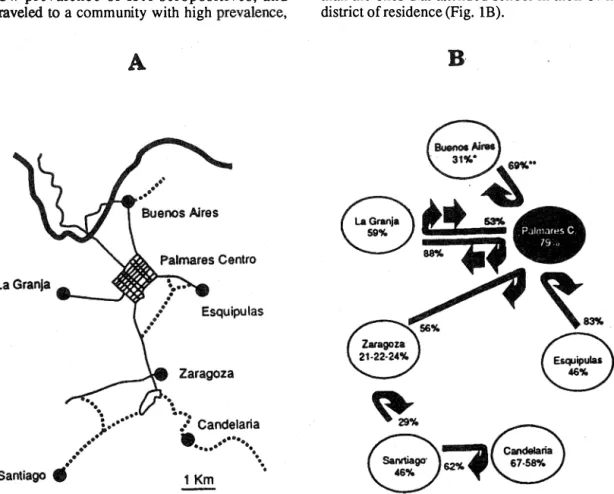
(4) REVISTADE BIOLOGIATROPICAL. 314. In general,chíldren who lived in a district of low prevalence of IFA-seropositives, and traveled to a community with high prevalence,. A. showed a higher percentage of seropositives than the ones that attended school in their own district of residence (Fig. lB).. B. Fig. 1. A. Districts and main routes of communication in Palmares County, according to the National Census, 1984: (-) Highway, (-) Road, (---) Secondary road. B. Percent of seropositives (* ) amon g individuals who attendent the scheoI of its own district of residence, Candelaria andZaragoza have two andthree schooIs respectively; and (**) children who studied in schools of neíghboring districts. The arrows indicate the way the children moved from one district to estudy in the neighboring scheol district.. In total, 1439 of the students belonged to families with two or more children included in the study,which allowed assessing family effect. The 2021 ehildren were grouped according to distriet and number of family members participating in the study (Table 3). The prevalenee of IFA antibodies in those groups was eompared with the seropositivity of the corresponding distriet. Differences among the families with 1, 2, 3 or 4 children, within a distriet,were not significant,with the exception of the families with one sehoolchildren from Palmares Centro,who had a higher percentage of positives than the families with two or more members (TabIe 3). Furthermore, differences between districts remained statistically signifi-. cant after adjusting by family groups,regardless of the numbcr of children per family. We obscrved that IgM and IgA positive titcrs (above 004 OD) were more frequent than IgG, in the 837 samples tested using ELISA (Table 2). The districts of Candelaria (14%) and Santiago (11 %) showed the highest prevalences for IgM and IgA respectively. DISCUSSION There has been no systematic investigation in tropi cal countries on the occurrence of M. pneumoniae infections,and liale is known about the prevalence of i15 antibodies and the relative burden of this agent on health in these areas..
(5) CAMPOS el al.:. Mycoplasma pn.eumoniae in. a tropical community. 375. TABLE3 Comparison ol lhe percentages 01 !FA seropositive children analyzed by district 01 residence andlamily nucleus conlormed by 1,2,3 and 4 schoolchildren. District of residence PalmaresCentro Zaragoza Buenos Aires Santiago Candelaria Esquipulas La Granja. %. Families with1 %** No.*. 79 22 31 46 58 46 59. 178 139 93 38 55 46 68. 85 *** 27 32 47 62 46 57. 49. 617 617. 52. District. Totalfamilies. Total children. * ** ***. Families with2 No. % 100. 82. 85 55 36 23 40 40 379 758. Families with3 % No.. Families with 4 No. %. 31 43 67 51 63. 22 17 15 14 11 16 6. 74 22 44 52 61 49 56. 1 6 1 3 2 1 2. 52. 101 303. 52. 16 64. 24. 50 17 50 33 50. 25 88. 45. Total number of families analyzed. Families with more than four schoolchildren were rare andtherefore excluded. Percent of seropositive schoolchildren. f"�:.tí·,,!¡(.('¡:. . i ." i'", f: pS; 0 .05 when compared with seropositivity in the district.. In temperate eountries, the frequeney of M. pneumoniae infections is known to inerease du ring winter months (Foy el al. 1979), while in the tropics, no specifie studies on the seasonal variations of M. pneumoniae infeetions have been eondueted. However, it has been observed that ARI increase during the rainy season (Monto and Johnson 1967). The samples for this study, were obtained during the rainy sea son of 1983. For that year, the Deparment of Statistics from the Ministry of Health, Costa Rica, reported a significant increase on ARI in relation to the previous three y ears, without i d entifying t h e etiology (Di v i s ión d e Epidemiología, Ministerio d e Salud d e Costa Rica, 1983). Therefore, by eoincidence, the sampling was performed during an ARI epide mico The data show that 53% of the schoolchil dren had positive antibody titers against M. pneumoniae by the IFA technique. This preva lence is high and consistent with an epidemic of M. pneumoniae. Furthermore, when the in formation of different districts was analyzed separate]y, significative differences were obser ved: percentage of positives ranged from 21 % in Zaragoza 10 79% in Palmares Centro (Table 2). lt is difficult to compare serologic data ob tained by dífferent procedures in several popu lations and al different times of the epidemic cycle; nevertheless our results ranged from as high as those reported by Brunner el al. 1977. (77%) and POnka and Ukkonen 1983 (77%) lO as low as those obtained by Foy et al. 1971 (14%) and Golubjatnikov et al. 1975 (18%). The differenees in the percent of seropositives observed among the Palmares's districts also suggests the coíncidenceof this sludy with an epidemic peak, which prob ably began i n Palmares Centro, was spreading t o the other communities, and y et had not affected sorne (like Zaragoza). This behavior is similar 10 the observation described by Foy el al. 1971, that the infeetion moved according 10 the supply of s u sceptibles, and the chanee f or effective contact eausing minor localized epidemies. Surprisingly, in that y ear, epidemics eaused by M. pneumoniae were also reported in several temperate countries (Ritter el al. 19i3, Lind and Bentzon 1988). The ELISA test was used 10 measure the ti ter of specifie antibodies against M. pneumo niae P-I prote¡n. Since these antibodies inerea se and decrease more rapidly after infection (Jacobs el al. 1986), when compared with the IFA-total antibodies against the complete bacte rial antigen(Hu el al. 1983), the presence of p I antibodies is associated with actual or very recent M. pneumoniae ¡nfection. Among the 837 children studied by this method. very few presented positive levels against P-l protein, as expected, since they were attendingschool at the moment of sampling. The few that were found positive may have had a recent ¡nfeedon.
(6) 376. REVISTA DE BIOLOGIATROPICAL. or were in me course of a mild one, as observed by others (Poy el al. 1966, Biberfeld and Stemer 1969, Denny etal. 1 971). The antibody responses, when positive, were mainly of the IgM and IgA type, as suggested by Cham hedain and Saeed 1983. The rustncts of Candelaria and Santiago have the highest proportion of ELISA seropositive children (TabIe 2). Both have the smallest schools and are more rural and isolated (TabIe 1, Fig . 1). Furthermore, the two schools in Candelaria showed differences between them (58% and 67%), by IFA, in contrast to the behavior observed among the three schools of Zaragoza (21 %, 22% and 24%). Again, the difference between me two schools of Candelaria may reflect an active epidemic process beginíng in that area and moving from Candelaria to Santiago. In this case, me children from Santiago who attended school in Candelaria could be taking me infection back to Santiago (pig. 1). In previous studies Foy etal. (1 9 66) found t hat children 5-14 years old were the most common primary cases of infection in me family, acting as a reservoir and becoming the most important vector. In contrast to mis observation, they considered mat the " cornmunicability .. at school was low compared with me transmission within the family (Foy et al. 1971). In the present study, the antibody prev alence of children who travel to Palmares Centro School, from an outside district was compared with me antibody prevalen ce of the children attending their own district's school (Fig. 1). The risk of acquiring me infection was five times greater for children traveling to study in Palmares Centro, compared with the children studying in their own school district. The importance of the school in the transmission of me M. pneumoniae was a1so evident when children living' in a high prevalence district traveled to study in schools of lower prevalence. In this case, the risk of acquiring the infection was lower for the children who traveled (TabIe 2, Fig lB). Furthermore, there were no significant differences between the prevalence of M. pneumoniae in families with 1, 2, 3 or 4 siblings (TabIe 3). , Similar to temperate countries, for 5 to 12 year old children, females had a higher antibody .prevalence (Golubjatnikov etal. 1975, Monto etal. 1975). The reasons are oot known and deserve further investigation.. The results of this study suggest that in Palmares the school played an important transmission role by concentrating the susceptible individuals and increasing me risk of an outbreak mat eventualy also hit families. This seems contrary to previous findings in countries with temperate cUmate (Foy etal. 1966). The reasons for these difference are not clear and should be subject for further sturues. ACKNOWLEDGEMENTS This work was supported in part by INCIENSA-DESAF, me Deutscher Akademis cher Austauschdienst (DAAD) and the International Center for Medical Research Training. We thank W.A. CIyde, University of North Carolina, and G. H. Cassel, University of Alabama, for training one of us in the M. pneu moniae diagnostic techniques. To Luz Marina Sánchez, Oiga Sánchez and Karen Oberle for their skillful technical assistance and Douglas Taren, Rolando Celada and Jorge Piza for help in the statistical analysis and critical review of this papero We also recognize the invaluable support given by the Community of Palmares and their health officers. REFERENCES Biberfeld, F. & G. Stemer. 1969 . A study of Mycoplasma pneumoniae infections infamilies.lInfect.Dís. 1:39-46. Brurmer, H., B. Prescott, H. Greenberg, W.D. James, R.L Horswood & R.M.'Chanock, 1977 . Unexpectedly high frequeney of antibody to Mycoplasma pneumoniae in human sera as measured by sensitive teehniques. J.Infeet.Dis. 135:524-530 . Chamberlain, P. & AA Saeed. 1983 . A study of me speci· fíe 19M antibody responsein Mycoplasma pneumoniae infection in mano J.Hyg.Camb.90:207-211 . Chanoek, R.M H.H. Fox, W.D. James, R.R.Gutekust, R.J. Whíte & L. B. Senterfit. 1967 . Epidemiology of Mycoplasma pneumoniae infection in military recruíts. Arm.NY.Acad.Sci. 143:484·496 . .•. Chavarría, J.F. 1985 . Mortalidadpor infección respiratoria aguda en Costa Rica, p. 181 -190 . In C ontrol and Eradication of Infectious Diseases. An Intemational Symposium. Washington, D.C.: Pan American Health Organization Copubl. Ser. NO.I. Dean, l.A., A.G. Dean & A. Burton. 1988. Epi-lnfo, version 5: computer programms for epidemiology. Department ofHealth and Human Services. Center for . DiseaseControl,.Atlanta, Georgia.157 p..
(7) CAMPOS el al.: Mycoplasma pneumoniae in a tropical community. Denny, F.W., W.A . C lyde & W.P. Glezen. 1971. Mycoplasma pneumoniae disease: clinical spectrum, p a lhophys iology, epidemiology, and control. J.Infect.Dis. 123:74-92. Dirección General de Estadísúca y Censos. 1987. Censo de población 1984. San José, CR: Imprenta Nacional. Tomo. I. 198 p.. Evans, A.S., V. Allen & S. Sueltman. 1967. Mycoplasma pneumoniae infeclions in University of Wisconsin students. Am.Rev.Resp.Dis. 96:237-244. Foy, H.M., G.E. Kenny, R. McMahan, .G.Kaisen & T. G r ayston. 1971. Mycopla sma pneumoniae in the community. Am.J. Epidemiol. 93: 55-67. Foy, H.M., G.E. Kenny, M.K. Cooney & LD. Allan. 1979. Long-L er m epidemiology of ¡nfeetions w i th. a dot enzyme-lin k ed immun osorbent Eur.J.Clin.Microbiol. 5:435-440.. 377. assay.. James, J.W. 1972. Longitudinal study of lhe morbidity of diarrheal and respiratory infections in malnourished children. Am.J.Clin.Nut. 25:690-694. Lind, K. & M. W. Bentzon . 1988. C hanges i n the epidemiological pattem of Mycoplasma pneumoniae infeclions in Denmark. A 30 years survey. Epidem.W. 101:377-386. División de Epidemiología, Ministerio de Salud de Costa Rica, 1983. Casos registrados de enfermedades de declaración obligatoria en Cost a Rica. Semana Epidemiológica. Enero-Diciembre 1983, San José, Costa Rica.. Mycoplasma pneumoniae. J,Weet.Dis. 139:681-687.. PA HO. 1980. Bol.Epidemíol., P an A merican Health Organization, Washington, DC, 1 :2.. Golubjatnikov, R., V.S. Allen, M.P. Olmos-Blancaparte & S.L. Inhom. 1975. Serologic profile of children in a Mexiean highland commu nity: prevalence o f complement-fixing an tibodies to Myco pl asma. Ponk¡¡, A. & P. Ukkonen. 1983. Age-related prevalence of com plement-fixing antibody to Myco plasma pneumoniae during an 8-year periodo J.Clin.Microbiol.. pneu m oniae, respi ratory s y ncytial virus and parainfluenza viruses. Am.J.Epidemiol. 101:458- 464.. Jacobs, E. & A. CIad. 1986. Electroelution of fixed and stained membrane proteins from preparative sodium dodecyl sulfate-polyacrylamide gels into a membrane trap. Anal.Biochem. 154:583-589. Jacobs, E., K. Fuchte & W. BredL. 1986. A 168-Kilodalton protein of Mycoplasma pneumoniae used as anúgen in. 17:571-575. Ritter, E., W. Nieklisch & A. Lange. 1983. Study about infections with Mycoplasma pneum oniae of out patients with respiratory ínfectÍons. Z.Gesamte.Hyg. 29:435-438. Wreghitt, T.G. & M. Sillis. 1985. A Il-capture EUSA for detecting Mycoplasma pneumoniae IgM: comparison with indirect irnmunofluorescence and indirect ELISA. J.Hyg.Camb. 94:217-227..
(8)
Figure
Documento similar
questionnaire (completed by family), and the “Mode and frequency of commuting to and from school” questionnaire (completed by children. The validation between family
The general aim of the present Doctoral Thesis was to study the patterns of commuting to school in Spanish children and adolescents, through three cross- sectional
In the preparation of this report, the Venice Commission has relied on the comments of its rapporteurs; its recently adopted Report on Respect for Democracy, Human Rights and the Rule
The present study analyzes the capacity of children with SLI, children with typical language development and adults to process the mentioned linguistic elements
This study aims to analyse the psychological impairment caused in Spanish children exposed to IPV. It was hypothesized that children who had been exposed to IPV would exhibit:
The objectives of this study in 7-8-year-old primary school children were to determine the effects of reading a book translated at a macrolevel in one of three ways
Toxoplasmosis, Toxoplasma gondii, epilepsy, cryptogenic epilepsy, focal seizures, seroprevalence, risk factors, antibody titers, IgG, children, adolescents, Libya,
Attention deficit hyperactivity disorder (ADHD) is one of the most common neurodevelopmental disorders in childhood. Up to 5.3% of the school-age children are
