50
W 0°
E
5098. FIRST RECORD OF THE EPIZOIC RED SEAWEED POLYSIPHONIA
CARETTIA HOLLENBERG IN THE MEDITERRANEAN SEA
José C. BÁEZ, Juan A. CAMISIAS, Julio VALEIRAS,
Francisco CONDE & Antonio FLORES-MOYA
Primera cita del alga roja epizoica Polysiphonia carettia Hollenberg en el mar Mediterráneo
Key words. Caretta caretta, epibionts, Mediterranean Sea, Polysiphonia carettia.
Palabras claves. Caretta carom, cpibiontes, Mar Mediterráneo, Polysiphonia carettia.
Pelagic animals, such as cetaceans and
sea turtles, are a singular habitat for growth of
benthic organisms. The loggerhead turtle,
Caretta caretta (Linnaeus, 1758), is a species
that can sometimes become an "ecosystem"
itself because it support a very rich flora (Cribb,
1969; Abel Sentfes
et al.,1999) and fauna
(Frazier
et al.,1985; Caine, 1986; Frick
et al.,1998; Frick
et al.,2000) occurring as epizoic
organisms.
Several studies on epibionts of loggerhead
turtles have been carried out from samples
collected on female individuals during egg
laying events that took place on beaches. Dodd
(1988) found 5 genera of seaweeds growing on
C. caretta, but they were identified in that
paper only as green or red algae, without
specific designation. Ninety-three species of
epibionts (including 7 identified genera of algae
as well as other unidentified green algae and
diatoms) have been recorded on C. caretta
from the North American shores of the Atlantic
Ocean (Caine, 1986; Frick
eta!.,1998). Abel
Sentíes
et al.(1999) reported 37 species of
seaweeds growing on C. caretta from the
Caribean coasts of Mexico. Recently, Frick
et al.(2000) found 7 new algal species on C.
caretta, among which an unidentified green
alga.
Frazier
et al. (1985) carried out a revision of the epibiont molluscs ofC. caretta from the
eastern Mediterranean Sea mentioning the
presence of Sphacelaria tribuloides Menegh.,
Chaetomorpha linutn (0.F. Müller) Kiitz.,
Cladophora sp. and Polysiphonia sp. As far as
we know, this is the only study of epibionts of
C. caretta carried out in the Mediterranean
Sea.
We now report the first record of
Polysiphonia carettia Hollenberg in the
Mediterranean Sea. The samples were obtained
from two individuals of loggerhead turtle. Both
animals had a shell 39 cm in minimum strength
450
4Ø0
3 50
198
Acta Botanica Malacitana26. 2001
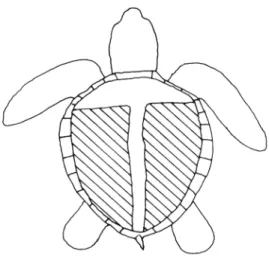
Figure
2.
Distribution of Polysiphonia careitiaHollenberg
on theloggerhed
turtle carapace (oblique lines area).carapace length
(MSCL);
therefore, they were probably young individuals because the shell of adult individuals usually measures around74
cm inMSCL
(Marquez,1990).
They were captured by aspanish longline
vessel on October30th 1999,
at38°12'69"N
001°29'62'E
(fig. 1). The algae, distributed on the carapace as shown in figure2,
were collected by scraping the shell carapace of the turtles with a diver's knife. The samples were preserved in4% formalin-seawater.
They were deposited at Herbarium of the Department of Plant Biology, University of Malaga(MGC
Phyc).
They were a cession from theInstituto
Español
deOceanografía.
The turtles were handled carefully in order to preserve the health of the animals.Polysiphonia carettia Hollenberg
(Ceramiales, Rhodomelaceae), MGC Phyc
3742
This species is characterized by its red-brown,
uncorticated thallus
of0.5-4
cm in length, with fourpericentral
cells surrounding one axial cell, which is smaller in diameterthan the
pericentral
cells (fig.3.1).
Thethallus
present creeping axes attached by unicellular
rhizoids,
which initially are in open connection withpericentral
cells (fig.3.2)
and, when fully developed, cut off by a cross wall (fig.3.3).
Erect axes have a sparse, irregular branching pattern in the basal and middle portions, whereas the branching is irregular and dense in the distal part. Erect segments are longer than their width (ratio length/width=
1.3)
and bear deciduoustrichoblasts. Tetrasporangia
are spherical and are disposed in a spiral series in the distal branches (fig.3.4);
they measure over40-43 j_tm
in diameter.Cystocarps
areovoid-urceolate,
with a short peduncle, and measure up to216
pm in length and144
p.m in diameter. Thepericarp
is formed by irregularly distributed polygonal cells similar to the cells of theostiole
(fig.3.5).
Thecarpospores
arepyri
form and up to70-80
p.m in length and30-33 ¡.tm
in diameter. Nospermatangial
branches were found.Polysiphonia carettia
has been reported on the shells of nesting loggerhead turtles in California(Hollenberg, 1971),
Canary Islands(Rojas-González
eta!., 1994) and the Caribbean Sea (AbelSentfes
et al.,1999).
The geographical distribution ofP.
earettia
is extended with this study to the Mediterranean Sea.In the Northern Hemisphere, loggerhead turtles make use of two nesting regions in the north Atlantic Ocean and in the Mediterranean Sea: the one is located on the southeastern shores of the USA and the Gulf of Mexico; the other one in the eastern Mediterranean
50
pm
2
3
RE
s=c-
-100
pm
30
pm
Figure 3. Polysiphonia carettia Hollenberg. 1, cross section of axes; 2-3, postrate axes with unicellular rhizoid; 4, teirasporangial branches; 5, branch with cystocarp.
Polysiphonia
sp. growing onOstrea edulis
Linnaeus (occurringas
anepibiont
onC.
caretta
in the eastern Mediterranean Sea), we think that species could not heP.
carettia
because thistaxon has
always been found on the loggerhead turtle and not on any other substratum(Hollenberg, 1971; Hollenberg
and Norris,1977; Rojas-González
eta!.,1994; Abel
Sentíes
et al.,1999).
It is known that the populations of loggerhead turtles from the eastern MediterraneanSea are
genetically isolated from the population from thewestern
area (Laurent eta!., 1998). Thus, the finding of
P.
carettia
growing on youngindividual
of loggerhead turtles in the western MediterraneanSea
could be explained bya
migratoryhypothesis, that
is,
some young turtles foundin
that area could come from Atlantic populations and have penetrated into thewestern
MediterraneanSea
through the Strait of Gibraltar(Camitlas, 1992, 1995, 1997b;
Bolton eta!.,
1998). By
this line of reasoning, it could be interesting to study theepizoic
algae growing on loggerhead turtles of the western Mediterranean
Sea,
in order to distinguish the Atlantic from the eastern Mediterranean populations of loggerhead turtles. Thus,P.
carettia
couldbe
usedas a
200 Acta Botanica Malacitana 26. 2001
Sea. However, it is necessary to study many
more samples of algae growing on loggerhead turtles from both the western and eastern Mediterranean Sea in order to test this
hypothesis.
The samples of P. carettia studied show rhizoids that when fully developed were cut off by a cross wall, in agreement with the observations from Rojas-González et al.
(1994). In the original description of the taxon, Hollenberg (1971) described rhizoids that were not cut off by a cross wall (as shown in fig. 3.2), but based on these more recent observations we believe that this character in
the original description must be revised (see fig. 3.3). On the other hand, our samples are bigger (up to 4 cm in length) than the thalli found in the Canary Islands by Rojas-González (1997) (up to 2 cm in length) and with tetrasporangia of greater diameter.
ACKNOWLEDGEMENTS. This study was supported by two projects from the Oceanographic Centre of Málaga of the Instituto Español de Oceanografía (IE0), in cooperation with European countries, and co-financially supported by the European Union: Project EMTP (Assessing marine turtle bycatch in European drifting longline and trawl fisheries for identifying fishing regulations) and Project SWOMED (Swordfish fisheries in the Mediterranean Sea). We thank to Jose Miguel de la Serna and Dr. David Macías (Oceanographic Centre of Málaga of the IE0) the data cession about the SWOMED Project. We also thanks to the skipper of the fishing boat "Nuevo Taconeo", Antonio Lozano Gómez, as well as its crew for their help on board during sampling periods. Dr. Antonio Secilla (Dpto. Biología Vegetal y Ecología, Universidad del País Vasco) confirmed the identification of Polysiphonia carettia. Dr. Eric C. Henry (Herbarium, Department of Botany and Plant Pathology, Oregon State University, Corvallis. Oregon, USA) kindly revised the style and English usage.
REFERENCES
ABEL SENTÍES, G., J. ESPINOZA-AVALOS & J.C. ZURITA -1999- Epizoic algae of nesting
sea turtles Caretta carctta (L.) and Chclonia mydas (L.) from the Mexican Caribbean. B. mar. sci. 64: 185-188.
BOLTON, A.B., K.A. BJORNDAL, H.R. MARTINS, T. DELLINGER 8z. M.J. BISCOITO -1998- Transatlantic developmental migrations of loggerhead sea turtle demonstrated by mtDNA sequence analysis. Eco!, app!. 8: 1-7. CAINE, E. A. -1986- Caparace epibionts of nesting
loggerhead sea turtles: Atlantic coast of U.S.A. J. exp. mar. Biol. Eco!. 95: 15-26.
CAMINAS, J.A. -1992- Hipótesis migratoria de la tortuga boba (Caretta caretta) en el Mediterráneo occidental a partir de datos procedentes de pesquerías superficiales. I Congreso Nacional de Reptiles marinos. Begur (Girona).
CAMINAS, J.A -1995- The loggerhead Caretta caretta (Linnaeus, 1758) pelagic movements through the Gibraltar Strait. Rapp. Comm. Int. Mer Médit. 34: 238.
CAMINAS, J.A. -1997a- Capturas accidentales de tortuga boba Caretta careful (Linnaeus, 1758) en el Mediterráneo occidental en la pesquería de palangre de superficie de pez espada (Xiphias gladius L.). International Commission for the Conservation of Atlantic tunas. Collective Volume of Scientific Papers, vol. XLVI (4): 446-455.
CAMINAS, J.A. -1997b- Relación entre las poblaciones de la tortuga boba Caretta caretta (Linnaeus, 1758) procedentes del Atlántico y del Mediterráneo en la región del Estrecho de Gibraltar y areas adyacentes. Rev. Esp. Herp. II: 91-98.
CRIBB, A.B. -1969- Algae on a Hawk's-Bill turtles in Nothern Australia. Aust. Zoo!., 15: 150-159. DODD, C.K -1988- Synopsis of the biological data on the loggerhead sea turtle Caretta caretta (Linnaeus 1758). United States Fish and Wildlife Service, Biological Report 88(14): 1 lOpp. FR A IZER, J., D. MARGARITOULIS, K.
MULDOON, C.W. POTTER, J. ROSEWATER, C. RUCKDESCHEL & S. SALAS -1985-Epizoan communities on marine turtles: I. Bivalve and Gastropod mollusks. Mar. Eco!. P.S.Z.N.I., 6(2): 127-140.
211-214.
FRICK, M.G., K.L. WILLIAMS, D. VELJACIC, L. PIERRARD, LA. JACKSON & S.E. KNIGHT 2000- Newly documented epibiont species from nesting loggerhead sea turtles (Caretta caretta) in Georgia, USA. Marine Turtle Newsletter 88: 3-5.
HOLLENBERG, G.J. -1971- Phycological notes. V. New species of marine algae from California. Phycologia 10: 11-16.
HOLLENBERG, G.J. & J.N. NORRIS -1977- The red alga Polysiphonia (Rhodomelaceae) in the Northern Gulf of California. Smith. Contrib. Mar. Sci. 1: 1-21.
LAURENT, L., P. CASALE, M.N. BRADAI, B.J. GODLEY, G. GEROSA, A.C. I3RODERICK, W. SCHROTH, B. SCH1ERWATER, A. M. LEVY, D. FREGG1, E.M. ABD EL-MAWLA, D.A. HADOUD, H.E. GOMATI, M. DOMINGO, M. HADJICHRISTOPHOROU, L. KORNARAKY, F. DEMIRAYAK & CH. GAUTIER -1998- Molecular resolution of marine turtle stock composition in fishery by-catch: a case study in the Mediterranean. Mol. Eco!. 7: 1529-1542.
MARGARITOULIS, D. -1982- Observations on loggerhead sea turtles (Caretta caretta) activity during the nesting seasons (1977-1979) in Zakynthos, Greece. Biol. Conserv. 24: 193-204. MARQUEZ, M.R. -1990- FAO Species catalogue. Sea turtles of the world. An annotated and illustrated catalogue of sea turtle species known to date. FAO Fisheries Synopsis, 125. Rome, FAO. Vol.: II.
ROJAS-GONZÁLEZ, B. -1997- Estudio de las especies de la Familia Rhodomelaceae (Rhodophyta), con exclusión de las Tribus Chondriaceae y Laurencieae, en las Islas Canarias. Ph. D. thesis. Univ. La Laguna. La Laguna, Canary Islands.
ROJAS-GONZÁLEZ, B., J. AFONSO-CARRILLO & C. IBEAS -1994- New records of Rhodomelaceae (Rhodophyta) from the Canary Islands. Rot. Mar. 37: 133-138.
Aceptado para su publicación en noviembre de 2001