Finalmente agradezco a todos los chicos maravillosos que comparten su tiempo y me brindan su amistad. A mi amada esposa por la fe y la confianza en mí, por los consejos, la paciencia y todo el amor.
INTRODUCTION …
The context of the research
Aim or purpose
Research questions
LITERATURE REVIEW …
Language learning
- Learning vocabulary
- Memory strategies in learning vocabulary
- Visual aids in vocabulary learning
- Diagnosing and testing vocabulary
- A song to develop vocabulary
It is not debatable that vocabulary is one of the primary tasks in teaching a second language. It helps students learn easily because of the senses they use in the learning process.
The listening skill
- Learning listening
- Native listening skill
- Foreign learners listening skill
- The Total Physical Response (TPR) method and visuals effect on listening
The top-down processing” listeners interpret the meaning of the message by making use of their previous knowledge. Whoever learns a foreign language must establish the context for the language performance.
Mnemonic devices / strategies
The song "I love going to school" in this study was written considering various words and expressions to be supported by the TPR method. According to Long & Richards (1987), one of the main issues of the Total Physical Response Method is to provide students with oral input in the language they are studying before they are able to read or write in the second language. Visual and physical mnemonic devices in this work were a very useful tool during the teaching of the vocabulary process, as they provide the necessary support for it.
In order to ensure the availability of information, they are mentioned in this part of the writing. They not only help students to recall words easily and quickly, they are also an effective tool for motivating students. Words are not the only thing that can convey meaning, images play an important role.
Physical response mnemonics (commands): In this strategy students are asked to follow some instructions or commands by moving some parts of the body according to the meaning of the words. For example, when the teacher says "get up guys!" students should understand that only the men in the class should stand up.
Listening materials
- Recordings as materials
- Home-made materials
All the conventional skills (listening, speaking, reading and writing) must be introduced simultaneously so that one can support, help and strengthen practice with the other. Rivers (1971) states that "early listening comprehension material must be kept within the bounds of structural patterns being learned". 3) Language learning is a comprehension-focused process. The tests that teachers use to deliver the input that students need to understand must include things that are placed one linguistic stage ahead of the learners' level of L2 production in order for comprehension to be learned.
Students should be allowed to answer questions in their L1 to develop the necessary confidence. According to Underwood (1989), one advantage of using tapes as teaching material is that they can be played as much as necessary to improve vocabulary and pronunciation. In the case of the song used in this study, it should be emphasized that some of the problems that non-authentic dialogues have, such as unnatural rhythm, unnatural rhythm, can be avoided or overshadowed even though the pronunciation is not authentically native. intonation and artificial stops and starts (Underwood, 1989).
An advantage of using homemade materials is that they are cheaper and it is not necessary to spend too much time finding them in the market. Robinson (1991) states that the most important thing is that teachers can pay attention.
Listening activities
- The Pre - listening stage
- The While – listening stage
- The Post – listening stage
This type of help from the teacher allows the listener to select the correct information from the message, thereby reducing the amount of information processing and memorization. Teachers should therefore work in advance with an adequate pre-listening activity, especially at the beginning of each course, to clarify the listening purpose and specific task details. Group format: working in a group format promotes and increases the social cooperation and integration of students in the classroom.
Anderson and Boyle (in progress) L1 research using controlled comparisons of the performances of groups and individuals confirmed the benefits of group work. When group work was combined with pre-listening activities where the previous knowledge of the students was activated, they performed better. Learners need to be supported and familiar with the topic before working in the main activity.
Underwood (1989) suggests that teachers help their students know in advance what they are likely to hear in the recording. According to Underwood (1989), post activities are an extension of the previous pre-listening and during-listening activities.
Songs in listening activities
- The effect of song on children in learning vocabulary process
Here the teacher's purpose is to know or check what students have learned to be aware of what they need to understand. Griffee (1992) states that emotions are very important in the learning process and songs are a very useful medium to stimulate them. Songs make the learning process more enjoyable for children and it stimulates and motivates them to learn.
Anton (1990) states that music as a memory booster is one of the most effective aids in teaching and learning a language to recover grammatical structures.
Writing a song to teach vocabulary
- Basic music concepts
- The music
- The lyrics
- The recording
Children experience low levels of anxiety and self-confidence when taught using songs. The song in this study is intended to entertain students when they have auditory contact with it through rhythm, melody and harmony. The rock genre is one of the most popular styles of music and children are easily involved in this type of song or music.
There are eleven words and eight commands that form the vocabulary that this study says students should learn through the song. The recording was developed in a home studio with the basic equipment consisting of an electric guitar, an electric bass guitar, a microphone, an audio mixer, an iPad for the drum sounds and simple software for the recording process, the definitive edition and master of the song.
The importance of context
Nevertheless, not only a song was used, visual aids supported the use of the song which facilitated the learning of vocabulary.
METHODOLOGY
- Research design
- Context and setting description
- Participants
- Instruments
- Song composition
- Data collection process
In other words, it is participatory classroom research where the researcher is part of the investigation. The second instrument was a diagnostic chart that includes eleven vocabulary items and seven commands; they are all part of the lyrics in the song. All words and commands are located in the first row of the table, and in the first column are the numbers of the student list.
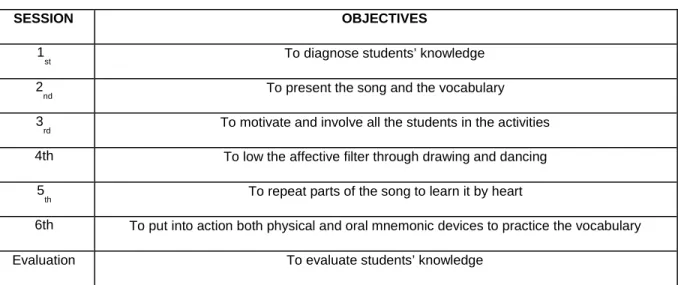
At the moment of diagnosis, the teacher asks the students to go close to the desk where the teacher has previously put three sheets with pictures related to the vocabulary. Furthermore, it was planned to maintain a connection between the recording material and the teacher's voice and pronunciation in order to accustom the students to them at this stage of the learning process. One of the first steps was the creation of a song containing vocabulary words relevant to the target audience.
Sometimes the song was played at this stage of the lesson, sometimes at the beginning, sometimes at the end, and the song was played twice. The vocabulary learned by the children at the end of the study was recorded in the corresponding evaluation chart.
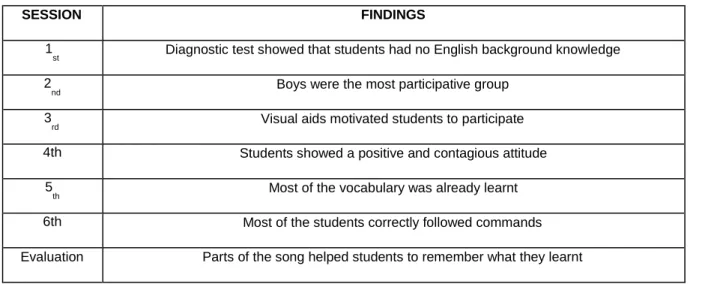
RESULTS
- First session
- Second session
- Third session
- Fourth session
- Fifth session
- Sixth session
- Evaluation
Previously, the song teacher made a warm-up related to the commands of the song and performed it as well. After that teacher played the song, some students were embarrassed and they did not participate very well; girls were the least participating in the activities and during the song practice. However, the rest of the class showed a good attitude towards the song which can answer the first research question from this study.
During the song, the teacher anticipated some parts of the song so that the students could hear them right away. Before the song, the teacher asked the students to repeat some parts of the song after him, first sentence by sentence and then a whole paragraph. He then talked to the students about the name of the song and its meaning.
Then the teacher and students repeated the second part of the commands from the song and later practiced the same commands during the song. When the students showed some confusion about the vocabulary, the parts of the song helped them a lot to remember the vocabulary or the commands.
CONCLUSIONS
- Implications
- Limitations
- Directions for further studies
- Final reflection
One of the key terms in the study was to identify a group of children from the third grade of kindergarten who had never attended English classes. A specific context does not make it possible to obtain a general perception of the effect of a song on vocabulary learning when applying the research to different schools with children of different ages. Time was the most important aspect that could affect the study, not only because of the time each session lasted, nor even because of the number of sessions in which the study was conducted.
A quantitative study can show more accurate results by considering or measuring the student's knowledge at the end of the research. A better planned or proven support for song (mimicry, flash cards, exercises or games to practice vocabulary, better audio. It is well known that music as a tool in the learning process is motivating, effective, entertaining, obstructive and much more.
Despite the fact that the students' lack of knowledge of the English language and the teacher's short experience, the results were unexpected but good results and finally answered the research questions. However, during this study I was able to expand that view to know and imagine when and how to apply music as a useful tool in the classroom.