This thesis has been read by the members of Javier Tapia Morales' committee. EDUCATIONAL MODEL UVP IN THEIR EDUCATIONAL PRACTICE, submitted as part of the Masters in English Language Teaching at the Universidad Autónoma de Puebla in May 2022, is my own original work.
Research questions
How the practice in the classroom is closed to the theory of the "Tlamatini" Model based on the teachers' perceptions. How do teachers perceive the usefulness of the "Tlamatini" model in their daily teaching practice.
Purpose of the study
The descriptive criteria of UVP's "Tlamatini" educational model are applied to all its diplomas, master's/doctoral programs and secondary schools. The purpose of this qualitative research is to analyze and analyze the perceptions of teachers who use the "Tlamatini" model at the Universidad del Valle de Puebla (UVP).
General objective
Specific objectives
Premise
Limitation of the study
Second, the resistance that some of them may show in participating in the research is based on the nature of the project. However, both the strengths and weaknesses of the model can be presented in a positive and reflective manner to maximize further improvements.
Importance of the research
Therefore, the purpose of this research is to examine the views of teachers at the Universidad del Valle de Puebla regarding the implementation of "Tlamatini". Through the teacher's experience and the use of the educational model, it is possible to see how the learning practices are related to what is expected in "Tlamatina".
Chapter's summary and overview
However, the understanding of the educational model may have some inconsistencies in practice, which may cause its failure if the community does not work in harmony with the university's philosophy.
THEORETICAL FRAMEWORK
UVP Model: Its grounds
Second, Tlamatini aims to make students aware of social reality through decision-making and independent judgment. In addition, with this foundation, Tlamatini intends to create an education where awareness of social and personal actions, behavior and decisions is encouraged.
Aims and objectives of the UVP model
By implementing this foundation, both teachers and students can live by the values of the Education Model. Through the use and implementation of these elements, both students and teachers can achieve the goals and objectives of the educational model.
UVP Curriculum
The one-dimensional element of the curriculum provides students with professional and disciplinary competencies that can be used in their field of study. The two-dimensional element of the curriculum is intended to develop in students the ability to create scientific and research projects.
Constructivism the pedagogical theory of the “Tlamatini” Model
Another important contribution of Vygotsky's social constructivism is that it considers individual learning as the result of a historical and social process where language plays an essential role. According to McLeod (2019), meaning construction is a social ability in which each member's interaction leads to or develops abstract concepts that exist only in the social minds of group members.
UVP Teachers’ role
For Payer (2005), new knowledge schemes of people are formed from the person's reality which are products of their interactions or reciprocal participations and their comparison with the schemes of the other individuals around them. Therefore, the teacher should also inquire about students' understanding of concepts before sharing these concepts with them.
Teaching competencies
Furthermore, teachers must be humble enough to recognize their own mistakes and learn from others. Students must be aware of their strengths and weaknesses, goal-oriented and open-minded and accept change as part of a process of improvement.
Assessment
It is therefore necessary to train teachers to promote learning and use modern and innovative teaching methods that will enable students to become active entities of their own learning. It is expected that this process' objectives will be achieved during the three evaluation periods in the semester.
Competencies
- UNESCO
- Common European Framework of References
Learning to know," is understood as learning to learn and includes the development of the capacities of memory, imagination, reasoning, problem solving and the ability to think coherently and critically (Delors, 1996). Finally, Delors offers another pillar called "learning to be" whose goal is to develop a sense of self-fulfillment of the person's behavioral, temperamental, emotional and spiritual.
Chapter's summary and overview
Finally, pragmatic competence focuses on meaning that cannot be predicted by linguistic knowledge alone and takes into account our understanding of the physical and social world. There is a close connection between knowledge of language and its use in communicative acts, because words can always convey much more than what they mean. Practical competence refers to the user's/learner's understanding of the principles according to which the messages are trying to be conveyed.
This chapter deals with the description of the methodological considerations taken into account in conducting this research.
Qualitative approach
The paper also tries to analyze whether the practice in classrooms is close to the theory of the model and the teacher's practice. Given the nature of the objectives of this research, the best way to collect data from the entire population of teachers would be to use a qualitative technique. Consequently, and due to the nature of the data to be collected, a qualitative approach was used to analyze the usefulness of the "Tlamatini" model, taking into account the perspective of the teachers who used it in practice in their daily teaching and the teachers who created it. .
As we have seen, during an interview participants can express their thoughts and criticize the theory of the model.
Case study method
Technique
Instrument
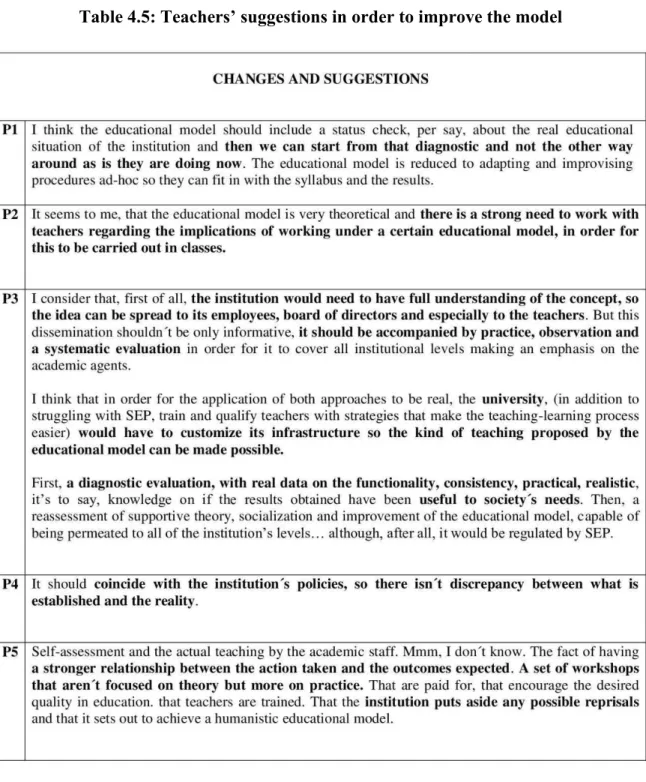
In the last section, the participants were allowed to give their own opinions on possible changes and suggestions for the model. The final part of the interview uses open-ended questions that let the participants answer all the questions (Creswell, 2005). The questions in the final part were: What changes would you suggest to the educational model in terms of evaluation, method, goals, roles of teachers and students, and institutional philosophy.
Finally, the instrument used in this study consisted of twelve questions (see appendix I).
Participants
In the first one, teachers are involved in their professional choices and continue to work with more energy. For Huberman, teachers with one to three years of experience are in the exploration and stabilization phase. On the other hand, experienced teachers were placed during and after the diversification and crisis phase, involving seven to eighteen years of experience.
He had three years of experience and he had worked at the Universidad del Valle de Puebla for two years.
Data gathering
For this reason, the second step of this research was to make some changes to the first interview. Some of them doubt the answer because the question went straight to the point: For example, the initial question included an item such as “Do you think the model is efficient. Asking how you think the assessment suggested in the model would allow measuring the students' learning process.
The second and last change it suffered was related to the emergence of some information in the transcript.
Data analysis
The first part of this work shows the teachers' opinion about the advantages and disadvantages of the "Tlamatini" educational model. First, it showed some advantages and disadvantages of the educational model held in UVP. Tlamatini" Educational model of the Universidad del Valle de Puebla in their daily teaching practice.
This section provides an explanation of the relationship between the model and the teacher's practice.
Data categories and codes
- Chapter conclusions
FINDINGS
- Objectives and roles established in TLAMATINI
- Evaluation
- Model practicability
- Changes and suggestions
- Chapter conclusions
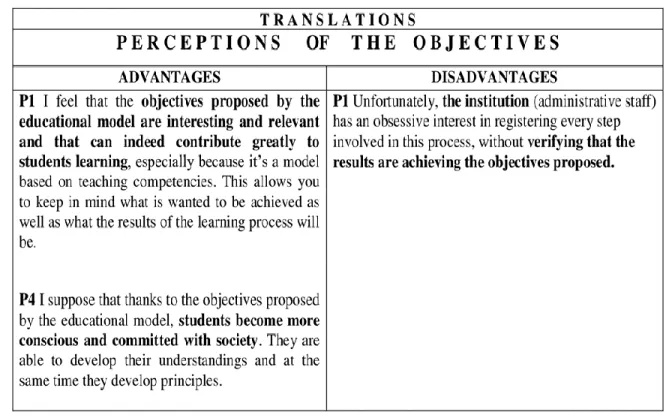
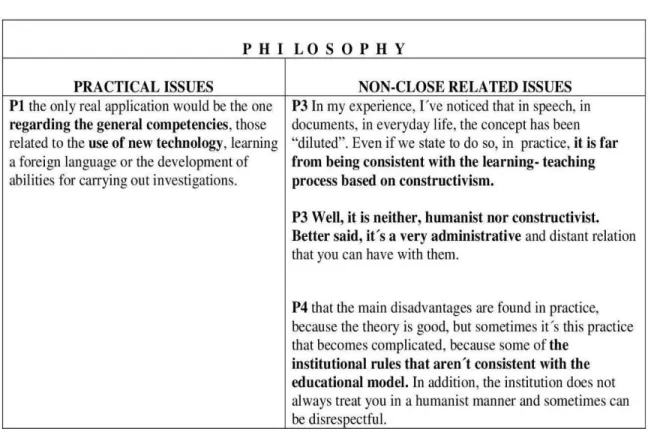
This section is intended to discuss the advantages and disadvantages of teachers in terms of the institution's philosophy, methodology, objectives, teachers' roles and evaluation. The first one deals with the institution's philosophy and methodology, while the second part describes the importance of the goals established by the model and teachers' roles. Finally, the last part of this section provides a clear description of the teachers' opinions about the evaluation that the "Tlamatini" prescribes for students.
The second part of the graph shows the advantage of the proposed role of teachers in TLAMATINI.

CONCLUSION
- Central Research question
- Supporting research questions
- What are some advantages of the” Tlamatini” Educational Model?
- What are some disadvantages of the ”Tlamatini” Educational Model?
- How is the practice in the classrooms close to the theory of the
- Educational model’s Theory evaluation
- Suggestions to the Educational model’s Theory
- Conclusions
- Limitations of the study
- Directions for further research
Finally, and in line with the previous advantage, the model also seeks to train professionals who are aware of this. From the teachers' narration, it emerged that the teachers do not find the values of the model very applicable to their reality. To complement this information, the second finding shows the practicability of the theory embedded in "Tlamatini" with the teachers' actual teaching practice.
This finding is important because it demonstrates the most practical and impractical aspects of the model.
PARTICIPANT 1 (P1)
Por otro lado, la falta de proyectos de largo plazo, producto de la constante rotación del personal, tanto administrativo como educativo, hace que el modelo educativo no tenga una aplicación real en los programas. Aunque teóricamente bien fundamentado, no es coherente con la realidad de la práctica docente en la universidad y está muy desconectado, especialmente con la parte administrativa. Creo que el modelo fue concebido con una función homogeneizadora, supongo que tiene que ver con establecer los principios según los cuales se gestionaría el servicio educativo de la universidad, pero es demasiado teórico.
Por parte de la administración universitaria existe un sentimiento constante de desconfianza y falta de respeto hacia los docentes.
PARTICIPANT 2 (P2)
78. Al parecer, el modelo educativo es muy teórico y sería necesario trabajar mucho más a fondo con los docentes sobre las implicaciones de un modelo educativo en particular, para que esto se refleje en las clases. 8) ¿Qué aplicación real puedes encontrar en la teoría del modelo educativo dentro de tu práctica docente? 10) ¿Qué aporte crees que hacen las metas propuestas por el modelo educativo al aprendizaje de los estudiantes?
12) ¿Considera que la evaluación que propone el modelo educativo ayuda a verificar el desarrollo de habilidades en los estudiantes?
PARTICIPANT 3 (P3)
En mi experiencia, repito, fue incluso frustrante encontrarme con la disonancia del discurso y las exigencias académicas y administrativas de la institución. Considero que para aplicar realmente ambos enfoques en una universidad sería necesario (además de combatir los COP, formar y educar al profesorado en estrategias que faciliten el proceso de aprendizaje) adecuar los espacios físicos para que el tipo de enseñanza que se manifiesta en el modelo se ha vuelto real. La definición de “humanizar” no me queda clara, y no entiendo cómo quieren realmente que se trabaje en el aula.
Luego un proceso de replanteamiento de las teorías que lo sustentan, luego la socialización y perfeccionamiento del modelo que lo permea a todos los niveles de la institución.
PARTICIPANT 4 (P4)
Me parece que las principales debilidades se encuentran en la práctica, porque la teoría es buena, pero a veces es la práctica la que se complica, por algunas reglas institucionales que no se corresponden con el modelo institucional. ¿Qué aplicación práctica puedes encontrar en la teoría del modelo educativo en tu práctica docente? ¿Cómo crees que las metas propuestas por el modelo educativo contribuyen al aprendizaje de los estudiantes?
Considere que la evaluación que propone el modelo educativo ayuda a verificar el desarrollo de habilidades de los estudiantes.
PARTICIPANT 5 (P5)
La única desventaja que le veo es que no se autoevalúa en la práctica modelo. Esta valoración no es sólo deber de quienes la redactan, sino también de quienes la ponen en práctica y sobre quienes se ejerce esa práctica. Ninguna, a menos que sepamos lo que necesitamos saber tanto en teoría como en la práctica.
No todos tenemos facilidad para discutir las prácticas docentes con el administrador por falta de tiempo, cercanía e incluso empatía.