I
BENEMÉRITA UNIVERSIDAD AUTÓNOMA DE PUEBLA
FACULTAD DE LENGUAS
“A COMPARATIVE STUDY BETWEEN THE TRANSLATION STRATEGIES USED BY STUDENTS FROM TWO
CURRICULAR PROGRAMS AT A BA IN TRANSLATION”
A thesis submitted to the Faculty of Languages for the Degree of
LICENCIATURA EN LENGUAS MODERNAS
By
JANNET OLMOS GARCIA
Thesis Director
Dr. Eliphelet Rivera Cuayahuitl
Puebla, Pue. September, 2014
II
“A COMPARATIVE STUDY BETWEEN THE TRANSLATION STRATEGIES USED BY STUDENTS FROM TWO CURRICULAR
PROGRAMS AT A BA IN TRANSLATION”
This thesis has been read by the members of thesis committee of
Jannet Olmos Garcia
And it is considered worthy of approval in particular fulfillment of the requirement for the degree of
LICENCIATURA EN LENGUAS MODERNAS
_______________________________
Dr. Eliphelet Rivera Cuayahuitl Thesis Director
Members of the Committee
Dr. Celso Perez Carranza Dr. María del Carmen Castillo Salazar
September, 2014
III Index
Acknowledgements ... VII Abbreviations ... VIII Key terms ... IX ABSTRACT ... X
CHAPTER I: INTRODUCTION ... 1
1.1 Problem ... 1
1.2 Purpose of the study ... 3
1.3 Main research question ... 3
Specific questions ... 3
1.4 Justification ... 4
1.5 The research context ... 4
1.6 Conclusion ... 4
CHAPTER 2: LITERATURE REVIEW ... 6
Introduction ... 6
2.1 Programs ... 6
2.1.1 Fenix Plan ... 7
2.1.2 Minerva plan ... 8
2.2 Translation ... 9
2.2.1 Translation theories ... 10
2.2.2 Main Problems in Translation ... 14
2.2.3 Process of translation ... 16
2.2.4 Translation Strategies ... 21
2.3 Conclusion ... 22
CHAPTER III: METHODOLOGY ... 23
Introduction ... 23
3.1 Instruments ... 23
3.2 Context ... 24
3.3 Participants ... 24
3.4 Procedures of collected data ... 26
CHAPTER IV: RESULTS ... 28
IV
Introduction ... 28
4.1 Programs ... 29
4.2 Results ... 30
4.2.1 Exploring students’ opinions about theories and methods ... 31
4.2.2 Students´ perceptions about the courses in translation ... 33
4.2.3 Students´ opinions about their knowledge about translation ... 35
4.2.4 Students’ views about their development ... 37
4.2.5 Students’ opinions about their translation approaches... 39
4.2.6 Students’ challenges in doing translation ... 43
4.2.7 The way that the students sort out their translation problems ... 46
4.3 Conclusion ... 48
CHAPTER V: CONCLUSIONS AND RECOMMENDATIONS ... 50
Introduction ... 50
5.1 Findings ... 51
5.2 The Translation Process ... 52
5.3 Challenges ... 53
5.4 Significance of the findings ... 54
5.5 Limitations of the study ... 55
5.6 Direction for further research ... 56
5.7 Conclusion ... 56
REFERENCES ... 58
Appendix A ... 60
Appendix B ... 61
Appendix C ... 63
Appendix D ... 64
Appendix E ... 67
V
List of Tables
Table 2.1 Translator and Reader’s definitions ... 9
Table 4.1 Minerva Program ... 29
Table 4.2 Fenix Program ... 29
Table 4.3 Interviewees ... 30
Table 4.4 The theories and methods known by students ... 31
Table 4.5 The courses support you to become a translator ... 33
Table 4.6 Students´ satisfaction about their knowledge as translators ... 35
Table 4.7 The need to improve as translator ... 37
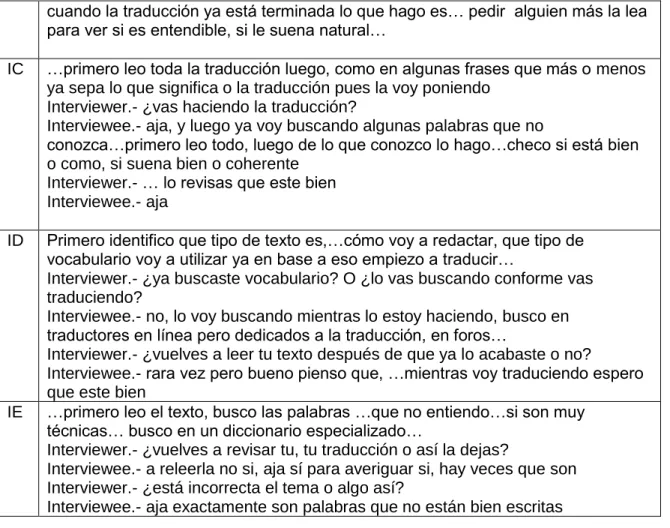
Table 4.8 Students’ translation processes ... 39
Table 4.8.1 Sequential procedures of the Fenix Plan students when doing translation ... 40
Table 4.9 Students’ translation processes ... 42
Table 4.9.1 Sequential procedures of the Minerva Plan students when doing translation ... 42
Table 4.10 The challenges of the students of Fenix Plan when doing translation ... 43
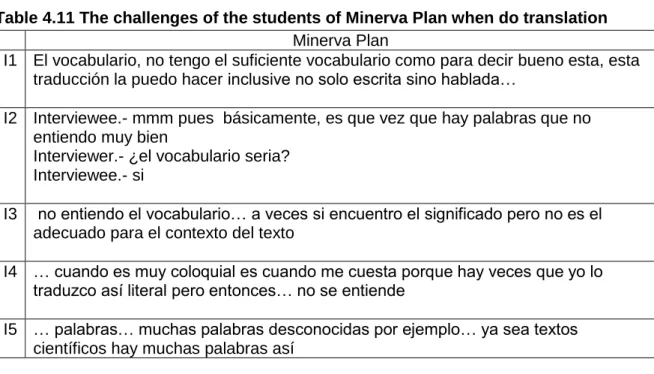
Table 4.11 The challenges of the students of Minerva Plan when do translation ... 45
Table 4.12 Students of Fenix Plan solve their translation process ... 46
Table 4.13 Students of Minerva Plan solve their translation process ... 47
VI
List of Figures
Figure 2.1 Translation problems ... 14 Figure 2.2 Triad of Pierce ... 17 Figure 2.3 The Process of Karl Weick... 19
VII
Acknowledgements
Thanks to my thesis Director Dr. Eliphelet Rivera Cuayahuitl, for all his comments and suggestions in each of the chapters in this work and for all his
support to do my thesis.
I also want to express my gratitude to my family especially to my parents who supported me unconditionally all the time, and showed me their love in many
ways.
Finally I express my love to my son who was my reason and motivation to
complete this project.
VIII
Abbreviations
BUAP Benemérita Universidad Autónoma de Puebla SL Source Language
TC Target Culture
TL Target Language
TT Target Text
ST Source Text
IX
Key terms
Equivalence.- The condition of being equal or equivalent in value, worth, function
Imitation.- The action of using someone or something as a model
Paraphrase.- A restatement of a text or passage giving the meaning in a
nother form, as for clearness; rewording.
X ABSTRACT
In the process of translating documents, new translators may follow different paths to accomplish their goals. In this regard this study explores the strategies that students belonging to two different plans (curriculums) on a BA in translation followed to do translation work. Drawing on interview data the study examines the knowledge the students hold about translation theories and how such knowledge is implemented in their translation practices. The study examines two groups of students studying under two different curricular plans (The Fenix and Minerva plans).
Findings show significant differences and similarities between the two groups of students’ awareness about translation theories and the actual procedures they followed in their translation practices.
1
CHAPTER I: INTRODUCTION
“Translation is a process of transferring text from one language into another”
(National network for Translation, 2012). Through such process it is important to consider other issues, such as the interpretation of meaning of a source language, and the production of a new equivalent text in the target language. Translators are expected to provide an accessible understanding of the source language to readers and contribute to know the culture of the source language, as well as the knowledge and thoughts of speakers of other languages.
Translation is an area that has to do with a wide range of professions, for example: project managers, lexicographers, librarians, publishers, authors, technical writers, software localizers, etc. Translation is not a mechanical task, it is true that we must follow and apply rules of grammar and language codes, but doing translation is not following rules or a step by step regulated behavior, it is an act which is featured by the creativity and selection of the most appropriate and meaningful words and expressions.
From the factors that shape a good translation, creativity is very likely what makes the difference between two translations of the same text, one of which we acknowledge as a good one and another which is not. Furthermore, translators need to know the context, the area, the terminology and most importantly they need appropriate training to do their job.
1.1 Problem
At the moment of writing this project, there were two curricular plans on the area of translation at the Faculty of Language working simultaneously. The first one,
2
was the Fenix plan, which worked from 1995 to 2008, this plan offered a BA in translation, and it continues offering courses but just to the remaining students, this is, to the last generation of students that were enrolled in that program in the year 2008. Currently the program is not offered any longer. On the other hand the Minerva plan, which started in 2009, and which is the current official plan at the faculty, offers only a few selective subjects focused on translation. This means that students from the BA in translation can take courses offered under both, the Fenix and Minerva programs.
While the Fenix plan consists of sixteen subjects focused on translation, that help students to acquired knowledge about theories, methods, linguistics and grammatical aspects of English-Spanish and Spanish-English translation. The Minerva plan only offers five courses focused on the characteristics of the text and theories, the purpose though is to give students the possibility to acquire complementary knowledge in language teaching, which might open further work opportunities in the future.
Both the ‘Fenix’ and the ‘Minerva’ plans hold similar features in relation to the focus of the contents of the translation courses. In other words students in both plans face similar challenges, although they may behave differently when coping with translation challenges. It is worth noting that the participants in this study are taking their last courses where they are contributing to the consolidation of professional education, and care needs of the environment. In this stage they do translations in different areas; this means that students from both plans are nearly to finish their majors. So, the fact that students are taking courses in the Fenix and
3
Minerva curricular plans, may play a critical role on the students’ translation techniques.
1.2 Purpose of the study
The purpose of this study is to compare the students’ strategies under the Fenix and Minerva plans. The study focuses on the translation strategies adopted by the students of both plans, and identifies main differences and similarities adopted by the two groups of participants. The study also examines the students’ translation strategies based on the knowledge they hold about methods and translation theories. The study finally identifies the problems that the two groups of participants found and how they sort out such problems.
1.3 Main research question
What are the similarities and differences of the strategies followed by the
students of the Fenix and Minerva plans throughout the process of translating texts?
Specific questions
What methods or approaches do students of the Fenix and Minerva plans use in the process of doing translation?
In the opinion of the students of the Fenix and Minerva plans, which courses from the BA in translation best support them to do translation?
What are the differences and similarities between the approaches followed by the Fenix and Minerva students when going through the translation process?
4
What are the most common challenges that students of the Fenix and
Minerva plans identified when doing translations?
1.4 Justification
This study will help us understand the challenges that the students from the Fenix and Minerva plans deal with when doing translation. It is worth doing this work, because it explores an area which has not yet been studied. So this study will help identify the similarities and differences of two groups of students enrolled in two different curricular plans. Furthermore this study may serve as a reference for future evaluations and revisions of the curriculum in translation.
1.5 The research context
The investigation will be carried out at the Facultad de Lenguas, at the Benemérita Universidad Autónoma de Puebla (BUAP), in the area of translation and will focus on students taking their latter courses or that are about to finish their major.
The study will focus on two plans, the first called Fenix plan and the second referred as Minerva plan, both having different characteristics in regard to the subjects and course contents, these play will be broadly discussed in the following chapter.
1.6 Conclusion
This project is organized into five chapters: chapter I describes the problem and the research questions which guide this investigation, the chapter II discusses relevant literature, to the purposes of this work. The chapter III discusses the methodology that is follow in this research, and the following chapter IV analyses the information obtained and finally the chapter V discusses the findings from this work and its significance to the context under investigation and to the participants.
5
Once this chapter has set out the directions of this work, I will proceed to move on the review of literature.
6
CHAPTER 2: LITERATURE REVIEW
Introduction
This literature review explores three dominant themes, addressed by the research questions, these are related to translation, the translator, and the Minerva and Fenix plans. All are focused on the process of translation, and the different problems that translators have and the way they cope with them.
2.1 Programs
The community of the BUAP in its Plan of Institutional Development (PDI) 2006-2009, expresses the commitment to answer the challenges arising from global changes resulting from the process of globalization and internationalization, the situation of higher education in Mexico and the specific conditions inside the institution as well as the challenges arising from the regional and national context.
The University has in the last decade worked on the basis of specific educational models or plans which set the mission, and vision of the institution as well as the regulations, goals and standards to be achieved by all the schools and faculties across the Institution through a specific period of time. Although the BUAP has worked for long years under curricular plans, it was until the year 2000 when the university first designated its curricular plan as Fenix Plan (2000- 2008) and then the second was designated as Minerva Plan (2009- 2014). As commented on early this project examines the translation strategies of two groups of students studying under these plans. The next sections describe the man features of these plans.
7 2.1.1 Fenix Plan
The “Fenix Plan” proposed across the university, the integral formation of students, the flexibility of the curriculum and adopted by the first time the “credits”
system (Vázquez, Barrón and Valenzuela, 2011)
Another aims of this plan were to promote the learning and use of foreign language to facilitate the communication and interaction between cultures, as well as specialized training professionals with a mastery of a foreign language, critics with a strong humanist, ethical and with theoretical and practical knowledge.
At the faculty of languages, where this study took place, two specialties were offered under this plan, these were teaching and translation.
The objective of the translation area was the formation of professional translators. Such students should in addition be able to process, evaluate, and use linguistic information to resolve problems of communication as well as do research drawing on the appropriate methods. The students would use this knowledge in different sectors locally and abroad, with an ethical sense and social responsibility.
The specific subjects in translation were the following:
Traducción (from1 to 8)
Latín II
Discurso referido
Cultura mexicana
Teoría de la traducción
Lexicología
Gramática textual
Evaluación de la traducción
Tecnología de la traducción
To see the whole program in translation see Appendix A.
8 2.1.2 Minerva plan
The propose of the “Minerva Plan” is focused on the educational process and its relationship with the student, the teacher and the Teaching-Learning Process, the mean objective is the professional practice where the students can apply their knowledge, skills and values in relation with their profession. (Vázquez, Valenzuela and Flores, 2009)
Within the faculty of languages the Minerva plan focused on English teaching only and did not offer the specialty in translation any longer, nonetheless the Minerva plan offered to the students in the teaching specialty, optional courses in three main areas: teaching to foreigners, language teaching and translation. Such options offered to the students the possibility to acquire complementary knowledge in the field of teacher training, for students to have more opportunities in their work area.
The objective of the translation courses in the Minerva Plan was to introduce the students in the dynamic of the translation to know the characteristics that a text needs to express in a written form. In the translation courses, the student learns the importance of written communication and comes to value the study of language.
The courses in translation in the Minerva Plan are the following:
Traducción y Teorías I
Traducción y Teorías II
Traducción de Ciencias Naturales
Traducción de Ciencias Exactas
Traducción de Ciencias Sociales
It is worth saying that the students from the Fenix Plan were not permitted to take any course from the Minerva Plan and vice versa.
9
As highlighted above this study worked with two groups students taking the courses listed above accordingly.
2.2 Translation
The term “translation” is difficult to define since it may assume different meanings according to the perspective of the translator or the readers. Robinson (1997:6) provides definitions from the perspective of translators and readers and these can be observed on the table below:
Table 2.1 Translator and Reader’s definitions
Internal External
Translator think and talk about translation from inside the process, knowing how it is done, processing a practical real world sense of the problem involved, some solutions to those problems, and the limitations on those solutions.
A non-translator thinks and talks about translation from outside the process, not knowing how it’s done but knowing.
As the table shows translators see the translation as an activity that they know that it is important and focused on the text although they see the translation process as a process of different methods that demands their creativity to sort out problems.
In contrast, from the readers’ views seen as the translation of text in which the most important is the content that goes from one language to another language.
In contrast with the above definitions Munday (2001:4-5) suggests a definition more specific and detailed for translation: “it can refer to the general subject field,
10
the product (the text that has been translated) or the process (the act of producing the translation, otherwise knowing as translation)”.
In both, Robinson and Munday’s definitions, exist a similarity; it is in the act or process of translation and the difficulties of going from one target language (TL) to a source language (SL).
We need to know that not each word in the TL has an specific equivalent word in the SL as Schulte and Biguenet (1992:22) affirmed “not all concepts that are expressed through the words of one language are exactly the same as the one that are expressed through the word of another…this causes unavoidable imperfections in all translations…” I can notice that the translation is an art and the use of creativity should not affect the meaning and look like if we were written in the TL. There are a lot of ways to determine the translation and in those cases we can see in the theories.
2.2.1 Translation theories
Newmark (1982) suggests that the existing translation theories´ main concern is the selection of the correct translation methods for the different types of texts. So, the theory supports a translator with rules, clues and process for translating. The theories entail the relation of meaning, culture and language of both TL and SL.
Hence, the theories assist the translator in the process of translating in the best way, and help them sort out the problems that translators face.
There are different theories that have appeared over the years that have helped translators to go through translation problems. Such as the “word-for-word,”
the “sense-for-sense,” the three categories of Driden (Munday, 2001), the Skopos
11
theory (Moya, 2004) and the polysystem theory (Munday, 2001); these are discussed below.
The first are the “word-for-word” and “sense-for-sense” that Newmark (1982) called the “pre-linguistic period of translation”. It is important to note that in the second half of the twentieth century there was a debate about literal and free translation; some translators preferred using the word-for-word but others like Cicero, and St. Jerome, opted for the sense-for-sense and such preferences were expressed in their translation works.
St. Jerome (as cited in Munday, 2001:20) talks about his translation strategy in the following terms:
Now I not only admit but freely announce that in translating from the Greek – except of course in the case of the Holy Scripture, where even the syntax contains a mystery –I render not word-for-word, but sense-for-sense.
That was just the beginning of new theories trying to help translators in the translation work. In this regard Cowley (Amos, 1920:151) proposes the term
“imitation” for the free method of translation, in using this method a translator attempts to express his perspective of the inevitable loss of beauty in translation by using his “wit or invention” to create new beauty in the poetry. Dryden (as cited in Munday, 2001) adds a term in one of his three categories that are the following:
1.- “metaphrase” Word by word and line by line translation
12
2.- “paraphrase” Translation with latitude where the author is kept in view by the translator, so as never to be lost but his words are not so strictly followed as his sense
3.- “imitation” Forsaking
(pag.25)
According to these categories Dryden focuses only on the second category
“the paraphrase” and expresses negatively in the use of the other two. Because it is related to the change of the words but he does not try to lose the meaning.
In the 1970’s the Skopos theory appeared, it was developed by Reiss but was first introduced by Hans J. Vermeer as a science in that period.
The Skopos theory proposed by Reiss (Moya, 2004) asserts that sometimes it is not possible an equivalence but is common that the target text (TT) has a purpose and what is expected of the translator is to make a communicative translation where the TT is functional in terms of the translation context. Therefore according to Munday (2001:78) “in skopos theory, knowing why an ST is to be translated and what the function of the TT will be crucial for the translation”
In other words, the translation is influenced by the purpose, and Moya (2004) suggests some strategies that we can follow to this theory:
1. The interlinear
a) The literal translation
Word-for-Word
It is similar but it is useful to teaching of a foreign language.
13
2. The philological translation It is considered ideal, especially for philosophers because it uses the syntax, semantic and pragmatic.
3. The communicative translation It is focused on the communication of his readers where some aspects cultures are changed in the Target Culture (TC).
4. The creative translation Where the source culture unknown different concepts, terms and views and the translator has to create new sign linguistic in the TL.
The unique difference between “interlinear” and “literal” is that the first does not follow the syntax in the SL. In the third “communicative translation”, the translator intends the reader believe that the text is in his target language. All of these concepts are in certain way similar to the above described but support at the translation in a way more detail. The following theory is the Polysystem as is studied as part of a literary works and it is defined as “systems of function of the literary order which are in continual interrelation ship with other orders” (Munday, 2001). In this theory the literature is a point really important in the translation because is part of the social, cultural, literary and historical framework and the most important is a concept of the systems and a continue dynamic of change.
14
Despite the numerous resources in translation, in the actual practice most translators cope with a number of dilemmas and challenges, some of which are discussed in the following section
2.2.2 Main Problems in Translation
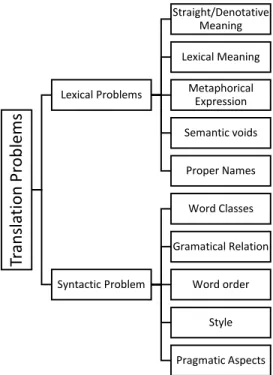
In doing translation, translators move in different directions according to the nature of the translation task or the translation problems they find out. Miremadi (1991) affirms that translation problems can be divided into two main categories: lexical problems and syntactic problems, which can be observed in the following diagram:
Figure 2.1 Translation problems
The lexical problems (See figure 2.1) according to Miremadi are the words in one language that may not be substituted with a word in another language when referring to the same concepts or objects. Miremadi (1991) divides the lexical
Translation Problems
Lexical Problems
Straight/Denotative Meaning Lexical Meaning
Metaphorical Expression Semantic voids Proper Names
Syntactic Problem
Word Classes Gramatical Relation
Word order Style Pragmatic Aspects
15
problems into five subcategories as follows: 1) straight/ denotative meaning which refers to those words of the SL that can be matched with those of the TL (e.g. mother, father, etc); 2) the lexical meaning refers to words or phrases which seem to be equivalent; 3) the metaphorical expression refers to the problem to translate idioms and similar expressions; 4) the semantic voids include those words and expressions that represent concepts that cannot be found in other special communities, and 5) proper names, refer to the specific meaning that the people´ names may entail and whose meaning may not exist in the target speech community.
The second category refers to syntactic problems which include: 1) word classes where languages differ from each other in the internal word formation of language classification; 2) grammatical relations which may exist among the languages in the way that a constituent of a sentence functions within that sentence;
3) word order which refers to the sequence that words follow within a sentence; 4) style which has to do to nature of the document under translation, this may be for example: informative, academic or scientific and 5) pragmatic aspects which refer to actual intentions of the texts.
Lorscher (1996: 28) argues that to cope with problems in translation, translators may use nine basic translation strategies as follows:
Original elements of translation strategies 1. Realizing a translational Problem
2. Verbalizing a translational Problem
3. Searching for a possible solution to a translational Problem 4. Solution to a translational Problem
5. Preliminary Solution to a translational Problem
16 6. Parts of a Solution to a translational Problem
7. Solution to a translational Problem is still to be found 8. Negative Solution to a translational Problem
9. Problem in the reception of the Source Language text.
This study will later show how the students under study used a number of strategies to go on their translation practice.
2.2.3 Process of translation
In the actual practice of translation, translators need to decide among different types of translation procedures. However, prior to choosing a particular method, the translator first needs to understand the text, analyze, and evaluate the text and then select an appropriate translation method.
Newmark (1982) listed the translation process in the following way. The first is the intention of a text, second the intention of the translator follows by the reader, the setting of the text, and finally the quality of the writing. The first step of Newmark is related to Hennequin (1999) called the “critical reading” where the translator needs to ask some questions such as which is the content of the text?, what are his intentions?, what language are writing?, what is his register?, what is his style?, what genre is for?, what is the form of presentation or publication?. These translation processes are focused on the intention and purpose of the text that will be translated instead of the mistakes and habits that acquire in the translation process.
Robinson (1997) suggests that the process of translation is when a new translator does not know how to proceed, starts making mistakes and then learning from those mistakes, and gradually they will translate faster and effectively until it
17
becomes an habit. This final process is called by Mihaly Ckszentmihalyi (as cited Robinson, 1997) the “flow” process where you have pleasure in the slowness where the knowledge is easy and familiar or find pleasure in speed where there is new and difficult challenging.
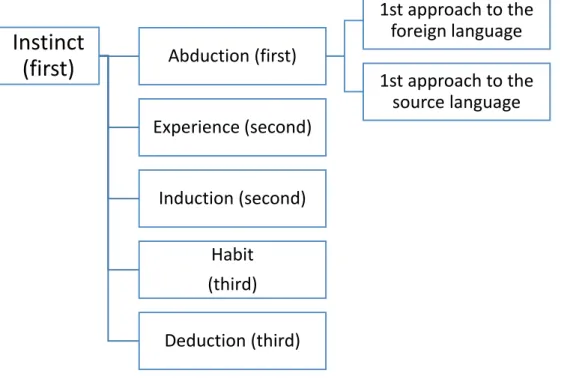
One formulation that Pierce shows about the translation process in Becoming a translator (as cited in Robinson, 1997) is a “framework of a triad or three-step process” and also another triad of Pierce called “Abduction, Induction and Deduction”, both triads were represented in a concept map as the following:
Figure 2.2 Triad of Pierce
In this concept map, we can see that the two triads are together because each one has relation with the other. In the first stage we have in the same level “Instinct”
and “Abduction”, this is because the Instinct is the proceed by translating words where the translator compare the similarities and dissimilarities with the words or
Instinct
(first)
Abduction (first)1st approach to the foreign language 1st approach to the
source language Experience (second)
Induction (second) Habit (third) Deduction (third)
18
phrases from the SL to TL and often the Abduction takes place that is the act of making an hypothesis due to the fact that translator do not understand the sense or meaning of the sentences or word. Besides the abduction has two approaches the first is the foreign language and the second the source of the text, in the first is when the translator find new words and does not know the meaning and the second is when the sentence has sense but seems resist translation to a TL.
In the second stage the “Experience” and “Induction” are and both are similar, the experience is when translator find specific solutions for specific problems and the second is when the translator understands the meaning of the words and the different patterns begin to emerge.
In the third stage, we find the “Deduction” and “Habit”, the first is when the translator understand the key words and regularities in the translation, and the second is when the translator translates rapidly and few times he stops to solve a problem. In both, “Deduction and Habit”, are related to the methods, rules and principles that translator knows or acquires in the translation process and he feels comfortable with the translation.
In addition, the process of Karl Weick (as cited in Robinson, 1997) is similar in some stages with the triad of Pierce but with some difference. This process is showed in a concept map as the following:
19 Figure 2.3 The Process of Karl Weick
The first is “Enactment to selection is governed by a principle of respond now, plan later” that is to take action and is not a requirement the organization. The second is “Selection” and it is divided in two approaches that are: rules and cycles, he considered that the rules are useful in specific situation and it cannot be always applied, but the cycles are more useful and there are different cycles but all of them deal in trial and is compare to the Induction of Pierce. Some cycles that he showed
“Act-Response-Adjustment Cycle” this is when the translator takes action, then the error of the action has an impact and a result change in his actions. Another is the
“Collaborative Decision Making-Talking” is the support of individual or small group where they know about the topic that the translator is translated and they give him new ideas that can help him to improve his translation because they give him different solutions and a brainstorm. The last is the “Retention” that is similar at the
Enactment (first) Selection
(second)
Rules
Cycles
Act-Response- Adjustment Collaborative Decision Making-
Talking Retention
(third)
20
“Habit” but Weick is not agreed that the retention is the goal because always the translator is in a process of new situations or challenges.
In terms of Weick (Robinson, 1997:102) it might be as “translate, edit, sublimate”
1. Translating is when you use your knowledge and instinctively start to translate.
2. Editing is when you start to think about different doubts and what is the best option for your translation and continuously change it.
3. Sublimating is when you learn about these doubts and they are part of your knowledge.
There are different methods or processes to make translation and the translator has to be aware about the image that he wants to communicate and the impression that he wants to give in relation to the use of the foreign language, as well as the knowledge that he holds and the development of his register and style. Newmark (1983:31) suggests different types of translation as listed below:
1. Transcription (loan word´s adoption)
2. One-to-one translation 3. Trough translation 4. Lexical synonymy 5. Componential analysis 6. Transposition (replace of one
grammatical unit by another)
9. Cultural equivalence 10. Translation label 11. Definition
12. Paraphrase 13. Expansion 14. Contraction
15. Recasting sentences
21 7. Modulation
8. Compensation
16. Rearrangement, improvement (jargon, mistakes, misprints, idiolect)
We can notice different alternatives to do the translations but we need to consider the sacrifices that a translator must take and these are the risks to which he exposes himself. As Schulte and Biguenet (1992:47) suggest, “if he does not observe the finest line in the effort to keep the tone of the language foreign, dangers from which he cans not escape entirely since every one draws the line in a slightly different way each time”. Moreover if he takes into consideration the unavoidable influence of the habit, he has not to worry that something new will creep into his own free and original production through the act of translation can become smooth.
As commented on above the translation procedures will depend on a number of factors such as; the nature of the texts to be translated, the author´s intention and the target reader of the translated document. In the following section a set of potential translation strategies are discussed.
2.2.4 Translation Strategies
To better understand the term “translation strategies” it is worth noting that strategies in translation are often used by the translator when they need to solve a problem. Some researchers have investigated and explained what translation strategy is, according to Krings (1986:18) a translation strategy refers to the
"translator's potentially conscious plans for solving concrete translation problems in the framework of a concrete translation task”. Also, Loescher (1991:8) defines translation strategy as "a potentially conscious procedure for solving a problem faced in translating a text, or any segment of it”. In this regard Venuti (1998:240) indicates
22
that translation strategies "involve the basic tasks of choosing the foreign text to be translated and developing a method to translate it”. In this work, however translation strategies refer to the procedures or theories followed by the students under investigation.
2.3 Conclusion
The literature review examined key topics related to the research questions addressed in this study. The chapter reviewed relevant topics and concepts that will help understand the aims of this work. Issues related to translation and to the procedures to choose an appropriate translation method as well as the strategies to cope with the most common challenges have been discussed. The following chapter will present the methodology adopted in this investigation.
23
CHAPTER III: METHODOLOGY
Introduction
The purpose of this chapter is to discuss the methodology followed in this investigation. The chapter first describes the instruments, the context and participants where this study was undertaken. Besides, the chapter then describes the procedures used to collect process and analyze the collected data. The chapter concludes with a summary of relevant issues emerging from this chapter.
3.1 Instruments
This study adopted semi-structured interviews to capture the opinions of the participants. This method of data collection was chosen because the students could explain in more detail the factors that affect their translation, their view in relation with it; as a result deep in more detail the different factors that can influent. As Kavele (as cited in Miles and Huberman, 1994) said it is where a lot of interpretations appear in the process of analysis due to the fact that the person tell his life, and in the data this information is a “reflect” of him and we have to interpret the “flow of meanings”.
The interviews (see sample appendix C) explored a number of topics. The next guide was used to guide the interviews:
Knowledge in Translation’s methods and theories
Point of view of students about their learning with the courses
How they feel, and their needs.
The translation process that they use
The problems that face in their translation
24
How they solve these problems
3.2 Context
The interviews were administered at the BUAP, Facultad de Lenguas Modernas. In the Bachelor’s degree in Lenguas Modernas, the interview was focused on students of the translation area with different plans; Fenix and Minerva.
This context was chosen because the researcher could easily access to the students and she was familiarized with The Fenix Plan.
The BA in translation of The Fenix program comprises 16 courses in the translation area and 43 other courses related to the teaching area. The purpose of the translation courses is to provide to the students with the theoretical tools and practice to translate a broad range of academic and non- academic texts professionally.
In the case of the Minerva program, translation refers to a set of optional courses in the field of translation. So we find only five specific courses in this field in contrast with the 16 courses of the Fenix Plan. In the Minerva Plan the students study 29 other courses focused on teaching. In this plan, the aim of the translation courses is to complement the formation of students as English language teachers.
3.3 Participants
The participants were chosen based on three key questions that Ritchie, Lewis and Elam (2003:86) said that is necessary to be addressed in defining the population for a study:
Which group or subpopulation is of central interest to the subject matter of the study?
25
Are there subsets of the central population that should be excluded?
Are the additional groups or subpopulations that should be included because
their views, experiences and so on would bring contrasting or complementary insights to the enquiry?
Therefore, the sample was more focused on the area of translation with particular courses and people. The questions supported her to analyse the possibility to include or remove different group of people of this area; as a result deep in the research.
In this research, two different samples of participants were used. The first was the Fenix plan that was in the Facultad de Lenguas in the area of translation as bachelor with students in the last class of translation or that they finished the translations courses. In this plan five students were chosen, four were females and one was a male, because the researcher had known them of different classes that she took with them and they were focused on the area.
The second sample was composed of 5 students belonging to the Minerva plan in the Facultad de Lenguas in the area of translation where they only took 5 courses, since they were in the final stage of the program. The students were, four females and one male, and they were chosen in the last class of their elective course that was Social Sciences Translation due to the fact that they had previous knowledge about translation and they were more involved in it. Moreover, the researcher did not know any student of Minerva plan to interview so it was much easier to find them according to the program of the last course.
26 3.4 Procedures of collected data
To both group of participants, from The Fenix and The Minerva plans, a short description of the aims of the project was given. The students were explained the structure of the interview, for them to understand what the researcher expected. The interviews were carried out in Spanish, for students to speak more freely and talk in more in detail about their perspectives, opinions and challenges in the translation process.
Each interview took approximately from 4 to 9 minutes, depending on the students and their opinions about the topic. All the interviews were at the Facultad de Lenguas, in the case of the Minerva plan was in their class of translation and the time of the interview was shorter because they were in classes; in some cases they did not feel comfortable about the interview. However in the case of Fenix, the time was not a problem because the researcher could contact them and make the interview when they had free time.
As the researcher carried out the interviews students in some cases had problems to follow or understand the questions even when she clarified them in advance. As a result some interviews were shorter or more confusing others, so in some questions she had to give some examples so that they better understand her questions. It is worth saying that in some cases students struggled to express their opinions about some questions.
With the results obtained in base of the interviews, she started the analysis of her data. Based on Miles and Huberman (1994) suggest as a “Flow Model” that consist
27
of three concurrent flows of activity: “data reduction, data displays and conclusion/verification”. The findings will be presented in the next chapter.
28
CHAPTER IV: RESULTS Introduction
This chapter aims to discuss the findings from this investigation and their significance to the research questions and to the context under study. To facilitate the understanding of the discussion the findings are presented in tables for their discussion and analysis. Since both, the Minerva and Fenix plans are referred recurrently, both plans were presented in two tables (4.1 and 4.2) showing the translation courses only. The research questions addressed for this work will be presented.
Main research question
What are the similarities and differences of the strategies followed by the students of the Fenix and Minerva plans throughout the process of translating texts?
Specific questions
1. What methods or approaches do students of the Fenix and Minerva plans use in the process of doing translation?
2. In the opinion of the students of the Fenix and Minerva plans, which courses from the BA in translation best support them to do translation?
3. What are the differences and similarities between the approaches followed by the Fenix and Minerva students when going through the translation process?
4. What are the most common challenges that students of the Fenix and Minerva plans identified when doing translations?
29
It is worth remembering that the participants were ten students, five from the Fenix plan and five from the Minerva plan. All these students were interviewed using semi structured interviews.
4.1 Programs
This section shows (Table 4.1, and 4.2) the main courses of the Fenix and Minerva BAs in translation. The complete program of both plans, including all the courses are shown in Appendices A and B.
Table 4.1 Minerva Program Translation
LMENI-406 Traducción y Teorías I LMENI-407 Traducción y Teorías II
LMENI-408 Traducción de Ciencias Sociales LMENI-409 Traducción de Ciencias Exactas LMENI-410 Traducción de Ciencias Sociales
Table 4.2 Fenix Program Translation
LEM 241 Traducción I
LEM243 Traducción II
LEM245 Latin II
LEM413 Discurso Referido
LEM427 Traducción III
LEM428 Cultura Mexicana II
LEM429 Traducción IV
LEM414 Teorias de la Traducción
LEM430 Traducción V
LEM407 Lexicología
LEM431 Traducción VI
LEM306 Gramática Textual
LEM432 Traducción VII
LEM433 Evaluación de la Traducción
LEM434 Traducción VIII
LEM531 Tecnología Traducción
30
As the table above shows, there is a substantial difference in the number of courses focused on translation in both plans, the Fenix plan shows several more courses than the Minerva plan, fact that very likely influenced the students’
translation practice. The next section introduces into the discussion of the main findings of this study.
4.2 Results
As explained above the findings, are discussed using tables, which allows to compare and contrast the strategies and techniques adopted from the participants of both plans.
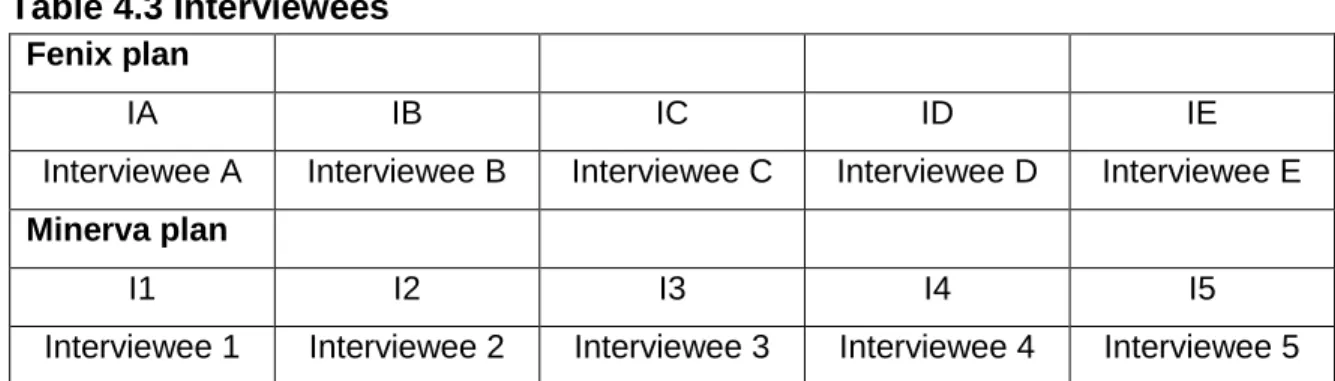
The participants were identified using abbreviations (Table 4.3). The interviewees from the Fenix plan will be identified using letters, for example:
interviewee A as IA, interviewee B as IB while the interviewees from the Minerva Plan, will be identified using numbers, for example Interviewee 1 as I1 and Interviewee 2 as I2.
Table 4.3 Interviewees Fenix plan
IA IB IC ID IE
Interviewee A Interviewee B Interviewee C Interviewee D Interviewee E Minerva plan
I1 I2 I3 I4 I5
Interviewee 1 Interviewee 2 Interviewee 3 Interviewee 4 Interviewee 5
The analysis of data is organized in the same order as questions were asked during the interviews. Therefore the results from the Fenix students are analyzed first, then, the opinions of the Minerva students are discussed, and then the opinions
31
of both groups in the light of the Fenix and Minerva Plans were compared and contrasted.
4.2.1 Exploring students’ opinions about theories and methods
Question one explored the students’ opinions about the theories and methods in translation that they best knew. Table 4.4 shows extracts of the students’ opinions.
Table 4.4 The theories and methods known by students
Fenix plan Minerva plan
1ª …La funcionalista porque es una teoría que mezcla, la teoría literal y…
en la que modificas muchas veces el significado… algunos términos los dejas literales otros cambias de acuerdo a las necesidades de la traducción por ejemplo si es médico pues te quedas con los términos médicos, si es una traducción para informar nada mas o es necesario que especifiques algunos términos pues los haces, en eso se enfoca la teoría funcionalista.
I1 …Los que son palabra por palabra, sentido por sentido… las teorías no las conozco sin embargo nada más los profesores nos han enseñado a cómo traducir de una manera en la que tenga sentido no solo traducir, bueno si palabra por palabra pero que eso le dé sentido, que tengas un poco de conocimiento acerca del tema además de… la noción de lo que es traducir.
IB …la teoría de skopos porque depende que es lo que quiere el cliente para nosotros saber de que manera traducir, en segunda instancia… el sentido por sentido porque hay traducciones que requieren más sentido que un propósito en general muchas veces el cliente no sabe que es lo quiere, lo que quiere es saber, enterarse de lo que trata el texto.
I2 pues es básicamente en diccionarios, traductor, diccionarios inglés-inglés
IC …la equivalente… de acuerdo a la cultura o al lenguaje… de inicio y de llegada es la que vas a utilizar.
I3 para empezar a traducir necesito entender el contexto para darle sentido al texto
ID …la teoría de Nida, en la que, importa más el mensaje que las palabras que traduzcas, importa más… que la idea no se pierda, aunque cambies un poco las palabras en la traducción pero que la idea siga siendo la misma.
I4 el de palabra por palabra
32 IE Interviewee.-… la de Nida, cubierta y
encubierta
Interviewer.- y ¿las utilizas? O casi no Interviewee.- no, casi no
I5 la de palabra por palabra por ejemplo, y la de funcionalista
As the table shows, the students of the Fenix plan knew some theories, the most mentioned was the “Nida” which they said they used in their translations. Only IE said that he knew some theories but he did not clarified them, besides he said he did not use them at all. On the other hand, the theories that the rest of the Fenix Plan interviewees affirmed using mainly focused on the ´meaning for meaning´, while some interviewees such as IA and IB focused on the ´intention of the text´. As for, the interviewees ID and IE, they affirmed following the “Nida” theory; the findings however, suggest that he had some notions of the ´Nida´ theory, maybe because that method is studied in the various courses across the curriculum.
In contrast, in the case of the Minerva plan students, their answers were somehow different from the students of the Fenix plan. Participant I5 from the Minerva plan was the only one who knew about the theory based on functionalism, but he was unable to explain such theory. Interviewees I1, I4 and I5 agreed in knowing the word for word method, although this method is basic and perhaps the best known among the students. On the other hand I3 was more focused on the intention of the text, because, he said he just though in the context. As for I2, was unique in his responses, he affirmed “pues es básicamente en diccionarios, traductor, diccionarios inglés-inglés” (basically in dictionaries, translators, dictionaries English to English). The answer of I2 may indicate that he was not involved in the translation context, and the courses were not clear in their content or even he confused the use of these instruments as a method.
33
The theories can help us make a better translation because we can use a wide range of methods and theories. Nevertheless, we can see a lack of knowledge about theories in the Minerva students, this may indicate that they are in a basic level of translation in contrast with the Fenix plan students, so it can affect their translation practice.
4.2.2 Students´ perceptions about the courses in translation
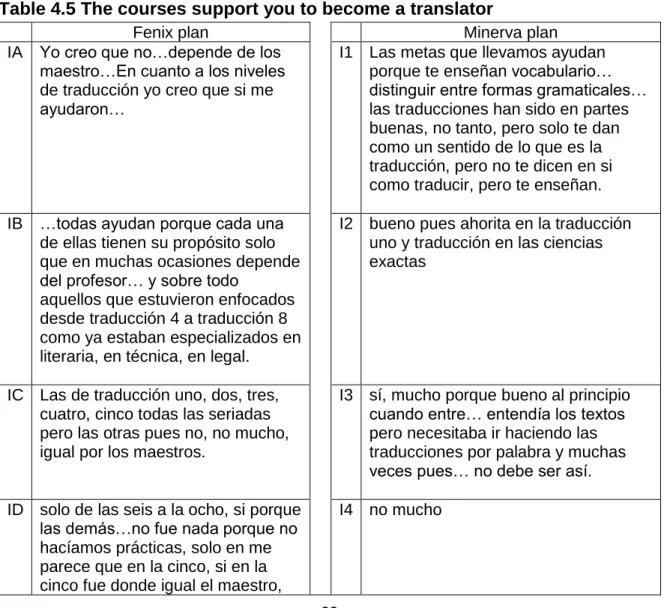
The second question asked the point of view of students about the courses focused on translation and if these help them to do translations.
Table 4.5 The courses support you to become a translator
Fenix plan Minerva plan
IA Yo creo que no…depende de los maestro…En cuanto a los niveles de traducción yo creo que si me ayudaron…
I1 Las metas que llevamos ayudan porque te enseñan vocabulario…
distinguir entre formas gramaticales…
las traducciones han sido en partes buenas, no tanto, pero solo te dan como un sentido de lo que es la traducción, pero no te dicen en si como traducir, pero te enseñan.
IB …todas ayudan porque cada una de ellas tienen su propósito solo que en muchas ocasiones depende del profesor… y sobre todo
aquellos que estuvieron enfocados desde traducción 4 a traducción 8 como ya estaban especializados en literaria, en técnica, en legal.
I2 bueno pues ahorita en la traducción uno y traducción en las ciencias exactas
IC Las de traducción uno, dos, tres, cuatro, cinco todas las seriadas pero las otras pues no, no mucho, igual por los maestros.
I3 sí, mucho porque bueno al principio cuando entre… entendía los textos pero necesitaba ir haciendo las traducciones por palabra y muchas veces pues… no debe ser así.
ID solo de las seis a la ocho, si porque las demás…no fue nada porque no hacíamos prácticas, solo en me parece que en la cinco, si en la cinco fue donde igual el maestro,
I4 no mucho
34 asesor nos puso hacer
traducciones pero igual no le tomaba la importancia que debería tomarle, y también, bueno vimos algo de subtitulage y eso igual me intereso y ya
IE Interviewee.- ¿para mejorar?
Interviewer.- ¿o crees que necesitaste más?...
Interviewee.- pues sí, yo creo que una más especializada en, como se llama en términos… una que trata
… de el uso de diccionarios, del uso de etimología
I5 en cierta forma te ayudan a practicar pero a mejorar siento que no, ósea no es tanto una mejora sino una práctica de traducción
In the case of the Fenix students, their answers were similarly in base that the courses could be good or bad depending in how teachers teach the courses.
However, they were not completely satisfied with any course, only in the courses related to translate where they can to practice.
Despite this, the interviewees IC and ID considered unnecessary the translations courses that were not focused in specialized texts for instance from first to fourth (See Table 4.2).
IE explained his need in the following extract of the Table 4.5:
Interviewee.- ¿para mejorar?
Interviewer.- ¿o crees que necesitaste más?...
Interviewee.-pues sí, yo creo que una más especializada en, como se llama en términos… una que trata …de el uso de diccionarios, del uso de
etimología
This suggests that he was not satisfied with the courses, and he considered the need of a specialized course in the use of dictionaries and etymologies to improve in his translations.
35
To the Minerva students, their answers were organized in two groups, the first group were the interviewees I1, I2 and I3 where they were agreed that the translation support them to improve and make a better translation, because acquired an idea about what is translation and how to make it.
But in the case of the second group that were the interviewees I4 and I5, were not sure about it. So, I5 did not think that the translation courses improve, it is just a practice; it may suggest that the I5 did not feel an advance in his learning with this courses.
4.2.3 Students´ opinions about their knowledge about translation
The following question investigated the students’ perceptions about the knowledge they had got in the translation program.
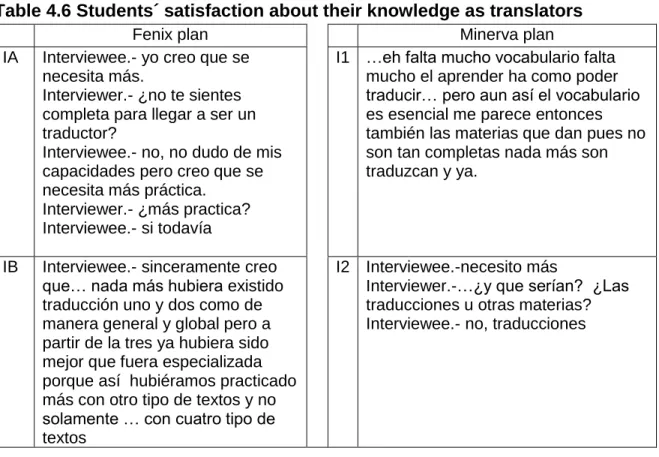
Table 4.6 Students´ satisfaction about their knowledge as translators
Fenix plan Minerva plan
IA Interviewee.- yo creo que se necesita más.
Interviewer.- ¿no te sientes completa para llegar a ser un traductor?
Interviewee.- no, no dudo de mis capacidades pero creo que se necesita más práctica.
Interviewer.- ¿más practica?
Interviewee.- si todavía
I1 …eh falta mucho vocabulario falta mucho el aprender ha como poder traducir… pero aun así el vocabulario es esencial me parece entonces también las materias que dan pues no son tan completas nada más son traduzcan y ya.
IB Interviewee.- sinceramente creo que… nada más hubiera existido traducción uno y dos como de manera general y global pero a partir de la tres ya hubiera sido mejor que fuera especializada porque así hubiéramos practicado más con otro tipo de textos y no solamente … con cuatro tipo de textos
I2 Interviewee.-necesito más
Interviewer.-…¿y que serían? ¿Las traducciones u otras materias?
Interviewee.- no, traducciones
36 Interviewer.- ¿y crees que fue
completa tu aprendizaje?
Interviewee.-no por esa razón, bueno considero que de alguna manera no estuvo completa IC no, yo necesitaba algo más
porque siento que es más
compleja la traducción y que no es solamente dar una palabra y ya a lo que quieres decir
I3 necesito más
Interviewer.-necesitas más Interviewee.- si todavía me falta Interviewer.- crees que necesitas más de práctica… como ahorita la que tienes, esta clase
Interviewee.- sí ID siento que necesito más
todavía… aparte el nivel de inglés no siento que me ayude como traductora y aunque creo que no es tan importante tu nivel lo importante es que sepas como redactar, que palabras utilizar aunque utilices el diccionario y pues ya poco a poco adquieres más el vocabulario
I4 No
…que sea más explicativo, las clases… paso por paso
IE …me hizo falta más, más textos que traducir porque luego las clases se enfocaban en algo, en pues muy poco, ósea no te daban un texto y para que traduzcas
I5 No…
Siento que necesitaría más practica...
practica de lectura, mucha lectura
According to the Fenix students, all of them did not think that their learning was complete and they required a more extensive practice of specialized texts.
However, in the case of ID, he explained that his problem was his level of English and writing and his knowledge of the language.
Even though Fenix students had taken eight courses on translation (See Table 4.2) and had spent some time in doing practices, all of them expressed the need more practice and a few of them believed that the first three translation courses were not helpful enough.
37
The results of the Minerva students on the other hand were very similar to the Fenix students, in relation to the need of more practice. Although they did not feel satisfied with the knowledge they had got in the field of translation. In this regard, about half of the Minerva students affirmed not being satisfied with their knowledge as translators. Participant I1 said in this respect, “las materias que dan pues no son tan completas nada más son traducción y ya”( the translation courses are not complete, it is just translation and that is all). Moreover, I4 mentioned the need that the courses could be more explanatory and provide a step by step guide. In both cases, the answers of interviewees I1 and I4 may suggest the necessity to know the purpose of doing translation and the procedures to carry out translation. As for I5, he agreed that he required more practice in doing translations and more reading.
Although the Minerva students did not have so many practical courses as the Fenix students, the needs of both groups were similar in regard to the need of changing the way teachers teach the courses of translation, in order to increase their knowledge. Almost all of the answers of the Minerva students in Table 4.6 are similar to the answers of the Fenix students (Table 4.5) where they expressed that the courses were good although they disagreed with the way teachers taught.
4.2.4 Students’ views about their development
The following question aimed to identify the needs that the students felt they required to become translators.
Table 4.7 The need to improve as translator
Fenix Plan Minerva plan
IA Práctica I1 Interviewee.- …primero hacer
traducciones pero que sean… de literatura todo eso, son difíciles…por
38
ejemplo tener un libro al inglés y un libro ya traducido de ese mismo libro
… debes de leer mucho…
Interviewer.- ¿textos paralelos te gustarían más?
Interviewee.-eso sería mejor IB … tener más práctica… tener un
buen asesor de traducción…
I2 …tener más… vocabulario o… que me enseñen… exactamente las palabras que vengan en el documento que estoy traduciendo.
IC pues más experiencia, yo digo que practicas es la clave para seguir traduciendo
I3 aprender más vocabulario y practica
ID Leer demasiado, de muchos temas no solo legales o a lo que nos estemos dedicando en ese
momento sino de todo, leer de todo para poder tener más
vocabulario,… bueno cuando lees tienes mucho más vocabulario sabes cómo utilizar el mismo y te es más fácil redactar y utilizar los signos de puntuación aunque no se nota si te ayuda mucho.
I4 yo creo que más práctica
IE …más cosas para traducir I5 (The answer were related to the table 3)
The opinions of the Fenix students, displayed in Table 4.7 were similar to findings in Table 4.6 where students explained the need of further practice. So, in the case of the ID, he said that he needed to read more, his opinion was similar to the opinion of I5 of the Minerva plan (Table 4.6.). ID on the other hand explained that he need to acquire new vocabulary, improve it and learn punctuation.
The interviewees I3, I4 and I5 of the Minerva plan also agreed completely with the answer of the interviewees of the Fenix plan, about the need to have more practice. But the interviewees I1, I2 and I3 considered that it is not enough the vocabulary that they have, so they require vocabulary more specialized and as I1 affirmed the needed to use parallel texts.