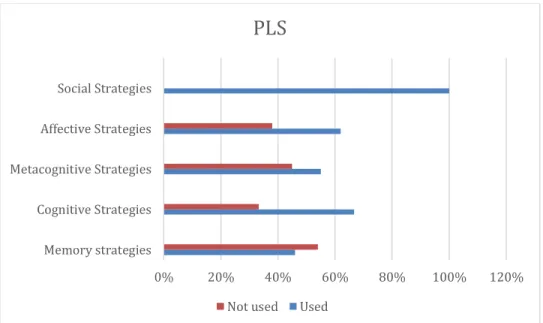
Memorize and listen to the recording several times……….108 Figure 4.35 Participants use the flash cards they decide from. I want to learn' cluster to 'I have not learned cluster'………..108 Figure 4.35 Participants do not encourage themselves to speak in English.
Introduction
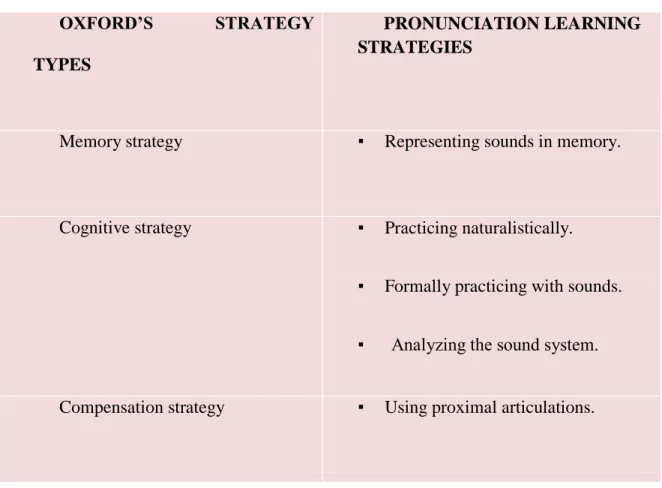
The instrument used with the students was the Pronunciation Strategies Questionnaire, based on the taxonomies of pronunciation learning strategies presented by Oxford (1990) and Peterson (2000). This study, conducted at the Jan Dųugosz University in Czħstochowa, Poland, found that English language learners who, on average, occasionally use pronunciation learning strategies should receive some strategies.
Aims
Furthermore, when I took phonetics and phonology lessons, I noticed that some of my classmates also had problems pronouncing some words. Finally, when I took target language V, I could also notice that some of my classmates had problems with pronunciation.
Significance of the study
Which group of strategies ELT undergraduate students use autonomously to improve their pronunciation the most. Finally, this study may also have positive implications for teachers when they have to make a decision about how to help or guide students to improve their pronunciation.
The context of the research
In addition to the reason for conducting this research, the location where this research took place was also presented. Furthermore, Chapter IV presents the findings of this project and presents and answers the research questions.
Introduction
Furthermore, phonetics and phonology cannot be separated because both of them help us understand how sounds are made and how sounds are distributed. Phonetics and phonology are important because they help us understand how sounds are made as Panenová and Hana (2010) support.
Perspectives to teach pronunciation
In addition, some teachers do not include pronunciation in their lessons due to time constraints, but this may show that they cannot teach it or that they need to develop certain skills that will help them teach pronunciation correctly. She claims that they need to hear sounds as they acquire the sounds of their first language.
Which English is the best to teach and learn?
This type of English is related to different fields of study, for example, an engineer should learn this type of English because he or she wants to learn a specific vocabulary. As we can see, there are different types of English that can be useful in relation to the dieter's needs.
English as a Lingua Franca
In my own point of view, English teachers should be familiar with these types or branches of English because they will teach English according to people's needs as I mentioned before and according to the different learning areas. There is a paradoxical situation for the majority of users of English; it is 'English as a foreign language' all the verbal communication in English does not involve native speakers at all, on the contrary there is a tendency for native speakers to be regarded as guardians of what is acceptable usage.
Fossilization
Speaking personally, English has become a world language that is almost ubiquitous as Meierkord (1996) describes that English is a means of intercultural communication. In addition, as Gubbins and Holt say it becomes a necessity in the business world, thus promoting English to become a lingua franca.
Intelligibility
Stress
- Rhythm
- Intonation
Similarly, Carr (1999) says that the foot is a central part of the rhythm of English. Finally, we can say that intonation is part of language that helps us express something in a different way.
Autonomous Learning in the English Language
Autonomy is not simply a matter of placing students in situations where they need to be independent. For example, Esch (1998, p. 37) states that: it is not self-instruction/learning without a teacher; it does not mean that intervention or initiative on the part of a teacher is prohibited;
Autonomous Learning from a Social Cognitive Perspective
Eckstein's study sought to examine the gap in pronunciation learning strategies among English as a Second Language (ESL) students. Finally, Eckstein proposed a new taxonomy that categorizes pronunciation learning strategies (PLS) into pedagogically sound groups based on Kolb's experiential learning theory. Furthermore, in the words of Akyol (2012) 'this is an experimental study which tries to elicit a general view of the use of the pronunciation learning strategy and to compare whether there is any significant difference between the group of students taking a pronunciation course , and the group did not participate in a specific course on learning pronunciation.' The participants were two groups from Akdeniz University, a total of 82 students.
Pronunciation Learning Strategies Taxonomies
Do special exercises for sounds that do not exist in the learner's mother tongue • Find out about the target language pronunciation. Eckstein (2007) supports that Kolb's (1984) theory in the field of pronunciation can help to make sense of pronunciation acquisition theory as well as help to categorize pronunciation learning strategies. To conclude, we can say that Kolb's (1984) theory is useful in learning pronunciation.

Introduction
Method
Context of the study
In addition, students took subjects such as 'Workshop II' and 'Workshop IV', both focused on developing listening and speaking skills, as well as students taking phonetics and phonology class.
Participants
Instruments
The second part contains three multiple-choice questions, such as: Did you take an English course before enrolling in university? The third part consisted of four multiple choice questions and included questions such as: why do you think good pronunciation is important? This questionnaire has been adapted and adapted from Katarzyna Rokoszewska's research entitled 'The influence of pronunciation learning strategies on mastering English vowels'.
Data Collection Procedures
75 In addition, the questionnaire is divided into four sections personal information, background, opinions and Pronunciation Learning Strategies (PLS). It consisted of 60 statements on a Likert-type scale from 1 to 5, where 1 stood for never 2 almost never 3 sometimes 4 almost every time 5 every time.
Data Analysis Procedure
In conclusion, this chapter presented the method, context and participants, a description of the instrument used in this project, the data collection procedures and the data analysis.
Introduction
Students’ background
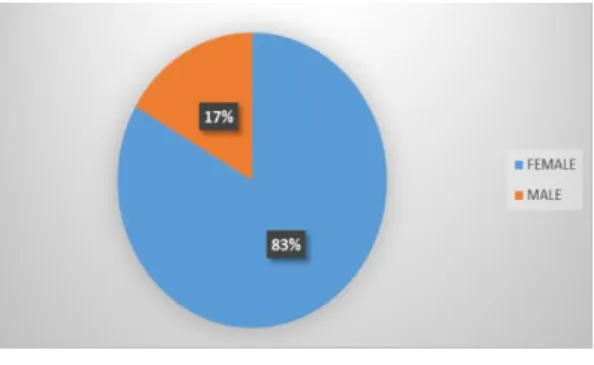
For this study, it is necessary to provide some information about students' English background so that we can get a broad idea of whether the participants took an English course before enrolling in college. 81 As Figure 4.4 shows, most students had not taken English classes before and only 17% of participants had taken an English course before enrolling in university. As we can see in the graph above, 83% of participants did not answer the question where.
General question
Strategies most frequently used
- Metacognitive strategies
- Social strategies
- Cognitive Strategies
- Metacognitive strategies
- Affective Strategies
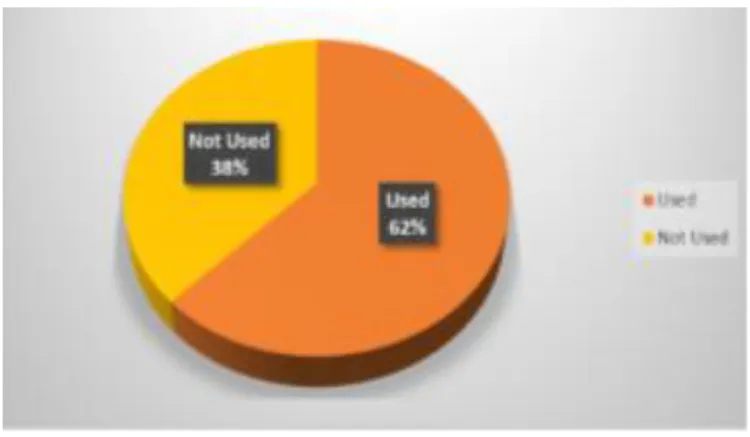
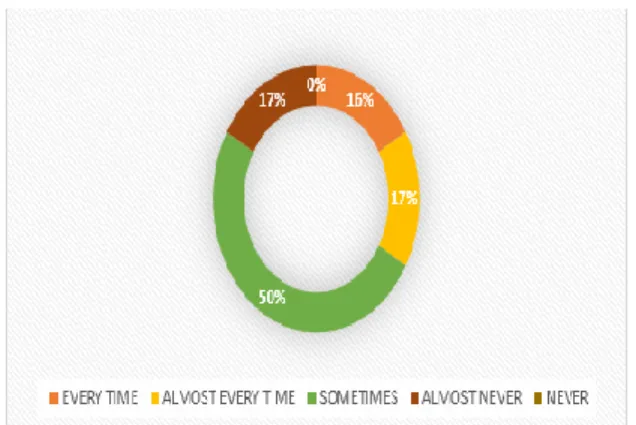
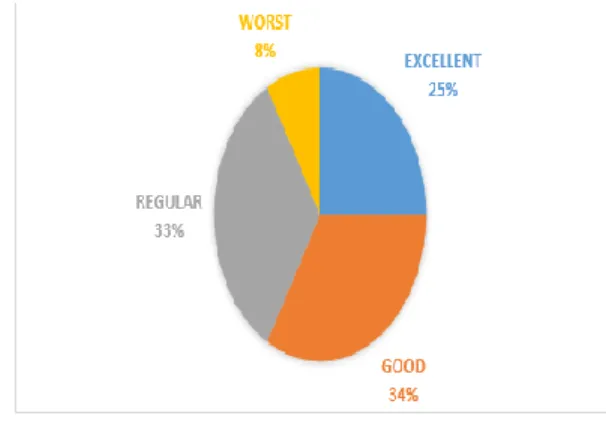
As we can see in the graph above, 50% of participants said they use it sometimes, 17% answered almost every time, 16% answered every time, and only 17% reported that they hardly ever use it. As we can see in the graph above, 33% of the participants said that they almost always learn pronunciation with their peers, 25% answered sometimes, 17% answered every time. As we can see in the graph above, most of the participants said that they sometimes use this strategy, 33% of them answered every time and only 8% answered almost never.
Students opinions
In addition, it is also important to know what the participants think about their phonetics and phonology lessons. In addition, it is important to know whether they believe that more phonetics and phonology courses should be added to the curricula. 112 In addition, 58% agree that 2 phonetics and phonology courses should be included in the curricula, 25% support the idea that 3 courses are needed, and only 17%.
Chapter conclusions
Chapter overview
Discussions to research questions, findings and their significance
In addition, most students indicated that they sometimes practice pronunciation by repeating the pronunciation of a native speaker. Similarly, Rokoszewska (2012) and Calka (2011) agree that students never use mechanical techniques such as flashcards. Rokoszewska (2012) and Calka (2011) also support that the students never observe their movements when speaking in English.
Study contributions
One of the most striking questions is that students want more phonetics and phonology courses to improve their English pronunciation. Moreover, as mentioned earlier, students are concerned about their pronunciation and therefore demand more phonetics and phonology courses. In short, we can say that this study has positive implications because it was revealed that students used PLS to improve their pronunciation.
Limitations of the study
This research project aimed to investigate the strategies used by ELT undergraduate advanced students autonomously to improve their English pronunciation. It was mentioned by the students that at least two courses in phonetics and phonology should integrate the curricula. Furthermore, it would be curious to develop a curriculum that takes into account pronunciation and to investigate what teachers teach in phonics and phonology classes.
Reflection
125 interesting to conduct a similar research with a large number of participants or to conduct an experimental research using the strategies suggested in this research and look at the students' improvement in pronunciation. This brings me to the question of what teachers teach in these courses or whether they teach what is in the course syllabus.
Directions for further research
A correlation of pronunciation learning strategies with spontaneous English pronunciation of adult ESL learners (MA thesis, Brigham Young University, . Provo, UT). -Harb, Rachel, Smith, Bruce L., Bent, Tessa and Bradlow Ann R.: The cross-language speech intelligibility advantage for native speakers of Mandarin: production and perception of contrasts in the final voicing of English words. Paper presented at the 42nd Annual TESOL Convention and Exhibit, New York, NY. 2001) 'Closing a Conceptual Gap: A Case for an Account of English as Lingua Franca', International Journal of Applied Linguistics, pp.
Personal Information
Background
To memorize the pronunciation of a certain word, I try to associate it with the pronunciation of another word (in another language I know) or with some sounds (eg animal sounds, machine sounds, equipment)…… ....1. I memorize the pronunciation of a certain word by associating it with an image or a picture (in my mind or actual drawing. To memorize the pronunciation of a certain word I use phonetic symbols or my code to write its pronunciation.