BENEMÉRITA UNIVERSIDAD AUTÓNOMA DE PUEBLA FACULTAD DE LENGUAS
USING ITALKI AND SKYPE AS AN ALTERNATIVE TOOL TO DEVELOP SPANISH ORAL SKILLS AS A FOREIGN LANGUAGE FOR
LANGUAGE LEARNERS
A THESIS SUBMITTED TO THE FACULTY OF LANGUAGES FOR THE DEGREE OF:
LICENCIATURA EN LA ENSEÑANZA DEL INGLÉS
BY
CRISTHIAN ERICK TORRES PEREZ
THESIS DIRECTOR
DR. MARÍA DEL CARMEN CASTILLO SALAZAR
APRIL, 2019
USING ITALKI AND SKYPE AS AN ALTERNATIVE TOOL TO DEVELOP SPANISH ORAL SKILLS AS A FOREIGN LANGUAGE FOR LANGUAGE LEARNERS
This thesis has been read by the members of the thesis committee of
CRISTHIAN ERICK TORRES PEREZ
And is considered worthy of approval in partial fulfillment of the requirement for the degree of
LICENCIATURA EN LA ENSEÑANZA DEL INGLÉS
Thesis Director
_______________________
Dr. María del Carmen Castillo Salazar
Committee Member
_______________________
Dr. Celso Pérez Carranza
Committee Member
_______________________
M.A. Verónica Lezama de Jesús
Benemérita Universidad Autónoma de Puebla
April, 2019
ACKNOWLEDGEMENTS
I would like to honor and thank some very important people in my life. To start, I would like to thank God for his unconditional love, for always being on my side and for showing me his goodness and kindness. I could not have done any of this without him. I would also like to express my deep gratitude to my beautiful and amazing parents, Benito and Guillermina for their incredible support, for always looking after me and for giving me all that they have without holding anything back and always being there for me. I am pretty sure that I could not have accomplished all of my achievements without them, I love you, Mum and Dad. Additionally, I want to thank my Aunt Isabel and Uncle Adrian for believing in me since the very beginning of my admission process for this degree, supporting me not only throughout my studies but all the way until completion. I do not have words to express how grateful I am, and also to my wonderful cousins Magnolia and Emiliano who have always shown me their support, thank you, guys! Moreover, I thank Doctor María Del Carmen Castillo Salazar for agreeing to be my Thesis Director and for being my Mentor during the production of this Thesis. You are an incredible person who has so much to offer. I am so amazed to see how much you know about the area of research, and I was so blessed to have you as my teacher in some classes during this degree, thank you, professor, for all the support you showed me in this process of writing my thesis.
Finally but not least, I want to thank Sam, Frank, James and Jonathan who agreed to be a part of this study. Thank you for all of the time you have invested in this, I really appreciate it.
DEDICATIONS
To my everlasting God, the one who fights on my side and gives me everything I need, to my wonderful parents who have worked so hard to make sure I finish my studies and to my Aunt
Isabel and Uncle Adrián for their incredible support.
TABLE OF CONTENTS
CHAPTER I: INTRODUCTION Page
1.1 Presentation 1
1.2 Statement of the problem 2
1.3 Main research question 3
1.4 Subsidiary research questions 3 1.5 Main research objective 3
1.6 Specific research objectives 3 1.7 Justification of the study 3
1.8 Delimitations of the research 4 CHAPTER II: LITERATURE REVIEW 2.0 Abstract 5
2.1 Technology in language teaching 5 2.1.2 Skype 5 2.1.3 Video call 6
2.1.4 Skype in education 7
2.1.5 Italki 7
2.2 Language 8
2.2.1 Language exchange 9
2.3 Communication 10
2.3.1 The interaction in the communication process 10
2.3.2 Intercultural communication 11
2.4 Language skills 12
2.4.1 Speaking skills 12
2.4.2 The importance of speaking 13
2.5 Difficulties developing the speaking skills 14
2.5. Vocabulary and difficulties 15 2.5.2 Pronunciation and mistakes 15
2.5.3 Grammar and inaccuracies 16 2.5.4 Mother tongue use 16
2.5.5 Fear of making mistakes 17
2.5.6 Lack of motivation 17
2.6 Activities to develop speaking 17
2.6.1 Develop speaking through technology 19
CHAPTER III: METHODOLOGY 3.0 Abstract 20
3.1 Research approach and method 20
3.2 Context 20
3.3 Participants 21
3.4 Research instruments and techniques 22
3.5 Procedures 23
3.6 Data analysis 23
CHAPTER IV: RESULTS AND DISCUSSION
4.0 Abstract 25
4.1 Results from the questionnaire for language learners 25
4.2 Results from the LL Journal 29
CHAPTER V: CONCLUSIONS
5.0 Abstract 36
5.1 General conclusions 36
5.2 Implications 37
5.3 Limitations 38
5.4 Suggestions for further research 39
REFERENCES 40
APPENDIXES
Appendix A: Questionnaire for Spanish learners 46
Appendix B: Language Learning Journal (LL) 47
TABLES
Table 4.1 Participant´s 1 answers 25
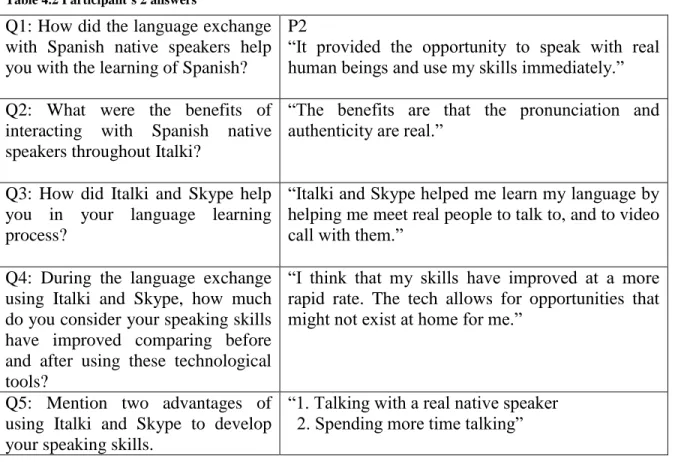
Table 4.2 Participant´s 2 answers 26
Table 4.3 Participant´s 3 answers 27
Table 4.4 Participant´s 4 answers 28
FIGURES
Figure 2.1: Example of communication process. Source. - Own design. 11
USING ITALKI AND SKYPE AS A TOOL TO DEVELOP SPANISH ORAL SKILLAS A FOREIGN LANGUAGE
CHAPTER I: INTRODUCTION 1.1 Presentation
In the last century, the world has become more interconnected as never before. This has been made possible through technology and internet, allowing interaction and interplay across different cultures. Many aspects of daily life have been influenced by this interaction such as education. Nowadays, people who desire to learn something new can have access to different platforms to get specific information, do homework, and even to learn and practice a foreign language. Technology is important in the learning process of a foreign language for people.
They do not necessarily have to attend to school to learn or practice the language because they can do it through different tools such as apps, platforms, and videos.
According to Sharma (2009), technology has had a vast and positive effect on the teaching and learning language process. It means that technology has helped the journey of people who is involved in the learning or teaching a foreign or a second language.
Many technological approaches bring the world into the foreign language classroom through video conferences and social networking using different internet technologies as Skype. In education, it is being used to facilitate the interaction between teachers and learners in a simpler way. Learners can take a class through having a video call as if they were in the classroom.
People are motivated to learn a language for many different reasons such as, to travel to a particular country, to study abroad, to get a better job, among others. However, at the end, people pursue the same purpose, that it, is to be able to communicate in the language they are learning.
Researchers have identified, learners seem to be more interested in the development of their speaking skills rather than the writing or the reading skill. It is common that during the learning process learners may have problems in this specific skill. They may have a hard time speaking in the foreign language. According to Pawlak, Waniek-Klimczak, and Majer, (2011) speaking a foreign language is not an easy assignment since it requires the development of different language subsystems to use them in natural conversations. In this sense, learners should use the update technology to face this problem. One way is to use alternative tools such as Italki where learners can find language partners from all over the world to do language exchange interaction
with native speakers using Skype in order to interact in a real setting. The interaction that learners have in the language exchange allows them to learn the language from a native speaker who helps the learner to see how the language is used and to receive useful feedback to improve.
It is extraordinary to see how Italki help people contact a language partner who speaks the language they are learning and assist them along the way.
1.2 Statement of the problem
Nowadays, Spanish Foreign Language learners seem to struggle at the time of communicating in Spanish because they are not immersed in a community context where they have the opportunity to practice in a real setting. In the United States, some learners take Spanish classes from Elementary or Secondary school. Due to the amount of Spanish native speakers living in this country, Spanish is a curricular subject in these two levels. However, the school system gives more attention on teaching grammar and does not give the chance to students to practice speaking and listening skills. Therefore, learners have a good level of grammar and even they are able to read or write content in Spanish. Nevertheless, when they need to use the language to talk to someone, they are not able to do it in the foreign language because they are shy or because of the lack of vocabulary and those with a great range of vocabulary. To be specific, in some parts of the United States, it has been observed that people who have learned the language at school does not use SFL in their classes because their teachers are more focused on teaching grammar rather than on promoting oral practice. Then, they are not motivated to speak the language and as a result they have a high knowledge of grammar but the majority of them cannot actually speak the language they are learning.
The participants of this study were ranked to have a high domain of the Spanish grammar rules;
however they found difficulties to express themselves in an oral manner. Furthermore, these participants who were learning Spanish at school, did not have the opportunity to practice the language outside the classroom face to face with a person as they would want to, even though there might be Spanish native speakers around the area. This situation occurs because those people were busy or preferred to talk in English rather than in Spanish and if they were willing to talk in Spanish they would not have the time to correct and offer feedback to them. In addition, one of the participants did not have to learn Spanish as a mandatory subject but he decided to do it by himself because of his personal interests or necessities.
1.3 Main research question
The main research question that leads the study is the following:
How can apps help SFL learners to improve their speaking Spanish skills?
1.4 Subsidiary Research questions
The following research questions will help to collect the information for this research.
RQ1: How does the language exchange help learners to develop their speaking skills?
RQ2: How can SFL learners use Italki to practice their speaking skills with native speakers through Skype?
RQ3: What are the advantages of doing language exchange by using Italki and Skype?
1.5 Main research objective
The main purpose in this research is to help learners develop their Spanish oral skills throughout Italki to find some language partners to participate in a language exchange with native speakers by Skype.
1.6 Specific research objectives
The specific objectives that are related to the subsidiary research questions are the following:
To investigate how the language exchange helps learners to develop their speaking skills.
To investigate how SFL learners use Italki to practice Spanish with native speakers through Skype.
To explore the advantages of doing language exchange by using Italki and Skype.
1.7 Justification of the study
In this study, Spanish learners from different parts of the United States will be benefited since it seems that they are having a hard time to have conversations in Spanish. They do not speak with someone who speaks Spanish and someone who can offer feedback. Consequently, this study aims to help participants to improve their speaking skills by the guidance of the use of a free website called Italki to find language partners to practice their Spanish in a way they interact with native speakers by Skype. In addition, this research will contribute to help the participants
to have the opportunity to communicate in Spanish using the knowledge they have to become confident in the use of the language.
In this particular case, Spanish learners will be assured that they will practice the language they are learning and they do not have to wait for going to a Spanish speaking country to practice the language. In addition, Italki has over one million users from all over the world so the participants will be able to choose the people they want to talk to as well as the accent they are interested in practicing.
1.8 Delimitations of the research
This research will be applied to users from Italki since they already have experience using it and are able to express their thoughts about language exchange using Italki and Skype. Moreover, in this study only people from the United States will participate in this research since they are more likely interested in learning Spanish.
CHAPTER II: LITERATURE REVIEW 2.0 Abstract
In this chapter, the most salient literature related to the main topic of the study is investigated and presented. Additionally, the concepts related to technology, communication, Spanish as a foreign language and technology in language teaching will be examined in this chapter. The main purpose of this section is to provide with solid a research basis of the topics and subtopics related to the study.
2.1 Technology in language teaching
In this 21st century, new technologies have expanded in all areas of people´s life. Thus, technology has become an important tool for education, especially in language teaching.
Eady, and Lockyer (2013) state that technology plays an important role for learners who are surrounded with technology, and teachers use it as a material to help the learning process of students. Furthermore, learners have access to different tools that technology offers to learn and practice a language, and teachers have the facility to teach through video conferences or using different materials in a classroom. For example, language teachers have access to documentaries, records to practice pronunciation, videos about the culture of any specific country that can be used in the classroom.
Wang, (2005) states that technology has advantages when it is incorporated in the classrooms for second or foreign language learners. Moreover, Soska, (1994) explains that foreign language learners can improve their skills such as speaking, reading, and writing throughout the used of educational technology. Therefore, it is essential to integrate technology in education since learners are already familiar with new technologies in the field of language learning.
2.1.2 Skype
As stated before, technology is invading the aims of communication; software for communication is being released and a new way to communicate with others all over the world regardless of their location. One of this software of communication is known as Skype. In the words of Burrell (2016) skype is known as a software that allows the user to have both audio and video calls, and it is a free online communication platform. Skype was first used in August 2003,
created by Dane Janus Friis and Swede Niklas Zennström in cooperation with Estonians Ahti Heinla, Priit Kasesalu, and Jaan Tallinn.
This software is easy to use and the only thing that people need to do is create an account using their email and add the person they want to talk to. Furthermore, Skype offers different features to its users such as phone calls, video calls, instant messaging, send files, conference calls, and screen sharing, all of these features makes Skype is a friendly and complete platform to use. Therefore, Skype has many users around the world. According to Statistic Brain (2016) Skype has 74,000,000 users.
Skype can be downloaded on any device; you can go to Skype.com to download the software on your desktop or you can look for the app on your app store or google store and install skype on your device, it is free and it will only take a moment depending of your internet connection.
2.1.3 Video call
Video call or video conference is a tool offered for many applications such as FaceTime, Messenger Facebook, WhatsApp, Skype, etc., which allows the user the possibility to contact to someone through internet and see him or her in real time. Many people use this service for many reasons from contact a family member to business purposes. Diggs-Brown, (2012) defines video conferencing as a tool that aims to connect people from different locations face to face. To make this possible, this tool uses video, computing and communication technologies. It may be sometimes difficult to communicate right away with a person face to face if he or she is in another spot or expensive to go where this person is. Therefore, using this technological service is beneficial because the only thing that both people need to have is one of the applications previously mentioned and a good internet connection. Seekey, (2005) states that videoconferencing removes the high-priced of traveling.
Video call is cutting edge in communication. However, it is not something recently invented.
Barlow, Peter, & Barlow (2009) affirm that Bell Labs technicians were actually the ones who first proved this by having a basic link between Washington, D.C. and New York City in the 1920s.
In the education field, video call or videoconference has turned into a practical way where learners can take lessons or even a course without leaving his or her house. Bonting, (1999) point
outs that this tool makes possible to keep the significant characteristics of the relationship between the teacher and learners even though if the teachers are far away. Video call does not only allow learners to contact their teachers from their home but to actually maintain a relationship teacher-learner. Therefore, this has had a critical impact in education.
2.1.4 Skype in education
Skype in used for different purposes especially for business and personal uses. In addition, people are also using skype for educational reasons. According to Branzburg, (2007) skype has been used even more for teachers and learners for educational purposes. Nowadays, thousands of people use skype to have lessons throughout a video call or phone calls without the necessity of meeting each other in a set location. Learners use this way to have lessons because it is practical for them. In the words of Fraser, (2013) skype is a tool in the classroom for educators to work with learners all over the world using this as an app to have an efficient learning experience. Moreover, learners use Skype to work on a particular project with their classmates, share note from class, study with a group of learners, etc.
In the field of language learning, Skype has had an important contribution. People can communicate to others who are also learning another language, share their culture, offer help, get support and solve problems during the conversation. Social interaction helps learners to get in touch with those who are also in the learning process. According to Elia (2006) Skype allows its users to do language exchange “two people of different mother tongues collaborate in the learning of each other’s language”' (p. 271). It is sometimes difficult to find a person who speaks the language you are learning and get some help along the way. However, Skype makes this possible since you can communicate easily with people using its different features. Furthermore, people can learn a new language by contacting a professor through Skype without having to travel to a Spanish speaking country. Skype has many advantages, one of them. In words of Melnyk (2015) study a language online allows you to improve your language skills in a comfortable setting. It is because learners are more related to the use of technology and they can do it at any time.
2.1.5 Italki
This is a Chinese platform created to help language learners from all over the world to master their language skills having connections among people. In this platform, there are over one million language learners looking to improve their language skills such as: speaking, reading, writing and listening.
This web site is a place where people can practice a language in an online setting with the help of language partners (people who help those who are learning a language because they speak that language). This website has different sections and functions. The first function is used to find a teacher. There, you can contact an experienced and certified language teacher or you can find a community teacher who can help you learn a language through informal tutoring or speaking practice. This function is not free; the prices change depending on the teacher you select. In the second section, learners have a notebook entry where they can do writings. These writings can be corrected by native speakers who are not necessarily language teachers. This function is helpful since learners can get feedback to improve their writings or they also can help other learners by checking some of their writings. Another section is the answer section. In this section the learners ask questions about language or culture. They have to write the question, add details if it is necessary, select what language is used in the question and the category. This question will be answered by native or nonnative speakers. The last section is called “language partners”. Here, the learners get free language practice by communicating in their native language with others for a certain time and then they switch to their partner`s language and continue practicing for the same period of time. To get a partner that suits each learners` needs, they need to select in the platform the language they are learning and the language they speak in order to see the options for partners to practice with.
A language partner is contacted by sending a message and setting a time to talk. This website lets their users include some communication tools such as Skype. When language learners get in touch, they agree in using skype to do language exchange because it is most common than FaceTime, Google Hangouts and QQ. In addition, during a conversation they can see how much time they have been speaking in Spanish or English.
It is necessary to highlight that the learners that use this platform have different interests, some of them might practice only writing but there are also those who want to practice speaking.
2.2 Language
Language communicates meaning to others. Merriam-Webster’s Collegiate Dictionary (2003) states that language is a systematic way which aims to communicate ideas or feelings and it is possible through the use of signs, sounds, gestures to have clear meanings. In other words, language is not limited, it can be seen in an expressive, spoken or written mode. Furthermore, language is considered as a skill. Pinker, (1994) refers to language as a difficult skill. He points out that a child can develop it without formal assistance since it takes place in a spontaneous environment, and its characteristic is to process information logically. Moreover, Brown (1941) suggests some possible definitions of language. They are simple but it does mean that the linguistic part is hidden since each concept has years of study, and each category has an area of study that can be seen after each definition.
1. Language is systematic: the ways of the system of language such as explicit and formal.
(e.g., phonological, syntactic, lexical, and semantic analysis)
2. Language is a set of arbitrary symbols: history about language, the connection between language and reality.
3. Those symbols are primarily vocal, but may also be visual: phonetics, phonology, writing systems, and the role of gesture.
4. Language is used for communication: communication systems, speaker-hearer interaction, sentences processing.
5. Language operates in a speech community and culture: dialectology, sociolinguistics, language and culture, pragmatics, bilingualism and second language acquisition.
Language is not limited to only one concept but in fact it has different categories of definitions as the previous ones. However, at the end the previous author ends defining language as the system of communication.
2.2.1 Language exchange
Language exchange is becoming more popular in the 21st century. People who learn a language are using it to improve the language they are learning but also to help others to learn languages.
Language exchange is also known as tandem language learning. In words of Cziko, (2004) language exchange refers to the interaction of two learners who speak a different language and want to learn the language that his or her partner speaks. In addition, Calvert
(1992) states that language exchange is founded on the idea that if someone helps one person, he or she will have to help another person as well as to understand each other.
Language exchange gives the opportunity to talk with native speakers from other countries and to share culture experiences. This language interchange results of mutual benefit for the participants. According to Calvert (1999), language exchange or tandem language learning helps both individuals in three different aspects which are to learn about the culture of each person, develop their language skills and give-and-take information.
In most cases language learners do not have the possibility to travel to interact with people face to face in order to practice the language they are learning. They have to use another alternative way to do so such as a language exchange through internet and software. Lewis, (2014) states that an ideal way to experience language exchange is through a website such as Italki where students can find a language partner and use the target language.
2.3 Communication
Communication is always present in daily life, in any activity people do. According to some researchers the word communication is not easy to define. It has different meanings depending on the purpose of each researcher, for example Littlejohn & Foss (2008) state that communication is the transmission of knowledge. Berelson and Steiner (1964) argue that communication is the conduction of information by the use of symbols. In the same way, Gudykunst & Yun Kim (2003) point out that communication is a representative procedure that contains meaning. In the same line, DeVito, (1967) states that communication is a procedure where a sender directs information to a receiver across a canal having noise as an obstruction.
Moreover, Mehrabian (2007) defines communication as the action a person does when he or she transmits or receives information about knowledge, desires, perceptions, or affective states from another person. Finally, Keyton (2011) concludes that communication is a procedure in which an individual gives knowledge and mutual understanding to another individual. For this study, the term communication is understood as the transmission of information to another person throughout symbols.
2.3.1 Interaction in the process of communication
Communication plays an important role in every day’s life because every single person needs to convey messages. According to Gudykunst & Yun Kim (2003) communication includes the used of symbols to express something. These symbols are not limited by words because they are used through gestures, spoken words, written words, facial expressions and gestures and may have diverse meanings in different settings.
When a person wants to communicate something is necessary to transmit his/her ideas to others. This person is known as the speaker. He is the one sending the message. In communication, this process of transmitting something is known as transmitting message (Gudykunst & Yun Kim, 2003). The same authors state that communication is the procedure of setting thoughts, feelings, emotions, or attitudes to others in an identifiable way. In other words, a person who wants to communicate needs to put his ideas in a way that others can understand them. During this process, there is another term called interpreting message that is the procedure of receiving and getting the main idea of the message. The person that receives the information is the listener. In the communication exchange the speaker and the listener exchange roles in all the interaction process. The communication process is represented in the following figure:
Figure 2.1: Example of communication process. Source. - Own design.
Speaker - Listener Listener - Speaker Transmitting message
Interpreting message
2.3.2 Intercultural communication
In the present, people are no longer limited to the contact of the outside world as they were before. The new ways of communication and transportation make possible to communicate with other cultural groups. It is not impossible now to contact a person from another part of the globe.
Interacting with other people is now a necessity. This process is conducted for different reasons such as businesses, education, policy, among other reasons. According to Jandt, (2007) intercultural communication involves having contact with people from different cultures. In the same way.
When a person has the opportunity to study abroad, he or she experiences an intercultural communication since the culture and the language in that context are different. Even if it were the same it is spoken in an unusual way. For example, if you are from Mexico and you decide to go on a trip to Peru you will have an intercultural communication because the language is not spoken as it is in Mexico.
Technology is one of the main sources people use to communicate with others from different countries. In businesses, people have travel a lot but with technology now they have the possibility of making a video call. It is not as complicated as it was in the past. In education, it is more common to see people applying to study abroad and have a new experience. However, if they do not have the possibilities to do so, they can live this experience at home through a virtual exchange.
Intercultural communication is increasing letting people communicate not only with persons from their own community or society but to those who have a totally different culture and language.
2.4 Language skills
According to Aydoğan & Akbarov, (2014), the language skills are divided into macro-skills and micro-skills. The basic language skills such are listening, speaking, reading and writing are named as macro-skills. Micro-skills, on the other hand, refer to grammar, vocabulary, pronunciation and spelling.
Although, language skills are also split into two types: receptive skills and productive skills. In words of Al-Jawi, (2010), listening and reading are the receptive skills and speaking and writing the productive skills. In these line, Bhatt & Lilian (2016) state that receptive skills indicate the
comprehension of the language across reading and listening. On other hand, Harmer (2007) points out that productive skills is speaking and writing. In this sense learners have to produce both skills by their own in the language.
2.4.1 Speaking skills
In words of Burns & Joyce (1997), speaking is one of the four language skills defined as a process of producing meaning. This skill involves obtaining, creating, and conveying information. The meaning depends on the context where the process of speaking is performed.
Similarly, McDonough and Shaw (2003) point out that speaking implicates actions such as expressing desires, wishes, opinions; solving problems or keeping relations with other people.
Additionally, Ur (1991) points out that speaking is a creative skill that produces verbal meaning.
In the same way, Hornby, (2005) states that speaking takes place when a person talks to another person. On the other hand, Kaski-Akhawan (2013) argues that speaking is the act of making sounds to express words. Bygate, (1987) perceives speaking as a mixed of motor-perceptive skills and interaction skills. Motor-perceptive skills allow to identify, recall and articulate sounds and structures of the language in an appropriate order. These facilitate the control of the superficial aspect of speaking. It is important to mention that interaction is crucial to have a successful communication with others. It is defined as the sub-skill which uses linguistic knowledge and motor-perceptive skills to speak with other individuals. This allows to have control at the moment of producing the language deciding what and how to say while the communication is taking place.
2.4.2 The importance of speaking
Nowadays, learners look forward to mastering this skill for they want to interact with other people and have a better control while they are speaking. According to Loubazid, (2012) language learners have to develop speaking as an elementary skill. Some authors, highlight the importance of the speaking skill. For example, Conrad & Dunek, (2012) states that speaking is a communication tool to exchange ideas. Ranson, (2000) points out that mastering the speaking skill allows the speaker to have a good background to communicate with others. This ability gives the speaker the facility to share opinions and understand them. Similarly, Griffin, (2008) says that speaking gives the power to influence others decisions. Ashour, (2014) states that the
speaking skill offers the opportunity to achieve personal goals in life. It opens the door to travel, to get a promotion, to get scholarships, to attend conferences or international meetings.
According to Ur, (2000) people see speaking as the most important skill in the foreign language learning process. If someone is able to convey his ideas properly in the target language, people may refer to him as a fluent speaker of that language. If someone wants to know if a learner has control over another language, he or she will ask him to speak that language, instead of writing, reading, or listening.
According to Aljumah, (2011) speaking may be the most significant skill in the foreign language backgrounds. Consequently, it brings Spanish into the context of global communities and working in an international context since we live in a globalized world that allows people to interact with others around the globe being Spanish one of the languages with more speakers around the globe after English.
2.5 Difficulties developing the speaking skill
According to Li (2003), speaking is not an easy skill to master for language learners; this is the most difficult skill to master for learners. Similarly, Zhang (2009), points out that Spanish learners find speaking as one of the most complex skills to dominate.
During the learning process, foreign language learners seem to struggle and have a hard time to communicate in Spanish. At school students are supposed to be able to hold a conversation with their classmates but unfortunately most of them seem to have problems when it comes to practicing speaking. In most cases they are nervous to make mistakes so they tend to avoid speaking all together. Teachers should therefore encourage them to speak as much as possible in order for them to improve upon their mistakes and errors over time.
In words of Ur, (1996) these are the reasons why learners seem to have difficulties in speaking:
1. Inhibition: learners are concerned of making mistakes, criticism from the rest of learners, or shyness.
2. Nothing to say: learners are not motivated to say something.
3. Low or uneven participation: the participation of learners is affected for the amount of students in the classroom and for those learner who take over, letting the rest of the learners not to speak much or nothing.
4. Mother tongue used: Learners who speak the same mother tongue prefer to use the mother tongue instead of using the language they are learning since they feel less unprotected and it is easier for them.
Al Hosni, (2014) suggests that learners should develop speaking but they have problems with this ability and one of the reasons is that students do not master this skill because in the class they communicate in their mother tongue. Learners who are not forced to speak in the native language in class cannot develop this skill.
2.5.1 Vocabulary and difficulties
In words of Diamond & Gutlohn (2006) vocabulary is the information of words and their meanings. Additionally, Hubbard (1983) define vocabulary as a transporter of meaning. Thus, Shafaei & Njati (2010) states that vocabulary is one the most important aims of teaching in a second or foreign language since he considers vocabulary the base of speaking.
Lack of vocabulary is one of the problems learners seem to have at the time of speaking.
They cannot stand in a conversation because their vocabulary is limited. In words of Thornbury, (2005) verbal language has fairly an amount of words and expressions. It means that a learner must know words and expressions to produce verbal language.
Moreover, during his research, Al Nakhalah, (2016) points out that the lack of vocabulary is one of the factors that learners face while they speak. This leads to feel unable to hold an interaction with someone. Speaking requires vocabulary to get the meaning across and to stand in a conversation but unfortunately some learners may not accomplish the process of communication because they do not have the enough vocabulary.
2.5.2 Pronunciation and mistakes
According to Thornbury, (2005) pronunciation can be defined as the ability that learners have to create sounds in order to accomplish a specific task. Moreover, Dalton (1994) states that pronunciation is the production of meaningful sounds which means clear and significant sounds in settings.
Pronunciation is considered as an important sub-ability to achieve a good communication. This is something that makes unique for the other languages and if someone mispronounces words, he or she may have problems at the time of communicating since the other person will not probably be able understand. According to Celce-Muria, (1995) misunderstanding may be present in a conversation if the pronunciation is not correct or it may produce frustration. If someone has a conversation with a person in Spanish pronouncing in a wrong way, he or she may get frustrated for not being understood by the listener. Trouvain & Gut, (2007) point out that in the learning of a language pronunciation has a significant role in the communication and for this reason leaners need to be conscious of what is essential for them. An inadequate pronunciation may cause the speaker and the listener frustration and displeasure.
Furthermore, Celce-Muria (1995) says that committing pronunciation mistakes may affect the well understanding of the language or cause frustration. In addition, Ozkan, Bada and Genc (2011) states that speaking deals with pronunciation and learners have a short time to recall the word taking care of pronunciation. Learners seem to have a hard time in speaking activities because they are not familiar with the pronunciation of some words
2.5.3 Grammar and inaccuracies
Parsons, (2004) states that grammar is a scheme of rules which leads to know the structure and the procedure of a language. According to Huddleston, (1984) grammar is classified into two categories called descriptive grammar which its aim is to display grammar how actually speakers use the language. Perspective grammar, on the other hand, aims to express its readers the grammatical rules they must respect.
Grammar is another factor that learners face when they have to speak a language.
Learners may not participate in speaking activities because they may worry to commit grammar mistakes. Davies and Pearse (2000) state that people who are learning Spanish as a foreign language do not like to speak especially if they are in large groups of people. The reason is because they may worry about speaking with many errors. In the same line, Bygate (1987) argues that to be able to communicate and have fluent speaking, a person not only has to have the knowledge of the technical side of speaking but in fact this person needs to know the grammar and vocabulary in order to produce utterances.
2.5.4 Mother tongue use
In words of Loubazid, (2012) learners who share the same mother tongue do not have the need to speak the language that they are learning to communicate. They prefer to speak in their mother tongue since they feel comfortable. In words of Baker and Westrup, (2003) learners can have obstacles when they consciously or unconsciously move their cultural rules from their mother tongue to a foreign language. Consequently, learners cannot achieve a complete interaction in the foreign language.
2.5.5 Fear of making mistakes
In speaking, learners do not participate since they are afraid of making mistakes and being corrected in public. Ur (2000) points out that students are insecure at the time of speaking in a foreign language since they are anxious about making mistakes. They also experience fear about losing face or being criticized by others. They are also worried about the attention they will get. Fear of making mistakes is another factor that stops students to practice speaking.
Therefore, teacher needs to make sure that students know that it is fine to make mistakes and that this does not represent an obstacle to speak the foreign language.
2.5.6 Lack of motivation
In schools, students learn Spanish as a foreign language and they may not have any motivation to learn since they see it as another subject. They seem to have lack of motivation to learn a new language because they do not participate in the activities such as speaking. In addition, those who learn the language by themselves may face the lack of motivation after a certain period of time since they may not see any progress. Harmer, (2001) describes motivation as an internal drive which impulses a person to accomplish something specific. Additionally, Tarone and Swierzbin (2009) states that language learning motivation is the perseverance and strength learners have to achieve a goal. Therefore, learners must be encouraged to accomplish their goals in the learning process.
Finally, Littlewood (1981) asserts that learners need to have motivation and the chance to communicate with people nearby such as classmates and teachers in order to improve their
communicative skills and to have a progress in their speaking. Thus, the lack of motivation needs to be removed and to place where they feel secure to practice their speaking skill.
2.6 Activities to develop speaking
Al-Abril (2008) points out that one of the main causes for learners struggle in speaking is for the absence of speaking activities in schoolbooks. Therefore, he states students should have more speaking activities to develop the speaking skill.
In this section, some of the most frequently used language teaching and learning activities to develop the speaking skill with language learners will be characterized.
The first activity is role play. This is a language activity that is developed to have speaking activities in the classroom taking a specific role. In words of Harmer, (1998) role play activities are for students to picture and performance different circumstances they are put in. Moreover, Gower & Phillips (1995) point out that role plays can be used for the following:
Help remembering the situation learners could be in.
Offer learners the possibility to try the language just presented, studied and performed in a beyond coordinated manner.
Present learners the opportunity to have an extensive diversity of language, in a range of settings and with different talkers in order to develop their fluency.
Aid learners to make a strategy, over the finding of the strengths and the weaknesses learners have in Spanish so they can work on them.
The second one is problem solving which refer to those classroom activities in which learners need to solve a given problem. VanGundy, (2005) defines problem solving as a process where you make something into what you desire to be. Moreover, Klippel, (1983) points out that problem solving are activities expected from learners to choose the topic to be evaluated.
Further, the language will be used according to the specific problem but in general learners will participate in these activities by giving reasons, making suggestions, listening, accepting and changing the reasons set by others. In this activity, learners have the possibility to practice their speaking along with their classmates and thinking about a real problem that is happening now.
For example, they can give a solution to a problem happening in their school, community, country or even something that is happening around the globe.
The third activity is discussion and debate. In these activities teachers use discussions and debates more commonly in the classroom to develop the speaking skills of learners. Cross, (1995) explains that discussion and debate does not have a limited time since they depend on the interest happening at the moment of doing the activity. Further, there are things happening daily which can be presented for discussion. The aim of this activity is not to put learners in the position of knowing that they are speaking in a foreign language but they focus more on what they are expressing and thinking.
In discussions, there are different formats that can be used in the classroom. Thornbury, (2005) mentions five discussion formats: discussion cards, warm up discussion, balloon debate, pyramid debate and panel discussion. In addition, Brown (2004) states that using discussion is the best option to help learners achieve the following abilities: negotiating meaning; intonating pattern for pragmatic effect; kinesics, eye contact, body language; and politeness, formality, and further sociolinguistic factors.
2.6.1 Develop speaking through technology
In language learning, the technology offers a list of tools to its users to learn or practice a new language. In the practice area, it helps learners to develop their language skills. According to Nunan (1991), not being able to have a conversation in Spanish is one of the biggest problems learners face. Thus, they need to look for ways to improve speaking as much as possible through the use of technology. There are apps that learners can get for free to practice with others who are also learning the same language. Here there is a list of apps learners can use:
HelloTalk
Tandem
Idyoma
Lext talk
Italki
Learners only have to sign up for free and start improving their speaking while they are meeting new people around the world. In words of Lewis, (2014) learners do not need to travel abroad to practice the target language in fact there are some ideas about what they can do:
Use the social network like Facebook or Google, check out Couchsurfing.org, InterNatioms.org, Meetyp.com where they will eventually find and contact people to practice the language with.
On Italki.com, a language learner create a new account, and look for a language partner who is interested in learning the target language or he/she can also find a private teacher and also practice the language using Skype.
CHAPTER III: METHODOLOGY 3.0 Abstract
In this chapter, the research design used in this research is presented. The research approach and method, context, participants, research instruments and techniques, procedures and data analysis are altogether described. The research approach is qualitative because it allows to explore the point of view of the participants in relation to the use of Italki and Skype to practice their Spanish with native speakers. The participants in this study are users of Italki from the United States. The research instruments are: a questionnaire and a language learning journal. The study was carried out in New Jersey, New England, San Francisco and Indiana.
3.1 Research approach and method
In this study, the research approach is qualitative. According to Hancock, B. (1998) qualitative research focuses on developing details of social phenomena, which aims to comprehend the things that are happening in a real setting. The research method will be case study. According to Robson, (1993) case study has to do with empirical examination of a specific phenomenon happening in real life context by means of different sources of data. Therefore, this research method will help to collect information about the use of Italki and Skype as a tool by seeing cases of people that have been using these tools in order to see how these apps help Spanish
Foreign language learners to develop their speaking Spanish skills. In addition, the data will be written because there will be documents and reports during the research. Moreover, questionnaires and language learning journals are the instruments used in this study.
The research design will answer the research questions of this study since the research approach and method are qualitative, allowing to get the data which from opinions of the participants in relation to the development of their speaking skills throughout the language exchange with native speakers using Italki and Skype.
3.2 Context
This study was carried out in the United States, specifically to users from Italki from New Jersey, Indiana and San Francisco. In these areas, Spanish is taught in elementary or secondary schools.
Moreover, in most of these states there are Spanish communities that speak Spanish and only a bit of English, therefore it is necessary to learn their language in order to communicate with them. Consequently, people from these areas learn the language and those who are interested in practicing the language have conversations using technological tools such as Italki and Skype.
This context relates to the research topic since these individuals use technology to practice the language they are learning.
3.3 Participants The participants of this research were users of Italki who are learning Spanish as a foreign
language. Users only from the United States were selected since Spanish language has a tremendous influence in this country. Only four users were part of this study because they had the following characteristics: time to be part of this research, have been using Italki at least for one year, had language exchanges during the week. The participants previously mentioned were selected in this study since they had the requirements to complete the instruments. The first participant is originally from New Jersey but he is currently living in New York City at the moment. He is 20 years old, he is studying international relations at Fordham University, he is learning Spanish because he thinks this language is helpful since there are so many Spanish speakers in the area he is living. He started studying Spanish outside the school in his freshman year of college (for three years), but he has been learning it at school since he was five (for fifteen years). His Spanish level is B2 and he uses technology all the time to learn the language
such as Netflix, Anki, Podcasts, Skype, Italki and Kindle to read books in Spanish. The second participant is from New England, he is 28 years old and he is a musician teacher. He is learning Spanish to learn about the culture of the language, to be able to communicate with Spanish speakers from New England and for work. He has been learning Spanish for eleven months, his Spanish level is A2 and he uses the technology to talk to Spanish native speakers and to read Spanish books/textbooks. The third participant is from Indiana, he is 25 years old. He is studying Biomedical engineering at University. He is learning Spanish because of leisure, cultural interest and travel. He started learning Spanish 13 years ago in school but stopped seven years ago and he started learning again two years ago. His Spanish level is upper intermediate and he uses the technology using Italki to meet exchange partners and tutors, Skype and WhatsApp to practice speaking, listening and writing. He also uses Duckduckgo and Reddit to find language learning resources; audible to listen to books; nytimes.com/es to read news;
sometimes YouTube and atresplayer.com for shows; meetup.com to meet local Spanish speakers where he has a conversation exchange group. He also uses WordReference.com, spanishdict.com, and dle.rae.es for translations and definitions; and he used to use Anki a lot to memorize new words and phrases. The fourth participant is from West Virginia. He is 26 years old and works as an engineering technician. He is learning Spanish because he likes the way it sounds and he wants to communicate with more people around the world. He has been learning Spanish online for 10 months, his Spanish level is intermediate and he uses technological tools to learn and practice the language such as Italki, conversation exchange, Duolingo, memorize, BaseLang and Youtube.
3.4 Research instruments and techniques
One of the instruments used in this study was an open-ended questionnaire. In words of Siniscaldo and Auriat (2005), a questionnaire is an examination instrument that helps to gather information from the participants about themselves related to social issues such as their every day or school activities. Therefore, it was a suitable instrument since the information collected focused on exploring the point of view that learners had in their everyday using italki and skype to practice their Spanish. In words of Mathers et al. (2007) the questionnaires need to be clear and specific in order to get satisfactory results. Therefore, the instrument was designed in English so the participants did not have any problem at the time of reading the questions and
they were comfortable using their mother tongue at the time of answering it. Likewise, the aim of this questionnaire was described at the beginning of the paper. The questions were elaborated according to the research questions because the data collected with this instrument would help to answer them. Finally, five questions were included in this questionnaire in concordance with the research questions. It did not take much time for the participants to answer it.
Another instrument that was used is the Language Learning Journal that aimed to explore the learner´ experiences, perceptions, and opinions about the use of Skype and Italki. According to Freeman, (1998) journals contain the opinions, thoughts, reflections, and observations of a person. They focus on recording in written form different content as a lesson, an activity, a learner´s experiences or it can reflect the writer´s everyday thinking. The journal used in this research contains some guiding questions related to the interaction that the learners experience by Italki and Skype. Besides, those guiding questions were designed considering the research questions. The participants kept this journal for about two weeks and their perceptions collected in this instrument are reported in chapter IV.
3.5 Procedures
In this section, the procedure of data collection is explained. To start, it was necessary to ask permission to each participant by having a video call on Skype or sending a message to those that did not have time to a video call in order to explain them the main reason of this investigation and the procedure they would have to follow. Once the permission was approved, the questionnaire and the journal format were sent to the participants by email. In the e-mail they were told that they would have two weeks to fill out the formats and then send them back to the same email account. After that, a video call on Skype was held with the participants to explain carefully what they had to do in each format and to answer any question they might had so far.
Five participants were expected to be part of this research but at the end one was not able to participate. The participants did not send the instruments on the day they agreed to do it, therefore, a message was sent to them to remind them the urgency to send the information. One person responded that it was not possible to send the documents the on time because of a family emergency but that he would make the compromise to send soon. The rest of the participants did not respond until one day later saying that they would send the instruments as soon as they could.
Once the documents started arriving to the email account, these were checked. One person did not send the journals so he received a message saying that he had only sent the questionnaire and
not the journals, he replied that he had not sent it because he thought that he had only to complete the questionnaire and not the journals so he had to send it later. Furthermore, another participant did not send the journal so a message was sent to his WhatsApp account to see why it had not been sent. But, he did not respond. Consequently, it was necessary to find another participant so the same procedure was followed and she sent the formats completed successfully.
3.6 Data analysis
In this section, the steps followed to organize the data are explained. First, the questionnaires were downloaded from the email account they were sent to. Then, they were put together in one file to change the letter style of the answers. All the participants’ responses were typed in word, the participants were asked to answer the questions given in the same document they received by email and then send it back. The most common things in the answers of the participants were that using Italki and Skype allow them to learn new words, to improve the listening skills, as native speakers speak faster, allow them to imitate the way native speakers say words, these two apps are easy to use, they can share work to be corrected, they can always ask questions about grammar or vocabulary. Additionally, the participants commented that talking with native speakers has helped them to increase their confidence in conversation by quite bit as they said they get to hear the way the language is at the time of speak with native speakers. For the language learning journal, the participants were asked to keep it for two weeks. The information collected was analyzed and then presented citing the participants exact words in order to be presented, interpreted and supported in the chapter concerning the results.
CHAPTER IV: RESULTS 4.0 Abstract
This chapter presents the results from the data collected from the research instruments. The results gathered are presented, then examined, and finally discussed. The data collected is presented in charts and then explained in detail. After that, the results obtained are interpreted using the experience of the thesis’ writer in the area and those interpretations are supported by the claims and principles offered by the experts that have worked in the areas associated to the study.
4.1 Results from the questionnaire for language learners
In this section, the most significant perceptions, opinions and ideas of the participants are presented in a chart that contains all the questions in the instrument. These ideas presented were selected considering the research objectives and questions and they are the participants´ exact words.
Table 4.1 Participant´s 1 answers
QUESTIONS PARTICIPANTS
Q1: How did the language exchange with Spanish native speakers help
P1:
“Language exchanges with Spanish native speakers
you with the learning of Spanish? improved my Spanish level exponentially.
Speaking with language partners gave me those real-world skills due to the emphasis on listening and speaking. Now, I am comfortable and confident while using my Spanish to connect with natives.”
Q2: What were the benefits of interacting with Spanish native speakers throughout Italki?
“Italki connects you directly with native Spanish speakers in the comfort of your own home.
Furthermore, the site allows you to make friends all over the world.”
Q3: How did Italki and Skype help you in your language learning process?
“Italki and Skype made language learning fun. … once I started using my language skills with real people, I became addicted to learning languages.
The two sites emphasize the speaking component, which is most important. By learning how to speak well, the learner can experience the world, make friends, and have fun without leaving their home, which motivates them to learn more and more.”
Q4: During the language exchange using Italki and Skype, how much do you consider your speaking skills have improved comparing before and after using these technological tools?
“My speaking skills have improved dramatically.
Thinking back, it amazes me how much progress I have made with only two years of using Italki and Skype. My speaking level is leaps and bounds better than students who have studied Spanish since primary school.”
Q5: Mention two advantages of using Italki and Skype to develop your speaking skills.
“It connects you with real people, so you can learn the way the language is actually used.
By using Skype, you can ask your partner to message you the new words you’re learning so you can refer back to them later.”
As it can be observed in the table above, Participant 1 stated that language exchanges with Spanish native speakers improved his Spanish level because of the interaction in real world situations. In the case of the benefits of Italki, the participant claimed that it is very comfortable to use and you can connect people from other countries. He also expressed that the language learning process is fun when using these apps. In the development of his speaking skills, he stated that his speaking is much better now than other students because of Skype and Italki. He also mentioned that in Italki you learn the language in a real context with the native speakers and in Skype you can ask the person you are talking to type the new words for you so you learn the new vocabulary later.
All these ideas expressed by this participant might mean that he likes to use technology to learn languages and he is interested in developing the oral skill by practical media such as Italki and Skype. In words of Melnyk (2015) study a language online allows a learner to improve his/her language skills in a comfortable setting.
Table 4.2 Participant´s 2 answers
Q1: How did the language exchange with Spanish native speakers help you with the learning of Spanish?
P2
“It provided the opportunity to speak with real human beings and use my skills immediately.”
Q2: What were the benefits of interacting with Spanish native speakers throughout Italki?
“The benefits are that the pronunciation and authenticity are real.”
Q3: How did Italki and Skype help you in your language learning process?
“Italki and Skype helped me learn my language by helping me meet real people to talk to, and to video call with them.”
Q4: During the language exchange using Italki and Skype, how much do you consider your speaking skills have improved comparing before and after using these technological tools?
“I think that my skills have improved at a more rapid rate. The tech allows for opportunities that might not exist at home for me.”
Q5: Mention two advantages of using Italki and Skype to develop your speaking skills.
“1. Talking with a real native speaker 2. Spending more time talking”
As it can be seen in the table above, Participant 2 said that having language exchanges with Spanish native speakers allow him to have people that he can talk to in order to practice his skills. He also mentioned that Italki gives a real place to interact with native speakers. In his learning process, he claimed that Skype and Italki give them the opportunity to interact with people. In his progress with the speaking skills, he stated that these apps have helped him to develop his speaking skills quicker and offering things he could not find where he lives. He said that the apps have some advantages such as giving the opportunity to spend time talking with a native speaker.
All of these thoughts expressed by the participant may represent that he uses Skype and Italki as a primary resource to practice the language with native speakers. He is also a person who has the opportunity to work on his oral skills.
In words of Lewis, (2014) on Italki.com, a language learner create a new account, and look for a language partner who is interested in learning the target language or he/she can also find a private teacher and also practice the language using Skype.
Table 4.3 Participant´s 3 answers
Q1: How did the language exchange with Spanish native speakers help you with the learning of Spanish?
P3
“Native speakers corrected me when I used ungrammatical or very unnatural speech and helped me express myself in Spanish (vocabulary/speech patterns).”
Q2: What were the benefits of interacting with Spanish native speakers throughout Italki?
“Italki helped me find native Spanish speakers for language exchange and helped me organize exchanges.”
Q3: How did Italki and Skype help you in your language learning process?
“I would meet exchange partners through Italki.
After that, I used Skype to do exchanges to improve listening, fluency and vocabulary primarily but also pronunciation, accent and rhythm. Without these tools I very unlikely would have exchange partners or exchanges.”
Q4: During the language exchange using Italki and Skype, how much do you consider your speaking skills have improved comparing before and after using these technological tools?
“Before Italki and Skype, my speaking skills were limited because I lacked the vocabulary and confidence. Also, I could not reliably understand fast-paced or “relaxed” speech (elementary/A2).
Now I confidently converse with strangers on non- technical subjects and understand practically all speech except slang from specific countries.”
Q5: Mention two advantages of using Italki and Skype to develop your speaking skills.
“1. With Italki and Skype, you can learn a language anywhere no matter how many speakers live in your (offline) community. 2 Italki and Skype helped me to find Spanish speakers whose level in English matched my level in Spanish.
Also, Italki users are more dedicated and open to language teaching and learning than the general population.”
As it is displayed in the table above, Participant 3 said that having language exchanges with native speakers helped him to speak in Spanish and received feedback from the mistakes he made in grammar. He also mentioned that he has benefited from Italki allowing him get language partners and set up language exchanges. In his language learning process, he stated that Italki helped him to find people to exchange with and then Skype helped him to interact with his language partners in order to develop his listening, fluency, vocabulary, pronunciation, accent