An eternal and special thanks to my mother, who has been with me at every essential moment of my life. Similarly, special attention should be paid to the concept of speaking as the ability to understand its implications when this process takes place.
Introduction
- Research Problem
- Rationale
- Research Questions
- Significance of the study
The aim of the EFL program at CELE/BUAP is to promote the communicative competence (Canale & Swain, 1981) of the English language in the students who study there. Hymes (cited in Munby, 1978) is one of many authors who discuss the concept of communicative competence.
Literature Review
Communication
- Communicative Language Teaching
- Definition of Communicative Competence
- Components of Communicative Competence
- Grammatical competence
- Sociolinguistic competence
- Discourse competence
- Strategic competence
- Language Skills
- Listening
- Reading
- Writing
- Speaking
For the purpose of this paper it is necessary to focus on the Communicative Language Teaching approach. Since speaking is the main concern of this research, it is necessary to see different perspectives of this skill.
Approaches to Speaking
- Factors that affect the speaking context
- Speaker
- Listener
- Message
- Channel
- Feedback
- Situation
Thus, all ideas, opinions and statements of the speaker become meaningful when the listener decodes these sounds. In addition, it is related to the verbal message, meaning the specific words that the individual expresses from the speaker and the non-verbal message such as the tone of voice, gestures or facial expressions used to send the message. This term is defined as reciprocal messages from the listener to the speaker in response to the original information provided by the speaker, which may be verbal or non-verbal (Lucas, 1998).
This factor has a great impact on the speaking process because it shows whether the message is understood by the participants of the process or not. It refers to the specific atmosphere and the right time to produce any kind of message.
The Importance of Speaking
It is not the same to have a conversation or talk about something in the street or in church. These two places reflect the difference between the formality and time of speaking and the physical characteristics of the places. In addition, the teachers' talk will be reduced; that is, learners are supported to speak more in the classroom.
Ur (1999) also states that “of the four skills [listening, speaking, reading and writing], speaking seems intuitively the most important: people who know a language are referred to as 'speakers' of the language, as if it includes speaking. all other kinds of knowledge.” Today, many second language learners prioritize speaking skills in their learning because if they master this skill, then they will be considered to have mastered all the other skills. Celce-Murcia (2001) argues that for most people "the ability to speak a language is synonymous with knowing that language since speech is the most basic means of human communication".
Characteristics of Speaking Performance
- Fluency
- Accuracy
- Grammar
- Vocabulary
- Pronunciation
The main goal that teachers want to achieve in teaching the productive skill of speaking is oral fluency; it is the main feature of the speaker's performance. The second kind is 'the ability to speak in coherent, reasoned and semantically dense sentences', which is a. mastery of the semantic and syntactic resources of the language'. These are all the necessary patterns to get appropriate utterances that involve not only the length, but also the complexity of the utterances (ibid).
To be a competent user of the language, it is necessary to supplement the grammar structures with the use of these rules in daily communication. They should be aware of the different sounds and their functions and where they are made in one's mouth.
Oral Communicative Strategies
- Achievement Strategies
- Guessing Strategies
- Paraphrase Strategies
- Co-operative Strategies
- Reduction Strategies
- Avoidance Strategies
The speaker can also use a word from his native language without changing it in the hope that the interlocutors will understand them, and a final guessing strategy can be used to find a word. For example, a student creates a new target language word based on his knowledge of the language, such as using 'air ball' for balloon (ibid). This strategy mainly involves looking for an alternative to the word or expression that the speaker needs in the target language.
The speaker can explain a concept or a word by making several kinds of phrases to express its meaning; this is also called circumstantial. Perhaps they want to avoid a particular sound sequence, for example, the 'th' sound in English.
Speaking Difficulties in Foreign Language Learning
- Inhibition
- Nothing to Say
- Low Uneven Participation
- Mother Tongue Use
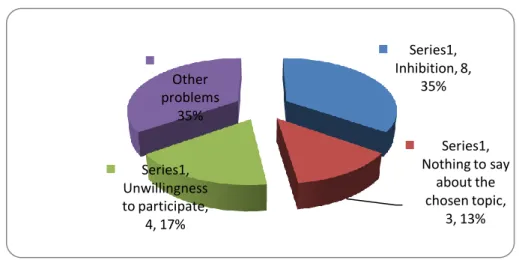
Rivers says that "The teacher may have chosen a subject which is not to his [the student's] liking, or about which he knows very little, and as a result has nothing to express, either in the mother tongue or in the foreign language. " Additionally, poor FL practice may contribute to this problem. Students may have a limited number of ideas to talk about; they may not know how to use certain vocabulary or are unsure of grammatical correctness. FL students of the same mother tongue tend to use it outside and even inside the classroom because they feel more comfortable and less exposed to the target language.
According to Baker and Westrup, learning barriers can occur if students consciously or unconsciously transfer the cultural rules of their native language to a foreign language." Therefore, learners will not be. Moreover, the lack of vocabulary of the target language usually leads learners to borrow words from their mother tongue.
Tasks
In summary, we can say that teachers have a great duty towards foreign language students to motivate them with an interesting topic, and make students feel confident to talk in the target language instead of using their native language. Breen (1989) believes that if a task can be adapted to variation in student performance, the task can be more effectively promoted as an appropriate activity for language learning. Nunan (1989), Skehan (1996) and Richards, Platt and Weber (1985), cited in Ellis (2003), clearly state that tasks should be designed to engage learners in practicing the target language in a meaningful context, through primary pay attention to conveying meaning.
Activities Teachers use to promote the speaking skill
Discover missing features: Learners A and B have the same picture, except that some items have been deleted from one of the pictures. The learner with the complete picture can have the initiative to ask questions and identify the details that are not shown in the other version of the picture. These questions can be limited to a certain type, such as yes/no questions to prevent the ease of the activity.
Communicating patterns and pictures: Learner A has a variety of shapes which he arranges in a pattern. Some limitations of the classroom situation: In situations outside the classroom, learners will have to satisfy a much wider variety of communication needs arising from the events of everyday life.
Methodology
- The research design
- Subjects
- Instrument
- Procedures
They all work as teachers of English as a foreign language, teaching at the third level of the program. These teachers are all veterans of the BUAP and know the curriculum well. They form the main team of English teachers within the CELE program and are responsible for all aspects of the teaching process, including: materials development, testing procedures, textbook selection, classroom management and, most importantly, creating classroom activities to enhance their speaking skills. promote students.
To arrive at a reliable interpretation of the answers, the 'piloting phase' was examined (Nunan, 1992 p.145). Each participant completed the questionnaire at different times, but the entire process took place within the CELE working environment.
Findings
- Speaking importance
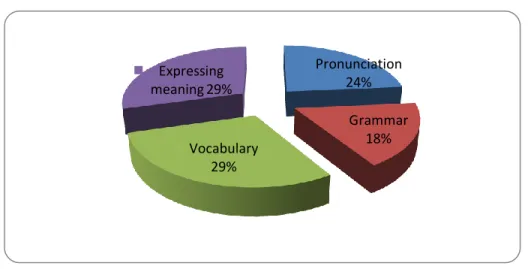
- Speaking aspects
- Frequency of oral practice
- Common oral activities
- Common speaking problems
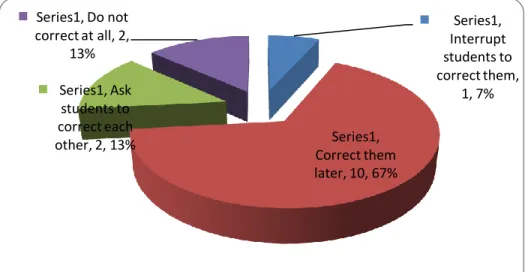
- Teacher reaction towards students speaking errors
- Teachers´ techniques to encourage students to participate in
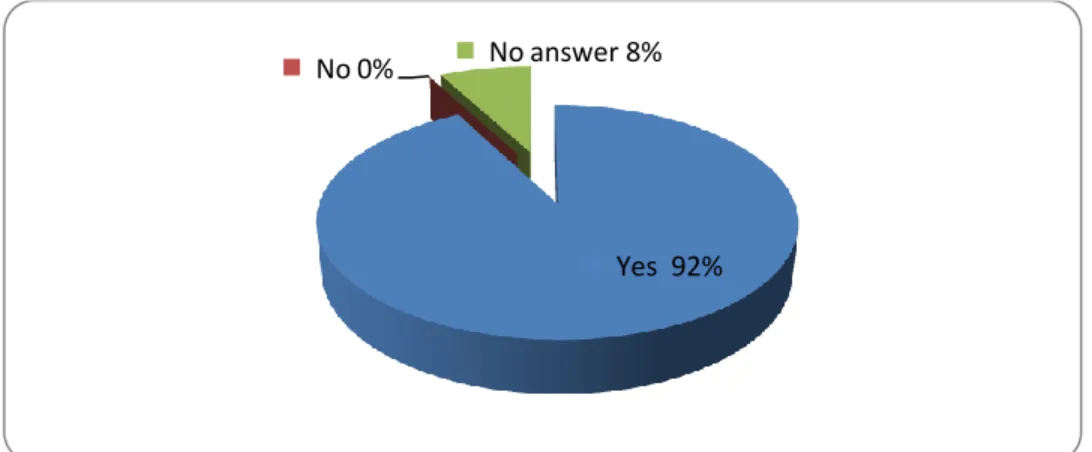
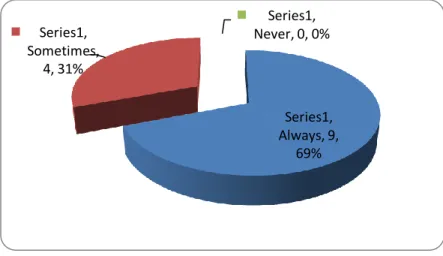
This information in the figure above can be confirmed with data from the interviews, as we can see below. In the future, they must be able to communicate in an international setting.” However, not all participants agreed. Once it is known which key aspects teachers emphasize when practicing speaking, it is also important to know how often teachers allow their students to practice the target language in class.
Considering this number, it is clear that the majority of teachers organize every classroom activity to use the target language. The table above describes the most common techniques teachers use as a tool to help students practice speaking in class.
- Key Findings
- Implications
- Limitations of the study
- Directions for further Research
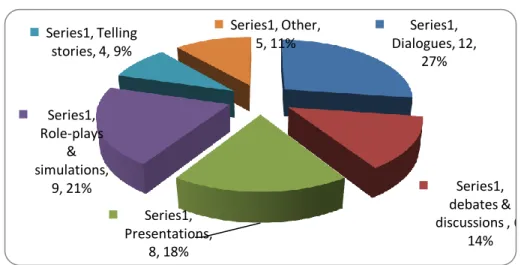
It becomes a reality when we as teachers notice a lack of interest in speaking the target language. Teachers believe that it is necessary to motivate students to practice orally in the target language with interesting topics, with any kind of prize or rewarding words for the students' performance. At this point it is necessary to mention the most common oral activities that teachers prefer to improve oral practice in the classroom.
According to the results, in the first place is the use of dialogues, with 27 percent followed by role-playing or simulations and presentations as the third place. It is hoped that this proposed further research can help shed light on oral activities in the CELE/BUAP.
I also consider grammar important to be able to communicate, because if you don't know how to structure a sentence, you can't convey a message. T3: In my opinion, if you are not able to express the meaning in a conversation, it is simply a failure… for me the most important thing is to give a message and be understood by others… here the pronunciation is also important because if the pronunciation is correctly it is easier to understand the message. T2: In general, I use different activities to practice speaking...actually I use some of them as a warm-up to get students talking...and during class I work on dialogues as the book says.
I can say that it is often at the end of the lesson if it is a presentation or at the end of the activity in a general way to be useful to the rest of the class. I think that in general when students speak the problems are more about pronunciation, fluency and vocabulary.