BENEMÉRITA UNIVERSIDAD AUTONÓMA DE PUEBLA
FACULTAD DE LENGUAS
Rapport between students and teachers: A multimodal interaction analysis.
Thesis
A thesis submitted to the School of Languages for the Degree of LICENCIATURA EN LA ENSEÑANZA DEL INGLÉS
Presenta
WANDA ALEJANDRA HUERTA ROJAS
Director
DRA. TERESA AURORA CASTINEIRA BENÍTEZ
Puebla, Pue. January 2018
Rapport between students and teachers: A multimodal interaction analysis.
This thesis has been read by the members of the thesis comitee of
WANDA ALEJANDRA HUERTA ROJAS
And is considered worthy approval in partial fulfillment of the requirement for the degree of
LICENCIATURA EN LA ENSEÑANZA DEL INGLÉS Thesis Director
_____________________
Dra. Teresa Aurora Castineira Benítez
Commitee Member Commitee Member
_________________________ _________________________
Dr. Michael T. Witten Mtra. Areli Nailea Flores García
BENEMÉRITA UNIVERSIDAD AUTONÓMA DE PUEBLA
PRIMAVERA 2018
1 Dedications
Oscar and Rosalba, thanks for showing me what hard work looks like every day our lives, you are truly an inspiration to me. This also goes to Vale, Oscar and Amalia thank you for your unconditional love. To the rest of my family Leonides, Rosalinda, Raul, Miguel, Ana, Patricia, Nancy, Ruben, Flor, Celso, Luciana, Elisea, Evencia and Juan, without your support and great example I would not be the woman I am today.
And to Leonardo, thank you for being the brightest light on my path, I love you.
2 Acknowledgements
I am forever grateful to Dr. Teresa Aurora Castineira Benitez, thank you for always being so kind and for making this the most rewarding and exciting process since our first meeting, I can only hope to become half as good as you are.
I would like to thank my readers Dr. Michael T. Witten and Mtra. Areli Nailea Flores García, thank you for your time and dedication.
And also thanks to the Faculty of Languages for facilitating the printing process of this paper.
3 Table of contents
Dedications...1
Acknowledgements ...2
Table of contents ...3
List of tables and figures ...4
Abstract ...5
Chapter 1: Introduction ...6
Introduction ...6
1.1 Significance of the study ...6
1.2 Theoretical context of the research ...7
1.3 Research setting ...7
1.4 Purpose of the study ...7
1.5 Questions ...8
Chapter 2: Literature Review ...9
Introduction ...9
2.1 Rapport ...9
2.2 Brief History of Rapport ... 10
2.3 Evolution of Rapport ... 10
2.4 Characteristics of rapport... 11
2.5 Importance of rapport building ... 14
2.6 Multimodal discourse analysis and interaction ... 15
2.7 Modes ... 16
2.8 Organization of the classroom ... 18
Chapter 3: Methodology ... 21
Introduction ... 21
3.1 Research Methodology ... 21
3.2 Research Context ... 21
3.3 Participants ... 22
3.4 Instrument ... 22
Chapter 4: Findings ... 24
Introduction ... 24
4
Class 2 ... 32
Class 3 ... 37
Chapter 5: Conclusions ... 43
Chapter Overview/ Introduction ... 43
5.1 Discussion of key findings... 43
5.2 Limitations of the study ... 45
5.3 Recommendations for further studies ... 45
References ... 47
Appendix A. Rapport observation sheet ... 49
List of tables and figures Figure 2.1 ………..……… 18
Figure 4.1: Confrontation ………..………... 26
Extract 4.1………..………... 27
Figure 4.2: Teacher Facing the Board………..………..28
Figure 4.3: Teacher’s barrier………..……… 29
Extract 4.2………..………...….30
Extract 4.3………..………....31
Figure 4.4: Classroom layout ………..……….. 32
Figure 4.5 : Classroom atmosphere………..………. 33
Figure 4.6 : Teacher’s movement………..……….34
Extract 4.4………..………... 35
Figure 4.6: Big Gesture………..……… 36
Figure 4.7: Teacher’s Gesture………..……….. 36
Figure 4.8: Teacher dancing with students………..………...…38
Extract 4.5………..………39
Extract 4.6………..………....40
Figure 4.8………..……….40
Figure 4.9: Teacher High Fiving Student………..………51
5 Abstract
This study focuses on rapport, it aims to understand the way teachers establish it inside their classrooms while utilizing the multimodal discourse analysis. It also examines which multimodal elements teachers use to establish rapport, as well as how effective multimodal interactions on rapport are. The research takes place at a public university in central Mexico, the participants are three teachers of three different nationalities, and they are responsible for language classrooms.
The three teachers were studied trough an observation sheet and recordings of their classes, that allowed a confirmation of what was observed as well as deeper analysis. Some extracts of the recordings are presented and analyzed from a multimodal approach. This project intends to shed some light on the importance and the process of building rapport in any place that deals with student-teacher interaction. After finishing the data analysis it was concluded that rapport is indeed an important element inside the classroom, and the quality of the interactions was significantly different from the teacher that tried to establish it from the ones that did not tried as hard. As this study was made in a University it may be interesting to observe this phenomenon in other levels of education.
6 Chapter 1: Introduction
Introduction
The interaction between teachers and students has evolved greatly in the past century, yet this process has only been receiving attention in recent years. Rhymes (2009) indicates that carefully studying interaction in your classroom and rearranging talk accordingly can lead to more productive and inclusive interactions, which is likely to contribute to student success. This paper aims to explore the way rapport gets involved all thorough the exchanges and the way modes affect the impact of teacher’s interactions on their students.
Granitz, Koernig, and Harich (2009) linked rapport with enhanced learning, attention, motivation, attendance, and involvement for students. They connected rapport with more rewarding teaching and higher ratings/evaluations. Not surprisingly, given these outcomes, the authors concluded that one of the key traits of a teacher is the ability to foster student rapport.
Many teachers are interacting with their students and rapport between them and their students may become difficult to detect, still the multimodal approach gives us the opportunity to study all the interactions and to identify how rapport works inside the classroom.
1.1 Significance of the study
This research aims to explore deeper the rapport phenomenon through a multimodal approach at a university in central Mexico by observing, recording and analyzing the interactions during class time. As well as the effect of rapport building between teachers and their learners to try to understand better the importance of the analysis of the interactions inside the classroom and focus some of the attention to this topic, which also plays a huge role in an aula and is unfortunate, highly ignored by teachers that do not establish it and by their students who had never experienced it.
7 1.2 Theoretical context of the research
Many studies around the world have explored the relationship between teachers and students, however rapport as a branch of this relationship does not get as much attention. There are many papers focusing on the rapport between a doctor, a psychologist and their patients or between a sales man and a potential buyer, but there are not as many studies on the educational realm. This study aims to increase the investigations on rapport from the interactional multimodal approach as well as to leave a statement on this topic, hopefully providing information for further investigations.
1.3 Research setting
This research takes place at a university in central Mexico, this university offers language courses during the year. This research is observing, recording and analyzing three teachers during their class time to search for multimodal interactions that enhance rapport.
1.4 Purpose of the study
The main purpose of this study is to analyze rapport interactions and their connection with rapport between teachers and their students, this investigation aims to observe and record three different classes from three different teachers and their students.
8 1.5 Questions
How do teachers establish rapport in their classrooms?
What multimodal elements does the teacher use to establish rapport in his/her classroom?
How effective are multimodal interactions between teachers and students in the establishment of rapport?
In Chapter 1 the study has presented the settings and characteristics of itself, it also aims to underline its importance as well as a brief introduction to multimodality and rapport. Chapter 2 presents the review of literature, Chapter 3 deals with the methodology as well as the instruments used to collect data. Chapter 4 provides the complete analysis of the observation and the recordings, in addition to some transcripts that illustrate better the rapport interaction. Finally, Chapter 5 draws conclusions.
The following chapter presents the theoretical foundations over which this study is based.
9 Chapter 2: Literature Review
Introduction
Many majors consider rapport as a fundamental aspect of their professional practice, it can be established by a customer and a seller, a patient and a doctor, a lawyer and a client, etc. I refers to any relationship that involves an exchange between two people. However in education it can be perceived as an unimportant and understudied branch. This investigation aims to explore rapport between teachers and students inside the classroom, Frisby and Martin (2008) affirm that rapport among instructors and classmates is related to perceptions of classroom connectedness, while living in an era where students seem more connected to their technological gadgets than to the people around them, rapport becomes an important element in the learning interactions and bibliography on this matter can clarify many misconceptions rapport has developed.
2.1 Rapport
Faranda and Clark (2004) define rapport as a relationship based on mutual trust and harmony.
Another definition claims that rapport is characterized by open communication and emotional and academic support that exists between students and teachers (Pianta, 1999). Even though a relationship between two strangers usually involves an equal participation, inside an aula the teachers plays the main role in this relationship. Because they establish the ground rules inside their classes and students are obligated to fulfill the requirements the teachers ask, including the kind of relationship they will share during their time together. Rapport is also the interaction between teacher and learners values; a positive rapport or relationship is “characterized by mutual acceptance, understanding, warmth, closeness, trust, respect, care and cooperation” (Leitão, N., &
Waugh, R., 2007)
10 2.2 Brief History of Rapport
The relationship between teachers and students has been studied since ancient times, as a result for that several theories have arisen trying to explain this phenomenon. According to Wang, Heartel and Walberg (1994) Plato, Socrates, and Confucius created most of the philosophical outline for teaching, which was theoretically based on the compression of knowledge through dialogue and the student-teacher relationship. Later Lev Vygotsky affirmed that the process of learning was not only a cognitive process, but also a sociocultural procedure in which the relationship between the student and the environment surrounding him was essential to the process of learning (Mazzarela, C., & Carrera, B., 2001).
Even though this relationship has been studied for a long time, rapport is a topic relatively new for educators and investigators, building rapport as a relationship variable, has only recently received scholarly attention in instructional settings (Webb, N. G., & Barrett, L. O., 2014) and little attention has been paid to this topic in previous decades. Nowadays there is so little information specialized on this topic that it can be described as an understudied phenomenon.
2.3 Evolution of Rapport
The evolution of rapport has to go as long as education starts, over 2000 years ago. Teaching exists long before schools and formal teacher education. Teachers in the nineteenth century did no received proper education; instead they receive an informal apprenticeship. If someone took a class they could later teach that class. The criteria for hiring a teacher was simply being able to control a class and keep order among students.
Later on, higher teacher qualifications were required, attention focused on creating better teachers. Teachers that understood their students learning nature resulted in making the process of
11 learning a lot easier. Fosnot (2005) claims that the constructivist teacher encourages a consideration of others’ points of views and a mutual respect, allowing the development of independent and creative thinking. From a constructivist perspective, meaning is understood to be the result of individuals “setting up relationships, reflecting on their actions, and modeling and constructing explanations” (Fosnot, 2005, p. 280).
As time went on more attention was brought to the interaction between teachers and students by proving that real knowledge comes not only from the information passing from one person to another, but for the complete learning experience. Vygotzky affirms that the process of learning involves a great amount of social influence. A dialogue that may seem simple at first transforms into inner speech where it organizes the student’s thought and becomes an internal mental function (Brady, 2014, p. 32). A classroom possess an environment of intimacy that cannot be replaced or reproduced anywhere else. Here, the teacher can engage a large number of interactions per class or per day with a huge impact on their students.
2.4 Characteristics of rapport
Buskis and Saville (2001, p. 3) affirm that rapport is tricky to understand. Perhaps that is why the voluminous literature on college and university teaching essentially ignores it. Not every book that explores the relationship between teachers and students gets to grasp rapport. It may be possible that not every teacher is aware of having experienced or practiced rapport; therefore it is impossible for them to establish it. There is not an official list on how to establish it; nevertheless the y provided some features that may help the understanding of it
Explaining your students the policies of your class and why they are what they are may not seem as important but it has been proven that this provides the students confidence at evaluation times. Besides, learning your student’s names to make the class less impersonal. Identifying your
12 students’ interests, hobbies and aspirations in order to plan contextualized classes and appropriate material for them to feel identified with the teacher and the topics. Rewarding learners’
participation with appropriate oral praises and teacher being enthusiastic about teaching and about the subject. The educator cracking a joke every now and then can make the students feel lightened and gives a sense of humility because accepting that teachers can and will make mistakes every now and then make the students less worried about their own ones. (Buskis, W., & Saville, B. K., 2001)
Some other studies have identified that a good rapport between teachers and pupils can be based on five criteria: trust, connectedness, enjoyable atmosphere, attraction and positive emotional response (Lim, C. S., Tang, K. N., & Tan, S. F., 2012)Trust is the affective link that brings teachers and students in a positive relationship, generating positive environment. Teachers must prove with their attitudes that they are trustable. Connectedness is when a teacher shows at least some hints of personality, this helps to create the bridge that connects with pupils and enhances the process of learning. An enjoyable atmosphere creates an environment of positivity and encourages the feeling of being “on the same page”. Price, Arnould and Deibler (1995, p. 35) found that there are three factors which had the most significant impact on positive emotional responses. The three factors are mutual understanding, extra attention and meeting minimum standards of activity.
Research about rapport has been carried out in recent years. There is a study made in Malaysia (Lin et al., 2012), researchers took six primary school teachers that were awarded as
“Excellent Teachers” and their thirty six primary pupils as a matter of investigation. Through recordings, in deep interviews, observation and photo elicited focus groups qualitative data was taken out of this research. Out of the six teachers, three of them showed great rapport building at
13 class and these characteristics were taken out of that study. Teachers took good care of their learners; they seemed to know their student’s background and their difficulties in the subject.
Harmonious relationship that was based on trusting each other, students were confident to ask for help when a subject was difficult and the educator encouraged this by showing and excellent attitude towards doubts and misunderstandings and a high level of respect between both of them was obvious. Teacher encouraged the students’ participation and they responded well because that was highly rewarded.
2.4.1 Characteristics of Rapport´s Body Language
It is important to remark that for a long time non-verbal interactions were not considered as important as the verbal exchanges. The sheer amount of verbal content body language has been studied as one of the most important elements rapport, some of these elements include eye blinks, head nods, finger movement, eye contact and even the breathing rhythm. Teacher making eye contact with each student can be very challenging because staring, glaring and flaring has to be avoided at all costs. Proper body language helps learners perceive that the time spent together is appreciated. Rapport is built through nonverbal behaviors such as facing the other person, leaning forward, making eye contact, and mimicry of the other person through posture, facial expressions, tone of voice and mannerisms. (Nadler, 2007)
Cabby & O’Connor (2004, p. 3) argue that rapport can be built through an approach called mirroring, that primarily involves subtle body movements to connect with the receptor. One example of this is tilting the head in a similar angle and/or respond with similar movements as the other person, but that the name of this strategy is mirroring and not imitating, therefore it has to be
14 carried out with great precaution, because if the movements are too obvious and the receptor notices these movements it may decrease the effect of rapport.
2.5 Importance of rapport building
Good rapport aims to create positive interaction that is the foundation of a good working classroom. This decreases the social worries that students might have and lets them focus on their learning. Positive rapport allows a positive climate in the classroom, which gives the student the opportunity to link concepts and skills to what they are learning and experiencing (Rimm- Kaufman, S., 2013)Also, this aims to have great peer interactions.
Students that find a positive rapport seem to be more motivated and synchronized with the teacher. Being willing to participate in the classroom in the way the teacher asks and decreasing disciplinary problems. Because teacher-student interactions embody the relational capacity of the classroom to promote positive development. (Pianta, R., Hamre, B. K., & Allen J. P., 2012).
Rapport can also create a positive attitude not only towards the class, but for the learning process in general. It has been proven that a student that is treated as a unique individual human being shows a general improvement in the school performance. To acknowledge that a learner has a life outside school and unique personalities helps the teacher choose class topics that will interest the students and make them feel appreciated and respected, Therefore the more a teacher knows his or her students the more improved, customized examples and activities can be created for the class.
(Babcock, 2001)
Rapport can adapt to the different needs of the teachers. Some teachers might think that their authority gets questioned by creating rapport and prefer a more disciplined environment, but they are taking a very traditional perspective, where the teacher is different to the students and they
15 avoid any kind of interaction that show hints of personality. Even the smallest efforts bring a huge difference in learning. For example, when teachers learn to make modest efforts to form a personal connection with their adolescent students—such that the students feel known—they can dramatically enhance student motivation in school and emotional functioning outside of school (Roesner, 1998)
2.6 Multimodal discourse analysis and interaction
In order to understand what multimodal discourse analysis studies it is fundamental to go to the fundaments of it. The simplest definition of discourse is “language in use” (Rhymes, 2009, p. 6) therefore discourse analysis is the study of how language is affected by its contexts and clearly by its use. On the other hand, multimodality is the study of non-verbal channels such as gesture, posture or the distance between people can – and do – carry meaning in any face-to-face interaction. All movements, all noises, and all material objects carry interactional meaning as soon as they are perceived by a person (Norris, 2004).
Then, it can be concluded that multimodal discourse analysis is the study of all interactions that include verbal and non-verbal interactions taking into account the context in which it occurs.
Norris (2004, p. 2) points out that all interactions are multimodal and that multimodal interactions are not concerned with the perceptions, thoughts and feelings that people are experiencing, but with the perceptions, thoughts and feelings that people are expressing. People move their bodies, hands, arms, and heads, and while the observer may try to understand the content of what is being spoken, they have already missed many important messages which each speaker is sending – intentionally or not – and the other speaker is reacting to through various modes. (Norris, 2004, p.
14)
16 2.7 Modes
For many years modes were described ad non-verbal types of communication but under this definition they were in a way connected to language itself. What Rhymes (2009) intended was for us to understand them as independent units that need to be analyzed independently as well. Modes are constructed by actions and actions take place during interactions. There are as well two types of actions, higher-level actions and lower-actions. Lower-level actions are fluidly performed by individuals in an interaction, they are mediated by a system of representation: lips-spoken language, hands-gesture. Higher-level actions are the sum of fluidly performed chains of lower- level actions.
Modes can be classified in two categories, embodied modes and disembodied modes. The embodied modes are gestures as well as language, the modes are of equal value and some examples of them are gesture, gaze and posture. Other examples of disembodied modes are music, print, clothes and layout, they can at times overrule embodied modes. Proxemics is the space relation between two people. It is also the study of the ways in which individuals arrange and utilize their space. The distance between two individuals can suggest many aspects of the relationship they have with each other (Norris, 2004). The interpersonal distance in Hall’s work presents four crucial distances that separate people in face-to-face communications and their meanings. Intimate distance (touch to 47.5 cm.), personal distance (47.5 cm. - 1.2 m.), social distance (1.2 m. - 3.65 m.), public distance (3.65 m. - 7.62 m.) (Scollon, R., & Wong Scollon, S. , 2003, p. 53). Social distance it is also the distance between a lecturer and his or her audience members in most cases.
According to Norris (2004, p. 24) posture is the way someone positions their body. “The two most important aspects are the form of the body position and the postural direction that the individual takes towards others.” Posture analyzes the body like open-closed arms, legs, knees and
17 hands, bending and straightened torso, lifting/lowering of the head and the position of the feet which may give insight into the person’s directional position. Attention must be paid to all the interaction because they are not definite. Body can be facing a direction but attention can still be paid into something else. Concerned with knowing how internal social, psychological or cultural states are displayed on the body, how they become somatized, if you like, so that they can be ‘read’
by others as a resources for the production of the interaction order. (Scollon, R., & Wong Scollon, S. , 2003)
Gesture is a deliberately expressive movement that has a sharp boundary of onset that is seen as an excursion, rather than as a result in any sustained change of position. There are two main groups of gestures hand/arm gestures, and positions of the head gestures. Norris (2004, p.
25) exposes that the hand/arm gestures include; (a) iconic, which is composed by three movement phases, preparation, stroke and retraction phase. It mimics what the individual communicates verbally; (b) metaphoric, that is a three movement phase gesture, the movements are preparation, stroke and retraction phase. It represents pictorial content as well as abstract ideas; (c) deictic is a three movement phase gesture is composed by preparation, stroke and retraction phase too, it is basically pointing to people, objects, or events in the past or future, as well as ideas as if they had physical location in the world; (d) beat, that has two movement phases, up/down or back/fort. It is performed by fingers, hands or arms and it looks as if the performer is beating musical time in quick succession. The positions of the head include the following gestures such as “rotational”
which is shacking the head “lateral” is tilting the head to the right or to the left and “sagittal” is nodding.
Gaze deals with the organization, direction and intention of looking. Gaze is more structured when the interaction is more structured. Is subordinate to language. Can fluctuate from
18 sequential to arbitrarily, we cannot be certain to what a person is looking. Gaze can also be interpreted by the reactions others have to it. Norris (2004, p. 33) also writes about artefacts, that are embodied modes when people use tools to write and express themselves, they are disembodied when people react to them. It also works for people pointing out pictures from a printed tool and uses gaze, writing, painting and drawing. On the other hand Jewitt (2014, p. 179) defines multimodal artefacts as objects or a texts in which more than once semiotic mode combined as resources for meaning-making. The artefacts that can influence the interactions inside the classroom can be markers, board, books or printed information and so on, all these have the ability to transform an interaction.
2.8 Organization of the classroom
Organization of the classroom refers to the setting and objects found in the interaction, participants draw a broader or narrowed layout depending on the interaction they are having. It is also concerned with the space in which teachers and students share their interactions, Scollon & Wong Scollon (2004, p. 39) describe several types of classroom arrangements, however this paper is interested in the teacher centered classroom which is also known as the “panopticon classroom”
where the attention focuses on the speaker, this person is the one regulating the conversation and the desks are accommodated to bring the attention into the front of the classroom (see Figure 2.1)
Figure 2.1 Panopticon Classroom
19 Scollon and Scollon (2004, p. 40) refer to the ‘panopticon event’a term suggested by Foucault, to try to explain the interactions taking place in a traditional classroom. In this type of classroom all the information goes thought the teacher and he monitors and controls all the interactions. “The teacher is placed at the front in a large space- often as much as one third of the total space in the room- and he or she is most often standing at a podium or behind a table which forms a symbolic bulwark or fortress to enhance his or her all-seeing, all monitoring position in the social interaction. Students in these classrooms are seated in smaller chairs, normally arrayed in rows where the students are shoulder to shoulder” (Scollon, R. & Wong Scollon, S., 2004, p.
40) The students are sited in front of the teacher, and even when the teacher sits among students, after a while they will go back to the front to regain the power.
Another very common interaction is the call of attendance where teachers sometimes make comments on some of the students’ and their classmates are also hold accountable for them and their classmates. Coming inside the classroom represents as well another opportunity for the teacher to confirm him or herself. While there are some teachers that prefer to be in the classroom before the class starts to have the opportunity to get ready and while doing this the teacher engages in off-the-class conversations with the students.
There are other teachers that march inside the class only when the students are inside. “The degree of syncroning and the ease of exchanges between teachers and students, even in the panopticon, teacher-controlled classroom, varies depending on the extent in which the teacher
‘tunes in’ to the students or, conversely, expects the students to ‘tune in’ to herself or himself.”
(p.41). Inside this type of event the teacher is responsible for their opening and their closure by announcing at the beginning and at the ending of the class with an utterance in which he tries to get the students’ attention to focus it on him or her.
20 According to Rhymes practicing classroom discourse in your classroom can enhance the overall experience of teaching and keep you engaged intrinsically in your professional pursuits as a teacher (2009, p. 4), it can also help you understand all the interactions that are taking place inside your classroom. Analyzing all the interactions taking place around a teacher during the class time is definitely challenging, that is why one of the strategies classroom analysis uses is recording of the class for further scrutiny, examining in a deeper way in order to improve the learning exchange. Chapter 3 introduces the methodology followed by this investigation.
21 Chapter 3: Methodology
Introduction
This chapter discusses the methodology starting with the theoretical fundaments of the research method chosen to carry out this investigation, followed by the description of the context and the participants. It also presents the instrument used and the data and analysis procedures.
3.1 Research Methodology
A case study was carried out due to the nature of this investigation, a case study method enables a researcher to closely examine the data within a specific context. In most circumstances, a case study method selects a small geographical area or a very limited number of individuals as the subjects of study (Zainal, 2007). In this case three classes were observed and recorded, a rapport observation sheet was also utilized to identify the main aspects of rapport. Field notes were taken as well, especially of interactions where multimodality and rapport met. Case study helps explain both the process and outcome of a phenomenon through complete observation, reconstruction and analysis of the cases under investigation (Tellis, 1997).
3.2 Research Context
The study was carried out in a public university in central Mexico, the faculty that was chosen was the Faculty of Languages, and in this faculty students from different majors are involved in language learning. This place receives a great amount of students each period, the year is divided into three of these ones; spring, summer and autumn, this research focused on the summer period.
The Faculty of Languages has different areas of teaching, however this paper only focused in the bachelor of English Teaching (Licenciatura en enseñanza del inglés, LEI) and the Foreign Language Center (Centro de enseñanza de lenguas extranjeras CELE).
22 3.3 Participants
The participants of this investigation are three teachers involved in the LEI and CELE departments.
As mentioned before this faculty deals with several languages and in this investigation the teachers are teaching three different languages, they also have three different nationalities. All of them are experienced teachers and have been teaching for at least 15 years and were willing and kind enough to cooperate with this paper.
The first teacher observed (Teacher 1 = T1) was teaching a class of five students, three girls and two boys. The second teacher observed (Teacher 2 = T2) had group of seven students, five girls and 2 boys and the third class observed (Teacher 3 = T3) was also a small group of 4 girls. T1 and T3 were female teachers while T2 was a male teacher. Their identity will not be revealed. All of the teachers had access to a classroom equipped with a desk, a chair, a board, a screen, a computer and markers.
3.4 Instrument
Observation was the primary strategy to detect rapport establishment, for that reason an observation sheet was used this consist on a systematic, trustworthy and valid record behavior and situations (Sampieri, R., Collado, C. & Lucio, P., 2010). Video recording is the secondary instrument used in this investigation, according to Norris (2004, p. 53) videotaped data are vital for the multimodal interaction analyst, as they give us the option to revisit the same interaction again and again, focusing upon one mode at a time and then analyzing their interplay and this provides the perfect opportunity to confirm or revoke the first analysis.
3.5 Data Collection Procedures and Analysis Procedures
Permission was asked before observing and recording the three classes. Each lesson was recorded with an Ipad which allowed the observer to take notes and fill the observation sheet in. The
23 observer did not have any participation during the classes. The teachers were observed and recorded for an hour, the footage includes some minutes before the class starts and an hour of class. From this material, the extracts that were analyzed.
Modified pictures of the teachers were done in order to protect the identity of the teachers that were kind enough to participate in this investigation as this paper is looking forward to create awareness in the establishment of rapport whether it exists in the classroom or not. Some screenshots of the videos were taken and high points of rapport were transformed into transcripts that will provide the reader with a richer overview of these classes. All of these is presented in the following chapter.
24 Chapter 4: Findings
Introduction
This sections presents the findings that the observations and the recordings show after being analyzed with the methodology presented in Chapter 3. This chapter is also provides the reader with several extracts and interaction examples of the three classes. This work takes on a multimodal interaction approach to analyze the exchanges between teachers and students, nevertheless it is also using all of the literature review on rapport to connect both of these lines of study in order to get richer results. Modes such as gaze and posture, which refer to embodied modes are examined as well as disembodied modes such as layout. It also scrutinized these modes deeply by taking some of the rapport’s body language characteristics that include leaning forward, making eye contact, and mimicry of the other person through posture, facial expressions, tone of voice and mannerisms (Nadler, 2007).
4.1 Questions
How do teachers establish rapport in their classrooms?
What multimodal elements does the teacher use to establish rapport in his/her classroom?
How effective are multimodal interactions between teachers and students in the establishment of rapport?
4.2 Findings
Throughout this paper the teachers and students that participated in this investigation are remaining anonymous, therefore names such as T1 = Teacher 1 or S1= Student 1 are used to focus merely in the exchanges and not on the people. As three classes were observed the analysis is divides into three categories, class 1, class 2 and class 3 and they are obviously presented in that order.
25 Class 1
This class starts with the teacher welcoming the students to the class and immediately after that asking for the homework, no time is taken by T1 to connect with the students before the class which is highly recommended by rapport (Lim et al., 2013). After that, a confrontation between the teacher and a student that did not have the homework with the characteristics asked in previous classes. This exchange takes place in front of the whole classroom and there are several points worth discussing.
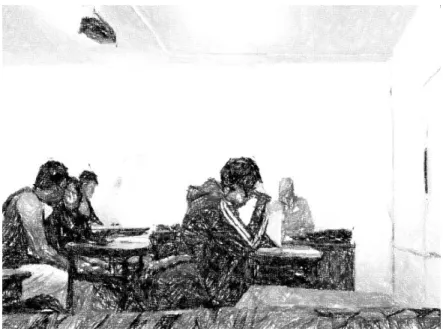
During this interaction (See Figure 4.1) T1 made some eye contact, nonetheless rapport was not established due to the circumstances of the exchange, which help us realize that eye contact by itself does not necessarily result on rapport. Through all this argument T1 remained sited behind the desk, which worked as a barrier between her and the learners. The normal distance between a teacher and its pupils in a classroom according to Scollon and Wong-Scollon (2003, p. 53) is between 1.5 and 3.6 meters but during this interaction T1 and S1 were inside the personal space and did not manage to connect in any possible way and it was, unfortunately, the other way around.
26 Figure 4.1: Confrontation
T1 takes almost four minutes to argue intensively with S1 and after all this time does not get to make S1 understand what she asked due to the fact that they are calling the homework with different names. Both participants do not to let go of the topic until T1 finally realized that it is not going to be possible to agree. Therefore, T1 blames herself in a sarcastic way affirming that at least two students understood what she wanted (see Extract 4.1). T1 shows great discomfort while doing this and makes several iconic gestures to emphasize what it is being said. It may be perceived that this is not the first confrontation inside the classroom, no other student participates in it but they do not look surprised by it, which is usually the case when strange events happen inside the classroom. The following text illustrates the above.
27 Extract 4.1
LINE SPEAKER TEXT TRANSLATION OBSERVATIONS
23 T1 Eso no es un acordeón del capítulo uno al capítulo tres
This is not a cheat sheet from chapters one to three.
24 S1 Pero acordeón es cuando
no tet e acuerdas de algo ya lo escribes
But a cheat sheet is when you don´t remember something and you write it down.
25 T1 No No
26 S1 Yo sé que eso es
acordeón
I know that is a cheat sheet
27 T1 Bueno, ok el problema lo tiene la maestra pero aquí hubo uno que lo entendió y en el otro salón también hubo otro que lo entendió, así que sorry…
Ok, ok the teacher has the problem but in this class there is one that understood and in the other classroom
someone else
understood, so…sorry.
S1 also expressed that she did not understand the assignment but she does not receive a comprehensive response from T1. One of the characteristics of rapport is willingness from the teacher to solve the students’ doubts right on the spot. Nevertheless after that, T1 realized that most of the students did not do nor understood the homework and T1 took almost thirty minutes of the class to write on the board the way she wanted the work done, during this time T1 remained facing the board (See Figure 4.2) and through all this time no questions were asked by the students.
The only noise inside the classroom was T1 voice that read out loud what she was writing. T1 did not ask questions either and did not make sure the students understand the assignment, she did not engage in any kind of conversation, it was a monologue held by the teacher and she kept reminding students that they have failed to deliver the works asked in previous classes as well as mentioning the poor participation from the class.
28 Figure 4.2: Teacher Facing the Board
Patience is not mentioned in any of the lists and works read in Chapter 2 but in this class it plays a huge role. T1 seems to have lost it with her students and the classroom environment may seem, at times, extremely hard to handle for all of the participants, therefore when T1 tries to make eye contact and open a communication exchange (See Figure 4.3) the connection, at least for that class in particular is already lost and the students do not respond to it, they kept their eyes down facing their notebooks. Figure 4.3 also shows T1 with open hands in front of her while trying to explain the differences between two terms, she uses a metaphoric gesture but only one students engages with this movement for two or three seconds to confirm verbally what T1 is saying, but while doing this she seems to be building yet, another fortress (Scollon, R. & Wong Scollon, S., 2004).
29 Figure 4.3: Teacher’s barrier
The text below illustrates the way T1 confronts her students about the lack of participation during the class, especially while solving exercises, therefore it is quite contradictory the way T1 manages her students participation because when T1 asks as question to S3 and S2 tries to answer it, S2 gets ignored due to the fact that T1 is trying to get the answer from S1 and T1 does not hear S2 trying to answer and ends up responding the question by herself (see Table 4.2) Exchanges like this happened during the class very often, which may be the reason of the students’ approach to the classroom dynamics. T1 may be trying to encourage the participation from all of her students, however she may be ignoring the enthusiasm of another student and ends up giving the answer by herself.
30 Extract 4.2
Line Speaker Text Translation Observations
78 T1 ¿Qué quiere decir el
hablante? ¿Qué quiere decir?
What does the speaker want to say? What does it mean?
T1 keeps eye contact with S3
79 S2 Que… That… S2 gets interrupted
by T1 80 T1 ¿Te gusta mi sombrero? Es
rosa. ¿Qué quiere decir?
¡No le gusto! ¡Pónganle no le gusto!
Do you like my hat? It’s pink. What does it mean? She didn’t like it! Write that she didn´t like it.
She does not notice S2.
A very similar exchanges took place during the class, nevertheless in Extract 4.2 there is a slightly change. It was mentioned before that teacher seems to have lost her patience with the group and that according to rapport the classroom environment is not the ideal, but how much time is the teacher supposed to wait for the students to get some answers from them. Rapport suggest that the teacher is responsible for the motivation inside the classroom but several examples are seen where teacher waits, what seems like forever because of the tension but that are actually only a few seconds, for their students to give her some answers (see Extract 4.3). When the teacher does turn himself or herself from a motivator into a bully?
31 Extract 4.3
Line Speaker Text Translation Observations
5 T1 Un parafraseo pragmático para it could keep me awake all night
A pragmatic
paraphrasing for: It could keep me awake at night.
Only one student looks like he is thinking about an answer
6 All students
- - - (Silence) Teacher looks at the
students for 13 seconds
7 T1 ¡Orale! * Come on! *Waits another 8
seconds before taking again…
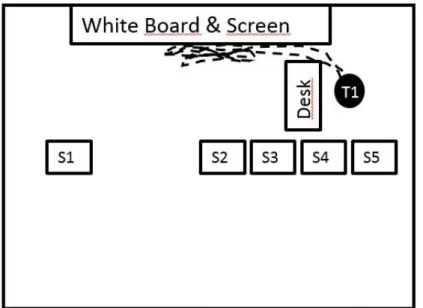
Price et al. (1995) affirmed that a teacher that shows rapport has to meet the minimum standards of activity during the class. In Figure 4.4 there are some dotted lines that indicate the movement of the teacher during the class. At the beginning of the class she moved students to have them sitting close to her desk. T1 did not move around the classroom, it worked in her advantage the fact that there were only five students, bigger groups may require more movement. However, the classroom layout made by the university is respected by the teacher almost in a religious way, the desk is facing the door and the teacher does not try on changing it. In other words, since the beginning of the class this classroom was playing against rapport.
32
Figure 4.4: Classroom layout
T1 barely moves around the classroom, from the desk to the board and back, she makes more eye contact with the students near her desk and the student who is sitting the farthest is S1 with whom T1 had the confrontation at the beginning of the class. The next section presents the findings of Class 2.
Class 2
Class 2 started with a very peculiar interaction between T2 and their students. The class began a little after the hour, giving enough time for students to arrive before T2 entered the classroom as described by Scollon and Wong Scollon (2004) in a panopticon situation, in which the teacher waits for the students to arrive and then marches into the classroom to take full control of it. After the teacher came inside the classroom a few minutes of silence went by and finally T2 greeted the students but did not receive an answer by any of them. Since the beginning of the class it is easily perceived that T2 and his students are not connected and the students that are not sitting together do not interact with each other at any point of the class. Rapport deals with creating an enjoyable
33 atmosphere in the classroom to make students feel more comfortable during the class (Lim et al., 2013) but in this class it may appear that everyone is responsible for its own atmosphere and they just co-exist with each other as seen in Figure 4.5 where all the students are looking at different directions and the teacher is simply looking down to a set of copies.
Figure 4.5 : Classroom atmosphere
Just as T1 did, T2 spends most of the time sitting behind the desk he may sit in very comfortable positions but yet again the position of the desk does not help T2 face the students, the desk is oddly directed to the door of the classroom and a similar barrier was built between the gestures of T2 and their students’, Scollon & Wong Scollon propose that the learner is most often seen standing at a podium or behind a table which forms a symbolic bulwark or fortress to enhance his or her all-seeing, all monitoring position in the social interaction (2004, p. 40). Seven students were sitting in different places of the aula, nevertheless there are two pairs of students sitting together and the rest were divided around the classroom (see Figure 4.6). He built the barrier between him and the students and it seems to grow higher and higher as the class goes by.
34 Figure 4.6 : Teacher’s movement.
All through the class T2 kept struggling with students’ willingness to participate in the class activities, just like T1. Questions like the one in line 24 (see Extract 4.3) were asked frequently and they were also followed by awkward silences. T2 did not forced any student to participate which is highly appreciated by rapport, however in this case T2 was visibly bothered with all of their students’ use of their phones and he even made jokes about it, nevertheless T2 never made clear to them that their use was forbidden or limited during the class, rapport encourages the teacher to give clear instructions and at times T2 ignored the fact that students were not paying attention to him which is also a big problem during the class.
35 Extract 4.4
Line Speaker Text Translation Observations
24 T2 Who can read that? If I´m not bothering too much texting or anything…
Teacher tries to crack a joke, unfortunately only two students get it.
However students that were texting stop doing it.
25 S1 Ha ha ha, I can
Even though T2 is sitting behind the desk he moves the upper part of his body constantly.
He makes a variety of gestures, especially iconic ones where he mimicked what he was saying. It was quite interesting to see the body divided in two, the upper part that were head, arms and torso and were in constant movement and he touched his head several times. But the lower side of his body, meaning his legs remained in the same position facing the door.
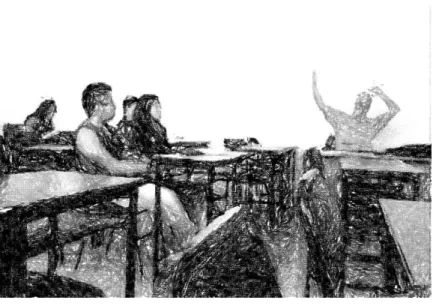
Gaze is another element that was constantly fluctuating during the class, nonetheless Scollon & Wong Scollon (2004) affirm that gaze can be interpreted by the reactions others have to it and in this specific situation not all the students are reacting to the teacher’s gaze. During on interactions (see Figure 4.9) T2 made one big gesture with arms wide open, however only two students responded directly to the teacher’s gesture that included arms movement and gaze. S1 and S5 were looking directly to the teacher’s eyes while the other students were either looking at their phones or simply not paying attention.
36 Figure 4.6: Big Gesture
There are long periods of time where T2 does not make eye contact with any of the students, he sometimes makes eye contact only with one student (S1) which is the student that is sitting closer to him and participating the most in the class. He may appear to be tuned in into himself Scollon and Wong Scollon (2004) suggest that this is a very common phenomenon in higher education levels. It is also referred by the authors in a sense that the university teacher in the classroom has too little to lose even if the students do not learn very much because he or she is getting paid no matter what (p. 47).
Figure 4.7: Teacher’s Gesture
37 The only times T2 seems more loosen up and comfortable in class is while sharing personal experiences, which unfortunately happened off cameras but was registered in the rapport observation sheet. One of the many aspects of building rapport is precisely the willingness of sharing personal information. But due to the fact that rapport was not being established students did not respond to the information being shared. T2 also cracks jokes very often, but yet again only S1 responds to it.
At the end of the class T2 called attendance and made some comments regarding some of the students that were absent, taking class attendance is another event which transforms into a demonstration of power according to Scollon & Wong Scollon (2004, p. 41), during this exchange T2 regained control of the class and finally had the students undivided attention. T2 shows that he knows all the students names or at least the connection between the names and the faces, it was extremely odd because he did not use any name during the class at all. Rapport’s literature remarks on teachers not only knowing the students’ names but also knowing their background (Lim et al., 2013).
Class 3
This class starts with the T3 waiting for her students inside the classroom, all of the learners arrived late, however before jumping into conclusions, T3 asked her students the reasons for their lateness, this exchange took place before the class officially started. Three students showed up and a conversation in German began, during this time teacher sat among students and used this opportunity to encourage the students to use the language. She took a different approach to the other teachers and took time to try to understand their students as individuals (Lim et al., 2013).
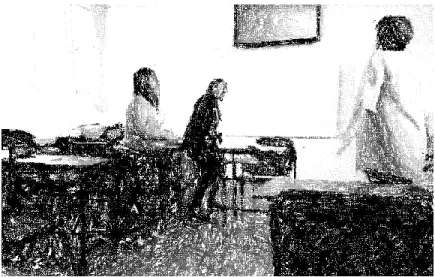
38 After that, teacher used an activity where students had to go to the board, the three students participated without hesitating and at the end corrections were made in a funny way which made students feel comfortable about their mistakes instead of ashamed or embarrassed. All through the class T3 participated and engaged herself in all the activities she asked students to do, for example, there was a song about the prepositions and teacher and students sang and danced to this song together, this was not strange for students and they seem comfortable with it. (See Figure 4.8)
Figure 4.8: Teacher dancing with students
Later in the class T3 started talking about the oral examination taking place in future weeks, even though teacher had already explained this in previous classes she took a long time explaining this again for some students that were not in the previous explanation. She took her time and never looked uncomfortable while trying to make that perfectly clear for her students (See Extract 4.5). As it was mentioned before rapport affirms that teachers’ willingness to solve doubts results in a better understanding between all the participants and her students feel comfortable enough to ask again when they did not fully understand which also reflects trust, according to Lim et al. (2012) trust is a link that brings teachers and students together.
39 Extract 4.5
Line Speaker Text Translation Observations
68 T3 Für die mündliche Prüfung muss dir etwas Vorbereitung. Dir könnt direkte Computer Machen oder mündliche eine Vorstellung von etwas, dass euch gefehlt dass, dir eure Kollegen sagen wollte. Ist das klar?
For the oral exam you must present something. You can use the computer or talk in front of your classmates about something you like.
Is it clear?
T3 takes a long time explaining an activity for 2 students that did not know about.
Just one student is aware of the oral exam.
69 S1 Hmmm noch einmal bitte. Hmm one more
time please.
T3 looks at S1 70 T3 Die mündliche Prüfung ich habe noch
gesagt vor zwei Wochen, dass eurem mündliche Prüfung...
For the oral exam I have told you almost two weeks ago that your oral exam...
T3 takes almost the same time to explain the activity she has just explained showing
willingness to keep solving doubts.
During the last exchange another very interesting one took place, because it showed the type of relationship students and T3 had. T3 showed how much she knew from her students’
background (see Extract 4.6), when T3 asked what topic would be suitable for their presentation she knew each of her students’ professions and interests. She made sure all the students understood what she expected from the presentation. In contrast with T1 that was extremely uncomfortable explaining an exercise to her students T3’s approach to the class is completely different and helped creating a respectful and amicable exchange between the participants.
40 Extract 4.6
Line Speaker Text Translation Observations
75 T3 Also, was ist dein Thema?
Soziologie. Dein Lieblings Thema? Psychologie. Dein Lieblings Thema? Lehrer sein.
So, what is your topic?
Sociology, your favorite topic?
Psychology. Your favorite topic? Being a teacher.
T3 looks at each student while saying this.
T3 also moves constantly during the class and never sat behind the desk, when she needed to sit down she simply grabbed a chair and chose a place among her students (see figure 4.8). An image was also created to illustrate the above, the dotted lines represent again the teacher’s movement around the classroom and compared to the previous teachers the different approaches are seen clearly (Figures 4.4 and 4.6). Also each time she talked to a student she made direct eye contact and her body faced the student she was talking to showing that she was giving her undivided attention to her students that were responding positively to it.
Figure 4.8
41 All thorough the class T3 uses several embodied modes to make examples clearer, gaze has already been mentioned however iconic and metaphoric gestures are often used. They go beyond hand/arm gestures because she uses her whole body to exemplify the words that she says.
When saying that she does not remember something she walked and talked like an old lady. Or when she is referring to a man she also walked and talked like one. T3 is well aware of the space inside the classroom and is often trying to reach out to students. She does not struggle with students’ participation and very often cracks jokes during the class.
Figure 4.9: Teacher High Fiving Student
For this class, mistakes were indeed corrected in a very distinctive way, one example of this is when S1 said something incorrect T3 acted out like someone broke her hear and all of the students tried to help S1 correct the sentence, however when teacher realized they were not getting it right she told the sentence correctly and explained what was done wrong. T3 also rewards correct participations in a peculiar way, sometimes T3 high-fives to students with a smile on her face and
42 in other times she gives two thumbs up while using reinforcement phrases such as, good job or well done! Chapter 5 presents the final conclusions.
43 Chapter 5: Conclusions
Chapter Overview/ Introduction
This chapter discusses the key findings of this investigation, it also presents some of the limitations that this study encountered and gives some recommendations for further papers on the same line of investigation.
5.1 Discussion of key findings
As demonstrated by the authors in Chapter 2, rapport is a very important component in the classroom. Throughout this paper several modes (Norris, 2004) and intents of rapport establishment were observed. T1 and T2 used eye contact to try to connect to students, the modes they used were mainly hand/arm iconic gestures, their posture showed that they were tuned into themselves and not to the class, T2 was a somehow more relaxed with his body, however, neither of them faced the students completely during their classes. They also remained seated behind the desk which made the interactions quite difficult, eye contact was very limited; therefore, students responded poorly to teachers. T1 and T2 struggled with the students’ lack of participation but T2 also had a big problem against the students’ use of their cellphones and therefore their attention.
On the other, hand T3 used a great amount of modes to express herself, her posture was always relaxed and she was facing the students most of the time with her whole body. She maintained eye contact with all of the students all through the class and students responded positively to it. Her distance with the learners was often personal and they seemed very relaxed by it. T3 had great participation during the class and her students were willing to engage in any kind of activity she asked from them, even singing and dancing. T3 often rewarded the learners’ input with displays of kindness, including high fives.
44 It was interesting to observe how rapport and multimodality can work hand in hand and they helped getting richer results. It can also be concluded that T1 and T2 did not establish rapport in any way which resulted in a very difficult environment inside the classroom for both, teachers and students. The confrontation between T1 and S1 was also a consequence of the lack of rapport during the class. All of these elements were also taking a lot of the time for learning to deal with all of these elements of discomfort from all sides. Neither teachers nor students looked comfortable being there and several fortresses were built. Alternatively T3 had a great class with comfortable students that were engaged in their process of learning, corrections were given and taken positively and participation was on point due to the teachers’ effort to establish rapport even when she was sitting, she remained among the students and no barrier existed between them. T3 not only knew the students’ names but also their background. She shared hits of personality and personal experiences which Frisby and Martin (2008) mention, called connectedness.
Most of the studies that have been made about rapport channel young students (Lim et al., 2012) from the ages of six to sixteen, however this study focused on university students and there are some elements of rapport that do not apply in the same manner. Some examples are teachers leaning to students of giving some pats on the students’ back. Body contact between a teacher and a student in a higher level of education may be perceived as inappropriate, nevertheless T3 handled these limitations with high fives which were not disrespectful of the learners’ personal space or integrity in any form.
T1 and T2 used an traditional classroom style to face their classes which made very hard for the students to apply themselves into it, they were controlling the class at all times and were interested on following their own rhythm. T3 took a different approach to it and she did not care to be the center of attention, she moved around the classroom freely and let students take control
45 a several times which made them also responsible for their own learning. While T1 and T2 used their classroom as a stage for their ‘panopticon event’ (Scollon, R. & Wong Scollon, S., 2004, p.
40) where they organized all the interactions, T3 had full control of the class but she did not need to manage all the interactions inside the class and the students participated in it freely and constantly.
5.2 Limitations of the study
One of the limitations of this study found was the size of the groups, due to the fact that it was the summer period small groups are very common and the rapport establishment was not seen in a large scale. Another limitation was that this study merely focused on the investigator’s perspective.
The opinion of the teachers and the students was not taken into account for this paper and finally, this research project was carried out in one specific context.
5.3 Recommendations for further studies
Due to the limitations mentioned above it may be interesting to analyze how this type of research takes place with large groups of students, as well as with students from different age and educational levels. On the other hand, studies in other contexts would enhance the understanding of rapport in the classroom. However, some other important questions appeared during this investigations such as how much the teacher is really responsible for the students’ lack of participation and interest. In this technological era, how teachers can compete for the students’
attention against their cellphones. It would also be very interesting to compare how rapport works in different types of teaching/learning.
Even when rapport is taught as a subject in psychology or medicine as it is one of the most important elements in psychologists or physicians’ everyday practice; teacher training programs lack this important subject or component. Therefore teachers need to be aware, they
46 should be able to understand it and try to use it because when teachers learn to make modest efforts to form a personal connection students they can dramatically enhance student motivation in school and emotional functioning outside of school (Roesner, 1998).
47 References
Babcock, S. (2001). The Value of student-teacher relationships. Vertical Thought, 4-7. Retrieved from www.verticalthought.org/issues/ym03/relationships.htm.
Brady, P. (2014). A case study of a student and teacher relationships and the effects on student learning. University of Rhode Island, 34-36.
Buskis, W., & Saville, B. K. (2001). Rapport Building: Creating positive emotional context for enhancing teaching and learning. American Psyclogical Society 14, 3. Retrieved from http://www.psychologicalscience.org/
Clabby, J. , & O’Connor, R. (2004). Teaching Learners to Use Mirroring: Rapport Lessons From Neurolinguistic Programming. For the Office-based teacher of Family Medicine, 2-4.
Faranda, W. T., & Clarke, I. (2004). Student observation of outstanding teaching: implications for marketing educators. Journal of MArketing Education, 26, 271-281.
Fosnot, C. (2005). Constructivism: theory, perspectives and practice. (Vols. 16-1). New York:
Teachers College Press.
Frisby, B. N., & Myers, S. A. (2008). The relationship amons perceived instructor rapport,student participation, and student learning outcomes. Texas Speech Communication Journal, 33, 27-34.
Granitz, N. A., Koernig, S. K., & Harich, K. R. (2009). Now it's personal: Antecedents and outcomes of rapport between business faculty and their students. Journal of Marketing Education 31, 52-61.
Jewitt, C. (2014). The routledge handbook of multimodal analysis. New York: Routledge.
Leitão, N., & Waugh, R. (2007). Students' view of teacher-student relationship in the primary school. 37th Anueal International Education Research Conference, 3-5.
Lim, C. S., Tang, K. N., & Tan, S. F. (2012). Building rapport with pupils to enhance teaching:
implications from observing three primary excellent teachers. (U. P. Press, Ed.) Journal of Social Sciences and Humanities.
Mazzarela, C., & Carrera, B. (2001). Vygotsky: enfoque sociocultural. Educere, Abril-Junio., 41-44.
Nadler, J. (2007). Building rapport and a better deal. Negotiation, 10, 3-9.
Norris, S. (2004). Analyzing multimodal interaction: A methodological framework. New York:
Routledge.
Pianta, R. (1999). Enhancing the relationship between children and teachers. Washington DC:
American Psycological Association.
Pianta, R., Hamre, B. K., & Allen J. P. (2012). Handbook of Research on Student Engagement.
Boston, MA: Springer.