AUTÓNOMA DE PUEBLA
Facultad de Lenguas
“THE EFFECTS OF NOT USING SPANISH WHEN TEACHING ENGLISH TO BASIC LEVEL
STUDENTS WHO WORK AT BIOTERIO”
Tesis presentada para obtener el título de:
Licenciado en Enseñanza del Inglés
Presenta:
José Antonio Guzmán Osorio
Director de tesis:
Dr. Gildardo Palma Lara
PUEBLA, PUE. OCTUBRE, 2015
Dedicatorias
“Un logro es imposible sin dedicación.”
Autor desconocido.
Las palabras no me alcanzan para agradecer a todos aquellos que hicieron posible este gran logro. A mi familia por todo su apoyo y amor, a mi querida y adorada madre Elena quien es mi fuerza e inspiración para dar lo mejor de mí., a mi padre Antonio quien sin importar que, hizo posible que yo estudiara, a mi tío Álvaro mi segundo padre y que siempre ha estado al pendiente de mí, a mi hermanita Lulú quien siempre ha estado ahí soportando mi forma de ser y echándome porras y por ultimo a mi enano donde quiera que estés.
A todos mis maestros quienes a lo largo de mi vida construyeron al futuro maestro que seré, al Dr. Gildardo Palma mi profesor y director de tesis, quien siempre estuvo dispuesto a ayudarme, asesorarme y responder mis dudas, a la Dra. Emma Zambrano Santander cuya amabilidad y paciencia me guiaron en este proceso y al Mtro. Rubén Zarate Soriano por su disposición de ser mi lector.
INDEX
CHAPTER I: INTRODUCTION ………. 6
1. Background ………... 6
1.2 Statement of the Problem ………. 7
1.3 Purpose of the Study ………. 8
1.4 Research Questions ………... 8
1.5 Significance of the Project ……… 9
1.6 Key Concepts ………. 9
CHAPTER II: LITERATURE REVIEW ……… 11
2.1 First Language/ Mother Tongue (L1) Beliefs ..……….. 11
2.1.1 Mother Tongue (L1) to Teach Target Language (L2): Complexities and Contradictions ……….. 12
2. 2 Age: Differences Between Children and Adults in Learning Process of English… 13 2.2.1 TABLE 1 Language –Learning: a Comparison ……… 15
2.2.2 Children and Adults Second Language Acquisition Process and Learning .….…. 16 2.2.3 Defining the Adult Worker Student ……… 17
2.3 Social Distance ………. 19
CHAPTER III: METHODOLOGY ……….. 20
3.1 Context and Participants ………..…. 20
3.1.1 Context ……….. 20
3.1.2 Participants ………... 20
3.2 Method ……….. 21
3.3 Instruments and Tools………... 21
3.3.1 Classes’ observation ……….. 22
3.3.1.2 Observation Sheet ……….. 22
3.3.2 Questionnaire ……….. 23
3.3.3 Teacher’s interview ……….. 24
3.4 Procedure ……….. 25
3.4.1 Identification of the problem ……….. 25
3.4.2 Collection and organization of data ………... 25
3.4.3 Interpretation of data ………... 26
3.4.4 Act on evidence ………. 26
3.4.5 Results ……… 27
CHAPTER IV: RESULTS ………... 28
4.1 Classes Observations …..………. 29
4.2 Checklists ……….. 30
4.3 Students’ Questionnaires ………. 32
4.4 Teachers’ Interviews Results …...………... 34
4.5 Diagnostic Exams and Students’ Opinions ……-……….. 36
CHAPTER V: CONCLUSIONS ….…….………... 37
5.1 Research Questions Conclusions …..……….. 37
5.2 Limitations ……… 39
5.3 Recommendations ……… 40
5.3.1 Further Research ………..……….. 40
5.3.2 Pedagogical Implications ………. 40
5.4. Personal Experiences ……….. 41
References ……… 42
Appendixes ……… 46
CHAPTER I: INTRODUCTION 1. Background
The influence of the mother tongue (L1) has always been a tough topic in English as a foreign language (EFL) and English as second language (ESL) processes, since there is not an absolute answer among researchers, teachers and speakers, if it is right or wrong to use it when learning and teaching English. Different existing theories have controversial opinions about the role of L1 influences on L2 learning Yan, (2010).
According to Gass (1996) cited by Brown (2007) mother tongue is an important factor in the development and achievement of the language that is being taught and learnt. The research done by Liu (2008) is an apt study which confirmed the role of L1 in L2 learning classroom as a facilitator. On the other hand, Krashen (cited by Brown 2007, p. 79) claims that there is little or no influence of the mother tongue because languages are learnt by strategies where mother tongue (L1) has not an important impact. Different projects made at Facultad de Lenguas state that the use of Spanish in LEMO is more common than what is believed and that according to the level of the students it is or it is not good using Spanish
Another example where the influence of mother tongue is clear, it is when code- switching is used by English teachers and students in the classroom, code switching is a nonsystematic process of bilinguals who mix two languages during conversation (Cantone, 2007), and this can be used as a help to students learn and achieve in a better way what is difficult for them, for example phrasal verbs which are very difficult to understand for all EFL students.
1.2 Statement of the Problem
There is a common belief among EFL teachers in Mexican schools, “Spanish must not be spoken when students are learning a foreign language in order to achieve a better comprehension and assimilation of it”. This is because most of the times, teachers try students to learn a foreign language (FL) as they learnt their mother tongue or as it was a second language (L2), but what teachers do not take into account is that this process can be appropriated for working with children but not with adults and that our environment just allow students using English in their classrooms or with their friends and this is just for a simple reason “Spanish” is their native language and it is spoken almost all the time .Then just using English, when teaching to adult students from basic levels could not be applied in our context.
However Kahraman (2009) awares that “There is a significant consensus: among language educators that the use of L1 can be highly beneficial resource for teachers and learners”.
Another two cases are: the students who start LEI have a basic or intermediate level and then they face the challenge or problem that students are supposed at this moment to know how to speak, read and write English and like two teachers told me in my Target Language classes “En esta carrera vienes a aprender cómo enseñar Inglés no sólo a aprenderlo” and workers of Bioterio who are required to understand books, articles and videos in English related to Biology, Chemist and Veterinary Medicine fields. It is there when teachers tend to speak most of the time in English and make students believe that something different to this behavior is incorrect. It is here when a serious problem arises, the idea of that you do not have the enough level to pass a subject or to be competitive in your job or Bachelor of Enseñanza del Ingles (BA) can create serious scholar and emotional conflicts. The fifth hypothesis of Krashen's Monitor Model, the affective filter hypothesis says that learners of a language will
filter or block out the target language if they become tense, angry or bored (Lightbown &
Spada, 1999).
1.3 Purpose of the Study
The purpose of this of this action research study is to explore the effects of the nonuse of Spanish at Bioterio with adult basic level students at Bioterio at the Universidad Autonoma de Puebla. At this stage in the research the effects of not using Spanish when teaching English to basic level students at Bioterio are a problem in the learning process, observing advantages and disadvantages when working with basic level students. A secondary goal is to observe Bioterio basic level classes and to identify the perception of what is believed by Bioterio teachers and students about the use of mother tongue in the learning and teaching processes.
Thus the main purpose of this paper is to observe that the use of Spanish in English classes is not wrong and can facilitate English learning process of Bioterio students.
1.4 Research Questions
This project sets out to solve the following research questions:
What effects do English teachers in Bioterio have in their students when avoiding the use of Spanish in their classes?
Does the use of Spanish represent an advantage when teaching English in basic level with adults of Bioterio?
If so, Why do teachers at Bioterio and LEI assume that Spanish must not be used when teaching English?
1.5 Significance of the Project
From an epistemic stance, the significance of this project is to have acquaintance of the process of teaching and learning English as a foreign language (EFL), in order to have a better idea of which factors represent a problem for adult students who learn EFL and reaffirm Krashen’s (1977) affective filter hypothesis of second language acquisition giving students the enough security to acquire a foreign language. It is hoped to obtain a better idea of the probable reason of why do students fail the first courses or why do students quit the B.A.?
then to think about how the B.A.’s standards could be approved and to have a better perception of the use of Spanish in English as FL classes and not just seeing it as something to be excluded in learning and teaching processes. Finally to show to adults who study English or want to do it, that English is not that difficult as they and society tend to believe.
1.6 Key Concepts
Mother Tongue (L1): Mother tongue is defined as the language which a child acquires from his/her home during his infancy period. This language becomes the instrument for communication in the later stages (Awoniyi as cited in Oluwole, 2008).
English as a Foreign Language (EFL): Used in contexts where English is neither widely used for communication, not used as the medium of instruction (Carter & Nunan 2001 p.87) Code-switching (CS): Coffey (2004) argues that in an educational context, code-switching is defined as the practice of switching between a primary and a secondary language or discourse.
Second language acquisition (SLA): Nunan (2001 p.87) claims that “The term second language acquisition (SLA) refers to the processes through which someone acquires one or more second (L2) or foreign languages (FL).
The use of mother tongue (L1): The use of students’ first language/mother tongue (L1) in foreign language classes. (Celik, 2008), but Gass and Selinker (cited by Brown, 2007) point out that a term like the use of mother tongue cannot be defined just with data from theory or practice.
Social Distance: Brown (2007) claims that Social Distance (SD) refers to cognitive and affective proximity of two cultures that come into contact within an individual. Distance is obviously used in a metaphorical sense to depict dissimilarity between two cultures. On a very superficial level one might observe , for example that people from United States are culturally similar to Canadians , while U.S. natives and Chinese are , by comparison , relatively dissimilar”
The Affective Domain: According to Brown (2007, p.53), the affective domain is the emotional side of human behavior.
The affective filter: It is a mental block that prevents acquires from fully utilizing the comprehensible input they receive from language acquisition (Krashen, 1985), this occurs when the acquirer is unmotivated, lacking in self-confidence or anxious, when he is on the defensive, when he considers the language class to be placed where his weaknesses will be revealed (Stevick, 1976).
The critical period hypothesis: It is the claim that there is an optimal period for language acquisition, ending at puberty (Abello. 2009 p.170).
CHAPTER II: LITERATURE REVIEW
This chapter provides the theoretical framework to place the current study “The Effects of not Using Spanish when Teaching English to Basic Level Students at Bioterio (a biology lab)” into the context of previous, related research. In accordance with, 3 basic issues, conceived from SLA perspectives which are presented in the next way: the use of L1, the age of students (adults) and social distance.
2.1 First Language/ Mother Tongue (L1) Beliefs
The use of mother tongue in EFL and ESL is a controversial topic because the different aspects it implies for example: the opinions pro and against of it, the kind of schools and their approaches where English is taught and the most important aspect for this project the age of students. There are different beliefs about the use of L1 around the world that have emerged and which were classified in 3 groups: ‘the first group believes that L1should be used for all the instructions and explanations done to the young learner’. ‘The second one believes that L1 should be only used in extreme cases’. And the last one believes that ‘the use of L1 in the language classroom should be banned’ Harmer, (1998 cited by Sanchez and Rivera 2008).
According to the ideology that an educational institution and teachers have about the use of L1 in ESL classes can lead in a high or low student’s achievement of the L2, because if the student feels uncomfortable or low competitive in use, the possibilities of failure are high.
Learners' beliefs about L2 learning are important. Positive attitudes and realistic beliefs about
language learning are related to faster progress at the early stages of studying an L2 (Horwitz etal. as cited by Lambert, O. 2008 p.162).
2.1.1 Mother Tongue (L1) to Teach Target Language (L2): Complexities and Contradictions
Debates regarding to the use of the first language (L1) in the classroom when teaching English continue to attract interest and research (Brooks-Lewis, 2009). In academic circles, the nexus of interest has shifted from a judicious use of the L1 to support the learning and teaching of the L2 to an interest in how L1 can be used to maximize learning in L2 (Butzkamm 2003). Much of the discussion around the issue of L1 in the language classroom, nevertheless, remains theoretical: Butzkamm (2003), for example, provides ten maxims for using the ‘mother tongue’ as a pedagogical resource, while Meiring and Norman (2002) examine the amount of teacher talk that teachers believe should be delivered in the L1. These debates around L1 use have particular relevance for bilingual English teachers (from here, BETs), especially those who share a first language with their learners. These teachers are able to draw on two languages as resources in the classroom and so, it could be claimed, have an advantage over teachers who can only speak the L2.
However, as Cots and Diaz (2006) argue, it is rare for BETs’ views to be heard in the debates, and even rarer that data from their classrooms be examined to reveal how L1 is exploited at the chalk-face. Copland (2012) attempts to redress this imbalance through reporting on an investigation into the use of L1 in private language schools in a Cypriot context, through an analysis of classroom and interview data, it uncovers when BETs use the
L1 in the classroom, why they do so, and how they feel about their practice. It reveals that classroom language choice is complex, predicated on both cognitive understandings of language learning and the affective realities of the language learning context. Teachers recognize this complexity; however, they seem less aware of the amount of L1 they use in class or the purposes for which they use it, underreporting and ‘differently’ reporting their L1 practices.
This contradiction between stated belief and classroom routines may be caused by feelings of guilt as teachers struggle to reconcile pedagogic ideals with contextual realities, leaving them feeling damned if they use L1 and damned if they do not. Copland (2012) concludes by suggesting that while debates about L1 use continue to flourish in academic circles, there is some way to go before BETs, such as these Cypriot teachers, feel confident about adopting a postmodern pedagogy that is particular to their own context (Kumaravadivelu, 2001). Some suggestions about how this might be achieved are given
2. 2 Age: Differences between Children and Adults in Learning Process of English.
In teaching and studying EFL processes, age has a crucial role because this has an important effect in the achievement of a target language. What teachers in LEI, and almost in all public and private schools where English is taught, is to teach a FL to adults and children with the following ideology: Spanish must not be spoken in classroom or as less as possible in order to achieve a better learning .
In an epistemic view, this is beneficial for children, as Schouten, A. (2009 p.1) argues,
“Virtually all children are able to master their native language, and most children who are surrounded by a second language at an early age can acquire this language with native like competence. In other words, both casual observers and scholars have posited that children have a particular advantage in acquiring language be it a first or second language before they reach a certain age (usually believed to be sometime around puberty)”
But if this was taken as a posture it could be assumed that children learn better a foreign language than adults , because assuming that children learn better a foreign language for their higher exposure to it , or in other words, children learn better English as a second or foreign language because they read, speak , listen and write more in English than their mother tongue or as same as this when they are learning it (but do not get confused, the focus is on the use of the mother tongue, not the exposure or practicing of the target language) this is perfect because the main goal of any English teacher is that students learn English, but what about adults? To learn better, do they have to do the same? just everything in English even when they might not know what they are doing, because imitating what is done with children when learning English would be an obvious way to teach adults in order for them to learn better, “Language learning is mainly a matter of imitation. You must be a mimic just like a small child” (Stern cited by Brown 2007 p.55). However, what is not taken into account for all people who believe that adults and young learners can be taught in the same way. It is that the students cannot be seen if they were the same.
“Teaching English to adult learners differs from teaching young learners; adult learners have very clear goals about what they want to learn and how they are going to achieve that. They also have very limited time and do not accept spending it on playing around with the language for no particular purpose”
( Dubovičienė, & Gulbinskienė, 2014)
2.2.1 TABLE 1 Language –Learning: a Comparison
The following table (made up by Robinson and Selman in 1996) states the differences between children and adults when learning a new language and it leads to a hypothesis: doing the same with children and adults when teaching a foreign or second language should be considered as incorrect or inappropriate.
Learning first language as a baby Learning an additional Language as an adult No time pressure Pressure to learn to meet other goals (e.g. ,
work or study )
No embarrassment May be embarrassed by errors
Surrounded by language related to physical events
May lack opportunity to hear English they can understand
No pressure to speak May be required to speak
Experiments with sounds ; learns all English sounds
Expect to make meaningful sounds; must learn unfamiliar sounds; may confuse unfamiliar sounds (e.g. , d and t)
Use language to get basic needs met Meets own basic needs – needs are more complex
Exposed to simple language about simple matters
Wants and needs to handle complex topics and abstract concepts
Parents tolerate and enjoy errors May experience negative reactions to errors Parents support language learning May lack support
Cries to compensate for lacking of language needed to get needs met
May rely on dictionary or translator or to be unable to communicate
Usually has acute hearing Hear may be less sharp , especially if older
Unable to analyze Can analyze language patterns
Can use only oral language If literate, can use reading and writing to support leaning
Start with single words Start with single words
Has no language to begin with Has a first language that differs from English No preconceived notions about how to learn
language
May preconceived notions about how to learn language
Adapted from: Language-Learning: A Comparison table, p.16-17 Partnerships in Learning, Teaching ESL to Adults, 1996.Robinson, J. & Selman, M.
2.2.2 Children and Adults Second Language Acquisition Process and Learning.
Children and adults processes when learning a foreign or second language seem to be similar processes, but they are very complex and different. Krashen, (2002) suggests learning as a process between acquisition and utterance. Language acquisition happens in subconscious system while language learning happens in conscious system.
The first main difference between adults and children processes is that children learn a new language in an intuitive way, while adults tend to think over it, Tippin (2011) claims the existence of “Deep motor area” a part of the brain which processes the activity that happens without thinking consciously, such as blinking and breathing. An automatic function of the children´s brain which is used to acquire language, so it becomes a natural process for the child but when adults this area decreases functions gradually.
The second difference is unlike children, adults are able to process formal thinking cognitively, children have no detention of formal operational thought in learning language.
Children’s cognitive abilities have not been developed while adults’ already have. The last difference is that adults are more conscious than children. Children mostly learn without awareness of their proficiency and motivation. Even if their proficiency of second language is limited, they do not feel nervous as much as adults do. This is because adults have pride of not making mistakes.
Thus adults pay more attention when they speak in second language. It can be said that adults learn second language in an analytic way. They tend to monitor their second language speech and avoid taking the risk of making mistakes. Majority of adults often feel embarrassed by their lack of comprehension of the second language they are learning. Different from
adults, children learn second language in a natural way. They absorb language information they obtained from teachers, parents and people around them without thinking if it is true and beneficial for them. According to Brown (2007) children are not aware of social values and attitudes put on language. They produce utterances effortlessly in comparison to adults. Self- consciousness of adults in second language learning affects them to filter and analyze whether they use the correct grammar and vocabularies when they are talking and whether the sentence they are saying has the right meaning and context.
2.2.3 Defining the Adult Worker Student.
Once differences between children and adults have been set up, it is important to know what an adult worker student is. Adult worker students have specific characteristics that set them apart from other common students, Merriam (2013 p. 11-12), claims the existence of the
following characteristics in adult learners:
Adults have accumulated life experience. They tend to favor practical learning activities that enable them to draw on their prior skills and knowledge.
Adults have established opinions, values and beliefs which have been built up over time and arrived at following experience of families, relationships, work, community, politics, etc. These views cannot be dismissed and must be respected.
Adults are intrinsically motivated. Learners increase their effort when motivated Individual differences. Adults learn at various rates and in different ways according to their intellectual ability, educational level, personality and cognitive learning styles.
Adults learn best in a democratic, participatory and collaborative environment. They need to be actively involved in determining how and what they will learn, and they need active learning experiences.
Adults are goal - oriented. They want to know why they are learning something. Adults have needs that are concrete and immediate. They are task- or problem-centered rather than subject-centered.
Adults are autonomous and self- directed. They prefer to work at their own pace.
Individuals learn best when they are ready to learn and when they have identified their own learning needs.
Merriam (2013 p.11-13) also noticed that all previous features can be taken as general for all adult students, but among all those students, a group emerges; “The adults who work and learn a Second language”, as simple as the student has a job. It is here when teachers must be conscious that this group has different motivations, expectations and goals to learn a foreign language, the main ones:
They learn a second language in order to have a better job or to improve their incomes.
They expect to see quickly results due to the lack of time
They are not necessary interested in learning grammar
They do not necessary enjoy taking classes
Whoever students and teachers must be aware and accommodate their strategies to their adult students have a satisfactory learning of a second language.
2.3 Social Distance
Language difficulty is often determined by how far or close the target and mother languages are, Contrastive analysis (CA) is a method to distinguish between what are needed and not needed to learn by the target language learner by evaluating languages (Gass &
Selinker, 2008). Then the assumption that English is a hard language to learn seems to be common among adult students even when it is clear the need for this.
Brown (2007) claims that social distance is a metaphorical construct that needs to be proven with further research in the field of SLA: “the concept of social distance emerged as an effective construct to give explanatory power to the place of culture learning in L2” (Brown, 2007 p.196). So, It can be noticed an epistemic gap in such metaphor. In this regard, the epistemic hole is about the socio-cultural differences of students from different backgrounds and the problem of such distance upon the SLA process. Thus the distance is neither linguistic nor cultural; so by using the L1 the acquisition of a foreign language can be facilitated.
In almost all the cultures the teacher’s role is seen as a high status. In this vein, Turner and Wilson (2006) claim that the three most common public perceptions of the activity of teaching in 2003 were educating, responsibility for children and controlling a class, so the teacher’s role in teaching is believed to be the most important and it is here when the perception of distance that emerges in students to the teacher when learning a L2 can create problems and interferences in this process.
CHAPTER III: METHODOLOGY
This chapter presents relevant information about the subjects and instruments involved in this project, thus the main issues discussed on chapter III are: (i) detailing information about the researching method, (ii) how the data was collected and specific information about the participants. Being the focus of this project the advantages and disadvantages of the non-use of Spanish, observations, interviews and surveys were the best option to collect and analyze data.
3.1 Context and Participants 3.1.1 Context
For this project the location used for the collection of data was: Bioterio Claude Bernard” (a biology lab) an institution that belongs to BUAP located at calle 14 Sur esq. San Claudio 6302 Col. Jardines de San Manuel in Puebla City , México. Where the main activity is to work with laboratory animals such as mice, rats, rabbits and dogs, but in order for workers to be better prepared, they take English classes.
3.1.2 Participants
In the case of Bioterio, 1 group of 10 students was observed, all of them are workers whose English level is basic, they were 3 male and 7 female students with ages rank from 21 to 35 years old, 4 of them were married and the rest single.
3.2 Method
This thesis is following the tenets of action research and qualitative method.
As such, Action research is a form of investigation designed for being used by teachers who attempt to solve problems and improve professional practices in their own classrooms. It involves systematic observations and data collection which can be then used by the practitioner-researcher in reflection, decision-making and the development of more effective classroom strategies (Parsons and Brown, 2002).
For this project a qualitative method was used in order to answer the research questions that were posed in chapter I and then know more about adult people’s understandings and experiences when learning English as foreign language and compare different aspects of using L1 in classrooms. This research followed a deductive process, starting with the analysis of all the general aspects around teaching English in a Mexican classroom and later finding a specific epistemic stance.
3.3 Instruments and Tools
For this thesis three different instruments: classes’ observation, surveys and interviews were considered relevant to be applied in order to obtain the information required for the purposes of this research, previously designed by myself and corrected by PhD Gildardo Palma Lara.
3.3.1 Classes’ Observation
In the first instrument classes of 2 hours long at Bioterio were observed, in order to take registers of how much time Spanish is used inside the classroom. Observation sheets, chronometer and tape recorder were used as supporting tools.
3.3.1.2 Observation Sheet
This tool was an observation sheet that was divided in 3 different main sections: (i) Use, (ii) Advantages and Disadvantages that were filled during class time. The first section consisted in the compilation of specific data in order to have an exactly idea about the groups which were analyzed such as date, class, number of students and topic. The section use was also divided in three parts: in this first one, a register about the times the teacher and students used Spanish during the class was taken, for example; if teacher at the beginning of the class greets their students saying “hola”, the utterance was registered as “1 time” in the section of times the teacher uses Spanish in class, and the same is done if students used Spanish in class (see appendix 1).
In the second part of use, a more accurate register about the use of Spanish by teacher and students was performed, considering the exactly length of this, which was taken using a chronometer, for example; if during the first time that teacher used Spanish she/he did it for 1:20 min. it was written like this: 1st time- 1:20 min. (in this part the support of another person to do it was necessary, because it would be hard to do for only one person). In the third and last part of use, the total times and their lengths were summarized to get a final record about the time that Spanish is used in English classes.
The 2nd section: ‘Advantages’ five positive aspects of using Spanish are registered This first part shows a scale time which helped to see the frequencies that statements below were done by teacher and students (see appendix 1). The next section shows 5 positive statements of the use of Spanish in class that were measured taking into account these aspects;
Students’ response to instructions, comfort and confidence to the teacher, students’
understanding and achievement of the topic seen, teacher’s management of the group and dynamism in the class.
The 3rd and last section analyzed 5 possible negative aspects that the use of Spanish could impact on students’ EFL learning considering these aspects; Students’ behavior, students’ use of English, students’ attitudes, class length/interruptions and student’s perceptions of learning. In the section TOTAL of the instrument, the total times of advantages and disadvantages were summarized. Using the previous instrument and tools, the analysis of the context in which the class took place was possible, focus on students’ and teachers’
behavior and development.
3.3.2 Questionnaire
This questionnaire was designed in order to trigger students’ perceptions, to survey aspects as student’s emotions, experiences and beliefs when they learnt English without grammatical aspects and it was applied in Spanish. The questionnaire consists in 1 part where students’ personal information is required and 7 questions of which 3 are of open response type and 3 yes/no/double questions type (see appendix 2).
In the first question, students answered with absolutely freedom in order to see if their context in class affected their emotion and development of learning. Item 2 triggers students’
beliefs about learning English. The third question was a yes/ no question about students’
background and context. Question number 4, a double question; the first one was a yes/no question about students’ opinion of age in learning process. In the second an explanation about the previous answer is required. For question 5, a double question about student’s perception of policies and use of mother tongue in classroom. Item 6, a yes/no question about students’
own experiences and thoughts of social distance and relationships. The seventh and final question about students’ behavior in and outside the classroom.
3.3.3 Teacher’s Interview
Teachers´ opinions are an important aspect to develop this project so a written interview was used to know them. The interview consists in 5 questions of which 3 are yes/no/double questions and 2 open response/double questions (see appendix 3).
The first question was about teachers’ experiences and contexts as English teachers. Question number two concerned on teachers’ daily practices, teaching style and approach. Question five was about teachers’ posture of the use of mother tongue in classroom. Questions 4 & 5 were about teachers’ experiences and policies in their EFL classes as students and teachers.
3.4 Procedure
3.4.1 Identification of the Problem
There was a common statement among students of Bioterio when teachers taught their classes just using L2 “Teacher no entendemos nada” it seems to be the cause of low understanding, apathy, failure and desertion on the other way students maybe do not like it or do not have interest in their classes, where the use or non-use of L1 is involved. Thus the use of mother tongue by teachers could be a possible solution to these problems.
3.4.2 Collection and Organization of Data
Before applying the instrument to the subjects, a pilot test was applied to students from Facultad de Lenguas, chosen in random way in order to see if the instrument was appropriate and then being valid to be applied to other participants. Once the instruments were designed and corrected they were applied on February 19th, February 22nd and March 5th and 10th of 2013 at Bioterio Claude Bernard de la BUAP, the group was chosen previously by their student’s level and age (basic level and adults students).
The procedure to apply the instruments was as follows: Firstly the observation of
‘Inglés 2’ in Bioterio classes without telling students the purpose of the research in order to fill the observation sheet with the most natural and possible results. Secondly, students answered a survey. All in the students group were pleased to cooperate with this project and accepted to answer it; the average time to answer the survey was from 10 minutes to 20 minutes. During the process the researcher asked participants if they had any doubt or question
with the instructions, but no one had questions. Finally; the interview was applied to teachers in charge of classes of ‘Ingles’ in a schedule previously established by them in order to no interfere with their classes.
3.4.3 Interpretation of Data
After the three instruments were applied teachers’ and students’ opinions about the use of mother tongue in classroom were gathered and analyzed. In the case of students’ surveys at Bioterio common answers that deal with possible problems in English classes were analyzed and described:Feelings about understanding teacher’s class,frequency of the use and non-use of L1 and L2,age in the process of learning a L2, student-teacher relationship in classroom.
On the other hand with Bioterio teachers’ interviews answers were registered and shown statement by statement in a table due to there were 3 teachers in charge of English classes (see appendix 5).
3.4.4 Act on Evidence
Once data was interpreted the following plan of action was conceived for Bioterio classes, first a diagnostic test was applied to students in order to realize what their actual level was before this project began and outside the control of this as Bioterio English Classes Program, then one class was taught just using English (L2), secondly with teacher’s support and willingness in the next class Spanish (L1) was used to explain when students had problems to understand meaning, grammar or use of topic or instructions, this process was
done randomly during the course (a class just in English and another using Spanish) later at the end of the course a diagnostic test was applied again (as the mentioned previously in this paragraph) to compare the development of students between classes given just in English and classes where Spanish was used . Finally students were asked to say their opinions about if the use of Spanish affected their learning of English.
3.4.5 Results
After the process in this action research project, the gathered results, are analyzed and explained in chapter IV, at the same time the effects of the intervention at Bioterio are assessed to show the improvement that took place with the adult students, all this providing the supporting evidence raised by this project and as possible additional improvements or implementations.
CHAPTER IV: RESULTS
The use of L1 in the classroom is a question that remains unresolved. As it can be seen in the discussion so far, attitudes towards using mother tongue (L1) Spanish in the classroom were complex. All teachers held strong views about certain aspects of mother tongue (L1) use and were ambivalent about others. A good deal more needs to be done to communicate findings regarding the value of L1 teaching, published in academic books and journals, to BETs who may not always be able (or willing) to access such publications, most of which are written in English in an academic register. This could be achieved to some degree through talks at local teachers’ conferences and through opening debates in local teachers’ magazines.
However, a serious research is based not only in assumptions but in a real investigation. If L1 instruction in ELT is to engage with the issue fully and reach their own conclusions about L1 practice, then classroom research by the teachers themselves is the way forward. Such an approach would go some way to ensuring that L1 use becomes part of a particular, practical, and possible pedagogy (Kumaravadivelu 2001), locally developed to respond to local problems, goal which all involved with the learning and teaching of English would surely welcome. Thus the beliefs, experiences proposals and solutions from students and the teacher from Bioterio are presented the next paragraphs.
4.1 Classes Observations
After the analysis of the observations of the first two classes the following results were obtained:
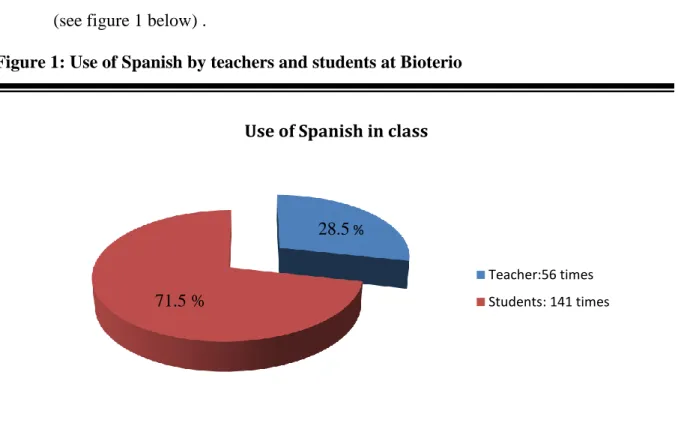
At Bioterio students used Spanish more times in comparison with teacher, to greet, to ask for information when they did not understand what teachers explain, translate their ideas when they felt they could not do it in English, make jokes and ask for information using words and sentences such as hola, no entendi, que significa eso, etc.
Spanish was used by teacher to give complete explanations, greetings, make jokes and translate
(see figure 1 below) .
Figure 1: Use of Spanish by teachers and students at Bioterio
Figure 1 shows that the use of Spanish by basic level students was a normal issue in classroom even if teachers were against of it. Then a better option could be the suggestion to use less Spanish instead the forbiddance.
28.5%
71.5 %
Use of Spanish in class
Teacher:56 times Students: 141 times
The total amount of time that Spanish was used by students was low since it was less than 1/10 of the total class length (see figure 2 below).
Figure 2: Length of the use of Spanish in class
Figure 2 shows that the use of Spanish in class did not take much time of the class, thus it does not represent an aspect for the teacher to be worried about.
4.2 Checklists
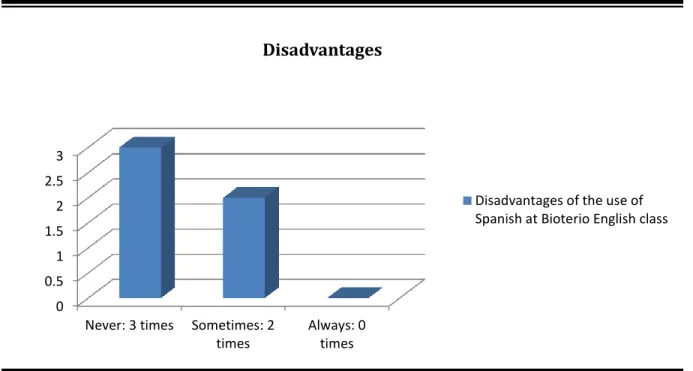
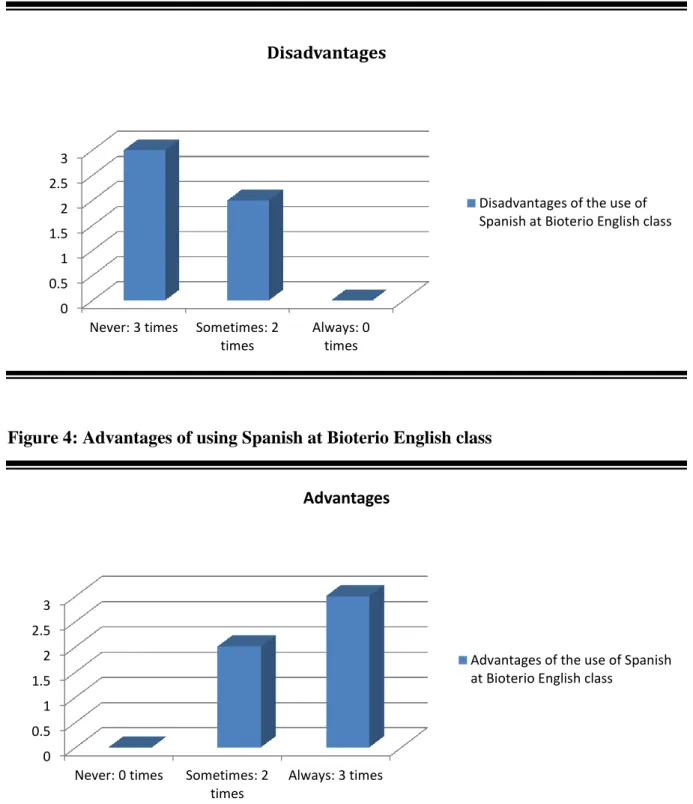
As it was mentioned in the previous chapter, 5 possible advantage and 5 possible disadvantages were suggested for the use of Spanish by teachers and students in English classes. The balance can be considered as positive because from the 5 advantages, 3 were always presented and 2 sometimes while from the 5 disadvantages 3 were never present and 2 sometimes (see figures 3 and 4 below)
66.1 % 33.9 %
Length of the use of Spanish in class
Teacher:8.6 min Students: 16.7 min Total class time: 2 hs
Figure 3: Disadvantages of using Spanish at Bioterio English class
Figure 4: Advantages of using Spanish at Bioterio English class
Figures 3 and 4 show that the use of Spanish can represent either an advantage or disadvantage in classroom, it depends how the teacher handle this with students.
0 0.5 1 1.5 2 2.5 3
Never: 3 times Sometimes: 2 times
Always: 0 times
Disadvantages
Disadvantages of the use of Spanish at Bioterio English class
0 0.5 1 1.5 2 2.5 3
Never: 0 times Sometimes: 2 times
Always: 3 times
Advantages
Advantages of the use of Spanish at Bioterio English class
4.3 Students’ Questionnaires
In the case of question 1 about the feeling that students have when understanding what teacher says in class, answers were so different, because a percentage of students and workers said to have negative feelings when facing something unknown or not understandable as these answers show: “Me siento tonta” “Me siento sin interés” and
“Me siento un poco raro”. But, other percentages shows that students did not have negative feelings and to look for a solution “Nada, solo pregunto mas para que me explique de otra forma” “Con la curiosidad de indagar para aprender” and “Siempre trato de entender”. Thus even when negative feelings were presented, a positive aspect emerged: the search for a solution (see appendix 4).
In question 2 about personal opinion of policies in classroom , opinions were divided, a half agrees with the statement that just English must be spoken in classroom with answers such as these : “Si porque de esa manera pones en práctica lo que has aprendido” and “Si para irme adaptando al language” and the other half says the opposite , that It should not be spoken just English in classroom with answers such as
“No porque a veces no entendemos lo que nos dice el professor” and “No porque no se entendería lo que dice” , here where students take English classes like a complement not as curricula , they are not so worried about how fast they acquire a foreign language, what they consider as an important issue is how well they learn.
In question 3 about previous experiences when learning English answers were divided too, a half has thought at least once that learning English is boring or hard and the other half has thought the opposite, but what was special here it is that those who considered the learning of English as hard attributed this to aspects such as schools where they previously studied and personal weaknesses no the L2 as itself.
For question 4 about personal opinion of age in the process of learning a foreign language, students and worker’s answers showed that for almost all of them, age is not an important aspect in the process of learning a foreign language with answers such as
“No porque a cualquier edad se puede aprender” and “No , la edad no importa , es cuestion de cada persona” and just one student answered that the age has influence when learning English, in this case the youngest student is 18 years old girl but the oldest is a 45 years old woman , so with their answers they communicate that they are conscious of their characteristics, limitations and strengths as mature adults learners and then age is not important when learning a L2.
For question 5 about personal opinion of the use of Spanish in English classes, the majority of the students considered the use of Spanish as a correct issue, and just one did not, some answers were “Correcto para que se entienda mejor”, “Correcto pues para entender mejor”, “Si porque a veces no lo comprendemos” and “Correcto porque cuando entiendes, para que entiendas hablan en Español” thus these answers show that students have had problems with the understanding and communication in English then the use of L1 is helpful and necessary.
In question 6 about student-teacher relation in classroom, almost all the students considered that the differences of English development does not affect the relation between student and teacher, and just two considered that it affects, but the special thing is that students who answered this considered that what is affected is the academic relation and not the personal and affective one as this answer shows “No ya que tratas automaticamente de traducir al español lo que aprendes”, then this can be interpreted as students do not see problem if they cannot communicate with their teachers in L2.
The 7th and final question about personal behavior in classroom, the 100% of the students answered that they use Spanish instead of English to communicate with others in the classroom, so what the results show is that they use L1 for a better mutual understanding and students see it as something natural and necessary
4.4 Teachers’ Interviews Results
In the case of in interviews, they were applied to 2 teachers in charge are mentioned below as teacher one and two.
Question 1 about the use of Spanish experiences in classes. Here both teachers agreed that depending on the student’s level is recommendable to use Spanish, but they clarify that from time to time use of L1 in advanced courses might be to some little extent beneficial for SLA. It depends of the situation.
Question 2 about classes planning.
Here teacher one answered that he takes into account students’ personal information and teacher two just takes into account the students’ level. Thus, one teacher perceives students as idiosyncratic people from just students. Then very different issues must be considered to plan a class, not just level or age.
Question 3 about teaching experiences.
Here both teachers expressed that, in basic level students tend to ask for the explanation and the meaning in Spanish, so the use of L1 in English classes is necessary, even when teachers considered it as something that needs to be avoided.
Question 4 about learning experiences
In this case teacher one experienced the prohibition of Spanish and teacher two did not, for this reason, teacher two sees it as something useless and teacher three as something useful , here it can be established that depending in our personal experiences as students we construct our beliefs and behavior as teachers , what is supported with the case of these teachers, the one who experienced the prohibition sees the use of Spanish as something correct and the one who did not, sees it as something that needs to be avoided.
Question 5 about behavior in classroom
Here teacher two expressed that he has not forbidden the use of Spanish, on the other hand, teacher three has done it what can be explained with the statement of the previous question.
4.5 Diagnostic Exams and Students’ Opinions
About this aspect exams were partially out of the control and design of this project, but they reflect that from the 10 students 8 had no or very basic knowledge of English at the beginning of the course and 2 were middle level and at the end 7 students had a significant improvement to be considered as basic middle level students. While students opinion about the use of L1 in classes were positive because the considered this facilitated their leaning of L2.
CHAPTER V: CONCLUSIONS
This chapter presents all the conclusions obtained during the process of this action research project and at the same time answers the research questions established in the first chapter, and also it shows the final epistemic stance developed this project and the findings of this paper. According to the literature review presented in this thesis, it can be established that the use of mother tongue is seen, to some extent as something useful. So, in fact, the use of mother tongue in this context Spanish cannot be described just as something correct or incorrect, further research should be taken into account to prove such a hypothesis. It can be said that for the students in Bioterio the use of Spanish represents something positive because they are not required to be proficient in another language and also because their context is completely different than the students in LEI, where they are studying to be future English teachers and their development in a foreign language is expected to be master at level B2 of the Common European Framework of Reference of all languages (CEFR).
5.1 Research Questions Conclusions
In general, conclusion about no using Spanish in classrooms from the data shown in this study suggests that teachers cannot assume and ignore important issues at the time of giving classes such as student’s needs. Due to the fact that the teacher considers something as correct or not does not really mean it is the best for students , and a student’s opinion presented in item two of the survey where the need of the use of mother tongue is described by this “Dependiendo el nivel , porque somos principiantes no entenderemos nada” , on the
other hand another important aspect, it was also noticed when this research was carried out that personal beliefs are important at the time of doing something , those who believe that learning English is something hard to do are predisposed to learn and then they might not enjoy and learn as well as they will.
About the research questions, the first one: What effects do English teachers in
‘Bioterio” have in their students when avoiding the use of Spanish in their classes? It cannot be said that the non-use had just negative or positive effects, it represented for students both of them, but the fact of ignoring students’ characteristics, needs, likes and opinions is something that can become a problem. At Bioterio when students presented difficulties in one skill or displeasure in some technique, the teacher looked for something appropriated to teach them and then they felt they were rally learning something and it was a nice experience for them, what it is proposed is that teachers should consider and take into account students´ personal skills, weaknesses and beliefs.
The second one: Does the use of Spanish represent an actual advantage when teaching English to basic level adults of Bioterio? A concrete answer can be given, “Yes” it represented for teachers an advantage and it is reflected when the results of diagnostic exams showed that grades and students’ development improved and students’ feedback about the use of Spanish were positive.
The third and final question, why do teachers at Bioterio assume that Spanish must not be used when teaching English?, it was clear that it has not relation with their personal experiences because even when teachers at Bioterio had good and bad ones, about the use of Spanish in classes, it is about what they considered as correct or not, so it is clearly that
personal beliefs are what construct teachers’ behavior. About the students who were the subjects for this project the conclusion is that age and level are important aspects at the time of learning a foreign language.
5.2 Limitations
This project faced some limitations as any action research project, the first one and most important was that at the beginning of the project, it was conceived to be an comparison between Bioterio and LEI students and teachers, but it was not possible to do, because it interfered and altered program and schedule at LEI and then teacher in charge was not open to participate. Thus, this was the main limitation.
The second limitation was the lack of time, and here is necessary to quote a teacher at LEI bachelor “Un proyecto de tesis como minimo deberia tomar un año para realizarlo, y a ustedes solo les dan cuando mucho 8 meses”. Thus the results and planning could be better and wider if this were different. The third limitation was problems with schedules, as a student to coordinate and to match researcher schedules with the teachers in charge of the classrooms where the instruments were applied, it was something hard to do. And the last limitation was student’s availability, because they are adults with d different responsibilities and activities so they cannot always attend to classes or answer the questionnaires.
5.3 Recommendations
As I stated in this project, it is considered that teachers at Bioterio and LEI should not just take into account student’s English level at the time of teaching, that seems to be the most important aspect for them, they have to consider other aspect as students’ age, likes, goals, context and background in order for students to enhance their EFL learning.
5.3.1 Further Research
This project just contemplated one institution where English is taught, maybe the collaboration and application of the instrument used in this project can be replicated to support the outcomes found in this thesis. On the other hand, more elements involved in the use or non-use of mother tongue in class, need to be researched deeply, such as the impact outside the classroom and the psychological impact in students.
5.3.2 Pedagogical Implications.
The results of this project can be useful to students and teachers at LEI and other institutions at the time of working with adults and then not just being good teachers, also being good people who are worried about others as people not just as students or teacher. Among all it is important to remember that teaching English involves many aspects such as in emotional, the contextual and the physical ones not just grammar, topics or skills development.
5.4. Personal Experiences
I cannot describe just with words all the experiences because they were good, bad, stressing and satisfactory but what I can say is that at the beginning just the fact of hearing the word “thesis” makes me fell worried and afraid, but with the support of my teachers, friends and family I could face these feelings and go ahead. I have to say that when I started this project what I thought and knew was completely different than what I think and know now, and facing different epistemic stances was a meaningful experience to me.
At the case of Bioterio and LEI subjects I can say that was a completely nice experience the fact that they were almost always disposed to help and work with me. Finishing this project leaves me with a completely happiness and satisfaction, because I see that I am able to do something really hard and also it leaves me the discovery that I really like to expand the horizon of the present thesis.
REFERENCES
Abello, C. (2008). Age and the Critical Period Hypothesis. ELT Journal, 63 (2): 170-172.
Available online at http://eltj.oxfordjournals.org/content/63/2/170.extract
Brown, H. D. (2007). Principles of Language Learning and Teaching, White Plains, N.Y. United States of America: Pearson Longman
Carter, R. & Nunan, D. (2001). The Cambridge Guide to Teaching English to Speakers of Others Languages. Cambridge, CB2 2RU, UK: Cambridge University
Press.
Celik, S. (2008). Opening the Door: An Examination of Mother Tongue Use in Foreign Language Classrooms. H. U. Journal of Education, 34: 75-85. Available online at
http://www.academia.edu/545507/Opening_the_Door_An_Examination_of_Mother_T ongue_Use_in_Foreign_Language_Classrooms (PDF)
Chilton, T, (2011). Why Adults Can Learn Language More Easily than Children.
Ferrance, L, (2000). Action Research, Themes in Education, Brown University, Available online at www.lab.brown.edu
Dubovičienė, T. & Gulbinskienė, D. (2014). Learning / Teaching EFL to Adult
Learners at Language Courses. Žmogus ir žodis / Svetimosios kalbos, t. 16, Nr. 3. doi:
http://10.15823/zz.2014.019
Essays, UK. (November 2013). Role and Influences of Mother Tongue Education Essay. Retrieved from http://www.ukessays.com/essays/education/role-and- influences-of-mother-tongue-education-essay.php?cref=1
Horasan, S. (2014). Code-switching in EFL Classrooms and the Perceptions of the Students and Teachers. Journal of Language and Linguistic Studies, 10(1), 31-45.
Available online at www.jlls.org
Jinnah, F, (2013). The Comparative Effectiveness of Achievement in Mother
Tongue and National Language in Arts and Science Subjects at Primary School Level. Biannual Journal of Gender and Social Issues Autumn 2013, Vol. 12, Number 2. Available online at http://www.bibliotecas.buap.mx/portal/search/index/ (PDF) Krashen, S. D. (1985). The Input Hypothesis. In The Input Hypothesis Issues and
Implications (p 1-32). London, England: Longman.
Lambert, O. D. (2008). Who Are Our Students? Measuring Learner Characteristics in Adult Immigrants Studying English. Adult Basic Education and Literacy Journal, volume 2, Number 3. Available online at
http://www.academia.edu/1827273/Who_Are_Our_Students_Measuring_Learner_Cha racteristics_in_Adult_Immigrants_Studying_English (PDF)
Thompson, G, & Harrison, K. (2014). Language Use in the Foreign Language Classroom. Foreign Language Annals, Vol. 47, Iss. 2, pp. 321–337. doi:
10.1111/flan.12079
Kahraman, A. (March 2009). The Role of the Mother Tongue in Fostering Affective Factors in ELT Classrooms1. English as an International Language Journal. Volume 5,107-128 .Available online at
http://consortiacademia.org/index.php/ijrsll/article/view/553 (PDF) Kistler, M. (2011). Adult Education and Retraning. Adult Learners
consideration for education and training. Available online at www.acteonline.org Krashen, S. D. (2002). Second Language Acquisition and Second Language Learning.
Available online at http://www.sdkrashen.com/ (PDF)
Kuhn, D & Pease, M. (August 2006) Do Children and Adults Learn Differently?.
JOURNAL OF COGNITION AND DEVELOPMENT, 7(3), 279–293).Available online at
http://www.tandfonline.com/action/doSearch?quickLinkJournal=&journalText=&AllFi eld=Do+Children+and+Adults+Learn+Differently&publication=40000693 (PDF)
Lambert, O. (2008). Who are Our Students? Measuring Learner Characteristics in Adult Immigrants Studying English. Adult Basic Education and Literacy Journal, Volume 2, Number 3. Available online at
http://www.academia.edu/1827273/Who_Are_Our_Students_Measuring_Learner_C haracteristics_in_Adult_Immigrants_Studying_English
Malone, S, (2007), Mother Tongue-Based Multilingual Education:
Implications for Education Policy. Available online at
http://www.sil.org/resources/publications/search?query=susan%20malone&sort_by=se arch_api_relevance&sort_order=ASC&page=1 (PDF)
Malone, S. (2014). Characteristics of Adult Learners.
Available online at http://www.aitd.com.au/resources-for-
training-and-development- professionals/articles-and-information (PDF)
Merriam, S. B. & Bierema, L. L. (2013). Adult Learning: Linking Theory and Practice.
San Francisco, CA, United States of America: Jossey- Bass.
Mora, I., Lengeling, M., Rubio, B., Crawford, T. & Goodwin, D. (October 2011). Students and Teachers’ Reasons for Using the First Language within the Foreign Language Classroom (French and English) in Central Mexico. Issues in Teachers' Professional Development, v13, n2, p113-129. Available online at http://eric.ed.gov/?id=EJ1051529 (PDF)
Nyika, A. (February 2015). Mother Tongue as the Medium of Instruction at Developing Country Universities in a Global Context. South African Journal of Science, vol.111 N.1-2. Available online at
http://www.scielo.org.za/scielo.php?script=sci_arttext&pid=S0038- 23532015000100011&lng=en&tlng=en
Robinson, J. & Selman, M. (1996). Partnerships in Learning Teaching ESL to Adults Pippin teacher's library, Toronto, Ontario, Canada: Pippin Publishing Corporation.
Sánchez B. & Rivera, M. (2008). Teaching English without Spanish, is it worth it?.
Memorias del IV Foro Nacional de Estudios en Lenguas (FONAEL). Available online at http://fel.uqroo.mx/index.php?id=7 (PDF)
Schouten, A. (2009). The Critical Period Hypothesis: Support, Challenge, and
Reconceptualization. Working Papers in TESOL & Applied Linguistics, Vol. 9, No. 1.
Available online at http://tesolal.columbia.edu/article/the-critical-period-hypothesis/
(PDF)