BENEMÉRITA UNIVERSIDAD AUTÓNOMA DE PUEBLA
Facultad de Lenguas
Maestría en la Enseñanza del Inglés
NESTs and NNESTs linguistic features’ impact on the Mexican context
A Thesis Submitted to the Faculty of Languages for the Degree of Maestría en la Enseñanza del Inglés
Isis Armilevy Vázquez Alegría
Thesis director:
Dra. Elizabeth Flores Salgado
Puebla, Pue. January, 2022
Acknowledgements
First and foremost, I would like to express my sincere gratitude to my thesis advisor Dr. Elizabeth Flores Salgado for all her time, guidance and patience in supervising this study.
I am grateful to Dr. Michael T. Witten for the opportunity to be part to one of the best master’s programs in the country and for all his kindness, encouragement and support through the program.
I would like to express my gratitude to my teachers in the program. I acquired tremendous learning with all of you. I will forever be thankful.
This thesis is dedicated to Oscar, who always believed in me and supported me through the whole process.
Abstract
This study explores and contrasts the perceptions of Mexican EFL learners’ and teachers towards the issue of nativeness in ELT. It explores findings from two surveys: One conducted to English learners and the other conducted to native and non-native English teachers. Additionally, it further explores on perceptions through follow-up interviews. The results of the study show that overall both NNESTs and NESTs in Mexico feel comfortable with their linguistic and sociocultural knowledge of English. This comfort influenced their teaching decisions. Additionally, teachers in the study expressed that their mother tongues (English or Spanish) had a positive impact in their teaching practices. However, NESTs expressed that being able to switch from English to Spanish was something that put NNESTs in a more advantageous place than NESTs. On the other hand, NNESTs expressed that NESTs were usually favored in teaching positions or salaries due to their mother tongues and backgrounds. All teachers considered academic training in ELT as vitally important. Finally, beginner learners leant towards non-native teachers while more advanced learners had a preference for native teachers.
Table of contents
Chapter 1. Introduction ... 8
1.1 Introduction to the problem ... 8
1.2 Significance of the study ... 9
1.3 Purpose of the study ... 10
1.4 Objectives of the study ... 10
1.5 Research questions ... 11
1.6 Overview of the research ... 11
1.7 Key terms ... 11
English as an international language ... 11
Native speakers... 12
Non-native speakers ... 12
Native speaker teachers (NESTs) ... 12
Non-native speaker teacher (NNESTs) ... 12
Chapter 2. Theoretical framework and literature review ... 13
2.0 introduction ... 13
2.1 English as an international language ... 13
2.2 English as a lingua franca. ... 15
2.3 Native speakers of English vs. Non-native speakers of English. ... 16
2.4 Native speaker teachers (NESTs) ... 17
2.5 Non-native speaker teachers (NNESTs) ... 18
2.6 The native speaker fallacy ... 20
2.7 Identity in ELT ... 21
2.8 Communicative competence... 22
2.9 Cultural awareness in ELT ... 23
2.10 The role of English in Mexico ... 24
2.11 Conclusion ... 25
Chapter 3. Methodology ... 26
3.0 Introduction and overview ... 26
3.1 Methodological process ... 26
3.2 Participants ... 27
3.2.2 The teachers ... 28
3.3 Data collection instruments ... 29
3.3.1 The questionnaires ... 29
3.3.1.1 The students’ questionnaire ... 29
3.3.1.2 The teacher’s questionnaire ... 30
3.3.2 The interviews ... 31
3.4 Procedure ... 31
3.5 Conclusion ... 32
Chapter 4. Results and discussion ... 33
4.0 introduction ... 33
4.1 Students’ perceptions ... 33
4.1.1 Students’ perceptions about NNESTs and NESTs’ linguistic knowledge ... 34
4.1.2 Perceptions of learners towards NESTs’ and NNESTs’ sociocultural knowledge ... 40
4.1.3 Perceived Advantages of NESTs and NNESTs ... 42
4.2 NESTs and NNESTs perceptions about themselves. ... 46
4.2.2 NESTs and NNESTs perceptions towards their linguistic competence ... 47
4.2.3 Teachers’ perceptions about their own sociocultural knowledge ... 49
4.3 Teachers’ academic preparation in ELT ... 50
4.4 The influence of a teacher’s mother tongue in their professional career ... 51
4.5 The ideal English teacher ... 53
4.6 Teachers’ perceptions of students’ preferences ... 55
4.7 Hiring processes and remuneration for teachers ... 57
4.8 Conclusion ... 59
Chapter 5. Conclusions ... 60
5.0 Introduction ... 60
5.1 Conclusions ... 60
5.2 Limitations ... 64
5.3 Directions for further research ... 64
5.4 Implications ... 65
References ... 66
Appendices ... 72
Appendix A ... 72
Appendix B ... 75
Appendix C ... 79
Appendix D ... 92
Chapter 1. Introduction 1.1 Introduction to the problem
In the present times, the English language possesses a prime status globally since it has become the most widely spoken language in the world. This status is the result of two factors: the expansion of the British colonization, and the economic and political power of The United States. The prestige of this language is present in over seventy countries, included Ghana, Nigeria, India, Singapore and Vanuatu (Crystal, 2003). Furthermore, English is considered the language for international communication. In fact, English is the only foreign language taught in public universities in Saudi Arabia (Alharbi, 2019). Similarly, in South America, English is used as a cognitive tool for accessing the world (Kamhi-Stein et al., 2017).
Almost three quarters of all English native speakers in the world come from the USA (Crystal, 2003). But in fact, it is non-native speakers of English who account for the majority of speakers of this language. It is estimated that about a quarter of the world’s population speaks English at a fluent or competent level and this number continues to grow due to the relevance of the language worldwide (Crystal, 2003).
Al-Nawrasy (2013) defines native speakers of English as those who learned it in early childhood and have spoken it ever since. On the other hand, Non-native speakers are described as those whose first language is different from English and learned the language as an L2. In the field of English Language Teaching (ELT) non-native English speaker teachers (NNESTs) outnumber native English speaker teachers (NESTs). In fact, Canagarajah (1999) states that 80% of the world’s English language teachers are non-natives. Nevertheless, NESTs are
usually favored over NNESTs especially in contexts where English is learned as a foreign language. This discrimination is mainly due to what Phillipson called “the native speaker fallacy” that perceives NESTs as “unaccented” speakers with superior knowledge of grammar, idiomatic expressions and culture. Whereas NNESTs are associated with deficient language proficiency and “accented” speech (Faez & Karaz, 2019).
Having a foreign-accented speech might entail bias against speakers, especially towards NNESTs. Levis et al. (2016) explain that “research exploring ESL and EFL students’
perceptions and attitudes toward teachers has shown that native language is a major (through unfairly implemented) influence on teacher confidence, student beliefs about the effectiveness of a teacher, and administrators’ willingness to hire” (p.3)
With the above in mind, the current study aims to explore and contrast the impact of Native English Speaker Teachers’ (NESTs) and Non-Native English Speaker Teachers’ (NNESTs) on learners’ opinions and native and non-native teachers’ perceptions about themselves.
1.2 Significance of the study
Despite the fact that most English teachers worldwide are non-native speakers of the language.
The issue of nativeness is still an object of concern among many scholars, teachers, learners and coordinators in the field of ELT. The manner in which NESTs NNESTs are perceived by learners and teachers themselves is reflected in many aspects. Some NNESTs might feel insecure about their own identity and competence as English teachers because they are not native speakers (Yazan, 2018). Similarly, the International Association of Teachers of English to Students of Other Languages (TESOL) expressed its position towards this issue and expressed that the fallacy of the native speaker as the preferred language teacher has led
NNESTs to find themselves often discriminated against in hiring practices or working assignments in the field of ESL or EFL teaching (2006).
Thus, the significance of the current study is to have a critical understanding of how both NNESTs and NESTs are perceived in the defined context and raise awareness on the need of reevaluating current beliefs and practices in the field of ELT.
1.3 Purpose of the study
The purpose of this thesis is to explore and contrast the perceptions of Mexican learners towards their native and non-native speaker teachers of English. Furthermore, it aims to explore and contrast the perceptions that NESTs and NNESTs in Mexico have about themselves. To fulfill this aim, this study will first apply a questionnaire addressed to learners and teachers in Mexico. The answers of the questionnaires will provide key information that will be further explored through exploratory interviews that follow up on questionnaires. The expected outcomes of this study might provide a richer understanding on what are the perceptions about both NESTs’ and NNESTs’ linguistic and sociocultural features, what influences these perceptions, and how being a native or non-native might impact teachers’ self- perceptions about their competence and identity. It may also establish the grounds for further research in the field.
1.4 Objectives of the study
To explore English learners’ perceptions towards their Mexican English teachers and Native English speaker teachers.
To explore and contrast the influence that linguistic and sociocultural features of NESTs and NNESTS has on teachers’ self-perceptions of their own professional competence and identity.
1.5 Research questions
The research questions that lead this thesis are:
1. What are the English learners’ perceptions towards their Mexican and Native English speaker teachers?
2. What are the Mexican English teachers’ and Native English speaker teachers’ perceptions of themselves in their work context?
1.6 Overview of the research
The current chapter presented an introduction to the research study and the key factors that support it: why this topic was researched and the significance of the study. It also established the context of the research, the aims and research questions. In the subsequent chapters, the theoretical framework, a literature review and the methodology will be presented as well as the data analysis and the conclusion that will derive from the data analysis. Finally, the limitations of the research will be described as well as some suggestions for further research in the subject.
1.7 Key terms
English as an international language
According to Jenkins. (2002) English as an international language (EIL) communication is perceived as international rather than oriented towards communication with native speakers.
Speakers of EIL are not considered foreign, but international speakers who belong to an international community where all members have the right to express their L1 identity in English by means of their accent as long as they do not compromise international intelligibility
Native speakers
Al-Nawrasy (2013) defines a native speaker of English as the one whose first language is English and has spoken the language since early childhood.
Non-native speakers
Al-Nawrasy (2013) defines non-native speakers as those whose first language is not English and who learned it as an additional language.
Native speaker teachers (NESTs)
Selvi (2011) explains that Native speaker teachers have long been conceptualized by creating a dichotomy between native speaker teachers (NESTs) and non-native speaker teachers (NNESTs). In the field of ELT, native speakers are usually preferred over non-native speakers as teachers of the language (Medgyes, 2001).
Non-native speaker teacher (NNESTs)
Almost three quarters of English teachers worldwide are non-native (Canagarajah, 1999) nevertheless, inequality is reflected in prejudices and discrimination against non-native speakers of English and speakers of the language who do not speak a mainstream US variety of the language (Lippi-Green, cited in Kubota, 2001).
Chapter 2. Theoretical framework and literature review 2.0 introduction
The current thesis work has two aims: Firstly, to carry out an exploration of the English learners’ perception towards their Mexican English teachers and Native English speaker teachers. Secondly, to compare and contrast the Mexican English teachers’ perceptions and Native English teachers’ perceptions of themselves. In order to fulfill these aims it is vital to clarify some concepts that will be approached throughout the thesis work. Thus, the current chapter provides insight into the theoretical framework and literature review of relevant aspects related to the concepts of NNESTs and NESTs.
To start, the definition of English as an international language will be provided, followed up by the description of the concept of English as a lingua franca. Next, the concepts of Native English speakers and Non-native English speakers will be addressed and explained.
Next, a description the dichotomy of native and non-native speakers will be given, followed by the concept of the native speaker fallacy. Later on, the definitions of linguistic and sociocultural aspects of English will be addressed as they are key concepts that might influence the perceptions towards English teachers. After that, the concepts of identity in ELT and cultural awareness in ELT will expand and contribute to the previous topics.
Finally, given that the current study takes place in the Mexican context, the role of English language in Mexico will be described. The chapter closes with a conclusion.
2.1 English as an international language
Nowadays English is spoken by more non-native than native speakers (Crystal, 2003). This fact raises questions on the impact it might have on how English is taught. For instance, Cook (1999) states that English pedagogy would benefit from paying closer attention to the L2
speaker, rather than the native speaker since the former outnumber the latter significantly.
Nevertheless, most teaching pedagogies still focus on emulating the native speaker’s pronunciation. In this regard, Rose and Montakantiwong (2018) explain that the growth of English language has caused many professionals to call for a change of paradigm in English teaching, moving from teaching English as a foreign language to teaching English as an international language.
English as an international language (EIL) perceives international communication rather than communication with native speakers as the goal for language pedagogy. Speakers of EIL are not considered foreign, but international speakers who belong to an international community where all members have the right to express their L1 identity in English by means of their accent as long as they do not compromise international intelligibility (Jenkins. 2002). For EIL, native speakers only represent “a part of a much larger group of speakers of the language”
(Llurda, 2004 p. 317). On the other hand, the notion of EIL has been reflected in some countries like Britain, where there is a growing belief that regional accent differences are actually the rule rather than the exception. Thus, it seems reasonable that the goal for language teaching evolves and aims to make students speak like a foreigner, but pronounce in a way that is intelligible enough to communicate with native speakers (Jenkins, 2002).
Nonetheless, in most parts of the world “the native speaker remains a given, and the native speaker standard measure still reigns supreme” (Jenkins, 2002). In this regard, Kachru and Ferguson (1992) state that: “The whole mystique of the native speaker and the mother tongue should probably be quietly dropped from the linguist's set of professional myths about language.” (p.320). Furthermore, they question that if the native speaker standard were
universal, what implications would it have for language acquisition and use? And what would they add to the concepts of bilingualism and multilingualism?
2.2 English as a lingua franca.
The English language has held the prestigious status of lingua franca since the end of World War II, and with the effects of globalization, now stands as the language of freedom, prosperity, and success in personal, educational, and professional lives worldwide (Moussu, 2018. P.1).
The term English as a lingua franca (ELF) should not be confused with English as an international language. The two concepts are similar in that both of them refer to communication among speakers with a different L1. However, what differentiates them is that ELF is considered a “contact language” for people of not only different native languages, but also different countries and cultures who choose English as their means of communication across linguacultural boundaries (Seidlhofer, 2005).
The concept of ELF not only includes speakers with an L1 different to English, but also those who speak English as a mother tongue and who belong to the inner circle countries. These people not only participate in speaking English as a lingua franca, but in fact they add to its variability (Mauranen, 2018). Furthermore, it seems relevant to highlight that there have existed other languages as lingua franca. nonetheless, the global extent of English as a contact language is unprecedented (Dewey, 2014).
For Mauraneen (2018) English as a Lingua Franca provides unique insights for understanding second languages, due to its diffusion and its contact with other languages worldwide.
Finally, ELF is mostly seen as non-controversial and widely accepted by many professionals worldwide (like businesspeople and technicians), although their positive orientation is rarely
verbalized, and thus, not published. In contrast, it is the negative judgments towards ELF that are usually published (Jenkins, 2009).
2.3 Native speakers of English vs. Non-native speakers of English.
From the perspective of English as a lingua franca and English as an international language, English belongs to everybody who speaks it. Thus, the origins of the teachers are not relevant in their professional career. Nonetheless, the field of English language teaching (ELT) worldwide still classifies teacher’s competence within the dichotomy of native and non-native speakerism (Fithriani, 2018). This dichotomy has led to racial and linguistic discrimination towards those teachers who are not native speakers of the language. In fact, many people hold the belief that a native speaker teacher would make the ideal English teacher due to their superior command in the language.
Al-Nawrasy (2013) defines a native speaker of English as the one whose first language is English and has spoken the language since early childhood. It is remarkable how the indisputable element in this definition is that a person is considered a native speaker of the language they learned first. Any other characteristic added to the definition, even those related to language competence, seem to be secondary. Furthermore, the definition suggests that someone who did not learn the language in childhood cannot be considered a native speaker (Cook,1999). Additionally, Stern (1983) expands the definition by claiming that native speakers share certain characteristics among them and lists them as follows: 1) subconscious knowledge of the rules of the language, 2) intuitive grasp of meanings, 3) the ability to communicate across different social settings, 4) a wide range of language skills, 5) creativity of the language use.
On the other hand, Al-Nawrasy (2013) defines non-native speakers as those whose first language is not English and who learned it as an additional language. Today, the number of non-native speakers of English is bigger than native speakers (Crystal, 2003) and the same trend is repeated in ESL/EFL contexts where non-native English speaker teachers (NNESTs) outnumber NESTs (Canagarajah, 1999). In spite of this fact, NNESTs are usually discriminated due to their origins.
2.4 Native speaker teachers (NESTs)
The current status of English as a lingua franca has caused a massive need for English teachers worldwide. This need has appeared not only in countries where English is a national language, but also in countries where it is a foreign language. Furthermore, this massive need has also brought forth the question of whether or not Non-native speakers of English are qualified to teach the language or, if native speakers are the only ideal of an English teacher (Moussu, 2018). Thus, the debate about what makes the ideal language teacher has been going out for at least the last twenty years and this issue is still subject of discussion (Al-Nawrasy, 2013).
Native speaker teachers have long been conceptualized by creating a dichotomy between native speaker teachers (NESTs) and non-native speaker teachers (NNESTs). Such dichotomy has only resulted in discrimination towards NNESTs. Even if there have been attempts to re- conceptualize the terms, the field of applied linguistics is still far from reaching consensus to adopt any concept (Selvi, 2011). For Chomsky (2014) the authority of native speakers is due to their facility to demonstrate fluent language. however, as Rampton (1990) states, this authority is complex and problematic because being born with certain language does not mean that a person is an effective speaker of it. In the field of ELT, native speakers are usually preferred over non-native speakers as teachers of the language. This preference is due to
different factors, for instance, being taught by native teachers can be motivating for some students, furthermore, there exists a belief that native speaker’s knowledge of the language can increase students’ learning potential. However, some authors believe that the effectiveness of teachers in motivating their students and developing their language skills should be more important than their nativeness (Alghofaili & Elyas, 2017).
This idealization of the native speaker is based mainly on the importance attributed to oral production in the target language. Furthermore, it has been stated that the main advantage of native English speaker teachers (NESTs) lies in their superior communicative and linguistic competence of the language, which is after all their mother tongue (Al-Nawrasy, 2013). On the other hand, research has provided no evidence of the superiority of NESTs. In fact, (Levis et al., 2016) explain that the effectiveness of a language teacher does not lie in their origins, but it is true that NNESTs bring tremendous advantages to learners since they have been through the process of learning the language and have become aware of the tricks and pitfalls learners might fall into.
2.5 Non-native speaker teachers (NNESTs)
In the present, native language is a common and unfairly implemented aspect that usually places native teachers in advantage over non-native teachers in hiring practices. In spite of findings that learners consider both NESTs and NNESTs as equally efficient language instructors, discrimination practices towards NNESTs continue in different parts of the world (Levis et al., 2016). One example of the discrimination that NNESTs face is that not all MA TESOL programs allow their non-native speaker students to participate in practicums because they are concerned about the noticeable accents of their student teachers, as well as their poor communication skills, fluency and limited cultural awareness in English. This lack of
opportunities for NNESTs results in decreased teaching experience (Moussu, 2018). On the other hand, while many non-native speakers of English tend to pursue improvement in their communicative competences by attending ESL/EFL classes, most native English speakers rarely receive training to develop awareness and communicative skills that allow them to interact with speakers of other varieties of English. This lack of balance often imposes blame of miscommunication in non-native speakers of the language and even native speakers who belong to the outer circle. As a result, this inequality is reflected in prejudices and discrimination against non-native speakers of English and speakers of the language who do not speak a mainstream US variety of the language (Lippi-Green, cited in Kubota, 2001).
In spite of this fact, NNESTs have gained some recognition in the last few years. For instance, TESOL (Teachers of English to Speakers of Other Languages), the largest international organization in the world for teachers of English as an additional language, with more than 12,000 members from 140 different countries, had always been represented by native speakers of English. In 2005 the organization elected a non-native speaker as editor of TESOL quarterly, the most remarkable journal in applied linguistics. Furthermore, a year later, in 2006, the first non-native English speaker president was elected by the organization’s general membership (Braine, 2012). These two events represent a tremendous recognition to NNESTs in the field of language teaching and more often non-native speakers are recognized as competent speakers of the language.
Additionally, Llurda (2004) explains that NNESTs usually advantage NESTs, particularly monolingual NESTs. Bilingualism is a privilege that NNESTs possess, which allows them to understand the learning demands of students. This understanding makes NNESTs the ideal teachers to guide learners in their process of acquiring or learning a second language. Finally,
Holliday (2006) highlights that despite some authors claim that the terms “native” and “non- native” are unviable in linguistics and used only to preserve a privileged group, the way these terms are used every day actually reveals the perception of the profession about itself.
2.6 The native speaker fallacy
In the last few years the field of ELT has shown concern about native speakers. This concern comes from the fact that Native English Speaker Teachers (NESTs) are usually favored over non-native speakers since they are perceived as the ideal language teacher. This preference might be due to the native speakerism concept. Holliday (2006) defined native speakerism as
“an established belief that ‘native speaker’ teachers represent a “Western culture’ from which springs the ideals of both the English language and of English language teaching methodology.” (p.385).
Additionally, Stern (cited in Cook, 1999) states that the native speaker’s knowledge and competence of the language make them the ideal point of reference for the concept of proficiency in second language teaching. In spite of this assertion, several program coordinators have acknowledged that some NESTs might in fact lack grammatical knowledge of the language and pedagogical preparedness (Moussu, 2018).
On the other hand, Canagarajah (1999) explains that the label of native speaker is controversial and questionable since there exist indigenized variants of English, a result of colonialism.
Many of the speakers of these variants, may consider themselves as native speakers and might have learned English as a first language simultaneously with another language. To describe these speakers who are native speakers of two or more languages, we need to use the term parallel bilingualism, coined by Hamers and Blanc (1989).
2.7 Identity in ELT
Language pedagogy has always been influenced by the cultural dimension of language. Given the relationship of culture and language, it results difficult to teach the language without mentioning the cultural context where it is used. Moreover, culture has also been a component in the communicative competence proposed by Hymes (1972) as he emphasizes the relevance of sociocultural knowledge. Nonetheless, with the use of English as a global lingua franca in different cultural contexts, a correlation between the English language and a particular culture and nation seems quite problematic. (Baker, 2012). In the past, language teachers were seen as technicians whose duty was to apply the appropriate methodologies in class to make students learn the target language. Nonetheless, it has become evident that classrooms are in fact complex settings where teaching methodologies of cause and effect are inadequate and where teachers play a crucial, non-neutral role that goes beyond the application of teaching methodologies (Varghese et al., 2005). Thus, teachers have recently become the focus of attention in research.
Research showed that in order to identify how language teaching was played out, it is necessary to focus on teachers’ identity in the classroom (Varghese et al., 2005). Norton (2017) defines identity as “the way a person understands his or her relationship to the world, how that relationship is constructed over time and space and how the person understands possibilities for the future” p. 4. For Norton (2017), the nature of language is not only linguistic, but also social. In this social practice, identities and desires are negotiated.
This definition recognizes that the language teacher identity comprehends social structure and human agency. Moreover, the identity of a teacher is intimately connected to the professional
decisions they make and their construction of their identity as teachers is essential to their process of professional growth (Cheung et al., 2014).
By the same token, research also revealed that some of the most relevant aspects of teacher identity in the classroom are matters of race, gender, and sexual orientation (Varghese et al., 2005). In the last few years, there has been a prevailing aspect in the discourse of teacher identity. English language teachers have been classified as belonging to certain nationalities, ethnicity and language histories. Teachers have been situated in a debate about who owns the English language, and issues of language and identity. Furthermore, teachers have been categorized in polarized concepts of “native” and “non-native speaker” which has led to a great deal of identity searching as well as debate within the English language teaching community (Cheung et al., 2014).
Thus, with the above in mind, it seems like the study of teachers’ identity can go deeper.
Furthermore, it is necessary to continue digging into teachers’ identities since the manner in which teachers perceive themselves and their environments and the different interconnected areas involved in language teaching might influence their pedagogy and their students’
learning.
2.8 Communicative competence
Wiemann and Backlund (1980) express that it is possible to state that one person is able to function appropriately in society as long as he/she achieves communicative competence. The authors express that this competence involves the use of language and non-linguistic behavior for the purpose of communication. Given this previous fact, communicative competence has situated at the heart of research in second language teaching and learning (Granado, 1996).
First, it seems relevant to begin by defining the grammatical and communicative approaches.
These two terms will acquire relevance in defining communicative competence more in depth.
Canale and Swain (1980) explain that a grammatical approach is mainly focused on the basis of linguistic or grammatical forms such as lexis, phonological forms, syntactical forms, etc.
On the other hand, the authors state that a communicative approach is based on communicative functions, which learners need to know and be able to navigate through. Such functions may include describing, inviting, refusing, promising, apologizing, etc.
Hymes (1972) in response to Chomsky’s concept of language competence, stated that grammar rules would be useless without paying attention to social rules of use. This response was certainly one of the bases for what today is known as communicative competence (Leung, 2005).
Building on the works of Hymes and other important scholars, Canale and Swain (1980) presented a model for communicative competence. This model initially included three sub- competences (grammatical, sociolinguistic and strategic competence), however it was later expanded to four sub-competences as discourse competence was added. This model became popular since it represented a practical guide for syllabus design, teaching materials and teacher education (Taş & Khan, 2020). Communicative competence meant a shift from a grammar-based teaching pedagogy to communicative language teaching (Leung, 2005).
2.9 Cultural awareness in ELT
The use of English as a lingua franca in diverse global settings where it is not an L1 nor an official L2 calls into question the notion of the ownership of the language. This questioning
also problematizes native speaker-based conceptions of English use and the dichotomy of native versus non-native speakers (Baker, 2012).
With the above in mind, it seems relevant to explore the concept of cultural awareness. The term cultural awareness has long been used by several different authors, but Byram (1997) formulates it as critical cultural awareness, which is the core to the concept of intercultural communicative competence (ICC), an attempt to expand the perception of communicative competence in language teaching. The focus of ICC is on communication among participants with different linguacultural backgrounds. The relevance of cultural awareness comes as it provides the foundation for evaluating one’s own and other’s perceptions and practices (Byram, 1997).
Despite that concepts of intercultural competences have been criticized for simplifying and essentializing other cultures, their advantage lies in the fact that these concepts provide a wider and more holistic perspective on successful than the concept of communicative competence in language teaching (Baker, 2015).
2.10 The role of English in Mexico
In Mexico, English language is given a high level of importance since the economies of Mexico and the United States are socially, culturally and historically intertwined (Borjian, 2015).
Furthermore, the economic imperialism of the United States has led people, particularly university students to hold the belief that learning English is mandatory if they aspire to a better social and economic life (Despagne, 2010). Indeed, according to a 2007 Mitovsky poll, being bilingual in Mexico is associated with speaking English since from the 9% of citizens who
speak a language other than Spanish, 86% speak English and only 2% speak French. The rest speak a non-specified language (Despagne, 2010).
On the other hand, despite the fact that English is a mandatory subject for both public and private education, it is actually the private sector which leads in terms of proficiency. The teaching of English in public education traditionally begins in secondary education, while in the private sector, students are exposed to the language since preschool. Furthermore, it takes a lot of teacher training and years of planning to implement changes in English language policies at a national level (Grounds, 2017) and despite governments have started to take actions that attempt to narrow the inequalities between the privileged and less-privileged sectors of the population, the success rate of the implemented programs has been very low (Moore, 2017).
2.11 Conclusion
Chapter two presented the theoretical framework and literature review that lead the study. First, the definitions of English as an international language and English as a lingua franca were presented. Then, the definition of English speakers and the dichotomy of native and non-native speakers were discussed. After that, the characteristics and some research results about NESTs and NNESTs were described and contrasted. This was followed by the concept of communicative competence. Further on, the concepts of identity in ELT and cultural awareness in language teaching were presented. Finally, the chapter closed with a brief description of the role of English language in Mexico.
Chapter 3. Methodology
3.0 Introduction and overview
The current chapter introduces the methodological process followed in order to fulfill the objectives of this research project. First, a complete explanation of the methodology adopted in this work is presented. Next, participants of the study are thoroughly described. Immediately after that, the instruments used to collect information are introduced and a description of them is offered. Later, the procedure of data collection is explained. Finally, a description of the data analysis is presented. The chapter ends with the conclusions of the information discussed in the chapter.
3.1 Methodological process Mixed methods
In order to fulfill the aims of the current research work, a mixed methods methodology was adopted. Creswell (2009) defines mixed methods as the mixing of both, quantitative and qualitative methods in one study. The author explains that this type of method is a little less common than the others and originated in 1959. This approach encourages researchers to employ multimethod matrixes that allow them to examine multiple approaches to data collection. The current study follows a sequential mixed method methodology. In this kind of procedure, the researcher tries to expand on the findings from one method by using a different method. For instance, this study begins data collection by applying survey questionnaires and based on the outcomes of them, follow-up interviews are conducted.
3.2 Participants 3.2.1 The learners
The type of sampling in this study was convenience sampling as the questionnaires were posted on Facebook groups of university English learners in Tabasco and Puebla, Mexico asking for their participation. They were also sent through WhatsApp messages. The survey questionnaire was answered by 87 English learners at university level from Tabasco and Puebla, Mexico, who at the time of answering the questionnaire were enrolled in English teaching training programs in public universities of Tabasco and Puebla. The field of study of all participants was English teaching and learning. 27 of the participants were from Puebla and 60 participants were from Tabasco. All participants spoke Spanish as their mother tongue. 59 of the participants were female and 28 were male. 42.5% of participants expressed they had taken or were currently taking English lessons with native speaker teachers, while 57.5% of participants had only taken lessons with non-native speaker teachers. 67.8% of all participants were female, whereas the other 32.2% were male. The ages of the participants were between 17 and 40 years old. The most common age was 17 years old where 20.6% of the participants accounted for this age. 60% of the participants were taking English lessons in the semester they took the questionnaire. The students were contacted through Facebook groups and WhatsApp messages. All participants gave their consent to take part in the study. Their participation was voluntary and overall, they showed interest and cooperation towards the research. Some of them even asked further information about the research and expressed they would be willing to participate in the interviews if necessary.
3.2.2 The teachers
Due to the nature of the study, it was necessary to invite both native and non-native speaker teachers of English in Tabasco and Puebla. Nevertheless, one teacher who worked in Hidalgo and one teacher who worked in Guanajuato also took part in the study. The survey questionnaire was answered by 119 English teachers in Mexico. The teachers who agreed to participate taught in the states of Tabasco, Puebla, Hidalgo and Guanajuato, Mexico. 80 teachers were teaching in Tabasco, 37 were teaching in Puebla, one teacher was teaching in Hidalgo and one teacher was working in Guanajuato. At the time of answering the questionnaire all of them were in-service teachers. 48 participants were male and the other 71 were female. The ages of the participants were between 23 and 65. The teachers who agreed to participate were invited through Facebook, WhatsApp messages and e-mail. Some teachers also shared the questionnaire link with some co-workers. The participation was voluntary and all of them were informed about the purpose of the survey and interviews. All teachers gave their consent to participate and were explained that their information would remain confidential and would be used only for the purposes of the thesis study. 54.7% of participants taught English in B.A programs while 35% of participants taught in high school programs.
28.2% of participants stated they taught in elementary schools. 22.2% of teachers taught in junior high schools. 9.4% of teachers worked in kindergarten, finally 2.6% of teachers taught in master’s programs. Most teachers worked in more than one educational level and school, and the survey allowed them to choose more than one option. Given that the participation was voluntary, it was more difficult to find native speaker teachers. Thus, only 7.7% of participants were natives and 92.3% were non-native speaker teachers. The years of residency of NESTs in Mexico were not stated by the NESTs participants, however it can be inferred from their
answers to the questionnaires and interviews that they had lived in Mexico for at least 15 years.
In terms of the educational sector where the teachers worked 60 of them taught in the private sector whereas 59 of them worked in the public sector. Most teachers had extensive experience in language teaching. 29.1% of teachers had between 6 and 10 years of teaching experience, 25.6% of teachers had between 2 and 5 years of experience, 14.5% of teachers had between 11 and 15 years of experience and 12.8% of teachers had more than twenty years of experience.
3.3 Data collection instruments
In order to fulfill the objectives of the current work, two types of data collection instruments were used. The first type of instrument was a questionnaire. Two questionnaires were created in total. One of them addressed to English teachers and the second addressed to English learners. The second kind of instrument used were semi-structured interviews which followed up on the questionnaires. The instruments will be described in the next paragraphs.
3.3.1 The questionnaires
Two questionnaires were administered to the participants. The first questionnaire was aimed for students of English and the second one was designed for English teachers. Both questionnaires were supervised by two researchers with extensive experience in research in the field of ELT and linguistics. The instruments will be further explained next.
3.3.1.1 The students’ questionnaire
The questionnaire was created on google forms. It was written in English, and addressed to learners of English at university level, particularly those enrolled in B.A programs in English teaching. It was sent to participants through Facebook groups and WhatsApp messages. The questionnaire consisted of 33 questions divided into three sections. The first section addressed
some general information about the student participants, such as gender, age, e-mail addresses, whether or not they were taking English lessons at the time and whether or not they had taken English lessons with a native speaker teacher. The second section addressed students’ beliefs about native speakers. The main aspects covered the perceived language and teaching competence of native speakers, the level of difficulty that students had to communicate with their teachers and how much they could understand information and instructions due to their teachers’ accent. Also, this section addressed the perceived advantages and disadvantages of taking lessons with native speaker teachers. Finally, the third section addressed the perceptions that students had about non-native speaker teachers in terms of their language and teaching competence, as well as the intelligibility of their accents and the advantages of disadvantages of taking classes with non-native speaker teachers. (For more detail see appendix C)
3.3.1.2 The teacher’s questionnaire
The questionnaire applied to English teachers consisted of twenty-two questions. This instrument was created on google forms. The first four questions dealt with general information about the participants, like age, email, gender, etc. Questions 5 to 11 dealt with teachers’ academic preparation in ELT and work experience in the field. Finally, questions 12 to 22 addressed teachers’ beliefs about their teaching skills, knowledge about grammar and culture in the target language, their opinions about perceived preferences of learners regarding their teachers and their beliefs about job benefits that teachers may have based on their mother tongue. All questions were written in Spanish. The type of answers requested were multiple choice, check boxes, agree or disagree with a statement, and for a pair of questions, participants could type an answer if none of the options fit their beliefs (For more detail see appendix D).
3.3.2 The interviews
To examine in greater depth, the findings from the surveys, follow-up interviews were conducted to English teachers and English students. Seven interviews were applied to English teachers. The main subject discussed in the interviews were the perceived preferences towards certain teachers and the reasons for those preferences, also the perceived inequality between native and non-native teachers in hiring processes and economic matters and the perceived linguistic and sociocultural competence of teachers were discussed. The participants were chosen based on their answers and willingness to be interviewed. On the other hand, there were six interviews to English learners at university level. The learner participants were also chosen based on the answers they provided in the survey questionnaires and their willingness to participate in the interviews. All interviews took place in zoom meetings. They all lasted between 15 and 35 minutes. Interviews were transcribed and then analyzed. The procedure of data collection processes will be next described.
3.4 Procedure
The procedure followed in the data collection process will be described next:
1. Piloting the questionnaires: In order to do so, the questionnaire for students was answered by five randomly chosen students of English at university level who provided their answers and even some comments about how clear the questions were.
2. The teachers’ questionnaire was piloted with four teachers who also commented on it.
3. The comments and answers provided during the piloting phase served to edit and improve the questionnaires.
4. After having completed the editing of the questionnaires, they were sent to two experienced researchers who commented on the appropriateness of the questions and the topics to be addressed according to the objectives of the study.
5. To apply the questionnaires, students and teachers were invited to answer through social media sites such as Facebook and WhatsApp. The invitations were answered enthusiastically by teachers.
6. After reading the answers provided to the questionnaires and organizing the information, semi-structured interviews that followed up on questionnaires were designed and scheduled with some learners and teachers who were willing to participate in the second part of the data collection process.
7. The second stage of the data collection process dealt with the follow-up interviews that derived from the answers of the questionnaires.
8. Interviews were recorded and then transcribed for analysis.
The learners’ questionnaire was answered by eighty-seven students of English at university level from Tabasco and Puebla, whereas the teacher’s questionnaire was answered by 119 participants. 103 of them non-native speaker teachers and 16 of them native speaker teachers.
3.5 Conclusion
In this chapter, the research methodology was described. First, the methodology adopted in the study was presented. This was followed by a description of the participants of the study.
After that, the instruments used to collect information were described. Finally, the data collection process was reported. Overall the information collected in both instruments provided relevant insights which will be described and analyzed in chapter 4.
Chapter 4. Results and discussion 4.0 introduction
The current chapter presents the results obtained from the data collection instruments applied to the participants of the research. Such results respond to the two research questions that lead the research. The first question deals with Mexican learners’ perceptions about their native and non-native English speaker teachers. The second question explores the perceptions that both native, and non-native English speaker teachers in Mexico have about themselves.
The information related to students’ perceptions is first presented in order to answer the first research question, followed by teachers’ perceptions that respond to the second research question. The extracts presented in the current chapter are nor translations, as the questionnaires and interviews were held in English. They represent the exact words of the participants. In addition, the terms participant 9, 10, 36, etc. in the extracts are employed for both, privacy purposes and to illustrate better the examples provided.
4.1 Students’ perceptions
The questionnaire applied to learners consisted of two sections, the first one about native and the second about non-native teachers. Each section contained 13 statements and two questions about the perceptions students had about English teachers. Learners were asked whether or not they had taken lessons with native speakers and based on their choice, they were redirected to one of the sections.
The findings of the questionnaires along with some comments and information from the interviews to English learners will be described next.
4.1.1 Students’ perceptions about NNESTs and NESTs’ linguistic knowledge
In this section, the perceptions of learners towards their native and non-native teachers’ linguistic knowledge will be addressed. In this study, linguistic knowledge also refers to knowledge of grammar forms. This concept is based on (Canale & Swain, 1980) who use the terms linguistic and grammatical forms interchangeably, such terms include lexis, phonological forms, syntactic patters and morphological forms. Furthermore, Fromkin, Rodman & Hyams (2018) lend support to this concept and define linguistic knowledge as the awareness of the structure, phonetic system and lexis of a given language.
4.1.1.1 Pronunciation
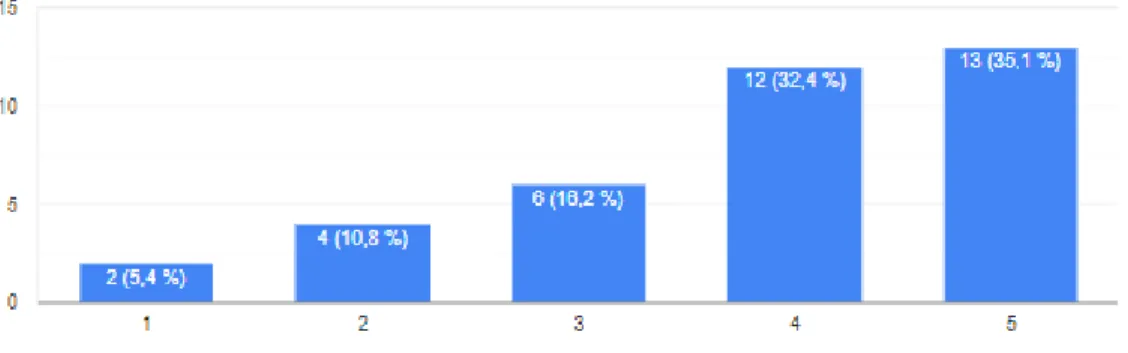
Graph 1 shows students’ opinions towards the statement “I consider that native speaker teachers are the best option for learning pronunciation.” In this statement, number 1 stood for strongly disagree and number 5 stood for strongly agree. Results show that 35.1% of learners strongly agreed that native speaker teachers are the best option for learning pronunciation. Additionally, 32.4% of participants expressed they agreed with this belief. Only 10.8% disagreed and 5.4%
strongly disagreed with native teachers being the best option for learning pronunciation. Finally, 16.2% of participants remained neutral.
Graph 1.Mexican learners’ preferences for native teachers for pronunciation learning.
In this regard, as can be seen in (1), (2) and (3) during the interviews, participants expressed that they believed they could acquire better pronunciation with native speaker teachers.
1) “I always try to be in the class of native teacher because I think I can have a good pronunciation in their classes. I can speak like an American person if I take classes with them.” (Participant student 9)
2) “…pronunciation is something I always take into account… if I can choose a teacher and I know the teacher is native or speaks like a native, I take that class. I want to speak very well English.” (Participant student 10)
3) “I have seen that the people who learn English in the United States speak like an American person, that is the reason why I think natives are the best option for pronunciation because you can imitate the way they speak.” (Participant student 22)
Based on (1) (2) and (3) it can be said that native speaker teachers are preferred as a model for emulating pronunciation. As can be seen in (1) and (3), the preference particularly points to American accent, so it can be inferred that the preference of a native speaker teacher for a pronunciation model is oriented towards those teachers with “a standard American accent.” To lend support to this finding, Ladegaard and Sachdev (2006) explain that American English is usually considered the standard accent of the language. Additionally, a study carried out by Scales, Wennerstrom, Richard and Wu (2006) found out that the pronunciation models that students usually prefer to learn are standard-inner circle models like the general American and received pronunciation (British accent).
4.1.1.2 Grammar
One relevant aspect to consider in terms of linguistic knowledge is grammar competence.
Grammar competence is defined as the knowledge of the rules of grammar (Canale & Swain,
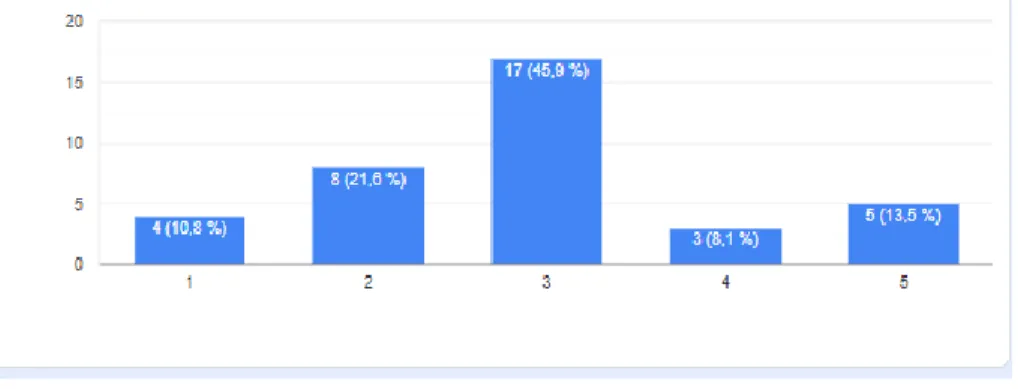
1980). Graph 2. illustrates the perceptions of students regarding their native teachers’ knowledge of grammar to teach English.
Graph 2. perceived native teachers’ skills for grammar teaching.
According to the answers provided by the learners illustrated in graph 2, it can be seen that in terms of grammar instruction, students do not perceive native speaker teachers as the best option.
According to graph 2, 21.6% disagree and 10.8% of students strongly disagree with the statement that a native speaker teacher explains better the grammar of the language. only 8.1% of participants agree with this statement and 13.5% strongly agree. Surprisingly, 45.9% of participants remained neutral in this question. On the other hand, students did express certain preference towards non- native speaker teachers in terms of grammar instruction.
4.1.1.3 perceived grammar teaching skills
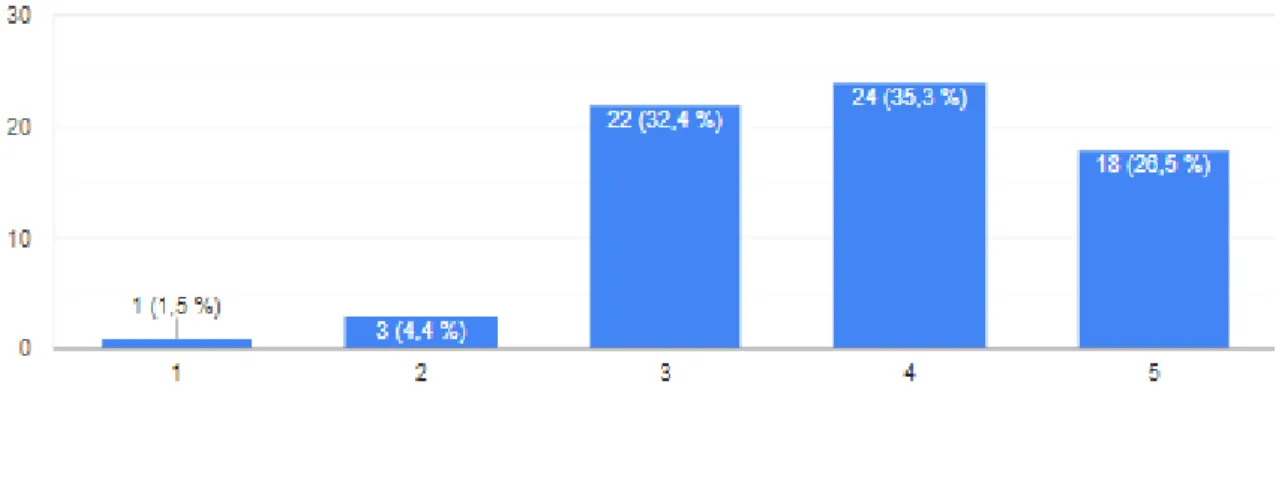
As graph 3 illustrates, 35.3% of learners agree and 26.5% of learners strongly agree that a non- native speaker teacher is able to explain grammar in a better way. Only 1.5% of participants strongly disagreed and 4.4% of participants disagreed with this statement. 32.4% of participants remained neutral in this regard. Moreover, as can be seen in (4) and (5), during the interviews students expressed their perception that sometimes native speaker teachers tended to take for granted their knowledge about grammar since it was their mother tongue. Also, as can be seen in (4) students perceive that NNESTs are more effective at grammar teaching as a result of having received instruction of English as a foreign or second language.
Graph 3. perceived non-native teachers’ skills for grammar teaching.
Visibly, participants expressed their preference towards NNESTs in terms of grammar teaching.
Interestingly, as can be seen in (4) participants stated that the reason why they believe NNESTs make a great fit for grammar instructors is the fact that they have been through the process of learning a foreign language or L2 as well. Direct quotes from the interviews are presented below.
4) “…Before… when I took classes in other schools or in private institutes, the non-natives were always better at explaining grammar, maybe because they were students first, like me. So, they had to learn the language correctly to be good teachers.” (Participant student 36)
5) “In my opinion native teachers sometimes don’t pay attention to many details of grammar because is their native language. They know it, but for example in my case, sometimes I asked my teacher, who was native, about certain things in grammar … sometimes he said that just because or sometimes he didn’t know, but in another school my teacher was Mexican and she always told me why something was like that, so…maybe teachers who are natives don’t think too much about grammar.” (Participant student 22)
To lend support to these findings, a study carried out by Lasagabaster and Sierra (2002) on the perceptions of university students about their native and non-native English teachers showed that NESTs were perceived as inefficient grammar instructors. Another study carried out by Beckett and Stiefvater (2009) showed that NESTs were perceived more flexible, fluent and colloquial in their language use, whereas NNESTs were believed to be more knowledgeable and able to apply their expertise in their teaching. Similarly, a study carried out by Mahoob (2004) showed that NNESTs were perceived by learners as aware of culture and metalinguistic. NNESTs were also perceived as empathetic, good at teaching reading, writing and grammar and more efficient than NESTs because they could understand learners’ needs.
By the same token, questionnaires showed that 29.4% of participants agreed and 44.1%
strongly agreed that NNESTs were able to understand the learning process of an L2 better than NESTs. (Levis et al., 2016) lend support to these opinions and explain that even if the origins
of a teacher do not interfere with their effectiveness in the classroom, it is true that NNESTs bring tremendous advantages to learners since they have been through the process of learning the language and have become aware of the tricks and pitfalls learners might fall into.
4.1.1.4 Teachers’ perceived clarity in instructions
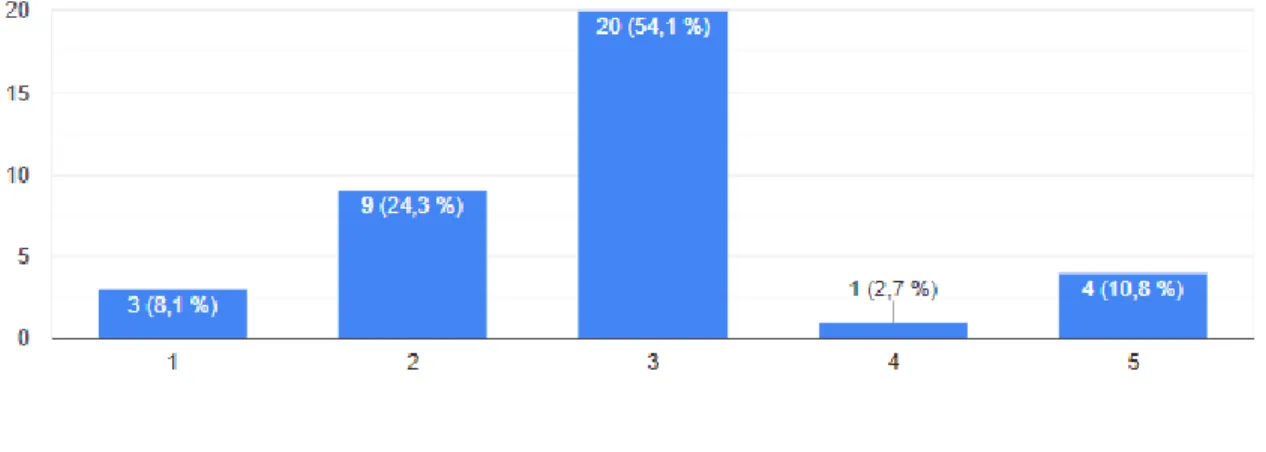
On the other hand, as graph 4 illustrates, when questioned about which kind of teacher made them understand better how to perform activities in class, only 10.8% of participants expressed that they strongly agreed and 2.7% agreed that native speaker teachers were clearer. 24.3% of participants disagreed with this statement and 8.1% of participants strongly disagreed. 54.1%
remained neutral.
Graph 4. Perceived clarity of NESTs in tasks instructions.
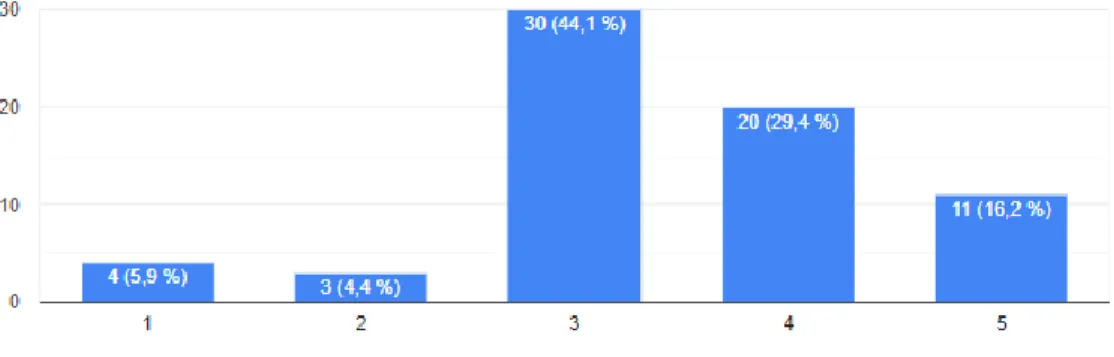
In contrast, as graph 5 shows, 29.4% agreed and 16.2% of learners strongly agreed with the statement that non-native teachers made them understand how to perform the activities better.
In contrast with NESTs, the number of participants who disagreed and strongly disagreed was smaller. Only 5.9% of participants strongly disagreed and 4.4% of participants disagreed with the statement that NNESTs were clearer with tasks instructions. The rest of the participants, who accounted for 44.1%, remained neutral in this aspect.
Graph 5. Perceived clarity of NNESTs in tasks instructions.
As can be seen in (6), during the interviews, participants were asked about this topic and expressed that they perceived that perhaps the fact that most of their teachers were NNESTs influenced the comprehension of instructions.
6) “It’s not an absolute true that all non-natives are more clear or anything. Probably is because most of our teachers are non-natives and we are used to them. Or maybe is because we have the same culture and that makes understanding easier.” (Participant student 45)
Based on (6) it can be inferred that culture has a major relevance in the perceptions of learners towards both NESTs, and NNESTs. The perceptions about NESTs’ and NNESTs’ sociocultural knowledge will be addressed in the following section.
4.1.2 Perceptions of learners towards NESTs’ and NNESTs’ sociocultural knowledge Sociocultural knowledge is explained by Alpetkin (2002) as:
“… the knowledge that deals with the social rules of language use, which involve an understanding of the social context in which language is used. Such factors include the
role of the participants in a given interaction, their social status, the information they share, and the function of the interaction” (Alpetkin, 2002, p. 58).
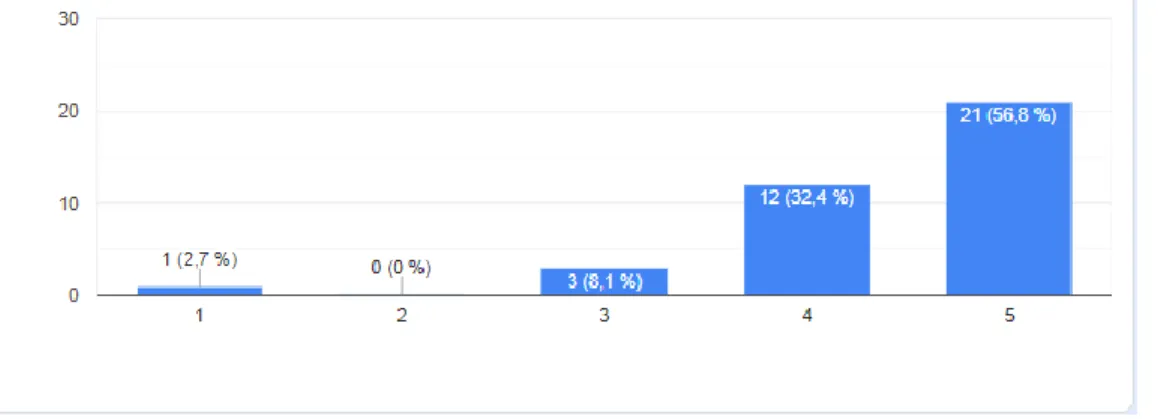
Graph 6 illustrates learners’ perceptions about teachers’ sociocultural knowledge. 56.8% of participants strongly agreed that in their perceptions, NESTs have a good sociocultural knowledge, which allows them to enrich lessons. Similarly, 32.4% agreed with the statement.
Graph 6. Perceived sociocultural knowledge of NESTs.
Furthermore, NESTs’ cultural background was pointed out by 81.1% of participants as an advantage of teachers that would add to the learning process, just behind pronunciation. During the interviews, participants explained that the cultural background of their teachers had little impact on their perceptions about the competitiveness of the teachers as can be seen in (7) and (8).
On the other hand, one participant expressed his view that sociocultural knowledge was highly relevant to acquire more competence in the language (see extract 9). Finally, one participant stated that no matter the origins of their teacher, a good English class is made up of different elements.
Interestingly, one of the most relevant elements of a class, according to them, is culture since it allows learners to develop and interact in a globalized society (see extract 10). Conversely,
NNESTs’ sociocultural knowledge of English was described by learners as sufficient to teach the language. Nevertheless, students perceived that the cultural aspects were not often explored in the lessons, as can be seen in (11).
7) “A teacher who is prepared for the job can speak about culture and enrich the lessons, it doesn’t matter if it’s native or not.” (Participant student 22)
8) “I think cultural aspects in the classes are very important, but I think only good teachers know how to teach that correctly, not only natives.” (Participant student 36)
9) “Only a native speaker can teach about their culture, for example I am Mexican and I know about my culture and traditions. The same with native teachers…Also I think is very important to include culture in the class.” (Participant student 9)
10) “I think culture is essential in English teaching nowadays. We live in a globalized society and students need to be able to interact with people from different backgrounds. It doesn’t matter where the teacher is from, the important thing is how prepared he is to help students communicate correctly with different people in the society.” (Participant student 42) 11) “I think non-native teachers know a lot about culture. I think they can teach the culture
very well, but it’s not common. They sometimes focus on other things like grammar.”
(Participant student 65)
4.1.3 Perceived Advantages of NESTs and NNESTs
English learners who participated in the study where inquired about the advantages and disadvantages they perceived in both native and non-native teachers. As can be seen in graph 7.
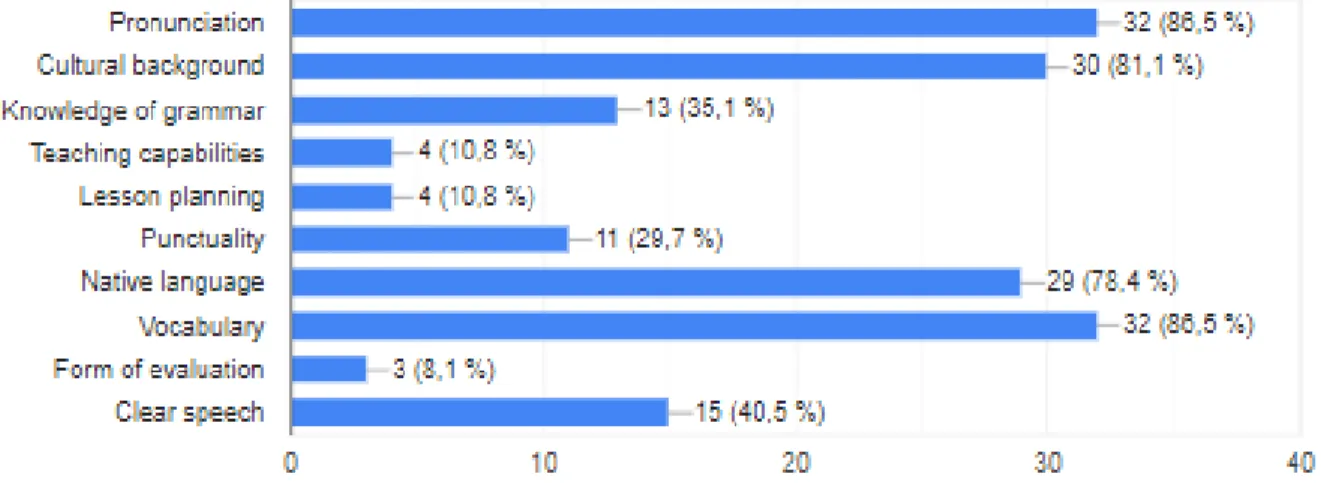
Among the advantages of native speaker teachers, 86.5 % of participants selected pronunciation as an advantage of native speaker teachers. Furthermore, as participants were free to choose as many options as they needed, another 86.5% of participants selected that one of the main
advantages of native speaker teachers was their lexical repertoire, or vocabulary. Furthermore, the choice of cultural background as an advantage of native speakers accounted for the 81.1% of the options. Less popular choices were knowledge of grammar which was chosen by 35.1% of participants, teaching capabilities and lesson planning with 10.8% respectively and finally form of evaluation, selected by 8.1% of participants.
Graph 7. Perceived advantages of native speaker teachers
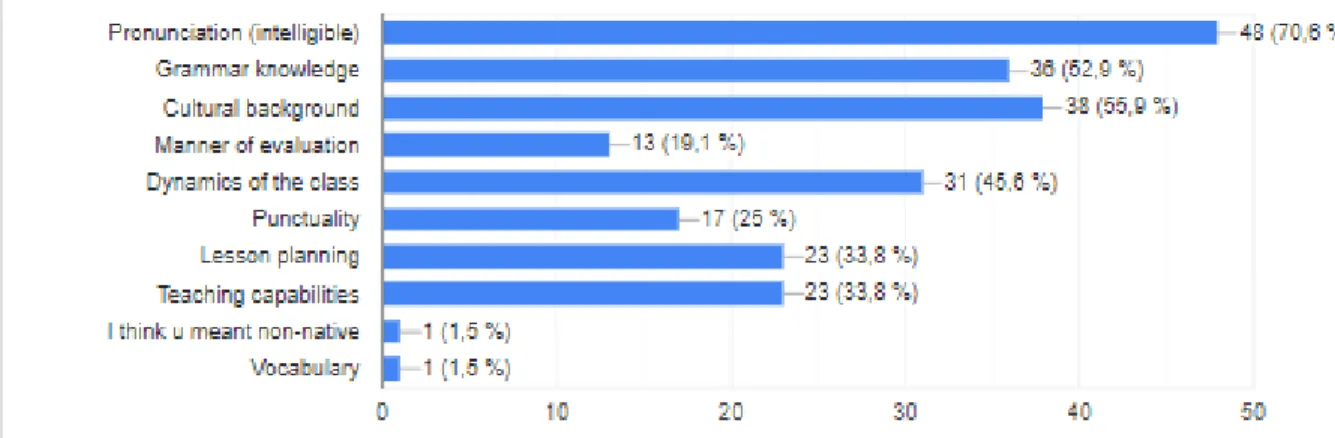
On the other hand, participants expressed their beliefs about the advantages of non-native speaker teachers, where the most popular choice was intelligible speech with 70.6% of participants selecting this option. Moreover, the second most popular advantage selected by 55.9% of participants was cultural background. Followed by grammar knowledge, which accounted for 52.9% of choices. Other relevant advantage chosen by participants were dynamics of the class, lesson planning and teaching capabilities. Interestingly, these aspects in NESTs were only mentioned by 10.8% of participants. While with non-native speaker teachers these aspects accounted for 45.6% regarding dynamics of the class and 33.8% for lesson planning and teaching capabilities. The results from the questionnaires about the perceived advantages of English
teachers suggest that learners consider native speaker teachers as ideal models for pronunciation learning and acquisition of vocabulary. Nonetheless, in terms of teaching skills and lesson planning, learners seem to prefer non-native speaker teachers. This might be a sign that students perceive NNESTs as more professionally prepared.
Graph 8. Perceived advantages of non-native speaker teachers
During the interviews, one of the participants expressed his beliefs in this aspect (see 12)
12) “I believe it is easier that a native with no preparation gets a job. That’s why non-natives are more prepared, because it is more difficult to find a job if you are not native and have little preparation.” (Participant student 42)
4.1.4 Students’ perceptions towards having a native or non-native English language teacher.
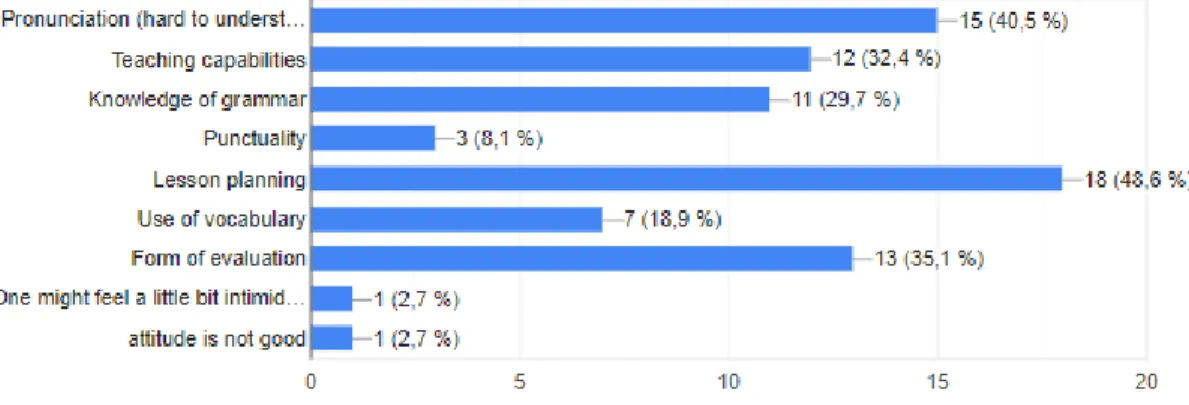
By contrast, graph 9 illustrates the perceived disadvantages of NESTs. For NESTs 48.5% of participants selected lesson planning as the main disadvantage of native teachers, followed by form of evaluation and teaching capabilities with 35.1% and 32.4% respectively. Furthermore, 29.7%
of participants also pointed grammar knowledge as a disadvantage of NESTs.
Graph 9. Perceived disadvantages of NESTs.
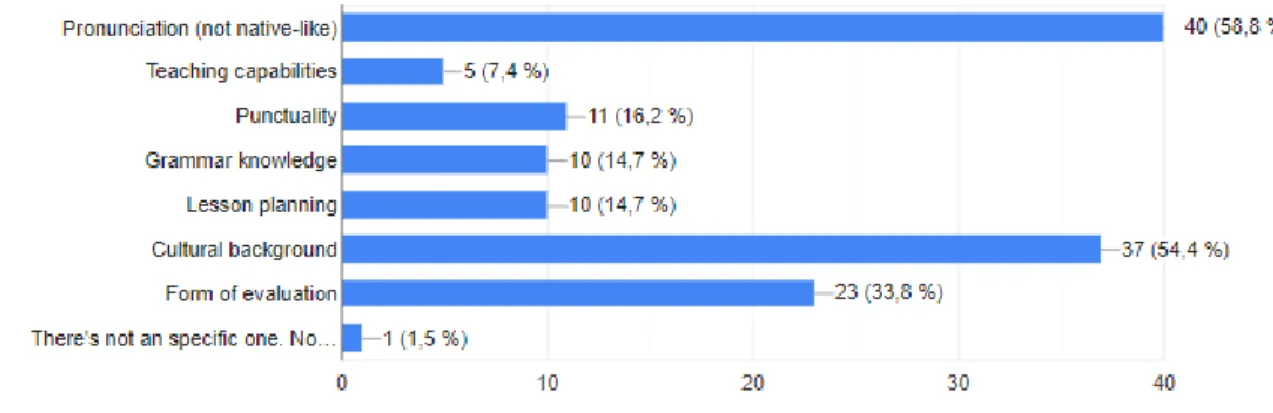
Finally, In the case of NNESTs, graph 10 illustrates the perceived disadvantages identified by participants. Amon these disadvantages were a non-native-like pronunciation which accounted for 58.8% of choices. Moreover, 54.4% of participants expressed that another relevant disadvantage of NNESTs is their cultural background. Interestingly, the least popular options among the disadvantages of NNESTs were lesson planning and grammar knowledge with 14.7% each, and teaching capabilities which was selected by only 7.4% of participants. The results obtained from the questionnaires applied to English learners suggest that overall learners consider NNESTs as competent teachers with high knowledge of grammar and skills for lesson planning.