The purpose of this research paper is to identify the experiences of LEMO students in obtaining the required level of language proficiency at the Faculty of Languages at the Universidad Autónoma de Puebla Benemérita. Furthermore, it is expected that this analysis could reflect pre-service teachers' experiences in acquiring the required level of language proficiency.
Research Questions
The purpose of this paper is to identify 4 problems of pre-service teachers in achieving the required level of knowledge at the Faculty of Languages. This article is useful for further research on pre-service teachers' language acquisition and even for teacher research in this field, because as Tetenbaum and Mulkee (1986) state, "analyzing the nature of basic skills in language teaching is a problem of some urgency."
Definition of terms
We also see the importance of language skills in pre-service teachers' learning process and its implications in their future development as in-service teachers. Language proficiency is also a subject of matter that is not only involved in EFL teachers' learning process, but is also subject testing through the TOEFL test, therefore the definition, composition and meaning of the test will be explained.
Language proficiency
- Definition of language proficiency
- Significance of language proficiency in ESL students
- EFL teachers´ needs analysis
- Pre- service teachers needs in context
- Teachers beliefs
8 sociolinguistic and discourse competencies (Harley, Allen, Cummins, & Swain, 1990) that preservice teachers must demonstrate in the TOEFL test. The analysis of EFL learners is an important issue that affects the future development of pre-service teachers as pre-service teachers.
Issues achieving a high score on the TOEFL test
Language Testing
Testing has become an important step in language teaching as the latest generation emphasizes what teachers do in the classroom. As a result of the development of language teaching, language testing developed appropriate techniques for the new pedagogy (Baker, 1989). Today, colleges, universities and schools use different types of language tests to classify students into appropriate learning levels.
Furthermore, the TOEFL test or the ELTS in British is used as entrance exams in the United States, Britain and many other countries around the world.
The Language Test
25 The observable organization of the language tests is significant, as the TOEFL follows the structure of abilities, which is reflected in the last part of the test with the essay. According to Ashok (2006), this essay is an important element of the TOEFL test because the essay tests the examinees' critical and analytical thinking ability and the way they express their thoughts rather than their in-depth knowledge of a specific topic. In addition, other subjects are tested and the skills, as reflected in the first three sections of the test (reading comprehension, structure and written expression and listening comprehension), which we have observed to meet the structure of language tests are fundamental for students to know the problems they will meet when they present the TOEFL test.
Finally, the organization of the data collection will be presented during the explanation of the theories analysis and the different processes in which this research was handled (Tapia, 2013).
Research Design
During this chapter, the research design of this investigative paper will be explained, as well as the methods and participants involved. In addition, it is essential that this research explains the structure, purpose and administration in which this research was conducted. As stated by Stake (1995 as cited in Cresswell, 2009, p13) “case studies are a research strategy in which the researcher explores in depth a program, event, activity, process or one or more individuals”.
Therefore, an open questionnaire and a narrative were the qualitative methods used during this research.
Participants
Data collection
In an interactive world, stories represent beliefs about the meaning that people give to their experiences and social worlds. The structure of the instruments is divided into two parts: first the fifteen open questionnaires and then the story. The topics into which the instruments are divided and included are the following sections: students.
Finally, participants were numbered from 1 to 4 to maintain participant anonymity (Bell, 1993) and also to identify and analyze data.
Data analysis
Second, we used the schema outlined by Creswell (2005) to process the narratives, where we used a thematic heading to organize, categorize and sort the raw data into rational data. This collection was divided into four categories: participants' experiences in the presentation of the TOEFL practice test, participants' feelings in the presentation of the TOEFL practice test, participants' opinions about the TOEFL practice test, and participants' suggestions for future TOEFL test takers. In this chapter, the results were collected in five categories: students' background, students' background related to English, students' prior knowledge of the TOEFL exam and graduate basics, and students' perceptions of the TOEFL, perceptions and feelings representing the TOEFL exam.
In addition, it was considered important to analyze students' backgrounds to understand their personal and unique contexts, which influence their perception of the world.
Questionnaire
Students´ background related to English
In addition, other languages spoken by the participants are also included. In this sense, table 1.1 shows that (75%) of the participants speak at least 3 languages, while (25%) of the participants speak 2 languages. In contrast, only they (25%) speak four languages, and it is also noted that this participant is the one whose native language is Náhuatl.
Students´ academic background related to English
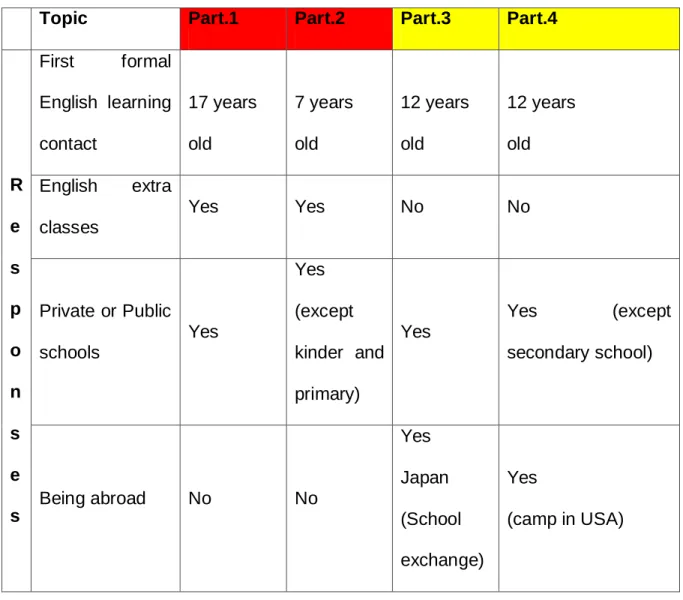
Low scoring students are those in red color and high scoring students in yellow to facilitate their identification. In addition, other remarkable findings, shown in Table 1.2, are that all the participants with a high score did not take extra English classes before attending the University. In contrast, all of the low-scoring participants took extra English classes before attending the University.
Finally, the findings presented in Table 1.2 show that all high-scoring participants have traveled abroad, 1 of them to an English-speaking country and the other to Japan where English was also a language of communication.
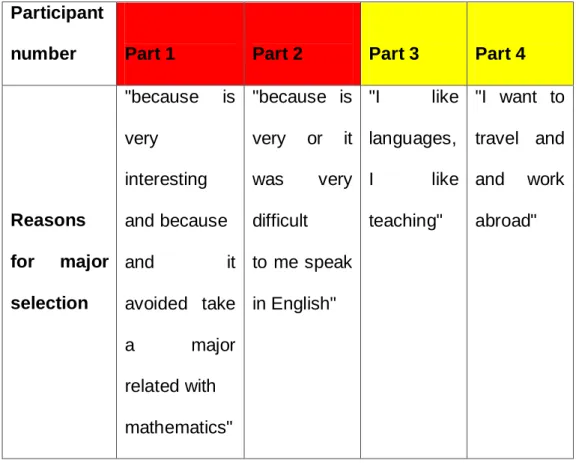
Reasons for major selection
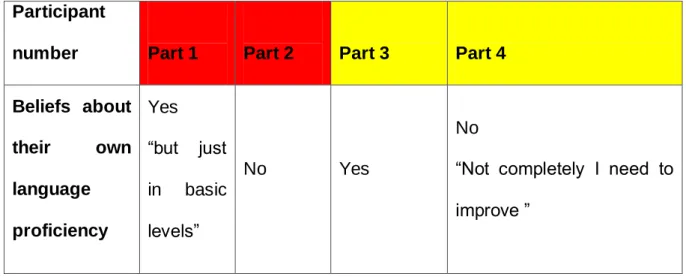
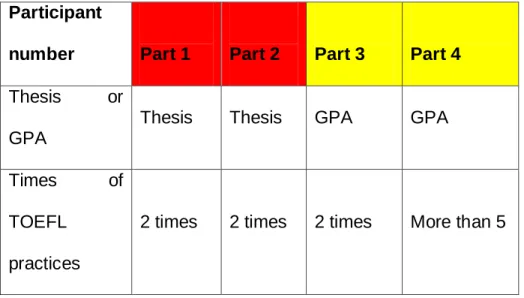
The results in table 1.4 show that 50% of the participants do not feel comfortable giving lessons, just as they do not believe that they have required language skills for their professional development. 38 The results in table 1.5 show that the 50% of participants plan to take the professional exam to defend their thesis project, this percentage represents the participants with low scores. In addition, Table 1.5 shows that only the 25% of participants presented the TOEFL test more than five times; meanwhile the other 75%.
Finally, Table 1.5 shows that all the participants know that they must score a minimum of 550 points in TOEFL exam to obtain their BA diploma, if they will graduate according to GPA.
Narrative
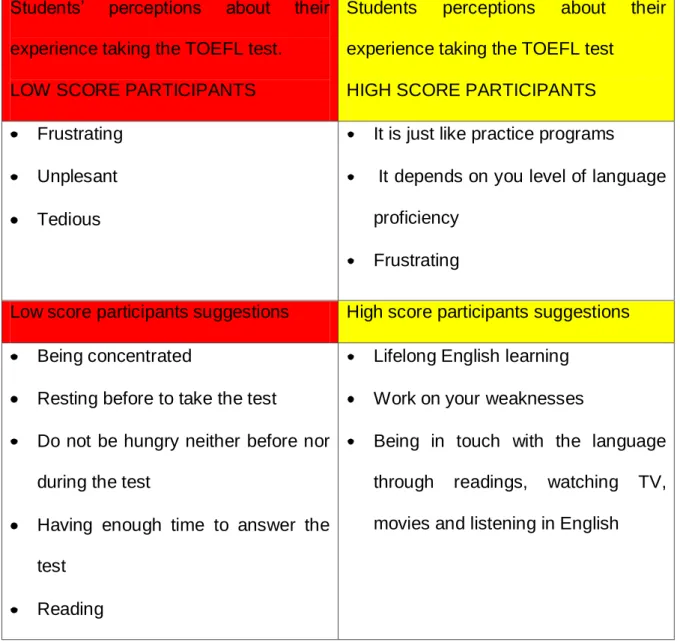
Students´perceptions about their experience taking the TOEFL test The fourth category of this investigation is students’ perceptions about
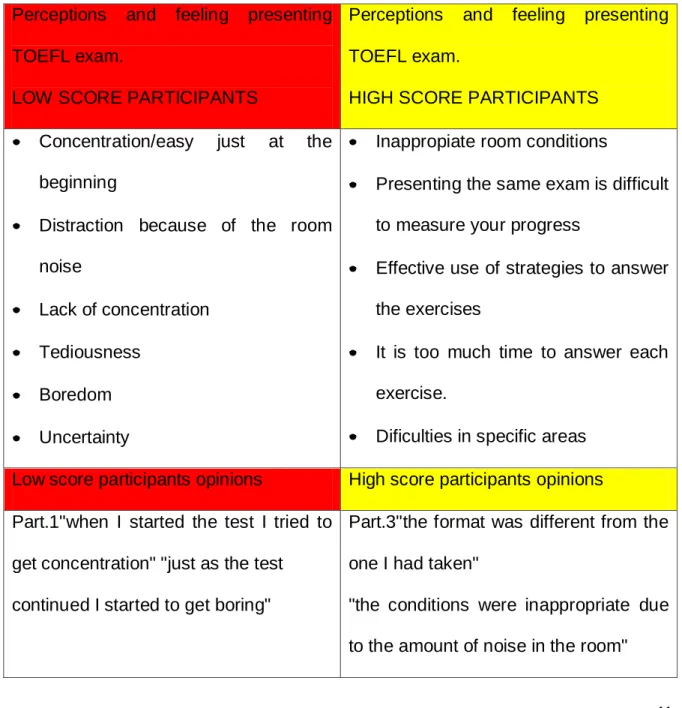
It is also important to note that 1 of the 2 participants with a high score presented the TOEFL test more than 5 times, while both participants with a low score presented the TOEFL test only 2 times. As we have seen, Table 1.6 shows that the 50% of participants considered their experience in presenting the TOEFL exam to be good. This part is all participants with a high score. Additionally, participants with high scores reported that external factors, such as the noise in the room, prevented them from listening to the audio.
Difficulties in specific areas Low score participants' opinions High score participants' opinions Part.1" when I started the test I tried to.
Introduction
In this chapter, the research questions set during the first chapter will be answered to understand, analyze and deeply understand the current research paper. In addition, the implications of the results in the current investigation paper will be discussed. Finally, the limitations of the research will be exposed and some suggestions for further researchers in this field will be given.
Research questions
However, reflecting on the participants "some other opinions emerged that revealed differences between high and low scoring participants". On the one hand, participants with low scores reported that during the test they experienced a sense of chaos, fatigue, frustration and pleasantness. In contrast, participants with high scores commented that for this major a lifelong English learning is necessary.
In the case of the participants with a high score, a minimum score of 560 points was achieved, while the participants with a low score achieved a maximum score of 410 points.
Discussion
Therefore, delineating the participants' reasons and motivations as these are reflected in their perceptions and beliefs, which are also reflected in their TOEFL practice test scores, was deemed crucial for this research paper. When analyzing the data on the difficulties of LEMO students in obtaining the required level in the TOEFL exam, many aspects were discovered. The presentation of the TOEFL test is a teaching evaluation that is the result of a long process of learning English during the course of the participants' studies.
Presenting the TOEFL test revealed the participants' perceptions as a result of their attitudes and motivation.
Limitations of the study
In addition, clear differences in attitude and motivation were observed; among low and high score participants. We could detect a more positive and confident attitude in high score participants than in low score participants. One of the consequences of this research paper is therefore that we were able to validate how motivation and attitudes clearly influence the participants' score and are part of the participants' score who acquire the required level of language proficiency on the TOEFL test.
Suggestions for further research
On the other hand, it would be worthwhile to continue this research with students of the Minerva generation to evaluate the new curricula and their effects on students' performance when presenting the TOEFL test. Furthermore, the application of this research at different levels of the BA would be of interest for further research. Cummins, J., Swain, M., (1990) The development of second language skills. 2002) Beliefs and knowledge of teachers in higher education.
Grouws (Ed.), Handbook of research on mathematics teaching and learning (p Teachers' uses of the target and first languages in second and foreign language classrooms.
Personal Information