This research was conducted to learn students' perceptions about the use of videos to improve pronunciation in the Bachelor of English Language Teaching in the Faculty of Languages BUAP in Puebla, Mexico. The results indicated that students have a fruitful opinion about using videos to improve pronunciation. This is the reason why this study was made to find out solutions to improve this skill.
On this journey, you will learn why using videos is a great choice for improving your pronunciation. You will not only be able to discover the number of studies carried out by authors all over the world, but you will also discover the opinions of students studying English at the BUAP Faculty of Languages and how they have implemented the use of videos to continue. In the first chapter you will find the background, followed by the rationale, problem and objectives.
- Background
- Rationale
- The Problem
- Objectives
- Research Questions
- Hypotheses
- Significance of Study
- Conclusion
16 When students are asked to speak, there is little cooperation, and one of the reasons is that they feel insecure about lack of pronunciation (Baran-Łucarz, 2014). Also, if they are in doubt, these are not asked for the same reason. One of the reasons is that teachers and students do not use English properly as it has to be in class due to the overuse of the mother tongue (L1) which affects EFL students (Al-Ahdal, 2020).
Moreover, when students are asked to participate in class, they feel uncomfortable or even embarrassed due to the feeling of pronunciation mistakes. Its absence in the classroom is also one of the reasons why students do not have the feeling to learn the language. 17 learning process and the lack of speaking, which is one of the reasons why students do not pronounce FL with the acquired intonation.
- Chapter Overview
- Pronunciation
- Prosody
- Connected Speech
- Word Stress
- Articulation
- Discrimation
- Teaching Pronunciation
- Pronunciation Learning Material
- Audiovisual
- Videos as a Learning Tool
- Movie Videos as a Medium to Teach Pronunciation
- Using Video Clips in Teaching
- Using YouTube
- Techniques to Use Short Videos in Class
- Effects of Videos on Pronunciation
- Recent Studies
Connecting words while speaking is one of the skills of humas, and this is called connected speech (Ding et al. 2020). In other words, articulation refers to the process of manipulating the error in airflow through the vocal tract to produce sounds. One of the skills considered the most important in learning English is speaking skills, but some factors such as nervousness and low self-confidence prevent students from using them when asked (Kathirvel & Hashim, 2020).
To improve pronunciation, one of the strategies that can be implemented is the use of auditory material to improve speaking skills to see and listen to anyone pronouncing the words so that students can imitate them (Kathirvel & Hashim, 2020). Because of the changes and possibilities that videos provide, videos are one of the best tools for improving students' speaking. Indeed, there is no denying that videos are one of the most excellent tools that can be used in classrooms by teachers.
Canning-Wilson and Wallace (2000) state that video comprehension is more a result of the visual elements than the auditory components that are offered. These emotions appear due to the movement of the actors, the songs in the background and the images presented (Berk, 2009). Thus, pictures, actors' body movements, speech and subtitles are a good set of elements that can be used to improve pronunciation regardless of the intelligence of any student.
Therefore, using videos in well-prepared classrooms will bring out the best in students and indeed the best in teachers. Moreover, due to the COVID19 pandemic, the use of this technology is becoming more demanding. In contrast to the traditional method, YouTube videos provide not only a more realistic language context, but also a more comprehensive competition.
The results of the study showed that the group where the videos were used as material outperformed the group that was taught using the traditional method.
- Introduction
- Research Approach
- Location of Research
- Sampling
- Participants
- Data Collection Technique and Instrument
- Procedure
- Ethical Consideration
- Data Analysis
To achieve the aim of the study, the non-experimental quantitative approach was chosen, specifically the survey. Therefore, teaching and learning must take place according to the needs of the students' community. By getting new information from the same study, researchers can see if the method can be applied in the place where it is needed.
The reliability and validity of the questionnaire must be consistent with the study conducted to prove the hypothesis. On the other hand, the researcher must consider three aspects: first, the willingness of the participants to share the necessary information. The research of this study considered Leavy's suggestion to select the sample of the study.
Population size is essential because it indicates the accuracy and margin of error in the study. 43 words, because the higher the accuracy of the research, the better the value of the results. To get the best possible answers, the researcher must anticipate the participants' answers.
The element or participants of the study can be a thing, a person, animal, a brand, an activity, a profession, language, among others (Sampieri et al. 2014). In fact, regardless of the choice of the participants, the answer has the same equality. The participants in this study were students of the Faculty of Languages BUAP in Licenciatura en la enseñanza del Ingles (LEI).
To proceed, researchers must explain to the participants how the data sets will be used (Gajjar, 2013).
- Results
- Benefits of Videos on Pronunciation
- Captions and Pronunciation
- Videos as Learning Material
- Video Uses
- Videos as a Motivation to Speak in Class
- Videos to Learn Vocabulary
- Videos and Dialogues
- Videos with Subtitles
- Videos and Lessons
- Videos and Content
- Videos and Participation
- Videos and Comprehension of the Lesson
- Videos and Learning
- Videos and Cultures
- Videos and New Information
- Videos and Recommendation
- Discussion
- Research Question 1
- Research Question 2
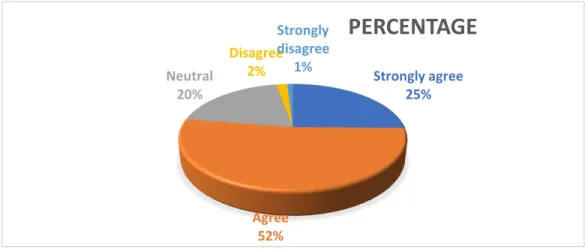
Most of the participants, 40%, agree that teachers' lessons are more interesting if videos are used as teaching material; while, less participants 33% fully agree; however, 24% are neutral, 2% disagree and a minority of participants 1% strongly disagree. Most of the participants, 52% agree that watching videos in English motivates them to speak in class; however, fewer than 25% of participants strongly agree, less than. Most of the participants, 47% agree that they learned to pronounce some English words by watching videos; however, fewer participants, 39%, strongly agree;.
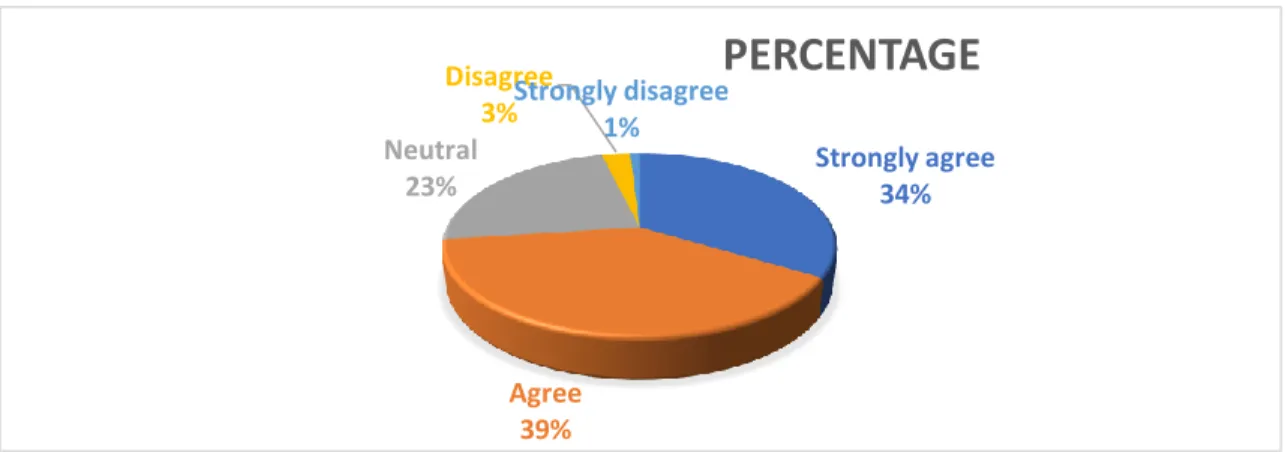
The majority of participants, 50%, agree that the dialogues in the videos can be used in everyday life; however, there are fewer participants: 37% strongly agree; while 11% are neutral, and a. The majority of participants, 52%, agree that watching videos with subtitles gives confidence and motivation to learn English; however, fewer participants, 37%, strongly agree; while less than 9% are neutral, and a minority of participants (2%) disagree. The majority of participants, 39%, agree that using videos makes the lesson more engaging; however, fewer participants (34%) strongly agree; while less than (23%) are neutral; Yet (3%) disagree, and a minority of participants (1%) strongly disagree.
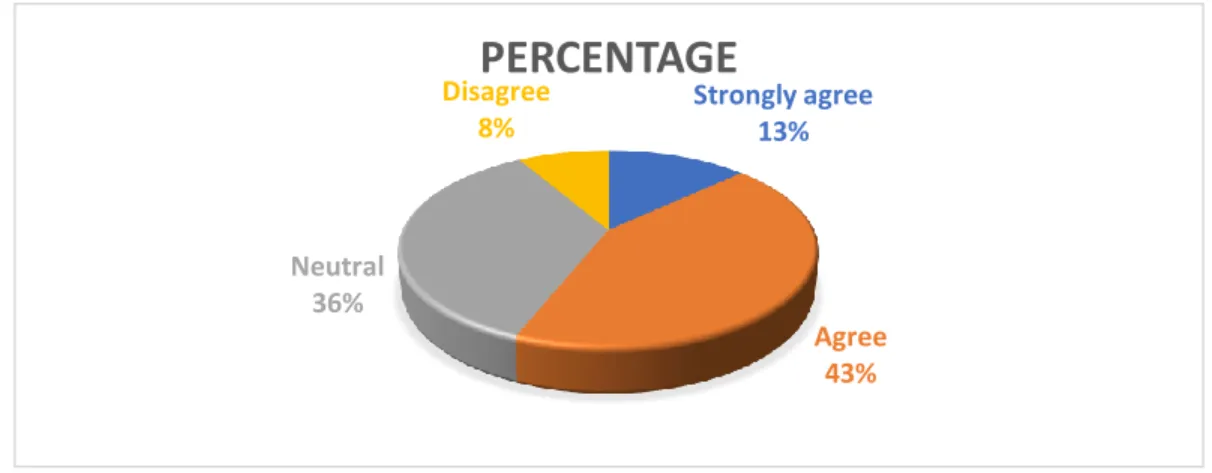
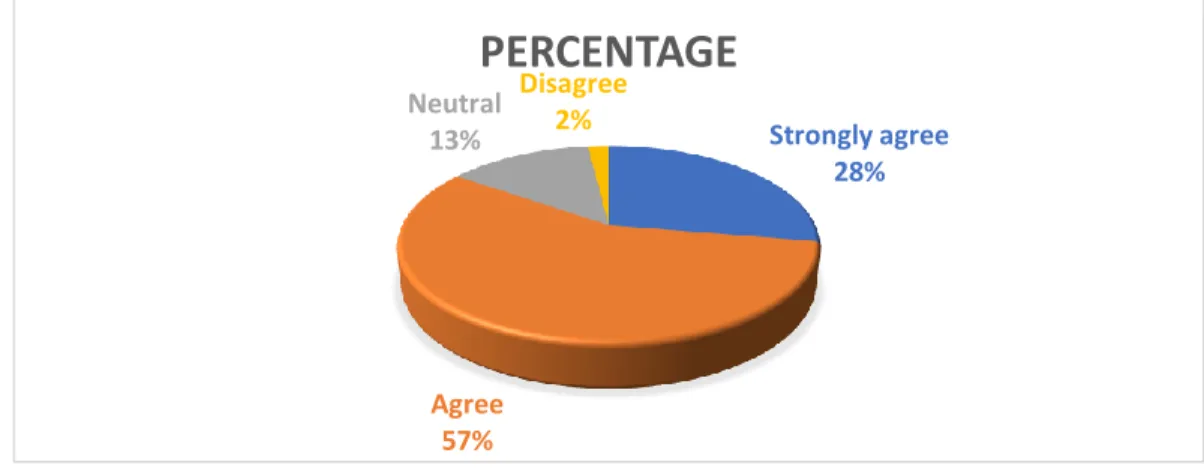
The majority of participants, 52%, agree that the videos used in class are relevant to the content; however, fewer participants, 24%, strongly agree, while less than 23% do. The majority of participants, 61%, agree that watching online videos develops the overall understanding of the lesson; however, fewer participants than 22% are neutral, while less than 14% strongly disagree, and the minority (3%) disagree. The majority of participants, 57%, agree that online videos are beneficial sources for learning the English language; however, fewer participants than 28% strongly agree; while.
Most of the participants, 50% agree that they like to discover new information using online videos; however, fewer participants, 34%, strongly agree; while less than 15%. Most of the participants, 50% agree on recommending online videos to learn English; however, fewer than 40% of participants strongly agree, and a minority of 10% agree. The majority of participants (55%) strongly agree that videos have a beneficial effect on English pronunciation.
To get more results, the participants were asked if lessons are more interesting if videos are used as teaching material, of which most 40% agree; however, fewer participants than 33% strongly agree; while 24% are neutral; nevertheless, 2% disagree and a minority of participants 1% strongly disagree.

- Introduction
- Conclusions
- Implication of the Study
- Limitations
- The Suggestion for Further Research
Therefore, it is important that teachers and students pay special attention to it because it is part of the communicative context and if there is little or no understanding between the listener and the speaker, the conversation is meant to end. One way to do this is to use videos that are related to the content. The use of original dialogue videos with real context, where the movement of the actors' mouths is clearly visible.
Since you have more time at home, you can always pause them to repeat the words, look them up in the dictionary or watch the subtitles more if they are used because of its great benefits. On the other hand, open questions can also be used; these questions were not used due to the difficulty of the COVID19 pandemic. To proceed, it is important to make a few changes in the teaching curriculum based on videos to improve pronunciation and the other skills not examined in this research.
The relationship between pronunciation anxiety and readiness to communicate in the foreign language classroom: The Polish EFL context. Teachers' and students' attitudes towards the use of YouTube videos in developing EFL learners' speaking skills. Students' perception towards the use of Youtube in vocabulary learning (A study towards the second grade of Mts Al-Khoirotpagelaran Malang).
Using audio-visual materials as a strategy to improve speaking skills among young ESL learners. 44.https://scholar.google.com/scholar?hl=es&as_sdt=0%2C5&q=The+Effects+of+Watc hing+Videos+in+Pre-. reading+in+EFL+Students%E2%80%99+Reading++comprehension+and+attitudes&b tnG=. https://www.uca.ac.cr/wp-content/uploads/2017/10/Investigacion.pdf. Lexical stress, importance and rhythm of English. https://translate.google.com.mx/?hl=es&tab=rT&sl=en&tl=es&text=English%20speech.
Che réra Juan Olivera Ortiz ha che ha’e temimbo’e LEI Seminario II-pe.
Videos and pronunciation items. Choose one of the five options that is best