BENEMÉRITA UNIVERSIDAD AUTÓNOMA DE PUEBLA
FACULTAD DE LENGUAS
TEACHING STRATEGIES TO MANAGE LARGE GROUPS OF 1 , 2
st nd, rd3 AND 4 GRADE OF PUBLIC PRIMARY SCHOOLS
thA thesis submitted to the Faculty of languages For the degree of
LICENCIATURA EN LA ENSEÑANZA DEL INGLÉS
By:
ALEJANDRA MUNGUÍA GALAN JAQUELINE ALCANTARA ROJAS
Thesis Director:
MTRA: GICELA CUATLAPANZI PICHÓN
Puebla, Pue. April, 2015
TEACHING STRATEGIES TO MANAGE LARGE GROUPS OF 1
st, 2
nd, 3
rdAND 4
thGRADE OF PUBLIC PRIMARY SCHOOLS
This thesis has been read by the members of the Thesis Committee of
ALEJANDRA MUNGUÍA GALAN JAQUELINE ALCANTARA ROJAS
And it is considered worthy of approval in partial fulfillment of the requirements for the degree of
LICENCIATURA EN ENSEÑANZA DEL INGLES
Thesis director
_________________________
Mtra. Gicela CuautlapantziPichón
Committee member Committee member
_______________________ _______________________
Mtra. Maritza del Carmen Rosas Mtro. Leonel Ojeda Ruiz
Álvarez
ABSTRACT
Nowadays teaching English as a foreign language in public primary schools has become more accessible and possible in Mexico due to the implementation of the program PNIEB (Programa Nacional de Ingles en Educación Basica) in the curriculum in order to satisfy the communicative needs and make students aware about the existence of other cultures.
As pre-service teachers, we had the opportunity to teach elementary school children, but during this process, we faced the lack of teaching strategies to manage large groups because none of us had some training about this issue. For that reason, the main purpose of this research was to observe some pre-service English classes so that we could identify, analyze and select the most successful teaching strategies applied to manage large groups of elementary school. Our investigation was carried out at four public primary schools located in one of the most important cities in central Mexico. The participants were 8 pre-service English teachers who were working with large groups and were teaching 1st, 2nd, 3rd and 4th grades.
According to the results of our study, the most useful strategies to manage large classes were the following: The teacher knew students’ names, punishment and disciplinary interventions were necessary, the teacher had to raise his/her voice when students were distracted, the teacher monitored students when they were doing an activity among other. Detailed strategies and implications are described within this thesis.
DEDICACIONES
Sabiendo que jamás existirá una forma de agradecer una vida de lucha, sacrificio y esfuerzo constante, solo deseo que sepan que el logro mío, es el logro de ustedes, que mi esfuerzo es inspirado en ustedes. Y que mi único ideal son ustedes por siempre y para siempre.
Los amo
Luis Munguía Jiménez y Guadalupe Galán González
Porque siempre han sido mi inspiración y mis modelos a seguir desde pequeña, les agradezco hermanos por su cuidado, apoyo y cariño pero sobre todo por creer y confiar en mí.
Los amo
José Luis, Miguel, Enrique, Laura, Maru y Alfredo
Con amor Alejandra Munguía Galán
DEDICACIONES
Dedico esta tesis a mis papas Alejandra Rojas Durán y Casimiro Alcántara Zavaleta por haberme apoyado durante este sueño que se hizo realidad gracias a su esfuerzo, dedicación y sobre todo por darme su amor incondicional que tengo por parte de ustedes.
Mamá y papá todo gracias a su sacrificio que hicieron por mí ahora les puedo decir que es reflejado, en especial a ti mamá por haber puesto tu confianza total en mí.
A mis hermanos Anahi, Ernesto y Axel quienes siempre me apoyan, me animan y están conmigo cuando más los necesito.
A mi abuelita Josefa por brindarme sus consejos y su apoyo que he tenido hoy en día, así también como a mis tíos, primos y amigos. Les agradezco de todo corazón.
Con amor Jaqueline
ACKNOWLEDGEMENTS
Firstly, we want to thank God for letting us finish our major and now the thesis.
Secondly, we would like to thank the following people for their dedication and contributions. Without their help, this research would not have been possible to do:
Professor Gicela Cuatlapantzi Pichón: Thank you so much for your unconditional support, dedication, patience and time to carry out this thesis project. Every time we had a session with you to review the advances of our thesis, it was an enriching process because you let us know or mistakes and improve our writing. We have always considered you as an excellent teacher, person and the best thesis advisor, we will be always grateful to you. We feel very proud of being directed by you.
Professors Maritza del Carmen Rosas Álvarez and Leonel Ojeda Ruiz: You are such amazing teachers. We had the pleasure to take classes with you, we always considered you as very intelligent and dedicated teachers; we could not choose better readers for our thesis.
Thank you for your teaching.
TABLE OF CONTENTS
CHAPTER I: INTRODUCTION………. 11
1.0 Introduction to the problem……… 11
1.1 Rationale………. 12
1.2 Location of research………... 13
1.3 Aims……….………... 13
1.4 Research questions………...………... 14
1.5 Significance of the topic………. 14
1.6 The context of the research ……… 14
1.7 Chapter conclusion………. 14
CHAPTER II: LITERATURE REVIEW………... 16
2.0 Chapter introduction……….. 16
2.1 English as a foreign language…………...……….. 16
2.1.1 English as a second language Language………. 17
2.1.2 Teaching English as a foreign language in public elementary school ……… 17
2.1.3 NEPBE……… 18
2.2 Classroom management……… 19
2.2.1 Elements of classroom management ……… 20
2.2.2 The implementation of rules and procedures.………...………... 20
2.2.3 Disciplinary interventions….………... 22
2.2.4 Physical conditions of the classroom………...……… 23
2.2.5 Lesson plans………. 24
2.2.6 The use of materials and equipment.……….. 25
2.2.7 Group and individual work between students….……… 26
2.3Teaching strategies for large groups…...……… 26
2.3.1 Large groups………...………... 27
2.3.1 Challenges of teaching a large group….………. 27
2.3.3 Strategies……..……….……….. 29
2.3.4 Alternative teaching strategies………... 29
2.4 Chapter conclusion……… 32
CHAPTER III: METHODOLOGY………. 33
3.0 Chapter introduction……….. 33
3.1 Setting……….. 33
3.1.1 Subjects………. 34
3.2 Method……..……… 34
3.3 Instruments……..……… 35
3.4 Procedure………..……….. 36
3.5 Chapter Conclusion…………..………... 36
CHAPTER IV: RESULTS……….... 38
4.0 Chapter introduction……….. 38
4.1 Purpose, aims and research question………. 38
4.2 General situations……….………. 38
4.2.1 Rules……….. 39
4.2.2 Program to control large groups.……… 41
4.2.3 Values in the classroom.………..……… 41
4.2.4 Disciplinary interventions……… 42
4.2.5 Classroom conditions.……...………... 43
4.2.6 Lesson plans………..………... 44
4.2.7 Equipment and material.……….. 45
4.2.8 Group and individual work……….. 46
4.3 Strategies to manage large groups……… 47
4.3.1 Strategies to manage large groups……….. 47
4.3.2 Control of the class………. 49
4.3.3 Organization of the class……….. 49
4.3.4 Students’ aptitudes………... 50
4.3.5 Multileveled classes………. 51
4.3.6 Use of time………..………. 51
4.3.7 Strategies according to students’ learning styles……….……… 52
4.3.8 Disruptive behavior……….………. 53
4.3.9 Dynamics to lower students’ hyperactivity…………...……….. 55 4.3.10 Working with reading……...………...
4.3.11 Sitting arrangement………...
4.4 Chapter conclusion……….
CHAPTER V CONCLUSIONS……….
5.0 Chapter introduction………...
5.1 Findings and significance of the study………...
5.2 Answer to research questions...
5.3 Research aims……….
5.3.1 Achievement of the research aims………...
5.4 Limitations of the study...
55 56 57 58 58 58 60 62 62 63
5.5 Further research………..
5.6 Personal reflection………..
APPENDICES………
Appendix A………..
Appendix B………...
REFERENCES………....
63 64 67 67 68 69
11
TEACHING STRATEGIES TO MANAGE LARGE GROUPS OF 1
st, 2
nd, 3
rdAND 4
thGRADE OF PUBLIC PRIMARY SCHOOLS
1.0 Introduction to the problem
Nowadays teaching English as a foreign language in public primary schools has become more accessible and possible in Mexico due to the implementation of the new program PNIEB (Programa Nacional de Ingles en Educación Básica), in English NEPBE (National English Program in Basic Education). This program was created to teach English to kindergarten and elementary school students who attend public schools. Some of the reasons why the PNIEB has been applied at elementary school level are to foment different social practices of the foreign language in order to satisfy their communicative needs and develop several learning strategies, as well as to make students aware of the existence of other cultures.
As novice English teachers, we have had the opportunity to teach elementary school children and we have observed some difficulties when being in front of the class teaching. One of those difficulties is the management of the classroom. For most teachers, this can be a real problem if they do not have the right strategies to work with large groups. “Management is the decisions and actions that teachers take and make in the classroom. Actions are presented as what is happening in the classroom. And decisions are about whether to do those actions when, how and who will do them” Scrivener, (1994, p. 4). In addition, according to Colin, Smith and Laslett (1995) “management refers to the skill in the organization and presentation of the lesson in such a way that all pupils are actively engaged in learning” (p. 8).
Most teachers agree that teaching English to a small group of students is easier, more enjoyable, and less time consuming than teaching a large group. The concept of a large group
12 is complex to analyze, because every author has a different idea about it. For example, Nolasco (1988) states “English Teachers who are used to groups of twelve-fourteen students might find a group of twenty to be rather threatening; others may be relieved when they have only 40” (p.4). However, Hess (2002) mentions that “a large class is considered with more of thirty students in elementary school” (p.1).
1.1 Rationale
We studied the undergraduate English language teaching program, so we were really interested in the language teaching process particularly about classroom management. We became interested in the management of large groups because in our social service we had to teach elementary school children and while teaching them we realized that we lacked strategies to control large groups and when we wanted to get their attention back it was almost impossible, given that students got easily distracted, started to play or lost the interest in the class.
In addition, for me Alejandra Munguía, since I started my elementary school, I have been in large groups and this always made me feel uncomfortable in my classes because of the lack of attention that the teacher used to have. We as children started to talk with other students or to make some noise, even to stand up and leave the class. For me Jaqueline, as a student I had a bad experience. I studied in a public elementary school and the groups used to be from 30 to 35 students, so the teachers d
13 id not pay attention to all students. The activities were carried out in an incorrect way, the classroom was a mess, the environment was inadequate for us, the teacher did not encourage learners and it is an important factor in our learning process. Elementary school students are inquisitive; they just want to play and it makes the management of the class more difficult. Therefore, we became interested in investigating how to have the control of a large group.
1.2 Location of the research
The study was carried out at four public primary schools located in a big city in central Mexico, it was a total of eight classroom observed; two classrooms of first grade from thirty to thirty-seven students, one classroom of second grade of thirty-one students, two classrooms of third grade from thirty-two to thirty-four students and three classrooms of fourth grade from thirty to thirty-eight students, all these schools were in both shifts (morning and afternoon) and the students were from different social classes. These schools made our investigation possible because they are implementing English as a new subject in the curriculum.
1.3 Aims
The principal aims of this study are the following:
a) To observe some public primary school teachers’ English classes.
b) To identify the strategies used by pre-service teachers to manage the classroom successfully.
c) To select the efficient strategies that we can apply in large groups.
14 1.4 Research questions
1 What are the strategies that eight elementary school pre-service teachers use to manage large groups of first, second, third and fourth grade?
2 Which strategies seem to be more useful to manage large groups successfully?
1.5 Significance of the topic
According to our previous experiences as language learners, we have observed what it feels to be in a large group and how teachers are not sometimes prepared to handle this situation;
for that reason, we wanted to research about the teaching strategies that pre-service teachers can use in this situation. We also wanted to determine the most successful strategies to manage large groups and in this way promote a significant learning and motivation in our students when they learn English.
1.6The context of the research
In this thesis the areas that are considered and related to our topic are teaching, classroom management, large groups, English as a foreign and second language and teaching strategies.
These areas are important and helped us to understand our investigation.
1.7 Chapter conclusion
So far, it has been stated that this work intends to identify the most successful strategies that pre-service teachers use when they are in front of a large group of children. Briefly, we will mention what will be found in the following chapters. Chapter II contains the literature review and theoretical framework where we presented the information which was relevant for our topic. Chapter III includes the Methodology where we provided a clear description of the overall research design, the instruments that we used (rubric of the observation classes and an open-interview to the novice teachers) and the description of the data collection
15 process. In Chapter IV the data and findings that we collected in order to answer the research questions are shown. Finally, Chapter V contains the significance of the research, the general conclusions and suggestions for future research.
16
CHAPTER II: LITERATURE REVIEW
2.0 Chapter introduction
This second chapter provides the theoretical information that we took into account for our research. A brief explanation about the NEPBE (National English Program in Basic Education) for the learning of a foreign language in public elementary school for pre-service teachers is given as well as some literature about classroom management, the elements that we consider are the most important for large groups and the definition of this concept. Finally, a brief review of the teaching strategies that might be employed by pre-service teachers in order to have the control of the class will be provided. However, before explaining these issues, it is necessary to discuss the concepts of EFL and ESL because it is important to recognize the differences between them.
2.1 English as a foreign language
According to Celce-Murcia (2001), “Foreign language is a language studied in an environment where is not the primary vehicle for daily interaction and where input in that language is restricted” (p. 359). In other words Saville-Troike (2006)states that “a foreign language is one not widely used in the learners’ immediate social context which might be used for future travel or other cross-cultural communication situations, or studied as a curricular requirement or elective in school, but with no immediate or necessary practical application”(p.4).In addition, Greer (2009) mentions that “EFL is an acronym for English as a Foreign Language and is studied by people who live in places where English is not first language” (p.39) As future teachers, we have seen that to learn English is more or less
17 difficult because we are not in the real environment where English is used all the time; for that reason, it is important to find strategies that fit to teach English as a foreign language.
2.1.1 English as a second language
Learning English as a second language is different from EFL; for that reason, we will provide some definitions to explain the differences. According to Celce-Murcia (1991) “TEFL (teaching/teachers of English as a second language): is used in educational situations where English is the partial or universal medium of instruction for other subjects” (p. 21). In other words Long(1991) states that “a second language is one being acquired in an environment in which the language is spoken natively” (p.6) and finally Saville-Troike(2006) claims that “a second language is typically an official or societally dominant language needed for education, employment, and other basic purposes. It is often acquired by minority group members or immigrants who speak another language natively” (p.4).
2.1.2 Teaching English as a foreign language in public elementary school
We as future teachers can help our students to develop their confidence and their own learning process through possible strategies that will create meaningful knowledge. Teaching a language is an interesting and exciting occupation, teachers are free to experiment and innovate the way they teach and apply strategies. As learners of the English language, we know that it takes an extra effort to learn a foreign language because we are not in the environment in which it is spoken. Nowadays, to learn English has become a necessity and with the implementation of the NEPBE in Mexico, it has become an extra subject for children. Therefore, English teachers have had the opportunity to teach these young learners but they have also faced some difficulties; for example, large groups which makes classroom
18 management difficult, if there is a lack of strategies. “The following section will discuss some of the characteristics related to NEPBE”.
2.1.3 NEPBE
In the first chapter we mentioned a general idea about the implementation of the National English Program for Basic Education (NEPBE). Now, we are going to explain about the specific purpose of this program:
The Program is designed to meet international standards of competence and maintain continuity between grades and cycles of the educational system. The continuity of the English Program from pre-school and primary through secondary school provides an important, uninterrupted instructional sequence that produces higher levels of competence in English.
The NEPBE is organized into four cycles consistent with the developmental levels and interests of children and adolescents according to age. The four cycles are structured as follows: Cycle 1: 3rd level of preschool, 1st and 2nd grades of primary school; Cycle 2: 3rd and 4th grades of primary school; Cycle 3: 5th and 6th grades of primary school; Cycle 4: 1st, 2nd and 3rd grades of secondary school (Coordinación Nacional de Inglés de la Dirección General de Desarrollo Curricular, 2011).
This research is just based on the first developmental cycle 1st and 2nd. The purposes of both cycles are the following:
The purpose of English Language Teaching for Cycle 1 in Basic Education (3rd grade Preschool, and 1st and 2nd grades of Elementary school) is to raise students’
awareness about the existence of a language different from their own and to get them
19 acquainted with English by developing specific competencies particular to routine and familiar social practices of the language, through the interaction among students and spoken and written texts belonging to various social environments
The purpose of English Language Teaching for Cycle 2 in Basic Education (3rd and 4th grades of Elementary school) is for students to acquire the necessary knowledge to understand and use English in order to recognize, understand, and use common expressions through the development of specific competencies particular to social practices of the language related to the production and interpretation of oral and written texts, pertaining to the Familiar and community, Literary and ludic, and Academic and educational environments (Coordinación Nacional de Inglés de la Dirección General de Desarrollo Curricular, 2011).
This program is based on the Pedagogical Constructivism Theory and on the Intercultural Communicative Approach. Some aspects were taken by the constructivism to explain the acquisition and learning process of English as a foreign language.
2.2 Classroom management
Effective teaching and learning cannot take place in a poor managed classroom. Teachers are the ones who have to manage the class; however, it can become a really difficult task if they have large groups, and as a consequence students learn less than they should. Marzano (2003) states that “managed classrooms provide an environment in which teaching and learning can flourish, but it doesn’t just appear out of nowhere. It takes a good deal of effort to create-and the person who is most responsible for creating it is the teacher” (p. 1) In addition, Marzano
20 (2003) points out that “at all public school grade levels, effective classroom management has been recognized as a crucial element in efffective teaching. If a teacher cannot obtain students’ cooperation and involve them in instructional activities, it is unlikely that effective teaching will take place…” (p. 4). Colin, Smith and Laslett (1995) mention that “management refers to the skill in the organization and presentation of the lesson in such a way that all pupils are actively engaged in learning” (p. 8). So, the one who decides what will be done during the class is the teacher because he or she has the power to do it; however, “classroom management may be considered the most fundamental, and the most difficult –task the teacher performs” (Cooper, 1990, p.230).
2.2.1 Elements of classroom management
According to Marzano (2003) and Underwood (1987), in order to find and create new strategies that can work in the management of large groups it is important to analyze the primary elements of classroom management that can help us to create a nice atmosphere for teachers and the learning process of the students. Such elements are the use of rules and procedures in the classroom, disciplinary interventions, physical conditions of the classroom, lesson plans, the use of materials and equipment, group and individual work between students. These elements will make teachers’ class motivating and will encourage students to learn English without losing control of the group.
2.2.2The implementation of rules and procedures
To have an effective classroom management, it is necessary to design rules and procedures in the classroom. For teachers it is impossible to give instructions to students if they (students) do not have a guide to behave or when to move around the classroom. “The rules
21 and procedures have some important differences, both are referring to the behavior; however, rules are the general expectations, and procedures are the expectations for a specific behavior”. (Everston et al., 2000; Emmer at al., 2003 cited in Marzano, 2003 p.13).
The implementation of rules and procedures at home will provoke an impact in how they behave and learn at school. There are programs of rules and procedures for classroom management, one of them is the Classroom Organization and Management Program (COMP) developed by Carolyn Evertson and her colleagues at Vanderbilt University (Evertson, 1995;
Evertson& Harris, 1999 cited in Marzano, 2003).The program consists of techniques for organizing the classroom, developing student accountability, planning and organizing instruction, conducting instruction and maintaining momentum, and getting off to a good start. COMP decreases student disruptive behavior, increases engagement and student achievements. The program is developed during 6 to 18 weeks of in-service training; teachers analyze their classroom practice using a series of checklists, try out research-based strategies, and examine the effectiveness of their efforts. Textbooks used in the course include Classroom Management for Elementary Teachers (Evertson et al., 2003 cited in Marzano, 2003).
To identify the rules and procedures it is necessary to recognize the needs and dispositions of the teachers; for example, General Classroom Behavior that involves general expectation about how we treat others and how they treat us, commonly involve areas such as: “politeness and helpfulness with others, respecting the property of others, interrupting the teachers and others, hitting or shoving others” (Marzano, 2003). Another is the beginning of the school day or beginning of the period, this means that it is important to start and finish well the class to make a self-contained classroom. In this way students will leave the classroom with an
22 impression that carries over to the next time you meet. It involves areas such as beginning the school day with specific social activities, doing administrative activities, ending the day by cleaning the room and individual desks and putting away materials and the last aspects are the transitions and interruption which refer to the actions of leaving and entering the classroom for different reasons. This situation will provoke chaos in the management of the classroom. The areas that involve this problem are to leave the room, return to the room; use the bathroom, the library, resource room, the cafeteria, playground and fire and disaster drills.
“The most effective classroom managers don’t simply impose rules and procedures on students; rather, they engage students in the design of the rules and procedures” (Marzano, 2003, p. 25).
2.2.3 Disciplinary interventions
Discipline is the main resource that every teacher uses to manage the class, but most of them believe that they are unprepared to deal with disruptive behavior and as a consequence this interferes with their teaching. Some teachers believe that disciplinary actions are ineffective and counterproductive for the behavior and achievements in students. Marzano (2003) states four categories of disciplinary behaviors:
(1) Reinforcement involves recognition or reward for positive behavior or for the timely cessation of negative behavior.
(2) Punishment involves some type of negative consequences for inappropriate behavior.
(3) No immediate consequences do not involve immediate consequences for inappropriate behavior but involve some type of reminder when an inappropriate behavior appears imminent.
23 (4) Combined punishment and reinforcement involve recognition or reward for appropriate behavior in conjunction with consequences for inappropriate behavior (p. 28).
2.2.4 Physical conditions of the classroom
To create a comfortable environment in the classroom, it is necessary to have enough physical conditions, in this way; the teacher can contribute in the learning process and students can be involved in the class. “The degree of freedom to make changes to the teaching environment varies from school to school and from country to country” (Underwood, 1987, p. 46). As pre-service teachers, we would be fortunate if we chose our classroom; however, most of us have to accept the classroom designated by the principal.
English teachers might consider that some features of the physical conditions of the classroom are the facilities to stick posters, pictures, wall-charts, charts and so, the layout of the desks/tables, the possibility of moving desks/tables and use of aids. These are opportunities to create an appropriate environment, so when somebody comes into the classroom he or she immediately knows that it is the English classroom. Nevertheless, we have to ask the head of department or principal whether sticking things on windows and walls into the classroom is acceptable; besides, this material helps students’ learning.
(Underwood, 1987). “This does not mean that we are precluded from organizing pair work or group work or even role play, however pair work rarely requires more than turning round or moving along and can therefore be done frequently and briefly without fuss”(p.49).While for group work the re-positioning of a few chairs is often helpful, besides we must be careful not to leave the classroom in disorder. Underwood (1987) also states “Ideally it will be
24 whether we decide two or three minutes used at the beginning and end of class to move the desk or chairs for our own purposes” (p.50).
In addition, we consider the shape and size of the room because we probably discover that there are just two or three layout that we will use to move students. Another feature is the aids because when we decide to use them, it is necessary to collocate them in a visible place for students and manageable for us, and to handle it correctly.
2.2.5 Lesson plans
To handle the classroom, the lesson plan covers an important characteristic. Marzano (2003) says that “Lessons are events which are fairly easy to recognize. They take place in a particular setting as school and classroom; they normally involve two kinds of participants’
teachers and students, to consist of recognizable kinds of activities” (p. 113).
According to Underwood (1987)“pre-service teachers spend a lot of time preparing very detailed plans” (p.61) The activities that the teacher will do during the class: move tables, chairs, the use of material, the activities, the time for each activity etc, are parts of lesson plans. Also teachers need to take the aim or objectives into account because the lesson must satisfy students and teachers, besides to create a good balance, the teacher should include controlled oral practice, oral fluency work, reading comprehension, listening comprehension and written work. To employ them in a lesson plan, a good design is necessary. Each planning will be different because it depends on each person, he or she decides what planning is better.
“In some parts of the world, teachers are required to make a lesson plan according to an officially laid down format” (Underwood, 1987, p. 61). The plan should not be too long and complicated but it must include each detail and material to be used (printed material, pictures,
25 charts, flashcards, drawing among others) visual aids (DVD, audio visual, T.V.), the skill practiced (listening, speaking, writing and reading), and the time to spend in each stage, and at the end the teacher’ s comments and homework for students.
2.2.6 The use of materials and equipment
Materials and equipment are crucial to teach English in elementary level, the use of black/white boards, recorder, computers, slide projectors, DVD, television, printed materials and so on is crucial. The frequent use of a board can help to develop a skill or ability. To achieve effectiveness in the classroom management it is necessary “to write clearly and in a large enough letters for everything, we should not jot words and phrases down at random all over the board. If we ask our students to copy something, we need to stand or sit well away from the board and wait quietly for them to do so” (Underwood, 1987, p.81). We should not use fluorescents colors. Recorders, computer, DVD and television have a major impact on the teaching of English language because they can give students the opportunity to hear, to speak, to see and use English structures being used for a range of different purposes by several people. Slide projector can be a delight to use. Underwood (1987) mentions that “only two things you need to become expert (i) the image the right size on focus and (ii) presenting your information in an attractive way” (p.81) The disadvantages of this aid is that you may need to borrow it and to know how to operate the machine before you start your class and this will be wasted time. Finally, the printed material provided to students will be useful to complement the class; for example, cards, articles from magazines and newspapers, maps, pictures, realia and drawings.
26 2.2.7 Group and individual work between students
Usually pre-service teachers try to make their students work in groups or pairs, in this way they will have more time and energy to devote closely to their students and reduce the amount of repetitive work. “Cooperative learning groups have a positive impact on student achievement, interpersonal relationship, and attitudes about learning” cited in Marzano (2003, p. 23).Interaction among students will bring positive benefits: help the weaker students but not dominate them, provide lots of opportunities for group discussion, learn how to join short pieces of discussion and make participation interesting and fair.
2.3 Teaching strategies for large groups.
Although teaching in large groups is far from easy, we should be interested in the behavior of students; this can increase the effectiveness in the classroom students’ behavior, and learning will be more efficient, pleasant and enjoyable. Kizlik(2013) establishes that teaching strategy describes instructional processes that focus directly on fostering student thinking, but goes well beyond that. According to Smith (2011) teaching strategy refers to a pattern of teaching acts that serves to attain certain out comes a teaching strategy is a purposefully conceived and determined plan of action. Teaching strategy is very important for smoothed transaction of curriculum.
In addition, Strasser (2011)states that Teaching strategy is a generalized plan for a lesson or lessons which includes structure, desired learner behavior in terms of the goals of instruction, and an outline of tactics necessary to implement the strategy. For teaching, it is important to draw several teaching strategies on, trying to make a desired environment for learners and at
27 the same time obtain a good development in the classroom in order to keep the control of the group.
2.3.1 Large groups
Hess (2002) considers “large classes as classes of thirty or more students in elementary level”
(p.2). In other words, Nolasco (1988)mentions that “English Teachers who are used to groups of twelve-fourteen students might find a group of twenty to be rather threatening others may be relieved when they have only 40” (p.4). Mckeachie (1999) says that “small classes are likely to be better than large classes for achieving long-term goals, such as retention and use of knowledge, thinking, and attitude change” (p.208). For that reason, managing a large group requires more challenges and strategies in order to have a successful class.
On the other hand, it is also necessary to take into account that all learners are different in language aptitude, in language proficiency, and in a general attitude toward language. We can probably say that most language classes are multileveled. Language classes also tend to be highly heterogeneous. This means that students can be different about genders, maturity, occupations, ethnicities, cultural and economic backgrounds as well as personalities.
Multilevel then, is more than a class size, it is a matter of perception.
2.3.2 Challenges of teaching a large group.
Swift (1975) says that “many children display behaviors that detract from their learning process, in almost every classroom there are children who have or will have significant behavioral difficulties during their school years” (p. 1). In other words, Hess (2002) states that teaching a large class may present us with many obstacles. She established five concepts
28 in which she explains the most common challenges that present the management of large groups.
The first obstacle from the Pre-service teachers is the loss of authority during the class, for us, controlling a group is to know how to organize students in the classroom and to list schedule activities for the lesson.
The second is when teachers feel trapped, sometimes to establish routines for the collection of homework or sometimes at the moment of the checklist. A possible solution is the use of presentations, dictation or conversation in specific days to promote students’ responsibility and make them work easier.
The third is the frustration feeling for the amount of written work; students need feedback to learn and to know what other people think of their written expression; however, teachers can feel overwhelmed because of the enormous work to check. Collaboration can make students excellent peer reviewers and editors and learn a great deal about their own writing in the process.
The forth difficulty is to know individual learning styles. Teachers would like to find the way their students learn in order to bind the principles of collaboration, personalization and individualization. It is sometimes hard to do because of large groups.
The fifth challenge is the difficulty to make introverted students to participate. Some students like to participate in class, but some others do not like to do it. Hess (2002) asks the following:
“how can we find ways to keep those who ever-participate calmed and more interested in what their fellow students have to contribute? (p.6). To organize teams or to work in pairs
29 can help students to speak more, practice the language, get their attention, and a get feedback at the end of the class.
2.3.3 Strategies
Teachers and pre-service teachers usually face problems to manage large groups, and most teaching strategies books do not contain solutions for every situation. For this reason, we selected some of the most efficient strategies that a pre-service teacher can work with.
According to Leighton (1990)“cooperative learning strategies are organized, highly structured methods that usually involve formal presentation of information, student practice and coaching in learning terms, individual assessment of mastery, and public recognition of team success” (p.309). In other words Oxford (1990, cited in Marín, 2007) states that
“learning strategies are specific actions taken by the learner to make learning easier, faster, enjoyable, more self-directed, more effective, and more transformable to new situation”
(p.16). In addition, Cohen (1990, cited in Marín, 2007) points out that “learning strategies are viewed as learning processes which are consciously selected by the learner. The element of choice is important here because this is what gives a strategy its special character” (p.16).
2.3.4 Alternative teaching strategies
Swift (1975) mentions several teaching strategies for children behavior in the school environment, one of them is legitimizing energy release. This strategy refers to students’
behavior when they are out of control and disturb others classmates. Ignoring that behavior will make it continue. An effective alternative could be to use physical activities; for example, the teacher can use activities that include songs, skits or stories that involve moving
30 around and noise making. The point is not just to allow active free play but provide energy release for some youngster.
McGlynn (2001) suggests strategies forward lecture, he establishes it will depend on the size of your lectures and the space available in your particular classroom. The alternative lecture format consists of making the lecture more interactive to get students’ attention. Some recommendations about it are the following:
“Organize your lectures with numerous illustrations of concepts, and deliver your lectures with enthusiasm and humor” (p.79)
“Add variety to the lecture mode, use visual aids such as the chalkboard, overhead transparencies, films and videos, slides, charts, tables, handouts, and, if you decide to use the visual aids, however, be sure they are clear and readable” (p.79) This strategy develops students’ imagination, besides it is a way to make the class more dynamic.
Duch, Groh and Allen (2001) establish the use of minilectures to have group discussion.
“After students identify their learning issues and have done some research on them, the instructor can base a minilecture on some central ideas that are critical to understanding those concepts” (p. 153). This strategy may be boring for some students, but we believe that this can improve their reading, and listening skills and at the same time as teachers we will not lose control in the classroom.
Mckeachie (1999) found some strategies involving classroom design to enhance student involvement and participation during the course. Classroom design gives us a freedom of movement. It means that pre-service teachers can walk down the center aisle to get closer to the students who prefer to sit in the back of the room, in this way we can observe their development during the whole class without losing them mentally.
31 In other words, McGlynn,(2001) states that “In the large classes of thirty-five or more students, where a circle would be cumbersome, teacher can divide the room down the center aisle and ask students on both sides to face the center (and each other). Students who are facing each other rather than the back of someone’s head are more likely to participate in class discussions” (p.81). Another involves mentally dividing the room in quadrants. It allows teachers to walk to the different sections and address questions to those sections. The strategies benefit the participation of students; the teacher can also monitor without problems.
Underwood (1987) suggests “to being able to address students by name has considerable advantages; it avoids all kinds of confusion which might arise in identifying who should be responding; it generates a friendly relationship with the students; it is the natural way to attract somebody’s attention; it spends up the organizing of pair and group work” (p.25).
This strategy is useful in order to motivate students and to improve the participation among them.
McGlynn (2001) suggests some seating arrangements that can promote interaction among students. These strategies help to get an agreeable atmosphere with students; in addition, teachers make students feel safe and willing to participate. Some seating arrangements are the following:
The U-shape design, which involves setting up the chairs in what looks like a horse shoe so that students can see each other.
Subgroups at tables or their desks around the perimeter of the room, facing each other.
The conference table approach The circle or semi-circle
32 The work station arrangement, in with students sits at separate tables. (p. 84)
In this case, the seating arrangements are favorable because each student can participate and interact. Besides, they avoid shyness and teacher will be able to see each student.
As we saw these are some of the most important strategies that we consider to take into account when we are in front of a large group to keep control in the classroom, but always paying attention to the learning process of our students, motivating them and provoking significant knowledge. Also as pre-service teachers it is necessary to have strategies for each situation that involves the classroom management, to be prepared for the real business world.
2. 4 Chapter conclusion
This chapter showed the literature review taken into account to develop our research and to have clear bases to support the design of the instruments in chapter III and the following chapters. In chapter, III will describe the locations, the participants’ characteristics, and the general procedure to apply the instruments.
33 CHAPTER III: METHODOLOGY
3.0 Chapter Introduction
In this chapter we describe the methodology that we used and how we used our instruments to collect the necessary information for our research. Our thesis is focused on the most efficient teaching strategies for the management of large groups of 1st, 2nd, 3rd and 4th grade of public primary schools. Here we present all the information about the setting, participants, instruments and procedure.
3.1 Setting
Our investigation was carried out at four public primary schools located in one of the most important cities in central Mexico. These schools were selected since they were close to our language department, also because they have had English pre-service teachers. Here we mention some information about the participant schools without mentioning the real names for ethical reasons:
- Public primary school number 1: The study was done in the morning shift. This school had 3 classrooms for every grade and each group had from 30 to 40 students.
- Public primary school number 2: The investigation was in morning shift. This school was the smallest; it had 2 classrooms for every grade and each group had from 30 to 45 students.
- Public primary school number 3: The study was carried out in the morning shift. This school had 3 classrooms for every grade and each group had from 30 to 40 students.
- Public primary school number 4: This research was done in the afternoon shift. It was the biggest school since it had 5 to 6 classrooms for every grade. Each group had from 35 to 55 students.
34 3.1.1 Subjects
The participants of this research were 8 pre-service English teachers in public primary schools. They were selected according to their work with large groups, but we focused our observations on1st, 2nd, 3rd and 4th grades with students from 6 to 10 years old. The participants were three males and five females and all of them were doing their social service and working with large groups.
3.2 Method
This research is qualitative because we are going to analyze our participants’ strategies to manage large groups. Creswell, (1998) states that qualitative research is an inquiry process of understanding based on distinct methodological traditions of inquiry that explore a social or human problem. The researcher builds a complex, holistic picture, analyzes words, reports details views of informants, and conducts the study in a natural setting. (p.15) According to Lincoln’s, (2003) qualitative research is a situated activity that locates the observer in the world. It consists of a set of interpretive, material practices that make the world visible. These practices transform the world. They turn the world into a series of representation, including fields notes, interviews, conversations, photographs, recording, and memos to the self. At this level, qualitative research involves an interpretive, naturalistic approach to the world. This means that qualitative research study things in their natural setting or attempting to make sense of, or to interpret, phenomena in terms of the meanings people bring to them. (p. 4-5)
This research is going to interpret a natural setting from participants’ perspectives and ensure validity through multiple data source.
35 3.3 Instruments
As we have already mentioned before, we used a classroom observation format and a structured interview as tools to obtain the necessary data. Allwright (1988) states that
“classroom observation is a procedure for keeping a record of classroom events in such way that it can later be studied, typically either for teacher training or for the research purposes”
(p.xvi). Wajnryb (1992) points out that “observation is a multi-faceted tool for learning” (p.
1). In addition, according to Wragg (1994) “classroom observation can benefit it both the observer and the person observed, serving inform and enhance the profession skill of both people” (p.2). In our own words, we consider classroom observation as an efficient tool to collect data because this allowed us to find more specific explanations for research qualitative purposes.
Our observation format was adapted from Cisneros (2007). It was made and divided into two parts, the first was related to classroom management and was built up with eleven statements and a section for observation comments. The second had 12 statements and they were about teaching strategies for large groups. The statements were complemented with rating scales.
According to Cohen, Manion and Morrison (2000), “One way in which degrees of response, intensity of response, and the move away from dichotomous questions has been managed can be seen in the notion of rating scale. (p.253) In other words cited in (Cohen, Manion
&Morrison 2000) state “observed teaching behavior might be entered onto rating scales by placing the observed behavior” (p. 309)
The final version of the instrument used in this research consisted of twenty-three items (see Appendix A).
36 The other instrument used was a structured interview. This allowed us to verify and compare what we observed with the answers from the pre-service teachers. Knobel (2004) says,
“structured interviews aim to maximize comparison across responses to interview questions”
(p. 201). The interview contained 9 structured questions to be answered by the pre-service teachers which consisted of letting them give their own opinions about how they manage their groups and the strategies used by them (see Appendix B)
3.4 Procedure
The classroom observation was used to see the development of the pre-service teachers in each classroom and to analyze the strategies used to manage the classroom. First of all, we explained to them the purpose of our research and asked them if they wanted to participate.
It is important to mention that they accepted because they had troubles to manage large groups and they were interested in knowing some strategies to improve their situation.
Secondly, we observed them with our observation format and wrote down some comments about both the problems they faced and the strategies that worked for them. Thirdly, we thought it was necessary to observe them twice since we wanted as much information as possible; therefore, we used the same format to observe the second time. Fourthly, at the end of the second class we interviewed them and recorded all the information obtained. These interviews used to last from 7 to 10 minutes. Finally, we transcribed the interviews and analyzed the information of the observation formats together with the interview transcripts.
3.5 Chapter Conclusion
This chapter provided the most important aspects taken into account to collect and analyze the data; besides, a specific description about the instruments used to get the information
37 required, the subjects and the setting was given. In the next chapter we will show the results obtained from both instruments.
38 CHAPTER IV: RESULTS
4.0 Chapter introduction
This chapter provides the results gathered from both instruments: the observation format and the interview. The format that was used during the observations was divided into two parts:
management which had 11 items and strategies which contained 12 items. As it was mentioned above, we observed each participant twice; therefore, the results of both observations are presented in the same order of the observation format and an analysis of the interviews was added in each item to support and enrich it.
4.1 Purpose, Aims and Research Questions
The main purpose of this research was to get the most successful teaching strategies used to manage large groups. The aims of this research were to observe eight primary school teachers’ English class, to identify the strategies they used to manage the classroom successfully and to select the efficient strategies that we can apply in large groups. Our research questions were the following:
1 What are the strategies that eight elementary school pre-service teachers used to manage large groups first, second, third and fourth grade?
2 Which strategies seem to be more useful to manage large groups successfully?
4.2 General Situations
Before the analysis of the first item, it is necessary to mention that PST A, PST B, PST C, PST D, PST E, PST F, PST G and PST H will be used to refer to each of the participants. T1 refers to transcript 1; T2refers to transcript 2 and so on. L1 refers to line 1 of the transcript;
L2 refers to line 2 of the transcript and so on.
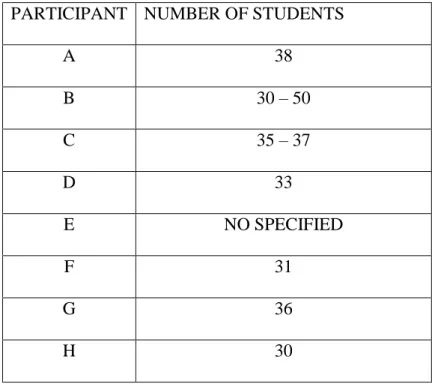
39 According to the interviews, all the participants stated to have large groups composed by 30 students or more.
PARTICIPANT NUMBER OF STUDENTS
A 38
B 30 – 50
C 35 – 37
D 33
E NO SPECIFIED
F 31
G 36
H 30
4.2.1 Rules
The following table shows the results of the first item which was about rules in the class. 7 participants had them for the whole group and only one did not have any.
Item 1 YES NO TOTAL OF
PARTICIPANTS The teacher has
rules for the whole class
7 1 8
Table 4.1 Rules The rules that the participants had were the following;
1 The teacher used words such as “be quiet”, “pay attention” and some others in Spanish like
“guarden silencio” to maintain students’ attention,
40 2. When students had to hand in some activities, the teacher counted until 10 to receive students’ worksheets.
3. To check students’ homework, they had to stand in a queue.
4. Students had to put their water bottles below their tables or chairs so that they did not have any accidents.
5. Students were not allowed to work with other subjects during the English class.
6. Students had to ask for permission to go to the bathroom or anywhere else.
7. Students were not allowed to play with their toys.
8. Students had to raise their hands in order to participate.
9. Students had to sit in their correct place and be quiet.
10. It was not allowed to have food inside the classroom.
11. If students did not do their homework, they had to stand up for 10 minutes.
12. Students always had to bring their own material.
13. Students could not scream in the classroom.
14. Students had to give their worksheets back to the teacher before leaving the classroom.
15. Students could not throw thrash on the floor.
16. Students had to say the word “Finished” in their places just once, so that the teacher could check their activity.
41 17. When the teacher gave students a worksheet, they had to wait for the teacher with their arms folded.
From the 6 teachers that had rules in their class, 2 always followed them (as it can be seen in table 4.2) and 1 usually applied them. Those teachers were constantly repeating students the rules established. However, 3 rarely applied the rules that were established since the beginning of the course and 2 never applied them probably because they forgot them since they had too many students. It was observed that each student wanted to have individual attention and therefore the teachers lost the control of the rest of the group.
Item 2 Always Usually Sometimes Rarely Never Total
The teacher applies the established rules.
2 1 0 3 2 8
Table 4.2 Application of rules 4.2.2 Program to control large groups
None of the participants seemed to use specific programs to manage and control large groups;
also the school did not give any kind of training about it.
Item 3 Always Usually Sometimes Rarely Never Total
The teacher uses a program to manage the group
0 0 0 0 8 8
Table 4.3 Program to control large groups 4.2.3 Values in the classroom
From the 7 participants that fostered values inside the classroom, 2 usually fostered values such as collaborative work, to help and respect their classmates and one teacher did not let students say bad words.3 sometimes encouraged values such as tolerance and help the weakest students. However,2 rarely incited values; for example, to share their material when
42 other students did not take their own school supplies. On the other hand, there were cases where students did not respect the teacher. Finally,1 never encouraged values. She allowed students to make fun of others when something wrong happened to them, besides students screamed, hit each other and chatted with their partners.
Item 4 Always Usually Sometimes Rarely Never Total
The teacher fosters values 0 2 3 2 1 8
Table 4.4 Values in the classroom 4.2.4 Disciplinary interventions
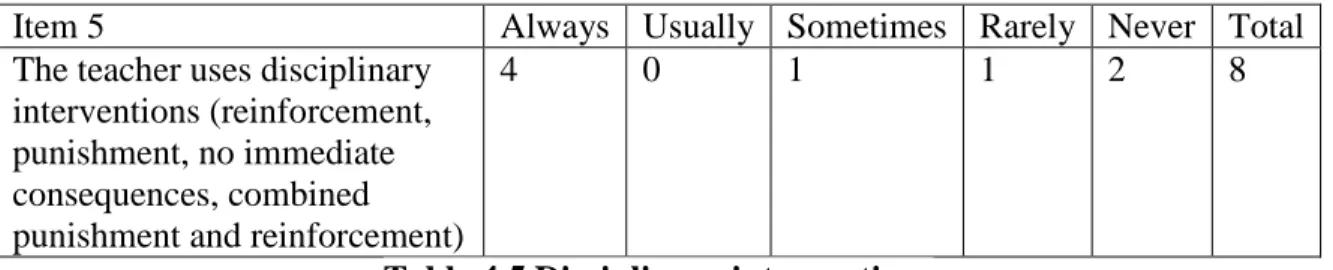
4 teachers always used disciplinary interventions, 1 teacher sometimes used them when students were talking or making noise, in that case, the teacher just called their attention once and it was enough to control them.1 rarely used them. When students were doing an activity and they did not finish it quickly, she gave 5 minutes more and changed the activity. Finally, 2 participants never used them; the first one because it seemed that the teacher did not have authority in front of the group. Students just paid attention to the teacher in charge of the group and not to the English teacher. On the other hand, the second teacher had a good relationship with students, so it was not necessary to use disciplinary interventions.
Item 5 Always Usually Sometimes Rarely Never Total
The teacher uses disciplinary interventions (reinforcement, punishment, no immediate consequences, combined punishment and reinforcement)
4 0 1 1 2 8
Table 4.5 Disciplinary interventions
From the 6 participants that used disciplinary interventions, 4 always used the following:
SITUATION DISCIPLINARY INTERVENTION
When students were doing an exam It was not permitted to cheat. Otherwise, the grade would be divided.
43 The teacher will immediately throw the exams away if students did not write their names on it.
If students were playing, talking or making noise
The teacher used phrases such as “be quiet”,
“sit down”, “pay attention”, “stop playing”
in English and in Spanish.
The teacher made students pick up the trash.
The teacher took students out of the classroom.
If students brought toys to the class The teacher took them away.
If students were talking to others The teacher came closer to ask them if they had already finished their work. Otherwise, he/she would hurry them.
when students were playing or making noise
The teacher raised his/her voice or mentioned specific names.
If students did not bring school supplies The teacher called their attention in front the class and she asked them to work standing up all the time.
Table. 4.6 Interviews Disciplinary interventions
In transcript 5 the P.S.T. mentioned: “they are very noisy and talkative, so I always have to sit them” (T5, L4).
4.2.5 Classroom conditions
From the 7 participants, 2 usually had the right conditions to give the English class: the classroom size was enough for the small kids, the lights were good in the room, the white and green boards and the tape recorder were in excellent conditions, the furniture was adequate, and there was a good space between the tables to walk around the classroom. 2 sometimes had favorable conditions: the chairs and tables were fine, but the space was limited to walk around or to stand up frequently, the lights were not perfect because just one light worked and the other needed to be fixed, the size of the classroom was regular, the length was good but the width was very reduced for them. 3 rarely had the right conditions: the classroom was small, one light did not work, the space between rows was limited, the chairs and tables were in good conditions but they were very close to each other; for that reason,
44 they could not move them. In addition, the conditions inside the classroom was nice because the windows were opened. Finally,1 never had the right conditions because the size of the classrooms was too small, students were sitting very close to each other, the classroom was dark, and the conditions of the room was too hot even with the fans working.
Item 6 Always Usually Sometimes Rarely Never Total
The classroom conditions are favorable to give the class
0 2 2 3 1 8
Table 4.7 Classroom conditions 4.2.6 Lesson plans
Item 7 Always Usually Sometimes Rarely Never Total
The teacher uses lesson plans to plan the class.
1 0 0 1 6 8
Table 4.8 Lesson plans
It is surprising that 6 participants never planned their lesson; as a consequence:
1. There was a lack of organization in each activity,
2. The teachers did not use time in a correct way and some others spent too much time working in certain activities.
3. The teachers spent all the class administering an exam to students.
From the 2 participants that used a lesson plan for their classes, 1 always planned his class, so it seemed his class was well-structured and worked using the correct material at the right time. Finally, 1 rarely used a lesson plan: she used previous lesson plans as a guide.
According to the interviews, PST A, B, C and H used a warm up. PST D did not mention anything about it, E and F never mentioned the term warm up, but E said she always started her class with the hot potato game and F always started his class with a physical activity, Finally, G said she never used a warm up.
45 4.2.7 Equipment and material
None of the participants used equipment during the observations. It is important to mention that some schools did not have any equipment and some schools had the equipment, but the teachers did not use it.
Item 8 Always Usually Sometimes Rarely Never Total
The teacher uses equipment in the group.
0 0 0 0 8 8
Table 4.9 Equipment
In the interview PST C, F and H did not have any equipment in the classroom, PST H mentioned that he wished he had specific equipment: “I don’t have a good equipment but I would like to have a DVD, a scanner and a computer” (T8, L14). PST A and D used computer programs. Finally, PST G took her own speakers to work: “In this school we don’t have a recorder so, sometimes I take with me speakers and I use them to sing a song; for example, the alphabet, or something like that” (T7, L13).
From the 7 participants that used designed material, PST A, E and H always used it: as a new activity PST E brought material to students such as magazines or ads in order to cut them and work with that; PST A used different worksheets to do activities such as cutting, drawing, pasting and coloring; PST G brought several materials made by hand; for example, strips of rush paper or pieces of cardboard. 4 usually used the following material: designed exams, flashcards, posters or worksheets for each student. It is necessary to mention that some of this material looked very expensive and well done. However, PST F 1 never used designed material; he just used the board, markers, an eraser and students’ notebooks.
46
Item 9 Always Usually Sometimes Rarely Never Total
The teacher uses designed material for the class
3 4 0 0 1 8
Table 4.10 Designed material
In the interviews, PST A mentioned “I always use flashcards, but in some cases, I use the enciclomedia and I also use dice” (T1, L19). On the other hand, PST B mentioned “For example, it depends on the activity, I usually use flashcards, and also worksheets according to the activity that I am using. In this case I administered a quiz so I needed worksheets” (T2, L19).
According to the interviews all the participants used flashcards; PST B,C, E, F,G and H used worksheets; PST C, G and H used the blackboard and markers; PST A used enciclomedia and dice; PST B worked with quizzes; PST D used drawings, the computer and songs; PST E used balloons and students’ notebooks; PST G used photocopies. Finally, PST H used posters.
4.2.8 Group and individual work
From the 2 participants that promoted group work, 1 always did it because the teacher applied several activities in teams of 4 or in pairs without asking students to move, 1 usually did it because students were already sitting in teams since the beginning of the class as a strategy of the teacher. However, 6 never promoted group work: students were already sitting in pairs or teams but the work was individual because students were talking and they were restless during the whole class. Another reason was the classroom size; this did not let students move.
We observed that teachers believed that students worked better in an individual way so that they had more control of the group.