BENEMÉRITA UNIVERSIDAD AUTÓNOMA DE PUEBLA
FACULTAD DE LENGUAS
LICENCIATURA EN LA ENSEÑANZA DEL INGLÉS
EXPLORING SENIOR CITIZENS´ INSIGHTS ABOUT LEARNING ENGLISH AS A FOREIGN LANGUAGE
TESIS PARA OBTENER EL GRADO DE: LICENCIATURA
FECHA: NOVIEMBRE 2020
PRESENTA: ANDREA CONDE JUÁREZ
DIRECTOR DE TESIS: DRA. TERESA A. CASTINEIRA BENÍTEZ
ASESORES: DRA ELIZABETH FLORES SALGADO
DR. MICHAEL T. WITTEN
Acknowledgements
I would like to express my gratitude to Dr. Teresa Aurora Castineira Benítez who has been a great support and guide to the development and accomplishment of this investigation, Thanks also to Dra Elizabeth Flores Salgado and Dr. Michael T. Witten for their comments, and advice during my courses at the B.A.
My deepest appreciation goes to my parents, Leonor and Miguel, for their encouragement and words of wisdom, without their guidance, support and patience this work would not have been possible.
Abstract
This study aims to explore seven senior citizens’ insights toward learning English as a Foreign Language (EFL) in central México. The purpose is to identify their beliefs, attitudes and experiences about EFL. I specifically compare in detail senior citizens’ insights who did not have the opportunity to receive basic formal education with those who did.
The paper aims to answer the following research questions:
1. What are senior citizens’ perceptions toward learning EFL?
2. How are senior citizens’ emotional dispositions towards learning EFL expressed according to the Appraisal framework?
Following the qualitative paradigm, this is a case study (Creswell, 2009), where historical and cultural contexts that people inhabit are explored and interpreted to capture the complexity of the problem (Ibid. 2009). To enlighten the interpretation of the data the Appraisal System (Martin & White, 2005) has been chosen as an analytical tool. The affect sub-system is used to classify participants’ perceptions toward EFL under the categories:
dis/inclination, un/happiness, dis/satisfaction and in/security.
This investigation was carried out in two different contexts; a retirement house in the center of the city of Puebla and four private houses. There were eight participants, five female and three male senior citizens. Their age ranged between sixty-two to eighty-one years old.
The instrument used to collect the data was a semi-structured interview. This interview was administered in Spanish and then translated, explored and examined in terms of the Appraisal System.
Findings suggest that both groups of participants hold similar positive perceptions toward learning EFL. In regards to the Appraisal System, significant findings are illustrated between schooled and non-schooled participants. This study also provides other insights into the relevance of giving voice to senior citizens in general educational contexts and revising EFL adult-programs.
Table of Contents
Chapter 1: Introduction
1 Introduction 1.1 Statement of the problem
1.2 Justification 1.3 Research questions 1.4 Objective
1.5 Significance of the study 1.6 Conclusion
Chapter 2: Literature Review 2 Chapter overview
2.1 English Language Teaching and the age factor 2.2 Who is a Senior Citizen?
2.3 Andragogy 2.3.1 Gerontology
2.3.1.1 Critical Gerontology
2.3.1.2 Critical Educational Gerontology 2.3.2 Geragogy
2.3.2.1 Critical Geragogy
2.4 The Critical Period Hypothesis 2.5 Systemic Functional Linguistics 2.5.1 The Appraisal System
Page 1 2 2 3 3 3 4
5
5 6 6 8 8 9 10 10 11 11
12 14
2.5.2 Appraisal’s three interacting domains.
2.5.3 The Affect Sub-system Chapter 3: Methodology 3 Chapter overview 3.1 Methodology 3.2 Research approach 3.3 Research settings 3.4 Participants 3.5 Instrument
3.6 Data collection procedure 3.7 Data analysis
Chapter 4: Findings 4 Chapter Overview 4.1 General Findings
4.2 Answer to the first research question 4.3 Answer to the second research question
4.3.1 Schooled participants dispositions toward EFL 4.3.1.1 Alma’s Results
4.3.1.2 Mariana’s Results 4.3.1.3 Camila’s Results 4.3.1.4 Martha’s Results
4.3.2 Individual Results of participants not taking EFL 4.3.2.1 Daniel’s Results
14 16
17 17 17 18 18 20 20
21
24 24 24 27 27 27 28 30 31
32 32 33
4.3.2.2 Angie’s Results 4.3.2.3 Gabriel’s Results 4.3.2.4 Rolando’s Results 4.4 Conclusions
Chapter 5: Conclusion 5.1 Implications
5.2 Limitations of the study 5.3 Directions for further research List of figure and tables
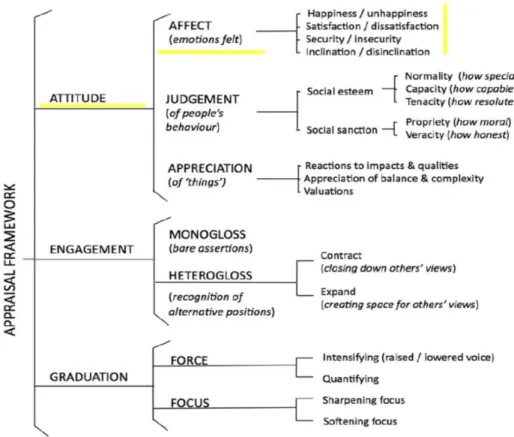
Figure 1 Appraisal framework: Basic semantic systems
Table 1 Martin and White (2005) Analyzing parameters of the Affect Subsystem.
Table 1.1: Summarized categorization of the Affect subsystem.
Table 2: Participant’s 1 analysis on the Affect subsystem.
Table 2.1: Obtained results from the Affect subsystem analysis.
Table 3: Participants’ perspectives about EFL (positive and negative evaluations).
Table 4: Alma’s - qualitative analysis on the Affect subsystem.
Table 4.1: Alma’s - quantitative analysis on the Affect subsystem.
Table 5: Mariana’s - qualitative analysis on the Affect subsystem.
Table 5.1: Mariana’s - quantitative analysis on the Affect subsystem.
Table 6: Camila’s - qualitative analysis on the Affect subsystem.
Table 6.1: Table 5.1: quantitative Analysis on the affect subsystem Table 7: Martha’s - qualitative analysis on the Affect subsystem Table 7.1: Martha’s - quantitative analysis on the Affect subsystem Table 8: Daniel’s - qualitative analysis on the Affect subsystem Table 8.1: Daniel’s - quantitative analysis on the Affect subsystem Table 9: Angie’s - qualitative analysis on the Affect subsystem Table 9.1: Angie’s - quantitative analysis on the Affect subsystem Table 10: Gabriel’s - qualitative analysis on the Affect subsystem
33 34 36 37
40 40 41
Table 10.1: Gabriel’s - quantitative analysis on the Affect subsystem Table 11: Rolando’s - qualitative analysis on the Affect subsystem Table 11.1: Rolando’s - quantitative analysis on the Affect subsystem Table 12: Appraisal resources from participants.
Appendix
I. Instrument - Questionnaire
References
“Education is the most powerful weapon which you can use to change the world. - Mandela, N.”
1. INTRODUCTION
Studies about learning English as a Foreign Language (EFL) have grown during the last decades. However, most studies have focused on the education of children and younger learners (Santibañez, Vernez, & Razquin, 2005). We may even say that learning EFL for the elderly has somehow been neglected; even when formal education helps senior citizens keep involved with the constant changes in society. As Formosa (2002) affirms; “the principles and practices of facilitating learning among older adults remains a relatively under- researched, yet highly significant, area of educational enquiry” (p.73–85).
This exploratory study aims to shed some light on this issue. The research proposes to analyze senior citizens’ perceptions toward learning English as a Foreign Language (EFL) taking into account their beliefs, attitudes and personal background in order to illustrate their experiences. Therefore, EFL learning theories in older adults will be searched too.
Mostly, English teaching pedagogy focuses on children and younger learners (Richards & Farrell 2005, and Nunan, 2011). However, gerontology has become a well- known term in adult and third-age learning. Gerontology comes from greek geron=old man, and refers to the branch of science that deals with aging and the problems of aged persons.
From gerontology the word geragogy is derived; geragogy refers to those teaching and instructional strategies that target learners aged 50 years and older use (Findsen & Formosa 2011).
This study will take the ideas from Formosa (2002, 2011, 2012), Glendenning (1992) and Battersby (1990) about learning and development in older adults.
1.1 Statement of the problem
Education is a field that keeps developing learning theories and methods throughout the years. These topics are meant for people to grow, even more when we talk about EFL, most of these developments are focused on children and teenagers. Education for senior citizens though, is an under-researched topic. Even when now there is an existing term for it, namely gerontology, there is still more information to be found.
Education allows people to be aware of the environment and socio-cultural concerns around us and allows us to be part of a group. But what happens to those whose education is ignored or undervalued? Sometimes this is the case of senior citizens, who have retired or simply become too old to be seen. Indeed, there is an existing social exclusion with this age group.
In response to this problem, my research proposes to give them a voice and to investigate the perspectives that senior citizens have toward learning EFL. The study focuses on two groups of people. One including senior citizens who have already taken some English classes, and another group who have had no access to formal education.
1.2 Justification
There is no doubt that, in contemporary societies, ageism is a powerful discriminatory force and manifests itself as a complex and subtle phenomenon in historical, social, psychological and ideological dimensions that place older people in something that we might even call a
‘culture of silence’ (Freire, 1972). Freire´s view was expressed 46 years ago, unfortunately it still stands true. According to the Consejo Nacional para Prevenir la Discriminación (CONAPRED) in Mexico 7.2% of the population are 65 years or more, and almost half of that percent have experienced different types of discrimination. One of most important forms of discrimination is that of education. This bias applies not only because in the past they had
no access to formal education but also in the present they are not provided with opportunities to do so. This exploratory study aims to give this age group a voice and to analyze their perceptions toward learning EFL taking into account their beliefs, attitudes and personal background in order to illustrate their experiences.
1.3 Research Questions
This project addresses the following research questions.
3. What are senior citizens’ perceptions toward learning EFL?
4. How are senior citizens’ emotional dispositions towards learning EFL expressed according to the Appraisal framework?
1.4 Objective
The objective of this study is to examine the perceptions of senior citizens toward learning EFL. This is a twofold investigation. On the one hand, it seeks to illustrate senior citizens´
aged 60-80 beliefs and perceptions. On the other hand, it aims to compare and contrast formally educated vs non-educated senior citizens emotional dispositions toward learning EFL.
1.5 Significance of the study
Findings of this study may redound to the benefit of senior citizens aged 60-85 in different aspects of their development; social, cultural, educational and health. Findings may also provide a foundation to corroborate or not recent studies about that age experiencing an age- related decline in mental functions, such as attention and memory and, which in some cases, have been seen as the acceleration of the development of Alzheimer's disease or some other form of dementia. Previous research on how bilingualism influences cognitive aging have demonstrated that learning a foreign language can slow the inevitable age-related cognitive decline or perhaps even delay the onset of dementia (Bak, Nissan, Allerhand, & Deary,
2014). Thus, findings in this study may be used to raise awareness of EFL teachers in creating special EFL programs for Senior Citizens, a population that inevitably keeps growing.
1.6 Conclusion
In summary, this paper argues that information about learning a second language is mostly focused on children and teenagers, but left aside older adults. Senior citizens who have been learning a second language have shown remarkable health improvement, there are different benefits when learning a second language at the age of 70 years and ahead, but there have not been sufficient programs or information in Mexico that focuses on them. The main objective of this study is to give voice to this group of population, to pay attention to what they believe, and how their perspectives have changed throughout the years of their lives.
Future research on this issue may be devoted to the development of English programs for Senior Citizens.
CHAPTER 2. LITERATURE REVIEW
2 Chapter overview
In this chapter, the most relevant theories about the development of senior citizens are included. Terms about the cognitive, psychological and physical changes of this population are also discussed. Educational recent studies about senior citizens and their effects on aging are incorporated too. Finally, a brief explanation of the Systemic Functional Linguistics and especially the Appraisal System are presented since they constitute the tools and methodology of this study.
2.1 English Language Teaching and the age factor
English language teaching demands a series of strategies and methodologies focused on different ages, the learning process of a child is very different from adults and from senior citizens therefore different theories and methodologies have emerged, some of them will be further explained.
Teaching EFL to senior citizens includes a set of benefits both for the teacher and for the students themselves. For a teacher, it is certainly a challenge, in the sense that senior citizens have rich life experiences and they bring them all into the classroom. These experiences offer different ideas and opinions on a wide range of areas where the teacher may become a learner himself.
Furthermore, senior citizens may not usually want to study to obtain a certificate or qualification, this makes teaching even more motivational. Senior citizens may want to study only to socialize, enjoy or become active again. This provides teachers with a great advantage to succeed language teaching (Findsen & Formosa, 2011).
2.2 Who is a Senior Citizen?
According to the Cambridge Dictionary a “Senior Citizen” is an older person, usually over the age of 60 or 65, specifically one who is no longer employed. The UN established the age of 60 to consider someone as “Senior Citizen”. In Mexico the recognized age of a senior citizen is 60 years old. Since most senior citizens can no longer endure long work hours, they usually receive financial support from the government and economic discounts and benefits in several establishments.
According to an article in the Mexico News Daily (2015) called “An aging population with limited services”, the population aged 60 years or more has increased a 118%
since 1990. In a report from the National Institute of Geography and Statistics (Instituto Nacional de Estadística y Geografía- INEGI) there are now 12 million senior citizens in Mexico and it is estimated that by 2030 there could be as many as 20 million. This age group will continue to increase and their situation now is not very adequate.
As reported in an article from the Instituto Nacional de Educación Para los Adultos (INEA, 2018) most senior citizens in Mexico are illiterate, making a distinction amongst women with a 26%. This issue, makes the opportunity of learning a second language in formal institutions almost impossible. Even when nowadays there are government programs that include academic courses including EFL for all types of population, unfortunately only a few are at reach. EFL has shown to have mental benefits in senior citizens (Vitman,, Iecovich, & Alfasi, 2013, p. 177) which most people are not aware of, therefore we need to inform more people about the effects that EFL has in senior citizen’s lives.
2.3 Andragogy
The term “Andragogy” was first coined in 1833 by a German teacher named Alexander Kapp who used it as a description of Plato, the Greek philosopher (Peltz & Clemons, 2019). The
term was introduced to North America by Malcolm Knowles in 1968 as "a new label and a new technology" distinguishing adult learning from children's learning or pedagogy. The word comes from the greek andr meaning “man”, and agogos meaning “leader of” giving as a result “leading man”. Knowles (1970) defines andragogy in a very illustrative form as “the art and science of helping adults learn”.
Knowles (1978) provided five main assumptions that differentiate andragogy from pedagogy. These are:
• Self-concept: as a person matures her/his self concept moves from one of being a dependent personality toward one of being a self-directed human being.
• Experience: as a person matures s/he accumulates a growing reservoir of experience that becomes an increasing resource for learning.
• Readiness to learn: as a person matures his readiness to learn becomes oriented increasingly to the developmental tasks of his social roles.
• Orientation to learning: as a person matures his time perspective changes from one of postponed application of knowledge to immediacy of application, and accordingly his orientation toward learning shifts from one of subject- centeredness to one of problem centeredness.
• Motivation to learn: as a person matures the motivation to learn is internal. (Ibid.
p. 53-7).
Knowles later (1984) emphasizes that adults are self-directed and expect to take responsibility for decisions. He suggested 4 principles that are applied to adult learning, these principles state that their personal background, current activities, motivation, and their involvement in the planning and evaluation of their instruction need to be taken into account
in order to have a significant learning,
Knowles is also known as “The Father of Andragogy” due to all of the research he provided to this term, which I conclude is essential to mention in order to understand better the learning process of older adults.
2.3.1 Gerontology
Aging is an inevitable human process that we will experience eventually. It is a phenomenon that generates changes in our society. Gerontology, from the Greek geron, meaning "old man" and logia, "study of” is the study of the social, cultural, psychological, cognitive, and biological aspects of aging. Many people confuse gerontology with geriatrics. Whereas geriatrics focuses strictly on the medical conditions and disease of the aging, gerontology is a multidisciplinary study that deals with multi-faceted aspects of aging.
According to Kastebaum (1995) gerontology includes scientific studies associated with aging from the perspective of the humanities. It is from gerontology that a variety of specific branches emerged, such as Critical Gerontology, Critical Educational Gerontology, Geragogy, and Critical Geragogy, these will be further explained.
2.3.1.1 Critical Gerontology
Critical Gerontology is an analytical approach to Gerontology. While traditional gerontology defends a multidisciplinary theoretical view based on aging, the critical version of this discipline proposes a different and active consideration of the elderly whose action is part of a socio-political context (Findsen & Formosa, 2011).
In Robert Ranzijn’s (n.d) article about Critical Gerontology, he explains that -
“Critical gerontology argues that aging is a social construction—it is society’s attitudes, stereotypes, and social structures, which are largely designed to best serve the interests of healthy younger people belonging to the dominant culture in society, rather than individual
attributes of older people, that create the difficulties and disabilities associated with aging”
(p.1). Therefore, Critical Gerontology takes a sociological approach and argues that the problems in ageism are due to the context in which older people develop and not aging per se. This notion becomes relevant when discussing issues of formal learning for senior citizens.
2.3.1.2 Critical Educational Gerontology
Critical Educational Gerontology (CEG) can be traced back to Allman’s (1984) book about later life learning. He claims that the quality of life of an older adult could improve reasonably if a liberatory education were given to them. This means that older learners would be able to develop critical thinking skills, including reflecting and acting on social problems as well.
This liberatory education’s goal is to generate critical awareness, which guides learners toward more ethical personal choices and, consequently, participation in social movements pushing for wider cultural and political transformations (Formosa, 2011).
Additionally, Glandenning and Battersby’s (1990) argue that most of older adult education is based upon erroneous taken-for-granted assumptions. These assumptions develop into biased social interactions and are recognized as the dominance of the psychological ‘deficit’ model of older adults’ learning abilities, assuming that any type of education is emancipating and empowering, an uncritical stance on the program’s aims and purposes, disregarding the program´s inherent bourgeois bias, overlooking the diverse degree of marginalization amongst older persons and assuming that older adult education is exercised in the interests of older people.
Later on the authors contributed CEG with four major principles (Battersby &
Glendenning, 1992; Glendenning, 1992). These included:
• An exploration of how the relationship between capitalism and aging influences
the concept and practice of education in later life.
• A critique of the dominant liberal tradition that involves a negation that education for older persons is essentially a neutral uncontested enterprise.
• The inclusion of concepts such as emancipation, empowerment, transformation, social and hegemonical control and what Freire calls ‘conscientization’.
• Developing ‘the notion of praxis’ to establish a ‘critical geragogy’ which leads older people to greater control over their own knowledge and thoughts.
Formosa (2011) renewed the definition of CEG as being concerned with the centrality of politics and powers in the way that late-life education works, with its ultimate goal being the empowerment of older persons to confront the social system with a view to changing it.
2.3.2 Geragogy
The term Geragogy had an important participation in John’s Teaching and loving the elderly (1983) and Geragogy: A theory for teaching the elderly (1988) which argued, “geragogy deals with unique instructional considerations that related to teaching the elderly” (Ibid.p.13).
Therefore, Geragogy refers to the practical teaching strategies employed in older adult education and has become a well-known term applied to teaching and learning in later life (Formosa, 2012).
Battersby (1987) conceptualized the practice of geragogy as teaching and learning as a collective activity, as well as assuming a liberating and transforming notion which endorses principles of collectivity and dialogue as central to learning and teaching. Therefore typical classroom activities will not have a successful effect in older adults. Considerations about life experience, motivation and social activity inclusion need to be taken into account
in classroom techniques.
2.3.2.1 Critical Geragogy
Critical Geragogy emerged as part of the field of CEG. According to Glendenning &
Battersby (1990) Critical geragogy consists ‘of the practical articulation of the principles of critical educational gerontology’, and recognizes that “education is not a neutral enterprise and that it involves moral and ethical dimensions” (p. 228).
Formosa (2002) proposed the first set of concrete principles for critical geragogy (CG) which state that CG must embrace older adults to become autonomous and able to make choices from their own perspective. “CG embraces an autonomous older adult education and it must enable older adult education to take the role of a ‘progressive’ movement by engaging in counter-hegemonic activities” (p. 79-82).
According to these principles, education for older adults requires a strong commitment between the educator and the learners. The teaching approaches used in a classroom with older adults are not just any type of teaching approaches. In order to make of older learners more critical it has to be a liberatory education, “educators should embrace a liberating practice that helps learners to perceive social, political, and economic contradictions” (Formosa, 2002, p. 8). This liberation must include first and at least the awareness to the elderly rights.
2.4 The Critical Period Hypothesis
Age has been seen as one of the most important factors in Second Language Aquisition in general because of its importance in assuring the success that a learner has in the process.
Due to this, an important hypothesis that explains the role that age plays when learning a L2 emerged, this is the Critical Period Hypothesis (CPH).
Lenneberg (1967) was one of the first pioneers in the research about age affecting the
L2 learning process. He suggested that there is a critical age in which a L2 can be acquired more easily. According to his studies, the adequate age is from 2-12/13 years old. He believed that when puberty arrived the brain would reach its maturation, meaning that the left hemisphere (Broca’s area) of the brain is no longer able to acquire a language. This idea may explain why adults and older adults may need more time and effort compared to children in second language learning (Lenneberg, 1967).
Therefore, according to Lenneberg learning a L2 from 2 years old until puberty would be a success. However, after puberty there would be a decline in the brain that would prevent learning a L2 to a native like level. On the other hand, the research presented by Lenneberg was from children recovering from aphasia, thus the results he got were from a not so ordinary context. Soon after there were researchers reaffirming the idea that of course there was a critical period in which learning a L2 would be more difficult but not impossible.
According to more recent studies we may need to look into many more factors when talking about learning a L2. Especially when discussing the issue of L2 for people 50 years old and ahead, features such as the context, motivation, time and life experiences among others need to be taken into account.
By illustrating some senior citizens´ perceptions about EFL, the present study aims to contribute to the concept of CPH too. Perhaps by exposing their perceptions and experiences, our idea about an ideal age for learning a L2 may vary.
2.5 Systemic Functional Linguistics
Systemic-Functional Linguistics (SFL) was developed by M.A.K. Halliday during the 1960’s in the United Kingdom and later in Australia, influenced by the work of the Prague School and British linguist J.R. Firth. SFL is a theory that places the function of language as central
(what language does, and how it does it). SFL views language as a social semiotic resource in a social context, it is concerned with text structure, function and meaning of language.
SFL involves the idea that language consists of a set of systems, which offer unlimited ways of creating meanings (Bloor & Bloor, 2004). This variety of choices are taken within a specific context which gives entrance to a system network. Eggins (2004) in her book An Introduction to Systemic Functional Linguistics lists four main theoretical claims about language use; it is functional, semantic, contextual and semiotic. SFL is concerned with how people use language and how it is structured for use in a social context (Matthiessen &
Halliday, 2014).
SFL analyzes text as a piece of language in use, its length is not important and it can be written or spoken, and it has to be directly related to an appropriate set of meaning. Context gives a text texture, which is its coherence and structure, which refers to the elements that fulfill the purpose and context. There are always two contexts in a text, the context of culture, described as all the possible outcomes of meanings in a particular culture, and when language is used in specific contexts and situations that is the context of situation (Butt, Fahey, Feez, Spinks, & Yallop, 2003).
To classify or interpret language forms SFL considers three aspects or parameters;
FIELD, TENOR, and MODE OF DISCOURSE. Field refers to what is to be talked or written about; tenor refers to the relationship between the speaker and hearer or writer and reader and mode refers to the kind of text that is made. These parameters affect our language choices because they reflect the three main functions of language. In Halliday and Matthiessen’s book An introduction to functional grammar (2014) they propose three metafunctions:
• IDEATIONAL that refers to uses of language to represent experience and which distinguishes two components, the experiential and the logical.
• INTERPERSONAL that deals with negotiating social relations; it uses language to express ideas about obligation, inclination and attitudes.
• TEXTUAL that deals with cohesion and how the text makes sense. This means that a text need to be organized into a coherent whole. This way, writers and speakers need to keep the message receiver of “where they are and where they are going” (Butt, et. al., 2003, p.134)
When analyzing discourse, these three metafunctions will be found. This sets of meanings are known as discourse systems. In Martin and Rose’s (2003) book “Working with discourse” they propose five key sets of resources for making meanings as text. One of these sets is the Appraisal System. This system has been chosen to analyze the discourse presented by the participants in this study, this system is explained below.
2.5.1 The Appraisal System
Appraisal is an extension of SFL, it is an interpersonal system at the level of discourse semantics. Appraisal deals with linguistic resources in which writers or speakers express, more particularly with the language of evaluation, attitude and emotion (Martin & White, 2005) their insights. It explores how “attitudes, judgments and emotive responses are explicitly presented in texts and how they are indirectly implied” (Martin & White, 2005, p.
35). This qualitative study bases on this system’s guidelines in order to analyze participants’
attitude toward learning EFL.
2.5.2 Appraisal’s three interacting domains.
Appraisal has three interacting domains, which make possible the mapping of feelings in discourse: Attitude, Engagement and Graduation. Attitude is concerned with our feelings, including emotional reactions, judgments of behavior and evaluation of things. Engagement
deals with sourcing attitudes and the play of voices around opinions in discourse. Graduation attends to grading phenomena whereby feelings are amplified and categories blurred (Martin
& White, 2005 p. 35).
Each of the interacting domains counts with a set of systems and each system has sub-systems. Fig. 1 is a summary of the categorization that Martin & White (2005) propose in their book Language of Evaluation. One of the concerns of this research is to illustrate the emotional dispositions participants express toward learning EFL. Therefore, from Appraisal’s three interacting domains the one chosen for this study was that of attitude domain. From this domain the Affect sub-system was used to categorize participants´
discourse, as highlighted in Fig. 1.
Figure 1: Appraisal framework: Based on Martin & White (2005)
2.5.3 The Affect Sub-system
The Affect sub-system is concerned with emotions, it classifies them by using a system of opposition. This means that emotions can be expressed from a positive or negative disposition (White, 2005). Martin and White (2005) map out 4 groups of variables to classify emotions with a system of oppositions, these are the following:
* DIS/INCLINATION – deals with desiderative and emotive mental processes, the negative form of this process is fear, and the positive is desire.
* UN/HAPPINESS - this variable covers emotions concerned with “the affairs of the heart”
– sadness, hate, happiness and love, it basically involves the moods of feeling happy or sad, and possibly directing these feelings at a trigger by liking or disliking it.
* DIS/SATISFACTION - this variable deals with feelings of achievement and frustration in relation to the activities in which we are engaged, in stereotypically gendered communities these feelings are associated with “fathering” and mentoring in general tuned to learning and accomplishment.
* IN/SECURITY - this variable covers feelings of peace and anxiety in relation to our context, such as anxiety, fear, confidence and trust, the feelings are associated with
“mothering” in the home related to protection.
From the data gathered in this research, the Affect sub-system was the most suitable to analyze participants’ responses considering that they expressed emotions and feelings covering the categorizations mentioned above.
discourse was analyzed based on the theoretical background of the Appraisal System which is an extension of SFL.
The following chapters will explain this study’s methodology and will show how the Appraisal System was used to analyze the data gathered from the participant’s response
CHAPTER 3 METHODOLOGY 3. Chapter Overview
This chapter aims to provide a description of the methodology that this study followed, information about the research approach is detailed as well as the instrument used to gather the data. The research setting where this study took place is described, along with a detailed description of the participants. The last part concerns the data collection procedure and the data analysis process.
3.1 Methodology
The methodology in this study seeks an understanding of phenomena from individual’s perspective, investigating interaction among individuals as well as the historical and cultural contexts that people inhabit, therefore, this is a qualitative study (Creswell, 2009). The purpose of this research is to analyze the perspectives of senior citizens toward learning English as a foreign language.
The study aims to investigate how participants perceive our society has included/excluded their age group in second language learning. Qualitative research intents to develop theories when partial or inadequate theories exist for certain populations and samples or existing theories do not adequately capture the complexity of the problem we are examining. This can only be established by talking directly with people, going to their homes or places of work and allowing them to tell stories unencumbered by what we expect to find or what we have read in the literature (Creswell, 2007).
3.2 Research Approach
This research specifically follows a case study development, which Yin (1984, p.23) defines as “an empirical inquiry that investigates a contemporary phenomenon within its real-life context; when the boundaries between phenomenon and context are not clearly evident; and
in which multiple sources of evidence are used”.
A case study is a qualitative research approach in which the investigator explores a real-life, a case or multiple cases over time, through detailed, in-depth data collection involving multiple sources of information (e.g., observations, interviews, audiovisual material, and documents and reports) (Cresswell, 2007). In order to gather the data this research used a semi-formal interview and the Appraisal System was used as an analytical tool to examine participants’ responses.
3.3 Research Setting
The context of this research was located in two different settings. The first one was La Casa del Jubilado of the Benemérita Universidad Autónoma de Puebla (BUAP), a space created by the BUAP for the retired teachers of the university. This house was inaugurated on January the 1st 2008. The main objective of this space is to ensure the human development of older adults, especially teachers. This place tends to provide this sector with jobs or occupations, fair remunerations, assistance and opportunities meant to reach a certain level of well-ness and a high life quality. The services this institution offers to its users, (faculty and administrative retired staff), is to provide orientation and training in health matters, nutrition and hygiene, programs that offer job opportunities and cultural, sporting and recreative activities. Such services have as its main interest to help the retirees to upgrade their life quality.
The other setting in which this study took place was in four different private houses.
The location of these four houses was chosen for convenience reasons. These four participants are old acquaintances of the researcher.
3.4 Participants
This project was carried out with eight participants, for this research to identify different
perspectives and different life experiences. Four participants held a formal educational background and are currently taking English classes in La Casa del Jubilado. The other four participants have no formal educational background and are not part of any English course.
These last participants have not had the opportunity to be formally educated and they were friends and old acquaintances. The names of all participants have been changed in order to respect their privacy. There is a specific description of each one of them below.
* Four participants with formal-educational background and taking EFL in La Casa del Jubilado:
1. Alma - A 72-year-old female. She used to work as a secretary, now retired and she has been taking EFL for three years with indefinite gaps.
2. Camila - A 68-year-old female with a Master’s Degree. She is a retired teacher, she has been taking EFL for one year.
3. Mariana - A 62-year-old female with a PhD in Medical Sciences. Her occupation was being a Teacher and Researcher and a General Physician, now retired. She has been taking EFL for 2 months after 5 years.
4. Martha - A 62-year-old female with a Bachelor’s degree in Engineering, now retired. She has been taking EFL for three years with indefinite gaps.
* Four participants not taking EFL and who did not have the chance to have formal education:
1. Daniel - A 79-year-old male who finished elementary school. He worked as a factory worker but now is retired. He has as never taken EFL.
2. Angie - An 81-year-old female who did not finish elementary school, she worked as a house cleaner, now retired. Has never taken EFL.
3. Gabriel - A 66-year-old male who did not finish his bachelor’s degree in Communication Systems. He worked in maintenance and now is retired. He took EFL during secondary
school but he did not have any significant learning as he reports.
4. Rolando - A 66-year-old male who finished elementary school. He is now working in the cleaning service of a museum.
3.5 Instrument
Qualitative research seeks to illustrate perspectives; therefore the case study methodology has been followed here. The instrument to collect the data was a semi-structured interview.
This sort of instrument is best used when the researcher will not get more than one chance to interview someone, “it is also a meeting in which the interviewer does not strictly follow a formalized list of questions” (Bernard, 2000). The semi-structured interview permitted the interviewer to have a wider discussion with the interviewee allowing them to deepen on their answers.
This semi-structured interview for this qualitative research was administered to the eight participants. All interviews were audio recorded and then transcribed. Interviews were explored and analyzed using the critical discourse analysis (Wodak & Meyer, 2001) as an approach and the Appraisal System by Martin and Rose (2005) as an analytical tool.
The semi-structured interview was divided into three parts. The first part was meant to ask for general information, such as participants´ age, educational information, occupation and to identify their educational background. The second part included questions about taking EFL and their reasons. The third part was meant to find out participants´ experiences, and their influence in their present. This instrument may be seen in the Appendix.
3.6 Data Collection procedures
The four interviews administered in La casa del Jubilado were done during two days, two interviews were conducted each day. The other four interviews were administered in four different days each as conveniently arranged with the participants. Interviews took about ten
minutes long. Questions were asked in Spanish, then discourse was transcribed and translated into English for the purpose of this study. Clauses containing expressions of emotions and feelings were separated and examined in the light of the Appraisal System. As this was a semi-structured interview, some of the questions asked to participants varied depending on their responses. (Full transcriptions of these interviews may be provided upon request).
3.7 Data Analysis
The data analysis procedure in this research was based on the Appraisal System framework.
This particular framework illustrates how attitudes, judgments and emotive responses are explicitly presented in texts or speech and how they may be more indirectly implied, presupposed or assumed. As previously explained, the framework is divided into three domains: engagement, attitude, and graduation (See Chapter 2). In this study, participants’
responses were categorized under the ATTITUDE domain that is concerned with “our feelings, including emotional reactions, judgments of behavior and evaluation of things”
(Martin & White, 2005, p. 35) (See Chapter 2).
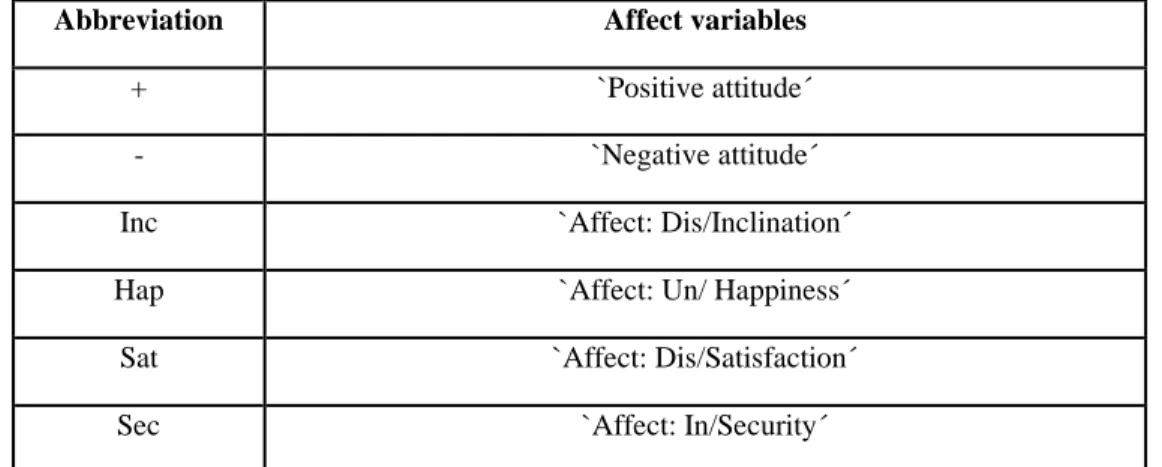
The variables followed were categorized based on Martin and White’s (2005, p.71) parameters represented in the following table:
Abbreviation Affect variables
+ `Positive attitude´
- `Negative attitude´
Inc `Affect: Dis/Inclination´
Hap `Affect: Un/ Happiness´
Sat `Affect: Dis/Satisfaction´
Sec `Affect: In/Security´
Table 1 Martin and White (2005) Analyzing parameters of the Affect Subsystem.
Once the data were gathered, the emotions presented in the participants’ narratives were categorized according to each variable. The results were categorized into charts, which are explained in Chapter 4.
In Martin and Rose (2003) words “The Appraisal framework helps to understand the kinds of attitudes that are negotiated in a text, the strength of the feelings involved and the way in which values are sourced and readers aligned (p. 22)”. In other words, the Appraisal System helps to understand the way people feel about things or people in discourse.
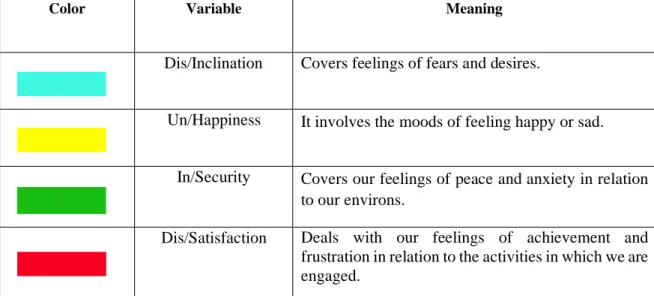
The results from this qualitative study are exemplified in color-coding to differentiate the four variables of the Affect sub/system along with the abbreviation given to each variable (see table 1). The following table seeks to explain the summarized presentation of each category.
Table 2: Summarized categorization of the Affect subsystem.
Color Variable Meaning
Dis/Inclination Covers feelings of fears and desires.
Un/Happiness It involves the moods of feeling happy or sad.
In/Security Covers our feelings of peace and anxiety in relation to our environs.
Dis/Satisfaction Deals with our feelings of achievement and frustration in relation to the activities in which we are engaged.
This chapter explained the methodology used to develop this research, it included the research approach, context, participants, instrument, specific instrument, and a detailed
description of the data collection procedure and analysis. The following chapter presents the findings.
CHAPTER 4 FINDINGS 4. Chapter Overview
This chapter reports the findings of the present study. The first part of the chapter describes de general findings and the second part answers in depth the two research questions posed in Chapter 1.
4.1 General Findings
General findings in this study appear to be contradictory. On the one hand, the schooled group of participants that are taking EFL are aware of the benefits English has in their health;
on the other hand, the non-schooled group of participants not taking EFL consider their age to be an obstacle and an impediment for them to take EFL. This last group also considers that EFL would have had more financial benefits than health benefits.
Additionally, participants´ responses do not show significant positive or negative feelings toward learning EFL, as may have been expected. For example, there were zero expressions of feelings showed by the participants in the HAPPINESS column. A more detailed description of these findings is clarified below.
4.2 Answer to the first research question.
The first research question in this study was: What were senior citizens’ perceptions toward learning EFL. In order to answer this question all participants´ broad responses about learning EFL have been classified into a positive and negative table, showing positive or negative evaluations. The results are the following:
Participant Positive Negative Alma I always wanted to learn English, but I
didn’t have the chance because of life matters, like marriage and children Now that I’m taking it I think that it helps my brain and memory.
Now I am learning English to have more knowledge and I’m trying to keep up.
Mariana Of course English helps a lot!
Mostly to the memory because after 50 years if you don’t make some sort of gymnastics or mnemonics your mind begins to drift away … so you have to push yourself a little or make brain exercises.
There is a cultural barrier with our age group, we struggle a lot … You forget things, it is normal.
Camila For sure, it helps my brain, and I get to have good friendships
I want to keep studying English to be able to travel … I believe that there is not an age limit, taking language classes helps your brain be active and avoids degenerative diseases in the long term.
Teaching us a lot of grammar does not work sometimes for us, because I consider that at our age it should be more practical, and daily, that is my opinion.
Martha I’m learning English to break boundaries, being able to travel some day because my son is abroad … Nowadays, in our country there are several announcements in English, taking this class has helped me a little to be able to understand some of the meanings.
Daniel If I had been able to take an English course in the past it would’ve been for
personal benefit and to earn money for my family.
Angie … and I would have liked to know English in the past because one of my bosses was American
There is no point in taking English at my age because I’m too old, and with whom am I supposed to speak? … I was always working, since I was 6 years old … Gabriel It is important to learn English
nowadays because there are more academic possibilities abroad.
I was never good at English, I took courses and I never learnt. Now I have problems with Parkinson’s, sometimes my brain gets lost.
I think it is difficult … In the past I did not have the economic resources to learn it, and it never caught my attention.
Rolando English is very important for the young people so that they can get better opportunities, also to know other countries and to understand different cultures.
If I had learned English in the past I would have had better financial resources … I lacked of initiative and encouragement from my family to learn it at a young age … I consider that English has more economic benefits than health benefits.
Table 3: Participants’ perspectives about EFL (positive and negative evaluations).
From the table above it can be seen that participants have slightly more positive perspectives than negative toward learning EFL. From the eight participants, seven agreed that it may have benefits for their mental health. According to the article by Sauer, A. (2018) “Why seniors should learn a new language” several studies have confirmed that learning a new language at an older age helps improve the cognitive abilities and improves the aging process in the brain.
4.3 Answer to the second research question.
The second research question in this study was: How are senior citizens’ emotional dispositions towards learning EFL expressed, according to the Appraisal System framework.
In order to answer this question a detailed analysis of participants discourse is presented.
Specifically, the affect sub-system of the Attitude domain was chosen to analyze participants’
emotional dispositions toward learning EFL. Findings in this section are presented in two sections. Section one (4.3.1) illustrates participants from “La Casa del Jubilado”; section 2 (4.3.2) illustrates non-schooled participants discursive analysis.
4.3.1 Schooled participants dispositions toward EFL
In this section the results from the four participants from “La Casa del Jubilado” are analyzed based on the Appraisal System. The discourse of each participant is presented and examined based on Martin & White’s categories mentioned in 3.7.
4.3.1.1. Alma’s Results
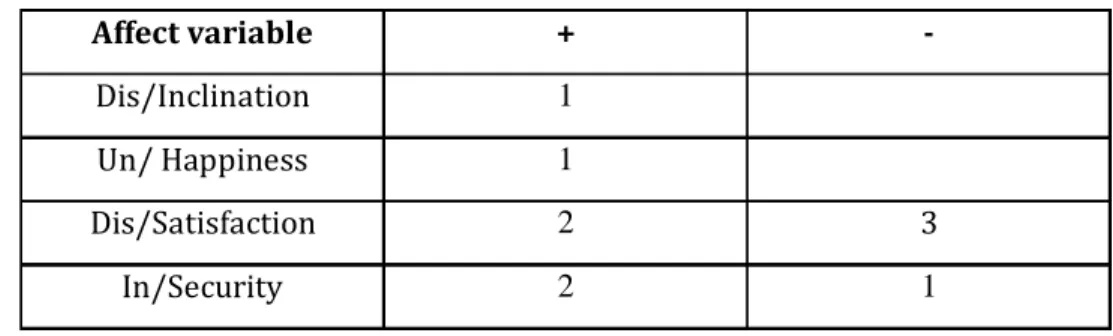
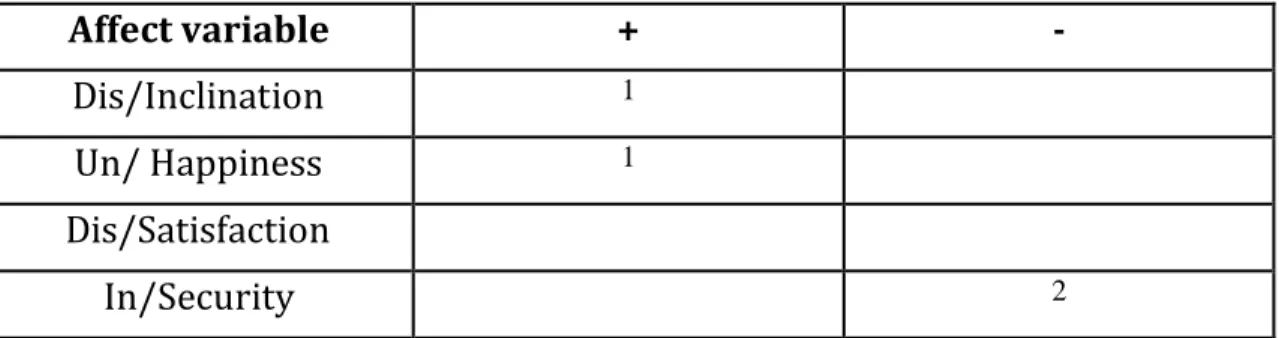
Alma is a 72-year-old student of EFL in “La casa del jubilado”. She has been taking EFL for three years with indefinite gaps, she was a secretary. The excerpts in table 4 exemplify her perspective regarding the topic of learning EFL. A summarized analysis can be seen on table 4.1 and it can be stated that the participant expressed with more positive feelings than negative ones. The most used variable was the +inclination highlighted in blue, meaning that she has a great desire to keep learning EFL. The negative feelings are due to the fact that being married and being a mother made it impossible for her to look after herself and keep learning in the past.
Table 4: Alma’s - qualitative analysis on the affect subsystem.
Table 4.1: Alma’s - quantitative analysis on the affect subsystem.
4.3.1.2 Mariana’s Results
Mariana is a 62-year-old student of EFL in “La casa del jubilado” with a PhD in Medical Sciences. Her occupation was being a Teacher-Researcher and a General Physician. She is now retired. She has been taking EFL for 2 months after 5 years.
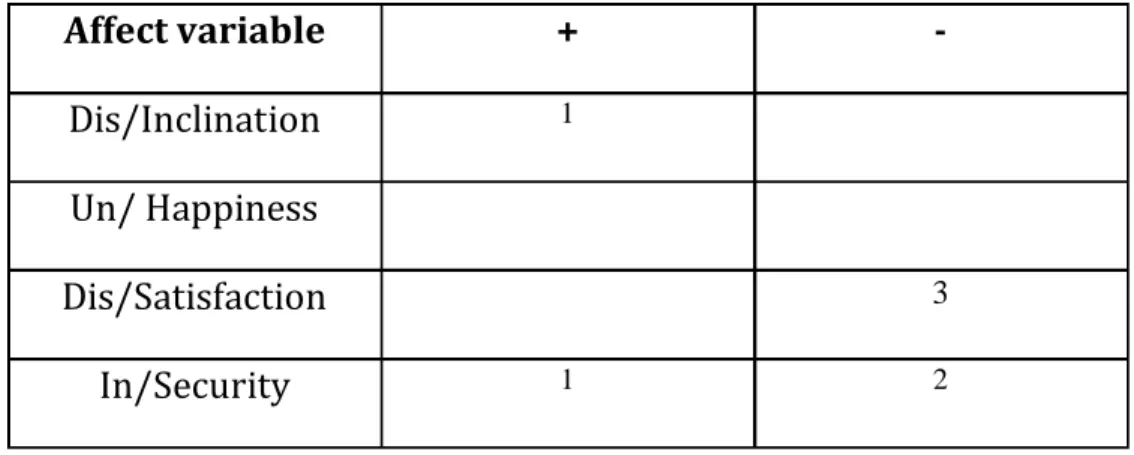
The extract on table 5 exemplifies her perspective regarding learning EFL. A summarized analysis can be seen on table 5.1 and it can be stated that the participant expressed mostly
Spanish
“Siempre tuve el gusto (+inc) por aprender Inglés, pero no tuve la oportunidad (-sat), por cosas de la vida, tanto el casamiento como los hijos.
Ahora que tomó la clase creo que agiliza (+sat) mi mente y memoria. Yo toda la vida he querido (+inc) aprender, pero las mismas actividades de la vida de casada pues ya te vas olvidando de ti (-hap) y nada más te dedicas al hogar y los hijos por eso mismo deja uno de interesarse (-sat) en aprender.
Ahora estoy tomando Inglés para tener (+inc) más conocimientos y estoy tratando (+inc) de llevar el ritmo”
English
“I always wanted (+inc) to learn English, but I didn’t have the chance (-sat) because of life matters, like marriage and children. Now that I’m taking it I think that it helps (+sat) my brain and memory. I’d always wanted (+inc) to learn English, but once you begin with the marriage duties you begin to forget about yourself (-hap) and all you can focus on is on your house and your children, that is why one can lose the interest (-sat) in learning. Now I am learning English to have more knowledge (+inc) and I’m trying (+inc) to keep up.”
Affect variable + -
Dis/Inclination 4
Un/ Happiness 1
Dis/Satisfaction 1 2
In/Security 1
with negative feelings, specifically using the dis-satisfaction variable 4 times and the insecurity variable two times.
Table 5: Mariana’s - qualitative analysis on the affect subsystem.
Table 5.1: Mariana’s - quantitative analysis on the affect subsystem.
English
“ … during university there weren’t English courses and it was elective, then is the economy, you couldn’t afford food or transport.(-sat)Of course English helps!
(+sec) mostly for the memory because after 50 years, if you don’t use it (-sat) your mind begins to drift away
It is not so difficult at a younger age. It’s easier taking it at a younger age than at an older age (-sec)
I certified the exams but when I wanted to speak I stuttered (-sat). In English, there is cultural barrier with our age group, we struggle a lot (-sec) … In the university there should be (+inc) subjects in English.
Spanish
… en la universidad no había Inglés y era optativo y la otra es la economía, no te alcanzaba (-sat) para comida, ni pasajes
¡Claro que el Inglés ayuda! (+sec) sobre todo para la memoria porque después de los 50 años tu mente como que si no la acostumbras (-sat) empieza a perderse.
Desde niños no les cuesta trabajo. Es más fácil tomarlo durante la infancia que en la edad adulta (-sec) … Yo acreditaba los exámenes, pero cuando yo quería hablarlo me trababa (-sat). En el Inglés hay una barrera cultural para nuestra generación, nos cuesta mucho (- sec) … En las licenciaturas debería de haber (+inc) materias que deben ir en Inglés.
Affect variable + -
Dis/Inclination 1
Un/ Happiness
Dis/Satisfaction 3
In/Security 1 2
4.3.1.3 Camila’s Results
Camila is a 68-year-old student of EFL in “La casa del jubilado” she has been taking EFL for one year. She has a Master’s degree and is now retired. The extract on table 6 exemplifies her perspective regarding the topics mentioned in chapter 3. A summarized analysis can be seen on table 6.1 and it can be stated that this participant is very satisfied with her English course due to the brain benefits and the social interaction she has had. Negative emotions expressed by her are due to the methodology that does not work for her group age, as she mentions.
Table 6: Camila’s - qualitative analysis on the affect subsystem.
English
“When I took English I couldn’t (-sat) keep up with my course because of, now that I’m taking it, it helps (+sat) my brain, and I get to have good friendships (+hap) … teaching us a lot of grammar does not work for us (-sat), because I consider that at our age it should be more practical (-sec) … I want to keep studying English to be able to travel (+inc) … I believe that there is not an age limit (+sec), taking language classes helps your brain activity (+sec) and avoids degenerative diseases on a long term and that’s good, I think that everyone or at least everyone who is here want to be healthy and to stay updated (+sat). I think that it is a mistake (-sat) when people do not learn English because it is now a Universal Language.”
Spanish
“Antes tomaba Inglés, pero no pude seguir (-sat) con mi curso por cosas de la vida, pero ahora que pude retomar mis clases me ha servido a agilizar (+sat) mi mente , y tener buenas amistades (+hap) …el saturarnos a veces de gramática no funciona (-sat) a veces para nosotros porque yo pienso que a nuestra edad debe ser (-sec) más práctico
… quiero seguir con el Inglés para poder viajar (+inc) … Yo creo que no hay limitantes de edad (+sec), aprender un idioma te agiliza (+sec) tu actividad mental y te evita enfermedades degenerativas a largo plazo entonces está muy bien yo creo que todo mundo bueno por lo menos los que estamos aquí queremos estar bien (+sat) en todo y estar actualizados. Pienso que es un error (-sat) que la gente no aprenda Inglés porque es un idioma universal”
Table 6.1: Camila’s - quantitative analysis on the affect subsystem
4.3.1.4 Martha’s Results
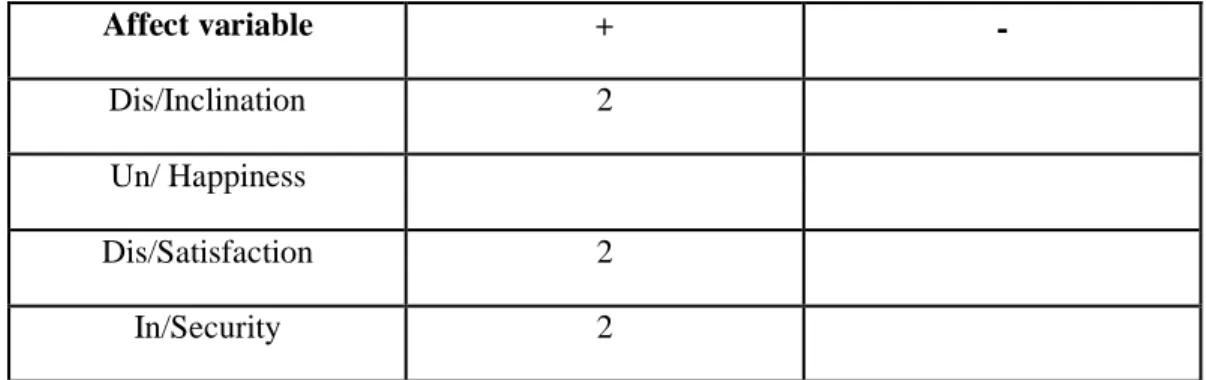
Martha is a 62-year-old student of EFL in “La casa del jubilado” with a Bachelor’s Degree in Engineering, she’s now retired and she has been taking EFL for three years with indefinite gaps. The extract on table 7 exemplifies her perspective regarding the topics mentioned in Chapter 3. A summarized analysis can be seen on table 7.1 and it can be stated that she only expresses with positive emotions. She states that having motivation and need to learn has made it essential for her to take the EFL course, and she considers that the age is never a limiting factor to learn a language.
Table 7: Martha’s - qualitative analysis on the affect subsystem Spanish
“Estoy tomando Inglés para romper fronteras (+inc), poder llegar a (+inc) viajar algún día porque mi hijo está en el extranjero … sí he logrado (+sat) comunicarme con él aunque en ocasiones me hace correcciones desde luego porque él ya lo domina.
Actualmente encontramos en nuestro país diferentes establecimientos que ya tienen su lenguaje en Inglés y tomar la clase me ha ayudado (+sat) a poder entenderlos(+sec) un poco más. Yo creo que no hay una edad límite para aprender, la inteligencia la tenemos simplemente hay que desarrollarla y más si es una necesidad pues se ve uno motivado (+sec)”
English
“I’m learning English to break boundaries (+inc), being able to (+inc) travel some day because my son is abroad
… but I’ve succeeded (+sat) in communicating with him even though in some occasions he corrects me, of course because he already dominates the language.
Nowadays, in our country there are several establishments and announcements in English, taking this class has helped me (+sat) a little to being able to understand (+sec) some of the meanings. I believe there are not age limits to learn a language, we all have the intelligence, we only have to develop it, even more when it is a necessity which is motivating (+sec).”
Affect variable + -
Dis/Inclination 1
Un/ Happiness 1
Dis/Satisfaction 2 3
In/Security 2 1
Table 7.1: Martha’s - quantitative analysis on the affect subsystem
Affect variable + -
Dis/Inclination 2
Un/ Happiness
Dis/Satisfaction 2
In/Security 2
4.3.2 Non-schooled participants dispositions toward EFL
In this section the results from the non-schooled participant are analyzed based on the Appraisal System, these participants are old acquaintances of the researcher. Their perspectives answer questions about what stops them from taking an English course considering their background. Their answers also provide insights about their past life experiences in relation to formal education.
4.3.2.1 Daniel’s Results
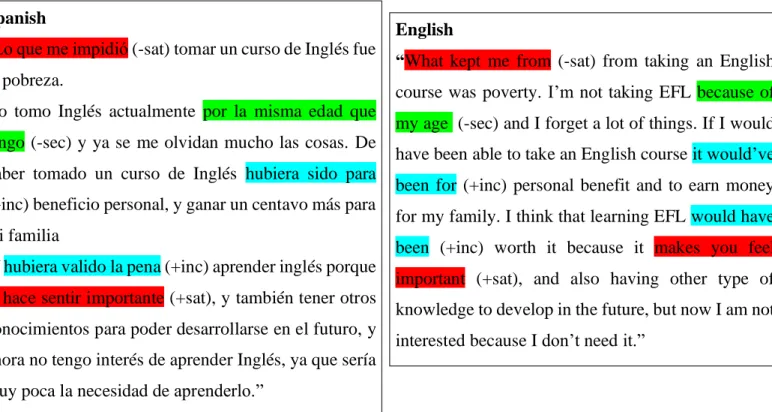
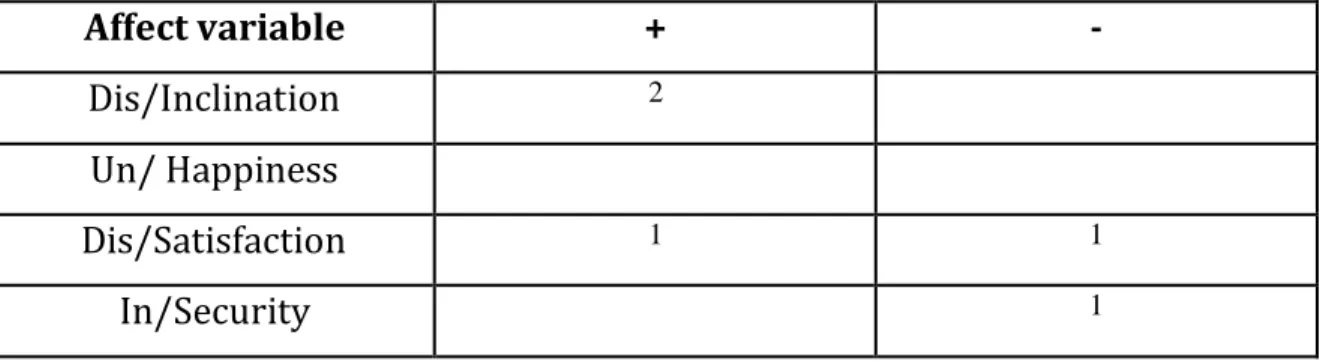
Daniel is a 79-year-old person whose educational background is elementary school and used to work as a factory worker. He has never taken EFL and is now retired. The excerpt on table 8 exemplifies his perspective regarding the topics mentioned in Chapter 3. A summarized analysis can be seen table 8.1. It may seem that Daniel basically perceives economic benefits in learning EFL. He argues that it would have been more beneficial when he was younger to feel “important”. He clearly states that at the moment he does not need it.
Table 8: Daniel’s - qualitative analysis on the affect subsystem
Table 8.1: Daniel’s - quantitative analysis on the affect subsystem.
Affect variable + -
Dis/Inclination 2
Un/ Happiness
Dis/Satisfaction 1 1
In/Security 1
4.3.2.2 Angie’s Results
Angie is an 81-year-old person who did not finish elementary school, she used to work as a house cleaner. She has never taken EFL and is now retired. The excerpts on table 8 exemplify her perspective regarding the topics mentioned in Chapter 3. A summarized analysis can be seen on table 8.1. Angie´s responses suggest that she does not perceive any benefits at the moment. She was a house cleaner, and as such she would have liked to speak it to talk to her Spanish
“Lo que me impidió (-sat) tomar un curso de Inglés fue la pobreza.
No tomo Inglés actualmente por la misma edad que tengo (-sec) y ya se me olvidan mucho las cosas. De haber tomado un curso de Inglés hubiera sido para (+inc) beneficio personal, y ganar un centavo más para mi familia
Sí hubiera valido la pena (+inc) aprender inglés porque te hace sentir importante (+sat), y también tener otros conocimientos para poder desarrollarse en el futuro, y ahora no tengo interés de aprender Inglés, ya que sería muy poca la necesidad de aprenderlo.”
English
“What kept me from (-sat) from taking an English course was poverty. I’m not taking EFL because of my age (-sec) and I forget a lot of things. If I would have been able to take an English course it would’ve been for (+inc) personal benefit and to earn money for my family. I think that learning EFL would have been (+inc) worth it because it makes you feel important (+sat), and also having other type of knowledge to develop in the future, but now I am not interested because I don’t need it.”
boss who was an American woman. She is eighty one and she feels there is no point in learning EFL at her age.
Table 9: Angie’s - qualitative analysis on the affect subsystem
Table 9.1: Angie’s - quantitative analysis on the affect subsystem
Affect variable + -
Dis/Inclination 1
Un/ Happiness 1
Dis/Satisfaction
In/Security 2
4.3.2.3 Gabriel’s Results
Gabriel is a 66-year-old person who did not finish his bachelor’s degree in Communication Systems, he worked in maintenance. He took EFL during secondary school but he did not have a significant learning. He is now Retired. The excerpt on table 10 exemplify his perspective regarding the topics mentioned in Chapter 3. A summarized analysis can be seen on table 10.1. As may be seen, Daniel´s main concern is that he feels learning English was hard for him in the past. However, he also mentions that he was able to translate Spanish
Para mí ya no tiene caso (-sec) aprender Inglés ya que estoy muy grande de edad (-sec) y con quién voy a hablar? … Nunca pensé en estudiar Inglés porque siempre estaba trabajando, desde los 6 años empecé a trabajar pero me hubiese gustado (+inc) aprenderlo porque una de mis jefas era americana.
Me gusta (+hap) oírlo aunque no le entiendo … Es importante aprenderlo ahora que hay más posibilidades
English
“There is no point (-sec) in taking English at my age because I’m too old (-sec), and with whom am I supposed to speak? … I was always working, since I was 6 years old, and I would have liked to (+inc) know English because one of my bosses was American. I like to (+hap) listen to it even though I do not understand it, it is important now to learn it because there are more possibilities”