LEMO students with an advanced level of English can manage the connected speech when they speak something. Do advanced level English students at LEMO have problems with their connected speech?
Definition of Terms
Phonetics: According to Yule (1996, p. 26) “phonetics is the general study of the characteristics of speech sounds. Phonology: Yule (1996, p.42) describes “phonology is essentially the description of the systems and patterns of speech sounds in a language.
Overview of Pronunciation and Teaching
Defining Pronunciation
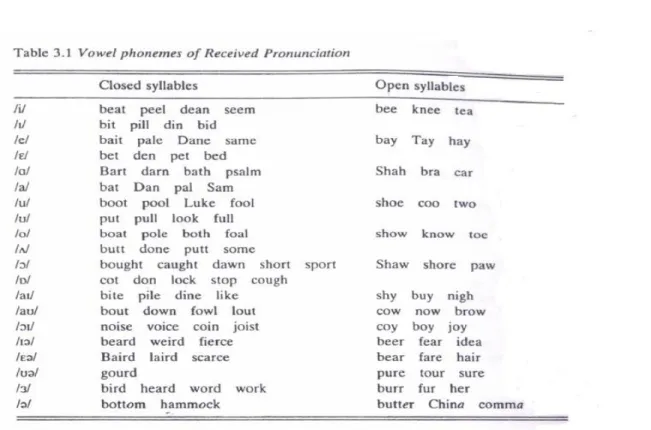
It is essential to review these studies to distinguish the difference between phonetics and phonology, and their importance when learning pronunciation. But nine of them are clearly diphthongs rather than simple vowels, and five are distinctly long (though not necessarily in contrast to short vowels of the same quality)'.
Defining Phonetics
It deals with the ways in which the sounds and prosodic features determined by phonetics are actually used in natural languages. That is why phonology, as opposed to phonetics, is said to deal with the entire system of sounds.
Dimensions of Phonological Description: Segmental & Suprasegmental
- Segmental Aspects of Pronunciation
- Defining phoneme
- Vowels and Diphthongs
- Distinctive Features
- Tongue Height
- Frontness & Backness
- Tenseness & Laxness
- Lip rounding
- Consonants
In fact, it is essential to discuss the main features of the tongue. A vowel in which the back of the tongue is the highest point is called a back vowel".
Place of Articulation
- Manner of Articulation
- Voicing
- Semivowels
- Allophones: Positional Variation
- Allomorphs
This means that the sound is due to vibration of the vocal cords in some sounds. 24 for "small turbulence" of the air flow; so it is a vowel that "almost becomes a consonant." For example, the formation of the correct past tense of English verbs corresponds to the rule of pronouncing the correct plural in terms of grammatical endings.
In a verb, if the final sound of the verb that is in the simple form is pronounced, the grammatical final pronunciation should be pronounced, for example /d/. But if the last sound of the simple form is voiceless, the sound of the ending is voiceless /t/, for example "reduced". Avery and Ehrlich (1992) suggest that if the final sound of a noun is pronounced, the pronunciation of the plural /z/, for example "signs", will be voiced.
When pronouncing a noun where the final sound is voiceless, the pronunciation of the plural will be voiceless, for.
Suprasegmental Aspects of Pronunciation
- Adjustments in Connected Speech
- Linking
- Assimilation
- Elision
- Rhythm
- Intonation
In addition, Hewings and Goldstein (1998, p. 73) claim that "it is sometimes difficult to understand native English speakers when they speak at normal speed, which can sound very fast. Furthermore, Kelly (2000, p. 109) claims, that "the concept of assimilation describes how sounds modify each other when they meet, usually across word boundaries but also within words. Furthermore, Roach (1983, p. 93) argues that "the production of stress is generally thought to depend on the speaker expending more muscle energy than is expended on unstressed syllables".
Roach (1983, p. 134) argues that "the concept of rhythm involves some perceptible event that occurs at regular intervals of time. Furthermore, Riggenbach (2000, p. 6) argues that "the concept of fluency has often been used to describe general foreign language proficiency in the form of "flow", "continuity". Reggenbach (2000, p. 8) affirms that "fluency refers to a series of acoustic-phonetic temporal features in naturally connected speech".
Beardsmore (1974), cited in Reggenbach (2000, p. 8), also confirms that “fluency has been associated with the ability to manipulate connected speech.”
Acquisition, Learning and Teaching of Pronunciation
- Second Language Acquisition
- Factors Involved in L2 Acquisition
- Factors affecting second language acquisition
- Age and the Critical Period Hypothesis
- Input, and Exposure to the Target Language
- Explicit Phonological Instruction
In this section there is a review of some aspects that influence the learning of a second language; these can be external or internal factors. It can therefore be said that attitudinal factors in language acquisition can contribute to an effective second language learning acquisition. He argues that "integrative motivation should encourage the learner to interact with second language (L2) speakers of the second language out of sheer interest, thereby gaining intake.
In other words, the attitude and aptitude can facilitate second language learning; as Krashen S (1981, p. 19) says “it appears both language aptitude (as measured by standard tests) and attitude (affective variables). In this section, some aspects that can affect the learning of phonology will be reviewed to know why a second language is difficult. Aptitude and motivation are some aspects that are also related to second language acquisition.
Gass and Selinker (1994, p. 50) claim that "aptitude is an important factor in explaining differential success in second language learning".
The Mother Tongue and Contrastive Analysis
In addition, Brown (2007, p. 377) claims that “attitude a set of personal feelings, opinions or foundations about races, cultures, ethnic groups, classes of people and languages”. The first element is aptitude, which is related to students' ability to learn another language easily and quickly. The second element is attitude, which is related to students' perspective on cultures, languages, etc.
The contrastive analysis involves making a list of similarities and differences to focus the differences between the first and the second language;.
Focus on Teaching Pronunciation
- Language Teaching Methodology
- Dimensions of Methodology: Approach, Design, Procedure
- Audiolingual
- The Natural approach
- Silent way method
- Suggestopedia
- Total physical response
- Community language learning
That is, the main focus is "(...) training in listening comprehension, accurate pronunciation, recognition of the speech symbols as graphic signs and the ability to produce these symbols in writing" Brooks quoted in Richards, J.C. According to Krashen and Terrell (2000, p. 58) “the main focus of the natural approach is primarily in the acquisition of the ability to communicate messages using the target language. From here, it is important that the teacher provides the students with comprehensible input acquisition, because the teachers can measure the speed and level of the learning development of the target language on the students.
This method aims to teach students "correct pronunciation" and "students learn to learn a language" Brown H. According to Richards and Rodgers (2001, p. 66) "Communicative language teaching is now seen as an approach (and not as a method), which aims to a) make communicative competence the goal of language teaching and b) develop procedures for the teaching of the four language skills that recognize the interdependence of language and communication". In contrast, Littlewood (1981, p.1) says, " one of the most characteristic features of Communicative Language Teaching is that it pays systematic attention to functional as well as structural aspects of the language".
Teachers must move away from traditional teaching techniques and materials because the role of the teacher is that of a consultant and the students are the “clients” and there must be a relationship and interaction between teacher and student.
Methodology
Participants
Instrument
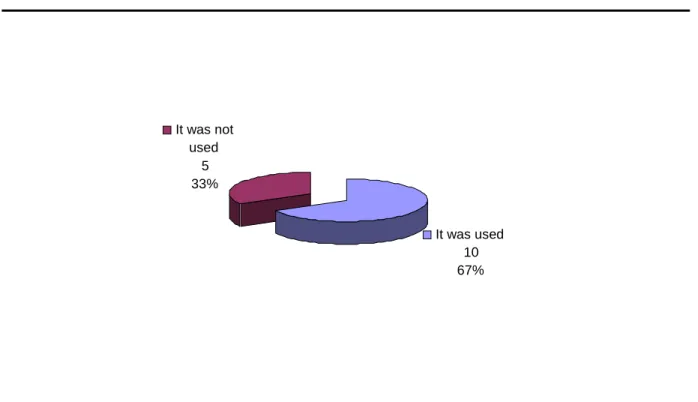
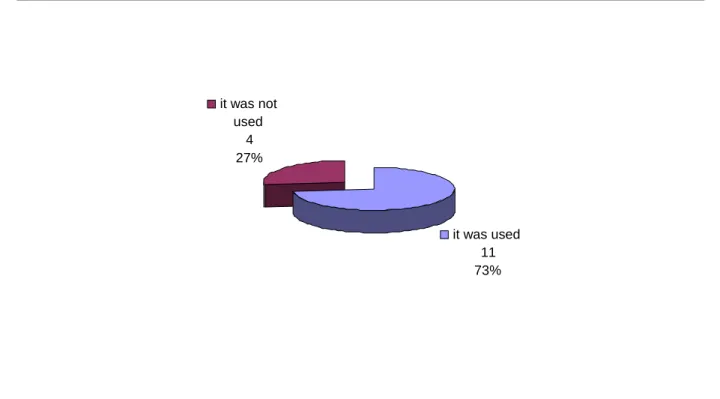
Then the results were entered into the computer to show the results of this research. The key was to give short readings to fifteen upper level LEMO students and record them in order to analyze the use of elements involved in the production of connected speech (intonation, rhythm, hyphenation, fluency, connective assimilation, weak forms, contractions and deletion of weak forms). Figure 2 shows the percentage of students who used English rhythm and those who did not.
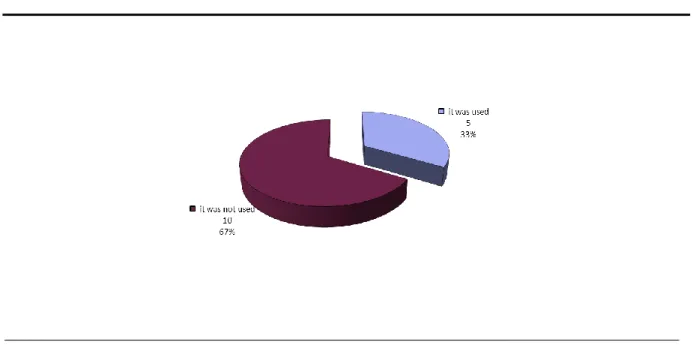
That is, only 27% of students who were recorded as reading used English rhythm and the remaining 73% did not. Thus, it was proved that most of the students did not do well in reading fluency. It was found that 73% of the students pronounced the words together because of the closeness between consonants and vowels, and 27% did not, as the figure below shows.
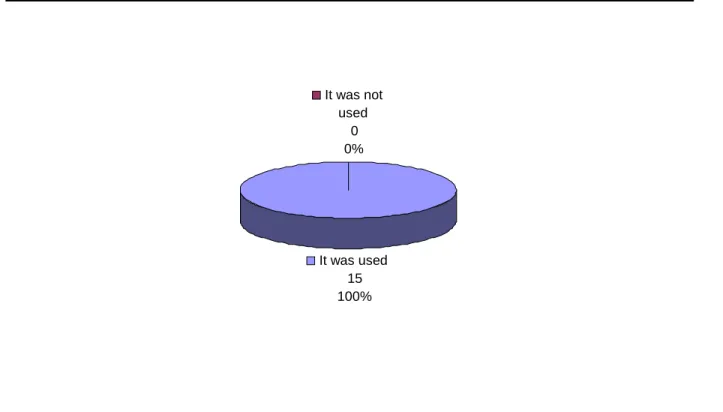
As mentioned earlier, most students pronounced contractions, which were reduced to make pronunciation easier. This study showed that some contractions were expressed in their full form. Most students correctly explained the stress when pronouncing “you” and “I.” One participant mispronounced “you”; the 'l' sound was not as articulated; there was a disappearance of this sound.
Summary
They found that they could not master most of these elements well when pronouncing some words. We can conclude that they could improve with some practice and if they are willing to learn, they can achieve almost native pronunciation. In addition, students who showed reading fluency had difficulty pronouncing some words and had difficulty understanding some words.
On average, students can be understood if they have the opportunity to have a conversation with a native speaker. The problem might also be that they might not understand the connected speech of a native speaker. In addition, students may have problems with assimilation because there is a change in sound when some words are put together.
74 The final problem is recognizing the sound of weak forms pronounced as schwa /ǝ /; this can be the most important issue to deal with.
Implications
Moreover, it seems that the theory of contrastive analysis can be a powerful tool for teaching connected speech and thus strengthening those aspects that differ from the learning process from native to foreign languages. First, it could be done with a methodology that shows how much students know about the topic, thus checking whether they know what connected speech is. That is, not only reading a written text can measure knowledge of connected speech; but students can also be asked to develop a conversation about a specific topic.
Finally, another important issue that can be mentioned is the claim that the results could be improved and enriched with specialists also evaluating student-linked speech pronunciation. Therefore, in order to use or how much students can manage connected speech, they can be tested by applying a test that contains examples of connected speech. Another point that could be useful for another research is to find out what impact connected speech has on the listening skill when it is introduced to students.
It can be recommended to use a qualitative method, which is ethnographic research, or do a quantitative research and test the listening skill before and place an introduction of connected speech theory.
INSTRUMENT INSTRUMENT
INSTRUMENT
CONNECTED SPEECH CHECK LIST
Comprehension and Fluency Instruction: Thinking, Speaking, and Writing About Reading, K-8. 1997) Input, interaction and the second language learner.