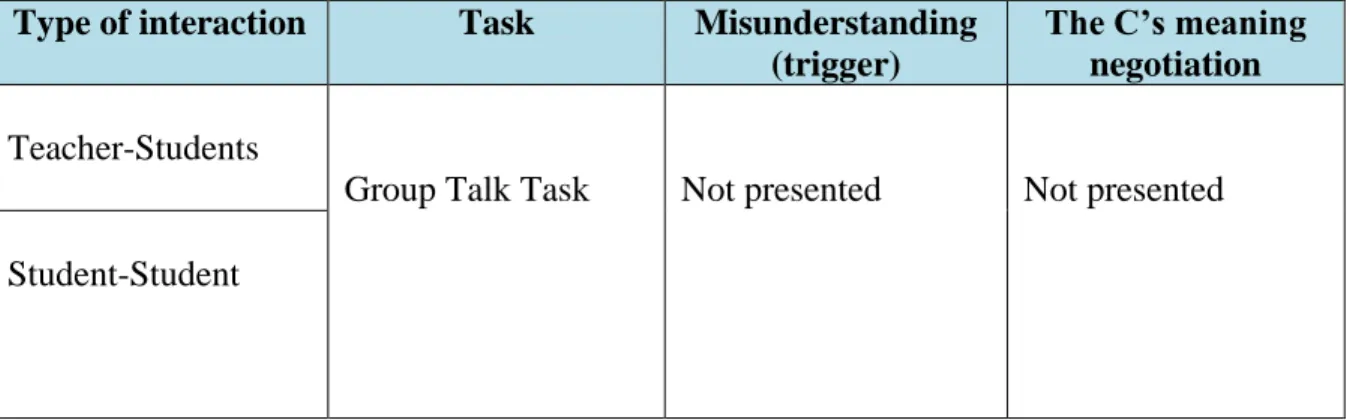
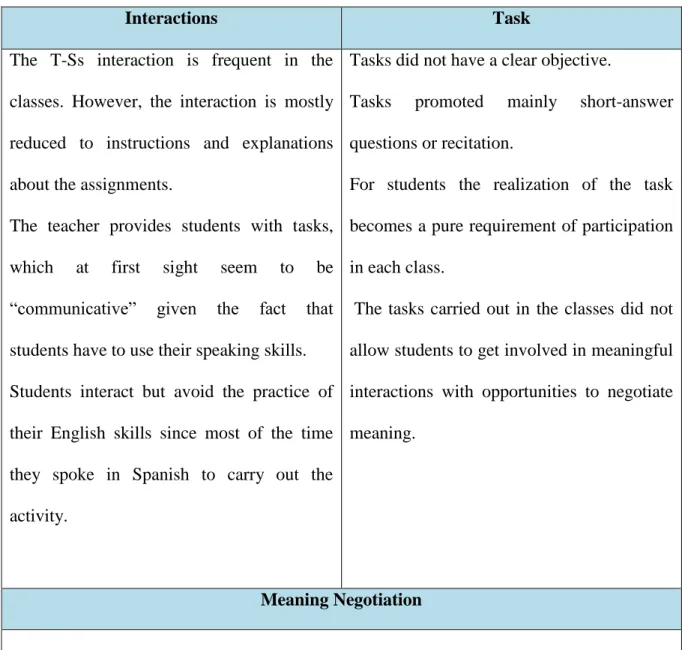
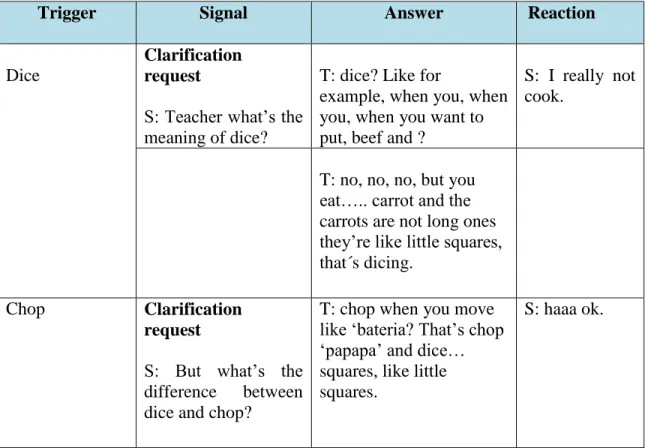
The results show that this process hardly occurs in the classroom and mostly in the teacher-student interaction. It is for this reason that the accreditation of a foreign language becomes very decisive in the integrated formation of a university student.
Significance of the Study
Research Aim
Research Questions
Methodology
Key Terms
The dialogue and communication involved will be placed in the context of teaching and learning English, assuming that in doing so, language is being constructed. In the 20th century, Noam Chomsky introduced the field of generative grammar which is concerned with the biological basis for the representation and use of human language acquisition and the universal principles that delimit the class of all languages.
Meaning and Communication
According to her, we are constantly changing our lexicon in response to the new language we hear and use. The fact that we use language in interactive settings and that we use contextual cues to figure out what our speakers are trying to say is an important part of this process.
Dialogue
15 targeted, which means that the teachers plan and facilitate dialogic teaching with special educational goals in mind. As noted, the dialogue conception is reflexive, critical and creative, supported by the students' informal experience of being constituted in a deep dialogue supported by argumentation and reflection.
Constructivism
Ergo, it can be said that people communicate meanings constructed in language, and that the ways in which they do so to achieve successful communication in real situations, not only among native speakers but also among foreign language learners, matter have led researchers to investigate at their best the features of meaning and dialogue as inherent elements of the communication process within the framework of foreign education and learning. Now it is also important to look at general theories of knowledge and learning that have provided valuable views on how students cognitively and socially process new information and learning. When we examine factors related to the construction of knowledge, we find two focuses: that of cognitive constructivism and that of social constructivism.
Social Constructivism
17 It was the dialectic between the individual and society and thus the effect of social interaction, language and culture on learning that became the focus of Vygotsky's work, and precisely this will be the key idea of social constructivism. 18 focused and using the language for meaningful purposes, as opposed to more traditional methods of language learning that focus on grammar, language exercises and direct teaching.
Communicative Language Teaching
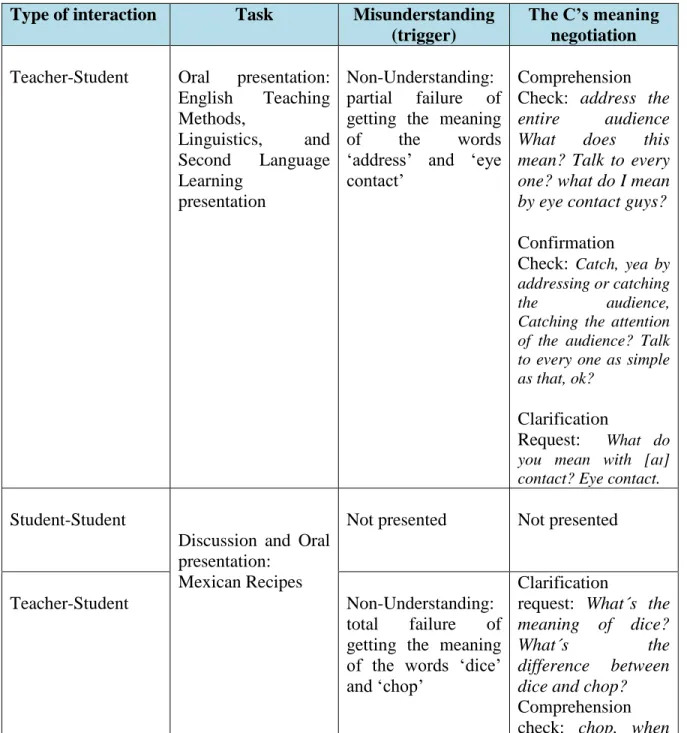
In summary, this instrument would indicate the existence of Meaning Negotiation characteristics in the target language class VI. Then, two classes representing the Teacher-Student and Student-Student interaction given in the 6th lesson of the target language were obtained. The following sections describe the results of each of the utterances identified as negotiations.
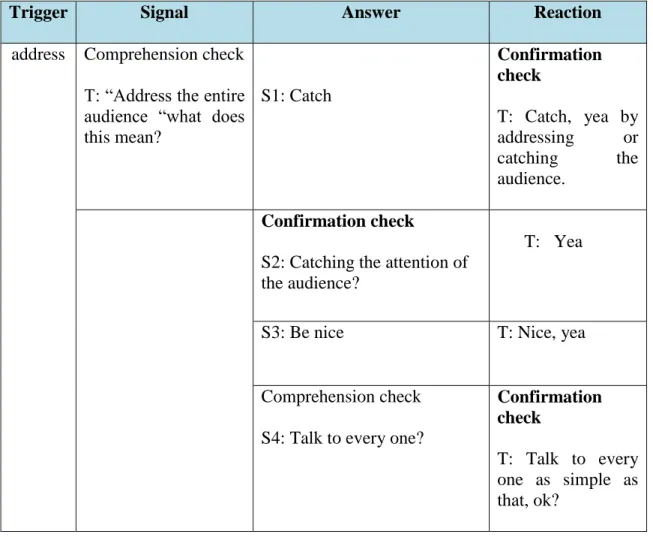
Then, in the former, it was recognized when the teacher said: "address the whole audience". That is, the teacher confirms that this word can be the same as "address". Then, in the fourth turn, S2 reformulates it into a question
The purpose of this chapter is to present general conclusions about this research project, which is about identifying the characteristics of the meaning negotiation process in the target language IV.
Task Based Learning
Interaction
Teacher-Student Interaction
In general, teacher-student interaction is created when a teacher speaks to the whole class, to small groups, or to individuals at the same time. In traditional classrooms, the teacher controls the topic for class conversation and determines when to start and stop talking in class (Cazden, 1988; Tsui, 1995, cited in Tuan & Nhu, 2010). Unless, as Wells (1993) states, feedback from the teacher is used to ask students to expand their thinking, justify, clarify their ideas or make connections with their experience.
Student-Student Interaction
So, for this reason, it is important to consider the quality of student speech promoted by interaction in the classroom. In this sense, theorists place different values on the role of interaction in second language acquisition. The basic types of interaction in the light of three different SLA theoretical perspectives discussed by Ellis are: Interaction hypothesis, Sociocultural theory and the depth of processing theory (Ariza & Hancock, 2003).
Long’s Interactionist Hypothesis
Since the purpose of this research is to focus on the type of interaction inherent in oral interactions in which learners engage in the negotiation of meaning, the interactionist hypothesis must be considered. 24 The interactionist hypothesis is based on the basic idea that conversation is not only a forum for the practice of language forms that language learners have already mastered, but also a means by which learning takes place. Such a process is called negotiation of meaning, and its main requirement is the way in which interlocutors try to understand and be understood in order to build their knowledge in the process of interaction.
Meaning Negotiation
Misscommunication
Tasks Fostering Meaning Negotiation
That is, the stimulus for modification in interaction is the interruption of communication in conversations in which partners seek mutual understanding often with the aim of completing a task (Muñoz, 2000). In his work Long (1996) found that two-way tasks, in which all students in a group had unique information to contribute, stimulated more negotiation of meaning than one-way tasks in which one student held all the necessary information. to complete the task. Working in a similar tradition, Dougthy and Pica (1986, cited in Nunan, 2004) found that required information sharing tasks generated significantly more negotiation than tasks in which information sharing was optional.
Chapter Conclusion
In the opinion of Malterud (2001), the purpose of such research is to investigate the meaning of social phenomena as experienced by the people themselves. It does not claim that what is discovered in the process is universal, and therefore repeatable (COE, 2006). Therefore, since the purpose of this research is to gain a deeper understanding of the Meaning Negotiation Process by describing its characteristics presented in oral interaction in the EFL classroom at BUAP Languages Faculty, this study followed a qualitative approach .
Participants
Instrument
34 participants regarding the meaning negotiation process; the instrument of this research was a Meaning Negotiation Checklist designed by the researcher. The most important issues to be addressed about such a process revealed in the literature review are in the checklist. Consequently, a column has been assigned to the type of interaction, task description, type of miscommunication and the definition of the three C's Meaning negotiation, so that they can be noted in case they are identified during the class.
Data Collection Procedure
The material used to conduct such research was a video recording so that the students could be recorded and the whole environment as well. 35 important data were obtained from the checklist designed by identifying and marking the meaningful characteristics of the negotiations in it.
Data Analysis
Chapter Conclusion
Background Knowledge
Class A Results
It is clear that the teacher offers students chances to participate in an oral presentation to improve their speaking skills. Then the teacher is observed to initiate negotiation until an acceptable level of understanding is reached. Nevertheless, as soon as the teacher told them to start working, it is noticed that students in most of the teams started speaking in Spanish to explain what they had to do and to carry out the task.
Class B Results
The teacher told them to just express their ideas and write them down, as the next class would process the information gathered. Then it is assumed that in this class the purpose was speaking, and in the next one we might focus on writing. Despite the fact that the teacher emphasized that they had to discuss the topics, it was found that they expressed their beliefs and opinions about the issues mainly by listening to each other.
General Meaning Negotiation Findings
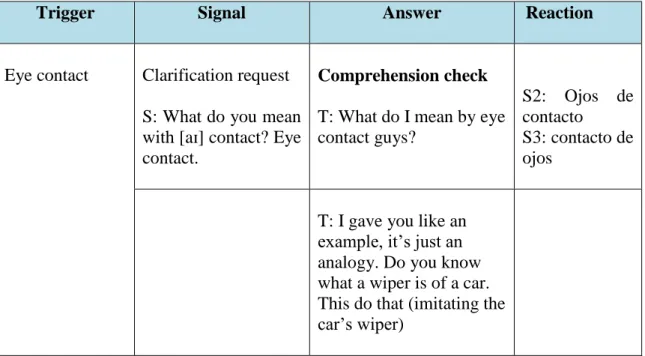
Comprehension Check
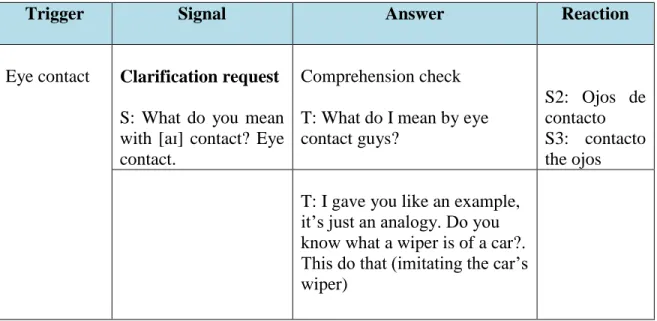
The concept was already explained, for this reason the teacher asked the whole class. Therefore, the teacher gave an analogy to explain the concept to the student < Do you know what a wiper of a car is. What the teacher meant by this is that they should look at the whole audience not just a part of it.
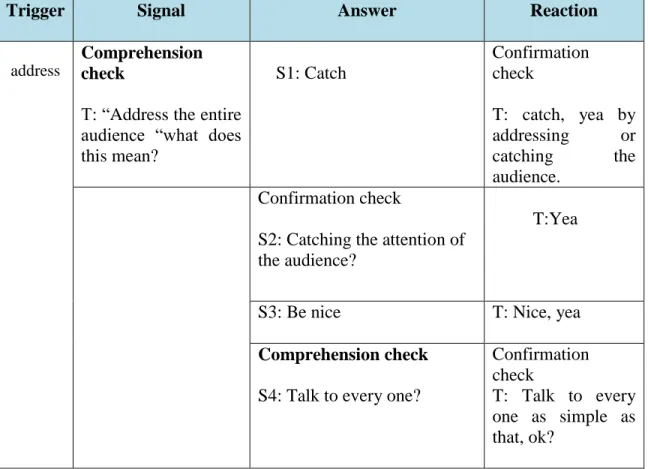
Confirmation Check
Clarification Request
In this case, the trigger was the partial failure to understand the meaning of the words. The students seemed to be confused about the meaning of both words, so the first sentence to elicit clarification was
Chapter Conclusion
In this regard, it seems possible that the tasks are not suitable or ways of doing them avoid the use of the English language. This suggests that one thinks about the teacher's perception of the ways of teaching languages. For all of the above, the next reflection is derived from this research project: in principle, it is indispensable to open a broad discussion in the lap of the faculty about the forms and processes of teaching and learning languages from the level of teaching practice.
Limitations of the Research
Directions for Further Research
García, I (1999) Dialogo crítico, reflexivo y autoregulación del aprendizaje escolar. http://biblioteca.clacso.edu.ar/ar/libros/cuba/cips/caudales05/Caudales/ARTICULOS/. Collaborative learning improves critical thinking. http://scholar.lib.vt.edu/ejournals/JTE/v7n1/gokhale.jte-v7n1.html. Re-evaluating the IRF sequence: A proposal for articulating theories of activity and discourse for the analysis of classroom teaching and learning.
Class A Results
Class B Results
General Findings
Sequence 1: Comprehension Check
Sequence 2: Comprehension Check
Sequence 1: Confirmation Check
Sequence 2: Clarification Request
Sequence 3: Clarification Request