In the case of the first globalization, steamships, railways and the telegraph were the focal points of this phenomenon. The dominant arguments for trade to stimulate economic growth stem from increasing the overall efficiency of the economy and expanding the market. A look at Latin America during two eras of globalization illustrates the diversity of the degree of integration into world markets and economic growth.
The pattern that emerges is the stagnation of the Latin American economies in the current period. Latin American economies managed to attract almost 20% of total foreign direct investment flows in the first wave and only 6.3% in the current wave. During the first globalization, Argentina was one of the richest economies in the world: it was the poster child of successful export-led growth.
The availability of arable land and the adaptation of producers contributed favorably to the expansion of the export sector. For the remainder of this globalization period, the export sector was linked to the performance of two commodities. These improvements contributed to the expansion of the struggling textile industry in the decades after independence.
During the economic boom of the 1880s, the expansion of exports exceeded 20% of GDP, a ratio not reached until a century later.
Data
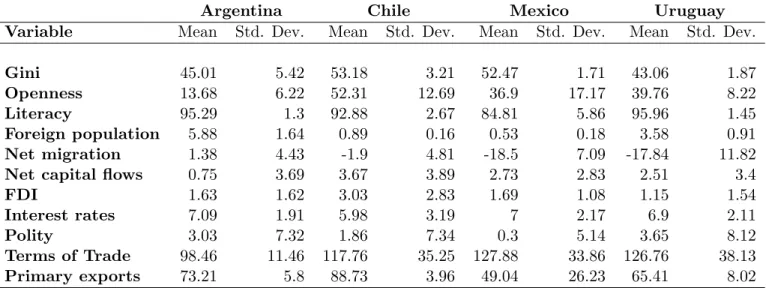
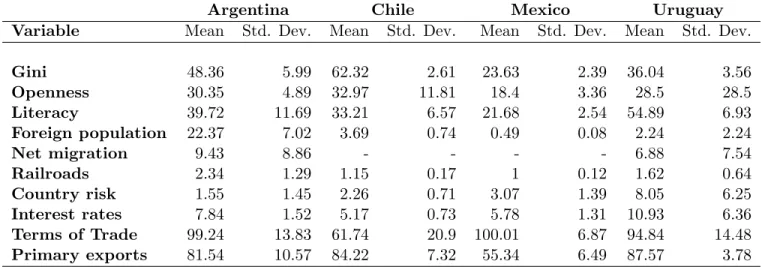
Second-generation reforms accelerated the dismantling of the protectionist framework by cutting tariffs and removing non-tariff barriers. At the beginning of the first era of globalization, the countries under study were already free from colonial rules; therefore, they could be considered open. Given the importance of primary commodities for Latin American economies, we also take into account the role of the relative prices of the country's exports to imports (terms of trade) and the unit prices of exports.
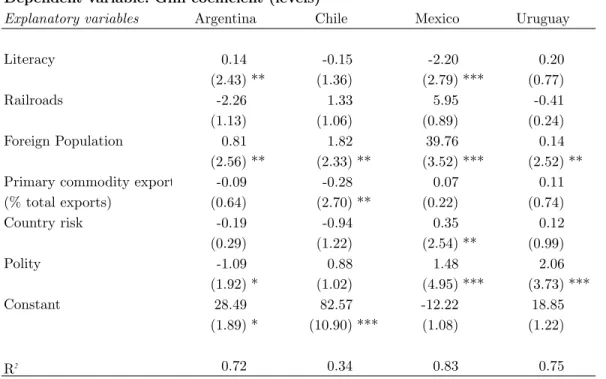
Due to data limitations in the first globalization, these factors are approximated by a country risk indicator, measured as the difference between the yields of Latin American countries and the United Kingdom, with government bond rates expressed as a percentage. Finally, it is clear that the data varies considerably over time and between countries. However, the dynamic properties of the data cannot be inferred from descriptive statistics alone.
Does integration into global markets mean greater inequality? whether it is a question of patterns of trade specialization of countries. The results prove that with the removal of trade barriers and the liberalization of the inflow of foreign capital in the studied countries, inequality within the country increased.
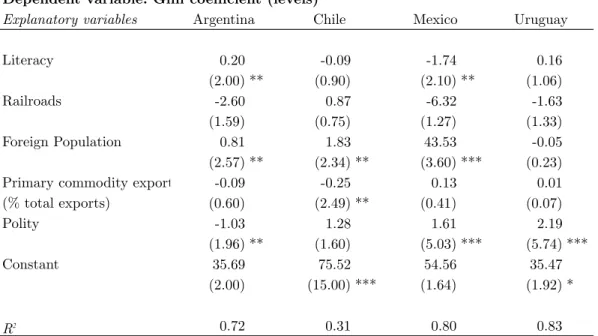
Modeling the first globalization years
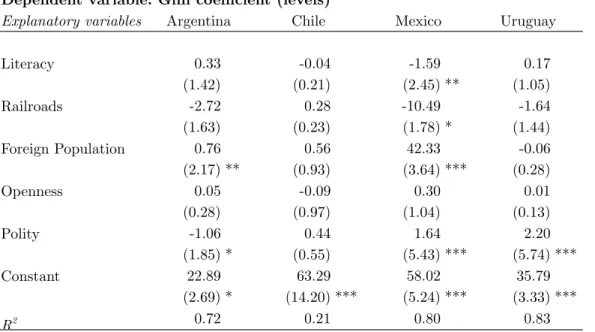
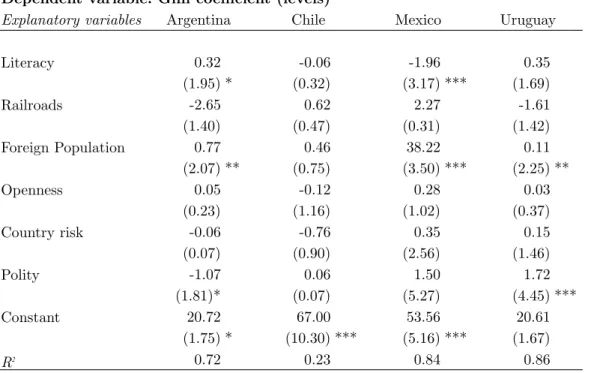
Interestingly, openness does not seem to affect inequality significantly, but the country's risk premium and polity also represent important features of the country's ability to engage in domestic and international productive activities. The analysis also examines the sensitivity of the above results to the use of alternative explanatory variables. Not surprisingly, in Chile, a net exporter of raw materials, the coefficient indicates a decrease in inequality due to an increase in exports of primary raw materials (i.e. a one percent increase in exports of primary raw materials will reduce inequality decrease by an average of 0.25 percent during the first wave of globalization).
The Second Globalization
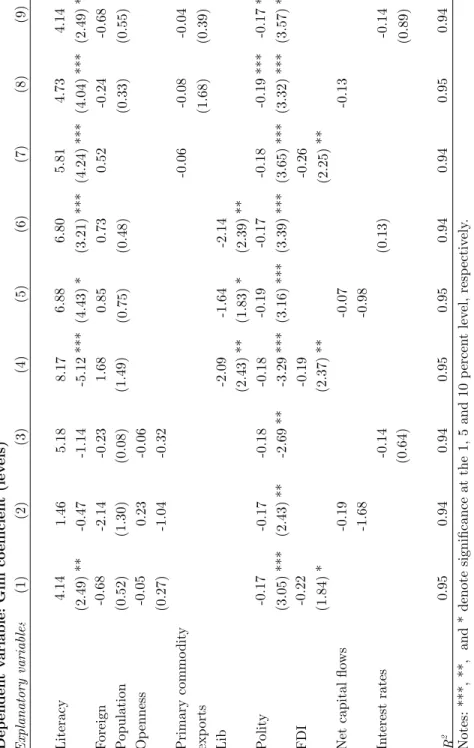
On the contrary, improving the political (and thus institutional) environment has important egalitarian effects. In the alternative specifications, the estimated coefficients for net capital flows as a percentage of GDP and interest rates are not statistically determined, but they also imply a likely reduction in income inequality. In columns 4 and 5, the liberalization dummy variable measures the response of inequality to trade openness.
These coefficients are robust when controlling for the impact of primary commodity shares on inequality (columns 7 to 8). But the relationship between primary export shares and inequality is not empirically confirmed in these specifications. For Chile (Table 10), in all the specifications the relationship between skills and inequality is significant and positive.
Immigration lowers inequality overall, contrary to the effect estimated in other sample countries. The ratio of primary goods to GDP exerts a positive influence on inequality, confirming that exports of primary goods are generally associated with rising inequality (Easterly, 2007). Different measures of capital flows and financial markets present ambiguous effects on inequality, and only the shares of net capital flows to GDP show a significant positive coefficient (column 6).
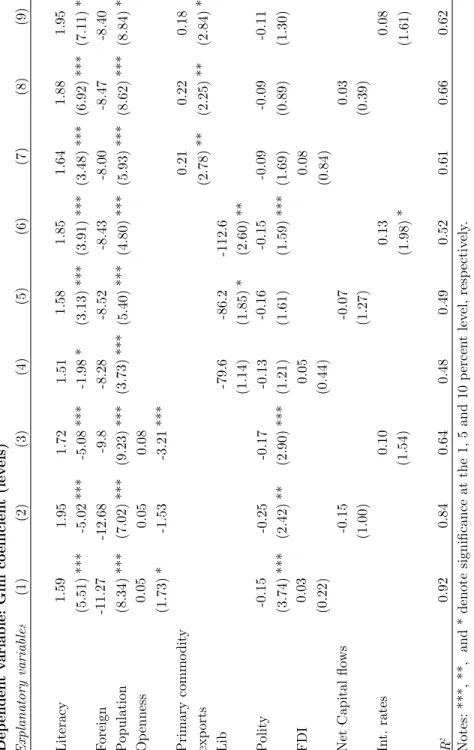
Focusing on Table 11, in Mexico the relationship between trade liberalization and inequality is different compared to Argentina and Chile. But net capital flows and interest rates appear to increase inequality, as well as FDI (although the FDI coefficients are not statistically sound). The adverse behavior of within-country inequality in response to net capital flows may be related to the negative effects of FDI and capital inflow liberalization in the 1990s, and the aftereffects of the accompanying recession in 1994.
Literacy and immigration are two of the main factors explaining Uruguayan income inequality in the current wave of globalization. The impact of trade openness (or liberalization) and export intensity in primary commodities on inequality is not significant. However, developments in income distribution are associated with improvements in institutions, especially when we control for trade openness as an additional auxiliary variable (see columns 1 and 2).
Instrumental Variables
In the case of Chile, openness and foreign population significantly increase and decrease income distribution. For Mexico, if we control for the relative impact of fluctuations in the terms of trade, openness increases inequality. Developments in the institutional and political framework also produce significant egalitarian effects in the reported models.
The results for Uruguay also confirm the positive influence of skills and foreign immigration rates on inequality. We also estimate the effects of the concentration of primary raw material exports on inequality using the terms of trade as tools and the results are shown in Table 16. The world has experienced two waves of globalization that have left deep scars on the structure, growth and dynamism of the participating economies.
Latin America was and is an active member of the global economy, and in many cases the degree and type of integration shared features of these two periods. Adopting a historical perspective, we have analyzed the relationship of globalization on inequality by looking at the separate effects of trade openness and primary commodity export shares during the first major globalization and the current wave of liberalization. For example, in the first globalization, the large immigrant flows to Argentina and Uruguay explained the increase in inequality.
According to empirical estimates, the development of political structures and institutions also caused considerable egalitarian effects in both periods of globalization. More than a century has passed and the region is still very unequal, and the historical high specialization of production and trade in certain types of goods still exists. Trade diversification is therefore a key element in discussions and studies of the link between globalization and inequality.
Overcoming Inequality in Latin America: Issues and Challenges for the Twenty-First Century, Chapter Inequality and Trade in Latin America. The impact of trade liberalization on exports, imports and the balance of payments of developing countries.
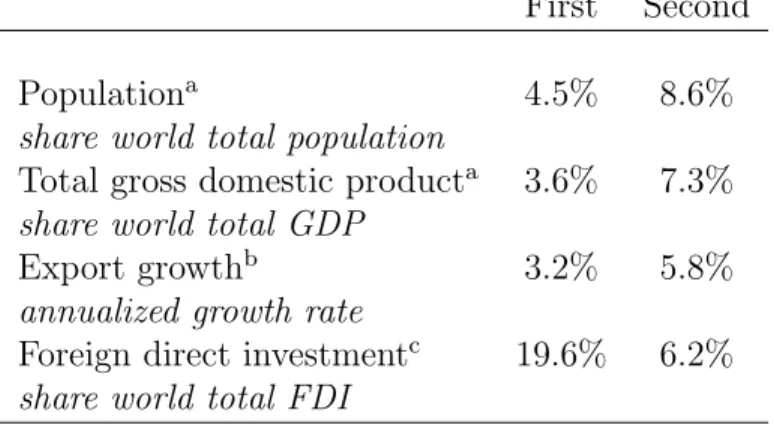
First globalization (1870-1913)
Second globalization (1970-present)