This working paper analyzes the role of different elements of social capital in economic growth for a sample of 85 European regions over the period 1995-2008. The study of the implications of social capital on economic growth has received considerable attention over the past two decades. In this context, our study evaluates the role that different dimensions of social capital play on the economic growth of 85 European regions during the period 1995-2008.
Previous evidence on the links between social capital and regional growth in Europe is limited exclusively to examples from the western region. Despite the difficulty of this task, almost all researchers agree that the effects of social capital are seen in reduced transaction costs. Among them, Knack and Keefer (1997) and Dearmon and Grier (2011) found a positive relationship between social capital and physical capital investment.
Social capital is also transferred through better education, as found by Dearmon and Grier (2011), Bjørnskov (2009) or Bjørnskov and Méon (2013). It may involve regions in good circles of low or high social capital scenarios (Putnam 1993). The above claims may cast doubt on the true causal relationship between social capital and growth.
1 These studies test the exogeneity of trust, which is arguably a special dimension of social capital.
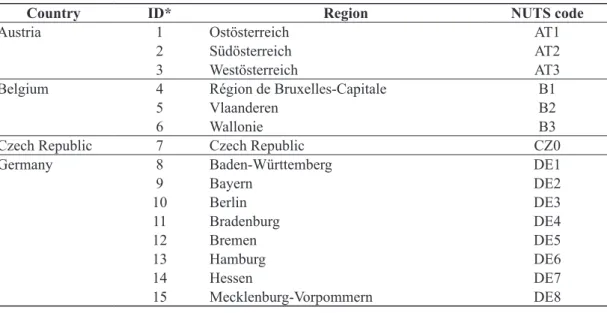
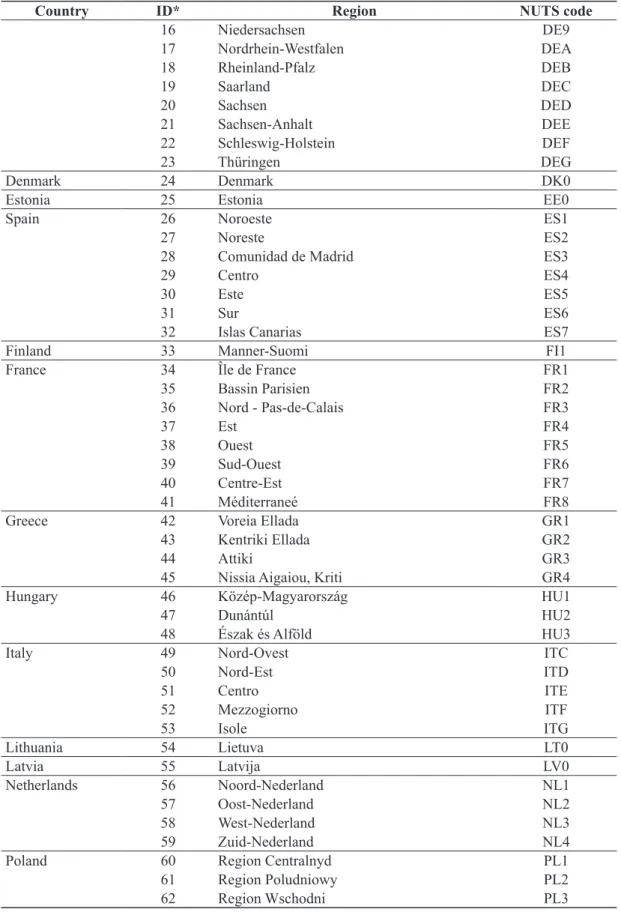
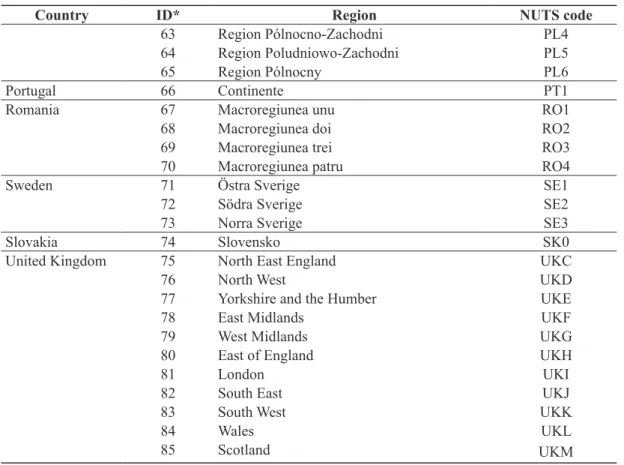
European regions (NUTS level 1)
Social capital variables
- Trust
The multifaceted nature of social capital has led scholars to use various indicators as measures of social capital. The indices of social capital in our analysis are based on Bjørnskov (2006), although we acknowledge that other formal approaches could also be possible. These two limitations, namely the availability and reliability of the sample, make it more appropriate to limit the analysis to NUTS level 1.
5 For example, the 1999 wave does not provide data at the NUTS 2 level for France, Germany and the United Kingdom; NUTS level 1 is the smallest geographical area for which data is available for these countries. Spanish regions, southern regions of Great Britain and northern parts of Italy also show relatively high levels. The lowest levels are for some regions of France6, southern Italy, Greek regions and regions corresponding to recent accessions to the EU from Eastern European countries.
Some within-country differences are particularly significant, such as those between northern and southern Italy, which would corroborate Putnam's (1993) findings. 6 Note that French regions have one of the lowest levels of social capital in Western Europe.
Social capital indicators
Active participation
MAP 2: Social capital indicators
- Social norms
- The Growth Model
- A Brief Outline of the Bayesian Methods
- Results
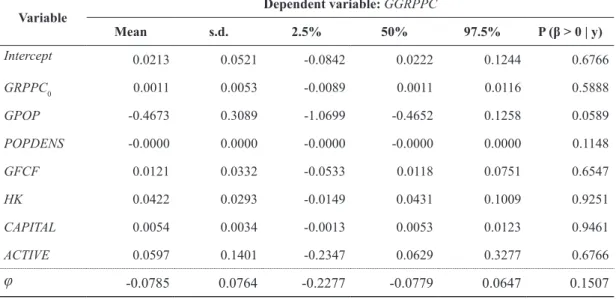
- Results for the social capital indicators
- Results for the control variables
- Concluding Remarks
In the SAR part of the model, W is an 85 × 85 adjacency matrix where Wij = 1 if regions i and j are adjacent and 0 otherwise (Wi refers to row i in W); vi is the number of neighbors of region i, i.e. the product. In the SAR part of the model, W is an 85 × 85 adjacency matrix where Wij = 1 if regions i andj are adjacent and 0 otherwise (Wi refers to row i in W); vi is the number of neighbors of region i, i.e. the product. These useful simulation procedures result in an approximate sample of the posterior distribution from which inferences can be drawn directly.
These useful simulation procedures result in an approximate sample of the posterior distribution from which inferences can be drawn directly. Objective Bayesian statisticians argue that using the appropriate unbiased prior results in the same conclusions as classical analysis while still enjoying the benefits of the Bayesian framework (Berger 2006). FOLLOWING the Bayesian paradigm, inferences can be drawn directly from the posterior densities of the estimated parameters.
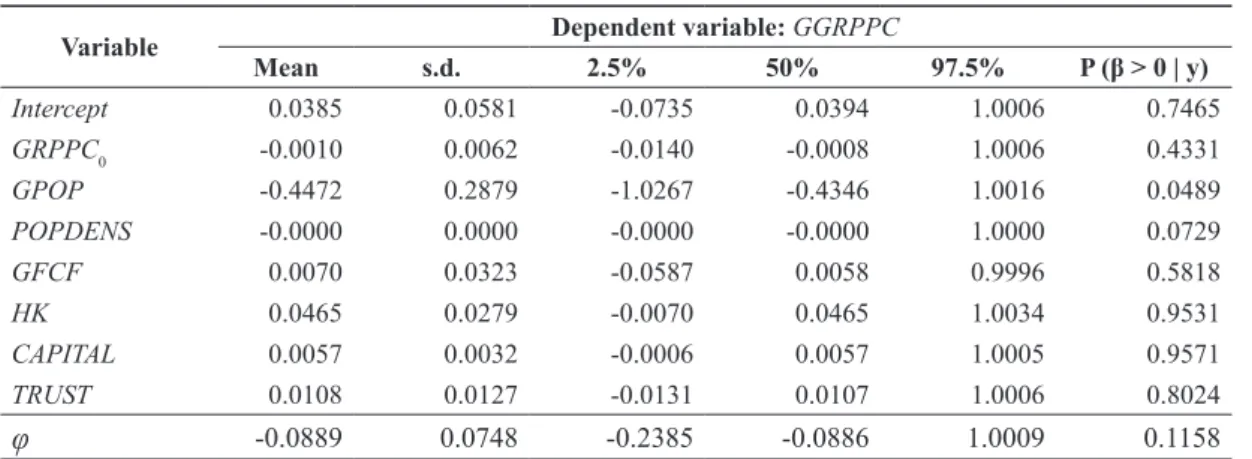
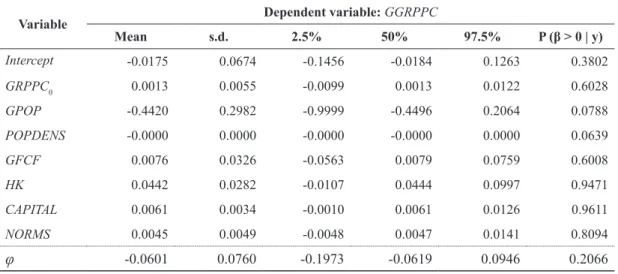
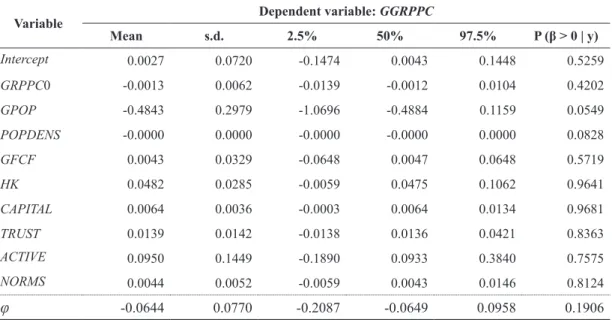
ACCORDING to the Bayesian paradigm, inference can be made directly from the posterior densities of the estimated parameters. Convergence of the simulated values from the posterior distribution is ensured by running three chains, each with 3,000,000 iterations and. In particular, we present a summary of realizations of the posterior distribution for the model parameters.
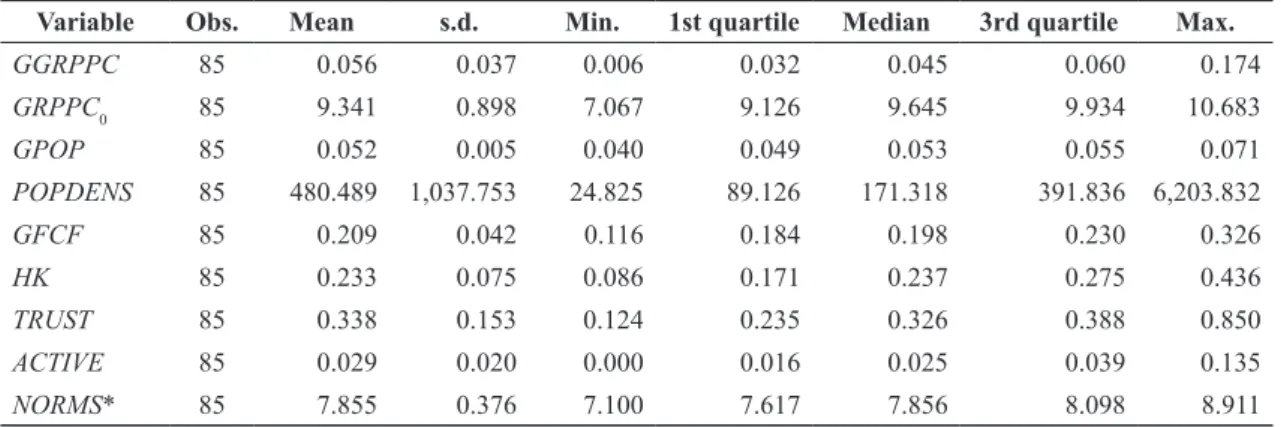
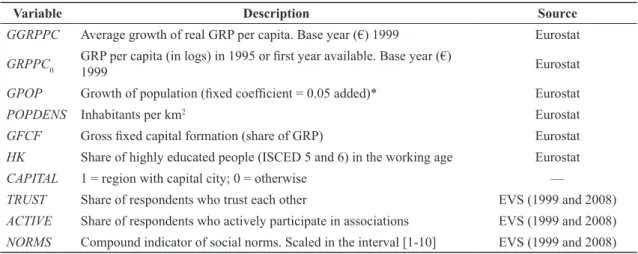
The posterior density for TRUST in panel (a) shows that the largest amount of the probability mass (80.2%, see the last column in table 4) is on the positive side. Considering the indicator of social norms (NORMS) (Model 3), the 95% credible interval provided in table 6 and the density plot in panel (c) of figure 1 show that the largest amount of the posterior probability density beyond 0 is 16 Note that in the Bayesian framework a 50% probability of being positive —or negative— means that nothing can be inferred about the direction of the effect of the population parameter of interest.
A likely explanation for this discrepancy is the heterogeneity of the sample. 2004) compares the robustness of the results across countries for the prominent contributions of Knack and Keefer (1997) and Zak and Knack (2001). In the benchmark of European regions, even the poorest regions are richer than some of the countries included in cross-country studies. The result changes dramatically when the variable NORMS is introduced (models 3 and 4), indicating a significant influence of the latter in the model.
Our results lend considerable support to the arguments held by social capital scholars, and most of the findings in country studies. In this sense, improving institutional quality could be one of the fronts to start from.
Fratesi (2004): "Between Development and Social Policy: The Impact of European Structural Funds in Objective 1 Regions". 1996): “Regional Cohesion: Evidence and Theories of Regional Growth and Convergence”. He currently holds a postdoctoral position at the Department of Economics at Universiy Jaume I (Castellón, Spain), where he teaches quantitative methods in economics. He also holds a master's degree in economic internationalization from the Jaume I University and received a doctoral scholarship from the Vali+d program of the Valencian government in 2011.
He is currently finishing his doctoral dissertation, focusing on the role of social capital in economic development. He has published articles in international journals such as Spatial Economic Analysis and European Journal of Political Economy, and has participated in many invited national and international congresses and seminars. He has also taught at the University of Alicante and received scholarships from various institutions (Fundación Caja Madrid, among others).
He has held positions as visiting researcher at the Autonomous University of Barcelona, the University of New South Wales (Australia), and the Economics Department of Oregon State University (USA). His specialized fields are banking economics, the analysis of productivity and efficiency, and the application of different techniques to problems in the banking sector. He has participated in many Spanish and international congresses and is principal researcher of the Spanish National Research Program project Evaluación de.
Cualquier comentario sobre el contenido de este artículo puede dirigirse a Emili Tortosa-Ausina, Departament d'Economia, Universitat Jaume I, Campus del Riu Sec, 12071 Castelló de la Plana, España. Agradecemos especialmente a un árbitro anónimo cuyos comentarios contribuyeron a la mejora general del artículo. También se agradece el apoyo financiero del Ministerio de Ciencia e Innovación (ECO y Generalitat Valenciana (VALi+d ACIF/2011 y PROMETEO/2009/066).
DT 03/13 A Bayesian Perspective to Analyze Branch Location Patterns in Spanish Banks Luisa Alamá Sabater, David Conesa Guillén, Anabel Forte Deltell and Emili Tortosa- Ausina. DT 14/12 Social Capital, Investments and Economic Growth: Evidence for the Spanish Provinces Emili Tortosa-Ausina y Jesús Peiró Palomino. DT 12/12 The impact of the subprime crisis on bank ratings: The effect of tightening rating policies and worsening solvency.
Documentos de Trabajo
Documentos
Jesús Peiró Palomino Anabel Forte Deltell
Does Social Capital Matter for European