This publication should be cited as: Economic Commission for Latin America and the Caribbean (ECLAC), Digital technologies for a new future (LC/TS.2021/43), Santiago, 2021. Meanwhile, the coronavirus (COVID-19) pandemic has had an unprecedented economic and social impact on Latin America and the Caribbean.
CHAPTER
- The systemic impact of digital disruption
- The difficult balance between digitalization and sustainability
- The roll-out of 5G networks: essential to the new models of industrial production and organization
- The mass take-up of new technologies requires more infrastructure investment
- Telecommunications are moving to the cloud
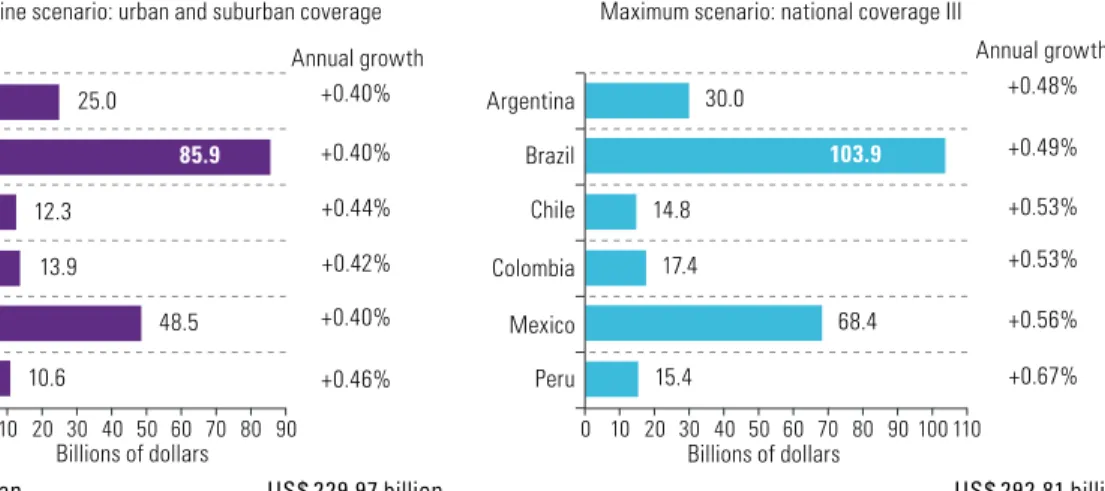
- The digital transformation driven by 5G networks will have a significant economic impact but require large investments
- The impact on digital transformation: benefits in the form of connectivity, digitalization of households and the production system, growth of digital industries
- The impact on GDP growth: the effect of the level of digitalization on GDP, partly because of investment in network roll-out, but mainly as a result of spillover effects (positive externalities) on the economy
- The impact on the GDP of certain industrial sectors: the spillover effects from increased operational efficiency and improved productivity in certain industrial sectors
Lunden, “The energy and carbon footprint of the global ICT and E&M sector Sustainability, vol. By the end of the first quarter of 2019, more than 50% of all towers in Latin America and the Caribbean were owned by specialized companies and not by these operators (Euromoney Global Limited, 2019).
Bibliography
Divides in broadband access
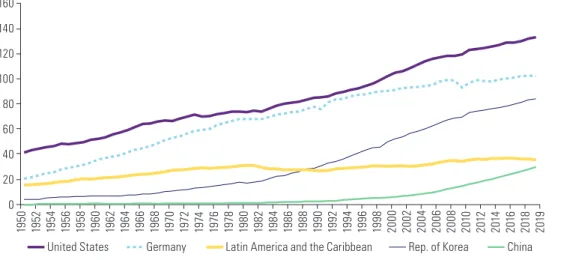
Latin America and the Caribbean: Fixed and Mobile Broadband Subscriptions Percentages of Total Population). Latin America and the Caribbean lag behind other regions of the world in the percentage of the population with mobile and fixed broadband subscriptions.
The use and take-up of digital technologies
- Distance learning: essential but inaccessible for many
- Digital health care in the pandemic emergency
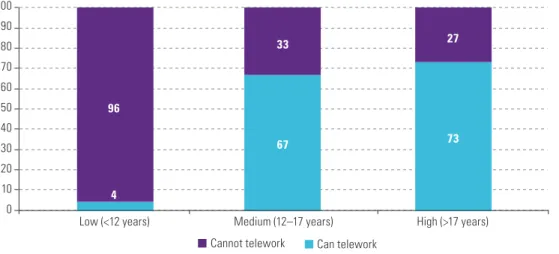
- Digitalization, the labour market and employment
- million firms will close +18 million newly unemployed
- Financial inclusion: the advance of financial technology (fintech)
- Smart cities: a hub of inclusive and sustainable development
The implementation of electronic health records is one of the most widespread digital strategies in the region (11 countries). The use of digital technologies in the financial sector has helped remove some of the biggest barriers to financial inclusion. Sub-Saharan Africa East Asia and the Pacific Middle East and North Africa Latin America and the Caribbean Source: GSMA, State of the Mobile Money Industry Report 2019, London, 2019.
Latin America and the Caribbean (20 countries): downloads of financial services applications, 2020 (Percentage of all active mobile phone subscriptions in each country). Latin America and the Caribbean (21 countries): app downloads with small business services, 2020 (Percentage of all active mobile subscriptions in each country). This is particularly important for Latin America and the Caribbean, as more than 80% of the population lives in urban areas, where there are serious deficiencies in the provision of public services.
Universalizing access
Mexico City (Mexico) Digital Public Innovation Agency Office of the Head of the City Government 8.3. Latin America (11 countries): monthly cost of digital basket of fixed and mobile broadband services and devices (percentage of monthly GDP). Source: Economic Commission for Latin America and the Caribbean (ECLAC), Building a New Future: Transformative Recovery with Equality and Sustainability (LC/SES.38/3-P/Rev.1), Santiago, 2020.
The creation of a regional fund for the universalization of ICT was proposed at the Seventh Ministerial Conference on the Information Society in Latin America and the Caribbean. Oviedo (ed.) (2010), e-Health in Latin America and the Caribbean: progress and challenges (LC/L.3252), Santiago, Economic Commission for Latin America and the Caribbean (ECLAC). 2020), "Bringing health care to the patient: an overview of the use of telemedicine in OECD countries", OECD Health Working Paper, no.
Digitalization and productivity
- Productivity dynamics in Latin America and the Caribbean
- Digital technologies and productivity
Source: Economic Commission for Latin America and the Caribbean (ECLAC), based on The Conference Board, Total Economy Database [online] https://www. Latin America and the European Union: productivity relative to that of large enterprises, by company size, 2016 (Percentages). Source: Economic Commission for Latin America and the Caribbean (ECLAC), "Sectors and businesses facing COVID-19: emergency and reactivation", COVID-19 Special Report, No.
Latin America and the Caribbean: productivity per employee and technology readiness (Thousands of constant 2017 dollars and technology readiness index values). Source: Economic Commission for Latin America and the Caribbean (ECLAC), based on the World Bank, World Development Indicators [database on the Internet] https://. Source: Economic Commission for Latin America and the Caribbean (ECLAC), based on the Digital Tourism Think Tank [online] https://www.thinkdigital.travel/;.
The digitalization of production chains
- The potential of disruptive technologies to dynamize the region’s sectors
- Agro-industry
- Manufacturing
- Retail
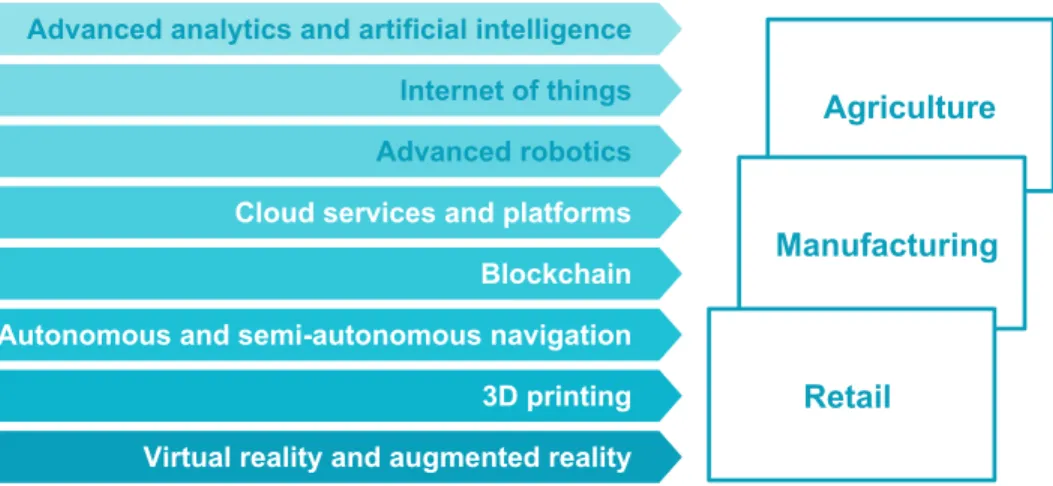
The agro-industrial sector is one of the main drivers of exports in Latin America and the Caribbean and one of the sectors with the largest share of employment in many economies of the region. Some of the platforms present in Latin America are Campo 360, the Taranis platform, GeoAgro, Climate FieldView and Auravant. Apart from the use of these new technologies in individual enterprises, their development involves a reconfiguration of the entire chain.
There are many examples of the use and application of digital technologies in the manufacturing sector. One of the providers of this technology in the region is Schneider Electric with its EcoStruxure platform, which is specially designed for production plants. Brazil has the only two factories in Latin America and the Caribbean that are part of the World Economic Forum, a global network of advanced factories that serve as showcases for the adoption of new technologies.
Procurement
The retail trade is the region's largest employer and one of the sectors least advanced in terms of digitization and the introduction of digital technologies, which is one of the reasons for the low productivity. Digitization is an opportunity to boost the sector by improving multi-channel supply chain management, automating warehouse and logistics, optimizing in-store operations, acquiring customers digitally and moving towards agile delivery models with real-time tracking (see diagram III.6). Intensification of economies of scale, changing consumer habits and the growth of e-commerce lead to an increasing role for digital platforms.
Leading digital commerce platforms in the region include Mercado Libre, Amazon, AliExpress, Wish, eBay, Shopify and Tiendanube. Demand planning using advanced analytics tools to improve forecasting capacity thereby reducing storage and inventory costs. Digital marketing tools enhanced by advanced analytics to increase the success rate by better identifying the target population and optimizing the timing of ads.
The digital ecosystem and the main barriers to digitalization of production
- The digitalization of production processes in the region
- Factors that enable and constrain the digitalization of production
Latin America and the Caribbean and selected regions and countries: cumulative change in Digital Adoption Index, 2014-2016. There is a large gap in the level of digitization between the countries of Latin America and the Caribbean and the countries of the Organization for Economic Co-operation and Development (OECD), primarily when it comes to digitization of production processes, digital industries and production factors, while the level of digitization in supply chains is also low. Argentina and Mexico, two of the largest economies in the region, only appear in the sixty-seventh and eightyth positions respectively.
Financial services and the information and communication technology (ICT) sector are the ones with the highest levels of digitization in the region, as they are globally. The dynamics of digitization in the region reflect patterns of marked inequality in productivity and income. This digital divide has become even more pronounced and negative in the context of the COVID-19 pandemic.
Digital policies for recovery and the transformation of production methods
The development of software, digital platforms and financial and agricultural technologies (fintech and agritech) should be encouraged to strengthen the ecosystem for technology start-ups of all sizes. The development of clusters and areas should be encouraged with appropriate regulatory and tax environments and access to infrastructure and skills. The public and private sectors must work together to facilitate the deployment of the connectivity network and encourage its sustainable adoption.
Logistics must be strengthened by increasing efficiency in customs processes, solving problems in last mile delivery and reducing transport costs. Online talent platforms that help connect individuals more effectively to jobs and create new, more flexible ways of working should be promoted. For this reason, the next chapter will analyze in detail the governmental framework within which actions must be prioritized and implemented, including not only the management of the digital universe at the national level, but also the need to strengthen the actions of the regional cooperation. agenda.
Digital agendas: empowerment and cross-sectoral policies
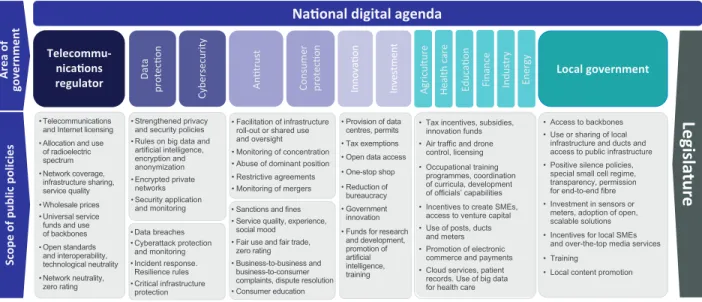
Of the 27 countries in Latin America and the Caribbean, 16 have current digital agendas being implemented, while 11 require reform or renewal in this area. In contrast, public consultations on strategy design and the creation of multisectoral coordination mechanisms and clear budget documents on the agenda are less common. Latin America and the Caribbean (14 countries): an institutional feature of national digital agendas, 2020 (Percentages of countries).
Source: Economic Commission for Latin America and the Caribbean (ECLAC), based on the Organization for Economic Co-operation and Development (OECD) and others, Latin America Economic Outlook 2020: Digital Transformation for Better Returns, Paris, 2020. Latin America and the Caribbean (19 countries): an institution that drives the country's digital agenda (Numbers of countries). Latin America and the Caribbean (13 countries): policy measures by topic on digital agendas (Numbers of countries).
Data & explanation
Competition, privacy and data security at the heart of digital agendas
This installation generates large amounts of data as a result of the actions of the authorities, health and research centers and the population. Social networks are very active in collecting personal data of their users during emergency situations, and the number of active accounts around the world has multiplied due to the blockades. Source: Economic Commission for Latin America and the Caribbean (ECLAC), based on Crunchbase [online database] https://www.crunchbase.com/; E.
Núñez, "Nawaya a kompetision iti digital nga ekonomia: Dagiti SME idiay Latin Amerika ken ti epekto ti COVID-19", Santiago, Ekonomiko a Komision para iti Latin Amerika ken ti Caribe (ECLAC), 2020, saan a naipablaak. Gubuayan: Komision ti Ekonomia para iti Latin Amerika ken Caribe (ECLAC), a naibatay kadagiti Macrotrends [online] https:// www.macrotrends.net/.

Fifteen years on from the first regional digital agenda
The regional digital market at the heart of subregional integration mechanisms
Based on the agreements adopted at the Ministerial Conferences on the Information Society in Latin America and the Caribbean held in 2015 and 2018, and with the support of ECLAC, the countries of Latin America and the Caribbean have a debate began on the opportunity presented by the creation of a regional digital market. Núñez (2020), "La libre concurrencia en la economía digital: las mipymes en América Latina y el impacto del COVID-19", Santiago, Economic Commission for Latin America and the Caribbean (ECLAC), unpublished. 2018), “Digital Agenda for Latin America and the Caribbean (eLAC2020)”, Cartagena de Indias [online] https://conferenceelac.
In 2020, it will be 15 years since the Action Plan for the Information Society in Latin America and the Caribbean (eLAC2007) was adopted in Rio de Janeiro (Brazil) in June 2005. The Digital Agenda for Latin America and the Caribbean is intended to be a catalyst for regional cooperation on digital matters and a mechanism to promote policy-making, capacity-building and policy dialogue on the challenges and opportunities that digital transformation creates for society and the economy. The purpose of the agenda is to continue previous agreements and provide input for policy dialogue at the Seventh Ministerial Conference on the Information Society in Latin America and the Caribbean.
Areas of action and goals
- Digital infrastructure
- Digital transformation and the digital economy
- Digital government
- Inclusion and digital skills and other competencies
- Emerging technologies for sustainable development
- Trust and digital security
- Regional digital market
- Digital regional cooperation
- Combatting the pandemic and facilitating economic recovery and reactivation