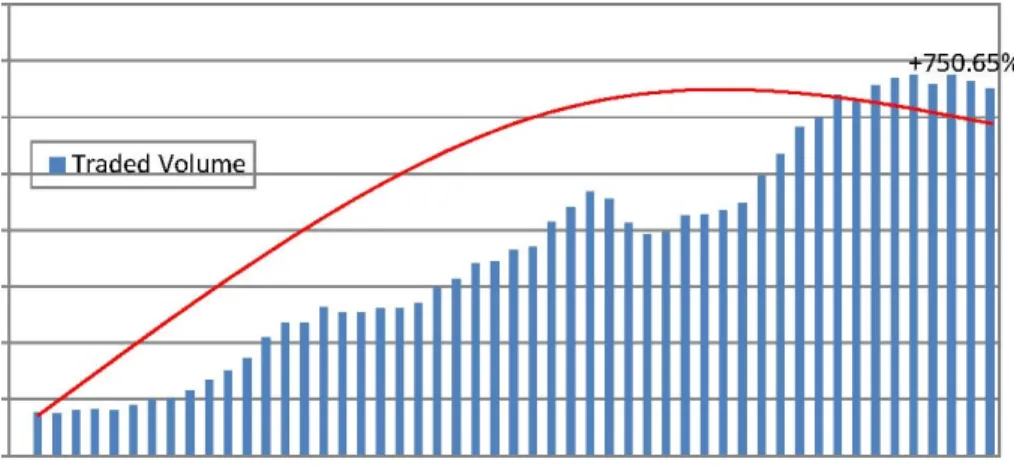
One of the certainties in the global financial industry refers to the explosive growth in trading amounts of commodities, either due to the needs of the real economy or the exponential increase in derivative positions (leveraged or unleveraged). Although the assessment may seem more adequate than their fellow regulated markets, the BCBS decided to change course in the wake of the subprime crisis of 2008. As a result, participants in the financial arena overwhelmingly fear that the weight of the new regulation is become excessive, to the extent that it can damage banks and stop the economic recovery.
SA has many similarities to the standardized method applied to stocks, although due to the volatile characteristics of these markets, the rates are fixed at a higher level. 3.1) i.e. the maximum between the previous day's VaR and the average of the last 60 daily VaRs increased by the multiplier3mc = 3(1 +k), k∈[0;. For the purpose of the present paper, the term "loss" refers to values located to the left (the long position).
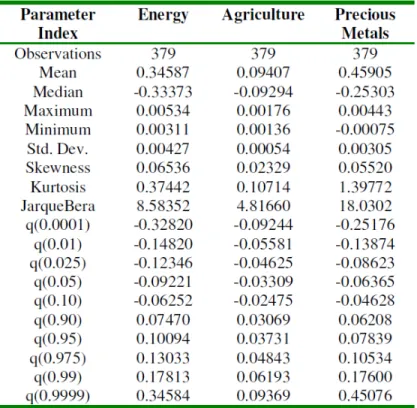
Methodology 1. Data
Regulation assumptions
Følgende forkortelser gælder: CBOT-Chicago Board of Trade, CME-Chicago Mercantile Exchange, ICE-International Commodities Exchange, ICE FE-International Commodities Exchange Futures Europe, LME-London Metal Exchange, LBMA-London Bullion Market Association, NYMEX-New York Mercantile Exchange.
The Models Approach: VaR specifications
At a given point in time V aRt+1 describes the risk in the tails of the conditional distribution of losses in a one-day period: it expresses the maximum loss of the exposure value due to adverse market movements, which will not be exceeded in a predetermined coverage probability α, if the portfolios are unchanged in a certain time period t, which makes P r(rt+1 <. The following parameters apply to VaR presentations: HS is calculated with a 1000-day sliding window; FHS, like CV schemes, is derived from GARCH and EGARCH models with normal and Student-t distributions estimated via ML, and EVT is achieved via POT with GARCH-Normal QML and GPD parameters found by MM.
Data analysis
Empirical patterns of financial time series
- Backtesting and performance of VaR models
- Backtesting and capital levels
- The Simplified Approach and Capital Requirements in Basel II
- Basel II, moral hazard and incentives
So, considering that the dependence is slightly verified, the present paper will assume the linear independence of the commodity series, in accordance with JP Morgan and Reuters (1996), Christoffersen (2003) and Alexander (2008). However, both the Yellow and Green Zones do not eliminate the gloom in the technicals as the amount of exceptions is on the edge of the Red Zone (9 for soybeans and 8 for rice, copper and silver), while the latter constitutes the only series which reports Green Areas for all specifications. The application of conditional volatility filters (GARCH and EGARCH) brings a change in the panorama with the relevant aspects to be analyzed.
Leaving aside all specifications containing Student-t for coal (Section 5.2), it is apparent that the result is more consistent with the heteroscedastic nature of the time series, although a closer look reveals that the pattern is somewhat disappointing for the EGARCH model, for the FHS variants and CV. In the CV camp, the situation appears to be slightly reversed, as the performance of the conventional models (GARCH and EGARCH) deteriorates, while the Student-t bound models recover. Based on the results mentioned above, CV/GARCH-t appears to be an inch ahead of the rest of FHS/GARCH-t in terms of overall performance, although the difference is far from conclusive.
However, there may be evidence of the fact that the (GARCH) model affects performance when a filtered empirical distribution is used to calculate the quantile (ie, VaR), while the distribution is more important at the time of fixing the theoretical density. (Student-t) to the detriment of the national team. As shown in Chart 3, the outcome of backtesting plays a central role in determining the MCR, which is followed by the 60-day average VaR rule (Formula 3.1). However, the rest of the models provide mixed performances that blur any well-defined differences between them, albeit at relatively high additional factors of over 40%.20.
On the contrary, the use of the Student-t distribution leads to a dramatic improvement over the Gaussian assumption under the CV regime: Columns 6-7 and 8-9 show that CV/GARCH-t and CV/EGARCH-t achieve seven and six Green zones against two and three respectively of CV/GARCH-N and CV/EGARCH/N. The MCR exhibited in Figure 10 indicates a relatively even panorama with few scattered outliers in EVT in terms of quantity demanded (there is a difference of 101% for soy, 77% for cotton, 71% for corn and 74% for silver between EVT's MCR and the next higher MCR belonging to the green zone). For the rest of the commodity series, it is possible to find a green model that can avoid the moral hazard trap: soy (FHS/GARCH-N, FHS/GARCH-t, FHS/EGARCH-N, FHS/EGARCH-t, CV /GARCH-t, CV/EGARCH-N and CV/EGARCH-t), cattle (CV/GARCH-t and EVT), cotton (CV/GARCH-t and CV/EGARCH-t), maize (CV/GARCH -t and CV/EGARCH-t), rice (all representations except HS), sugar (EVT), copper (FHS/GARCH-t, FHS/EGARCH-t and EVT), silver25(FHS/GARCH-N and FHS/ GARCH-t), oil (CV/GARCH-t) and coal (EVT).
The introduction of the SA is not entirely at the expense of the IM approach, as it does not always yield the lowest MCR, undoubtedly due to the 87.50% increase in the former.
Basel III: The regulatory response to the crisis 1. The impact of the introduction of the sVaR
The SA and Basel III:old sins have long shadows
As can be suspected, this plays to the disadvantage of any VaR model, a statement that is confirmed by Graph 17 which shows the percentage increase in MKR after the application of the sVaR against the SA. Based on the stellar performance of EVT29, this chapter inquires into the motivation to apply precise VaR techniques, and suggests possible alternatives to implement Basel III and align the accuracy incentives between the IB and SA assessments. EVT-derived MCR2 would have protected banks from daily losses ranging from 1.60 (rice) to 5.64 (wheat) times the maximum loss of the backtest year 2008 (translating into 18% and 48% shortfalls respectively) as shown in Chart 18, Column 2 under the heading Loss Coverage (LC).30 In terms of the highest daily losses, Chart 18 Column 3 informs that positions in silver and soy can afford to fall by 78.14% and 54.63% (Loss coverage of 5.61 and 2.33).
Danielsson, Hartmann and de Vries (1998) identified the size of the multiplier factor mc as one of the main stumbling blocks of Basel II, and although setting it at 3 may help to provide financial institutions with sufficient MCR to avoid that of Taleb- it. Given the aforementioned evidence, Basel II does not seem to encourage the implementation of IM assessment. While in very unusual market circumstances, SA could not survive, the scenario does not look so dramatic, thanks to the 87.50% increase in the fixed ratio.
So there is a sense of disadvantage for IMs, especially the more accurate ones, although the moral hazard arising from this fact seems somewhat limited based on SA's quite satisfactory performance. As Section 7.1 implies, the adoption of the highlighted term undoubtedly achieved its intended purpose: Columns 2 and 4 in Chart 21 show that LC increases by an average of 60%, from 3.91 to 10.38, the minimum and maximum losses for rice and natural gas, respectively), giving ultimately represented daily losses of 35% (cocoa) and 96% (silver). On the basis of the results obtained for the Basel III configuration, chart 22 informs the result of the sensitivity analysis - expressed in terms of MCR or, equivalently, the maximum daily loss - using different combinations of mc and dhem factors.
Therefore, one likely alternative to mitigate the degree of that distortion while preserving the current structure again boils down to downgrading the size of the multipliers mc and ms with a view to finding a more satisfactory combination. Finally, many complications arise at the time of finding the equivalence between the EVT-based IM and the SA: the pair mc = 1,ms = 0.5, allowing some flexibility, can bring the MKR close to the 18% fixed rate characteristic of the latter, although still above (especially for cocoa, silver and natural gas as shown by Chart 22, line 9).
Final remarks
The paper proposes a feasible and relatively simple solution characterized by changing the values of the mc and ms parameters when using a leptokurtic model, ideally EVT, in order to: a) provide sufficient protection against market shocks and b) maintain the incentives for accuracy under SA. 2008), Market Risk Analysis, Volume II: Practical Financial Econometrics, John Wiley & Sons Ltd., The Atrium, Southern Gate, Chichester, West Sussex, United Kingdom. Basel Committee on Banking Supervision, (2009), Revisions to the Basel II Market Risk Framework, Bank for International Settlements, Basel, Switzerland.
Persand, (2000), An EVT Approach to Calculating Risk Capital Requirements, Discussion Papers in Finance ISMA Centre, University of Reading, Reading United Kingdom. An Introduction to Statistical Modeling of Extreme Values, Springer Series in Statistics, Springer Verlag, London, United Kingdom. Banking Banana Skins 2014: Incing into recovery, Center for the Study of Financial Innovation, London, United Kingdom.
Beyond Value at Risk: the new science of risk management, Wiley series in Frontiers in Finance, John Wiley & Sons Ltd., The Atrium, Southern Gate, Chichester, West Sussex, United Kingdom. Measuring Market Risk, Second Edition, Wiley Series in Frontiers in Finance, John Wiley & Sons Ltd, Chichester, The Atrium, Southern Gate, Chichester, West Sussex, United Kingdom. Finger, C., (2006), How Historical Simulation made me lazy, in April 2006 Research Monthly, RiskMetrics Group, New York, United States.
Forecasting Volatility in Commodity Markets, Policy Research Working Paper 1226, World Bank, International Economics Department, International Debt and Finance Division, Washington DC, United States. The peak-above-threshold method for estimating high-quantity loss distributions, Proceedings of the 28th ASTIN International Colloquium, North Queensland, Australia.