A Comparative Study of Thermophilic
Campylobacter Isolates of Clinical, Food
and Pet Origin
Researchers involved:
Dr Paul Whyte 1(Principal Investigator), Ms Kevina McGill 1, Ms Lorraine Kelly 1, Mr Damien Cowley 1,
Professor Seamus Fanning 1, Professor Dan Collins 1, Ms Els Acke 2, Ms Amanda Lawlor 2, Professor Boyd Jones 2 Dr Robert Madden 3, Ms Lynn Moran 3, Ms Pam Scates 3, Dr Cyril Carroll4, Ms Aoife O’Leary4, Dr Eleanor McNamara 5 Dr John Moore6, Professor Martin Cormican 7
1 Centre for Food Safety and the Department of Large Animal Clinical Studies, University College Dublin (UCD), Belfield, Dublin 4.
2 Department of Small Animal Clinical Studies, Faculty of Veterinary Medicine, UCD, Belfield, Dublin 4.
3 Queen’s University Belfast, (QUB), Newforge Lane, Belfast BT9 5PX.
4 Enteric Pathogen Research Laboratory, Department of Microbiology, National University of Ireland, (NUIG), University Road, Galway.
5 Public Health Laboratory, Cherry Orchard Hospital, Ballyfermot, Dublin 10.
6 Molecular Epidemiology Research Unit, Northern Ireland Public Health Laboratory, Belfast City Hospital, Belfast, BT9 7AD.
7 Clinical Microbiology Laboratory, Department of Bacteriology, University College Hospital, (UCH), University Road, Galway.
A Comparative Study of Thermophilic Campylobacter
Isolates of Clinical, Food and Pet Origin
Executive Summary 3
1. Introduction 7
2. Methodology 11
3. Results 14
3.1. Prevalence of Campylobacterin retail foods and raw milk 14
3.2. Speciation of human clinical Campylobacterisolates 15
3.3. Phenotypic antimicrobial resistance profiles of food and clinical Campylobacterisolates 16
3.4. Analysis of genotypic profiles 18
3.5. Similarity between Campylobacterstrains isolated from food and human clinical cases
(Cluster Analysis) 19
3.6. Prevalence of Campylobacterin companion animals 20
4. Discussion and Conclusions 22
5. Summary of Key Findings 28
References 29
Appendix 37
Table of Contents
Research was carried out to investigate the role of foods and companion animals in the epidemiology of Campylobacterinfection in humans on the island of Ireland. The prevalence of campylobacters in a range of retail foods purchased from retail outlets in three population centres on the island of Ireland (Dublin, Belfast and Galway), and in cats and dogs at two animal rescue shelters, one in Dublin (Shelter 1) and the other in Belfast (Shelter 2), was determined.
Food samples were screened for the presence of thermophilic campylobacters using selective enrichment followed by plating on selective media. Any campylobacters isolated from foods were speciated and antimicrobial resistance profiling carried out. Dogs and cats in two animal shelters were screened for faecal carriage of campylobacters using several culture methods. Concurrently, campylobacters isolated from humans with symptoms of enteritis were collected from collaborating hospital laboratories in each of the three
population centres. Subsequently, clinical, food and pet isolates were genotypically characterised using flagellin gene (fla)typing, Pulsed Field Gel Electrophoresis (PFGE) and Amplified Fragment Length Polymorphism (AFLP) techniques in order to investigate the degree of similarity between the three cohorts of isolates.
A total of 2,391 retail food samples were analysed over a 20 month sampling period between March 2001 and October 2002. Campylobacterwas isolated from 444 raw chicken (49.9%), 33 turkey (37.5%) and 11 duck samples (45.8%). Lower isolation rates of 7/221 (3.2%), 10/197 (5.1%) and 31/262 (11.8%) were observed for raw beef, pork and lamb, respectively. One sample of pork pâté from 120 samples analysed (0.8%) was
Campylobacter-positive. A total of three shellfish samples (oysters) from 129 raw specimens examined (2.3%) were found to contain Campylobacter. Low prevalence of the organism (0.9%) was also isolated from fresh mushrooms. Of 62 raw bulk tank milk samples analysed, Campylobacterwas recovered from a single sample (1.6%). Campylobacterwas not detected in any of the comminuted pork puddings, prepared vegetables and salads, retail sandwiches or cheeses made from unpasteurised milk. In total, 543 Campylobacterisolates were obtained from food samples, of which 453 (83.4%) were confirmed as C. jejuniand the remaining 90 (16.6%) as C. coli.
High prevalences of antimicrobial resistance were observed among both food and human clinical
Campylobacterisolates. Similar resistance patterns to the range of antimicrobials tested were observed in the two groups. Multi-drug resistance was recorded for both food and clinical Campylobacterisolates, with 81.2% of food isolates and 93.2% of human clinical isolates found to be resistant to more than one of the nine antimicrobials studied.
Executive Summary
A total of 166 dogs and cats were sampled at two animal rescue shelters. The faecal swabs yielded a Campylobacterspp. isolation rate of 51.1% in dogs and 75% in cats in shelter 1. There was a significant correlation of age and species associated with the recovery of campylobacters. Dogs and cats younger than six months had a higher isolation rate of Campylobacterspp., and cats had a significantly higher prevalence than dogs (P ≤0.05) (Chi square test). In shelter 2, where 47.8% of dogs displayed clinical symptoms of gastro-intestinal disease, an overall prevalence of 87% was found in canines, however, there was no
statistically significant difference between the age groups (P ≤0.05). The prevalence of Campylobacterspp. in symptomatic dogs compared to asymptomatic dogs was similar with 86.4% and 87.5% of animals infected, respectively. Several culture methods were applied to each sample collected from the animals in both shelters. This combination of different culture methods increased the overall recovery of Campylobacter spp. significantly.
The genotypic characterisation of isolates and comparative cluster analysis revealed that the degree of similarity between food, pet and clinical isolates was dependent on the technique applied. Both of the fla techniques (Hinfand Dde) were found to be the least discriminative and consequently larger clusters of isolates were formed when both food and clinical Campylobactercohorts were compared. For example, clusters of up to 258 indistinguishable isolates were formed using the fla(Hinf) technique comprising 178 food and 80 clinical isolates. When both Hinfand Dde flaprofiles were combined, an increased level of discrimination was observed with fewer clinical and food isolates forming common clusters. The PFGE typing method showed a high level of strain discrimination, however, 41 (28.3%) human clinical and 89 (28.9%) food isolates still formed common or indistinguishable clusters. This finding demonstrates the significant role foods, and in particular poultry products, play in the epidemiology of Campylobacterinfection in humans.
The potential role of companion animals in the dissemination of disease to humans was also investigated.
As with the other comparative analyses carried out, extensive associations between pet and clinical isolates were observed when fla(Hinfand Dde) typing techniques were used. For example, 18 (90%) pet and 93 (30.2%) human clinical isolates formed three clusters that contained indistinguishable genoprofiles.
However, when PFGE was applied to the pet isolates and a comparative analysis with clinical isolates carried out, no common clustering between the two cohorts was observed. This suggests that companion animals do not play a significant role in the transmission of campylobacters to humans.
Overall, the study demonstrated that there is a high level of strain diversity among both food and clinical Campylobacterisolates. However, a high proportion of Campylobacterisolates found in foods of animal origin appear to also occur in patients with symptoms of enteritis. This suggests that a high proportion of human Campylobactercases may be contracted via the handling and consumption of contaminated foodstuffs of animal origin, particularly poultry. The study also showed that companion animals have the potential to cause illness in humans as a result of direct contact, due to the high rates of intestinal carriage of Campylobacterencountered in this study. However, further investigation using highly discriminative genotyping revealed that companion animals are likely to be a less significant reservoir of Campylobacter infection than contaminated foods.
Summary of Key Findings:
• Campylobacterwas found to be a common contaminant of poultry (chicken 49.9%, turkey 37.5% and duck 45.8%) in the three population centres studied (Dublin, Belfast and Galway), with lesser isolation rates from beef (3.2%), pork (5.1%), lamb (11.8%), pork pâté (0.8%), oysters (2.3%), mushrooms (0.9%) and raw milk (1.6%).
• C. jejuni was the most prevalent species (83.4%) isolated from all foods except pork where C. coli predominated.
• C. jejuniwas also the most prevalent species (95.9%) isolated from human cases of campylobacteriosis in the three population centres.
• PFGE proved to be a more discriminative genotyping method for Campylobacter than flagellin gene (fla) typing. AFLP analysis proved to be relatively quick but its reproducibility with C. jejunirequires more investigation before it could be recommended as a routine analytical tool.
• Genotyping by PFGE followed by cluster analysis revealed that 28.3% of human clinical Campylobacter isolates and 28.9% of food isolates shared common genotypic profiles, which demonstrates the significant role food, and in particular poultry products, plays in the epidemiology of Campylobacter infection in humans.
• Similar trends in antimicrobial resistance were observed for food and human clinical Campylobacter isolates.
• Multi-drug resistance was observed amongst both food and clinical Campylobacterisolates, with 81.2% of food isolates and 93.2% of human clinical isolates found to be resistant to more than one of the nine antimicrobials studied.
• High Campylobactercarriage rates were observed in dogs and cats at two animal shelters in Dublin and Belfast. Young dogs and cats (< 6 mths), in particular, had high isolation rates of Campylobacter.
• Campylobacterisolates from dogs and cats did not cluster with any of the human clinical isolates when typed by PFGE, the most discriminative of the typing methods. This suggests that cats and dogs play a less significant role in the transmission of Campylobacterto humans than food.
Campylobacters are now recognised as the most prevalent cause of bacterial foodborne illness in humans in many developed countries, including Ireland and the United Kingdom (Nachamkin et al., 1998; PHLS, 2001;
Fitzgerald et al., 2001). Campylobacter jejuni, and to a lesser extent Campylobacter coli, accounts for the majority of human infection (Friedman et al., 2000). The infectious dose required to cause enteritis is considered to be low, ranging from 500-10,000 cells. The manifestation of disease following ingestion of this pathogen can depend on a number of factors such as the vehicle in which the organism is ingested, the numbers ingested, the susceptibility of the individual and the virulence of the strain involved. It is thought that the infective dose may be lower for children than adults (Altekruse et al., 1998; Anonymous, 2002a). Acute gastrointestinal symptoms are typically associated with Campylobacterinfection. These symptoms can vary from mild self-limiting enterocolitis lasting 24 hours to more severe illness including diarrhoea or bloody diarrhoea, abdominal cramps and vomiting which can last up to 10 days (Fields et al., 1999; Anonymous 2002a). In most cases, no medical intervention is necessary and patients recover within a few days.
Complications following infection are rare, but Guillain Barré syndrome (GBS) can occur (Nishimura et al., 1997). This is a disorder affecting the peripheral nervous system resulting in symmetrical limb weakness, loss of tendon reflexes, absent or mild sensory signs and variable autonomic dysfunctions (Hahn, 1998; Yuki 2001).
This condition affects approximately 1-3 per 100,000 population (Kaplan et al., 1983; Blaser, 1997; Hahn, 1998).
In the Republic of Ireland, 2085, 1613, 1286 and 1613 confirmed cases of campylobacteriosis were reported in the years 1999, 2000, 2001 and 2002, respectively. This corresponds to a Crude Incidence Rate (CIR) of 57.5, 44.5, 35.5 and 44.5 per 100,000 population for the years 1999, 2000, 2001 and 2002 (Foley et al., 2003). Data published in Northern Ireland by the Communicable Disease Surveillance Centre reveal the numbers of confirmed Campylobacterinfections at 862, 1001, 885, 817 and 740 for each year from 1999 to 2003
respectively (Figure 2). These figures equate to CIR of 51.3, 59.5, 52.4, 48.15 and 43.6 per 100,000 population (Anonymous, 2004a). Children under the age of five appear to be most susceptible to infection in Ireland, as in most developed countries (Fitzgerald et al., 2001, Foley and McKeown, 2002). Gender appears to have an effect on the incidence of disease in Ireland with 55.7% and 43.2% of cases affecting males and females, respectively. This trend was particularly apparent in children under 5 years of age (Foley et al., 2003).
Due to the relatively mild symptoms and self-limiting conditions associated with campylobacteriosis, most individuals affected by the disease fail to report it to medical practitioners. As a result, it is widely accepted that gross under-reporting occurs. The actual numbers of cases occurring each year have been estimated to be 10 to 100 fold higher than the number of confirmed cases reported (Skirrow, 1991; Kapperud et al., 1992). It
Introduction
1.
has been estimated, using costings from 1994-95, that each case of campylobacteriosis in the United Kingdom costs on average £314 (approx. €455). This corresponds to an estimated annual cost of £150 million when reported figures for 1999 are considered (Anonymous, 2000b), which demonstrates the burden on society in terms of the human suffering and economic costs that campylobacteriosis causes.
Numerous studies have been carried out to ascertain the modes of transmission of Campylobacterto humans. Most have concluded that contaminated foods represent the most significant risk. A review of literature pertaining to risk factors associated with human campylobacteriosis was published by the EU Scientific Committee on Veterinary Measures Relating to Public Health (Anonymous, 2000a), which summarised the risk factors associated with human campylobacteriosis as follows:
• eating undercooked poultry
• handling raw poultry
• frequent contact with (diarrhoeic) dogs and cats
• drinking non-potable water
• drinking unpasteurised milk or dairy products made from non-heat treated milk
• drinking doorstep delivered milk with caps damaged by birds
• eating barbequed poultry, pork or sausages
• eating poultry liver
• foreign travel.
The dissemination and persistence of campylobacters in the domestic kitchen as a result of preparing contaminated foods has also been identified as a major risk factor (Humphrey et al., 2001). Detailed sentinel studies have been carried out in the United Kingdom which identified broadly similar risk factors associated with Campylobacterinfection. These include the consumption of pâté, bottled water or untreated water from lakes and rivers, unpasteurised milk, eating in restaurants, travel abroad, the consumption of ready-to-eat meats or contact with diarrhoeic household pets (Adak et al., 1995; Frost et al., 2002; Gillespie et al., 2002;
O’Brien et al., 2002; Gillespie et al., 2003).
Food animals represent a significant reservoir for Campylobacterspecies of public health significance.
Campylobacters are frequently found in the intestinal tracts of clinically healthy food animals, including poultry, cattle, sheep and pigs. Once colonised, animals often persistently shed the organism up to time of
slaughter. The pathogen can subsequently be disseminated onto foods of animal origin as a result of contamination with faecal material during the slaughter and processing stages.
Numerous opportunities exist during live animal transportation (Whyte et al. 2001; Minihan et al. 2004) and within the slaughterhouse environment for cross-contamination of Campylobacterto occur. As a result, foods of animal origin are frequently reported to be contaminated with campylobacters. These foods are often implicated as vehicles in the transmission of this infectious agent to humans. Fresh poultry carcasses and further processed raw poultry products have, in particular, been associated with high levels of
Camplyobactercontamination and illness in humans (Berndtson et al., 1992; Whyte, 2000; Jeffery et al., 2001;
Moore et al., 2003; Keener et al., 2004). The reported prevalence of camplyobacters on raw meat products from other food animal species tends to be lower than those reported for poultry. Campylobacters have also been recovered from shellfish where they have been harvested from contaminated aqueous environments.
As shellfish are frequently consumed raw, they have been implicated in human campylobacteriosis cases (Abeyta et al., 1993; Endtz et al., 1997; Teunis et al., 1997; Frost et al., 2002). Raw or non-heat treated milk has also been implicated as a potential vehicle in the transmission of infection to humans (Robinson and Jones, 1981; Skirrow and Benjamin, 1982; Hudson et al., 1999; Frost et al., 2002; Anonymous, 2002c). The
consumption of milk from bottles whose tops have been pecked by feral birds has also been identified as a possible route of infection (Southern et al., 1990). The main route of contamination of raw milk is via the introduction of faecal material during the milking process. However, direct excretion of campylobacters within the mammary glands of mastitic dairy cows has also been reported (Orr et al., 1995).
Companion animals or pets (particularly those with enterocolitis and diarrhoea) have been identified as potential risk factors associated with the transmission of Campylobacterto humans via direct contact.
Previously reported isolation rates for Campylobactercultured from puppies range from 8-76%, 0-50% in adult dogs and 0-45% in cats (Burnens et al., 1992; Torre and Tello, 1993; Baker et al., 1999; Lopez et al., 2002;
Sandberg et al., 2002; Engvall et al., 2003). Campylobacter jejuniand Campylobacter upsaliensisappear to be the most prevalent species recovered from domestic pets. Carriage in pets is often asymptomatic, however, gastrointestinal disease has also been associated with younger animals in particular.
Objectives of study
This study was carried out so that relevant public health data pertaining to Campylobactercould be generated on an all-island basis. The specific objectives of the study were to:
• Determine prevalences of Campylobacterin a range of foods on retail sale
• Concurrently collect human clinical Campylobacter isolates
• Speciate isolates recovered from retail food samples
• Determine the phenotypic antimicrobial resistance profiles of food and clinical isolates
• Genotypically characterise both clinical and food isolates
• Carry out cluster analysis of isolates and assess levels of similarity between strains of different origin
• Investigate the prevalence of Campylobacter in pets and assess the possible role of companion animals in the epidemiology of campylobacteriosis.
Retail food survey
Retail food samples were collected on a monthly basis over a 20-month period between March 2001 and October 2002. The samples were purchased from a range of supermarkets and butchers shops in three population centres, namely Dublin, Galway and Belfast. Typically, 20-30 samples from each city were purchased every month and forwarded to the Veterinary Public Health and Food Safety Laboratory in the Faculty of Veterinary Medicine, University College Dublin (UCD). A range of food sample types were collected during this period including: chicken, duck, turkey, lamb, pork, beef, seafood (oysters and mussels), raw bulk tank milk, mushrooms, pork pâté, pork puddings, unpasteurised cheese, vegetables/salads, and pre-packed sandwiches. All samples were transported to Dublin in insulated cooler bags containing ice packs and were delivered to, and processed in, the UCD laboratory within 24 hours of purchase.
Clinical isolate collection
Campylobacterisolates were obtained from the collaborating Public Health Laboratories in Dublin, Belfast and Galway and transported to the Veterinary Public Health and Food Safety Laboratory in UCD between March 2001 and October 2002. Isolates were transported to the laboratory on Amies medium transportation swabs (Copan Innovation, Italy).
Microbiological analysis and speciation of isolates
On arrival at the laboratory, all food samples and clinical isolates were assigned identification numbers and logged together with sample details and date of arrival. For all solid foods, including meat and poultry, 10g from each sample was aseptically removed using sterile scissors and forceps, placed in 90ml volumes of Preston broth (Mast Diagnostics, UK and Oxoid, UK) in sterile plastic bags and processed for 1 minute in a stomacher (Lab Blender 400, Seward Medical, UK). The homogenised samples were transferred to sterile plastic disposable 100ml universal containers and additional broth was added, as required, in order to minimise headspace between the liquid and the container lids. Liquid food samples, including raw milk and yogurts, were selectively enriched by adding 50ml volumes of sample to sterile sample bottles containing an equal volume of double strength Preston broth.
Preston broths were prepared in accordance with the formulation developed by Bolton and Robertson (1982) and included growth and antimicrobial selective supplements as well as 5% v/v lysed horse blood. Following initial processing in a stomacher, all samples were selectively enriched in the Preston broths for 48 h at 42°C
± 1°C. All enriched samples were subsequently subcultured on to selective solid media, modified charcoal
Methodology
2.
cefoperazone deoxycholate agar (mCCDA, Mast Diagnostics, UK and Oxoid, UK). The mCCDA plates were incubated for 48 h at 42°C ± 1°C under a microaerophilic atmosphere which was achieved using gas jars and catalyst-free gas packs (Biomerieux, France). Suspect colonies on solid media were subcultured on to Columbia blood agar containing 5% v/v horse blood which were again incubated for 48 h at 42°C ± 1°C in a microaerophilic atmosphere. Colonies were examined morphologically and Gram stained as presumptive identification of positives. Final confirmation and speciation was carried out using the CampID biochemical profiling system (Mast Diagnostics, UK) or a multiplex PCR assay as described by Wang et al. 2002. The confirmation and identification of isolates was based on characteristic reactions for hippurate hydrolysis, indoxylacetate hydrolysis and urease activity. The multiplex PCR assay was based on the simultaneous amplification of the 23S rRNA from Campylobacterspp.; the hipOgene (hippuricase) from C. jejuni; the glyA gene (serine hydroxymethyltransferase) from C. coli, C. lari, and C. upsaliensis; and the sapB2gene
(surface layer protein) from C. fetus. The PCR amplicons were subjected to further confirmation and characterization by digestion using a number of restriction endonucleases with cleavage sites within the amplicon (Wang et al., 2002).
Phenotypic antimicrobial resistance profiling
When this study commenced, no standardised method for antimicrobial susceptibility testing was available for campylobacters. Therefore, the antimicrobial resistance of isolates was determined using an agar disc diffusion method based on a method recommended by the National Committee for Clinical Laboratory Standards (NCCLS) (Anonymous, 2002d). Isolates were classified as resistant based on the diameters of zones of inhibition observed on the plates. The classification criteria used for determining whether isolates were resistant, intermediate or sensitive have been previously published for Enterobacteriaceae by the NCCLS (Anon., 2002d). Campylobacterisolates were grown on Columbia agar (Oxoid, UK) containing 5% (v/v) lysed horse blood incubated microaerophilically at 42°C for 48 hours. Cultures were prepared from a fresh
(nonfrozen), pure 48 hour culture diluted with sterile distilled water, to give an inoculum with an equivalent cell density to a 0.5 McFarland turbidity standard, and then swabbed evenly onto agar plates and allowed to dry. The following antibiotic discs were then applied to each agar plate: ampicillin (10mg), erythromycin (10mg), tetracycline (30mg), ciprofloxacin (5mg), nalidixic acid (30mg), streptomycin (25mg), chloramphenicol (10mg), and either trimethoprim (5mg) or ceftiofur (30mg) (Oxoid, UK).
Isolation of Campylobacterfrom companion animals (pets)
Rectal swabs and faecal samples were taken from dogs and cats in two animal rescue shelters, one in Dublin (Shelter 1) and the other in Belfast (Shelter 2). A total of 120 dogs and cats were sampled in Shelter 1, where none of the animals were showing signs of gastrointestinal disease, except for one kitten. In Shelter 2, rectal swabs were taken from 46 dogs. Signs of gastrointestinal disease were present in 47.8% of the dogs. Rectal swabs were transported in tubes containing Amies transport medium (Copan, Italy) and cultured within 48 hours. Five different culture methods for Campylobacterspp. were used for rectal swab samples consisting of direct plating and enrichment techniques (described in detail by Acke et al. 2005).
Genotypic profiling of Campylobacterisolates and clustering analysis
Pulsed Field Gel Electrophoresis (PFGE)
PFGE profiling of the human clinical, food and a selection of pet isolates was carried out using the
‘Campynet’ protocol as previously described (Anonymous, 2000c).
Flagellin (fla) Gene Typing
Standard protocols as devised by Nachamkin et al. (1993, 1996) and recommended by ‘Campynet’ were used to carry out flagellin gene analysis.
Amplified Fragment Length Polymorphism Typing (AFLP)
Food and clinical Campylobacterisolates were typed using AFLP analysis protocols as previously developed (Kokotovic and On, 1999; On and Harrington, 2000).
Both PFGE and fla typing were carried out in the Enteric Pathogen Research Laboratory in NUI Galway, while the AFLP profiling was completed in the Food Microbiology Laboratory, Queen’s University Belfast.
All of the genoprofile and cluster analysis of isolates was carried out using Fingerprinting II software, Version 3.0 (Bio-Rad Laboratories, Inc.). For the purposes of this study, all isolates clustering at 90% or greater were considered indistinguishable. Clusters for PFGE and fla typing were defined as one or more isolates with profiles distinguishable from other cohorts of isolates following analysis.
3.1. Prevalence of Campylobacter in retail foods and raw milk
• A total of 2,391 food samples were tested for the presence of Campylobacter spp. over a 20-month sampling period between March 2001 and October 2002. Samples were purchased from retail outlets in Dublin, Belfast and Galway. A summary of Campylobacterprevalences in the foods sampled is presented in Table 1.
Table 1:Prevalence of Campylobacterin a range of retail foods sampled in three population centres on the island of Ireland between March 2001 and October 2002.
Food Sampling location Campylobacter Prevalence
category Dublin Belfast Galway spp. isolated
Chicken 207/3761 104/222 133/2922 376 C. jejuni(84.7) 444/890
(55) (46.8) (45.5) 68 C. coli(15.3) (49.9)
Duck 8/18 3/6 - 9 C. jejuni(81.8) 11/24
(44.4) (50) - 2 C. coli(18.2) (45.8)
Turkey 12/24 17/54 4/10 28 C. jejuni(84.8) 33/88
(50) (31.4) (40) 5 C. coli(15.2) (37.5)
Lamb 14/100 7/82 10/80 27 C. jejuni(87.1) 31/262
(14) (8.5) (12.5) 4 C. coli(12.9) (11.8)
Pork 6/101 2/73 2/23 1 C. jejuni(10) 10/197
(5.9) (2.7) (8.6) 9 C. coli(90) (5.1)
Beef 2/103 4/83 1/35 6 C. jejuni(85.7) 7/221
(1.9) (4.8) (2.8) 1 C. coli(14.3) (3.2)
Seafooda 3/117 - 0/12 3 C. jejuni(100) 3/129
(2.5) - (0) (2.3)
Raw milk 0/10 1/52 - 1 C. coli(100) 1/62
(0) (1.9) - (1.6)
Mushrooms 1/90 0/77 1/50 2 C. jejuni(100) 2/217
(1.1) (0) (2) (0.9)
Pork pâté 1/53 0/42 0/25 1 C. jejuni(100) 1/120
(1.8) (0) (0) (0.8)
Pork pudding 0/19 - 0/4 - 0/23
(0) - (0) - (0)
Unpasteurised 0/62 - 0/4 - 0/66
cheese (0) - (0) - (0)
Vegetables/ 0/46 - 0/16 - 0/62
salad (0) - (0) - (0)
Sandwiches 0/20 - 0/10 - 0/30
(0) - (0) - (0)
Total no. 1139 691 561 453 C. jejuni(83.4)
samples 90 C. coli(16.6) 543/2,391
Results are expressed as the number of Campylobacterpositive samples/total number of samples analyzed with % samples positive in parentheses.
Results
3.
3.2. Speciation of human clinical Campylobacter isolates
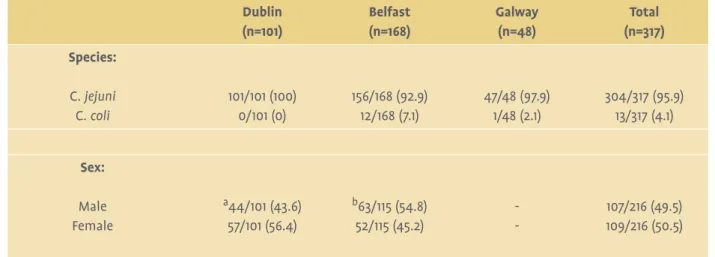
• A total of 326 human clinical isolates were collected from the collaborating Public Health Laboratories during the period 2001–2003. A breakdown of species (where available) for these isolates from the three population centres is provided in Table 2. Overall, Campylobacter jejuniaccounted for 95.9% of isolates, withCampylobacter coli accounting for the remaining 4.1% of clinical isolates.
Table 2:Speciation of Campylobacterclinical isolates and gender distribution of human cases.
Dublin Belfast Galway Total
(n=101) (n=168) (n=48) (n=317)
Species:
C. jejuni 101/101 (100) 156/168 (92.9) 47/48 (97.9) 304/317 (95.9)
C. coli 0/101 (0) 12/168 (7.1) 1/48 (2.1) 13/317 (4.1)
Sex:
Male a44/101 (43.6) b63/115 (54.8) - 107/216 (49.5)
Female 57/101 (56.4) 52/115 (45.2) - 109/216 (50.5)
Results are expressed as the number positive/total number of isolates tested with % samples positive in parentheses.
a,bDenotes statistical significance when geographical locations were compared (P ≤0.05).
- = no data available.
• Data pertaining to the gender of patients from which isolates were recovered are also presented in Table 2. Overall, clinical isolates collected during this study affected approximately equal proportions of males and females. However, there appears to be some geographical variation with 43.6% of males affected in Dublin compared with 54.8% in Belfast, whereas the reverse was the case for females - Dublin 56.4%
compared with 45.2% in Belfast.
• Overall, the highest prevalence of campylobacteriosis occurred in the 21-30 year old age group (25.9%).
Other age groups where high numbers of cases occurred were in the 31-40 (17.6%), 0-5 (14.1%) and 41-50 (13.2%) year old age groups.
3.3. Phenotypic antimicrobial resistance profiles of food and clinical Campylobacter isolates
• The antimicrobial resistance profiles of Campylobacter isolates obtained from food and human clinical cases during 2001 and 2002 are compared in Figure 1. Similar trends in antimicrobial resistance were observed in isolates from the two sources.
Figure 1:Comparison of the antibiotic resistance profiles of Campylobacterisolates of food and human clinical origin:
AMP = ampicillin, ERY = erythromycin, TET = tetracycline, CIP = ciprofloxacin, NAL = nalidixic acid, STR = streptomycin, CHL
= chloramphenicol, TRI = trimethoprim, CEF = ceftiofur.
• Extremely high numbers of both food and clinical isolates were resistant to trimethoprim, with greater than 90% of isolates recovered in 2001 from both sources found to be resistant. This may have resulted from interference by blood contained in the agar with resistance profiles of isolates tested using this antimicrobial. As a consequence, it was decided to replace this antimicrobial with ceftiofur for isolates screened during 2002 (n=253). Overall, 64.4% of both food and clinical isolates were resistant to ceftiofur.
• A large number of food isolates were resistant to a range of the antimicrobials tested. Relatively high levels of resistance were also observed for ampicillin (24.5%), tetracycline (11.9%), nalidixic acid (13.9%) and ciprofloxacin (14.4%). Lower prevalences of resistant isolates were observed when screened using erythromycin (6.3%), streptomycin (9.1%) and chloramphenicol (7.8%).
• Considerable resistance was also observed among human clinical isolates to several of the antimicrobials tested. A total of 17.2% of isolates were resistant to ampicillin, 13.5% to ciprofloxacin, 16.9% to nalidixic acid, 11.0% to tetracycline and 98.6% and 64.4% resistant to trimethiprim and ceftiofur, respectively. Lower frequencies of resistance were found in isolates to erythromycin (7.4%), streptomycin (9.8%) and chloramphenicol (5.2%).
• A considerable number of isolates of both food and human origin were found to be resistant to more than one antimicrobial: 323 (81.2%) strains of food origin and 304 (93.2%) strains isolated from humans (Figure 2).
Figure 2:Prevalence of multi-drug resistance in Campylobacterisolates of food and human origin collected between 2001 and 2003 on the island of Ireland.
• Overall, 39 food isolates (9.9%) and 30 clinical isolates (9.2%) were found to be resistant to 4 or more antimicrobials. Small numbers of both food (12/395) and clinical isolates (7/304) were resistant to 7 or 8 of the antimicrobials tested.
• Some variations in antimicrobial resistance profiles were observed between the three geographical locations studied. For example, significantly lower levels of resistance to nalidixic acid were observed in food isolates originating from Galway (9.5%) when compared to corresponding isolates from either Belfast (19.1%) or Dublin (14.3%) (P ≤0.05). A significantly higher proportion of Dublin food isolates (13.1%) were resistant to streptomycin compared with either those recovered from Belfast (6.4%) or Galway (5.6%) samples (P ≤0.05).
These differences in resistance based on geographical location were not observed in human clinical isolates with the exception of tetracycline, where the number of resistant isolates from Dublin and Galway were significantly higher than corresponding strains from Belfast (P ≤0.05).
3.4. Analysis of genotypic profiles
• In total 600 Campylobacterisolates originating from both humans and foods were collected for genotypic characterisation over the duration of the study. Of these, 453 (308 food isolates and 145 human clinical isolates) were successfully genotyped using flagellin gene analysis (fla), Pulsed Field Gel Electrophoresis (PFGE) and Amplified Fragment Length Polymorphism (AFLP) profiling techniques. It did not prove possible to successfully genotype 147 of the 600 isolates due to either the existence of mixed or co- cultures (n=40), failure to resuscitate a number of isolates from frozen storage (approximately 60 isolates), or the failure of a number of isolates to provide acceptable patterns.
• A comprehensive database containing AFLP, PFGE and flaprofiles was set up combining information generated by each of the collaborating laboratories. Genoprofiling and cluster analysis of isolates was carried out using Fingerprinting II software, version 3 (Bio-Rad Laboratories, Inc.). For the purposes of this study, all isolates clustering at 90% or greater were considered indistinguishable.
3.5. Similarity between Campylobacter strains isolated from food and human clinical cases (Cluster analysis)
• Figure 3 summarises the distribution of food and human clinical isolates within clusters formed when results of four different typing approaches were analysed. Fla (Hinf), Fla (Dde), Fla(Hinfand Dde
composite) and PFGE typing resulted in 69, 183, 182 and 257 clusters of isolates, respectively. The number of isolates within clusters ranged from 1 to 258 isolates.
Figure 3:Distribution of food and human clinical isolates within clusters obtained by four different molecular typing methods.
• When PFGE, the most discriminative typing method, was used 28.3% (41/145) clinical isolates and 28.9%
(89/308) food isolates clustered together into 21 different clusters.
• AFLP analysis proved to be relatively quick and highly discriminatory, but its reproducibility with C. jejuni requires more investigation before it could be recommended as a routine analytical technique.
3.6. Prevalence of Campylobacter in companion animals
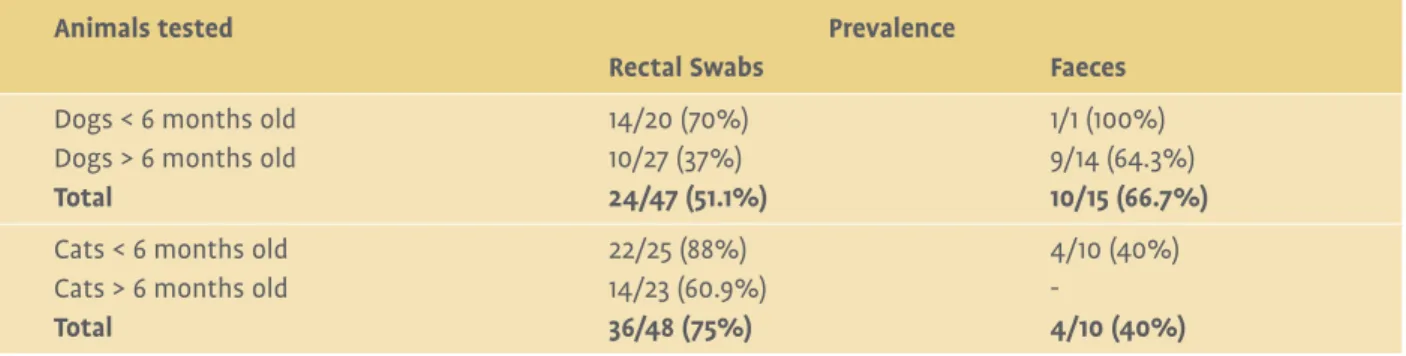
• Culture of rectal swabs yielded a Campylobacterspp. isolation rate of 51.1% in dogs and 75% in cats in Shelter 1 in Dublin (Table 3).
Table 3:Prevalence of Campylobacterspp. in rectal swabs and faecal samples from dogs and cats in Shelter 1 located in Dublin.
Animals tested Prevalence
Rectal Swabs Faeces
Dogs < 6 months old 14/20 (70%) 1/1 (100%)
Dogs > 6 months old 10/27 (37%) 9/14 (64.3%)
Total 24/47 (51.1%) 10/15 (66.7%)
Cats < 6 months old 22/25 (88%) 4/10 (40%)
Cats > 6 months old 14/23 (60.9%) -
Total 36/48 (75%) 4/10 (40%)
• There was a significant correlation of age and species associated with the recovery of campylobacters.
Dogs and cats younger than six months had a higher isolation rate of Campylobacter spp. and cats had a significantly higher prevalence than dogs (P ≤0.05, Chi square test).
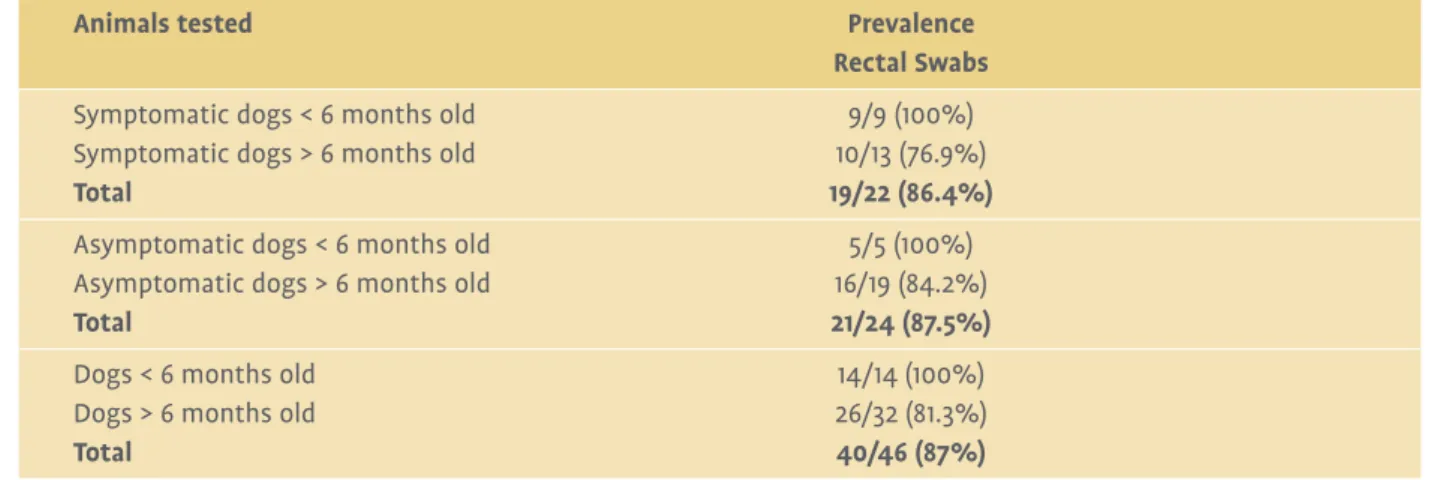
• In Shelter 2 in Belfast, an overall prevalence of Campylobacter spp. of 87% was found in dogs (Table 4), however, there was no statistically significant difference between the age groups (P ≤0.05).
Table 4:Prevalence of Campylobacterspp. in rectal swabs from dogs in Shelter 2 located in Belfast.
Animals tested Prevalence
Rectal Swabs
Symptomatic dogs < 6 months old 9/9 (100%)
Symptomatic dogs > 6 months old 10/13 (76.9%)
Total 19/22 (86.4%)
Asymptomatic dogs < 6 months old 5/5 (100%)
Asymptomatic dogs > 6 months old 16/19 (84.2%)
Total 21/24 (87.5%)
Dogs < 6 months old 14/14 (100%)
Dogs > 6 months old 26/32 (81.3%)
Total 40/46 (87%)
• The prevalence of Campylobacter spp. in symptomatic dogs compared to asymptomatic dogs was similar with 86.4% and 87.5% of animals infected, respectively.
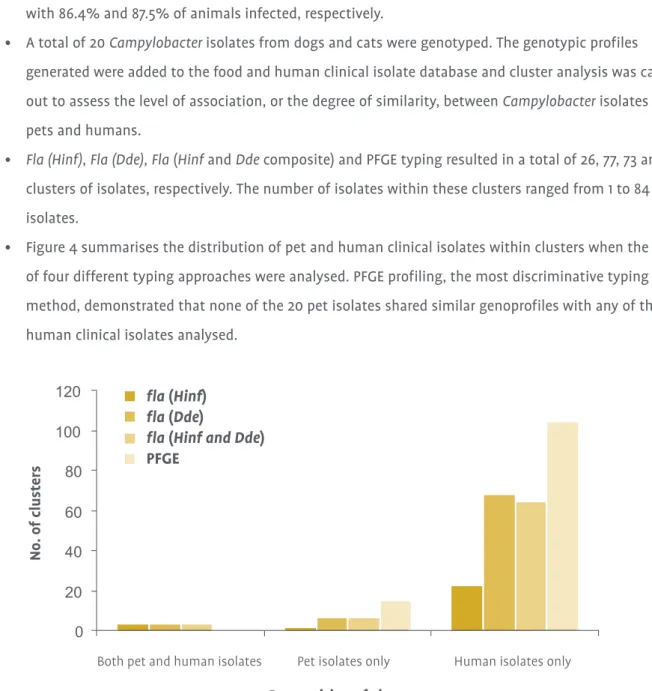
• A total of 20 Campylobacter isolates from dogs and cats were genotyped. The genotypic profiles generated were added to the food and human clinical isolate database and cluster analysis was carried out to assess the level of association, or the degree of similarity, between Campylobacterisolates from pets and humans.
• Fla (Hinf), Fla (Dde), Fla(Hinfand Ddecomposite) and PFGE typing resulted in a total of 26, 77, 73 and 119 clusters of isolates, respectively. The number of isolates within these clusters ranged from 1 to 84 isolates.
• Figure 4 summarises the distribution of pet and human clinical isolates within clusters when the results of four different typing approaches were analysed. PFGE profiling, the most discriminative typing method, demonstrated that none of the 20 pet isolates shared similar genoprofiles with any of the 145 human clinical isolates analysed.
Figure 4:Distribution of pet (n=20) and human clinical isolates (n=145) within clusters obtained by four different molecular typing methods.
fla (Hinf) fla (Dde)
fla (Hinf and Dde) PFGE
Campylobacter and foods
A wide range of retail foods was screened for the presence of Campylobacter. Overall, 543 of the 2,391 food samples tested were found to be contaminated with the organism. The most prevalent species recovered from food samples was C. jejuni(83.4%). The remaining 16.6% of isolates were identified as C. coli. With the exception of raw chicken, no significant differences in the prevalence of Campylobacterwere observed between Dublin, Belfast and Galway for any of the foods of animal origin examined.
Poultry samples were most frequently contaminated with Campylobacterwith mean isolation rates from the three population centres of 49.9%, 37.5% and 45.8% from broiler, turkey and duck samples, respectively. All of the poultry samples purchased were domestically produced on the island of Ireland. Isolation rates of Campylobacterin chicken samples from Galway were significantly lower compared to Dublin samples (P≤ 0.05). A previous UK Food Standards Agency survey found that 77% of retail poultry carcasses in NI were contaminated with Campylobacter(Anonymous, 2001). In a Food Safety Authority of Ireland study, 53% of raw poultry samples in the ROI were Campylobacter-positive (Anonymous, 2002b). These findings are in close agreement with the prevalences observed on raw retail poultry sampled for the current study.
Campylobacter jejuniwas the most prevalent species identified from poultry samples with 84.7%, 84.8% and 81.8% of isolates recovered from chicken, turkey and duck, respectively. All of the remaining isolates from these samples were identified as C. coli. This finding is in agreement with previous studies reporting
prevalences of C. jejunion raw poultry ranging from 80% to 98% (Kwiatek et al., 1990; O’Sullivan et al., 2000;
Nielsen et al., 1997; Jorgensen et al., 2002).
Campylobacterwas recovered at lower prevalences in retail meat samples from other food animal species, with isolations of 3.2% (beef), 5.1% (pork) and 11.8% (lamb) observed. Campylobacter jejuniwas the most prevalent Campylobacterspecies recovered from beef and lamb samples with 85.7% and 87.1% of isolates confirmed as C. jejuni, respectively. The remaining isolates recovered from these samples were confirmed as C. coli. Conversely, the dominant species observed in retail pork samples was C. coli(90%) with the
remainder of isolates confirmed as C. jejuni(10%).
Some processed ready to eat foods of animal origin were examined, including pork pâtés and puddings.
From these, Campylobacterwas recovered from a single jar of pâté out of 120 sampled (0.8%). No viable Campylobacterwas recovered from pork-based puddings (a comminuted pork product also containing grain
Discussion and Conclusions
4.
and dry seasonings). Pigs and pork carcasses have been recognised as a reservoir for Campylobacter,
particularly C. coli. Madden et al. (2000) recovered Campylobacterfrom 100% of postmortemanal swabs from pigs in NI, while Nielsen et al. (1997) reported a prevalence of 46% in pig faeces. Other studies have reported varying levels of Campylobacterisolation from pork, ranging from 0% to 56% (Epling et al., 1993; Zanetti et al., 1996; Ono and Yamamoto, 1999; Pezzotti et al., 2003). The dominant Campylobacterspecies isolated from pork previously was C. coli, which is in agreement with the current study.
The prevalence of Campylobacterin beef samples was relatively low at 3.2%. Other studies have also demonstrated low prevalences in beef, with 0%, 0.9%, and 1.3% isolated by Ono and Yamamoto (1999), Kwiatek et al. (1990), and Pezzotti et al. (2003), respectively. In the present study, 11.8% of retail lamb samples were found to be Campylobacter-positive; these levels are higher than previously reported data (Edwards, 1999; Raji et al., 2000). Higher prevalences may have resulted from cross-contamination during boning and packing, particularly in small butcher shops where there may have been closer proximity to meat from other food animal species.
A total of three shellfish samples were found to be positive for Campylobacter, which corresponded to 2.3%
of the raw samples screened in this food category. The seafoods examined in our study were all raw specimens and do represent a significant risk to public health as shellfish, in particular oysters, are often consumed raw. All three isolates were subsequently confirmed as C. jejuniand all were found in raw oysters, with no Campylobacterorganisms detected in any of the other seafoods tested. The consumption of
contaminated shellfish has been implicated in foodborne illness (Abeyta et al., 1993). Higher prevalences of Campylobacterto those obtained in the current study have been reported previously in shellfish. In a report from NI, Wilson and Moore (1996) found Campylobacterin 42% of shellfish tested. It would appear that the levels of contamination in shellfish are directly associated with the microbiological quality of waters in which shellfish are cultured and harvested.
A low prevalence of Campylobacterwas also observed in retail mushrooms with two samples found to be positive from 217 batches sampled (0.9%) which contrasts with the findings of McMahon and Wilson (2001), who did not recover the organism from fresh organic mushrooms. Both mushroom Campylobacterisolates recovered in the current study were confirmed as C. jejuni. Again, the prevalence of campylobacters in mushrooms could represent a risk to public health as they are sometimes consumed without cooking.
Transmission of Campylobacterinfections to humans via the consumption of raw milk is acknowledged with numerous outbreaks and cases previously reported (Finch and Blake, 1985; Hargrett-Bean, et al., 1988).
Campylobacterwas detected in one bulk tank raw milk sample out of a total of 62 examined (1.6%) in this study. The isolate was speciated as C. coli. Previous studies have also recovered Campylobacterfrom raw milk with prevalences of up to 12.3% reported (Humphrey and Hart, 1988, Rohrbach et al., 1992). In Ireland, all retail liquid milk must be pasteurized as a minimum heat treatment. Therefore, most of the public would not be exposed to contaminated raw milk. However, the consumption of raw milk by farm families is still widespread and could pose a potential risk to public health.
Campylobacterwas not isolated from ready-to-eat retail sandwiches, prepared salads and vegetables or cheeses made from unpasteurised milk. These foods would be unlikely to be contaminated with
Campylobacterunless they acquired the organism during preparation as a result of cross-contamination.
Previous studies have also failed to detect Campylobacterin vegetables and unpasteurised cheeses (McMahon and Wilson, 2001; Allmann et al., 1995).
No apparent pattern in the seasonality of Campylobacterprevalences was observed in this study. Prevalences found in chicken sampled in Dublin, Galway and Belfast varied greatly between seasons and ranged from 28.5% to 70.4%. In Europe, it is recognised from public health surveillance data that the numbers of human campylobacteriosis cases peak during the summer months (Altekruse et al., 1999; Sopwith et al., 2003).
Furthermore, other studies have shown an increase in the prevalence of infected live broiler flocks during these months (Altekruse et al., 1994). In the current study, seasonal peaks were not observed in retail chicken samples. It is suggested that the effect of seasonality observed in live birds may have been negated as a result of extensive cross-contamination during slaughter and processing, resulting in irregular and frequently high levels of positive samples year round.
In conclusion, a high prevalence of Campylobacterwas found in retail foods of animal origin from the three population centres on the island of Ireland. In particular raw poultry meat was most frequently
contaminated with Campylobacterspp. However, other foods also represent a lower but potentially significant source of Campylobacterin the food chain, particularly, other meats (including beef, lamb and pork), shellfish and raw milk.
Antimicrobial resistance of campylobacters of human clinical and food origin
Although most human clinical cases of campylobacteriosis are self-limiting, antimicrobial therapy is occasionally necessary to treat severe or recurrent infections. Erythromycin is normally the favoured antimicrobial where chemotherapy is required, with fluoroquinolones such as ciprofloxacin also used to a lesser extent. As a result, surveillance of resistance among Campylobacterpopulations of both food and human origin to clinically relevant antimicrobials is important in terms of public health protection.
High prevalences of antimicrobial resistance were observed among both human clinical and food Campylobacterisolates. Overall, similar resistance patterns were observed to the range of antimicrobials tested in the two groups of isolates (food and clinical). The highest levels of resistance for both food and human clinical isolates were observed for trimethoprim and ceftiofur. A total of 92.4% and 98.6% of food and clinical isolates, respectively, were resistant to trimethoprim. Overall, 64.4% of both food and clinical isolates were resistant to ceftiofur.
Some variations in resistance profiles were observed between the geographical locations studied. For example, significantly lower levels of resistance to nalidixic acid were observed in food isolates originating from Galway (9.5%) when compared to corresponding isolates from either Belfast (19.1%) or Dublin (14.3%) (P≤0.05). A significantly higher proportion of Dublin food isolates (13.1%) were resistant to streptomycin compared with either those recovered from Belfast (6.4%) or Galway (5.6%) samples (P≤0.05). These differences in resistance based on geographical location were not observed in human clinical isolates with the exception of tetracycline, where the number of resistant isolates from Dublin and Galway were significantly higher than corresponding strains from Belfast (P≤0.05).
A wide variation in antimicrobial resistance profiles was observed for food isolates originating from different food animals. Overall, Campylobacterisolates from both poultry and pork samples demonstrated a higher and broader spectrum of resistance to the antimicrobials tested in this study than those from beef or lamb.
This could be a result of differences in production systems and husbandry practices applied to produce these food animals. The intensive high throughput systems used to produce both pigs and poultry may result in an increased necessity to medicate animals to treat infectious diseases, thereby exerting increased selective pressures on enteric pathogens, including Campylobacter. Also the high stocking densities associated with poultry and pig production systems may also facilitate the dissemination of these organisms within and between flocks/herds.
The current surveillance highlighted the prevalence of multi-drug resistant (MDR) campylobacters in food and clinical populations. For example, a relatively high proportion of food isolates were resistant to between 3 and 8 of the antimicrobials tested. Similar trends in MDR isolates of clinical origin were also observed. This phenomenon may be a result of the promiscuous nature of campylobacters and their ability to incorporate extraneous sequences of DNA into their genome. Another possible mechanism is the presence of an energy dependant efflux system, Cme ABC, and this has been implicated as a mechanism of resistance for multi- resistant Campylobacter.
Campylobacter and companion animals
This study demonstrated that high rates of intestinal carriage of Campylobacterare common in both cats and dogs. Furthermore, the study showed that there is a relationship between the enteric prevalence of these organisms and the age of companion animals with young kittens and puppies more susceptible to colonisation by this organism than older animals. The isolation rates in the present study were high with a prevalence of 51.1% (24/47) in dogs and 75.0% (36/48) in cats in Shelter 1 (located in Dublin) and 87.0%
(40/46) in dogs in Shelter 2 (located in Belfast).
Comparative analysis of food, clinical and pet Campylobacter isolates
By applying several fingerprinting techniques, the current study has identified a number of interesting findings pertaining to the relationships between Campylobacterpopulations found in humans, foods and companion animals on the island of Ireland. It is concluded that the extent of these associations or levels of similarity between isolates is dependent on the typing techniques applied. For instance, it was observed that flagellin (fla) gene typing was the least discriminative of the techniques used while both PFGE and AFLP allowed for a more detailed and discriminative comparison to be made. On analysis of the typing patterns using the Bionumerics software and evaluation of the comparative dendrograms produced from isolates of food and human clinical origin, it was consistently observed that there is a high level of diversity within and between populations of Campylobacter. This extensive strain diversity found within both foods and humans makes it difficult to identify predominant vehicles of infection. It also suggests that the epidemiology of Campylobacterin food animal production systems is highly complex and multifaceted. Furthermore, the degree of heterogeneity suggests that there are multiple reservoirs in the environment and food chains
responsible for the infection of food animals and humans. The high level of diversity observed may also in part be explained by the high evolutionary rate of genomic DNA acquisition and deletions in
campylobacters. However, it was found that a considerable number of both food and human clinical isolates produced indistinguishable profiles, which implicates foods, and in particular poultry, as a significant vehicle in the transmission of Campylobacterto humans.
The extent of overlap or degree of similarity between pet and human Campylobacterisolates was also dependent on the typing method employed. Extensive multi-isolate clustering composed of both pet and food isolates was observed when fla (Hinf)typing was applied, however, substantially lower level of mixed clusters were observed when fla (Dde)or combined Hinfand Ddeanalyses were compared. No mixed clusters containing indistinguishable strains of both human and pet isolates were observed when the more
discriminative PFGE typing method was applied. This may be a result to some extent of the low numbers of pet isolates typed during this study. Direct contact between carrier animals and humans is a potential route of infection with Campylobacter, however, the results of this study strongly indicate that pets play a less significant role in the epidemiology of campylobacteriosis than consumption of contaminated foodstuffs.
• Campylobacterwas found to be a common contaminant of poultry (chicken 49.9%, turkey 37.5% and duck 45.8%) in the three population centres studied (Dublin, Belfast and Galway), with lesser isolation rates from beef (3.2%), pork (5.1%), lamb (11.8%), pork pâté (0.8%), oysters (2.3%), mushrooms (0.9%) and raw milk (1.6%).
• Campylobacter jejuni was the most prevalent species (83.4%) in all foods except pork where C. coli predominated.
• C. jejuniwas also the most prevalent species (95.9%) isolated from human cases of campylobacteriosis in the three population centres.
• PFGE proved to be a more discriminative genotyping method for Campylobacterthan flagellin gene (fla) typing.
• Genotyping by PFGE followed by cluster analysis using Fingerprinting II software (BioRad Laboratories, Inc.) revealed that 28.3% of human clinical Campylobacter isolates and 28.9% of food isolates shared common genotypic profiles, which demonstrates the significant role food, and in particular poultry products, plays in the epidemiology of Campylobacterinfection in humans.
• Similar trends in antimicrobial resistance were observed for food and human clinical Campylobacter isolates.
• Multi-drug resistance was observed amongst both food and clinical Campylobacterisolates, with 81.2% of food isolates and 93.2% of human clinical isolates found to be resistant to more than one of the nine antimicrobials studied.
• High Campylobactercarriage rates were observed in dogs and cats at two animal shelters in Dublin and Belfast. Young dogs and cats (< 6 mths), in particular, had high isolation rates of Campylobacter.
• Campylobacterisolates from dogs and cats did not cluster with any of the human clinical isolates when typed by PFGE, the most discriminative of the typing methods. This suggests that cats and dogs play a less significant role in the transmission of Campylobacter to humans than food.
Summary of Key Findings
5.
Abeyta, C., Deeter, F.G., Kaysner, C.A., Stott, R.F. and Wekell, M.M. 1993. Campylobacter jejuniin Washington State shellfish growing bed associated with illness. Journal of Food Protection 56, 323-325.
Adak, G.K., Cowden, J.M., Nicholas, S. and Evans, H.S. 1995. The Public Health Laboratory Service national case-control study of primary indigenous sporadic cases of Campylobacterinfection. Epidemiology and Infection 115, 15-22.
Allmann, M., Hofelein, C., Koppel, E., Luthy, J., Meyer, R., Niederhauser, C., Wegmuller, B. and Candrian, U. 1995.
Polymerase chain reaction (PCR) for detection of pathogenic microorganism in bacteriological monitoring of dairy products. Research in Microbiology 146, 85-97.
Altekruse, S.F., Hunt, J.M., Tollefson, L.K. and Madden, J.M. 1994. Food and animal sources of human Campylobacter jejuniinfection. Journal of the American Veterinary Medical Association 204, 57-61.
Altekruse, S.F., Swerdlow, D.L. and Stern, N.J. 1998. Campylobacter jejuni. Veterinary Clinics of North America:
Food Animal Practice 14, 31-40.
Altekruse, S.F., Stern, N.J., Fields, P.I. and Swerdlow, D.L. 1999. Campylobacter jejuni– an emerging foodborne pathogen. Emerging and Infectious Diseases 5, 28-35.
Anonymous. 2000a. European Commission. Opinion of the Scientific Committee on Veterinary Measures relating to Public Health on Foodborne Zoonoses. Brussels: Health and Consumer Protection Directorate- General. http://www.europa.eu.int/comm/food/fs/sc/scv/out32_en.pdf
Anonymous. 2000b. Report of the study of infectious intestinal disease in England. Food Standards Agency.
The Stationery Office, London.
Anonymous. 2000c. "Campynet" prototype standardised protocol for Pulse-Field Gel Electrophoresis-based DNA typing of Campylobacter jejuniand Campylobacter coli. http://www.campynet.vetinst.dk/PFGE.html
Anonymous, 2001. Salmonellain retail chicken drops to all time low, but the battle with Campylobacter continues. Food Standards Agency. http://www.foodstandards.gov.uk/wales/pressrelease/lowsalmonellainchicken
References
Anonymous. 2002a. Control of Campylobacterspecies in the food chain. Food Safety Authority of Ireland Report, pp. 1-42. ISBN 1-904465-00-5.
Anonymous. 2002b. Poultry monitoring report. Draft report of the Food Safety Authority of Ireland.
http://www.fsai.ie
Anonymous. 2002c. Outbreak of Campylobacter jejuniinfections associated with drinking unpasteurised milk procured through a cow-leasing programme - Wisconsin, 2001. Morbidity and Mortality Weekly Report 51, 548-549.
Anonymous. 2002d. Performance standards for antimicrobial susceptibility testing; Twelfth information supplement, NCCLS, Pennsylvania.
Anonymous. 2004a. Laboratory reports of Campylobacterspp. (all specimen types). Communicable Disease Surveillance Centre, Northern Ireland. http://www.cdscni.org.uk/surveillance/Gastro/Campylobacter_sp.htm
Anonymous. 2004b. Campylobacterspp. Laboratory Reports of Faecal isolates – England and Wales 1986-2003. Health Protection Agency.
Berndtson, E., Tivemo, M. and Engvall, A. 1992. Distribution and numbers of Campylobacterin newly slaughtered broiler chickens and hens. International Journal of Food Microbiology 15, 45-50.
Blaser, M.J., 1997. Epidemiologic and clinical features of Campylobacter jejuniinfections. Journal of Infectious Diseases 176 (suppl), S103-105.
Bolton, F.J. and Robertson, L. 1982. A selective medium for isolating Campylobacter jejuni/coli. Journal of Clinical Pathology 35, 462-467.
Burnens, A.P., Angeloz-Wick, B. and Nicolet J. 1992. Comparison of Campylobactercarriage rates in diarrheic and healthy pet animals. Journal of Veterinary Medicine 39, 175-180.
Edwards, D.S., 1999. High voltage electrical stimulation: its effect on microbial contamination of lamb carcases in a commercial abattoir. Meat Science 52, 387-389.
Endtz, H.P., Vliegenthart, J.S., Vandamme, P., Weverink, H.W., van den Braak, N.P., verbrugh, H.A. and van Belkum, A. 1997. Genotypic diversity of Campylobacter lariisolated from mussels and oysters in
The Netherlands. International Journal of Food Microbiology 34, 79-88.
Engvall, E.O., Brandstrom, B., Andersson, L., Baverud, V., Trowald-Wigh, G. and Englund, L., 2003.
Isolation and identification of thermophilic Campylobacterspecies in faecal samples from Swedish dogs.
Scandinavian Journal of Infectious Disease35, 713-718.
Epling, L.K., Carpenter, J.A. and Blankenship, L.C. 1993. Prevalence of Campylobacterspp. and Salmonellaspp. on pork carcasses and the reduction effected by spraying with lactic acid. Journal of Food Protection 56, 536-537.
Finch, M.J. and Blake, P.A. 1985. Foodborne outbreaks of campylobacteriosis: the United States experience, 1980-1982. American Journal of Epidemiology 22, 262-268.
Fitzgerald, M., Bonner, C., Foley, B. and Wall, P.G. 2001. Analysis of outbreaks of infectious intestinal disease in Ireland: 1998 and 1999. Irish Medical Journal 94, 140-144.
Fleming, M.P. 1983. Association of Campylobacterjejuni with enteritis in dogs and cats. Veterinary Record 113, 372-374.
Foley, B., Garvey, P. and McKeown, P. 2003. Campylobacteriosis in Ireland, 2001. Epi-Insight 4, 2-3.
Foley, B. and McKeown, P. 2002. Report on Campylobacteriosis in Ireland, 2001. National Disease Surveillance Centre, Dublin, Ireland, 1-9.
Friedman, C.R., Neimann, J., Wegener, H.C. and Tauxe, R.V. 2000. Epidemiology of Campylobacter jejuniinfections in the United States and other industrialized nations. In: Campylobacter, 2nd Edition p 121-138. Eds: I. Nachamkin and M.J. Blaser. American Society for Microbiology, Washington DC.
Frost, J.A., Gillespie, I.A. and O’Brien, S.J. 2002. Public health implications of Campylobacteroutbreaks in England and Wales, 1995-9: epidemiological and microbiological investigations. Epidemiology and Infection 128, 111-118.
Gillespie, I.A., O’Brien, S.J., Adak, G.K., Tam, C.C., Frost, J.A., Bolton, F.J., Tompkins, D.S., and others. 2003.
Point source outbreaks of Campylobacter jejuniinfection - are they more common than we think and what might cause them? Epidemiology and Infection 130, 367-375.
Gillespie, I.A., O’Brien, S.J., Frost, J.A., Adak, G.K., Horby, P., Swan, A.V., Painter, M.J., Neal, K.R., and others.
2002. A case-case comparison of Campylobacter coliand Campylobacter jejuniinfection: A tool for generating hypotheses. Emerging and Infectious Diseases 8, 937942.
Hahn, A.F. 1998. Guillain-Barré syndrome. Lancet 352, 635-641.
Hargrett-Bean, N.T., Pavia, A.T., Tauxe, R.V., 1988. Salmonellaisolates from humans in the United States, 1984- 1986. Morbidity and Mortality Weekly Rep. 37(no. SS-2), 25-31.
Hudson, J.A., Nicol, C., Wright, J., Whyte, R. and Hasell, S.K. 1999. Seasonal variation of Campylobactertypes from human cases, veterinary cases, raw chicken, milk and water. Journal of Applied Microbiology 87, 115-1124.
Humphrey, T.J. and Hart, R.J.C. 1988. Campylobacterand Salmonellacontamination of unpasteurised cow’s milk on sale to the public. Journal of Applied Bacteriology 65, 463-467.
Humphrey, T.J., Martin, K.W., Slader, J. and Durham, K. 2001. Campylobacterspp. in the kitchen: spread and persistence. Journal of Applied Microbiology, 90, 115S-120S.
Jeffery, J.S., Tonooka, K.H. and Lozano, J. 2001. Prevalence of Campylobacterspp. from skin crop, and intestine of commercial broiler chicken carcasses at processing. Poultry Science 80, 1390-1392.
Jorgensen, F., Bailey, R., Williams, S., Henderson, P., Wareing, D.R.A., Bolton, F.J., Frost, J.A. Ward, L. and Humphrey, T.J. 2002. Prevalence and numbers of Salmonellaand Campylobacterspp. on raw, whole chickens in relation to sampling methods. International Journal of Food Microbiology 76, 151-164.
Kaplan, J.E., Schonberger, L.B., Hurwitz, E.S. and Katona, P. 1983. Guillain-Barré syndrome in the United States, 1978-1981: additional observations from the national surveillance system. Neurology 33, 633-637.
Kapperud, G., E. Skjerve, N. H. Bean, S. M. Ostroff and J. Lassen. 1992. Risk factors for sporadic Campylobacter infections: results of a case-control study in southeastern Norway. Journal of Clinical Microbiology 30, 3117- 3121.
Keener, K.M., Bashor, M.P., Curtis, P.A., Sheldon, B.W. and Kathariou, S. 2004. Comprehensive review of Campylobacterand poultry processing. Comprehensive Reviews in Food Science and Food Safety 3, 105-116.
Kokotovic, B. and On, S.W.L. 1999. High-resolution genomic fingerprinting of Campylobacter jejuniand Campylobactercoli by analysis of amplified fragment length polymorphisms. FEMS Microbiology Letters 173, 77-84.
Kwiatek, K., Wojton, B. and Stern, N.J. 1990. Prevalence and distribution of Campylobacterspp. on poultry and selected red meat carcasses in Poland. Journal of Food Protection 53, 127-130.
Lopez, C.M., Giacoboni, G., Agostini, A., Cornero, F.J., Tellechea, D.M. and Trinidad, J.J. 2002. Thermotolerant Campylobacters in a defined population in Buenos Aires, Argentina. Preventative Veterinary Medicine 1719, 1-8.
Madden, R.H., Moran, L. and Scates, P. 2000. Optimising recovery of Campylobacterspp. from the lower porcine gastrointestinal tract. Journal of Microbiological Methods 42, 115-119.
Madden, R.H., Espie, W.E., Moran, L., McBride, J. and Scates, P. 2001. Occurrence of Escherichia coli O157:H7, Listeria monocytogenes, Salmonellaand Campylobacterspp. on beef carcasses in Northern Ireland. Meat Science 58, 343-346.
McMahon, M.A.S. and Wilson, I.G. 2001. The occurrence of enteric pathogens and Aeromonasin organic vegetables. International Journal of Food Microbiology 70, 155-162.
Meanger, J.D. and Marshall, R.B. 1989. Seasonal prevalence of thermophilic Campylobacterinfections in dairy cattle and a study of infection of sheep. New Zealand Veterinary Journal 37, 18-20.
Minihan, D., Whyte, P., O’Mahony, M., Fanning, S., Doyle, M. and Collins, J.D. 2004. An investigation of transport, lairage and hide cleanliness on Campylobacterprevalence in feedlot cattle and dressed carcasses.
Journal of Food Safety 24, 37-52.
Moore, J.E., Wilson, T.S., Wareing, D.R.A. and Murphy, P.G. 2003. Occurrence and characterization of
thermophilic Campylobacterspp. in a poultry processing plant in Northern Ireland. Irish Veterinary Journal, 56, 95-98.
Nachamkin, I., Bohachick, K. and Patton, C.M. 1993. Flagellin gene typing of Campylobacter jejuniby restriction fragment length polymorphism analysis. Journal of Clinical Microbiology 31, 1531-1536.
Nachamkin, I., Ung, H. and Patton, C.M. 1996. Analysis of HL and O serotypes of Campylobacterstrains by the flagellin gene typing system. Journal of Clinical Microbiology 34, 277-281.
Nachamkin, I., Allos, B.M. and Ho, T. 1998. Campylobacterspecies and Guillain-Barré syndrome. Clinical Microbiology Reviews 11, 555-567.
Nielsen, E.M., Engberg, J. and Madsen, M. 1997. Distribution of serotypes of Campylobacter jejuniand C. coli from Danish patients, poultry, cattle and swine. FEMS Immunology and Medical Microbiology, 19, 47-56.
Nishimura, M., Nukina, M., Kuroki, S., Obayashi, H., Ohta, M., Ma, J.J., Saida, T. and Uchiyama, T. 1997.
Characterisation of Campylobacter jejuniisolates from patients with Guillain-Barré syndrome. Journal of Neurological Sciences, 153, 91-99.
O’Brien, S.J., and others. 2002. Ciprofloxacin resistance in Campylobacter jejuni: case-case analysis as a tool for elucidating risks at home and abroad. Journal of Antimicrobial Chemotherapy, 50, 561-568.
On, S.W.L. and Harrington, C.S. 2000. Identification of taxonomic and epidemiological relationships among Campylobacterspecies by numerical analysis of AFLP profiles. FEMS Microbiology Letters, 193, 161-169.
Ono, K. and Yamamoto, K. 1999. Contamination of meat with Campylobacter jejuniin Saitama, Japan.
International Journal of Food Microbiology, 47, 211-219.
Orr, K.E., Lightfoot, N.F., Sisson, P.R., Harkis, B.A., Tweddle, J.L., Boyd, P., Carroll, A., Jacson, C.J., Wareing, D.R.A. and Freeman, R. 1995. Direct milk excretion of Campylobacter jejuniin a dairy cow causing cases of human enteritis. Epidemiology and Infection, 114, 15-24.
Pezzotti, G., Serafin, A., Luzzi, I., Mioni, R., Milan, M. and Perin, R. 2003. Occurrence and resistance to antibiotics of Campylobacter jejuniand Campylobacter coliin animals and meat in Northeastern Italy.