BANK ASSET SECURITIZATION BEFORE THE CRISIS:
LIQUIDITY, BANK TYPE AND RISK TRANSFER AS DETERMINANTS
MARTÍ SAGARRA MIGUEL GARCÍA-CESTONA
JOSEP RIALP
FUNDACIÓN DE LAS CAJAS DE AHORROS DOCUMENTO DE TRABAJO
Nº 690/2012
De conformidad con la base quinta de la convocatoria del Programa de Estímulo a la Investigación, este trabajo ha sido sometido a eva- luación externa anónima de especialistas cualificados a fin de con- trastar su nivel técnico.
ISSN: 1988-8767
La serie DOCUMENTOS DE TRABAJO incluye avances y resultados de investigaciones dentro de los pro- gramas de la Fundación de las Cajas de Ahorros.
Las opiniones son responsabilidad de los autores.
1
Bank asset securitization before the crisis:
Liquidity, bank type and risk transfer as determinants Martí Sagarra*
Miguel García-Cestona*
Josep Rialp*
Abstract
This paper analyzes the determinants of asset securitization in Spanish banks during the period 1999-2007. We distinguish savings banks (Cajas) from the rest of banks, mainly commercial banks, and compare both their decision to securitize or not, and the volume of securitization. Asset securitization seems to play a key role at explaining both the sector exponential growth and the deep crisis that followed. Due to the special nature of Cajas, we focus our study in these institutions, highlighting the role of some factors, such as the regulatory capital and the risk transfer. We find that those banks with greater credit risk exposure and lower liquidity are more likely to securitize, and they do it in greater amounts during the boom (pre-crisis) period. In contrast, we do not find a significant role of capital in terms of securitizing. Furthermore, for the specific case of Cajas, the only significant determinants are risk and liquidity.
JEL classification: G21; G28
Keywords: Securitization, ABS, credit risk transfer, regulatory capital arbitrage, savings banks, Spain
Corresponding author: Martí Sagarra Garcia, Department of Business Economics, Faculty of Economics and Business Studies, Universitat Autònoma de Barcelona, 08193 Bellaterra (Cerdanyola del Vallès), Spain. E-mail address: [email protected]
*Department of Business Economics, Faculty of Economics and Business Studies, Universitat Autònoma de Barcelona.
Acknowledgements: This research is part of the Project ECO2010-21393-C04-01
financed by the Spanish Ministry of Science and Innovation.
2 1. Introduction
Securitization is probably the key exponent of the intense financial innovation carried out in recent years and we want to analyze the determinants of asset securitization by banks during the pre-crisis period, 1999-2007. Securitization has played an essential role, both in the boom period and in the crisis of the financial system. In spite of the potential benefits of securitization as a powerful funding tool, there has been, in general, little detailed analysis about the real risks concerning the generated securities, or the existing conflicts of interest in some parts of the process, in particular those affecting credit rating agencies and the risk behavior of the agents. Only after the impact of the recent crisis, the European Union (EU) authorities have shown their intention to regulate and supervise more carefully. Additional measures have also been taken by the national authorities.
The volume of securitized assets worldwide has grown exponentially during the last decade, especially during the years previous to the financial turbulences. Europe has been no exception (Figure 1 shows the total securitization issuance per year in European countries). More specifically, securitization in Europe can be divided in two periods:
one period which reaches the second quarter of 2007 (until the first financial turbulences) and presents permanent high growth ratios (the total amount issued from 2000 to 2007 increased almost six-fold), and the period just after mid 2007, characterized for irregular total issuance amounts. During this last period, and due to the crisis, it has been increasingly harder for banks to sell the originated bonds in capital markets. Nevertheless, most of them have followed a strategy of holding bonds and discount them as eligible collateral in the ECB (European Central Bank) money auctions. Figure 1 also shows the relevance of Spain as one of the most active European countries in securitization activity, becoming the second most active country during the expansive years, only behind the UK.
The Spanish National Securities Market Commission (CNMV, or Comisión Nacional del Mercado de Valores) is the agency in charge of supervising and inspecting the Spanish Stock Markets along with the activities of all the participants in those markets.
This agency has pioneered the implementation of specific regulations designed to
increase the regular public reporting requirements of securitization funds. This is also
3
one of the sources for our data. Since 1992 (with the Law 19/1992 of securitization vehicles) the Spanish financial institutions were authorized to securitize mortgages, it was not until 1998 (with the Royal Decree 926/1998) that those institutions could securitize assets other than mortgages. In line with this, the securitization activity carried out by Spanish banks before 1999 remains marginal.
As mentioned above, our goal is to explain which are the factors underlying the decision of securitizing assets in Spanish banks, distinguishing also between savings banks (Cajas) and the rest of Spanish banks (commercial banks and credit cooperatives). In addition, we also analyze the significant determinants behind the total securitized amount, since the collected data allows us to deepen our most basic question and to confront the results of both analyses.
More specifically, this paper analyzes the specific determinants of asset securitization in Spanish banks for the period 1999-2007, that is, which are the factors that induced those entities to securitize their assets in a period of boom. Furthermore, we compare the Cajas results with those from the analysis of the rest of Spanish financial institutions, that is, commercial banks and credit cooperatives. Cajas represent a banking form that during last decades had reached nearly half of the Spanish credit market (commercial banks have been holding around 45% of the sector, while credit cooperatives have been maintaining the remaining 5%). While shareholders and customers are the owners of commercial banks and credit cooperatives, Cajas had a peculiar governance system.
They have no formal owners and are closer to the commercial nonprofit organizations described by Hansmann (1996), with four groups of stakeholders (employees, customers, politicians and founders) forming part of their government bodies.
Asset securitization seems to play a key role, in particular, explaining both the sector's
credit growth and the depth crisis in recent years. This fact, all together with the recent
turbulences in financial markets and the subsequent restructuring of Cajas (leading to
their disappearance in many cases) have motivated this work. Most Cajas have been
transformed or merged in the last two years. The 2007 financial crisis has put some of
these institutions under great financial difficulties and the Spanish government has been
forced to intervene to avoid further damages to the financial system. In fact, there have
4
been several restructuring plans that included a wide range of financial support measures, and most of the Cajas have eventually disappeared.
There has been some previous works conducting international comparisons. One important problem with the economic literature that covers several countries and large geographic areas is that most papers only take into account the largest and listed entities, introducing a bias that may offer an incomplete picture of reality. Other times this reality is oversimplified due to the inclusion of heterogeneous countries, or the joint analysis of many different types of financial firms. Through our emphasis in the Cajas, banks with specific corporate governance and risk features, and its comparison with the rest of Spanish financial institutions, we want to go deeper in the analysis, highlighting the role of some determinants, specifically the regulatory capital and the risk transfer factors, with important implications for future supervisory policies.
Concerning the methodology, we use multivariate techniques to carry out the analysis
and, in particular, we run logit and tobit estimations to analyze the determinants behind
the decision to securitize and the total amount securitized. We conclude that those
Spanish banks with greater exposure in terms of credit risk, and lower liquidity were
more likely to securitize. Furthermore, they did it for a greater amount during the boom
period in the Spanish credit market, although there are no conclusive results in terms of
obtaining higher performance. In contrast, the capital factor does not seem to play a
significant role. In addition, when we focus our study on the specific case of Cajas we
find risk and liquidity as the only significant factors. Furthermore, size becomes a
significant determinant of securitization in all Spanish institutions. Unlike previous
research concerning Spain, mainly Cardone-Riportella et al (2010), who center their
study on the effects differences between asset securitization and liabilities
securitization, our contribution focuses on asset securitization only, but we carry out a
more detailed analysis between the Cajas and the rest of Spanish banks, both in terms of
the securitization decision itself and the volume involved. The securitization of
liabilities is often considered as an inappropriate form of securitization, and we prefer to
insist on the relevance of other determinants, and risk transfer in particular, that we
consider more relevant. Additionally, and in order to compare our results with other
international studies, we do not focus only in the determinants of securitizing or not, we
5
have also collected and analyzed the total volume of asset securitization for a given bank. For all these goals, asset securitization is the relevant type.
The paper is organized as follows. Section 2 presents the literature review. Sections 3 and 4 describe the methodology employed, analyzing the theoretical framework and the hypotheses along with a description of the data sources and the sample used in the empirical analyses. We also propose the model containing the determinants of securitization. Section 5 presents the results of the econometric analyses and some robustness checks. Finally, section 6 discusses the empirical findings and the conclusions.
2. Literature review
The economic literature on securitization can be divided in three main streams:
theoretical studies, empirical studies about ex-ante characteristics or determinants of securitization, and empirical studies about ex-post effects of securitization.
Agostino and Mazzuca (2008) point out that some theoretical studies remark the presence of information asymmetries as the great motivator of the growth and implementation of securitization all around the world. In particular, they mention that while banks had liquidity transformation (Diamond and Dybvig, 1983) and delegated monitoring (Diamond, 1984) as two of their key functions, securitization can be an additional source of funding for entities, less likely to achieve an adequate level of portfolio diversification and in which investors or depositors would not invest a priori.
But securitization also may be used to bypass the difficulty arisen from the existence of
both credit-rationed and non credit-rationed markets, under a framework of information
asymmetries and costs. More specifically, Carlstrom and Samolyk (1993) claim about
the limitations of such theories, since the first is based on an unrealistic locally
segmented market and since neither theory can explain the key role of the credit
enhancement activity in the securitization process. Later, Wolfe (2000) argues about the
potential changes in the operational structure of deposit-taking financial institutions that
securitize assets, concluding that through securitization banks enhance their return on
capital due to the possibility of increasing their business volume of loans without having
to increase their liabilities or their capital levels. More recently, Affinito and Tagliaferri
6
(2010) argue that since banks are no longer the primary holders of illiquid assets and so securitizing banks have less incentive to monitor their borrowers, this potentially significant change in activity raises the issue of what induces (or induced) banks to revise one of their basic business activities.
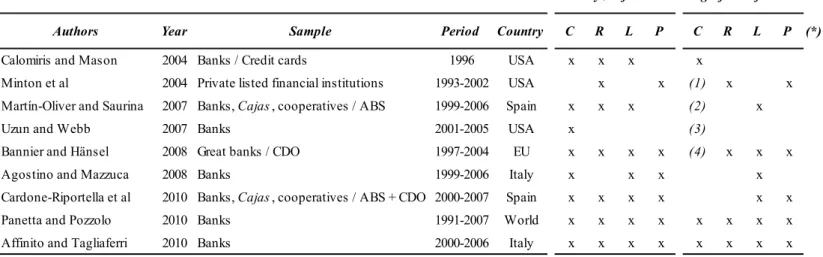
Few papers have analyzed the determinants of securitization or their ex-ante characteristics in empirical terms. Table 1 summarizes the principal empirical studies about securitization determinants and their significant findings, and shows the differences in samples and in determinants considered among papers.
Although most of the early papers focused in one, two or, at most, three main groups of determinants (Calomiris and Mason, 2004; Minton et al, 2004; Martín-Oliver and Saurina, 2007; Uzun and Webb, 2007; Agostino and Mazzuca, 2008), there seems to be a recent consensus in studies (Bannier and Hänsel, 2008; Cardone-Riportella et al, 2010; Panetta and Pozzolo, 2010; Affinito and Tagliaferri, 2010) about considering a total of four types of determinants related to liquidity, risk, capital and performance, in order to obtain a more complete vision of the problem.
Concerning the empirical studies about the ex-post effects of securitization, several authors analyze whether and to what extent the securitization influences its originator, and in some cases they check the effect for the overall financial system. More specifically, Affinito and Tagliaferri (2010) point out that some of these studies provide evidence that the option of transferring credit risk reduced the incentives of US banks to screen and monitor loans, lowering the lending standards. Agostino and Mazzuca (2008) summarize some studies about the effects of securitization on capital and risk of the originator banks, about the effects on bank loan supply and monetary policy, about the effects on performance, and finally those studies (principally done by central banks or international organizations) which remark the potential negative effects overall financial system. Finally, Allen and Carletti (2006), Hänsel and Krahnen (2007), Uhde and Michalak (2010) and Nijskens and Wagner (2011) also introduce financial stability issues in their studies.
Being the literature of securitization effects so extensive and the literature of its
determinants so scarce (as showed in Table 1 the only economic regions analyzed up to
7
date are US, EU, Italy and Spain). Then, it is not so surprising that for the case of Spain the analysis of the determinants of securitizing comes from two papers (Martin-Oliver and Saurina, 2007; and Cardone-Riportella et al, 2010). In the first paper the authors conclude that the only factor that drives Spanish financial institutions to securitize is the search for new sources of bank financing (Liquidity), while the second adds the improvement of efficiency ratios (Performance) as a key determinant. Our contribution differs from previous results in different levels. First, unlike Cardone-Riportella et al, we run separate regressions for it is based in a more specific analysis, as it is detailed in next section, between the Cajas and the rest of Spanish banks, and since it shows the relevance of other determinants and risk transfer in particular. Unlike Martin-Oliver and Saurina (2007) our data is coming from public sources (Bankscope and CNMV) rather than the data from the Bank of Spain. Recent studies about Italy (e.g. Affinito and Tagliaferri, 2010) call into question the friendly results from the previous ones (e.g.
Agostino and Mazzuca, 2008) and, and we wonder whether the case of Spain has not been an exception to this. Next, we detail our framework and the hypotheses.
3. Theoretical framework and hypotheses
We emphasize two specific features of our study which allow for a better understanding of all the significant determinants of the securitization phenomenon.
On the one hand, due to the special nature of Cajas, a banking form that during last
years has reached nearly a half of the Spanish credit market, we highlight the significant
role of factors like the regulatory capital requirements (Capital) and the exposure and
transfer of risk (Risk) factors. We highlight three reasons. First, unlike commercial
banks, the Cajas have some limits to expand their capital. They cannot issue shares, and
they depend exclusively on their reserves’ generation capacity (burdened at the same
time by their obligation to distribute part of the benefits into social works and charity)
and on the issue of preferred shares and subordinated debt, always supervised and
limited by the regulator Banco de España. Consequently, this is an argument in favor of
a major securitization activity in the Cajas respect commercial banks. Second, Cajas
face a historical problem of risk due to a strong geographic concentration of their offices
(with the only exception of the biggest entities), and a lower diversification of their
business (extremely concentrated in loans and, more specifically, in real estate loans), in
8
contrast with the case of Spanish commercial banks. Finally, due to their specific corporate governance nature, Cajas behave differently from banks in terms of governance mechanisms (Crespi et al., 2004), and they also show great differences among themselves in terms of risk taking. In addition, Cuñat and Garicano (2010) find a significant impact of the human capital of the Cajas on the risk measures of loan book composition and performance, differentiating between good and bad performers. At the moment, there are no other studies confirming these results, but, in terms of risk we expect that riskier ones would be more inclined to securitize.
On the other hand, we focus on asset securitization, and avoid the liabilities securitization (in most cases structured as CDOs backed by liabilities issued by banks, as mortgage-covered bonds named cédulas hipotecarias, treasury bonds or subordinated debt). Liabilities securitization is much smaller in terms of the total amount issued (approximately 20%, depending on the year considered) and, furthermore, asset securitization clearly reflects the behavior of Spanish banks in relation with the evolution of their credit activity in recent years. We also take into account the role and evolution of the four mentioned determinants. Entities cannot use liabilities securitization to transfer the risks associated with their assets, and consequently, one cannot expect that the transfer of credit risk, or the improvement of solvency, be the motivating factors of this type of transaction. As confirmed by Cardone-Riportella et al (2010), the only factor driving banks to securitize liabilities seems to be the need of additional liquidity. Even more, as pointed by Catarineu and Pérez (2008), the securitization of liabilities could be considered an improper securitization, since it does not concern the transfer of rights and risks related to assets, and therefore, by no means implies a mechanism for managing credit risk. In reality, these structures have become an alternative for the placement of those items in the market, at a more attractive cost than direct sale. Securitization, through the subordination of the securities issued, may achieve the highest credit rating (AAA) for almost the entire issue, exceeding in many cases the credit rating of the original bank. Therefore, we have discarded liability securitization from our analysis.
Concerning the determinants, and as we mentioned earlier, there seems to be a recent
consensus in the literature about considering four types of determinants, as potential
drivers of the securitization activity in financial institutions: the capital requirements,
9
the exposure and transfer of risk, the search for new sources of bank financing, and the improving of efficiency ratios. We review these four groups in order to construct a formal theoretical framework while enumerating the hypotheses.
The reduction of capital requirements (Capital) as a securitization driver has been studied extensively by the literature. Banks with capital ratios closer to the regulatory minimum requirements should be more inclined to securitize their assets to improve those ratios, since capital issues (e.g., shares only in the case of banks but not in Cajas, preferred shares, or subordinated debt) have a high cost, typically greater than the cost of debt. In addition, the existence of limitations to these issues imposed by the regulatory institutions, financial institutions may be inclined to reduce their lending activity rather than increasing their capital. Some authors have pointed out the risk of a regulatory capital arbitrage, in the sense of reducing the regulatory capital requirements as an opportunistic and malicious behavior, specifically during the period in which Basel I was active (the implementation of Basel II, especially since 2008, should decrease the effect of this regulatory capital arbitrage). While Pennacchi (1988) considers bank regulation as one of the incentives to securitize, a large number of posterior studies have claimed the existence of this regulatory capital arbitrage or, at least, they view the capital requirements as a strong determinant of securitization (Duffie and Garleanu, 2001; Calomiris and Mason, 2004; Ambrose et al, 2005;
DeMarzo, 2005; Uzun and Webb, 2007; Kashyap et al, 2008; Panetta and Pozzolo, 2010; Affinito and Tagliaferri, 2010, among others). Nevertheless, we can find some opposing views: Bannier and Hänsel (2008) have found a “reverse effect” of regulatory capital, that is, the more solvent entities should be more inclined to securitize, as an argument for the non existence of regulatory capital arbitrage. A plausible explanation to this is that those entities with highest capital ratios can securitize more (and thus increase non-capital liabilities) because they do not need to raise further capital. In any case, for these previous reasons, and because Cajas are limited in their options to increase their capital amount, we would expect that:
H1. Entities with lower capital ratios have a higher probability to securitize.
Financial institutions may also securitize because of their exposure to risk (Risk) but,
once again, one can find opposite theories to explain this. As summarized by Affinito
10
and Tagliaferri (2010), banks with higher risk on their assets securitize in order to transfer and reduce those risks, or their related expected losses. More specifically, loan securitization may be used as a tool in terms of credit risk transfer. In contrast, they mention also the practice of securitizing high-quality loans while retaining the loans with low-quality for different reasons (e.g., strong differences between economic capital linked to market discipline and regulated capital; asymmetric information; bank reputation; among others). Most recent studies highlight the importance of risk as a determinant for securitization (Minton et al, 2004; Bannier and Hänsel, 2008; Panetta and Pozzolo, 2010; Affinito and Tagliaferri, 2010). Concerning the Spanish case, different authors (Martin-Oliver and Saurina, 2007; Catarineu and Pérez, 2008;
Cardone-Riportella et al, 2010) have discussed the existence of duality of models in the problem of risk related to securitization activity, defending with their results the existence of a buy-and-hold model in the case of Spain (i.e., the bank loan is kept in the balance sheet until maturity, and so there cannot be an effective risk transfer), versus the originate-to-distribute model, typical of other regions, such as the US. In this last view, securitization has an effect on the incentives that the lender has to properly screen and monitor borrowers, giving an excessive reliance on the wholesale market to fund lending growth, and promoting an effective risk transfer. But we can argue against those premises. Although motivated by information asymmetries, the bank usually takes a first-loss position in the default risks of the underlying loan portfolio, raising the question about the effective extent of risk transfer in securitizations. For example, Franke and Krahnen (2007) use an European collateralized debt obligation (CDO) dataset to find how the risk of extreme unexpected losses, that is, the bad tail risk, is transferred from the bank to investors. Hänsel and Krahnen (2007) findings suggest that credit securitization goes hand in hand with an increase in the risk appetite of the issuing bank. In addition, we must take into account the moral hazard problem, especially in the case of Cajas due to their ownership structure. In terms of incentives and risk behavior, they are more exposed to abuses, as it happened to the American S&Ls in the eighties. Therefore, we proceed to formulate the following hypothesis:
H2. Riskier entities have a higher probability to securitize.
In terms of Liquidity, the search for new sources of bank financing has been pointed out
as one of the most important factors to securitize. In fact, according to some authors
11
(Martin-Oliver and Saurina, 2007; Agostino and Mazzuca, 2008) this is the only determinant behind securitization, and in almost all the remaining literature this factor has been found as a statistically significant determinant of securitization. All these results seem obvious if we think that the principal purpose of asset securitization is to convert illiquid assets into liquid ones, and that this instrument has been implemented by financial institutions in an exponential form not only during the last years of the boom period (i.e., real estate market), but also during the crisis. After 2007 it has been increasingly harder for many banks to sell the originated bonds in capital markets. The strategy followed by most of them, nevertheless, has been to hold the bonds and discount them as eligible collateral in ECB money auctions. We then expect the following:
H3. Entities with highest needs of liquidity have a higher probability to securitize.
Finally, the most recent determinant invoked by the empirical literature (Minton et al, 2004; DeMarzo, 2005; Bannier and Hänsel, 2008; Duffie, 2008; Agostino and Mazzuca, 2008; Cardone-Riportella et al, 2010; Panetta and Pozzolo, 2010; Affinito and Tagliaferri, 2010; among others) has been the need to improve efficiency ratios or profit opportunities (Performance). The results in most studies are not conclusive. As mentioned by Cardone-Riportella et al (2010), based on the risk-appetite argument, banks with a relatively superior performance should be particularly active in loan securitization. However, Affinito and Tagliaferri (2010) have summarized the reasons for which financial institutions may securitize: firstly, the overvaluation of the retained interest that is carried at fair market when market values of loans exceed their book values, secondly, the re-distribution done by financial institutions of their sold loans towards more profitable business opportunities, and finally, the securitization of loans designed specifically for an intermediation profit rather than for long-run warehousing.
In terms of Spanish banks, we expect the following:
H4. Worst performers have a higher probability to securitize.
4. Empirical analysis
4.1. Data source and sample
12
Our empirical analyses use a sample comprising all the Spanish banks stored in the Bankscope database for the period 1999-2007. This database is the source for all the explanatory variables and comprises all the population of Cajas (a total of 46 entities in 2006, just at the moment prior to the beginning of the crisis period and the restructuration of the sector). Although for some year observations, specifically in the case of the smallest institutions, there is no existing data, we eliminated those observations, jointly with those presenting abnormal ratios or extreme values, but we do not have excluded those institutions from the analysis, taking advantage of a wider and more realistic database to understand the securitization behavior in Cajas. Table 3 shows our sample composition for the asset securitization activity among Spanish banks. The database also comprises the 18 biggest commercial banks and the 7 biggest credit cooperatives, since all of them have at least one year observation in Bankscope.
The data on asset securitization activity, that is the information relating to the dependent variables considered, has been obtained from the information sent to CNMV by the financial firms for every securitization issue.
4.2. Variables
Combining both Bankscope and CNMV sources of information allows us to analyze which are the determinants of asset securitization activity in Spanish entities, detailing below all the variables considered in our analysis.
4.2.1. Dependent variables
As mentioned above, we want to explore further which are the factors behind the
decision of securitizing assets in banks. In addition, volume seems to matter and, in
order to further analyze previous results, we also consider the determinants behind the
total amount securitized. For the first analysis the dependent variable is a dichotomous
one, taking the value 1 in case the entity has securitized for a specific year, and the
value 0 in case it has not securitized that year. For the second part, the dependent
variable becomes the value of the total amount of securitized assets in a given year.
13
4.2.2. Explanatory variables
As it was mentioned earlier, there have been a number of explanations behind the decision of asset securitization. Next we list a number of variables for each one of the four possible explanations behind asset securitization.
In terms of capital requirements (Capital), we use the following alternatives:
Capital Ratio. It is the ratio which defines the level of solvency of the entity as established by the Basel Accord, that is the capital requirements for the credit and market risk weighted assets. Spanish regulation for the period analyzed required a minimum ratio of 8%.
K-Buffer. It is a ratio defined by Ayuso, Pérez and Saurina (2004) as (Regulatory Capital – Minimum Requirements) / Minimum Requirements. As pointed by Martín-Oliver and Saurina (2007), the potential econometric problem that may arise using the Capital Ratio explanatory variable is that, by definition, this measure has a lower bound in values around 8%, provided all banks maintain the level of capital established by the Basel Accord, and the variable may not well capture the actual capital buffer of a bank.
Equity / Total Assets. This ratio measures the protection of assets given by a determined level of capital and reserves, and corresponds to the classic solvency level.
The three variables are expected to show a negative influence on a bank’s propensity to securitize its assets or, in case of a “reverse effect”, a positive influence.
Concerning the exposure and transfer of risk (Risk), we consider:
Loan Loss Provisions / Net Interest Revenue. It is a ratio which measures the
credit risk provision relative to net interest income, indicating the respective
subjacent effect of credit risk in both numerator and denominator. Bannier and
14
Hänsel (2008) point out that banks may have a risk-appetite to raise their revenues, and so they securitize to free capital for new risky businesses which can report higher revenues. Furthermore, entities with high levels of risk and, therefore, a high probability of financial distress, may engage in securitization processes to fund the activity of lending instead of doing it with debt and equity.
Loan Loss Reserve / Gross Loans. It is a ratio which measures the entity’s loan portfolio coverage by the current reserves of the entity: this ratio indicates the quality of loan portfolio.
Impaired Loans / Gross Loans. This ratio measures the total amount of impaired loans over the total loans of the entity, and reflects the quality of loan portfolio in terms of the worst or doubtful loans.
The three variables are expected to show a positive influence on a bank’s propensity to securitize its assets.
In terms of searching new sources of bank financing (Liquidity), we have considered the following variables
Net Loans / (Dep + ST Funding). It measures the relation between loans and deposits as the two main asset and liability side items. In other words, this is a direct proxy to the level of liquidity of the entity.
Interbank Ratio. It measures the money lent to other financial entities over the money borrowed from other financial entities (i.e., an entity with a ratio below 100 is a net borrower and will be more inclined to securitize than a net placer entity with a ratio over 100).
Liquid Assets / (Dep + ST Funding). Quite similar to the previous ratio, but
being the numerator the most liquid assets of the entity.
15
While the second and the third variables are expected to show a negative influence on a bank’s propensity to securitize (due to a major level of liquidity showed by higher ratios), the first variable is expected to exhibit a positive effect due to the greater need of liquidity derived from a larger proportion of loans or higher growth of the loans.
Finally, in terms of improving the efficiency ratios (Performance):
CIR (Cost-to-Income Ratio). It measures the costs of running the bank, which include personnel expenses plus other operating expenses (e.g., amortizations), over the income before provisions. The lower the value of this ratio, the more efficient the bank performance becomes. Due to the fact that different markets operate with different profit margins structures, this ratio should be used only with banks under similar market conditions. In our case, all the entities inside compete within the Spanish financial market.
ROA (Return On Assets). It is defined as the return of entity profits over its total assets. It is a measure of the level of returns generated by those assets, and it is the most widely used ratio to compare the performance among financial institutions.
ROE (Return On Equity). It is defined as the return of entity profits over its equity. Since a high ratio may be influenced by an over-leveraged situation of the entity (i.e., because of low levels of equity), the results on this variable should be treated with caution. There is a potential contradiction: a high ratio of ROE should indicate a lower propensity to securitize, but this high ratio may be influenced by low levels of equity (over-leveraging) which imply a higher propensity to securitize.
Being the results in previous studies far from conclusive, the expected effect of profit development on the securitization choice is also unclear in our sample. Nevertheless, we do expect the ROA and ROE variables to present an opposite effect when compared to the CIR variable and its effect on asset securitization.
Control variables
16
Finally we include some other bank-specific regressors as control variables in order to check the results allowing for other factors.
Size (Ln TA). Since biggest entities have more resources and biggest asset portfolios to run the securitization activity, it is expected this variable will exhibit a positive influence on a bank’s propensity to securitize its assets.
Bank type. Two dummy variables are introduced to identify Cajas and credit cooperatives respectively.
Year. This variable is introduced as a dummy (for each one of the years).
Our hypotheses and explanatory variable effects over the likelihood to securitize are summarized in Table 2.
Table 4 shows the summary statistics for all the explanatory variables considered in our hypotheses. We also distinguish between the group of banks that securitize and the group of non-securitizers. While the differences between the two groups are not so clear for the case of capital indicators, we can confirm the hypothesis for the case of risk, liquidity and performance ratios. Those Spanish banks which are subject to greater risk exposure, less liquid and less profitable are more likely to perform securitization.
4.3. Model
Our goal is to correctly identify and measure the significant determinants behind the
securitization behavior of Spanish banks. We will use the most parsimonious model in
order to avoid those variables that do not add relevant information. For this we enter
the variables into the model in a stepwise fashion. This process is done by finding the
best fitting equation model, using the maximum likelihood method. To obtain the final
model with this stepwise process we have started with a base model, only composed by
the control variables (i.e. size and year dummies). Next we have added all the variables
from each group of determinants, one by one, while seeking a reduction of the
likelihood ratio (i.e., -2 log likelihood value) and controlling for a substantial
17
improvement of the chi square value, depending on the degrees of freedom considered for the new variables entered in each model.
Following the previous considerations we have run several alternative models with this stepwise manner to verify the determinants of asset securitization in banks. The final model considered is the following one:
S
i,t= b
0+ b
1· Capital Ratio
i,t-1+ b
2· Loan Loss Provisions / Net Interest Revenue
i,t-1+ b
3· Net Loans / (Dep + ST Funding)
i,t-1+ b
4· CIR
i,t-1+ b
5· Size (Ln TA)
i,t-1+ b
6· Bank type
i,t+ b
7· Year
i,t+ ε
i,tS is the dependent variable and refers to the bank asset securitization, while the group of explanatory variables is composed by proxy variables for the four main determinants of securitization, and by the group of control variables. Each bank is denoted by the sub- index i, while the sub-index t refers to the time period (year).
To deal with potential problems of endogeneity we have performed all the analyses taking the explanatory variables or regressors with a one-period lag. On the other hand, since we are using panel data for our estimations, all the models are run using random effects to deal with the unobserved heterogeneity across entities that the explanatory variables cannot capture. A simple model assumes that the regression constant is the same for all cross-sectional units. However, it is likely that we need to control the
“individual” character in each entity. One problem with fixed effect estimations is that it is no longer possible to separate, in discrete choice models, the parameters accompanying the regressors in the likelihood function from the parameters of the effects (in case of being fixed, they are dummies and, therefore, they come with their respective parameters). Under these circumstances we cannot obtain consistent (unbiased) estimators. Finally, regressors must be strictly exogenous, so the model cannot be dynamic.
In our first approach, we use both logit and probit models to predict the probability that
a Spanish bank securitizes its assets, being S
i,ta dichotomous dependent variable with
value 1 for the case the entity has issued securities a specific year, and value 0 in case it
has not securitized that year. Probit results are not shown in this paper but they are
18
available upon request. Although both logit and probit analyses are quite similar (the logit analysis is based on the log of the odds, while the probit analysis makes use of the cumulative normal distribution), we have performed the probit model in order to confirm the logit results.
Once we have carried out this analysis on the probability of securitizing, we go one step further: we want to know not only which are the factors behind the decision of securitizing assets in Spanish banks, but also which are the significant determinants behind the total securitized amount. To deal with this issue we use a tobit model with the censure coming from those banks that did not securitize and whose observed value is equal to zero. We maintain the same model and the explanatory variables as in the previous analysis, but using now as dependent variable, S
i,t, the log of the securitized amount. This model has the advantage of keeping the information of the dependent variable distribution contained in the non-securitizing Spanish banks observations.
Finally, in order to observe and compare the significance of the four factors for the specific case of Cajas, we have run all the analyses once more, but considering only these institutions.
5. Empirical findings
5.1. Results
In order to avoid possible multicollinearity problems in our regressions, and before carrying out logit and tobit analyses, we show the correlation matrix (see Table 5) for all the potential explanatory variables initially considered. One can observe high and significant correlations among some of the variables. This is the case of K-buffer, Equity / Total Assets and ROE. To confirm a possible problem of multicollinearity originated by these variables we perform a Variance Inflation Factor (VIF) analysis of all the explanatory variables initially considered. A VIF figure exceeding a value of 10 (or even a 2.5 value in weaker models) could indicate a problem of multicollinearity. Being the VIF values for the three mentioned variables higher than 12, we eliminate them while noting how the rest of variables maintain VIF values clearly below the 2.5 level.
More importantly, we also carry out an additional VIF analysis for the explanatory
19
variables present in the final model considered in section 4.3. In this case, the VIFs values are all very close to 1.
Table 6 shows the results from the logit and tobit regression analyses using the total sample of Spanish banks (Models 1 and 2, respectively). The number of observations is a little larger compared with Table 4. Due to the smaller number of considered variables, we have managed to increase the size of the sample. As it can be seen, the signs of the different coefficients confirm those expected from our hypotheses. Thus, we find strong statistical significance for those variables which represent the risk and the liquidity factors, that is Loan Loss Provisions / Net Interest Revenue and Net Loans / (Dep + ST Funding) respectively, supporting the Hypotheses 2 and 3 regarding the exposure to risk and the search of liquidity. In other words, banks with higher risk levels and lower liquidity are more likely to securitize assets, and they do it in larger amounts.
This result is especially important in the case of risk factor, because it questions, or at least it casts some doubts onthe originate-to-hold model of securitization argued by some authors for Spain (Martin-Oliver and Saurina, 2007; Catarineu and Pérez, 2008;
Cardone-Riportella et al, 2010), in contrast with the originate-to-distribute model of other countries. The fact that risk becomes significant in all the analyzed models may change our view about the proposed buy-and-hold model, at least for the boom period of Spanish credit market: banks with higher credit risk exposure tended to securitize and they securitized assets in greater amounts. The variable Size also presents a strong statistical significance, and confirms the hypothesis that the largest entities, having more resources and biggest asset portfolios, run most of the securitization activity.
Interestingly enough, the capital factor seems not to play a role in Spanish banks securitization, since our results do not support the Hypothesis 1 regarding capital arbitrage. In addition, we find some significance for the case of the CIR performance ratio in the logit regression analysis, but we cannot find the same result for the total amount securitized, reflected by the tobit analysis. For this reason it will be interesting to do some robustness checks in order to confirm these initial results.
More importantly, we find a strongly significant effect of the Cajas dummy variable in
both models, allowing us to focus on this kind of institutions through additional and
specific analyses. We have done the same stepwise process for Cajas, using the
maximum likelihood method to construct the best fitting equation model. We find
20
almost the same relevant variables than for the overall model. The specific results for Cajas are presented in Models 3 and 4. The most significant factors from Models 1 and 2 (risk, liquidity and size) are also confirmed for Cajas in Models 3 and 4, with coefficients that are strongly significant, supporting the hypotheses regarding the exposure to risk and the search of liquidity. However, it is necessary to mention the lack of significance for the capital factor in the case of Cajas, hence the capital hypothesis is rejected. Although this factor has been often mentioned as a driver of securitization, the variable Capital Ratio which represents this factor is not statistically significant in the logit regression, nor in the securitization amounts. A plausible explanation to this is that Cajas have used interchangeably the securitization process and the traditional capitalization instruments such as preferred shares or subordinated debt, to raise further capital. Furthermore, the CIR performance ratio is not statistically significant in any of the models, which prevents us to present conclusive results for this factor in Spanish banks.
Finally, since in Models 1 and 3 we use logit regressions, we need to calculate the marginal effects to obtain a reliable idea of the direct effect of the explanatory variables over the probability to securitize. In the case of Spanish banks we find the risk factor as the most influent of the four determinants analyzed: a marginal effect value of 1.868 in the case of the Loan Loss Provisions / Net Interest Revenue ratio means that, for an increase of one point of the ratio, the likelihood of securitizing assets increases by 1.868%. In the specific case of Cajas this percentage increases up to 2.065%. However, we would to highlight the great effect shown by this risk factor in robustness checks section, specifically when we substitute the variable employed in the basic model by the other two risk variables.
Comparing the results in Models 1 and 3, that is, the whole Spanish banks sample with
the Cajas one, we find the estimators of both models are significantly different. We
observe that the marginal effects for the risk and liquidity factors are higher in the case
of Cajas. In other words, riskier and less liquid Cajas are more likely to securitize than
their counterpart banks, given a marginal increase of risk and liquidity variables. In
contrast, this is not the case for the Size variable: large banks are more likely to
securitize than large Cajas. In addition, these differences between both samples are
confirmed by Tobit models (Models 2 and 4).
21
5.2. Robustness analysis
In order to confirm the results obtained for the basic models previously established, we develop next several additional analyses, some of them shown in Table 7. The main conclusion emerging from these additional analyses is that the different coefficients of our basic model are robust to the different specifications.
First, we perform once more the analysis but entering now all the explanatory variables initially considered before performing the maximum likelihood stepwise method, while keeping away those variables which may cause problems of multicollinearity (K-buffer, Equity / Total Assets and ROE). The results are presented in Model 5 and confirm that the coefficients and their levels of significance respect the initial Model 1 are practically unchanged. We estimate again the previous model while substituting the Capital Ratio explanatory variable with the other two capital variables considered initially in our study (K-buffer and Equity / Total Assets). The regressions are shown in Models 6 and 7 respectively, and confirm the previous results. Next, in Model 8, we replace ROA ratio by ROE, avoided initially, and we observe how the magnitude and the signs of the coefficients remain constant. That is, none of these two ratios appears to have an effect on the decision to securitize, in contrast with the effect we observed for the cost-to- income ratio (CIR). This result should lead us to rethink about whether the Spanish model follows the originate-to-distribute model instead of the originate-to-hold model.
In addition, we have run the original tobit Model 2 using now the explanatory variable
specification mentioned for Model 5, and we have also confirmed the previous results in
Model 9. To add robustness to our tobit model we have changed the original dependent
variable by another one, the percentage of the amount securitized over total assets, used
previously by Affinito and Tagliaferri (2010). In addition, we have also performed the
analysis with a new dependent variable, the percentage of the securitized amount over
gross loans, as it reflects more accurately the real extension of the securitization activity
over the assets most likely to be securitized. In both cases the results, shown in Models
10 and 11, confirm the strong significance of the determinants considered in former
analyses.
22
Finally, and due to the implications from the risk factor, we have also performed some robustness checks on the coefficients of the initial model for Spanish banks (Model 1).
In particular, we have substituted the Loan Loss Provisions / Net Interest Revenue ratio for Loan Loss Reserve / Gross Loans and Impaired Loans / Gross Loans in Models 12 and 13 respectively. As it can be seen in Table 7, one can observe an important increase in the coefficients of the risk factor variables, compared with the ones obtained in Model 1. This implies a substantial increment in the marginal effects depending on the chosen variable. Furthermore, these results confirm the role of credit risk in the securitization decision, in contrast with previous results for Spain but in accordance with other studies on Italy (Affinito and Tagliaferri, 2010).
Several additional tests have been carried out. For instance, we have considered the same analysis for the period 1999-2006. In our basic model we have considered 2007 as the last year of the boom period. However, it is impossible to determine the exact date on which the shift took place with the available data. The results with this sub-sample are practically identical to those obtained in the basic models. The detailed results are not shown here but they are available upon request.
An additional goal of the robustness tests was to check the consistency of the role played by the performance variable in the securitization activity. In the basic models the results were not conclusive, as it was shown in Table 6. After analyzing the different models contained in Table 7, we find some significant role for performance in the securitization decision for banks in general, and not significant in terms of the securitized volume. Furthermore, the performance variables are not significant in the case of Cajas.
6. Concluding remarks
Asset securitization is an instrument of structured finance used by banks for pooling
together various types of debt, transforming them into marketable securities with
various levels of seniority, through the means of financial engineering. Asset
securitization seems to play a key role at explaining both the sector's credit growth and
the depth of the crisis in recent years. This fact, along the recent turbulences in financial
markets and the consequent restructuring of Cajas have motivated this work. We have
23
first analyzed the specific determinants of bank asset securitization during the period 1999-2007, taking into account both the decision to securitize and, unlike most studies, and the total securitized amount.
We can distinguish two main periods in most European credit markets. First, there is a period that finishes in the second quarter of 2007, the time just previous to the first financial turbulences. This period shows continuous high growth ratios in securitization.
Second, there is another period that begins just after 2007, and that is characterized by irregular total issuing amounts. Although it has been impossible for financial firms to sell during this last period of crisis the originated bonds in capital markets, most banks have followed the strategy of holding the bonds and discount them as eligible collateral in the ECB money auctions. The securitization of liabilities is not our objective though and we have focused on asset securitization.
Our results support the hypotheses regarding the exposure to risk and the search of liquidity, while the capital hypothesis is rejected. From the four determinants suggested in the literature, we find liquidity as a significant factor, like previous studies, but we also find, unlike other works on Spanish banks, that the risk variable becomes significant too and this may change our view on the proposed buy-and-hold model for Spain, at least for the case of banks during the boom period of the credit market.
Concerning the remaining two factors, capital shows no significant effect on securitization and performance has an effect on the sample of all banks that disappears when we focus on the case of Cajas, indicating that this type of banks may be more concerned with growth than with performance, in accordance with its governance mechanisms.
While previous works covering Spanish financial institutions (Martin-Oliver and Saurina, 2007; and Cardone-Riportella et al, 2010) argue in favor of the buy-and-hold model for all Spanish banks (as mentioned in Hypothesis 2 from Section 3), we introduce here an originate-to-distribute behavior in terms of risk for those institutions.
This result may have important implications for banking regulators, since securitization
activity may be used by banks as a tool to increase the risk-performance balance of their
asset portfolios.
24
Due to the special nature of Cajas, our study on this kind of institutions highlights the role of some key factors, specifically the regulatory capital and the risk factor. We conclude that, in one hand, those Cajas with greater credit risk exposure and lower liquidity are more likely to securitize and, even more, when they securitize assets they do it in a greater amount than the rest of banks. On the other hand, neither performance measures nor capital variables present significant results. A plausible explanation for this result is that Spanish Cajas have used interchangeably the securitization process and the traditional capitalization instruments such as preferred shares or subordinated debt, to raise further capital. Finally, the role of size is statistically significant.
Under an academic point of view, and as we already pointed out in the introduction, the problem with the research that covers large geographic areas that include several countries and different systems, is that it often takes into account only the largest and/or the listed banks, with a number of implicit characteristics that may fail to offer a complete view of the reality. Other times this reality is oversimplified due to the inclusion of many heterogeneous countries or quite different types of entities. By focusing on the Spanish banks, and also the Cajas, with a peculiar governance nature and risk features in contrast with the rest of Spanish financial institutions, we have tried a context that allows us to go deeper in our analysis.
We also believe that these results, especially those concerning Cajas, may have important implications for banking regulators in other countries (i.e., Germany, and Norway, among others) where financial firms of similar nature to the Cajas coexist with traditional commercial banks. A more extensive study, in terms of securitization activity, concerning the past behavior of the financial firms in these countries may reach more conclusive results.
Additionally, under a managerial point of view, we can interpret our results concerning the decision to securitize and the total securitized amount as signals of the managerial tasks and the decisions carried out by those managers in charge of the different banks.
That is, those institutions with a higher securitization activity may actually reflect a
management style more likely to take greater risks for their institutions.
25
At this point, it is important to note that the motivation behind the analyses for Spanish
financial institutions comes from observing the large volume of securitization and the
need to find the underlying reasons or the features behind such strong activity. We also
believe that in future analyses it will become important to specify the uses of those
resources generated through the securitization activity, taking also into account their ex-
post effects. Such an approach will help us to understand more comprehensively the
problem of banks as a whole, and more specifically, the case of nonprofit organizations
such as the Cajas.
26 References
Affinito, M., Tagliaferri, E., 2010. Why do (or did?) banks securitize their loans?
Evidence from Italy. Journal of Financial Stability 6, 189-202.
Agostino, M., Mazzuca, M., 2009. Why do banks securitize? Evidence from Italy.
Bancaria 9, 18-38.
Allen, F., Carletti, E., 2006. Credit risk transfer and contagion. Journal of Monetary Economics 53, 89-111.
Ambrose, B.W., Lacour-Little, M., Sanders, A.B., 2005. Does regulatory capital arbitrage, reputation, or asymmetric information drive securitization? Journal of Financial Services Research 28, 113–133.
Ayuso, J., Pérez, D., Saurina, J., 2004. Are capital buffers procyclical? Evidence from Spanish panel data. Journal of Financial Intermediation 13, 249-264.
Bannier, C.E., Hänsel, D.N., 2008. Determinants of European banks’ engagement in loan securitization. Discussion Paper, Deutsche Bundesbank.
Calomiris, C.W., Mason, J.R., 2004. Credit card securitization and regulatory arbitrage.
Journal of Financial Services Research 26, 5–27.
Cardone-Riportella, C., Samaniego-Medina, R., Trujillo-Ponce, A., 2010. What drives bank securitisation? The Spanish experience. Journal of Banking & Finance 34, 2639–
2651.
Carlstrom, C.T., Samolyk, K.A., 1993. Examining the microfoundations of market incentives for assets-backed lending. Economic Review, Federal Reserve Bank of Cleveland, Issue QI, 27-38.
Catarineu, E., Pérez, D., 2008. La titulización de activos por parte de las entidades de crédito: El modelo español en el contexto internacional y su tratamiento desde el punto de vista de la regulación prudencial. Estabilidad Financiera 14, 88–121.
Crespí, R., García-Cestona, M., Salas, V., 2004. Governance mechanisms in Spanish banks. Does ownership matter? Journal of Banking and Finance 28, 2311–2330.
Cuñat, V., Garicano, L., February 2010. Did Good Cajas Extend Bad Loans? The Role of Governance and Human Capital in Cajas’ Portfolio Decisions. Working Paper, Fundación de Estudios de Economía Aplicada.
DeMarzo, P.M., 2005. The Pooling and Tranching of Securities: a Model of Informed Intermediation. Review of Financial Studies 18, No. 1, 1-35.
Diamond, D., 1984. Financial Intermediation and Delegated Monitoring. Review of
Economic Studies, 51.
27
Diamond, D., Dybvig, P., 1983. Bank Runs, Deposit Insurance and Liquidity. Journal of Political Economy, 91.
Duffie, D., Garleanu, N., 2001. Risk and valuation of collateralized debt obligations.
Financial Analysts Journal 57, 41–59.
Duffie, D., 2008. Innovations in Credit Risk Transfer: Implications for Financial Stability. BIS Working Papers, No. 255.
Franke, G., Krahnen, J.P., 2007. Default Risk Sharing between Banks and Markets: The Contribution of Collateralized Debt Obligations. M. Carey and R. Stulz (eds.), The Risks of Financial Institutions, University of Chicago Press, Chicago, 603–631.
Hänsel, D.N., Krahnen, J.P., 2007. Does credit securitization reduce bank risk?
Evidence from the European CDO market. Mimeo, Goethe-University, Frankfurt.
Hansmann, H., 1996. The Ownership of Enterprise. Harvard University Press, Cambridge, MA.
Kashyap, A.K., Rajan, R.G., Stein, J.C., 2008. Rethinking Capital Regulation. Mimeo.
Martín-Oliver, A., Saurina, J., 2007. Why do banks securitize assets? XV Spanish Finance Forum Conference Proceedings. Spanish Finance Association, Palma de Mallorca.
Minton, B.A., Sanders, A., Strahan, P., 2004. Securitization by banks and finance companies: Efficient financial contracting or regulatory arbitrage? Working Paper, Ohio State University.
Nijskens, R., Wagner, W., 2011. Credit risk transfer activities and systemic risk: How banks became less risky individually but posed greater risks to the financial system at the same time. Journal of Banking & Finance 35, 1391–1398.
Panetta, F., Pozzolo, A.F., March 2010. Why do banks securitize their assets? Bank- level evidence from over one hundred countries. Working Paper.
Pennacchi, G.G., 1988. Loan sales and the cost of bank capital. The Journal of Finance 2, 375–396.
Uhde, A., Michalak, T.C., 2010. Securitization and systematic risk in European banking: empirical evidence. Journal of Banking & Finance 34, 3061–3077.
Uzun, H., Webb, E., 2007. Securitization and risk: Empirical evidence on US banks.
The Journal of Risk Finance 8, 11–23.
Wolfe, S., 2000. Structural effects of asset-backed securitization. The European Journal
of Finance 6, 353-369.
28 Tables and Figures
Figure 1. Securitization. Total European issuance and percentages of the most active countries
0 100 200 300 400 500 600 700 800
0%
10%
20%
30%
40%
50%
60%
70%
80%
90%
100%
Securitized amount in Europe (€billions)
Weight of each country over Europe total amount securitized
Spain Italy France Germany Rest of Europe Securitized amount in Europe (€ billions) 2000 2001 2002 2003 2004 2005 2006 2007 2008 2009 2010
Source: ESF Securitization Data Reports and own elaboration
Table 1. Summary of previous empirical studies about securitization determinants
Authors Year Sample Period Country C R L P C R L P (*)
Calomiris and Mason 2004 Banks / Credit cards 1996 USA x x x x
Minton et al 2004 Private listed financial institutions 1993-2002 USA x x (1) x x
Martín-Oliver and Saurina 2007 Banks, Cajas, cooperatives / ABS 1999-2006 Spain x x x (2) x
Uzun and Webb 2007 Banks 2001-2005 USA x (3)
Bannier and Hänsel 2008 Great banks / CDO 1997-2004 EU x x x x (4) x x x
Agostino and Mazzuca 2008 Banks 1999-2006 Italy x x x x
Cardone-Riportella et al 2010 Banks, Cajas, cooperatives / ABS + CDO 2000-2007 Spain x x x x x x
Panetta and Pozzolo 2010 Banks 1991-2007 World x x x x x x x x
Affinito and Tagliaferri 2010 Banks 2000-2006 Italy x x x x x x x x
(*) Considered factors: Capital (C), Risk (R), Liquidity (L) and Performance (P) (1) Leverage (Capital-Asset Ratio) is considered as Risk factor, not Capital factor (2) Only in the case of SME securitizations
(3) Depending on the type of securitized assets, the effects can be positive, negative (reverse effect), or without significative effects (4) Reverse effect
Analyzed factors Significant factors
29 Table 2. Hypotheses and explanatory variables effects over the likelihood to securitize
Hypothesis
effect Explanatory variables
Effect over assets securitization
activity
Capital Ratio -
K-Buffer -
Equity / Total Assets -
Loan Loss Reserve / Gross Loans +
Impaired Loans / Gross Loans +
Loan Loss Provisions / Net Interest Revenue +
Interbank Ratio -
Net Loans / (Dep + ST Funding) +
Liquid Assets / (Dep + ST Funding) -
Return On Assets (ROA) -
Return On Equity (ROE) -
Cost-to-Income Ratio (CIR) +
Size (Ln TA) +
- H1 CapitalH2 RiskH4 PerformanceH3 Liquidity
-
+
-
Table 3. Asset securitization among Spanish banks (sample composition)
1999 2000 2001 2002 2003 2004 2005 2006 2007 TOTAL
Securitizing entities 12 13 9 16 13 11 12 14 18 118
46% 52% 30% 55% 46% 38% 41% 39% 51%
Non-securitizing entities 14 12 21 13 15 18 17 22 17 149
54% 48% 70% 45% 54% 62% 59% 61% 49%
Total entities 26 25 30 29 28 29 29 36 35 267
Securitizing entities 5 7 6 7 9 8 7 9 9 67
56% 78% 60% 64% 69% 73% 70% 90% 90%
Non-securitizing entities 4 2 4 4 4 3 3 1 1 26
44% 22% 40% 36% 31% 27% 30% 10% 10%
Total entities 9 9 10 11 13 11 10 10 10 93
Securitizing entities 1 1 1 1 1 1 1 5 4 16
50% 50% 50% 50% 50% 33% 50% 100% 80%
Non-securitizing entities 1 1 1 1 1 2 1 0 1 9
50% 50% 50% 50% 50% 67% 50% 0% 20%
Total entities 2 2 2 2 2 3 2 5 5 25
Securitizing entities 18