This includes most of the rights set out in the European Convention on Human Rights and the International Covenant on Civil and Political Rights. In the case of the Labor Code, the consultation process lasted almost two years.
Vision Statement and Policy Goals
Definitions Sex and Gender
The Local and I nternational Setting
- Background
- The National Environment and the Gender Machinery The Office of Gender Affairs and Public Sector Initiatives
- International and Regional Initiatives and Commitments CEDAW – A Rights Based framework
- Interrelationship of the International and Local Contexts
The biennial Commonwealth meetings provide an impetus for reporting progress on gender equality in VI and benchmarking knowledge with gender experts from other parts of the Commonwealth. The CARICOM model is part of and influences much of the internationally funded research and action on gender in the region.

Participation, Consultation and Research in the Formulation of the VI National Gender Policy
Participation and Consultation
Each of these components is important for policy generation to ensure that the policy choices and strategies outlined in the Policy and Action Plan are informed by those whose lives will be most affected by this document. To ensure public participation, the policy process was guided by principles of inclusivity, diversity and respect for the views and concerns of individuals or interest groups.
Research
- Data Collection and the Changing Face of Policy Development
They showed the integral support of the Public Sector and political will of the Government to drive and implement the policy. Diagrams 1 and 11 provide a schematic overview of the consultation and research process leading to a defined choice of policy areas.

A Situational Analysis of the Virgin Islands from a Gender Perspective
- Demography
- The Economy of the Virgin Islands
- Labour Force Participation Gender differentials
- Education
- Health
- Domestic Violence
In general, according to the available data6, there is a high level of participation of women in the labor force in VI. The VI government invests heavily in the post-secondary training of its citizens. In VI, reproductive health services constitute an important component of health care provided to adults throughout the territory.

The National Policy on Gender Equity and Equality
- Legislation 5.2. Education
- Family life, Sexual relations and Gender Based Violence
- Economic Activity, Employment/Unemployment and Labour Practices 5.5 Health and Medicine
- Gender Ideologies: Religion, Media and Culture
- Gender, Political Participation and Political Decision-Making
- Legislation
The Penal Code (1997) is reviewed for the progress made and the obstacles that remain both in the adoption of legislation and in their implementation. This section focuses on the legal framework in the Virgin Islands for fulfilling, respecting and promoting the human rights of women, men and children towards the achievement of gender equality and equity. For this purpose, this policy looks at the progress made and the obstacles that remain both in the adoption of legislation and in their implementation in society.
Legal Literacy Programmes - There is need for programmes of legal literacy as it applies to all aspects of the law and its provisions for gender justice
Legal Literacy Programs – There is a need for legal literacy programs as they apply to all aspects of the law and its gender justice provisions.
Drafting of a Sexual Offences Bill - The policy advocates a modernizing of the law that is fundamental to the achievement of gender equity and equality. It
Child Support and Maintenance of the Family – The policy advocates an urgent review of child support legislation with a view to introducing alternative
Legal aid – The gender policy advocates the allocation of increased resources to cover domestic violence cases where the qualifying criterion of need is met. This
It is a scheme funded and administered by the Government and regulated under a Memorandum of Understanding between the Bar Association VI and the Government. However, due to funding constraints, criminal, matrimonial and family matters are prioritized, but some degree of leniency may be extended to domestic violence cases. A certain level of leniency has been extended to victims of domestic violence for order processing.
Education
Only at primary level is there a parity measure of 1, which indicates equality in participation between men and women at the primary level. In 2011, the VI government is further challenged to ensure that it meets the needs of both national and non-national populations. Given that men are less likely to pursue education and are attracted to areas of higher risk, such as crime, it is important to ensure that the principles of universal access to education are adhered to.
Data Collection in Education – The policy advocates the collection and analysis of sex disaggregated data on student and teacher education at primary, secondary
Comprehensive reviews of gender, education and development - The policy advocates a comprehensive study of the fit between gender, education and
Equity for male and female teachers - The policy urges that the Ministry of Education reviews and proposes specific packages that will attract and hold male
Technical and vocational education – The policy emphasises the need to establish clear pathways and incentives for education and subsequent occupation
Sex Education in schools - The policy advocates the examination of school curricula to ensure an articulated programme of content and delivery on sex
Teenage Pregnancy and education – The policy urges a review of best practices related to the education of school age pregnant girls and adoption of mechanisms
Family life, Sexual relations and Gender Based Violence
Some of the significant changes reflected in the 2011 statute include the following: An expanded definition of domestic violence. Factors both internal and external to the administration of the justice system affect whether victims are able to access legal remedies. Both stakeholders and key informants noted that there was a gap between the adoption of legislation and implementation.
Research and Collection of sex disaggregated data – The policy advocates that adequate data collection systems are in place to monitor the implementation of
Factors extrinsic to the justice system that affect victims' access to justice; include shame and embarrassment, fear of the offender, reconciliation (forced or otherwise), economic dependence on the offender, inability to take time off from work and lack of childcare. Key informants indicated that while these issues can affect both owners and non-owners, the latter are in a particularly difficult situation due to the fear of revocation of work permits or deportation. Stakeholders also expressed concern that male victims were discouraged from accessing the drugs under domestic violence legislation due to the ridicule they faced when they attempted to take such action.
Domestic violence legislation – The policy advocates the effective implementation of the Domestic Violence Act 2011 and the Domestic Violence
Staff from the organization highlighted the acute need for these services, but noted the human resource and financial challenges they faced in this endeavor (Pargass, VI Consultation July 2011). In the latter case, the issue can be exacerbated where the offender is also the sponsor of the victim's work permit as was the case with one of the victims interviewed for this study. Protection of children, both young girls and young boys, must be part of the institutional and legal provision around the issue.
Mainstreaming of gender in services – The policy advises the mainstreaming of gender and the conduct of on-going and systematic gender training for police
Community education – The policy advocates consciousness raising form part of the work on the DV Protocols. Programmes must be undertaken with the
Economic Activity, Employment/Unemployment and Labour Practices The Labour Force Data in the VI is collected in the category labour force participation by sex but
Data collection – The policy advocates a more complex system of data collection on economic activity and categories relevant to the labour and economic activity
Workplace discrimination
If the minister does not reach a settlement, the case is referred to the court. The court has not yet been established and all cases to date are handled at the level of the Commissioner and the Ministry of Labour. The Ministry of Labor has drawn up some protocols to guide the implementation of the legislation, but others are needed, particularly in relation to sexual harassment, equal pay for work of equal value and family responsibilities.
Effective implementation and enforcement of the Labour Code – The policy advocates urgent effective enforcement and implementation of the Labour Code
A Human Rights Commission Bill, 2010 has been drafted to give effect to Article 34 of the Constitution. The entry into force of the draft HRC will be most important for the effective implementation of the Labor Code, as well as other areas of discrimination identified under this policy, and should relate to the wider population of members and non-belongings. Educating the public on the rights protected under the legislation was seen as necessary as many workers were unaware of their rights and the remedies available if they were violated.
Paternity leave - There is need for a review of the existing arrangements for paternity leave and to bring these in line with the guidelines under the ILO
The CC can only investigate actions taken by ministries or government agencies in the exercise of their administrative functions. The HRC will, among other things, be able to receive complaints about any act or practice which may be contrary to or contrary to human rights, and generally investigate any matter, including any law, practice or procedure, whether or not it is governmental or non-governmental, if there appears to be a violation of human rights. Measures are also needed to give female migrant workers access to the remedies under the Code.
Sexual Harassment Migrant Workers
Many migrant workers in lower-paid sectors were overworked and underpaid, but generally did not complain for fear of having their work permits revoked. Victimization is prohibited under the Labor Code, but they are still afraid to file complaints. The issue of poor working conditions for immigrant women who were legitimately brought in as barmaids, waitresses and entertainers, but who also engaged in sex work, was also raised.
The Sex Industry
According to a key stakeholder, the non-belonging woman's employer (male) rejected her application to renew her work permit following her complaint of sexual harassment against him. Domestic workers, particularly immigrant, live-in domestic workers, have been singled out as particularly vulnerable to overwork, underpayment and sexual harassment. The rights of illegal immigrants under UN protocols include that they must be detained in humane conditions and have access to medical, psychological and other services.
Health and Medicine –
Health services for men and women need to be carefully structured in existing health plans to ensure equitable access throughout the life cycle for appropriate,
For the purposes of this gender policy it is used as an umbrella term covering religious beliefs and practices related to gender, media awareness and treatment of gender, and a general understanding in society of the roles and functions of women and men. Occupational diversification and the combined role of female breadwinner and protector in the family, demanded by both women and men in the 21st century, have overcome if not undermined the assumed "natural roles" of men and women. In general, most of society is critically ill-equipped to see changes in the sexual division of labor as a response to changes brought about by technology and new production systems over time and new forms of employment.
Full use of media technologies – There is need for a policy and set of practices that monitor and promote positive images of gender and gender issues through in
It was clear that there is still a firm acceptance that men and women must occupy different roles in society. Women, by and large, are seen as nurturers, educators, caregivers, and anchors of the domestic sphere, while men are seen as the rightful inheritors of the public domain. Nor have they fully understood that the current economic climate globally has required both men and women to earn money to support households and families.
Partnership of the Church – The policy promotes the use of existing services already provided by the organised churches such as professional counsellors,
It is not easy to change or change attitudes among people and much of this can be done by public education through various forums, in a joint partnership between the public sector and civil society. Although it may be difficult to reach an older age group, a gender policy must try to influence the younger age groups in society in ways that will make a difference to the choices they make, how their practices for equality change from a very young age. and how they will in turn raise their children.
Civic Society support – The policy promotes the ongoing partnership between the Public sector and Civic society such as Rotary clubs to ensure that tried and
As in many regional countries, women's participation in electoral politics in the VI lags behind that of men. Despite women's increasing presence at the level of elected politics, there is an ongoing need to interrogate the difference in women's experience in administrative and political spaces. Political parties should be encouraged to examine their internal structures and procedures to remove all barriers that directly and indirectly discriminate against women's participation in the political process.
Evaluation of progress - The policy advocates the monitoring and evaluation of progress in representation of women through regular collection, analysis and
Between 1995 and 2006 there was no change in the proportion of seats held by women in the Legislative Council and in the proportion of female ministers. As the VI seeks to build a more gender-just society, the barriers related to women occupying the political arm of government and their grouping within the Civil Service are issues that require ongoing public engagement. Women's activists and civil society groups must work to build solidarity and capacity among women to create a critical mass of women who can advocate at all levels to enable women to influence the political process.
Co-ordination and Implementation of the Gender Policy
- Building the necessary Partnerships at the Beginning
- Gender Training
- The Output Coordinates
- Locating ownership of the Policy
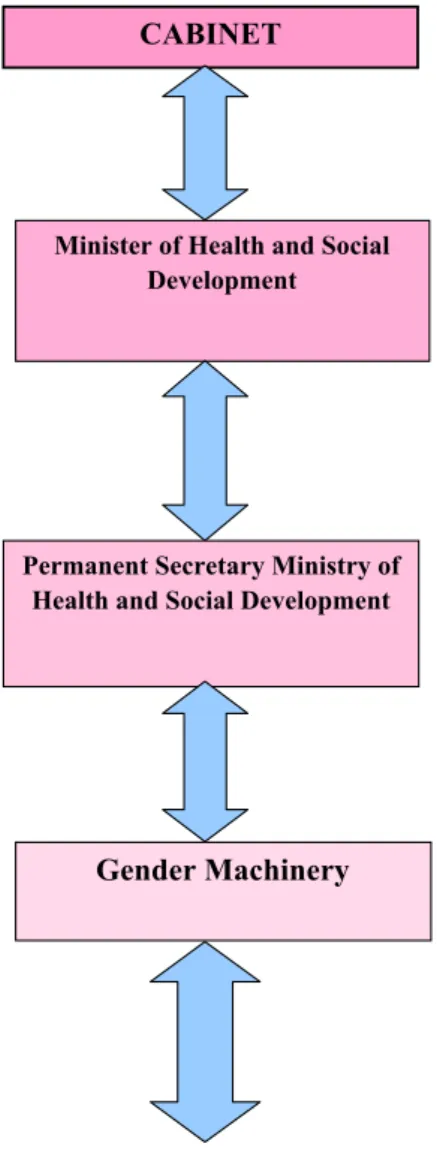
The Office of Gender Affairs is the driving force and lead agency in the implementation of the National Gender Policy and Plan of Action. The multi-sectoral nature of the Policy and Plan of Action dictates that ownership must be shared for successful implementation. Educating the public and partners of the critical place of gender in any nation's sustainable and holistic development.
Ministry officials and Technical Support Committee Members Appendix 2 List of Consultations, Meetings and Interviews
Selected List of Reports, Documents and References Appendix 4 Legal Sector Study of the Virgin Islands - (Gaietry Pargass)
Ministry officials and Technical Support Committee Members
List of Consultations, Meetings and Interviews 2008 and 2010-2011 Item
27% July 27, 2011 % Clinic visits in Tortola and consultations with church pastors, immigrant associations and Rotaract at the gender affairs office.
Selected List of Reports, Documents and References consulted
NNATIONALATIONAL
Page1&
Page2&
Page3&
Page4&
Page5&
Page6&
Page7&
Page8&
Page9&
Page10&
Page11&
Page12&
Page13&
Page14&
Page15&
Page16&
Page17&
Page18&
Page19&
Page20&
Page21&
Page22&
Page23&
Page24&
Page25&
Page26&
Page27&
Page28&