THEORETICAL REFLECTIONS ON IDENTITY
—
María del C. Peña-Cuanda
Intercultural University of Chiapas (UNICH)
— Abstract—
This article is an effort to retrieve the theoretical contributions of diverse disciplines, schools of thought, and authors who used to think the problem of identity in the light of my research project. Firstly, I focus on the theoretical discussion on the concept of identity, to propose a theoretical stance in relation to it and set the limits within which it will be understood.
Subsequently, raise analyze and build differs a reflection that allows between personal identity and collective identities, analyzing their points of encounter and distinctive features. Finally, I discuss with one collective identity which is relevant depending on the subjects of the research study: ethnic identity.
Keywords
Identity, Personal Identity, Collective Identities, Ethnic Identity.
Although the theory tends to be a generalization of the study of reality, the truth is not always useful to understand the characteristics and peculiarities of the various situations and phenomena that occur in life, the world and society.
Therefore, this article is an effort to regain the theoretical contributions of various disciplines, schools of thought and authors who think about the research problem that concerns me, namely the study and reflection on the transformations and reinterpretations in the identities of young indigenous students from the Intercultural University of Chiapas (UNICH) and its reflection as a basis for the development of research projects or interventions that are consolidated from building of a future or "forward or utopian imagination, envisioning the future, the what’s to come" (Giménez, 2005i).
When working with UNICH students who call themselves and perceive themselves as indigenous, it is possible to observe that upon arrival at the university, a space which is inserted in a city where they have contact with multiple cultures, they begin to have changes in their behavior, to express themselves, to dress, to talk, to relate, etc. These changes are important to them because they wonder about the motives and meanings of the changes they are seeing in themselves and in the "others."
It seems interesting to learn how they transform in how they perceive themselves, define themselves, how the position themselves, (identities) are named and how these changes are observable from certain attitudes and behavior.
Problematizing this situation leads me to my research questions, which I am interested in knowing: What are the roots of these transformations?
How are the changes experienced by youth?
Therefore, the intent of this article is to make a discussion about theory, trying to build bridges between the question about the change or reconfiguration that occurs in young indigenous identities and contributions from its generality and abstraction which allow us to understand study and learn a specific case study. This work in this regard will be an effort to build a seesaw between the theoretical aspects and their relationship to the social reality which is being studied.
To do this, Firstly, I focus on the theoretical discussion on the concept of identity, to propose a theoretical stance in relation to it and set the limits within which it will be understood. Subsequently, raise analyze and build differs a reflection that allows between personal identity and collective identities, analyzing their points of encounter and distinctive features.
Finally, I discuss with one collective identity which is relevant depending on the subjects of the research study: ethnic identity..
WHAT IS IDENTITY?
You were right, because the secret of human existence consists not only in living, but in finding the reason for living...
Fedor M. Dostoiesvky, 1878-80 Nowadays we can find as many definitions of identity as there are books on it. Therefore I do not wish to contribute more but take up the various contributions to locate theoretically there from where I am starting to study the resignifications of identity of UNICH youth.
Despite this situation, among the various authors we can find a general awareness or consensus on two points: first, polysemy and dispersal of the notion of identity (Dubar 2002, Giménez 2000, 2005i-ii, Valenzuela, 2000, Hall 1996); and, on the other hand, the dualist position that has deeply influenced the currents of its conceptualization (Dubar 2002, Hall 1999 Alcoff 1989, Riquer 1992).
It is important to explain in detail the dualism that has been characterized. On one side is the essentialist position, which basically refers to the conceptualization of identity as sameness, that which gives us the quality of identical (hence the name), as unchanging substance or shared and transmitted natural category, is the eidos (essence) of the people or groups, therefore something that is permanent and timeless. All of these are deeply rooted meanings in philosophical thought and in etymological origin of the word.
The other, more recent position, are defined as nominalism (Dubar 2002), constructivist approach (Hall 1996 and 1999, Gimenez 2000 and 2005i 2005ii, Castells 1999), positional definition (Alcoff1989), questions the identity such as A given category or as an attribute of classification of individuals and groups, posits that identity is subject to changes and transformations, refers to the ways in which we identify, the identity built from a specific action that is the process of identification, is built from ways to name or names that characterize our belongings from the stated positions that are assumed in the representation of an "I" or "we" finally refers to a borderline notion, contradictory, ambivalent or boundary between social- cultural and individual or subjective.
For many of these authors, the first position, or the essentialist, has been surpassed in conceptual terms, but its discursive and symbolic effectiveness is recognized in many social movements that have emerged or gained momentum at the present time and have supported an identity as a basis for mobilization and social cohesion1 , based on one or a few attributes that are assumed identical, permanent or ahistorical, although the mobilization of these groups are based on historical processes colonization,
exclusion, discrimination, marginalization, abuse, negations, resistors, confrontations, etc. However, this situation does not upset the nominalist or constructivist stance, because the identity retaken as a flag, constructed from essential social movements, can be thought of as an assumed position for political action (Alcoff, 1989) or imaginary reunification which positions subjects as political actors (Hall, 1999).
In Chiapas, an ethical emblematic case of the use and appropriation of the essentialist position in the process of building representations that produce political actors was located and remains the armed movement of Zapatismo. In this case the imaginary reunification made sense since the identity of being Indian, erasing linguistic, cultural, religious, ideological, etc., diversity that existed between them.
This case is not only a must in terms of the importance it has gained in national and international space and transformations in various (political, social, economic, cultural) areas that have been enabled, but in the case of UNICH2 sets a very important precedent for its creation. Within its grounds is the one that was designed as an institution to open a space for those indigenous young people who for decades had been excluded and ignored on this level, that is, discursively these young people are provided, having a multiplicity of highly complex stories, an essential identity: being indigenous.
But precisely my research is in the second theoretical perspective, since it is asked for by the critical points of difference, part of the questioning of what the educational model itself does not consider on subjective constructions which are actually being, in what have become part of the historical processes and context in which they develop, for what they want these young people to become.
In this second sense, cultural identity is a matter of "becoming" as well as "being". It belongs to both the future and the past. It is not something that already exists (...) these identities are subject to constant change (...) identities are the names we give to the different ways we are positioned,
1 It is very interesting, in this sense, the analysis done by Hall (1999) when studying the diaspora of the Caribbean as a cultural identity. It is important to note that he mentions the symbolic efficacy of the essentialist position to explain the diaspora as a fact of "imaginary reunification" that starts from the practices of representation (nominalist posture) of that group. For this reason it can be said that his analytical, epistemological and ontological position of identity starts from the constructivist proposal.
2 This can be found mentioned in the document explaining the foundations of the educational model of the nine intercultural universities that exist in our country (Casillas and Santini, 2006 and 2009). It is also worth noting that Chiapas was the second to be created in 2004 (Fábregas, 2008 and 2009), meaning that it was only ten years after the date of the Zapatista uprising.
and within ourselves, we have positioned ourselves through the narratives of the past. (Hall, 1999, p.134)
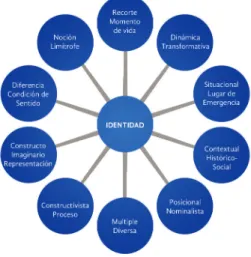
Within this definition can be identified some epistemological theoretical positions that guide the perspective under which the study of identities of young people in the UNICH are placed. My full proposal on the identity is summarized in Figure 1 and starts with various theoretical positions. Then I explain each one in detail features or elements that help me to clarify and explain the notion of identity relevant to this investigation.
Figure 1. Positioning theory on the notion of identity
Source: own preparation
The first element that emerges from the stance that I take for this work starts from their opposition to one of the central tenets of the essentialist view, namely identity is not static, but mobile, dynamic, and transformed. The identity does not represent an imaginary construction that is elaborated in a moment of the life of the subjects and that once constructed remains along the time, giving structure to the subject. By contrast, the central notion of experience is based on the fact that throughout the life of a person there are an endless number of events, among them those that are significant, they have enough symbolic force to generate changes and reorganizations in the individual subjective terrain. But these individual accommodations are always in direct relation to the interaction with the other ones, with intersubjective processes, which are also marking the experience of subjects.
(...) the experience. Concept from which one can articulate collective representations on humans that are sexually differentiated, with the way that these representations are experienced and interpreted by individual subjects in the light of the accumulated, decanted and converted experiences into social representations. (Riquer, 1992, p. 61)
Although in this case the author refers to the case of gender identity, particularly women, this statement is generalizable to any kind of identity we are studying. It is therefore possible to say that identity is transformed and changes throughout the life of people, according to new situations and events and experiences that integrate their experience.
From this position, the impossibility of joining the positions that have worked the transformative quality of identities as "crisis" is evident. From the point of view of social psychology, i.e., personal identity, the main representative of this position has been Erikson who in speaking of the notion of identity crisis argues that "(...) has its own evolutionary period before which one could not reach a crisis (...) This period of development is, of course, adolescence and youth, which also means that the identity crisis depends partly on psychobiological factors (...) ". (1972, p.12)
You can question this theory evolutionary postulates that pose a determinism in the development of human beings without considering that the notions of youth and adolescents are socially constructed, i.e. a young person is at the same time result or product of a specific social place and culturally it is assigned and not the result of biological and psychological development to which all people are predetermined (Burman3 , 1994).
Moreover, the transformative quality of identity is associated in turn with three more aspects that define and orient my positioning, which are: is the product of a process (is constructed); it relates to the various positions that are allocated and that they are allocated to the subjects (positional);
and the process of construction of meaning is linked to various groups and events that generate identification in subjects (it is multiple).
The first of these is the central foundation of the constructivist view that consolidates its opposition to the essentialist position, because although both recognize identity as an imaginary processing (see below), the second argues that this development is done once and it behaves as a distinctive feature, while the former suggests, according to Hall that "(...) instead of
3 Even Burman (1994) works all his criticism in relation to the construction of childhood from the theories of development, his contributions are interesting to think in general to question all the stages that are part of the biological cycle of development to explain the change or the psychological evolution of people.
thinking about identity as a fait accompli, (...), we should think of identity as a" production " which is never complete but it is always in the process and is within the representation, and not outside it. " (1999, p. 131)
Hence the central idea that identity involves the implementation of a process, a process from which meaning is constructed. From this perspective it is also recognized that this process is reactivated indefinitely throughout the life of the subjects by the transformative quality of identities.
But that is a never completed process not only can be understood by the fact that identities are changing, then we would not escape a reductionist explanation rotating on its own axis. For Hall (1996) this situation is overcome if the explanation is based from the language, or rather, from a discursive stance.
(...) the discursive approach sees identification as a construction, a never completed process: always in "process" (...) identification is ultimately conditional and is based on contingency. Once consolidated, it does not cancel the difference (...) identification is thus a joint process, a suture, one over determination and not a subsumption (Hall, 1996, p. 15).
In other words, we move within the scope of meaning and significance, from a a discourse posture, changing, contingent field because meanings slip.
For example, Wittegenstein (1953) addresses the problem of constructing meaning from understanding from the process of language use. At the center of his proposal is the approach of indeterminacy of meaning by the existence of multiple "language games"4, i.e., it is a performance and continuous updating, because "pronouncing a word is like touching a key in the plane of the imagination ". (Wittegenstein, 1953, p. 23)
For him, there is a slip of the senses because the use of language makes associations and interconnections between meanings, i.e., associative chains between meanings are indeterminate and endless and depend mainly on language games that come, but knowing how to play these games depends on experience, reason, passion, context, "training", socialization, etc. Lso shows that there is an intention in the act of speech, as an activity of people, depending on what you mean. This is because the meaning to him is not correspondence between the statement and the world, but the meaning is
4 There are many ways in which Wittegenstein (1953: 25 and 39) explains and defines one of the main concepts of his theory. These notes in my opinion partially clarify their position: "(...) I will also call"
the language game " to everything formed by language and the actions with which it is interwoven"
There are innumerable genders: innumerable different types of employment of all that we call "signs",
"words", "sentences". And this multiplicity is not something fixed, given once and for all; but new types of language, new language games, as we can say, are born and others age and forget ... The expression
"language game" should emphasize here that speaking the language is part of an activity or a lifestyle".
the use, how the word is used in different social contexts and what intention you have to name it .
We learn words in a thousand ways (words are instruments that serve to act, just like prayers and signs) and their uses are different according to the "language games" that are developed. All games exist (e.g. language game to say hello, to offend, to teach, to build, etc.) and together form language.
The meaning is given only by its use, i.e. it acquires a certain sense, not anything else, depending on the language game in which a word is used.
Returning to the issue of identity conceived in terms of significance, we can understand from the discursive position, because it has established itself as an always moving process, and that is constructed through action, represents an act.
(...) "identity" is revealed to us only as something to be invented rather than discovered; As the target of an effort, "a goal", as something to build from scratch or choose from alternative offers and then fight for them to protect them afterwards with an even more fierce struggle ... (...) The fragility and forever provisional status of identidy can no longer hide. (Bauman, 2005,Pp. 40-41)
This position implies recognition of the identity of an agency by the subject, because identity is a choice, which is assumed5 and is not carrying or having as an attribute or a previously established fixed category. This leads to the explanation of the second element that helps to understand the transformative quality of identities, i.e. the claim that identity is positional and nominalist, i.e., they are a political quality, in the case of the first , and discursive, in the second.
Starting from the nominalist quality for its continuity with what I have explained previously on the constructivist stance identity, as it is again supported from a discursive perspective, but from the recognition of positional quality.
The position or positions for Hall deal with the possibility of the enunciation of the subject, "(...) the identities are the names we give to the different ways we are positioned and within which we position ourselves, through the chronicles of the past ". (1999, p.134)
5 It is important to note, as will be seen later, I'm not thinking about identity as a subjective quality of individuals and groups that is built on absolute freedom. In saying that it is a meaning assumed by the subjects, it cannot fail to be seen that this assumption often has to do with something that is imposed explicitly or implicitly, or that are attributed by others and assumed by the subject by have no other option, or they can be meanings that are assumed "for others", that is, as part of a social pact that makes membership possible, etc.
Definitely the names we use refer to current or present positions, which are always contingent, but in addition to its enunciation from the narratives of the past, I would add that they are also constituents the views or future projections, while from the narrative emerges "being", named from the past and history, and also makes the issue of "becoming"- in this sense we speak of the future, of projective identity.
The claim that identity is part of a discursive nominalist vision of subjectivity implies a specific position of the relationship between subject and language. I mean the place of language in the evolution of the subject as such, while as a power and position of subjectivity.
It is in and through language that man is constituted as subject; because language alone founds in reality, in its reality that is the one of the being, the concept of "ego". "Subjectivity" that we deal with here is the ability of the speaker to present himself as a "subject" (Benveniste, 1966, p. 180) Presenting oneself as a subject implies the existence and recognition of the other, which makes clear that language, although its enactment can be individual (speech) -what is remitted subjectivity (Benveniste,1966), in his apprehension and enunciation only makes sense from the others. Whenever something is said, it is said to at least someone else (Wittegenstein, 1953)6 . In addition, this enunciation is always generated from a context and a specific situation, which refers to what Foucault (1971) relates with great success in
"The order of discourse", i.e. all those elements involved in the discursive production of a subject and that have to do with the different types of procedures of control of the speech, that is to say, the speeches are possible always within a pre-established order.
This subjective capacity of enunciation (nominalism) is related, but also differs from the positional quality. The position has to do with the discourse construction from a position taken by the subject, in this sense referring to a policy condition of identity (Alcoff, 1989, p. 14) that is consolidated from the possibility of acting, "The idea is that identity itself is taken (and defined) as a political starting point, as a motivation for action, and as an outline of personal politics. (...) identity is a position that is politically supreme ".
6 The relationship between subject and language is much more complex than what I tightly expounded here. It is not possible for me to extend more, but it is a subject of an inexhaustible wealth - therefore, a subject in itself – that I left briefly punctualized. However, this is sufficient for the delimitation of the positioning that guides this work satisfying the purpose I pursue in these pages.
This concept is very important for building my notion of identity as it takes up the relationship between action and identity, two central elements that I am considering. I fully agree with the notion of "identity politics", assuming a particular identity (or activate it) makes sense as an orientation of the action, and therefore is strategic and arbitrary (Hall, 1999). For example, from the position of being UNICH students it is possible at times (if not all) that there results a strategic position of being indigenous (ethnic identity) in the process of use and appropriation of university space.
What does standing here mean? (...) The external situation determines the relative position of the person, just as the position of a pawn on a chessboard is considered safe or dangerous, powerful or weak, depending on its relationship with the other pieces. Essentialist definition of a woman makes her identity regardless of their external situation (...) the positional definition, on the other hand, makes her identity in an ever - changing context (...). (Alcoff, 1989, p. 14)
It is clear that the positional quality gives the subject the capacity for change and choice (agency) while recognizing that it depends on social conditions, i.e., the various positions that can be assumed to always be defined by the socio- historical conditions of its production.
Since these qualities of identity there is found a potential in the construction of meaning, which in the case of the study subjects of my research are generated the space of the university. This enables the students to discursively construct the meanings of their positions, the senses of their identities, and this is in turn triggers (after activation for the preparation of the meaning) action and production. The posture of identity in both action and political posturing is my interest, I think that young people are actors who (re) define and (re) position themselves in multiple areas, one of them has to do with his place as investigators or auditors of the social reality of which they are part, who study and in some cases are interested in transforming it.
This leads me to the last aspect that helps to understand the transformative qualities, namely identity is multiple, it has many facets, many faces, diverse, contradictory, ambivalent, hybrid and generates something new from the complex of its possibilities. In being the fruit of experience
5 Es importante señalar, como se verá más adelante, que no estoy pensando en la identidad como una cualidad subjetiva de las personas y colectivos que se construye en una libertad absoluta. Al decir que se trata de un sentido asumido por los sujetos, no puede dejar de verse que esto que se asume muchas veces tiene que ver con algo que se nos impone explícita o implícitamente, o que son atribuidas por otros y asumidas por el sujeto por no tener otra opción, o pueden ser significados que se asumen «para los otros», es decir, como parte de un pacto social que posibilita la pertenencia, etc.
and movement, it combines endless elements that define and redefine continuously, especially since it is positional and depends on the positions that are assumed and the imprints of time and circumstances.
The concept accepts that identities are never unified and, in the times of late modernity, are increasingly fragmented and fractured; they never are singular, but built in multiple ways through speeches, practices and different positions, which are often crossed and antagonistic. They are subject to radical historicizing, and in a constant process of change and transformation. (Hal l, 199 6, p. 17)
The understanding of the relation between identity and action can only be developed from the theoretical currents that comprise the first as multiple representations that, on the one hand, increase and transform as the experience of the subject advances or modifies; And, on the other, when it is recognized that these representations produce action in function of contexts and situations.
This relates to the previous attribute in the sense that subjects never have one position; they are always different and sometimes contradictory. This can be explained by three more characteristics of the identities, characteristics that in this case define them as object of study.
The first is that the study of identity can only be understood and analyzed as a cut at a specific time of life of the subjects; it is a cut in the experience that refers to the past and glimpses the future or builds it from autobiographical narratives (Giménez, 2005 ii). When developing or glimpsing the future it is also a motor or movement, released actions of the subjects.
Recall, according to Hall (1999), which set out the assumed positions and which are built from the past and the future, but always refer to the present.
They can only be studied at a time of life of the subjects, because they are constantly changing by movements of their meaning.
Because signification depends on the perpetual repositioning of its differential terms, meaning in a specific instance depends on the contingent and arbitrary stop: the necessary and temporary "rupture" in the infinite semiosis of language... This "cut" of identity, this positioning that makes the meaning possible, like natural and permanent “final” (…) (Hall, 1999, p. 138) . In sum, in the narrative of the subjects appears identity as a significant unit, which is possible in that it both represents this "cut" delimited by positions, which is necessary and happens all the time, since in this way the subject is lead throughout their lives. The ability to define meaning and construct meaning does not mean that this remains crystallized and remain
over time. Therefore, when studying identities what we know are these
"cuts" of significance that refer to the time of life of the subjects in which they are produced.
The second and third features are that identity is situational (an emergency place) and contextual (historic- social) , because it always is in direct relationship to a specific place of production and the historical moment when the emergency is possible . The ways in which a subject is identified are related directly (though not causal, as evidenced by the recognized diversity) with the place it emerges. In the case of my research at the UNICH , it is the space that matters in the construction process of meaning. On the other hand, identity is always produced from specific socio-historical conditions, which are those that characterize the current moment. For Dubar (2002, p. 24)
The subtraction of new forms of individuality is seen here as a result, neither voluntary nor programmed processes that modify the ways of identifying individuals as a result of major transformations in economic symbolic, and political organization and in social relations.
This position is related to the recognition that the present time has a specific way of constructing subjectivity that allows us to talk about contemporary hybrid identities (Clifford, J. 1997), those that emerge and restructure the inevitable contact with "others" with the "different", the
"strange", the "alien" , from which it appears just one of the positions of my notion of identity, the difference as a condition in the process of constructing meaning . Also, talking about the situational and contextual character of identity inevitably leads to the recognition that this cannot but be social in the sense that it is a product and producer; It is therefore a bordering notion.
Let’s look at each.
Identity makes sense from otherness, it is marked as difference, it is the Dialectic process of difference -equality that makes it possible and understandable.
(...) it is defined and stated in the difference. Between identity and otherness there is a relationship of reciprocal presupposition. Ego is only the definable opposition to alter, and the borders of a "we" are always delimited by reference to "them" to "others" to "strangers" to "foreign" (Giménez, 2005 i , p. 89-90) .
It is a process of individual and collective construction which is based on a permanent basis to define and redefine the boundaries between the one and the other, it is the swing of the border between the different and the
"equal"; "(...) identities are constructed through difference, not outside it" . (Hall, 1996 , p.18)
Identities matter, I mean that they arouse interest and generate action or agency, whether they are in a situation of change, transformation or redefinition. They can only enter these processes when they are in conflict, which is what happens when they face a difference, otherness, otherness.
However, not only the difference matters, but it is a double operation, as mentioned by Dubar (2002, p. 11)
(...) the identity (...) [is] the result of an "identification" contingent. It is the result of a double language operation: differentiation and generalization.
The first is the one that tends to define the difference, which affects the uniqueness of something or someone in relation to the others: identity is the difference. The second is the one that seeks to define the common link to a number of different other elements: identity is the sense of community.
(...) what is unique is what is shared (...) two operations: the identification on the other .
Hence the paradox of identity, contradiction inherent in the notion, is constructed and is from otherness, diversity, the other, the different, even the antagonistic, what is "missing", but possible from the representations of equality, similarity, common . It is a paradoxical notion by its constitutive ambivalence of equal-different.
The second element, we might consider also paradoxical, of the notion of identity is related to a classical problem of social theory, namely: that of relations between society-individual-agency structure, etc. For Hall (1996 ) identity is a concept suture, a notion boundary which refers precisely to this link and synthesizes,7 therefore it stands as a notion that can answer the question of how the symbolic sphere and the social sphere in the formation of the subject are articulated?
Use "identity" to refer to the meeting point, the point of suture between, on the one hand, the discourses and practices designed to "challenge us,”
tell us or put us in our place as social subjects of particular discourses and, secondly, processes which they produce subjectivities, which construct us as subjects capable of "having said" . (Hall, 1996, p. 20)
|In terms of the concept of identity and its characteristic ambivalence of same-different, it is important to locate that from the point of view of
7 Esto se amplía en el siguiente apartado que se centra en la discusión de las diferencias e interrelaciones entre la identidad individual y colectiva.
psychoanalysis the identification process refers to the same, the process of recognition in the other, and an individual process; but the interesting thing about this proposal is that this subjective process that takes place in a subject takes place in a socio-cultural framework, which is what gives meaning and evidence to the difference.
(...) the concept of identity is at the border between individual consciousness (psychological) (...) and the field of social interaction- a field from which cultural products emerge that, over time, we consider as external and emerging realities outside of their producers (...) (Riquer, 1992, p. 52) . Thus, the identifications that subjects take up again in the process of enunciation of positions will always be related to moral codes, social norms, value judgments, aesthetic appreciation, etc. society and culture that are keeping links , in other words, feed and sustain social representations (Giménez, 2005 i ) .
Thus, identity is a borderline concept between the personal and the social, "Identity is not substantive but relational; It is formed in a double process of self - identification and hetero-acknowledgement (...) ".
(Valenzuela, 2000, p. 109), and also is a notion that is generated in tensions, relationships and interdependencies of the discursive and reflective and actions of the individual and collective subjects, hence many authors have explained their current boom.
So far I have described all the features and qualities of identity that define my position, but there is something important that needs to be said- what is identity in of itself. I consider that identity is a representation; it is one imaginary construct loaded with meaning and sense which changes constantly. The process of change of meaning (resignification) is discussed when an order of the representations is generated.
Identity is an imaginary that the individual or the group is building itself;
to say it is an imaginary means recognizing that identity is not equivalent to being of the subject but a representation that the subject forms itself (...) . (Tostado, 1999, p. 294)
Thinking in terms of representation puts us in the realm of the imaginary. Identity is an imaginary construct that is generated through the process of identifying and allowing the individual or group located or positioned from the multiple situations and conditions that produce it , is produced and sometimes produces .
Until now I have continually stated the difference between the individual and the collective without making any mention of their
characteristics and how they will be addressed in this work, which is why then in the following I will work on the debate between personal identity and collective identities and their joints .
LEVELS OF IDENTITY: FROM THE PERSONAL TO THE COLLECTIVE In this section it is inevitable to enter into, albeit submitted by others, a very old discussion on the differentiation of the individual-personal and the collective-group-social. Durkheim himself (1938) criticized that some evolutionist’s positions in which the study of cultural and social was limited to the study and understanding of the individual or individual consciences.
With this problem we face two aspects of the discussion distinctly. On the one hand, the recognition of these as forms and reality is different, we could say, that the ontological field of study or individual and the collective;
and , on the other hand, the way they recognize, understand and understand the interrelationships between these levels or realities , and here we would located ourselves the areas of the epistemological and methodological .
In my opinion the first discussion has been overtaken by modern scientific and postmodern thought, because it is recognized that there are two different realities, and that each of them is capable of being studied 8 . Recognition of the social-group-collective as a distinct manifestation of the individual-personal has been appointed and affirmed long ago and from many perspectives- for this work I simply join the explanation of Durkheim to synthesize the posture:
(...) we must seek the explanation of social life in the very nature of society (...) the whole is not equal to the sum of its parts. It is somewhat different, and their properties differ from those of parts that comprises it(...) the company is not a simple sum of individuals, but the system formed by their association which represents a specific reality that has its own characters.
(1938: pp.248-249)
By this I start from the assumption that there are two different realities and the recognition of their existence can argue that identity is also manifested in these two levels of reality. We could then support the idea that there are two levels, but which actually operate in a closely interconnected way that they cannot be differentiated clearly enough to determine if any prevails over the other.
8 The clearest evidence of this is the division of science and specialization and livelihood of the objects of study in disciplines such as psychology, social psychology, anthropology and sociology.
Speaking of personal identity, we are placing ourselves at a specific level, which has important analytical and methodological implications.
When we recognize that people construct their personal identity from the distinction of others, we can recognize that this criterion of differentiation is performed as Giménez (2005) recognizes- retaking three sets of elements that allow their understanding and therefore can be resumed as an analytical approach to personal identities of youth, while allowing for the understanding for the choice of "life stories" as a methodological tool.
Investigations so far include three sets of elements: 1) belonging to a plurality of groups (classes, groups, networks and large communities);
2) the presence of a set of relational or idiosyncratic attributes; 3) a biographical narrative that tells the life story and social trajectory of the person being considered (Giménez, 2005: p. 22) .
This accounts for the opportunity to learn and study this level of identity, but also realizes that the collective-social is constitutive of the individual, and as always built from it .
Culture involves planning, organization and attribution of meaning exerted on a reality which by itself has no order or means anything (...) management necessarily entails the setting of limits, of marks and differentiations (...) (Serret, 2000: p. 234-235) .
In terms of the concept of identity and its characteristic ambivalence of same-different, it is important to locate the identification process that refers to the same thing, as an individual process; but the interesting thing is that this subjective process that develops in an individual takes place in a socio- cultural framework that is what gives meaning and shows the difference.
In other words we cannot think about personal or individual without the social and relational context in which it is structured.
Speaking of the process through which meaning is constructed and the world is ordered to build personal identity from the same and different, we find that this construction is drawn from sharing some characteristics and differentiates from others, in other words, that which gives meaning to a subject to be defined as the same or similar to others means that an assumed position is always a shared identity, it is a social identity that "we" assume against " others”.
(...) social belonging (...) implies the inclusion of an individual personality in a community to which a sense of loyalty is experienced. This inclusion is usually done by taking a role within the community (...) through the
appropriation and internalization at least in part of the symbolic-cultural complex that serves as the emblem of the community in question (Giménez, 2000: p. 52) .
Therefore, a personal identity, although unique in its shape or particular configuration [9] particular, always refers to the social identities that others assume ,in other words, the positions designated by a subject are social or collective identities which through their own experience are assumed as their own.
This point will be a central analytical axis in my investigation, because the first analysis of the identity of the intention is to recognize that feeling of social belonging, as a prerequisite to know where they can focus their research interests and actions of youth, and to analyze which elements have internalized the cultural symbolic complex or symbolic-cultural complexes in which they have been socialized and form part.
In short, we can resume the definition of collective identities of Gimenez (2000: . P 59-60) to explain this second level of reality.
(...) relational entities (...) consisting of individuals linked together by a common sense of belonging, which means, as we have seen, share a core of symbols and social representations and, therefore, a common orientation of action .
This reaffirms the theoretical positioning on the notion of identity that I mentioned above, and means that we are confronted with a notion that refers to equality that allows, from the psychological point of view, to build a sense of belonging, while the difference allows us to reaffirm the singularity as opposed to others. On the side of the social or anthropological, the characteristic of equality is what makes you stay with a certain identity in the shared collective imagination (although these imaginaries are permanently in reconfiguration, change or transformation), while its quality differentiation reaffirms us and "us" versus otherness.
Although the level of collective identities refers to the symbolic and imaginary condition of equality in groups or collectives, one should not think that this means that they have an effect on the subjects that have identical, uniform and standardized behaviors. Personal-individual level is not erased when the group-collective-social level is studied.
9 When speaking of configuration, I mean the specific combination that identifies a subject, in other words, the particular way in which a subject assumes certain positions (social) as part of their personal identity.
The last point is of great interest to reflect on both ethnic and generational identities (youth) 10 , because one of the mistakes that often falls or has dropped out in the studies that have been developed on the subject, is to think that all subjects who participate in a given collective identity (of being young or being indigenous) necessarily have a set of essential attributes that characterizes them as a group or community. I think methodologically a bet of my job is to work the notion of identity from the complexity of the singular and the collective and mutual representations that are set in the actions of subjects, which are not exclusive and that point to the non - uniformity of subjects.
For everything said so far, we can say that the real problem then lies in the second discussion on the differences and relationships between the personal-individual and social-collective-group, since their interrelationships are so narrow, complex and multidimensional that there is no consensus that allows freedom from them.
Dubar (2002 : . p.14 ) in the first part of his book solves this dilemma by arguing that the opposition is meaningless from the nominalist - constructivist stance, assumed in this work, "(...) because any individual identification uses words, categories and references what are socially identifiable ".
In my opinion this is recognition of the inescapable relationships are held between these two levels, and this explains what kind of link exists between them, but does not avoid the question of the existence of these two elements. Relevance and need to separate them analytically is always based on the interests, objectives and research questions, on the one hand, and the positions of the researcher, on the other.
In short, and starting from these reflections, I can say that the positions taken for this work is that any collective identity finds expression in an individual identity and all personal or individual identity is supported from identification, i.e., in recognition of " wanting to be like others”, recognizing that other people have more, in the equality for building the "we" that underlies the collective.
Finally, I should mention one aspect that I think is fundamental to continue thinking that not all collective identities have the same "status"
or imaginary attributions in subjects. They are different in their process of conformation, thus each can be studied differently considering the socio-
10 These two collective identities are presented on the following pages in more detail, so now I do not stop to make any further clarification.
cultural conditions and historical forming processes, so we can talk about different configurations of collective identities (See Figure 2) .
This marks the need for reflection on diversity within diversity, because collective identity is constructed from various references and organizes its meanings from various patterns and relationships with its environment and with reality.
This proposal (more analytical than descriptive) classification of collective or social identities, constructed from the distinctions made by Giménez (2005i: 53, referencing Merton, 1965) among community, group and imagined communities, and the analysis of gender identity constructed by Serret (2000) in his text.
We have, on the one hand, collective identities that I have named
" base ", " originating " or " primary " that refer to symbolic aspects originating in the subject and are shaped by socio-historical conditions in which subjects develop and socialize. These are very important because every subject assumes them and they have a lot of symbolic and imaginary levels of subjectivity such as the social bond strength. Among them we can locate those that refer to the family background of subjects, where we can locate ethnic groups, and those that have a relationship with culturally biological meanings, among which are gender (male, female) and generation ( childhood, youth, adulthood, old age) 11 .
Figure 2. «Configurations of Collective Identities»
11 Barth (1969: 20) states that "(...) ethnic identity is similar to sex and rank, as far as it constricts the subject in all of their activities and not only in some defined social situations. You can also say that it is imperative, as it cannot be overlooked or temporarily suppressed by other definitions of the situ- ation. “I agree with him that it constrains the subjects, but what I dare not say is still that it cannot be overlooked in any situation. However, this is something we have to discuss from the results of my fieldwork.
The second group is composed of those identities that are developed by proximity, and therefore are based on group relations, which presuppose a close, daily relationship, and considering groups as forms of organization and present acting social existence, (González, 1991 Radosh, 2000).
Moreover, in this I consider also the significant social positions that are built from various activities performed in daily life as individuals form part of a society that are active in us and in which we operate in our daily lives , so they are closely linked to social roles, as in the case of student youth identity. Therefore, in these collective identities action (making subjects) , coexistence and daily close contact (proximity) are key elements in the construction process . The third group is made up of collective identities that conform to the maintenance, growth and expansion of the dominant socio-economic model and are based on the development of "ideal types"
which are validated, hegemonic and homogeneous, which function as projective models that are part of the "cultural industry" (Horkheimer and Adorno 1944), and therefore diffuse through the mass media as in the case of student youth identity.
Therefore, in these collective identities action (making subjects) and coexistence and daily close (proximity) are key elements in the construction process. The third group is made up of collective identities that conform to the maintenance, growth and expansion of the dominant socio-economic model and are based on the development of "ideal types" validated, hegemonic and homogeneous, which function as projective models that are part the "cultural industry" (Horkheimer and Adorno 1944), therefore diffuse through the mass media.in these collective identities action (making subjects) and coexistence and daily close (proximity) are key elements in the construction process .
As far as I know young people, the first two groups are the most important, but the strong influences of the third group are equally appreciated, which often are what make them enter into conflict and confrontation.
Finally, in close connection with the above , we can find those defined as " omnipresent " (for lack of a better name) , which relate to the concept of Anderson in Imagined Communities and has served to explain national identities that are little significant in the daily lives of people, but reactivated depending on the context of social mobilization (migration) , in some struggles or social movements within nation states themselves and generally ubiquitous presence of other identities . In this group I also included which I have called historical continentals, which refer to the identity that gives belonging to a particular continent and that operates and are constructed similarly to national identities, but has historically divided the globe not
only under a geographic-spatial category, but also racial category and cultural, scientific and economic domination.
3. “SIGNIFICANT” IDENTITY POSITIONS
In this section I want to build my position around a collective identity that has been widely studied and, as in most cases, given the existing various theoretical arguments to explain it, namely the ethnic identity.
This identity is definitely not the only and perhaps not the most important factor in the identity configuration of college students, however, it is a position of personal identity that I want to develop ,because my research questions as well as my first approaches to the reality that I studied are based on the questioning of the identification processes that develop and are reconfigured in youth from interethnic or intercultural contact that are generated in the subject by the fact of living in San Cristobal de las Casas and for studying in the UNICH .
Also, because I discuss the often idealized visions of indigenous groups in Mexico that which have described "being Indian" under a romantic vision and always referred to ancestral traditions and customs that culturally characterize them12 , it is important to separate myself from these positions .
Ethnic identity
(...) are just products of our imaginary activity, imaginary parcels of the real, which are historically constructed.
Daniel Mato, 1994 To speak of ethnic identity, we must first "take sides", i.e., place in a theoretical and ideological position the meaning of ethnicity13 , just like what currently happens with many notions in social sciences, which are many, varied and often contradictory of the heated reflections that exist around it.
Before doing so, it is important to note that the notion of ethnicity appears as a concept in full recognition of having an entirely social meaning,
12 In this regard I agree with the critique of Barth (1969) when he mentions that one of the main weak- nesses of the descriptions of ethnic groups is to define, delimit and group them based on their attri- butes or cultural categories, which are not necessarily that they are sufficiently distinct to sustain the limits or boundaries of differentiation that are constitutive of identity
13 I do not speak of "ethnicity" since I retook the position of Cardoso (1992, p.16) when he explains that
"Unless confused with group (ethnic), ethnicity is a "classifier" operating within the interethnic system and the ideological level, as a result of collective representations polarized by social groups in opposi- tion, whether latent or overt. Such groups are ethnic insofar defined or identified as taking advantage of cultural, "race" or religious "symbols.
unlike the notion of race that started from the idea of the existence of permanent biological components. (Giddens, 2001) .
In the case of the notion of ethnic group the discussion - increased in modern times as a result of social, cultural and economic political transformations and injustices that have been committed on behalf of the notion and social movements which have sought recognition under its flag- is too extensive and encompassing it is beyond the scope of this work.
Therefore, it is sufficient to note that I join the non - essentialist vision as mentioned by Valenzuela (2000, p. 97-98) who has recognized that:
Ethnic groups are social groups which have certain specific characteristics and cannot be defined essentialist; therefore, it has chosen to describe rather than define them. An important point in delineating ethnic dimensions are its relational aspects, that is, the fact that ethnicity is defined from the group find features that makes it different from the other groups and equal to itself.
If we think of essentialist so that an ethnic group can be defined as from a set of attributes that should always be present, as in the case of speaking the same language or set of cultural traits, we find that in the process of describing the same is not a criterion that serves to understand from the relational aspect those characteristics which serve to define themselves as opposed to others. For example, Tzotzil, a linguistic group of the Maya family located mainly in the region of the highlands of Chiapas, are identified as such by the language they speak, but they recognize social and cultural differences that are significant according to the place where they live and from which they originate. In other words, the Tzotzil of San Juan Chamula, Huixtán, Zinacantán, or Chenalhó is not the same.
One of the major criticisms on the notion of ethnic groups which Barth (1969) developed stated that for many years it was assumed that what was important for the study and description of these groups was the fact that they shared a common culture . Therefore, fieldwork was based on "ideal, typical models" that defined the significant aspects of its origins, structure and operation thereof, where two problems were derived: the first is focused on the analysis of cultures and not properly organizational and imaginary characteristics thereof; and second, to study an ethnic group involved going out to prove or disprove the characteristic set that arose from these models.
From this position, Barth respectively * defines ethnic groups as follows : "(...) ethnic groups are categories of ascription and identification which are used by the actors themselves and thus have the characteristic of organizing interaction between individuals (...) " and " (...) ethnic groups are considered as a form of social organization (...) the critical feature (...)
the self - ascription and ascription characteristics by others (...) ". (1969 pp.10-11-15 *)
These statements are possible because for him the need to differentiate is not culture itself, because in many cases we find striking cultural similarities between ethnic groups who described themselves as radically different or are far apart geographically, but rather in the fact that there has always been contact between groups, that is, the need to create an ethnic limit makes sense for the presence of the other.
This statement breaks with another romantic approach from which a story has been built that holds that ethnic groups have retained their distinctive features because they have had no contact with other groups, in other words, it is a story of separate towns, each with their own cultures and forms of organization, but the construction of ethnicity is based on interethnic contact that has always existed.
So the important thing is that the investigation of ethnic groups the focus is on the ethnic boundary. This limit is the recognition of others, of other groups, so the imaginary border is a foundational and fundamental concept of an all-identity construction of a "we”.
Identity can be thought of as a limit, as a social process of demarcation of differences and similarities or sense of belonging, and in this sense I am placing one of the possible meanings that acquire the notion of limit. For example, D'Andrea (. 2005, p 62) says:
Sanctioning a belonging means the same as delimiting diversity: to recognize and circumscribe a shared space, draw a line, defining an "outside". Many of the most significant characteristics of a group identity, and much of the conflicts that this can generate, are decided from the nature and form of that border.
Therefore, going a little further, identity is a border, a type of imaginary border which supports the definition and delimitation of ethnic groups.
Identity is not a property of objects, not a truth linked to the nature of things. It is rather the adoption of a -motivated but unprovable border - whose reasons lie not in the nature of the objects but in the requirements of definition and limitation of the subject. Identity is the inclusion of a difference in the continuum of the similar, under which the distinction is made between us and the others (...) (D'Andrea, 2005, pp. 63-64) . From all of these considerations we can say then that the various concepts that have been developed around the concept of border, these points are much closer to the proposal of Lattimore who says that a border arises when
two different societies, with different cultural ecologies, contact each other (Fábregas, 2005) .
In this sense the border serves as the limit to make a difference and assert certain relationships that are socially and culturally recognized by a group (Fábregas, 1984).
This concept of a border is not new and reminds us of the history of the term. The border today is a notion that is strong and deeply charged with political connotations and serves to define the geographical line that separates communities which are legally integrated in the form of nation-states (geopolitical) . However, tracing the origin of the term we find another meaning which I have adopted as central to this work following Barth (1969). Think of the border as an imaginary construction of difference, and thus the similarity takes us back to the Middle Ages , a period in which the border was conceived as a "mental category" (Miter, 1997).
For all of this it can be argued that the definition of ethnicity is inseparable from identity, as the definition of it passes by the second in the process of building the "ethnic boundary”.
But I have said to this point that it may be argued as too broad and applicable to any type of collective identity. In one sense, the criticism makes sense, because any collective identity has the same attributes and characteristics to be considered as such. But in another, each of the collective identities has features that differentiate it from others, from features which make sense the way it is named.
Hence the ethnic identity that characterizes and differentiates it from others is unlike current social identities in at least three respects. The first is that which was already mentioned, it is a social organization, is an identity that builds forms of socialization, relationships and interaction both inside and outside the ethnic group .
To the extent that actors use ethnic identities to categorize themselves and others for purposes of interaction, they form ethnic groups in this organizational sense (...) The features that are taken into account are not the sum of “objective” differences, but rather only those that they actors consider significant (Barth, 1969, p. 15) .
The second is that it is a contrasting identity, which at its base is defined from the assertion of us against the other, but it does so always in a 'ethnocentric "manner or from the system of representations recognized as ethnocentrism. (Cardoso, 1992) Understanding other ways of social organization through the "lens" or vision of the self to judge the other , passes through the set of values held within the group, and therefore has
an ideological and ethical character , that is associated with standards and value systems .
Finally, the third aspect has to do with the ideological support of cohesion of the "we" that is built from the proposal of D 'Andrea (2005, pp. 62- 63)
"I propose to define ethnicity as one human group in which membership is based, ultimately, on the subjective representation of a family relationship (...) representation of a blood bond."
"Inbreeding, which represents the heart of ethnicity, is a belief, a subjective conviction. Its effectiveness as a binder of the social group does not depend on its truth value (...) the cohesive power of belief in a common origin is not linked to the truth of a fact. "
It is very important to avoid the frequent criticism of this trait which puts ethnic identity in the essentialist position. The fact that its symbolic and imaginary effectively involves an aspect that can be made essential by the group, and does not mean that ethnic identity is that , because we are talking about a subjective belief that does not negate its quality of self - ascription .
In addition, speaking of representations and the order of the symbolic recognizes that ethnic identity refers to culture, since it is built from the symbolic and imaginary framework that gives meaning to the subject in his actions as a member of a group.
Speaking then in this work of ethnic identity, I do not mean that imposed and superimposed political identity formed in connection with a nation-state, but the identities that are referred to by Deep Mexico (Bonfil, 1987) or deep identities (Valenzuela, 2000 ).
Speaking of ethnic identity as a manifestation of cultural identity, it is separated from the ethnic-nation association. The difference between these types of identity can be found in Valenzuela:
Cultural identity and national identity corresponding to different analytical dimensions, (...) the first caters to the specific configuration of the world of life of social groups and the second contains an ideological-political dimension identified with a national project, (...). (2000, p.110)
In addition to the need to clarify the difference between national and ethnic identity, in the case of Mexico there is another important aspect mentioned in connection with the second (Peña-Cuanda and Esteban, 2012) . In our country's ethnic identity it is intended as a construction of indigenous identity, which are virtually synonymous because the ethnic groups in
the territory, according to the features previously mentioned, would be indigenous groups14 . Hence for this work the notion of ethnic group is worked equally as a synonym of indigenous group, recognizing both as a generalization to appoint a wide variety of groups.
In conclusion, I would like to make a methodological remark. I consider that the challenge of studying ethnicity from the position outlined here lies in having the ability to listen, observe and discuss with the subjects themselves on those elements in a continuous, mutable manner, and that they remain permanently, incorporated and reinvented in groups to characterize themselves as belonging to a particular ethnic group. As Valenzuela (2000), notes, this process can also develop because:
(...) there can exist as relevant aspects, unweighted by social groups, that change by modifying the context of their daily lives and that, given the presence of cultures whose difference with them is greater, identify or build commonalities (. ..) (Valenzuela, 2000, p. 99).
This brings us to the current context of accentuation of interethnic daily contact and continuous and reciprocal crossing of borders or ethnic boundaries, something that leaves the purposes of this paper and that therefore I need only point out.
14 In fact, characterizing ethnic groups as indigenous groups is an affirmation explained by Bonfill ( 1987) from the hypothesis of the common origin of these groups under the idea of Mesoamerica.
However, this is an idea that is still quite controversial and by entering into its debate I stay away from the intention of this work.
REFERENCES
Alcoff, L. (1989). Feminismo cultural versus pos-estructuralismo: la crisis de identidad en la teoría femenina. En: Feminaria, Año ii, (4), noviembre de 1989, Tejepalabras, pp. 1-18, Buenos Aires.
Barth, F. (comp.). (1969) Los grupos étnicos y sus fronteras. La organización social de las diferencias culturales. Fondo de Cultura Económica: México.
Bauman, Z. (2005). Identidad (Conversaciones con Benedetto Vecchi), Losada, Buenos Aires.
Benveniste, É. (1986). Problemas de lingüística general, Tomo I, (13ª edición).
Siglo xxi, México.
Bonfil B., G. (1989). México Profundo. Una civilización negada (2ª edición) De Bolsillo, México.
Burman, E. (1998). La deconstrucción de la Psicología Evolutiva. Aprendizaje - Visor, España.
Cardoso, R. (1992) Etnicidad y estructura social. ciesas – Casa Chata, México.
Casillas M., M. L. y L. Santini V. (2006) Universidad Intercultural. Modelo educativo, Serie Documentos, cgeib – sep, México.
————, (2009). Universidad Intercultural. Modelo educativo, 2ª edición. Serie Documentos. cgeib – sep, México.
Castells, M. (1999). La era de la información: El poder de la identidad, Volumen ii, Siglo xxi, México.
Clifford, J. (1997) Las diásporas, en: Itinerarios Transculturales, 1999, Gedisa.
(pp.299-340) Barcelona.
Cruz, T. (2006). Las pieles que vestimos. Corporeidad y prácticas de belleza en San Cristóbal de las Casas, Chiapas. Un estudio con jóvenes indígenas y mestizas, Tesis de Doctorado, ciesas - México.
D’Andrea, D. (2005) «Las razones de la etnicidad entre la globalización y el eclipse de la política» (tomado de Identitá e conflitti, Franco Angeli, Milán, págs. 83-91), en: Giménez, Gilberto, Teoría y análisis de la cultura, Volumen Dos, (pp. 61-71) conaculta- México.
Dubar, C. (2002). La crisis de las identidades: la interpretación de una mutación, Bellaterra, Barcelona.
Durkheim, E. (1993). «Reglas para la explicación de los hechos sociales», en:
Bohannan, P. y Glazer, M., 1988, Antropología lecturas (2ª edición) (pp.
242-262) España: Mc Graw Hill,
Dostoiesvky, F. M. (1968). Los hermanos Karamazov.Porrúa, México.
Erikson, E. (2007) Sociedad y adolescencia. (20ª edición). Siglo xxi, México.
Fábregas, A. (1984). «Desde el sur una revisión del concepto de frontera», en: Ensayos Antropológicos, 1990–1997, 1997, unicach, págs. 107-114, México.