EARLY LITERACY. FIRST APPROACHES WITH THE CULTURE OF WRITING
—
Claudia Gisel Hernández Hernández
FACULTY OF HUMANITIES Autonomous University of Chiapas [email protected]
— Abstract—
This paper presents the results obtained by the early literacy workshop applied to children aged 2-3 years in daycare at the nursery school of the Universidad Autónoma de Chiapas (Tuxtla Gutierrez, Chiapas; Mexico) during 2015. The nursery school admits exclusively the sons of the students in bachelor programs.
The workshop was designed for the purpose of supporting children’s first approaches to reading and writing through playful experiences, storytelling and the use of didactic materials specific to their school context.
Likewise, it aims to indentify the factors that encourage early literacy, and the effects of the literacy mediators represented by the nursery school teachers.
This study was conducted following the participatory action research methodology for identifying the problem, analyzing the information obtained in interviews and non-action and action observations, and proposing strategies for the early literacy workshop.
Keywords
Childhood, play, literacy mediators, storytelling, didactic materials, nursery school.
Currently, being literate goes beyond deciphering a text, reproducing it in writing or performing basic arithmetic operations. It implies a long and complex sociocultural process that involves the development of different abilities to identify, interpret, understand, create and communicate texts with different purposes in different media (Braslasvky, 2003 and Ferreiro, 2008). It is indispensable for the exercise of citizenship, since UNESCO (2008) considers literacy as a basic principle of learning, since it is an individual right necessary in order to fully exercise the rights of health, education, work and culture.
Literacy is a socio-cultural, multimodal, multi-media, historical and dynamic process-but when and how did this process start?
Clemente and Ramírez (2008) point out that promoting children's approach to written culture from the first years of life has several advantages:
improvement in oral language development in two-year-olds, experience in textual organization and construction of meanings, it stimulates their imagination and creativity and above all establishes a bond of affection more closely with the adults who accompany them in this initial process.
Therefore, literacy is closely linked to the individual, social and emotional development of girls and boys (Fundación Germán Sánchez Ruipérez, 2009). With reading, the child knows about himself and about the world around him, just as with playing (Vygotsky, 1996).
In this investigation, play was considered as a generator of significant experiences at the beginning of early literacy (Natale, 2014), based on the design of a workshop for children aged 2 and 3 who are cared for in the Nursery School of the UNACH, based in Tuxtla Gutierre 1 . The workshop combined play activities, oral narratives and the use of contextualized teaching materials with the purpose of bringing children in an affective and effective way to the written culture.
1 In this daycare center, children of students in undergraduate classroom courses are the only children who attend. The center was created in 2012 in response to the school dropout rate on grounds of maternity and paternity.
READERS AND PRE-READERS
Once there was a duck who had her ducklings, And then the ugly duckling left ...
And went to a farm, and then left ...
Alexa, 2 years 7 months According to the National Reading Survey (CONACULTA, 2006) in Mexico, an average of 2.9 books per year are read. This survey measures the inten- sity, diversity, motivations and assessments that are read in Mexico from the age of 12.
From the samples that were obtained, ten reading profiles were determined from three criteria: diversity, frequency and purpose.
These profiles range from less frequent reading and diversity (profile 1:
little reader) to the one with the highest frequency and variety (profile 10: frequent reader of various publications). For each reader, profile sociodemographic variables, access to reading materials, assessment and readers records were analyzed 2 .
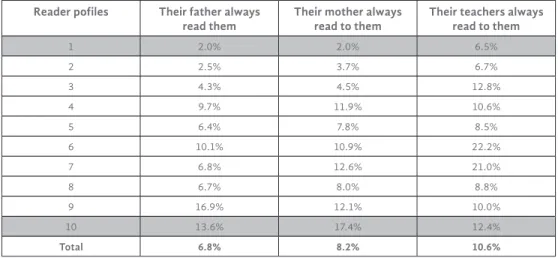
Table 1. Background of readers by reader profile
Reader pofiles Their father always read them
Their mother always read to them
Their teachers always read to them
1 2.0% 2.0% 6.5%
2 2.5% 3.7% 6.7%
3 4.3% 4.5% 12.8%
4 9.7% 11.9% 10.6%
5 6.4% 7.8% 8.5%
6 10.1% 10.9% 22.2%
7 6.8% 12.6% 21.0%
8 6.7% 8.0% 8.8%
9 16.9% 12.1% 10.0%
10 13.6% 17.4% 12.4%
Total 6.8% 8.2% 10.6%
Source: National Reading Survey (CONACULTA, 2006)
2 Readers answered background questions: When you were a child, did your father read?; Did your mother read to you? And did your teachers read to you? Chapter 5 of the National Reading Survey (CONACULTA, 2006) shows the relationship between the taste for reading and paternal encourage- ment, for example a third of respondents who expressed that they enjoy reading responded that their father (31.3%) and mother (26.8%) always read to them (31.3%), while those who expressed that they liked to read little or did not like to read, stated that their father and mother never read them (39.2%
and 38.2%, respectively).
As for the readers' background, it can be observed that there is a close relationship between the low reader profile and poor reading by parents (2%) and teachers (6.5%), whereas in the frequent reader profile of different publications, reading in childhood is higher (father 13.6%, mother 17.4% and teachers 12.4%, see table 1).
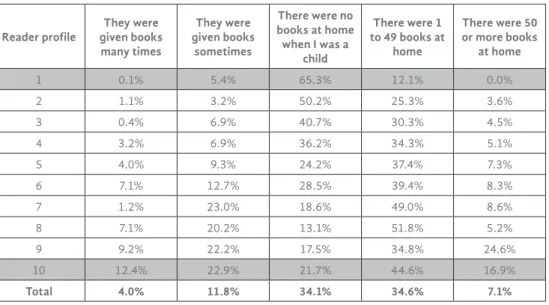
In addition, access to books in childhood is greater in frequent profiles, whether they were given away (12.4%) or had books at home (44.6%);
While the little reader profile almost never received books (0.1%) and also lacked them at home (65.3%), see table 2.
Table 2. Availability of books by reader profile.
Reader profile They were given books many times
They were given books
sometimes
There were no books at home when I was a
child
There were 1 to 49 books at
home
There were 50 or more books
at home
1 0.1% 5.4% 65.3% 12.1% 0.0%
2 1.1% 3.2% 50.2% 25.3% 3.6%
3 0.4% 6.9% 40.7% 30.3% 4.5%
4 3.2% 6.9% 36.2% 34.3% 5.1%
5 4.0% 9.3% 24.2% 37.4% 7.3%
6 7.1% 12.7% 28.5% 39.4% 8.3%
7 1.2% 23.0% 18.6% 49.0% 8.6%
8 7.1% 20.2% 13.1% 51.8% 5.2%
9 9.2% 22.2% 17.5% 34.8% 24.6%
10 12.4% 22.9% 21.7% 44.6% 16.9%
Total 4.0% 11.8% 34.1% 34.6% 7.1%
Source: National Reading Survey (CONACULTA, 2006)
These figures show how there is a correlation between taste or rejection of reading, and the intervention of parents and teachers to encourage reading during childhood.
According to Clemente and Ramírez (2008), facilitating direct and indirect contact with the written culture of children from the earliest years of life will make it possible to initiate the process of literacy, a long, unlimited and changing process both in its development and support of communication.
These previous experiences are subject to the reading abilities, disposition of time and emotions of the adult as a mediator of reading (Márquez, 1988), as well as the space in which they are developed.
Therefore, in addition to promoting these approaches from the earliest years of life, it will be necessary to consider the techniques and materials appropriate to their age in order to be a pleasant activity, otherwise the opposite effect could occur: the early rejection of reading.
HOW DO I READ TO YOU? READING ALOUD IN THE CLASSROOM The nursery school is located in Tuxtla Gutiérrez and was created in 2012 in response to the school dropout due to maternity and paternity in under- graduate students of on campus courses, as this was one of the main rea- sons why students decided to interrupt their studies . Annually it serves 65 children whose ages oscillate between 45 days to 3 years 11 months of age.
When children enter the room for the first time, they must go through an adaptation phase that lasts approximately 2 weeks, after which they are evaluated for the following developmental aspects (according to their age range): psychosocial , motor, cognitive and domain of language. At the end of each semester, the children evaluated in the four aspects of aforementioned development. If the child covers all evaluated aspects according to their age range, they switch to another classroom 3. There is also the possibility that they change because of the saturation of the groups, although it does not necessarily imply a pedagogical advance (Zúñiga, personal communication, March 26, 2015).
The activities carried out in each room are planned according to competency learning. This educational model emerged in the 1960s from the neoliberal economic model applied in developed countries. Since 2000, it has been applied as an educational model in Mexico and has been incorporated in all levels of the national education system, from preschool to higher. In the case of initial education, corresponding to the education provided in nursery and day care centers, it is to stimulate "selected development areas and dosed in precise times and spaces" (SEP, 2013: 61).
Among the activities scheduled for pre-school 2 and 3 are reading stories for 15 minutes from Monday to Friday, followed by 15 minutes of free activity. The following situations were identified during four non- participant observation sessions in the Preschool 2 group (children aged 2 years to 2 years 11 months):
3 The groups in the nursery school are formed by age range, and are called "rooms". Three rooms belong to infants (45 days - 1 year) and three to toddlers (1 year - 3 years 11 months)
I. I. The books selected by the teachers have thin sheets, or are pop-up; For this reason the books are kept out of reach of the children, since according to the statement by one of the teachers
"they could break them". Thus the desire for the purpose of reading is interrupted and the possible "dual relationship with the book" is suspended (Barthes,2009: 45). It is important is to note that during childhood, tactile stimulation is fundamental because through this activity there is better psychosocial development (UNICEF, 1984).
II. They are constantly called to attention, for example: "Until you sit down, I will continue reading the story” “sit down and pay attention” “sit down and don’t scream”. So these interruptions cause children to lose interest in the story and in fact demonstrate greater restlessness. Then, the act of reading becomes an imperative, rigid and obligatory activity (Patte, 2011).
III. The teachers expressed weariness and boredom: "It’s my turn to read? Why don’t you do it?" “How much longer until it’s over?”
Such expressions connote valuation that teachers have about reading as a tedious and boring activity. The role of the adult is very significant as a mediator of reading, so it should be "sensible and generous ... It is often due to a form of reading by the teacher who is personally committed to the students... feeling genuinely interested in the discovery of the same work "(Patte, 2011:211).
IV. Sometimes the acting teacher prefers to tell the story according to what they know and not by reading the text. This happens especially when the texts are too long and the children appear restless, which is why they hastily read the story. In addition to the choice of text with respect to the length that is not appropriate for 2 year old children, the previously noted factors continue creating an atmosphere of tension and a lack of attention in the children, precisely because the teacher ( mediator) does not demonstrate interest in this practice.
V. Regarding the group of Preschool 3 (children from 3 years old to 3 years 11 months of age) the observations of reading practice in the classroom took place during a workshop. In two sessions of the workshop books were brought with the topics of stories, history, and science in order to play Library. In these sessions it was
observed that the teachers were participative and demonstrated interest in the books that the students selected. The spoke with them regarding the illustrations and at times also narrated stories individually.
The situations described show how the role of the mediator is so significant during reading, since they are responsible for stimulating and encouraging reading habits (Márquez, 1988; Patte, 2011 and Petit, 2015). In the case of the children of Preschool 2 and 3, who are future readers, it is the teachers who take on the role of mediators of reading in the classroom.
In diagram 1 we can observe the characteristics of the mediators:
reading ability, mood, value given to reading (boring, entertaining, tired, exciting, etc.), age, schooling and intention, intervention in rejection or attachment to reading by the children (initial readers).
Scheme 1. Effects on early readers derived from the skills and attitudes of reading
Source: Authors based on Márquez (1988), Patte (2011) and Clemente and Ramírez (2008).
LEARNING FROM THE GAME
I am the lion, I am not Matthew Mateo, 3 years 2 months From the earliest years of life, children begin to make their first explorations of the world around them through the senses. Smell, taste, touch, hearing and sight are the channels through which the child receives information and be- gins to develop their insertion into social life and their readiness for learning.
In fact, there are studies in neuroscience, such as the Philadelphia Study (Bhattacharjee, 2015) that shows how the experiences lived during child- hood structure the way people think and act. This study found that children whose homes had at least ten books and their parents showed and spoke with affection, took time to answer their doubts and questions, read to them, taught them numbers and played with them, showed better skills in the use of language and a higher than average IQ.
This is why the environment in which we develop as children is so important. Space, both physical and social, links us and shapes us. It gives shape to who we are and what we will be in the future.
The child gives meaning to that space in which he is when he begins to understand. Understanding the world around him is thanks to his reading of it: "the reading of the world precedes the reading of the word, hence the subsequent reading of the word cannot dispense with the continuity of reading the word " (Freire 1981: 1).
From the age of 2 the child knows his surroundings through experi- mentation and play. He knows his world when he touches, tastes, smells, hears and observes. The pre-readings of his senses accompany the process of knowledge of the mother tongue, through which the child begins to know the signifiers and meanings of the world. During this stage, children observe the attitude of their parents and / or caregivers in the face of a given situa- tion and imitate it, that is, they assume behaviors for their social referents, which initiate symbolic play.
For Huizinga (2007) and Brougere (2013) play is a cultural phenomenon through which the child experiences the process of socialization, since it is an activity that takes place in a delimited time and space, in an order determined by rules and in which the child interprets different cultural models. By means of play the child has the possibility to express himself either alone or in company through dialogues in which he experiences the diversity of combinations of language.
Bruner (1983) considers that language development and the ability to reason depends on the child's opportunities to play with language and thought. It is also the ideal practice with which it explores and recognizes
the elements of its environment, which is why prohibitions limit the ludic experience.
During the game, the child appears as something more than he usually is, be it a pirate, a prince or princess, or even a mother or father. This simu- lation seems real while playing. When the game ends everything returns to the point of departure. These expressions are the symbolic representations of culture, and their existence depends on "the individual (childs), age, gender and social status" (Brougere, 2013, p.5).
Early Literacy
According to Vigotsky (1996) cultural learning and education are not limited to the accumulation of knowledge. It involves the construction of ways of thinking. Language and education go hand in hand in the development of the identity of individuals and societies, and literacy serves as "the necessary foundation of all cultural activity" (Freire, 1981: 6).
Harris and Hodges explain that the term literacy is plural, because it refers to multiple skills: "reading, reading and writing levels, levels of com- prehension, social and cultural functional dimensions, and extension of the term for new skills and a strategy of liberation in the capacity to read the world, as proposed by Paulo Freire "(cited by Braslavsky, 2003: 4).
Clemente and Ramirez (2008) mention that a promotion of reading in early ages may prepare the child to form prior ideas about reading and writing. These first direct and indirect contacts with the written culture as Sulby, Teale and Pressley define them as "emergent literacy" (cited by Clemente and Ramírez, 2008: 15). These initial experiences make it possible for the child to develop his oral language and his reading ability, emerging literacy has as its main axes:
The dialogical experiences about written and imagined books - that is, the guide of the adult to the child in a process of approach to the written mate- rial - and the narrative in its specific modality of the childhood, the story, is like a fundamental form of introduction to the world of writing (Clemente and Ramírez, 2008: 16).
Through reading stories, the child can begin to establish communication relationships with the people around him, from being just an observer to being an active participatory explorer through dialogue. In addition to the approach to literature through the story, it will be necessary to bring her closer to other languages such as music and images, to encourage her to
express her emotions and begin to construct her own imaginaries (Zuluaga and Giraldo, 2012).
Literacy in children is a process that is intimately linked to their emo- tional, social and individual development, so being in contact with litera- ture, music and images is a vital experience (Fundación Germán Sánchez Ruipérez, 2009).
From these principles, Natale (2014) explains that "emergent literacy"
goes beyond the first contacts with written culture, since the child is also an active participant in experiencing for herself the proximity with mul- tiple languages. Therefore we define this process as early literacy, which is understood as:
“The first stage of a long process of acquisition of written language, which takes place in early childhood from birth to eight years, which also includes a stage prior to entry into the formal education system. In this sense, the term includes all of the child's experiences with language, including oral, through songs, verses, stories and linguistic games.
As far as written language is concerned, early literacy includes the child's first approach to printed materials in the environment, the books read to her and images that are shown to her, and the conversations she maintains with her parents or caregivers about these materials. It also represents her initial experimentations with writing instruments such as pencils, keyboards, and brushes, among others, to achieve mastery of the writing system that lets her read and write in a conventional and autonomous man- ner (Natale, 2014. Retrieved from: http : //dinle.eusal.es/searchword.php?
Value = Literacy% 20temprana)
It is through play that you can provide all of these vital experiences to children at an early age. In play, such as in reading, children create and inhabit imaginary worlds, reading from multiple sources (stories, music, images, objects) which provokes spontaneity, fascination and wonder in the little ones.
METHOD
Under the above scenario, a workshop was designed and implemented called Magic Words, whose main objective was that girls and boys of 2 and 3 years of age at the Nursery school of the UNACH succeed in establishing emotional ties to reading and writing by combining play activities, oral narratives and the use of contextualized teaching materials.
Participants
The Preschool 2 group was integrated by 11 girls and boys whose age range ranged from 2 years 1 month to 2 years 11 months, of which there were 6 girls and 5 boys. Almost all are single children, except for a newly admitted child who has a younger sibling (who was attending the Nursery school).
Most have been in the school since 45 days of birth, or have been inte- grated before and have progressed from another room according to skill development.
In Preschool 2, most girls articulated phrases to express ideas or emo- tions, except one that uttered words unrelated by sentences. In the case of children, two of them articulated prayers to express ideas and emotions, the rest were just beginning to utter words.
In general, the children were very curious and receptive to the activi- ties of the stay. In particular, girls were very sociable, while children were more reserved and kept away until they felt confident. As for the fine motor development of three children and a girl, it was difficult for them to take the crayon to draw. Most of the girls had developed this ability more.
In the case of Preschool 3, the group was made up of mostly children from Preschool 2 with the change of semester. Of the 12 children, 7 changed rooms, four were already in this group and only one girl was recently admit- ted. The ages of this group oscillated between the 2 years 7 months old and the 3 years 9 months old, and were made up of 7 girls and 5 boys.
Most of the children in the group expressed themselves with sentences to express ideas or emotions, except for two children who expressed them- selves in isolated words, and one of them almost did not utter words because she communicated most of the time with sounds or pointing at objects. As for the development of their fine motor skills, three girls and two boys had developed this ability more. In general, both girls and boys were interested in reading stories. Two girls and one boy reported that their moms read them bedtime stories, one of them said she was going to buy books with her mom and another girl mentioned that she knew the library.
Techniques and instruments
The techniques used in the diagnostic step were the semi-structured inter- view and non-participating and participant observation. The data that was obtained allowed us to know in which way reading was developed in the rooms of Preschool 2 and 3, the types of books and / or materials used by the teachers, as well as the time allocated for this activity. It was possible to
recognize attitudes and emotions that children showed during this activity, as well as the skills and attitudes expressed by teachers.
In addition to the design of the workshop, the documentary review was carried out to determine which types of readings were most appropriate for the proposed purposes.
Workshop design
The objective of the workshop Magic Words was to design strategies for girls and children 2 and 3 years of age at the Nursery school of the UNACH in order to succeed in establishing emotional ties to reading and writing by combining recreational activities, oral narratives and the use of t contextual- ized teaching materials. In addition, there was the promotion of autonomy of children in the selection of their reading materials and beginning of writ- ing, fostering the development of their creativity and expressivity by telling their own stories and encouraging rapprochement between children and adults who care for them thanks to reading and play (see diagram 2).
Scheme 2. The game as a generator of affective links of initial readers- writers and mediators towards reading-writing.
Source: Elaboration based on Bruner (1983), Vigotsky (1996) and Natale (2015).
For the design of the contextualized didactic material, Bruno Munari's (2004) design method was used which consists of a series of logically or- dered operations that respond to a given need in a given context. Therefore,
the design of the didactic material responds to a relationship with the users of the same age (children of 2 and 3 years old), and to the space in which they are located (rooms of Preschool 2 and 3).
The illustrations that were made are of simple forms, with rounded strokes to give the feeling of smoothness or texture to simulate the stroke by hand or pencil strokes. The selection of typography was based on the research carried out by Walker and Reynolds (2005) on the use of typography and its effect on the reading process. According to these authors, the sans serif font with thick and uniform strokes is ideal for teaching reading to young children. The typographic families that were selected were:
1. Sans serif, by the thick, uniform and unadorned strokes. Vogue typeface and its roman variants and bold were used.
2. Script in graphic mode, since it mimics the stroke of letters by hand and is very similar to the strokes that children have when they start writing, the typeface 123Marker was selected.
The materials which were selected to make cards, badges, signs, etc., were:
poster paper, cardboard and foamy because they are easy to acquire, have a very low cost, are simple to use and very practical for manual activities.
The purposes of these didactic materials were:
• Personalized with the name of each child on their material.
• That their name was legible, in large print, with a uniform thick- ness and stroke.
• That the children could familiarize themselves quickly with their use, in other words, that their function was easily recognizable.
• That the children felt good about the materials that they finished.
• That they promoted creativity by including them in the elaboration of the materials.
• Objects used for reading and playing.
The workshop was divided into three stages, in 18 sessions of 35 minutes twice a week for 4 months and 2 weeks 4 and 2 sessions lasting 40 minutes for the closing. These stages were adjusted to the school calendar of the
4 The workshop was held during the months of April, May, August, September and two and in two weeks in October of 2015.
nursery school, which is on par with the beginning and end of the semester of the university.
The preliminary stage consisted of three sessions that involved readings in various approaches and modes of narration such as a song, the reading of dialogue and the reading of a story told by a cloth puppet. The purpose of this stage was to perform the diagnosis to identify children's attitudes during storytelling, as well as their fine motor skills.
Stage 1 was designed taking as a reference the learning of reading and writing from the teaching of proper names (Conafe, 2011 and Ferreiro, 2013), as it has a strong affective and positive meaning. The objective of this step was that children identify and write their name (supported by the writer) using educational materials (foamy figures, cards and paper figures) and linking the art activity with dialoged readings and dramatized stories. This stage lasted 3 weeks (6 sessions of 35 minutes) with the Preschool 2 group.
In stage 2 , the activities were assigned to Preschool group 3, the objective was for the children to identify in writing and begin to write
"mom", "dad" and "house", as well as encouraging them to express new situations or stories from the oral narration of a story.
The techniques which were implemented were dialogue reading and dramatized reading. In addition the children interpreted characters from a fable using cardboard masks. This stage was structured in 4 weeks, with 8 sessions of 35 minutes.
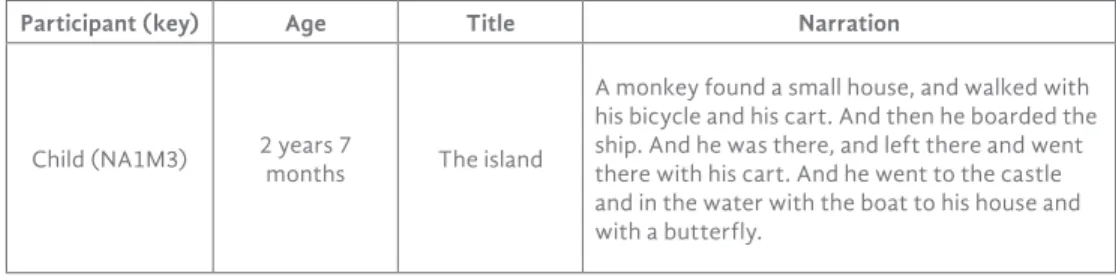
Workshops for closing two 40-minute sessions were conducted. The first activity was asking children tell a story of their own creation from interaction with an object, a cloth puppet shaped like a monkey (see Table 1). In the second activity, storybooks of "The Very First" ( Los primerísimos) collection by the Fondo de Cultura Economica were given out, and the children had the freedom to choose the book they liked, and then narrated the story to their classmates using the books’ illustrations.
Table 1. Oral Narratives published in the book "The Adventures of the Little Monkey" (Las aventuras de Monito)
Participant (key) Age Title Narration
Child (NA1M3) 2 years 7
months The island
A monkey found a small house, and walked with his bicycle and his cart. And then he boarded the ship. And he was there, and left there and went there with his cart. And he went to the castle and in the water with the boat to his house and with a butterfly.
Child (N1M3) * 3 years Amauri Tree (He was asked “did he climb the tree?”
What did he see in the tree?) Boat
Child (N2M3) * 3 years
5 months The Monkey It's on a boat ( He was asked “Where is he go- ing?”) To the sea.(What did you find?) The sun.
Child (N4aM3) * 3 years 1 month
The little monkey
(Where was he?) On an island (what did he find?) A boat. (And then what happened?) The pirate took their bananas. (And then what he happened?) A princess was found, and along with the princess he shared his bananas.
Girl (NA2M3) * 3years
4 months Trapped mon- key
(What was the little monkey doing?) It was climbing up and found the sun. (And then what happened?) He caught the monkey with the sun and bananas too. And he also went on a pirate ship. And then he was trapped. (And could he free himself?) No, he is there, trapped.
Girl (NA3M3) * 2 years
9 months The tree A joke. He got to see the sun. The monkey hid in the tree. The monkey hid. (What did he find?) Treasure
Child (NA5aM3) 3 years
3 months The little monkey
Once upon a time the Little Monkey found three balloons and a castle. Once upon a time the Little Monkey was at a party. He found a castle, he ran. (What did he find?) A princess and a prince, he went to the party. A library, a library, it is a library! There were books missing, many books.
Look at my library!
Child (N5aM3) * 3 years
2 months Matthew (Where is the little monkey?) He is on a boat.
(Where is he going?) To an island (what did he do?) Ran. (What did he find?) A donut.
Girl (NA7M3) * 2 years
9 months The little
monkey Oh how beautiful! (What did the little monkey do?) He fell into the pond and went to sleep..
* In the case of the boys - N1M3, N2M3, N4aM3, N5aM3 and NA2M3- and the girls-NA3M3 and NA7M3 – it was necessary to ask some questions in order for the child to narrate what was happening to the character.
The final product of the workshop was a printed album entitled "The Adventures of the Little Monkey", which contains the stories told by the children and illustrated with their drawings, so that the children are presented as the authors of their stories. A copy was given to each participant as well as a multimedia book that included the workshop proceedings. The presentation of the book was done with the parents.5
5 The presentation was held one month after the workshop ended in November of 2015.
Workshop results
The following were the results that were obtained according to the objectives set in the workshop Magic words:
1. It was identified that reading aloud provides a meaningful and emotional pathway between the children and the culture of writing, above all when the techniques of oral narration were implemented, such as: dialogic reading, dramatic reading or the use of puppets.
Dramatized readings make it possible for children to pay attention during the reading and they were excited; it created a pleasant atmosphere and it was easier for them to get involved with the plot and recognize characters with different voice intonations.
Using a puppet as a narrator also motivates their curiosity, however it was observed that children take longer to pay attention to the story as they preferred to be in physical contact with the puppet, and they gradually showed interest and enthusiasm in the story.
Dialogic reading always has favorable results when the selected book has flashy and colorful illustrations, preferably covering the entire page. It was observed that children easily lost interest in books with few images and text. With dialogic reading it is essential that the visual part is rich in images.
2. The use of teaching materials that have been designed by taking as reference the school identity and context where the child develops also promotes the game of reading since the child goes from being a passive participant (only listening to the reading), to be an active subject by being part of the story with these materials and even being involved in their development. The object that the child constructs involves various dimensions:
• Individual. It symbolizes their identity by having her name written on it as well as when she tries to write her name autonomously.
• Communicative. It can be expressed through drawing and help develop their creativity.
• Social. When they are prepared for someone else like their mother or a classmate, affective connections are made through the medium of the object.
3. The beginnings of writing are also stimulated, especially when techniques are used that permit artistic expression, such as drawing or painting with various media and tools, even using their own body to paint or write. It was observed that after having painted or colored, their hands were less tense and this facilitated and helped them in the tracing of the graphics of their name. Art favors the development of motor skills, since they have more control over their body and on the writing area.
Drawing in early childhood is crucial since it is the initial process of writing. For Vygotsky (1996: 33) "the little child draws first, then determines what they have drawn; in the next age the child gives a name to the drawing when it is half done and finally, she decides in advance what she will draw ". This complex process involves motor skills, language development and thinking.
4. When a child uses its own name from the beginning of reading and writing, the child identifies with it and is motivated, and their learning is significant. This also makes them feel even more confidence to start writing autonomously, which was observed in the last workshop sessions.
5. They began to familiarize themselves with the library and this gives them the opportunity to select their own reading materials.
6. During the closing of the workshop it was fomented that the children express and narrate their own stories, in order to stimulate their creativity and expression through the reading of their drawings. With this activity there were recognized as readers and writers.
7. One month after completion of the workshop, the presentation of the final products was done with the students and their parents. A printed book and an interactive digital book entitled
“The Adventures of the Little Monkey" was delivered, which contained the stories narrated by the children during the close of the workshop. When making the delivery of the materials to the children it was observed that several of them showed affection for their books, hugging them and indicated to their parents that they had made them. One child narrated the same story that she had given the month before.
CONCLUSIONS
Literacy is a long and complex process involving sociocultural development of various skills to identify, interpret, understand, create and communicate verbally or in writing. It is indispensable for the exercising of citizenship, and therefore constitutes a vital right.
This process is modified throughout life, since it is historical and dy- namic. It is possible to start from early childhood, since the early years of a human being are fundamental in shaping neuronal structures. In later years, the effects of the environment and people surrounding the child will be observable in their behavior, performance and in how they relate to the environment and people.
Both reading and play are two necessary activities that contribute to the development of thought and language in children. Hearing the narra- tion of text allows the child to develop their vocabulary, learn the language structures and the relationship between the spoken and written, and above all, allows them to establish caring relationships with adults involved with them by lending their voice to the texts.
Play represents access to culture for the child, because thorough play they can mimic and experience relationships and roles of adults. It is an activity where they can express and relate to others, thus it represents a form socialization. Play is especially a fun and inexhaustible activity thanks to the child’s imagination. This project was proposed to show reading and writing as playful practices for children 2 to 3 years of age, as a practical, affordable way in their school environment to begin the first steps towards literacy during childhood.
Offering texts in various formats and with age appropriate materials enables the enrichment of their experiences . Touching, observing and even biting these materials allowing them to begin to identify and relate orality to writing. They can also select texts that interest them or call their attention;
possibly resorting again and again to the same text when it pleases them and begin to form a bond to the book.
Reading aloud is essential to initiate this process, because children are benefited with this practice in various ways. Oral language develops to expand their vocabulary and learn linguistic structures, thus their thinking will also begin to become structured, and to know and recognize signifiers and meanings.
Through reading children experience varying moods, surprise, joy, anger, sadness, fear, and love, therefore their sensitivity is enhanced. To achieve this, it was identified that dramatized reading techniques enables them to recognize the different characters and pay attention to the story,
using different voice intonations. Dialogic reading can also be used as a strategy, as long as the right material is taken with attractive illustrations and little text. In longer texts, the ideal is to use the dramatized reading.
Through reading, children feel closeness and affection for the adults around them (parents, caregivers and teachers), and they begin to commu- nicate with them through dialogue. Therefore, adult participation is critical because they will be responsible for lending a voice to text to come alive in the imagination of children. Therefore the attitudes and values that adults place towards reading will influence the perception that the child has on it.
Both materials and the environment favor the diversity of readings and games, but it is especially adult participation as a mediator which is fundamental to the quality of reading and play.
The beginnings of writing are also stimulated, especially when artistic expression techniques are used such as drawing or painting with various media and tools, or even using their body to paint or write. This improves their motor skills, since they have more control over their body and writing space.
When their proper name is used at the start of reading and writing, the child feels a greater sense of identity, feels motivated, and their learning is significant. This also achieves a sense of greater confidence in order to begin to write autonomously.
Finally, it should be pointed out that the proposal in the workshop is presented as an opportunity to begin to open up the pathway in the histori- cal, dynamic and complex reading-writing process.
REFERENCES
Barthes, R. (2009). El susurro del lenguaje. Más allá de la palabra y la escritura.
Barcelona: Paidós.
Bhattacharjee, Y. (2015, enero). The first year. National Geographic 227(1), 58-77.
Braslasvky, B. (2003, junio). ¿Qué se entiende por alfabetización? Lectura y vida. Revista latinoamericana de lectura 24 (2), 2-17.
Brougere, G. (2013, octubre). El niño en la cultura lúdica. Ludicamente 2 (4), 1-10.
Bruner, J. (1983, marzo). Juego, pensamiento y lenguaje. Conferencia presentada en la reunión anual de la Preschool Playgroups Association of Great Britain, Llandudno, Gales.
Clemente, M. & Ramírez, E. (2008). Primeros contactos con la lectura. Leer sin saber leer. Salamanca: Fundación Germán Sánchez Ruipérez.
conaculta. (2006). Encuesta Nacional de Lectura. México: Autor.
Recuperado de http://sic.gob.mx/publicaciones_sic.php
Conafe. (2011). Aprendo con mi nombre. Guía para enseñar a leer a partir del nombre propio. México: Autor.
Ferreiro, E. (2008, 17 de abril). Hechos de carácter general que tienen incidencia en las condiciones de enseñanza. Conferencia presentada en el programa de capacitación "Lectura y escritura en la alfabetización inicial", La Plata, Argentina. Vídeo recuperado el 3 de octubre de 2015 de: https://www.youtube.com/watch?v=zh6lVMB66SI&list=PLVpYk08 XQAeRMCrgcvBuL3FK83SRbUou9&index=2
________. (2013, 27 de agosto). El significado del nombre propio. Vídeo recuperado el 23 de marzo de 2015 de https://www.youtube.com/watc h?v=QULVOhaeJyA&index=22&list=WL
Freire, P. (noviembre, 1981). La importancia del acto de leer. Conferencia presentada en el Congreso Brasileño de Lectura, Sao Paulo, Brasil.
Fundación Germán Sánchez Ruipérez (2009, 3 de octubre). Plan General de Promoción y dinamización de la lectura. Salamanca: Autor.
Huizinga, J. (2007). Homo ludens. Madrid: Alianza Editorial / Emecé Editores.
Márquez, G. (1988, enero-marzo). Sociología del libro y de la lectura: La comunicación cultural en Andalucía. Boletín de la Asociación Andaluza de Bibliotecarios. 4(10), 5-20.
Munari, B. (2004). Cómo nacen los objetos. Barcelona: Gustavo Gili.
Natale, L. (2014, 2 de abril). Alfabetización temprana. En Diccionario digital de nuevas formas de lectura y escritura. España: Universidad de Salamanca. Recuperado de: http://dinle.eusal.es/searchword.
php?valor=Alfabetizaci%C3%B3n%20temprana
Patte, G. (2011). ¿Qué los hace leer así? Los niños, la lectura y las bibliotecas.
México: Fondo de Cultura Económica.
Petit, M. (2015, 7 de agosto). El acto de leer y compartir. El País. Recuperado de: http://www.elpais.com.uy/cultural/acto-leer-compartir-michele- petit.html
sep (2013). Modelo de Atención con Enfoque Integral para la Educación Inicial.
México: Autor.
unesco (2008). El desafío de la alfabetización en el mundo. París: Autor.
unicef. (1984). El desarrollo del niño en la primera infancia. Dos documentos sobre la política y la programación del unicef. Programa de Cooperación unesco - unicef. (18). París: unesco / unicef.
Vigotsky, L. (1996). Pensamiento y lenguaje. México: Ediciones Quinto Sol.
Walker, S. & Reynolds, L. (2005). The typographic design for children project.
Recuperado de: http://www.kidstype.org/
Zuluaga, S. & Giraldo, Y. (2012, 15 de agosto). Tengo palabras para nombrarte y amarte. Revista Iberoamericana de Educación. 59(4), 1-9.
Recuperado de http://www.rieoei.org/expe/4939Zuloaga.pdf