http://hdl.handle.net/10459.1/68184
The final publication is available at:
https://doi.org/10.1016/j.esd.2020.01.009
Copyright
cc-by-nc-nd, (c) International Energy Initiative. Published by Elsevier, 2020
Està subjecte a una llicència de Reconeixement-NoComercial- SenseObraDerivada 4.0 de Creative Commons
STAND-ALONE RENEWABLE ENERGY AUCTIONS: THE CASE OF PERU Hugo Lucasa,b, , Pablo del Ríoc *, Luisa F. Cabezab
aSustainable Energy Initiative (SEI), Faculty of Environmental Studies, York University, Toronto, Canada.
bGREiA Research Centre, INSPIRES Research Centre, Universitat de Lleida, Pere de Cabrera s/n, 25001 Lleida, Spain.
cInstitute for Public Policies and Goods, Spanish Council for Scientific Research (CSIC), C/ Albasanz 26- 28, 28037 Madrid, Spain
*Corresponding author: Tel+35916022560, [email protected]
Abstract
Electrification policies are crucial to improve the welfare of rural populations worldwide. In this context, auctions for the deployment of stand-alone solar home systems (SASHS) are an appropriate alternative to facilitate access to electricity in rural areas. The aim of this paper is to analyze the design elements and functioning of the SASHS auction in Peru in order to derive lessons for the effective and efficient design of those auctions. Based on an analytical framework developed elsewhere, this article draws on official documents and data, secondary material and interviews with stakeholders. Our results show that some design elements are particularly suitable in this regard. In contrast to renewable electricity auctions in general, for which the volume auctioned is usually set as capacity (MW) or generation (MWh), the volume of SASHS auctions should be set in terms of the number of SASHS providing an electricity service. Geographical diversity, with different auctions per region, would ensure the adoption of a minimum amount of SASHS in a given geographical area.
Financial solvency, but not technical reputation, should be required. Otherwise, only the incumbents would be able to participate in the auction. The choice of technology- specific, price-only, sealed-bid, single-item auctions brings benefits in terms of economies of scale, lower support or transaction costs and a greater transparency or simplicity. A correction factor on the remuneration which accounts for the quality of the service, as applied in the Peru auction, is suitable for this type of auctions. Finally, provision of technical information, which facilitates the participation in the auction, and the implementation of a non-disclosed ceiling price are deemed appropriate. In contrast, given the low presence of local companies in the Peruvian PV market, the adoption of local content requirements would lead to higher support costs without significantly increasing the local development potential.
Keywords: electrification, off-grid, stand-alone solar home systems, decentralised, auctions, Peru.
1. Introduction
1.1 Background: universal electricity access
In 2011, UN Secretary-General Ban Ki-moon launched “Sustainable Energy for All” as a global initiative with three major interlinked objectives for the year 2030: (i) providing universal access to modern energy services; (ii) doubling the global rate of improvement in energy efficiency; and (iii) doubling the share of renewable energy in the global energy mix (United Nations, 2011). Universal access to affordable, reliable, sustainable and modern energy remains a key challenge with far-reaching consequences for socio-economic development outcomes. In 2017, the amount of people lacking access to electricity globally, for the first time, fell below 1 billion (IEA, 2018) although more than 600 million people are likely to remain un-electrified by 2030 (International Bank for Reconstruction and Development/The World Bank, 2018) (IRENA, 2019a).
Some scenarios predict that nearly 60% of additional generation needed to achieve universal access to electricity by 2030 will come from off-grid installations, which can be either mini-grids or stand-alone systems (IEA/OECD, 2014). Several factors are behind the increasing installation and use of distributed (off-grid) renewable energy technologies in remote areas: (i) improved technologies that can be tailored to meet customers’ specific needs for electricity, cooking, heating and cooling; (ii) improved affordability due to a sharp reduction of the cost and greater access to financing; and (iii) greater knowledge about local resources and renewable energy technologies (IRENA, 2013). Off-grid renewable energy technologies offer cost-efficient and rapidly implementable solutions for populations where grid expansion is not economically viable or takes too long (IRENA, 2019b). They are already acknowledged as an important driver of progress towards the achievement of universal electricity access.
The focus of this paper is on the auction of one of those main types of off-grid installations, e.g. stand-alone solar home systems (SASHS) in Peru.
1.2 Market and access gap: the role of auctions
Policies are needed in order to promote off-grid electricity services. Similarly to the information and communications services, when promoting universal access to energy services, there is the need to address the 'market efficiency gap', and the actual 'access gap'. The market efficiency gap refers to the difference between the current level of service penetration and the level achievable in a liberalized market, under a stable regulatory environment. The access gap refers to those situations where the population cannot afford the market prices at which the service is offered (Navas-Sabater et al., 2002).
To address the market gap there is a need to introduce competition and to leverage the private provision of a service. This requires the development of a transparent and non- discriminatory regulatory environment and the establishment of an institutional framework (Navas-Sabater et al., 2002).
East African off-grid markets and the success stories around some notable ventures give credence to the role of privately driven electrification endeavours, as well as to the business case around mini-grids and SASHS. Falling technology costs and the emergence of innovative business models and technologies (e.g. PAYGO, the Pay-As- You-Go Revolution, see for example Nique & Smertnik (2015)) allowed the formation of dynamic and growing off-grid markets in the region. This has also progressively encouraged market-based approaches in other continents. Still, entrepreneurs in the stand-alone sector continue to face challenges inherent to their business context. The affordability of systems and the high likelihood of payment default which is inherent to the financially weak customer base limits the profitability of SHS businesses, as well as their capability to service all those who are in need. A further limitation to market development for stand-alone is the risk of grid-arrival (Heynen, Lant, Sridharan, Smart,
& Greig, 2019). The arrival of a reliable grid connection may lie in distant future for many regions, but it is generally considered as a threat to project developers and business makers wishing to invest in systems with lifespans of 10 to 25 years. While mini-grids and SHS have proven their usefulness and importance for rural electrification, existing business models and purely private-market driven approaches, as well as the ecosystems in which they aim to function, will need to develop further to
close the 'market efficiency gap'. Most likely, however, the private market approach alone will never suffice to close the 'access gap', where no other incentives are in place.
In order to close the 'access gap' regulatory incentives to attract investors to high cost or challenging areas can be created through specific universal access policies and public investment subsidies.
A wide range of policy options exist for closing the access gap. Auctions, as a policy option, are being increasingly adopted by rural electrification agencies and public utilities and distribution system operators to procure the design, supply, installation, testing, and commissioning of both mini-grids and stand-alone systems (e.g., solar home systems and solar irrigation pumps) (IRENA, 2019b). However, auctions should not be regarded as the silver bullet that will solve every possible problem and, particularly, the access to electricity challenge. As with other complex problems, this one is multifaceted and the contribution of auctions is limited in this regard. They should rather be seen as part of a broader policy mix, i.e., one alternative implemented together with other instruments. These include policies and regulations, such as auctions, but also delivery and financing models, institutional frameworks, capacity building, technology adaptation and cross sector-linkages (IRENA 2018). There are several public sources of financing which can bridge the financing gap. These include direct financing for public services, rural enterprises and households that are unable to access available solutions and are at risk of being left-behind; and financing instruments that derisk investments and, thereby, attract private capital for enterprises and projects (e.g., high-risk innovation funds) (IRENA 2019b). In addition, several types of policies can strongly influence the affordability of stand-alone systems for rural communities, including fiscal incentives to promote market development (such as import duty and value added-tax exemptions), measures to level the playing field (e.g., evaluating fossil fuel subsidies, raising public awareness), quality standards and dedicated consumer/ enterprise financing channels (IRENA 2019b).
Notwithstanding, auctions are being chosen in this article because they are considered the most cost-efficient instrument to procure SASHS, which is in line with the general choice of auctions for the support of electricity from renewable energy sources (RES-E) nowadays (see IRENA 2019a).
The efficiency and effectiveness of auctions for stand-alone RES-E and their design is a topic which, to our best knowledge, has received scant attention in the past. The aim of this paper is to cover this gap in the literature by analysing the experience of Peru with SASHS auctions in order to learn more on how they could be designed to be efficient and effective. In particular, this paper assesses the pros and cons of different design elements in the Peruvian SASHS auctions and infers lessons on the most appropriate design options for this type of auctions.
Peru represents a relevant experience regarding the auctioning of stand-alone PV systems. It is a case worth analysing for two reasons: it has a relatively high rural electrification rate, with the remaining non-electrified population clearly being part of the access gap that can only be reached with targeted subsidies, and it implemented a massive program for stand-alone electricity systems based on solar PV. Since a sufficient time has passed since the organisation of the auction (2014), some lessons from this experience can be deducted.
The national electrification rate in Peru reached 94.8% in 2016 (SE4ALL, 2018), but the rural electrification rate was lower, with an average of 75% in 2016 (SE4ALL, 2018).
Policy support is required in order to increase this rural electrification rate. Auctions of SASHS have been adopted with this purpose. In 2013, an auction was announced to supply electricity through SASHS to a minimum of 149,000 households and 2,890 community buildings. The auction, which was carried out in November 2014, aimed to break the status quo of rural electrification. It contributed to the large-scale electrification of rural and isolated areas, to encourage social inclusion through private investments using alternatives to grid extension at competitive prices (Mitma, 2018;
IRENA, 2019a).
Despite its relevance, an in-depth analysis of the design of the solar PV stand-alone auction in Peru and its results is missing. A literature review was performed by the authors specifically on this auction, and no references were found, although the auction has grasped considerable attention in the (energy) mass media (see section 3). We base our analysis on official documents and data, secondary material and stakeholder interviews (see section 3).
Accordingly, the paper is structured as follows. The next section provides an overview of rural electrification policies in Peru. The analytical framework and the method for the assessment of the stand-alone auctions in Peru are described in section 3. Section 4 includes the results of the assessment. Section 5 concludes.
2. Rural electrification policies in Peru
2.1 The initial steps
In 1992, Peru enacted the Law Decree 25844, “Law of Electricity Concessions”, which laid down the basis for a major restructuring of the power system. It transformed the vertically integrated state-owned monopoly of the time to a system with unbundled activities of generation, transmission and distribution, allowing the participation of the private sector and liberalizing the wholesale electricity market (Congreso de la República del Perú, 1992).
With the promotion of private investment in the newly formed market, the market gap for access was addressed and the provision of the electricity service was improved considerably, increasing the national electrification rate from 55% in 1992 (MEM, 2014a) to 75% in 2002 (MEM, 2003). This advance benefited mainly the urban areas due to the prevalence of competitive market conditions, along with no specific regulation for rural electrification for the new agents of the market (MEM, 2003).
Nevertheless, an access gap persisted. The electrification level in 2014 reached 92% at the national level (MNER, 2015), with considerable regional differences across districts.
3 million Peruvians did not have electricity and 0.7 million households were not connected to the grid. The degree of rural electrification was much lower than the national electrification average (75% in 2014), although it had increased significantly, from 8% in 1993 (and 30% in 2007) (MNER, 2015).
This access gap arises due to a combination of technical and economic challenges to carry out grid extension and interconnect rural zones to the existing system. These factors include mainly (i) geographical isolation, (ii) topographic conditions, (iii)
dispersed demand, and (iv) low energy demand per user (typically domestic demand) (ARE, 2015; Dammert, 2010). All these render electrification works very costly while, on the other hand, rural communities typically have low purchasing power and require having regulated tariffs that sometimes do not cover the costs. As a result, compared to the expected income, in many cases the required investments do not reach a level of profitability that is attractive enough for private actors to take a step forward, thus requiring state intervention in the form of dedicated programs and subsidies.
2.2 Regulatory framework for rural electrification
Although the electrification rate in rural areas had increased to 24.7% in 2002, more than 5 million rural users still lacked access to electricity (MEM, 2003). In order to tackle this problem, Law 27744 on ‘Rural electrification and isolated and border communities’ was enacted in 2002. This declared rural electrification as a matter of national interest and welfare, “with the objective to contribute to sustainable socioeconomic development, improve the quality of life of rural population, fight poverty and promote the use of clean and renewable energy” (Congreso de la República del Perú, 2002). The State should lead the development and funding of the associated projects (Congreso de la República del Perú, 2002).
Later, in 2006, the Law 28749, ‘General Law on rural electrification’, repealed the Law 27744 of 2002. It kept the same guidelines while complementing further the provisions for rural electrification, in order to ensure the “promotion and the efficient and sustainable development of the electrification in rural, isolated and border zones”
(Congreso de la República del Perú, 2006). This remains today the main legislative piece on the subject, along with the accompanying regulation (Supreme Decree No.
025-2007-EM of 2007).
The Law 28749, “General Law on rural electrification” establishes that the Ministry of Energy and Mines (MEM), through its General Direction of Rural Electrification (DGER by its Spanish acronym), is responsible for the rural electrification policy. In a consultative process with regional and local authorities and other interested actors, DGER-MEM will draft, implement and monitor the National Plan on Rural Electrification (PNER by its Spanish acronym). The PNER determines the
electrification goals on a ten-year horizon and outlines the strategies and programs to be carried out for that period.
Besides, DGER-MEM rural electrification projects can be executed by regional and local governments and by the private sector. A minimum subsidy will be awarded to private investment in rural electrification to make those viable.
The Law 28749 establishes several sources of funding for the PNER: (i) a transfer from the national budget; (ii) a tax on incomes to companies producing, transporting and distributing electricity and other extractive activities; (iii) a cross subsidy from the electricity tariff; (iv) penalties imposed by the regulator on utilities; (v) financial resources from privatization of public utilities; (vi) support from regional and local governments within the framework of rural electrification cooperation agreements and (vii) local and international donors.
Besides the Law 28749 and the accompanying regulation, Legislative Decree No. 1002 for the ‘Promotion of Investment on electricity generation based on renewable energy’
in 2008 is relevant regarding the legal framework of the auction of SASHS assessed in this article. It establishes auction as the mechanism to promote renewable energy technologies in Peru.
2.3 Recent developments and perspective of rural electrification
With all the efforts that have been put forward to improve electricity access, the rural electrification rate was only 75% in 2014 (MEM, 2014a). Moreover, due to the goals of the PNER 2015-2024, Peru aims to invest US 1.4 billion to grant electricity access to 3.8 million additional rural households in the 2015-2024 period. This would raise the electrification rate in rural areas to over 99% in 2024 (MEM, 2014b).
For this purpose, four technological solutions are currently considered in the PNER.
The extension and/or reinforcement of transmission and distribution networks (where more than half of investment is dedicated) is the preferred option (MEM, 2014b). If the economic and technical conditions do not favour this, then the priority would be to
deploy solar PV systems1. The third alternative is to construct small hydro projects (<2 MW) (MEM, 2014b). Finally, the utilization of wind power could be assessed (MEM, 2014b). The SASHS projects were planned on the basis that the electricity grid would not reach the area in the medium to long-term (MEM, 2014b).
2.4 The auction for SASHS.
A program for the massive deployment of SASHS has been launched. It has been estimated that there are around 500 thousand households that could potentially benefit from the program. Providing these users with a SASHS would be a significant contribution to close the energy access gap. This has led to the implementation of the first auction for energy supply for off-grid zones. It was called on September 2013 and run on November 2014.
According to Article 5 of the Regulation on Renewable Energy Sources in Areas Not Connected to the Grid (Reglamento RER de Áreas No Conectadas a Red) on June 27th, 2013, the Ministry of Energy and Mines published on July 2013 the Previous Notice for the Call of the First Auction on Renewable Energy Sources for the Provision of Energy to Areas Not Connected to the Grid. The auction took place on November 7th, 2014 and was closed on April 30th, 2015.
The auction was established in the regulatory framework which includes (i) the
“General Rural Electrification Law” (Law 28749); (ii) The Legislative Decree 1002 which creates incentive mechanisms in order to promote the generation of electricity with renewable energy sources and the setting up of an auction process in order to grant long-term revenues for investors; (iii) the Supreme Decree 020-2013-EM which approves the “Regulation on the Promotion of Electricity Investments for Areas Not Connected to the Grid” and sets up the guidelines for the auction; and (iv) The Supreme Decree 036-2014-EM, which tasks the distribution companies and ADINELSA2 with the commercialization activities related to the users of the PV installations.
1 For the period 2015-2024, this represents one third of the forecasted investments for rural electrification (MEM, 2014b).
2 ADINELSA is a private company, which manages and operates electricity services in rural and remote locations where there are not any other operators (neither public nor private).
Regarding the main actors in the auction, these are described in detail in del Río (2017b). MINEM (Ministry of Energy and Mines of Peru) develops regulations and standards in the energy and mining sectors, including those related to renewable energy.
It also sets the policy and regulatory guidelines for conducting renewable electricity auctions. The Supervisory Agency for Energy and Mining Investment (Organismo Supervisor de la Inversión en Energía y Minas, Osinergmin) is the entity responsible for the supervision and regulation of the energy and mining sectors in general and the renewable energy market in particular, and designs and implements the auction at the request of MINEM. It steers the auction, sets the maximum prices, supervises the contracts resulting from the auction, fixes the final tariff for the users of these installations, and regulates the subsidies to top up the tariff in order to secure the sustainability of the system (cargo RER autónomo)(del Río 2017b, p.5). The distribution companies and ADINELSA are providers of the commercialization service for the stand-alone installations, carry out public awareness and information campaigns on electricity supply with PV systems and verify the operation of the installations. The commercialization service includes setting and distributing bills and collecting the payments.
3. Material and methods
The analytical framework, which draws on economic theory and empirical research in RES-E auctions from countries around the world, has been developed elsewhere (del Río, 2015) and used to analyze the outcome of RES-E auctions, whether in general for on-grid electricity (del Río, 2017), for given countries such as those in Sub-Saharan Africa (Lucas et al., 2017) or for given technologies, such as concentrated solar power (del Río and Mir-Artigues, 2019). However, it has never been applied to SASHS auctions.
Before an auction is implemented to promote renewables in general, and off-grid electricity in particular, governments must consider whether this is an appropriate mechanism, taking into account their energy policy priorities and the main features of the technology they aim to support. Then, specific design elements can be chosen.
These are highly context-specific (Kitzing et al., 2016). The most relevant design
elements in RES-E auctions are described in Table 1 (see del Río, 2015 and IRENA, 2017 for further details).
Design
element Description
Volume Three metrics have traditionally been used in on-grid auctions to set the volume auctioned: capacity (MW), generation (MWh) or budget (e.g., million €). In addition to those, in SASHS auctions the volume to be auctioned may refer to a given number of installations (e.g., stand-alone systems).
Diversity Diversity with respect to technologies, locations, actors and sizes of the installations could be promoted in an auction by organizing different auctions per alternative (e.g., technology-neutral vs. technology-specific), by including minimum quota per alternative, by providing different remuneration levels for different alternatives or by lowering prequalification requirements or penalties for specific categories (i.e., small actors).
Participating conditions:
facilitation and requirements
Several elements may facilitate the participation in an auction, while others are requirements for this participation:
- Streamlining of administrative procedures.
- Information provision (e.g., measurement of resource potentials).
- Prequalification requirements in order to participate in the bidding procedure are adopted to prove the seriousness of bids. They can refer to specifications of the offered project (such as technical requirements, documentation requirements and preliminary licenses) or to the bidding party (providing evidence of the technical or financial capability of the bidding party). They also include economic guarantees (bid bonds).
- Local content rules.
Selection
criteria Price-only auctions are organized using only one criterion (the bid price). In multi- criteria auctions, price is the main criterion among other criteria (e.g. local content rules, deliverability, industry and jobs or environmental impacts).
Auction
format In a single-item auction, a single product is allocated to a single owner and the product cannot be split. In a multi-item auction the auctioned product is split among different owners and bids are submitted for only part or the total auctioned amount.
Auction type Under sealed-bid auctions, project developers simultaneously submit their bids with an undisclosed offer of the price at which the electricity would be sold. An auctioneer ranks and awards projects until the sum of the quantities offered covers the volume of energy being auctioned. Under the multi-round descending-clock auction, the auctioneer offers a price in an initial round, and developers bid with offers of the quantity they would be willing to provide at that price. The auctioneer then progressively lowers the offered price in successive rounds until the quantity in a bid matches the quantity to be procured.
Pricing rules Under uniform pricing, all winners receive the strike price set by the last bid needed to meet the quota (highest accepted bid) or the first bid that does not meet the quota (lowest rejected bid). Under pay-as-bid (PAB), the strike price sets the amount of generation eligible for support and each winner receives his/her bid.
Price ceilings A maximum bid price limits the costs of support. A main decision is whether or not to disclose this price.
Realisation
period Deadlines are set for building the projects which have been awarded contracts.
Penalties Penalties can take different forms, including confiscation of bid bonds or penalty payments.
Defining “success” in the choice of design elements is certainly not a trivial issue.
Assessment criteria are used for this purpose, although an unambiguously preferred ranking of criteria does not exist. This article focuses on the two most common criteria
Table 1: Main design elements in SASHS auctions (adapted from del Río and Mir-Artigues, 2019).
to assess auctions: effectiveness and minimization of support costs. The effectiveness criterion in auctions refers to the realization rate, e.g., to the volume which has been awarded in the auction (MW, GWh or number of stand-alone systems as in the case of SASHS) and which is actually built. Minimization of support costs refers to the prices being awarded in the auction.
The links between specific design elements and criteria to assess those design elements are mediated by their effects on bidders and the market (see del Río, 2015 for a detailed discussion). Design elements affect the participation of bidders in the auction through their impact on the costs, risks and expected benefits of participation (“bidders’
effects”). The higher the costs, the higher the risks or the lower the expected benefits, the lower the number of participants (del Río, 2017) and competition, the higher the bid prices, the lower the efficiency of the auction and the higher the support costs (Haufe and Ehrhart, 2015). Effectiveness is affected by those design options with an influence on investors risks’ (negative influence), competition (negative influence, since a higher level of competition induces more aggressive bidding and, eventually, underbidding and underbuilding), and bid levels (positive effect).
We have used three complementary data sources to gather material on both the design elements and the results of the auction. First, we have relied on official documents.
Osinergmin and MINEM are the two main sources of data in this regard. Therefore, we have deeply searched for relevant documents in the websites of both institutions (http://www.osinergmin.gob.pe/ and https://www.gob.pe/minem, respectively). These included details on the regulation of the SASHS auction as well as their outcome in terms of awarded prices in the auction, the allocation of auction volumes across awarded actors, non-successful bids, etc. (see section 5 for details). This information was then structured according to the aforementioned classification of design elements and assessment criteria, i.e., it was included in the relevant categories.
Second, a literature review on Peru SASHS auction for the period 2013-2019 was performed. Although, as mentioned in the introduction, no publicly available document was specifically dedicated to this auction, there were several articles in the mass media which contained some views from different types of stakeholders (BNamericas, 2019;
Peruinforma, 2018; RSE Perú, 2018; Rumbo Minero, 2018; Tamayo, 2019 and Tozzigreen, 2018).
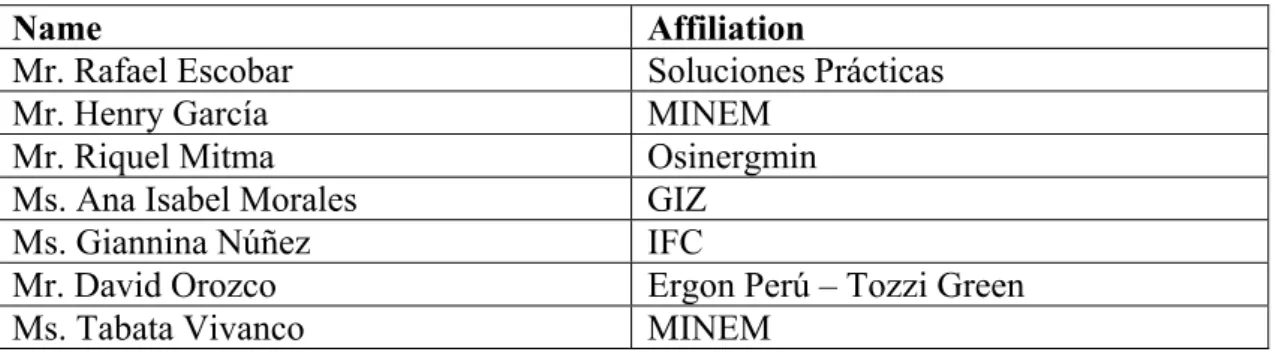
Third, seven interviews with main stakeholders were performed in Spanish, including representatives from the awarded company, the regulator, MINEM, international financial institutions, practitioners and energy experts (see Table 2 for a list of these stakeholders). These personal interviews were carried out in Lima in two batches, November 2015 and May 2017, and lasted between 30 and 60 minutes each. They were semi-structured interviews in which interviewees were initially asked three categories of questions: 1) the goal of the SASHS auction program as well as its context conditions;
2) which design elements were implemented in the SASHS auction and; 3) how the interviewee assessed the functioning of the auctions, relating it to the design element being chosen.
Table 2. List of interviewees and their institutions.
Name Affiliation
Mr. Rafael Escobar Soluciones Prácticas
Mr. Henry García MINEM
Mr. Riquel Mitma Osinergmin
Ms. Ana Isabel Morales GIZ
Ms. Giannina Núñez IFC
Mr. David Orozco Ergon Perú – Tozzi Green
Ms. Tabata Vivanco MINEM
4. Results and discussion.
4.1 Assessing the design of the SASHS auction in Peru
We describe the design element being adopted in the SASHS auction in Peru, followed by an assessment of the choice of design elements. We base our analysis on economic theory and own experience.
4.1.1 Volume of the auction and product auctioned
The goal of the auction was to award the provision of the electricity service in so-called off-grid areas for a minimum of 149,000 and 2,890 community buildings and a maximum of 500,000 RES-E installations.
Several interviewers highlighted the difficulties to set the minimum volume, which should be large enough in order to be attractive and to foster economies of scale.
However an excessively large volume would be unrealistic, taking into account that the greatest previous experience in Peru was the deployment of few thousands SASHS. The government estimated that 1 million households were lacking access. Half were expected to be reached through extension of the grid in the coming ten years. Therefore, it was assumed that setting the volume in at least 149,000 SASHS was attractive and realistic. Experts interviewed agreed that leaving the final number of households to be under the service contract open until the winning company had studied the optimal volume on the ground was a good practice.
Technical requirements were set in the auction terms of reference. These are PV stand- alone systems of a minimum capacity of 85 kWp for households, 425 kWp for medical centers, and 850 kWp for schools (Mitma, 2018)3. The product auctioned included delivering pre-defined electricity services, covering the installation, operation, and maintenance of stand-alone PV systems in households, medical centers, and schools, for 15 years. Two of the interviewees agreed that the technical requirements for the SASHS were too detailed, which reduced the possibilities to offer more optimal solutions for the same service.
The program with PV systems is targeted especially at towns in remote places with a high poverty index and which could not be reached by the conventional electricity grid in the next ten years (MEM, 2014a). Three geographically different auctions were organized in the North, Center and South of the country (Table 3).
Companies bid for a predefined minimum number of stand-alone PV systems that need to be deployed. These minimum thresholds vary by region, but lie between 47,000 and 55,000 household systems, 175-280 systems for medical centers, and 410-1,200 solar PV systems for the use in schools. After the contract is awarded to the successful bidder, but before the signature of the contract, the project developer has five months to
3 Regarding the minimum features of the installations, the common elements which make up the installations are: PV panels of at least 36 cells, electronic load controller, sealed battery without liquid electrolyte which should operate at 80% of its nominal capacity, mounting system, wiring and indicators of the state of the battery.
conduct a census to ascertain the number of customers the project will effectively be able to service, and communicate respective estimates to the authorities. For households electrified above the minimum requirements, the project developer receives the same unitary remuneration as defined by the bid (the remuneration for one household is defined by the bid divided by the minimum thresholds of systems).
Area not connected to the grid
Type 1: households Type 2: medical centres
Type 3: schools
North 55,000 280 1,200
Center 47,000 175 650
South 47,000 175 410
TOTAL 149,000 630 2,260
In addition to these minimum thresholds, the original terms of references stipulated that there should be at least 2,000 solar PV systems in operation per defined area by August 31st, 2015. All contracted systems were required to be operational by December 31st, 2018. However, inconsistencies with respect to investment contracts caused delays, leading to downward revisions of the schedule in February 2017. With the revised goals, 30,000 solar PV systems were required to be in operation by the end of 2017, 130,000 systems by the end of 2018, and 220,000 systems in 2019.
Several experts interviewed agreed that the mandatory minimum in the three regions as well as the initial milestone of 2,000 SASHS by August 31st, 2015 were set for political reasons and were too tight. The contract was awarded to a private entity in 2014 which offered to install and operate 220,000 systems (Tozzigreen, 2018). The contract is for 15 years, and the company (ERGON) is responsible for the design, installation, operation, maintenance and, if needed, replacement of the system. The ownership of the system is transferred to the State at the end of the contract (IRENA, 2018). Each month, the awarded company gets paid directly from a trust fund set for this purpose. In this public-private partnership model, the operator invests and operates, while the distribution companies are responsible for billing and collecting the money from the tariff.
Rural electrification tariffs are administratively set by Osinergmin. Effectively, these tariffs are subsidised, according to IRENA (2017); in practice this translates into
Table 3: Minimum quantity of stand-alone solar systems required (Osinergmin, 2014).
consumers paying about 20% of the service cost, with the remainder coming mainly from cross-subsidization of the electricity tariff of grid-connected consumers.
In contrast to on-grid auctions, which define the volume auctioned according to a budget, capacity or generation metric, the number of customers to be provided by the rural electrification service with SASHS has been set. This is probably a more appropriate metric in SASHS auctions, whereby a service for 15 years is provided in a single-product auction (winner gets all) and, thus, in this case the PV systems have to be scattered across the rural areas. A generation-based metric does not seem to make much sense, since the focus is on providing a pre-set service. A budget-based metric is also not deemed appropriate for SASHS auctions since it may unnecessarily limit the installation of SASHS systems. All those metrics do not seem to fit well with the features of SASHS auctions. They are too general, and it is difficult for them to have a decentralized territorial component, which is deemed crucial in this context.
4.1.2 Qualification requirements
Participation was dependent upon meeting some qualification requirements. Some of these referred to meeting the technical characteristics of the installations and others fell on the bidder. Regarding the former, the installed equipment must comply with some technical specifications, it should have been manufactured within the two years before the signing of the investment contract, and the batteries should not be more than one year old. Participants (bidders) needed to provide an implementation schedule in order to comply with the dates of the different milestones envisaged in the auction as well as the commitment to comply with such schedule and the date when the components of the equipment were manufactured. The company had to be registered in Peru, with a social capital of at least USD 10 million.
Other requirements referred to financial guarantees. The bid guarantee per each geographical area to be electrified was USD 1 million, the construction guarantee USD 10 million, and the contract guarantee USD 2 million. There was no requirement for previous experience in the implementation of SASHS for project developers.
Prequalification requirements were mainly financial guarantees. Taking into consideration that there was not a real off-grid market in Peru when the auction was set, and little experience in the world in one single programme of this scale, the option of setting nimble prequalification criteria, with no need to have previous experience (no need to proof technical reputation), was deemed a suitable choice. This finding was confirmed during the interviews.
Last, but not least, it was highlighted in the interviews that the high contract guarantee was preventing technology providers to be part of bidding consortiums.
4.1.3 Geographical diversity
Three geographically different SASHS auctions have been organized (North, Center, and South). Encouraging geographical diversity in auctions results in lower allocative efficiency levels, since not necessarily the best sites are used first. However, it is also usually defended on other grounds: more social acceptability, a lower excessive remuneration in best sites, and ensuring proximity to the grid and/or loads (del Río 2017).
However, most of the pros and cons of geographical diversity in on-grid RES-E auctions are unlikely to apply in the case of SASHS auctions in Peru. Allocative efficiency is not a priority since the aim is to provide a service, rather than to do so at minimum generation costs across the whole territory. Ensuring optimal use of the transmission grid is obviously not an argument in SASHS auctions. Social acceptability is likely to be enhanced by a greater geographical diversity, since people from different areas would benefit from it. Geographical segmentation may have reduced the economies of scale and added transaction costs, but it also ensures the adoption of a minimum amount of SASHS in a given geographical area and facilitates the provision of a standard product in regions with similar characteristics. In fact, given that SASHS auctions have been organized as single-item ones, a greater geographical segmentation of the auction (per departments, provinces or districts) could open the door for the participation of smaller actors, potentially increasing the number of participants being awarded and, thus, participation and competition. Therefore, geographical diversity (different auctions per region) would lead to substantial benefits. In the case of the
Peruvian auctions, the interviewees agreed that geographical diversity was set for political reasons and to increase social acceptance.
4.1.4 Technological neutrality/specificity
The Peruvian SASHS auction is technology-specific (solar PV). Concerning the technologies, one of the interviewees for this article argues that mini-grids were considered, but as a 2nd stage after the 1st stage of SASHS. Notwithstanding, this 2nd stage never materialized. It was left for a later stage due to two reasons: 1) rural dwellings are highly dispersed across the territory and it is not reasonable to implement mini-grids; 2) mini-grids need detailed information on the expected electricity consumption of the settlements to be electrified. This information was neither accurate nor reliable.
The question of whether technology-neutral or technology-specific support should be adopted is a much debated topic, whether in general (see Azar and Sanden 2011 or Kitzing et al 2018) or with respect to auctions (del Río, 2017; Kitzing et al., 2019).
Furthermore, there is an on-going discussion on whether technology-neutral auctions exist at all since this term implies some level of ‘fairness’ or a level playing field when in fact different technologies face different costs, risks and other differences that may predetermine the outcome of the auction in favour of one technology or the other4. The former arguably contributes to promote strong competition due to a potentially higher number of participants and projects with lowest costs are implemented first, leading to lower support costs. Technology-differentiated support is deemed useful for other goals:
building local industries, system integration and participation of small actors or social acceptance. We deem the choice for a technology-specific auction, with only one technology being eligible to participate, an appropriate one, given the benefits in term of economies of scale and lower transaction costs. The choice for PV seems reasonable, given the abundant solar resource potentials in the country and the fact that PV is a proven, modular technology which can effectively provide an off-grid electricity service.
4 We thank an anonymous reviewer for raising this point.
Very detailed technical specification for, both, the equipment and the system, were partly responsible for the delay in initiating the deployment of the stand-alone systems.
MINEM-DGER and the awarded company had a relatively long discussion on the protection equipment of the systems. The awarded company proposed that magnetic protection was required, whereas the MINEM-DGER argued that a mechanical protection system was mandatory. The referee ruled in favor of the company. In addition, this level of detail was criticized in the interviews, since it prevents the use of possibly less costly solutions with different photovoltaic types and storage equipment of different system configurations. This is in line with the findings from auctions in Sub- Saharan Africa (Lucas et al., 2017).
In addition, one interviewee mentioned that an isolated rural home was an informal construction built with less common materials. Installers could not meet in many cases the official rules and procedures for cabling in the houses, because of the materials and configuration of the dwellings. This led to delays in the approvals of the installed systems.
4.1.5 Selection criteria
Regarding the selection criteria, the SASHS auction in Peru is a single-price one, i.e., not a multi-criteria auction. A purely price-only selection process is associated with lower support and transaction costs, while the inclusion of other criteria imposes restrictions that might lead to higher costs and decreased transparency. However, multi- criteria auctions can also help promote social acceptability and local economic development. While EU countries have price-only auctions, non-EU countries opted for multi-criteria auctions (Wigan et al., 2016). Given the specific features of this SASHS auction, in which the contribution of the stand-alone PV systems to the welfare of the population and local economic development have already been taken into account in the product being auctioned (provision of electricity for non-served population) and the geographical delimitation, this seems to be an appropriate choice. It does not seem reasonable to include more elements in this context which could distort the functioning of the auction and/or add unnecessary transaction costs.
4.1.6 Auction format
Auctions can be organized as single-item or multi-item. A priori, one is not unambiguously better than the other and the choice may depend on the particular features of the product being auctioned. “The amount of off-grid installations which the bidder commits to deploy and which are included in the bid will need to be single values per Area Not Connected to the Grid. The amount of those installations belonging to an Area Not Connected to the Grid cannot be split in stages, systems, phases or any other form” (Article 11.2, Supreme Decree 020-2013). The winner wins the whole package for each area. Given that the metric on the auction volume is the PV systems in a given area, the small size of systems, economies of scale and the transaction costs involved in the implementation of these systems (some of which are fixed), it makes sense to have a single-item auction per area in which the winner wins the contract for all the systems in such area. The advantage in terms of economies of scale of the choice for a single-item auction compared to multi-item auctions probably offsets the disadvantage in terms of greater risks of non-compliance (since in multiunit auctions this risk is diversified because there are several awarded winners).
4.1.7 Bidding procedures
With respect to bidding procedures (sealed-bid vs. dynamic auctions), the choice in this auction has been for first-price sealed bids for an annual remuneration (USD/year).
Compared to dynamic auctions, sealed-bid auctions can be more appropriate in this case because it is simpler and avoids the risk of collusion (IRENA, 2015). This is deemed an advantage in this context given the small number of actors. The three auctions (one per zone) are carried out simultaneously and confidentially.
4.1.8 Remuneration scheme
Annual guaranteed remuneration, in monthly installments, is provided to the awarded winner for 15 years after the start of commercial operation of the minimum required installations per area. The source of revenues for the project investor is a trust fund specifically set to guarantee the payments (Supreme Decree 020-2013-EM)5. The
5 Both the remuneration to the awarded bidder as well as the commercialization costs are covered by a trust fund which has been created for this auction, as required in Supreme Decree 020-2013-EM. The
annual remuneration per non-connected area will be corrected by: (i) a correction factor which depends on the performance of the installations, according to their operation and the quality of the service provided; and (ii) an updating factor linked to the evolution of prices.
The remuneration period of 15 years is standard in on-grid auctions everywhere, as it is also the updating factor linked to the evolution of prices. The correction factor accounting for the quality of the service is unprecedented in on-grid auctions, but it is probably a highly relevant design element in SASHS auctions in order to encourage the well-functioning of the installations, which is a key factor in order to provide an appropriate electricity service. Interviewees highlighted the need to learn from previous experiences, whereby the maintenance of the SASHS was not secured and the systems were out of service after the first problem arrived.
As the awarded company mentioned during the interview, the main cause of delay in the deployment of the system was the different interpretation between MINEM-DGER and the company on the responsibility for collecting the tariff. Finally, the government charged the distribution companies with this task.
The contract is set in USD, it is updated every year, with a preset formula that considers the evolution of international and national prices. This, together with the very strong and clear legislative framework, was considered by the awarded company being interviewed as key to find international finance.
4.1.9 Ceiling prices and disclosure
The auction had a non-disclosed ceiling price. The only other bidder was disqualified for exceeding this price. The existence of non-disclosed ceiling prices is a safeguard against high support prices in case there is not sufficient competition, in particular when there is not much information on the market, as it was the case. We deem the existence of a ceiling price an appropriate choice. The existence of few bidders in the case of the Peruvian SASHS auction would make selecting this design element a quite useful funds of the trust fund stem from the billing to users and subsidies. Subsidies account for 80% of this charge (12$/MWh), and the rest (20%, 3$/MWh) comes from billing the user (MNER 2015).
alternative to mitigate the potential negative impact of a weak competition on high bids, although it is obviously a second best with respect to designing the auction in order to have strong competition in the first place.
Another issue is whether the ceiling prices should be disclosed. If they are, this would increase transparency and investor confidence. But it would also bias the results of the auction and lead to the “anchoring effect”, whereby bidders may propose relatively high bids close to that price. We deem the risk of anchoring greater than the benefits in terms of transparency/higher investor confidence. Therefore, the choice of non-disclosure is considered an appropriate one. Since the maximum price has not been disclosed, we cannot judge on the suitability of its level.
4.1.10 Local content rules
There were not any local content rules. Taking into account the characteristics of the Peruvian solar PV market, with a small existing manufacturing capacity and low local presence in all the stages of the value chain, the adoption of local content rules would be problematic, since it would increase the support costs (higher bids), without significantly increasing the local development potential. Therefore, we deem the lack of local content rules an appropriate design element in the Peruvian auction.
4.1.11 Information provision
OSINERGMIN has provided considerable information on the auction procedure in its website, including (i) the list of potential beneficiaries; (ii) database with all the contact details of all the relevant actors at the district level; (iii) information on previous programs for the installation and training in stand-alone solar systems; (iv) map of the excluded areas; (v) information on the length (km) of the different types of roads (paved, not paved or unknown); (vi) information on the geographical influence of the 11 national electricity distribution companies; (vii) solar irradiation in the different locations; and (viii) technical specifications of the systems and their components. In addition, to gather on-site information, the awarded company had five months to develop a census of users interested to have a PV system. Distribution companies were mandated to provide support in the elaboration of the census. The provision of technical
information is deemed an appropriate design element to encourage participation in the auction (and, thus enhance competition). It facilitates the proposal of high-quality bids, although it usually involves a cost which falls on the auctioneer (the government) and not on the bidders.
4.1.12 Seller concentration rules
Seller concentration rules can be justified in order to enhance competition and actors’
diversity. This may be required to prevent that, if there is only a single bidder, he captures the whole budget with a very high bidding price (in the absence of a reserve price). A negative aspect would be that these rules interfere with the market allocation.
They may make more sense in some market contexts than in others. There are several options to set seller concentration rules: setting a minimum number of bidders under which the auction will not be carried out, limiting the size of bids per bidder and limiting the number of rounds in which bidders can participate. Given the existence of few potential bidders and the presence of strong economies of scale, seller concentration rules would be problematic. They could even lead to contracts not being awarded if there is only one bidder participating in the auction (or doing so at a much higher price since, as it has been the case in the Peru SASHS auction, the second best bidder bid at considerably higher prices).
4.2 Assessing the functioning of the auction
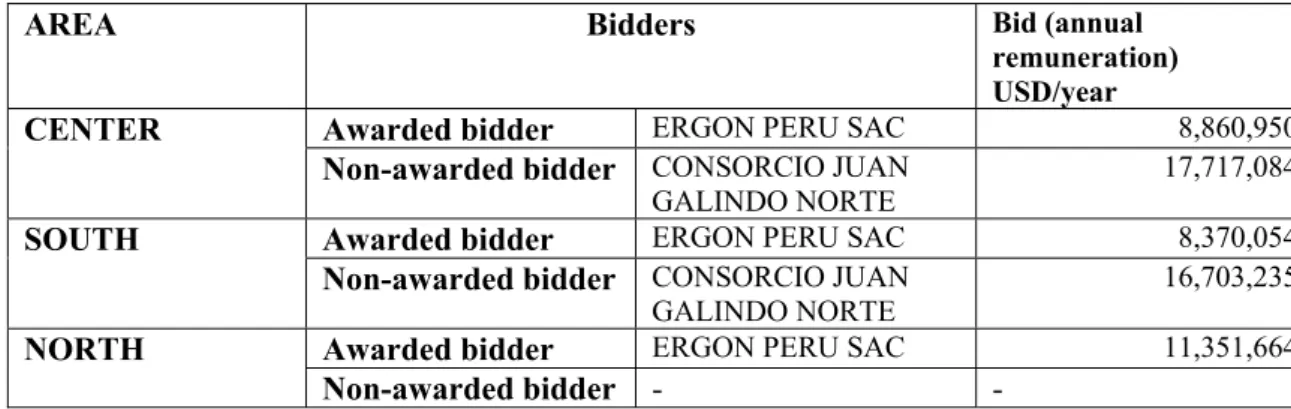
A priori, it could be expected that both the standard but not too stringent qualification requirements and the simplicity of the process would have encouraged participation and, thus, competition in the auction. Thirty companies bought the terms of reference, whereas eight companies were active during the public consultation, commenting on the bases and following the process. However, only two actors participated in the Center and South auctions (Consorcio Juan Galindo Norte and Ergón Perú), and only a single bidder participated in the North auction (Ergón Perú). The same bidder was the awarded winner in the three auctions (Ergón Perú), at a total annual remuneration of about 28.5 million USD (see Table 4 for details).
Therefore, it seems that a main shortcoming of the auction has been the existence of weak competition. However, we may argue that, given the features of this type of auctions, the low participation rate might be a normal issue, taking into consideration the size of the auction and the low market development. Furthermore, participants do not seem to have colluded. This may be partly related to the single-item design element being adopted, which makes it unlikely that an agreement between participants is reached, since only one of them would be awarded. Of course, the two participants could have agreed to share the markets (e.g., one would be the winner in one region and the other in another region). However, the fact that the same company won in the three auctions discards the possibility that a collusive agreement had been reached (at least a successful agreement, which was not broken by the winning participant). This was confirmed during the interviews.
Nevertheless, the weak competition in the auction has still led to considerable cost reductions (i.e., compare the bids of the winner and the loser in the auction in Table 4) and, according to Mitma (2018), “competitive prices”. The fact that the same bidder has won in the three auctions may bring positive aspects in terms of economies of scale and lower public and private transaction costs. Cheaper compact systems made in China could be installed thanks to the non-existence of a local content rule. The contract in USD attracted international finance, finally relieving the company from the very costly task of collecting payments from users. This was also a critical factor behind the submission of a very competitive bid.
AREA Bidders Bid (annual
remuneration) USD/year
CENTER Awarded bidder ERGON PERU SAC 8,860,950
Non-awarded bidder CONSORCIO JUAN GALINDO NORTE
17,717,084
SOUTH Awarded bidder ERGON PERU SAC 8,370,054
Non-awarded bidder CONSORCIO JUAN GALINDO NORTE
16,703,235
NORTH Awarded bidder ERGON PERU SAC 11,351,664
Non-awarded bidder - -
Regarding the effectiveness of the scheme, there have been delays in meeting the targets. As of July 2019, around 133,800 PV systems had been installed by the awarded
Table 4: Successful and non-successful bidders and bids (source: Ramos (2014)).
company (see Figure 1), 99% of these systems (132,535) have been installed in households, 0.9% in schools (1,164) and 0.1% in health centres (101) (BNamericas, 2019). These are clearly below the 200,000 PV systems that the awarded bidder (Ergón) expected to have installed by July 2019 (Rumbo Minero (2018), Peruinforma (2018), MEN (2018), RSE Perú (2018)) but, most importantly, they are clearly below the 149,000 SASHS which were initially expected to be implemented by August 2016. The targets revised in 2017 envisaged 150,000 systems by October 2019. The installation of PV panels should have started in 2015, but it started in 2017. Although the investment contracts between the MINEM and the awarded bidder (ERGON PERU S.A.C.) had been signed in April 2015, the discrepancies between both parties on the interpretation of the content of those contracts led to delays in their implementation. Amendments to those contracts were signed between the parties in February 2017. The deployment of PV systems grew tenfold between July 2017 and July 2018, but it has been rather stagnant ever since. It remains to be seen if such (revised) target will be complied with in October 2019. While the main reason for the delays was the need to solve the legal discrepancies, several of the experts interviewed, including the representative from Ergon, mentioned the lack of professionals to install the systems in rural areas as another important reason for the delay. In this regard, MINEM-DGER highlighted the role of the Council for Resource Management for Capacity Development and Electricity Training (CARELEC) under the MINEM-DGER. CARELEC promotes the development of local capacities, mainly by providing training, also in rural electrification. It takes local social relations into account, aiming to avoid sending people to areas where they shouldn't be since in rural isolated areas of Peru local people trust primarily members of their ethnicity. Gender aspects are taken into account in CARELEC programmes.
On the other hand, the program is expected to increase the (overall) electrification rate from 91% in 2013 to 97% in 2019. In 2018, the rural electrification rate was 88%, whereas the overall electrification rate in the country was 97% in that year. The PV systems have already been installed in 20 out of the 24 regions in Peru, with a great concentration in Puno, Huánuco and San Martin, which account for around 40% of all the installed systems. 9546 local communities have benefited from such installation (BNamericas, 2019).
In addition, according to Mitma (2018), the program is expected to reduce the electricity prices for the final users from 3.2 USD/MWh (tariff administratively set by Osinergmin) to 2.5 USD/MWh. The needed investment per dwelling was reduced from 2103 USD in the 2012-2014 period to 555 USD in the 2015-2018 period.
5. Conclusions
Several countries around the world, such as Mali, Sierra Leone and Peru, among others, have adopted auctions as a mechanism to provide off-grid electricity services, whether supporting the uptake of mini-grids or stand-alone systems, and this will continue to be so in the near future. It is crucial that these systems are designed appropriately in order
0 20000 40000 60000 80000 100000 120000 140000 160000
1 2 3 4 5 6 7 8 9 10 11 12 13 14 15 16
Figure 1: Evolution of stand-alone PV systems in Peru (own elaboration based on Tamayo, 2019 and BNamericas, 2019).
to provide those services in an effective and efficient manner. The case of Peru suggests some lessons that should be taken into account in this context.
In particular, our results show that some design elements may be especially suitable in this regard. There is a need for strong political willingness, and a robust legal and regulatory framework for rural electrification in general and for SASHS auctions in particular. In contrast to on-grid renewable electricity auctions in which the metric to set the volume is generally capacity (MW) or generation (MWh), the volume of the auction in SASHS should be set in terms of the number of SASHS which provide an electricity service. While robust data on the non-served population are unavailable, the final number of SASHS to be deployed can be set afterwards by the awarded company, albeit always within a floor and a cap.
Geographical diversity should be encouraged, with different auctions per region. This would ensure the adoption of a minimum amount of SASHS in a given geographical area favoring fairness, inclusion and social acceptance.
Nimble prequalification criteria should be required. This should include financial solvency but not technical reputation. Otherwise, only the incumbents will be able to participate in the auction, since this is a barrier for new entrants. Technology-specific, price-only, sealed-bid, single-item auctions would bring benefits in terms of economies of scale, lower support or transaction costs and a greater transparency and simplicity.
A correction factor on the remuneration which accounts for the quality of the service, as applied in the Peru auction, may be appropriate for this type of auctions to secure a good post-sales service.
Finally, provision of technical information, which facilitates the participation in the auction and the implementation of a non-disclosed ceiling price are deemed appropriate.
In contrast, other design elements might be problematic. This is the case with the adoption of local content requirements. Given the low presence of local companies in the Peruvian PV market, the adoption of these requirements would lead to higher support costs without significantly increasing the local development potential.
Some of the aforementioned design elements would also be appropriate for on-grid auctions and particularly the existence of stringent prequalification requirements and ceiling prices (see, e.g., del Río, 2017; IRENA, 2015). However, others are clearly distinctive for SASHS auctions, such as the metric used to set the volume auctioned and geographically diverse, single-item auctions.
Nevertheless, our results suggest that auctions for SASHS, such as the one designed in Peru, may be challenging in some respects. First, there might be a mismatch between the features needed for a successful auction and the characteristics of the provision of off-grid electricity services, taking into consideration that usually off-grid is a nascent market with a limited number of players. While the former requires the existence of several bidders to allow for healthy competition in the auction, the considerable up-front investment costs and the crucial role played by economies of scale in providing this service at lower costs means that only very large actors will be able to provide this service, which in turn means that only a very few bidders can be expected to participate in the auction. Organizing several auctions per region (as done in Peru) may mitigate this trade-off and provide some balance between those opposing features, but only to some extent, because a greater level of competition will be achieved at the expense of lower economies of scale. Furthermore, as the case of Peru shows, this split of the overall auctioned volume in several auctions did not lead to a greater level of competition. A second trade-off may be related to the fact that for auction to be attractive for bidders the product auctioned has to be as standardise as possible, whereas it is not easy to find a standard product in the context of access to energy (IRENA, 2019a).
The difficulties for donors to participate in financing access to energy through auctioning the service were highlighted in the interviews. The contract is known in advance and crafted for the auctions; this means that international financing institutions cannot add clauses to them. For instance, it is not easy for international financing institutions to enter into a fifteen-years commitment.
As mentioned above, although the terms of reference were very detailed and framed in a very solid legal and regulatory framework for access to energy through renewable energy sources, several gaps remained. Some of these were legal, such as fee collection
from users, while others were rather technical, such as the specification for the protections. It was highlighted in the interviews that these situations were overcome thanks to strong political commitment.
Therefore, the findings of this paper suggest that there is a need to provide subsidies for access to energy in order to bridge the access gap. Auction has proven that it is able to allocate these subsidies in a cost-effective way, in particular for a very standardised technology such as photovoltaics. The need to secure the optimal operation and maintenance over the years has led to a move from sourcing equipment to sourcing access services. Many access programmes depend on funding from development financial institutions. Replicability of the Peruvian model is likely to be limited by the fact that these financial institutions may not be able to take a multi-year liability. How this challenge should be addressed is a subject for further research.
Some limitations of this paper, which suggests other avenues for further research, can be identified. First, the analysis has focused on auctions to efficiently allocate subsidies to promote the dif